Showing posts with label speculation. Show all posts

Thursday, June 20, 2013

It's Time To Reform US Ethanol Policy

  • Virtually all of the assumptions underlying the Renewable Fuels Standard enacted in 2007 have changed, as the US emerges from energy scarcity into abundance.
  • The linkage between the RFS and food prices is controversial, but a new quantitative model underscores concerns, especially for its impact on developing countries.
This April, two separate bills were introduced in the US House of Representatives to reform, or repeal, the federal Renewable Fuel Standard (RFS) that mandates how much ethanol and other biofuels must be blended into gasoline. A similar bill has just been introduced in the Senate. To understand why reform or repeal makes sense now, we should recall the factors that led Congress to enact this standard six years ago and consider how many of the basic assumptions underlying its design have changed since then.

That requires a review of US fuel consumption and import trends, commodity prices, and the impact of the RFS on food prices. After summarizing the other points I want to focus on the last one, based on an interview I conducted with Dr. Yaneer Bar-Yam, an expert on complex systems who has developed a model that explains the behavior of food prices since the introduction of the first, less ambitious RFS in 2005.
In the fall of 2007, when Congress was debating the Energy Independence and Security Act that included the current, enhanced RFS, the US energy situation looked dire. For four years oil prices had been rising more or less steadily from their historical level in the low-to-mid $20s per barrel (bbl) to around $90, on their way to an all-time nominal high of $145/bbl the following summer. US crude oil production was in its 22nd consecutive year of decline, while our crude oil imports had climbed to 10 million bbl/day, twice domestic production that year.

Even more relevant to the thinking behind the RFS, US gasoline consumption stood at a record 142 billion gallons per year and had been growing at an average of 1.6% per year for the previous 10 years–another 2 billion gallons added to demand each year. In its annual long-term forecast for 2007, the Energy Information Administration (EIA) of the US Department of Energy had projected that gasoline demand would grow to 152 billion gal/yr in 2013 and 168 billion gal/yr by 2020. Meanwhile, US net imports of finished gasoline and blending components had reached a million barrels per day in 2006, equivalent to 15 billion gal/yr–equal to the corn ethanol target set by the 2007 RFS for gasoline blending in 2015. And by the way, US corn prices for the 2006-7 market year averaged $3.04 per bushel (bu). In this environment, policy makers regarded ethanol as a crucial supplement to dwindling hydrocarbon supplies, from a feedstock that was cheap and readily expandable.

Without belaboring the events of the last five years, virtually every one of those trends has reversed course. That has occurred partly as a result of the recession and the lasting changes it produced in the US economy, and partly due to an energy revolution that was largely invisible in 2007 but had already begun.

US gasoline consumption peaked in 2007 and has since declined to 133 billion gal/yr last year. The EIA forecasts it to fall to 128 billion by 2020 and 113 billion by 2030. US crude oil output is the highest in 22 years and is set to exceed imports this year, while the US has become a net exporter of gasoline and other petroleum products. Since 2007 US ethanol production has grown from 6.5 billion gal/yr to 13.3 billion gal., and it seems more than coincidental that corn prices had doubled to an average of $6.22/bu by last year.

That brings us to the controversy that has been widely referred to as “food vs. fuel”. In the last several years I’ve read numerous papers attempting to determine by correlation or other empirical methods whether and to what extent the increase in US ethanol production from corn has affected food prices. To put this in context, since 2005 the quantity of corn used for US ethanol production has grown from 1.6 billion bu/yr to 5 billion bu/yr, or from 14% to 40% of the annual US corn crop.

Some studies, such as this 2009 analysis from the non-partisan Congressional Budget Office found a significant influence on food prices. Others, including an Iowa State study recently cited in a blog post from the Renewable Fuels Association, found a negligible influence. What differentiates the work of Dr. Bar-Yam is that he and his colleagues have developed a quantitative model based on two key factors — corn consumed for ethanol and commodity speculation — that closely fits the behavior of a global price index. Their model also accounts for the “distillers dried grain” byproduct from ethanol plants, which returns about 20% of the corn used in the form of protein-upgraded animal feed.

Before speaking with Dr. Bar-Yam, I was a bit skeptical of his results. Aside from skepticism being my default mode in such situations, I had spent a lot of time looking at claims of speculator influence on crude oil prices in the 2006-8 period and was never convinced that they were more than the “foam on the beer”, rather than a basic driver of prices. However, as I was reviewing his paper prior to our call, a light went on.

The curve his model predicted, which closely matched food price behavior, looked very much like the behavior of a process control loop responding to a ramped change in the set point–forget the jargon and think about how the temperature of your home responds to a steady increase in your thermostat setting: overshooting, then undershooting, before converging. We discussed this and he confirmed that it was effectively an "under-damped oscillator", which can be characterized the same way whether you're talking about an electrical circuit or a market. In effect, the steadily increasing corn demand from the ratcheting up of the RFS started corn prices rising, and the presence of lots of speculators, including “index fund” investors, caused the price to successively overshoot and undershoot the equilibrium price track one would expect.

Dr. Bar-Yam explained that he had arrived at these two factors by eliminating factors that other groups had investigated, but that turned out to have no predictive value. These included shifting exchange rates, drought in Australia, a dietary shift in Asia from grains to meat, and linkages between oil and food prices. In his view the focus on ethanol and speculation is validated by the shift in dialog on this issue away from other, extraneous causes.

He also emphasized that his main concern is not the price of processed foods in developed countries such as the US, for which commodity grain costs are only one input, but rather the price paid for simple foods by poor people in the developing world. From that standpoint he doesn’t just want to see the RFS reformed. ”It is important not just to repeal, but to roll back the amount of ethanol used in the US.” He would prefer not 10% ethanol in gasoline, let alone 15%, but about 5%. “The narrative has to shift,” he said, “to recognize that people are going hungry.” Those are powerful words, and I’m still thinking about them.

At current production levels ethanol from corn contributes the energy equivalent of 6% of US gasoline consumption and about 2.5% of total US liquid fuel demand. That’s not trivial, and there’s a whole domestic industry of investors, employees and suppliers who made that happen at our collective request. However, If Dr. Bar-Yam has accurately captured the relationship between ethanol and global food prices, then we urgently need to reassess what we’re doing with this fuel.

We are also in a far better position now to consider scaling back our use of ethanol produced from grain than we were when the RFS was established. With increasing production of shale gas, tight oil and various renewables, the energy scarcity that has defined our policies for the last four decades is far less relevant to our policy choices going forward. I’ll tackle the practical aspects of RFS reform, in terms of the so-called “blend wall” and its impact on gasoline prices, in a future post.

A slightly different version of this posting was previously published on Energy Trends Insider.

Wednesday, June 13, 2012

The Summer Oil Slump

Instead of US consumers facing $5 gasoline this summer, as some analysts had predicted, we now find prices slipping well below $4 per gallon as oil prices respond to weakening demand, a stronger dollar, and steady supply growth.  Yet as welcome as this is, it's largely the result of a mountain of bad news: Not only does financial turmoil threaten the very existence of the European Monetary Union and its currency, the Euro, but economic growth in the large emerging economies is also slowing, at least partly in response to the weakness in the developed countries that constitute their primary export markets.  The engine of global growth for the next year or two just isn't obvious.  That's the backdrop for this week's OPEC meeting in Vienna.

Before we become too enthusiastic about the prospect of a period of cheaper oil, we should first put "cheap" in context.  Even ignoring West Texas Intermediate (WTI), the doldrums of which I've discussed at length, the world's most representative current crude oil price, for UK Brent, has fallen consistently below $100 per barrel for the first time since the beginning of the Arab Spring in 2011.  Yet even if it fell another $10/bbl, to about where WTI is currently trading, it would still exceed its annual average for every year save 2008 and 2011.  So while oil might be less of a drag on the economy at $90/bbl than at $120, that's still short of the kind of drop that would be necessary for it to provide a substantial positive stimulus, particularly when much of the drop reflects buyers around the world tightening their belts. 

The US is in a somewhat better position, thanks to surging production of "tight oil" in North Dakota and onshore Texas. This has more than made up for the inevitable slide in output from the deepwater Gulf of Mexico, two years after Deepwater Horizon and the ensuing drilling moratorium. With much of the new production trapped on the wrong side of some temporary pipeline bottlenecks, parts of the country are benefiting from oil prices that are $10-15/bbl below world prices, although short-term gains are a poor reason to perpetuate those bottlenecks, rather than resolving them and allowing North American production to reach its full potential.

Then there's the issue of speculation, which some politicians blamed for the recent spike in oil prices.  To whatever extent that was true--and I remain skeptical that the impact was nearly as large as claimed--we could be about to see what happens when the dominant direction of speculation flips from "long" to "short"--bullish to bearish--as noted in today's Wall St. Journal.  Since the main effect of speculation is to increase volatility, we could see oil prices temporarily drop even further than today's weak fundamentals would suggest they should.

All of this will be on the minds of the OPEC ministers meeting in Vienna Thursday, along with the usual dynamics between OPEC's price doves and hawks.  The pressures on the latter have intensified as Iran copes with tighter sanctions on its exports and Venezuela's ailing caudillo faces a serious election challenge.  OPEC meetings are rarely as dramatic as last June's session, but the global context ensures a keenly interested audience for this one.  Given the impact of gas prices on US voters, both presidential campaigns should be watching events in Vienna as closely as any traders.  $3.00 per gallon by November isn't beyond the realm of possibility.  It would only require a sustained dip below $80/bbl.

Monday, March 01, 2010

Oil Price Hangover

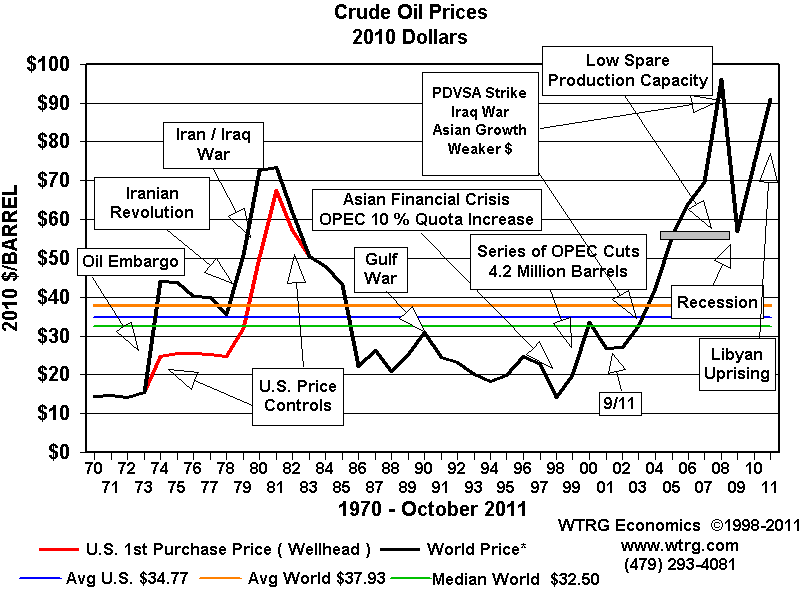
The price of oil is an odd thing. It's watched by millions of people every day, especially when it reaches uncomfortable levels, yet no two observers agree on all the details of how it's determined. Having traded the stuff professionally, I've always given a lot more credence to the fundamentals of supply and demand than to the influence of speculators as the main driver of day-to-day price movements, though it's clear that both supply and demand are pretty complex constructs in their own right these days. For some time, however, I've also been intrigued by the extent to which current oil prices seem to be affected by their own history, something more in keeping with behavioral economics than the kind I learned in grad school. When I consider all the factors converging to yield this morning's price for the prompt (April 2010 delivery) West Texas Intermediate crude oil futures contract, it's hard to rationalize a value just over $80 per barrel any other way, without taking into account that less than two years ago it was nearly $150 per barrel-- though just a year ago it stood at $40, after a dip into the mid-$30s.

Over the weekend I happened to look back at some scenario work I did almost six years ago, when oil prices were rising steadily but before they had passed the $50 per barrel mark for the first time. Though it seems hard to credit now, at the time even that milestone seemed nearly unimaginable for the group of energy industry managers participating in the workshop I was leading. WTI had just broken through $40/bbl, which represented the highest nominal oil price any of us had seen in our careers, a record set in the lead-up to the first Gulf War. Although the prices in the early 1980s, after the Iranian Revolution, were higher on an inflation-adjusted basis, we had just lived through a couple of decades in which oil had notably failed to keep up with general inflation. Of course from our current vantage point $40 or $50 now seems cheap, and that's precisely the point. With an all-time high of $145 still relatively fresh in memory for "anchoring" purposes, $80 might not seem low, but it hardly provokes the kind of anxious political pronouncements that flavored the 2008 US presidential campaign.

Things couldn't be more different than the first time we passed $80/bbl in September 2007, when there was much talk of the risk premium on oil prices due to tensions with Iran, as well as the impact of a weakening US dollar. Most importantly, the global economy was still booming and OPEC was having trouble keeping up with growing demand, particularly from the developing economies of China and the Middle East oil producers themselves, along with the US at the tail end of the bubble. By contrast, despite expectations for a recovery in 2010, today's oil market is dominated by weak demand, with average US demand for oil and its products in 2009 down by 10%, or 2 million barrels per day (MBD) from '07. The global appetite for oil fell by 1.5% in 2009, with only Asia and the Middle East registering any growth. Inventories are ample, refineries are running at extremely low rates of utilization--partly due to some ill-timed capacity increases--and OPEC has as much spare oil production capacity as it did in 2003, when WTI was in the $30s.

So why isn't oil back in the $30s or $40s, rather than the $70s and $80s, particularly with the dollar having strengthened by almost 6% since the beginning of the year? Certainly a big part of the credit or blame, depending on your perspective, belongs to OPEC, which has managed to take 2-3 MBD of production off the market and keep it there, with minimal cheating and without triggering a price war driven by members whose national budgets needed significantly higher oil prices or sales to balance. It's also clear that since the beginning of the last decade the marginal cost of incremental non-OPEC production has gone up significantly, whether from Canadian oil sands or deepwater Gulf of Mexico platforms. Part of that is due to the fact that these are intrinsically costlier barrels to produce, but it also owes a lot to the costs of raw materials and construction involved. Those soared during the last decade, weakening subsequently but not returning to their former levels. That means that the much lower oil prices we saw briefly at the end of 2008 and beginning of 2009 aren't sustainable for any length of time, though precisely where a realistic floor now lies is anyone's guess.

Arriving at a price of $80/bbl despite slack demand, ample global supply and a refining sector that's losing money doesn't require nefarious speculation, but it probably depends on two crucial factors: Most oil deals today are negotiated as a stated premium or discount relative to a handful of grades like WTI and Brent that involve as many financial players as refiners who must process the stuff and try to make a profit on it. And for those few, correspondingly more influential markets in which traders must negotiate an actual price and not just a differential, traders' price expectations are anchored by the history of the last couple of years. Once you've seen oil above $100 without the world ending--though it came close--you simply can't look at the market the same way you did before. If the range of possible prices is now seen as $40-$150, rather than $15-$35, today's circumstances understandably yield a mid-range interpretation, backed by an expectation that OPEC would intervene even more strongly if prices began falling towards that uncertain floor--a threat the credibility of which is greatly enhanced by OPEC's remarkable cohesion and discipline over the last year or so, perhaps providing more psychological anchoring in the form of availability bias.

So in a strange sort of way, we may still be experiencing the consequences of the extraordinary oil price spike of 2007-8, which was itself either an outgrowth of the global financial bubble, or a major, independent contributor to the ensuing collapse, in classic oil-shock fashion. While the extreme prices of that period have receded, they haven't vanished from the market's memory, and so they may continue to influence prices for some time to come, until the next spike or oil-price collapse resets them again.

Monday, November 16, 2009

Indexing Crude Prices

Although oil trading hasn't been my primary focus for many years, the recent announcement by Saudi Aramco that it is switching its price mechanism for oil delivered to the US caught my attention. Instead of basing its formula for deliveries here on the price of West Texas Intermediate crude oil, it will apparently reference the new Argus Sour Crude Index (ASCI.) While that lends substantial credibility to this new index and may gain Argus more than a few new subscribers, the implications for the widely-traded NYMEX WTI contract and the dynamics of the broader international oil market seem much less clear. In particular, I am skeptical of suggestions that this move could ultimately reduce whatever influence non-commercial financial participants--speculators, in common parlance--have on oil prices.

The question of how best to price crude oil for buyers and sellers is a perennial problem, particularly for oil that differs significantly in quality from the light, sweet grades behind the extremely liquid WTI and ICE Brent futures contracts. US refiners, in particular, have invested many billions of dollars in the hardware required to turn lower-quality oil into high-quality petroleum products. Any time the peculiarities of these contracts drag up the prices of the grades of oil they prefer to run, they grumble about basing deals on WTI. Likewise for sellers of sour crude, foreign and domestic, who suffer when the WTI price moves out of sync with world prices, such as when storage at its nexus at Cushing, OK fills up, as it did earlier this year. However, after listening to the Q&A podcast concerning the ASCI on Argus's website and reading the background document there, I'm skeptical that this index will settle the sour crude market's discontent, because it won't change the way this oil is traded by nearly as much as it might appear.

Without getting into all of its details, as I understand it the ASCI is effectively a composite daily report of the deals done for three specific streams of offshore Gulf of Mexico crude oil, all of which trade at a differential to WTI. In calculating a daily price, Argus will add the average daily discount or premium vs. WTI from the transactions it learns of to the daily price for WTI to come up with a single price in dollars per barrel. The Argus podcast was very clear that NYMEX WTI is still as the heart of the new index, not just because this reflects the way deals are done with reference to WTI, but also because WTI remains the highly-liquid futures contract that the buyers and sellers of the ASCI oil streams use to hedge their market risk. In other words, the new ASCI index is not a substitute for WTI-based pricing, but merely a more transparent gauge of the relationship between WTI and the sour crude market--though an index you have to pay to read falls a bit short of the kind of transparency currently provided by WTI itself.

What would happen if speculators drove up the price of WTI by $30/bbl? In theory, ASCI would reflect any disconnection between the fundamentals-based pricing of its included sour crude streams and the financially-driven WTI market by remaining more or less unchanged, after summing the combination of correspondingly wider discounts for the ASCI grades to the inflated daily WTI prices. Only by looking at the differentials themselves would we see any indication of distortion of the market by non-commercial players. But is that realistic? Consider that between January 2007 and July 2008, when the price of WTI rose more or less steadily from the mid-$50s to nearly $150/bbl, the discount between WTI and the monthly average refiner acquisition price for imported crude only widened from around $4.75/bbl to roughly $9/bbl. If WTI was being driven by speculation in that interval, differentials-based trading of the kind that ASCI will measure hardly insulated refiners from its effects.

That historical result might merely indicate that speculation had little real effect on the market in that period--a view to which I'm sympathetic--but it might just reflect the inertia of negotiated crude differentials. Either way, if you're Saudi Aramco and you're selling crude into the US based on ASCI, I'd conclude that your prices would still go up more or less in tandem with the NYMEX, despite the superficial "arms-length" mechanism flowing through ASCI. Perhaps I've missed some subtlety in the mechanism.

From what I can tell, neither ASCI nor the prospect of new futures contracts based on it addresses the underlying concerns I have had since the industry migrated to pricing based on differentials against the WTI and Brent futures contracts, and away from negotiating actual "fixed and flat" prices for each cargo or pipeline deal, back when I was trading oil in the 1980s and early 1990s. While that shift made life much easier for risk managers and took a lot of heat off traders to strike the best deal on any given day, it also opened the door to a host of other influences on pricing that I still don't think we entirely understand.

The market will pass its own judgment on ASCI and other new tools like it. If it proves useful to traders and risk managers, it could become the new industry standard, as Argus must hope, having made such a big splash over its launch. If it's not useful, it will fade into the background, becoming just another dataset in an already bewildering sea of energy-related information. With Gulf of Mexico output booming and more discoveries yet to be made, it looks like a reasonable bet to join other useful physical crude indices around the world. But anyone hoping it will shine a beacon on speculators in the next oil price spike is likely to be disappointed by the core of a system still rooted in WTI, the speculative influences over which remain uncertain and possibly unprovable.

Monday, August 10, 2009

The Influence of "Peak Oil"

An article in the Washington Post this weekend, together with a must-read interview in The Independent, a paper I used to read regularly when I lived in London, reminded me of an observation I made several years ago concerning the similarities between Peak Oil and Y2K. Having spent a fair amount of time in my former corporate role planning for the serious outcomes the latter might have produced, I don't intend this as a slam on the former. Without rehashing the technical arguments behind either phenomenon, it's worth spending a few minutes thinking about the consequences of a growing belief that we might be only a few years away from the end of oil, as we know it. Whatever one's take on the validity of the Peak Oil argument, it has already evoked noteworthy consequences, both positive and negative.

A week ago The Independent ran an interview with Fatih Birol, chief economist of the International Energy Agency (IEA). In it Dr. Birol repeated a warning he has issued previously, that higher-than-expected decline rates in the world's mature oil fields and "chronic underinvestment by oil-producing countries" are setting up a severe oil supply crunch within the next few years, as a recovering global economy resumes its growth in energy consumption. It's not hard to imagine the "green shoots" withering if oil reprised its 2007-8 march from around $70/bbl to nearly $150. From the supply side, I have little doubt that this is correct, for reasons I've mentioned frequently in the past: restrictions on access to resources, routine diversion of national oil company profits into social budgets at the expense of reinvestment, chronic project delays, and the inherently long timelags between discovery and production. I'm less convinced that the demand side of the equation would play out the same as last time, with that experience so fresh in our minds. At the very least, though, Dr. Birol describes a highly credible scenario, and belief in its likelihood could have far-reaching consequences, good and bad.

On the plus side, our reactions needn't go to the extent of the author of a Washington Post piece, searching for self-sufficiency on a small farm in New Mexico, to have a beneficial impact on consumption patterns. Our best chance of avoiding the apocalyptic outcomes that Mr. Fine fears is to live our lives on the assumption that the days of cheap oil are indeed past, and that it will be more expensive in the future. From initial reports of the transactions involved in the Cash for Clunkers program, many people already sense this, despite gasoline prices that remain one-third below where they were at this time last year. And while I certainly don't advocate survivalism as an indicated strategy for individuals, everyone who chooses to downshift in this way stretches out the supplies available for the rest of us, making the transition to more sustainable energy sources more manageable. Merely being prepared mentally for another oil crisis might reduce the likelihood of counterproductive behavior, such as hoarding, should we find ourselves in one.

Unfortunately, these psychological effects also point to the main downside of a widespread belief in imminent Peak Oil. While I remain unconvinced of the role of speculation in last year's spike in physical oil prices, to whatever extent the s-word was driving prices on the oil futures exchanges it was underpinned by a pervasive mentality that we were experiencing something truly unprecedented, backed by hints that oil supplies had already reached their natural limit. If you believe in the inevitability of Peak Oil, today's oil futures prices must look like a buy--a steal, even at levels over $90 for delivery in 2016 or 2017.

There are many good reasons to invest in the alternative energy sources that would help mitigate a true Peak Oil crisis down the road, and that hold the seeds of eventually escaping from that threat entirely. The real mark of success for our various renewable energy, nuclear renaissance, and energy efficiency efforts would be the eventual arrival of a peak in global oil output without crippling the economy. However, the dark side of Peak Oil is a self-defeating notion that no amount of increased investment in new oil production can make any worthwhile difference in this outcome.

If the IEA is right, we certainly can't escape this pickle by drilling alone. However, it's equally true that if oil production began to drop in the next few years, no other strategy, by itself or in combination--not even dramatic improvements in energy efficiency--could make a big enough difference to avoid a serious, economy-wrenching crisis. Many of the cars on the road in 2015 will either be those already on the road today or others very similar to them, if a bit thriftier with fuel. Nor could we electrify more than a small fraction of the global car park within that timeframe, let alone a US car fleet of 245 million vehicles at a time when sales (and thus turnover) have collapsed. Double today's biofuel output--which in that timeframe mainly means more corn ethanol, with all its problems--and we still won't have made a big enough dent.

Inescapably we will need as much more oil as we could eke out, because the whole world would be going through this transition at once. If we're saving the oil in ANWR, offshore California, and the Eastern Gulf of Mexico for a rainy day, then imminent Peak Oil would be that deluge, and it takes 5-10 years to go from bidding on leases to full production. Even if this bought us only an extra 1 million barrels per day--Mr. Pickens apparently thinks twice that--the value of that to the US in a world of $200 oil would be $73 billion/year in today's dollars, along with the possible preservation of critical services if the shortfall that went beyond a mere price spike. The US can't make up for the problem of "chronic underinvestment by oil-producing countries" of which Dr. Birol rightly warns, but we could certainly exacerbate it through deliberate under-investment in our own oil capacity.

Tuesday, July 28, 2009

Speculation and Physical Oil Prices

The story above the fold on the front page of this morning's Wall St. Journal suggested that the Commodity Futures Trading Commission (CFTC) is about to issue a report tying last year's oil price spike to speculation by non-industry participants in the oil futures, options and swaps markets. This would reverse the agency's previous finding that speculation had not played an important role in influencing the record-breaking prices we experienced in 2008. Although I plan to assess the report with an open mind, the dissemination of such contradictory conclusions--separated mainly by the handoff from one administration to another--hints that a jaundiced eye might be in order regarding both. More important than any politics that might be involved, however, is the deeper question of whether the futures-market speculation the CFTC has apparently uncovered actually harmed the real economy by spreading its contagion to the markets for physical oil with which consumers interact. The answer to that question has serious implications not just for the justification of stricter regulation of energy markets, but for overarching policies and trends affecting the production and consumption of real energy.

As I noted in a posting last summer, the growth of the futures exchanges over the last two decades has fundamentally changed oil trading. Most oil is now bought and sold on price formulas pegged to the futures prices, or to published market reports strongly influenced by them. What traders are agreeing to when they do a deal is not a fixed price, but a differential above or below a particular futures contract during a set period, usually aligned with the time when the shipment will be loaded or delivered. So while these differentials fluctuate due to a variety of factors, the price that refiners pay for crude oil remains directly tied to the futures price. That means that anything that drives up the futures market, whether a disruption in supply, higher demand, or speculation by a new class of commodity investors, has a direct impact on what we all pay for the products that refineries make.

When I discussed this issue last summer, I was careful to note that if the prices for physical grades of oil moved in lock step with the futures price, that might not by itself absolve speculators from driving up those prices, along with the futures. Other factors could produce a similar result, even if the futures were mainly driven by speculation. However, when I now look at last year's price relationships for two of the most important crude oil streams in the country, I see evidence that goes beyond a neutral result and undermines the notion that anything other than the fundamentals of supply and demand was driving prices in the run-up to oil's peak of $145 per barrel last July.

The chart below tracks the price difference between two important grades of physical oil and the monthly-average NYMEX futures price for West Texas Intermediate, which is the focus of the CFTC's investigation and the principal grade of oil against which most US oil--and indeed much of the world's--is typically priced. I chose Alaskan North Slope crude and West Texas Sour because both are produced in substantial quantities, are representative of the medium-gravity, medium-sulfur crudes that many US refineries turn into gasoline, and cannot be delivered into the NYMEX WTI contract. While there might conceivably be some degree of speculation in these grades, anyone buying them would be required either to take physical delivery themselves or sell to a refiner or other physical buyer before the oil was delivered. If futures market speculation had been driving the prices of these grades of oil last spring and summer, we'd expect to see their discounts either remain steady or widen, indicating that they were being dragged along by frothy futures. Instead, between March and July 2008 we see these grades strengthening relative to WTI--their discounts shrinking--both sequentially and relative to their average discounts since 2004. In other words, in that period the prices of these grades of physical oil appear to have been stronger than the futures market that was thought to be driving them.


Why is that important? First, the argument for stricter regulation of the commodity markets, beyond the very sensible suggestion to increase the transparency of participants' trading positions, depends on a finding that speculators not only influenced the futures markets in which they participated directly, but also the price of the physical oil purchased by refiners and thus the prices of the petroleum products that consumers, trucking companies, school districts, airlines and others purchased, to the detriment of the economy and our trade deficit. If speculation was driving oil futures but not the price of physical oil, the necessity for clamping down on it aggressively begins to resemble a fever remedy that works by banning thermometers that read above 99 degrees.

Of greater significance, I believe, is the psychological effect on our expectation of oil prices in the future. If we convince ourselves that $145 oil and $4 gasoline were mainly the fault of big, bad speculators, and that regulating them will avert such an outcome in the future, we foster a dangerous illusion that supply and demand will somehow always result in prices more congenial to our preferences and lifestyles. That's arrant nonsense, and you don't have to be an ardent believer in Peak Oil to see how unrealistic expectations of low future oil prices can stimulate demand and stifle expensive oil projects, with their long inherent time-lags. That would eventually lead to precisely the outcome we wish to avoid: much higher oil prices.

Since the summer of 2007 I have been arguing that speculation might have been influencing oil prices around the edges, but that with or without it the narrowing gap between growing demand and straining supply was the main factor behind high prices. The sudden inversion of those forces--the sharp drop in oil demand caused by the recession and the growth of inventory and restoration of adequate spare production capacity--equally and fully explains the price collapse that followed, pummeling exposed speculators and index investors. Whatever the CFTC concludes about last year's price spike, it shouldn't distract us from the necessity of investing in expanding oil production and alternative energy sources, while working hard to improve the efficiency with which we use energy, and particularly oil. Blaming it all on Wall St. would be the quickest way to undermine the gathering momentum for improving our real energy security.

Wednesday, July 08, 2009

Speculation Witch Hunt?

This morning's financial press was riveted by the prospect of the Commodity Futures Trading Commission (CFTC) imposing tough new regulations on energy markets. Speculation has been widely blamed for the run-up in oil prices since early spring--as well as for last year's roller-coaster up to $145 per barrel and then down to $34--though in a subtle but important shift the focus seems to be turning to volatility, which is a very different thing than absolute price levels. I don't need to add my voice to the many already warning that limits on speculative positions could hamper the proper functioning of the market by drying up liquidity and depriving "legitimate" participants of the access to hedging they need. Instead, I believe the CFTC and its supporters in Congress and the administration are barking up the wrong tree, altogether, based on a fundamental misunderstanding of the markets.

Let's begin by stipulating that speculation probably has a finite but impossible-to-quantify impact on oil prices. I pointed out this likelihood in mid-2007, when oil prices were at roughly their current level and before they began their wild ride. I've also described the difficulties involved in discerning precisely which trades are speculative and which aren't, based on my own experience trading oil commodities, futures and derivatives over a 10-year span earlier in my career. However, the current determination to clamp down on speculation appears to be based on two hypotheses that are not only unprovable in the real world, but probably entirely false: First, that in the absence of speculation, oil prices would not have spiked to nearly the degree they did last year and would be much lower today than they are, and second, that a market without speculators--or indeed without any futures trading at all--would be inherently less volatile than one in which those factors are present.

The latter proposition is easier to refute, because we've seen ample volatility in markets for which no futures contracts or easily-traded derivatives exist. I experienced this first-hand in the west cost spot gasoline market in the 1980s, a market consisting entirely of the trading representatives of local refiners and a small number of trading companies, some with storage tanks but many with no fixed assets other than a phone and a desk. Every time a refinery experienced a major operational upset, the market would spike by as much as a dime a gallon--a significant fraction of the value of a commodity that was trading well under a buck at the time. I recall one instance when the coking unit of my employer's L.A. refinery had a major fire and was out of commission for several months. Local supplies weren't adequate to cover the shortfall, and the gap had to be filled through imports. I started buying gasoline cargoes at around $0.60/gal., and by the time I had lined up all the supply we needed the price had hit $1.00/gal. before it fell back to more normal levels. That's volatility, and it is a feature of markets in tight balance between supply and demand, whether or not speculators play a role.

The question of where oil prices would have ended up last year absent speculation seems much more complex, until you consider that between 2002 and 2007 global oil demand had been growing steadily at an average rate of more than 1.5 million barrels per day (MBD) per year, outpacing the growth of global supply, and crucially of non-OPEC supply. The latter was essentially flat from 2004-7, when the price of oil roughly tripled from the low-$30s to the low $90s. In effect, the demand curve was marching to the right against a supply curve with a sharply steepening slope, as spare capacity was used up and the long inherent time lags for new oil projects constrained the amount of new production that could be brought on quickly. That path was then quickly reversed in mid-2008, once it became clear just how rapidly demand was falling, both in direct response to the high price of petroleum products--the full manifestation of which in many markets was delayed by government price controls--and by contraction of the global economy due to what we now know was the onset of a recession on a scale not seen in decades. Between February and September of last year, demand in the developed world fell by an astonishing 3.5 MBD. We'll never know whether prices would have fallen sooner if speculation hadn't maintained its momentum during the first half of 2008, but it's borderline delusional to imagine we wouldn't have spiked above $100/bbl without it.

The Wall St. Journal's "Heard on the Street" column on this topic begins with the sage observation that blame is a commodity in infinite supply. To that I would add that we rarely like to apportion that blame on ourselves, though in this case the government would do well to consider how its own actions exacerbated last year's oil price spike and the run-up in prices we've seen this year. The oil markets are mainly driven by supply and demand, and with OPEC maintaining remarkable discipline and cohesion in the face of last year's demand collapse, the supply component that has the most influence in holding down oil prices is non-OPEC production. What has our government done to promote that production? Have we seen our elected officials traveling the world and using their influence and the still-considerable diplomatic and economic leverage of the US to urge producing countries to increase access for foreign firms and investors to new oil exploration and production opportunities, on attractive terms, as the Chinese government has? Have they fast-tracked development in the most promising regions of our own country that were off-limits for drilling, including the eastern Gulf of Mexico, where reserves have already been discovered?

Such actions didn't even occur under an administration that was widely viewed as being in the pocket of the oil industry, and they certainly aren't happening now, for reasons I could devote many more paragraphs to dissecting. "Drill, baby, drill" has given way to tax, baby, tax--and I'm not referring to the climate bill, here, but to earlier talk of a windfall profits tax to fund tax relief for the middle class, which has morphed into an effort to close perceived tax loopholes such as the intangible drilling allowance for producers and the manufacturing tax deduction for refiners. None of this is going to add a barrel of real oil to our supply, and it seems likely to eliminate more than a few, while we pin our hopes on corn ethanol that still only supplies 2% of our total liquid fuels demand, after adjusting for its lower energy content. How much of the market's volatility ultimately derives from our own deeply conflicted attitudes towards oil?

Oil prices have fallen by $10/bbl. or around 14% since June 29. This coincides with a general recognition that the economy hasn't yet turned the corner to a real recovery; we've also seen the S&P 500 drop by about 7% since mid-June. Now, you might suggest that this proves that speculators had driven up prices unrealistically, but it makes at least as much sense to suggest that the producers and consumers of physical oil and its products have altered their buying and inventory decisions in light of new information about the likely state of the economy for the rest of the year. No one can win that argument, but we can all lose if regulators impose tough new controls on energy markets based on a misunderstanding of what has occurred. To that end, while I am deeply skeptical of the idea of anyone at the CFTC passing judgment on what is and what is not a proper hedge, I wholeheartedly support Chairman Gensler's call for greater transparency of market reporting, and for a healthy dialog between the industry and its regulators aimed at reining in those practices most likely to add speculative froth to the market without contributing meaningfully to the liquidity required by all participants. Let's get the additional insights that transparency will bring us, before we decide to blunt the tools that actually provide one of the few means by which firms can mitigate the effect of underlying physical market volatility on their activities.

Thursday, June 25, 2009

A Funny Thing Happened on the Way To Cap and Trade

How much of an unappetizing jumble can you put into a dog's breakfast, before the dog refuses to eat it? That is the question that the authors of the Waxman-Markey "climate bill" appear intent on testing, before it goes to an expected vote of the entire House of Representatives tomorrow. Aside from addressing truly momentous, economy-altering matters--a cap & trade system for greenhouse gas emissions and a national renewable electricity standard to promote green power even more than cap & trade would, anyway--this bill includes more than its share of tenuously-related add-ons, some of which might be nearly as significant as the provisions that have garnered the headlines. Nor has last week's Congressional Budget Office analysis settled all the questions about the bill's likely cost to the public, except to raise suspicions that if it truly amounted to only $175 per household per year, there wouldn't be so much fuss about it.

Let's start with those costs, before we come back to the miscellaneous provisions that begin on page 808 of 1092. The CBO examined the cap & trade provisions of Waxman-Markey and its issuance of free emissions permits to various sectors and groups. They then allocated the costs among all American households by quintile of income. That's an important detail, because of the bill's provisions for rebates and other assistance to lower-income families, the lowest-earning of which would actually come out ahead in their analysis. For the rest of us, I believe the key figures to focus on are not the estimated $235-340 per year "net cost", but the range of $555-1,380 per year in expected "gross costs" before "direct relief to households"--which if you read the bill doesn't look very direct at all. It consists mainly of those free emissions permit allocations that go to utilities and various other industries and groups, not consumers.

The other aspect of the CBO analysis to focus on is its assumptions, explicit and implicit. The key explicit one is the emissions permit price of $28/ton of CO2 from which these costs were derived. While it's certainly possible that permit prices might be that low in 2020--the equivalent of $0.25 on a gallon of gasoline or roughly $0.03/kWh on coal-fired electricity--in the long run they would likely rise much higher, in order to cover the cost of deeper, more difficult reductions in industrial and transportation emissions. The CBO's big, implicit assumption relates to the impact of cap & trade on the economy as a whole, which footnote 3 indicates is excluded, along with the impact of the bill's many other provisions. If cap & trade slows growth, as seems very likely, incomes would be lower and jobs less plentiful than otherwise--even if "green jobs" grew--and other taxes would need to increase to service the debt and cover growing entitlement costs. When you factor in these uncertainties, the probability that cap & trade would cost American families no more than a couple of hundred bucks a year looks low.

The other day I described the severe mismatch between actual US emissions and the sectors chosen in Waxman-Markey to receive the lion's share of free emission permits. The bill would also establish an "Emission Allowance Rebate Program" to help energy-intensive industries engaged in international trade. Remarkably, however, it states, "The petroleum refining sector shall not be an eligible industrial sector." So US refineries, which under this bill would be responsible for both their own emissions and those from the subsequent use of their products--in our cars, for example--could not seek relief for the permit costs associated with products they export to the Caribbean and other markets, while other industries could. That would hamper not only refinery profitability, but also their ability to produce a suitable mix of products for domestic consumption. Last year US refineries exported 1.8 million barrels per day of products to balance their operations and meet stringent US fuel specifications. Raising the cost of those exports would ultimately result in fewer US refineries and more petroleum product imports. That would make US fuel prices more volatile, while increasing the average Waxman-Markey premium at the pump, over and above the direct cost of emissions permits.

Now let's consider what else has been included in this bill. Among the surprises I found in its last few hundred pages was another $4 billion of funding for the cash-for-clunkers program I discussed last Friday, along with its extension until next April 1st. Another provision would give the Secretary of Transportation broad powers under an "Open Fuel Standard" to require auto makers to produce large volumes of flexible fuel vehicles--a key enabler for increasing the country's biofuel production above the amount that can safely be blended into ordinary gasoline. According to yesterday's Washington Post, it would also establish and fund a new multi-billion-dollar federal agency, the Clean Energy Deployment Administration, in apparent competition with the Department of Energy.

Moving further afield, Waxman-Markey would also impose sweeping new rules on energy commodity markets to allow the Commodity Futures Trading Commission to regulate derivatives and swaps and limit speculation. The CFTC would decide what constituted a "bona fide hedge" and what didn't, setting limits on how many contracts a non-hedging entity could hold--not just in the US but also on foreign exchanges dealing with US-based commodities. It would also control energy commodity speculation by index funds. And while these measures at least have a connection to energy, that certainly does not hold for Section 355, which would place strict limits on who could buy a credit default swap, and under what circumstances.

I hope you haven't concluded from the above that I am a wide-eyed idealist who is easily shocked by the way the world really works. This is not a case of liking an idea only in its most abstract form. Although I have long supported cap & trade as the best approach for reducing emissions, I always expected a certain amount of horse-trading to get there--and note that the Senate has yet to weigh in on this bill. Unfortunately, the central cap & trade provisions of Waxman-Markey have been sufficiently distorted to cast serious doubt on their likely efficacy in managing our actual emissions, while issues as important as the regulation of energy markets and credit default swaps surely warrant separate legislation that would expose these proposals to the scrutiny and transparency they deserve. This might be the way laws are made these days, but the insertion of a grab-bag of disparate provisions into a bill of this magnitude represents an act of legislative mischief. In the context of the similar process that shaped last year's version of cap & trade, the Boxer-Lieberman-Warner Bill, I have begun to wonder if it's even possible for cap & trade to be implemented effectively under our political system, or whether a simpler carbon tax might be less prone to this sort of excessive creativity.

Tuesday, June 09, 2009

Is Oil Shock 2.5 Imminent?

The rebound of oil prices has been getting a good deal of attention, lately, though we haven't yet reached the point at which, like much of last year, the daily closing price of WTI is reported on every evening news broadcast. I've even seen the dreaded "s-word" bandied about, implying that oil might have become disconnected from its fundamentals in ways that ought to worry those responsible for ensuring that the nascent economic recovery is not extinguished before it can gather momentum. Such fears look premature at this stage. Despite reaching $70 per barrel during last Friday's session--an increase of 107% from its post-crash lows last December--crude remains far below its highs of 2008 and currently trades at a level it first reached in spring 2006. Nor does it seem likely that US demand would support a return to $4 gasoline, which helped alter consumer behavior in ways that set the stage for oil's precipitous collapse and could do so again.

To understand current pricing, we have to pull apart the threads affecting supply and demand. On the supply side, the dampening effect of high oil inventories is offset by worries that high decline rates from mature fields and deferred and canceled production projects are setting the stage for a repeat of the capacity crunch of 2004-7 as soon as global demand growth resumes. Last week's Economist did a fine job explaining how each oil bust contains the seeds of the next boom, and why that cycle could be even shorter this time around. And in a recent "Heard on the Street" column, the Wall Street Journal's Liam Denning provided some insightful analysis on how traders playing the spread between short- and long-dated oil futures can translate higher prices for the out-year contracts into a boost for near-term prices. (He also questions the sustainability of China's recent oil import spike.) But if current oil prices are being dragged up by concerns about future supply--abetted by inflation fears and the recent weakness of the dollar--weak demand and its demonstrated elasticity should forestall an imminent return to last year's peak.

In recent weeks US gasoline demand has rebounded close to last spring's level. Driving season still matters, it seems, and we've seen pump prices respond accordingly. This reflects more than just the recent strength in crude oil. The NYMEX "gas crack", the spread between prompt gasoline and crude oil futures, averaged $2/bbl higher in April and May than in February and March, at the same time crude oil added $30/bbl. However, this strength is merely relative. US gasoline demand in the first quarter of 2009 was the lowest for that period since 2003, and that's before taking into account the approximately 175,000 bbl/day of demand--around 2%--met by higher mandated ethanol blending, after adjusting for energy content. Moreover, demand for distillate fuels--diesel and heating oil--is off even more than for gasoline. This isn't just a US phenomenon, either. The International Energy Agency sees global oil demand down by 2.6 million bbl/day, or 3%, vs. last year. That's no one's idea of a surge.

When we sum up all these developments, we see a very different dynamic than the one that took oil prices to the brink of $150/bbl. Then, demand seemed insatiable, and the capacity crunch was a measurable reality, not just a future prospect. Today, oil supply and demand and the global economy are linked in a set of counter-acting feedback loops. Higher petroleum product prices put greater pressure on price-sensitive consumers, whose ranks have been swelled by the recession. Even countries that insulate their consumers from the global oil market may have to adjust if prices edge closer to $100/bbl. So while higher oil prices could threaten economic growth, the demand response to higher prices--and any hesitation in expected growth--seem just as likely to stall oil's momentum and send it lower. This is a delicate balance, and it could be upset by many factors, including a sudden change in the value of a key currency, or an unanticipated supply disruption. Only time will tell whether, just as Oil Shock 1.0 (the Arab Oil Embargo) was followed a few years later by Oil Shock 1.5 (the Iranian Revolution), last year's Oil Shock 2.0 will soon be followed by version 2.5, or give way to entirely new scenario.

Monday, December 29, 2008

Energy Lessons of 2008

A year ago, I looked back on 2007 and ahead to 2008, a year that has defied the predictions of most observers. Although I can't claim to have foreseen the possibility that oil would break $140 and $40--from opposite directions--in the same year, I worried about energy market volatility and cautioned that risk cuts both ways. That seems equally appropriate advice today, when markets are focused on the downside, and "confirmation bias" is such a powerful force. But while we shouldn't expect a repeat of the wild ride of the year now ending, the experience has provided some expensive lessons about energy markets. The following is a non-exhaustive list of those that struck me:
  1. Demand matters as much as supply in determining prices. The difference between oil at $145 per barrel and $40 is only a couple of percent of global demand, or more precisely a swing between steady growth of 1-2% per year and a shrinkage of similar magnitude.

  2. Speculation can amplify prices and market volatility, but it can't override a dramatic shift in the underlying fundamentals of supply or demand. Leverage increases not only the magnitude of speculative gains and losses, but apparently also the speed of the shift from one state to the other.

  3. When prices have been rising steadily, commodity price hedging can look like a sustainable revenue source--almost a perpetual motion machine--until the trend breaks. Then we see that the main benefit of hedging is to smooth out cash flows and enable firms to take on risks they couldn't bear otherwise. Used improperly, it's just an elaborate form of speculation, and as risky at Las Vegas.

  4. Fundamental price imbalances between commodities that are substitutes for each other, however imperfect, don't persist indefinitely. For much of the year, natural gas traded for less than half the energy-equivalent price of oil. As of Friday, this relationship had closed to about an 11% discount for gas vs. oil.

  5. High oil prices don't automatically make alternative energy sources competitive. For the last several years many alternatives faced higher construction costs, as they competed for some of the same inputs (materials and workers) as new oil and gas projects, while alternatives with low "net energy" or Energy Return on Energy Invested (EROEI) saw their operating costs rise in tandem with oil and gas prices.

  6. In particular, investors in corn ethanol production found they were making two bets: one on the difference in price between food and fuel and another on the difference between petroleum products, with which ethanol competes, and natural gas, of which it consumes large amounts, directly and indirectly. (See #4 above.)

  7. Government incentives and mandates can help to create a market for alternative energy, but they cannot guarantee its profitability, particularly when capacity is added faster than mandated targets rise, or than existing infrastructure can accommodate. The recent Chapter 11 filings of VeraSun and several other ethanol producers are evidence of this.

  8. The cost of capital turns out to be as important as the cost of oil for the expansion of all forms of energy, conventional and alternative alike.

I'm sure I've missed some important learnings in this quick tabulation. Next week I'll look at what the coming year might bring, or at least what bears watching. In the meantime, I wish my readers a happy, healthy, and more prosperous New Year. Let's hope the economic consensus is as wrong about the length and severity of the contraction we're in, as it was about the prospects for a soft landing from the bursting housing bubble.

Monday, October 13, 2008

Oil and Asset Classes

An article in yesterday's Financial Times raised some provocative questions about the future status of commodities as an attractive asset class for institutions and other investors seeking to diversify their risks and improve their returns. Anyone who believes that the extraordinarily high oil prices we experienced this summer were influenced by commodity speculation should regard the response of portfolio managers to this proposition as quite significant for the future path of oil prices, which have recently plummeted in line with other assets. And because that drop has been overshadowed by a global stock market crash, we haven't had a chance to work out all its implications, other than its short-term benefits for consumers.

As of this morning's session, oil prices were down nearly 45% from their peak of $145 per barrel in July. The largest part of that decline is attributable to the dramatic reversal of long-term demand trends in the US and EU, and a slowing of demand growth in developing Asia. However, non-fundamental factors have also played a role: Liquidations by hedge funds and other institutions needing to cover redemptions and margin calls, along with a healthy dollop of fear and flight to safety, helped drive oil to a $77.70/bbl close last Friday, the lowest since September 2007. This is almost certainly an over-correction, and the steep "contango" in the market reflects that likelihood, with prices for delivery in 2010 and beyond in the mid-to-high $80s. Those are still dramatically less than just a few months ago.

What does all this mean for the price of oil in the years ahead? That question ought to be of great interest to struggling automakers, among others. If you are scrambling to build highly-efficient cars in response to the $4 per gallon pump prices that effectively ended the SUV fad, falling prices are a big potential problem. Gas prices starting with a "2" are popping up in some markets, and if current oil prices and refining margins hold, they should be ubiquitous in November, with the possible exception of California. Could that prompt another shift in car-buying patterns, slowing demand for smaller, thriftier cars, and for alternative fuel or flexible fuel vehicles?

At the same time, the $700 billion oil wealth transfer statistic cited by T. Boone Pickens and endlessly repeated by politicians and pundits now looks wildly off: At current prices, the tab for net US oil and petroleum imports in 2009 could end up below $350 billion. That's still a huge amount of money, but it cuts by half the payoff available from drastic changes in our energy economy.

Future oil prices will be determined mainly by the fundamentals of supply and demand, including the durability of demand growth in Asia and the Middle East and OPEC's discipline in cutting output and making the cuts stick. Although commodity index investors could amplify the resulting price changes, as they probably did earlier this year, their impact is likely to be on a smaller scale. A rebounding dollar reduces the potential rewards, while global de-leveraging dries up the fuel for such investments. I'm just not sure where oil prices go from here--lower or much higher, again. But unless the deficits from massive government financial interventions trigger a new wave of inflation, making oil and other commodities look more attractive to a much broader array of investors, the controversy over oil-price speculation that raged for much of this year is starting to look like another casualty of the financial crisis.

Thursday, August 21, 2008

Defining Speculation

Oil market speculation is back in the news, because Vitol S.A., one of the world's largest oil-trading firms, has apparently been re-classified as a "non-commercial" market participant by the Commodity Futures Trading Commission (CFTC). That marks them as a speculator, this year's scarlet letter. Before we pass judgment on the influence of such firms on the price of oil, and thus on the petroleum products consumers buy, it's worth considering what we really mean by speculation, and how this might be distinct from the activities of the participants that the CFTC deems "commercial", i.e. those conducting futures, options and swap transactions in conjunction with their physical production or consumption of various forms of energy. More importantly, we should evaluate whether speculation is an important enough factor in the oil market to merit distracting us from the urgent pursuit of solutions that would expand energy supplies and shrink demand.

As big as they are, Vitol hardly fits the profile of the kind of speculators that stand accused of driving up the price of oil and everything connected to it to unprecedented levels. Vitol has been trading oil since the 1960s, and I did my first deal with them in the 1980s, when I traded petroleum products for Texaco's West Coast refining and marketing subsidiary. I got a much better sense for just how large a player they were in the physical markets for oil, feedstocks and refined products when I traded international products in London in 1989-91. There were few markets in which Vitol didn't participate, and a few niches that they dominated. Although I haven't had any contact with them in at least 14 years, their growth during that interval has been impressive. So I was hardly shocked to learn that they had apparently accounted for a significant fraction of the open interest in crude oil on the New York Mercantile Exchange (NYMEX) earlier this year. Any non-producer transacting the volumes of physical oil and products deals they do could not manage their business properly without extensive use of futures, options and over-the-counter swaps, little of which could fairly be called speculation.

Texaco's trading division had very firm rules about speculation on futures or options, which it defined as long or short positions that weren't directly linked to a like quantity of physical oil or products we were buying, selling, or holding in inventory, contemporaneously. Even for a group focused on "wet" cargoes--actual liquids on ships, barges, or in pipelines--that was sometimes limiting, because it meant we had to do the physical transaction first, and then scramble to hedge it. But while we couldn't take "naked" long or short positions in the market, we could transact "spreads" that were basically bets on some aspect of the market, such as a widening or narrowing of the price difference between futures contract months, or between different products, or different locations. While we weren't speculating on the absolute price, risking large swings in profit and loss, we were certainly risking smaller amounts on these other market attributes. I think most people would consider that speculation, since we didn't have to do it to support our physical trading or the company's much larger producing and refining businesses. But aside from some modest, inconsistent profits it gave us insights into market trends that passive observers don't usually gain: if you really want to understand a market, you have to be in the market.

Now consider Vitol, buying and selling oil and product cargoes all over the world and owning interests in oil terminals on three continents, a few oil fields, and a small refinery in the Persian Gulf. That doesn't put them in the same league as ExxonMobil--which, unless things have changed a great deal since the Exxon-Mobil merger in 1999, doesn't trade on the NYMEX at all--or legitimize every position they take as non-speculative. However, it's a far cry from the stereotypical view of asset-class commodity speculation by pension funds and hedge funds, executed by twenty-somethings who wouldn't know an octane from an antelope. That's important, because long-established oil trading firms like Vitol have institutional memories that span many up and down cycles of the oil market and know that a trend can turn when you least expect it. It doesn't mean they wouldn't risk a big loss to make a big profit, but in my estimation it makes them poor candidates to be the driving force behind a wave of speculation perceived to have pushed the price of oil beyond the level that could be explained by the fundamentals alone.

The roughly 20% drop in oil prices since the beginning of July should calibrate our estimates of the influence of such speculation. It was clearly not sufficient to maintain momentum in the face of weakening fundamentals of demand, supply and risk. At the same time, our response ought to distinguish between the kind of speculation represented by oil market neophytes hoping to cash in on an attractive investment trend, and the speculation that is an absolute requirement of a smoothly-functioning commodities market. Anyone who thinks the oil market would work just fine with only producers, refiners and end-users has never spent a day trading, or seen liquidity vanish just when a specific transaction was most desirable or necessary, because there was no middleman willing to take it on as a bet. But regardless of whether one variety of speculation should concern us more than another, the market's dramatic response to sliding demand serves notice to policy makers that their best and most productive avenue for addressing the impact of high oil prices is surely prompt and meaningful action on supply and demand, rather than rounding up today's version of the usual suspects.

Friday, July 11, 2008

Airlines vs. Speculators

Yesterday a friend sent me a copy of an email letter she had received from an airline on which she is a frequent flyer. It made an urgent plea for public support to rein in oil market speculation, which it blamed for between $30 and $60 per barrel of the current oil price, which has been ruinous for the airline industry. Millions of Americans received the same letter--apparently I haven't flown enough, lately, to merit one--with a link to the "Stop Speculation Now" campaign website. Congress and the Commodity Futures Trading Commission have been grappling with this issue, and new energy futures market regulations should be forthcoming shortly. However, I hope that the chiefs of America's airlines are not banking on a speedy return to sub-$100 oil, and the $1.00 or more per gallon this would subtract from their jet fuel bills. Even if all speculation were eliminated tomorrow, the combination of a weak supply response and the low price elasticity of demand for oil make it unlikely that prices would quickly revert to last fall's $80-$95 per barrel price range.

For the last year, I have discussed the potential impact of speculation on oil prices. Investment in oil futures, options and derivatives as a new asset class has affected the market in ways that traditional speculation by financial players--a key ingredient of market liquidity--didn't. Even if these investors never take delivery of a single barrel of oil, they constitute a new segment of demand for oil futures and exert upward pressure on the market. I have also described at length the mechanism by which the resulting higher futures prices affect the prices that refineries pay for the physical barrels of oil they process, and why in that margin-based business, resistance to higher prices is likelier to come from end users, rather than refiners. But none of this alters the main facts governing the price of oil: The growth of global demand over the last five years has consumed most of the existing spare production capacity, and restrictions on access to resources--within OPEC and the US--combined with the time-lags inherent in bringing new supplies online have left the market balanced on a knife edge, setting up the conditions without which asset-class investments in oil futures would just be another complicated way to lose money, which may still be the ultimate result for many.

In a recent Wall Street Journal op-ed, Martin Feldstein, a former chairman of the Council of Economic Advisers, provided an exceptionally clear explanation of how small changes in supply and demand can translate into large price movements for commodities with very low short-term price elasticity, or sensitivity, of demand. Yesterday I discussed the recent demand response in the US. It took $4 per gallon pricing to halt the steady year-on-year rise of US gasoline consumption, a trend that was unbroken since 1991. And in the absence of serious refining problems, the only two paths to $4 gasoline were $130 oil or the imposition of a $1.00 per gallon surtax when oil was still under $100/bbl. Constraining the futures market now might provide some temporary relief, but it won't resolve the underlying problems that brought us to this point.

I don't blame the CEOs of the airlines for grasping at this straw. The signatories to the letter include my former boss at Texaco, Glenn Tilton, who understands the oil and airline businesses better than most. These executives know that a commercial aviation industry built on cheap fuel will emerge from a long period of sustained high oil prices as transformed as if it had been re-regulated, and that the mass access to cheap and convenient air travel that we have taken for granted could disappear. Their effort here may even pay off, but as I noted recently, the exact form of any new regulations on energy trading matters greatly, if the cure is not to be worse than the disease.

Friday, June 27, 2008

The Baby and the Bath

Over the course of the last year, speculation has become a primary focus of concerns about the rapid increase in oil prices. For a Congress under intense pressure from constituents to address energy prices, regulating speculation in energy commodities could present the best prospect for appearing to deal decisively with the current energy crisis prior to the November election. Nor would I rule out the possibility that it might even provide some genuine price relief, although there are ample fundamental reasons for oil to be much dearer than it was just a few years ago. However, if Congress is going to take on the energy markets, it is imperative that it does so in a measured way, to avoid impeding their legitimate functions--some of which might be considered as speculative as the "commodity index" investment that has come in for the most severe criticism. Overkill could ultimately cost businesses, and eventually consumers, as much as inaction.

There's no shortage of conflicting opinions on this topic. A number of academics and financial experts have dismissed the possibility that speculation in oil futures could have much influence on the price of the physical commodity, pointing instead to the very real contribution of rapid demand growth in the developing world, slower production growth, particularly among non-OPEC producers, and the disappearance of global spare production capacity. Others have highlighted the recent and substantial flow of funds into the market from a new class of commodity investors, including pension funds and other institutions. They spot a cause-and-effect relationship in the accompanying rise in oil prices and find worrying parallels to the high-tech and housing bubbles. For my own part, I worry about the systematic linkages between the impact of this additional demand on futures prices and the mechanisms by which the price of oil purchased by refineries is set. But while I see a connection between speculation and higher fuel prices, I am skeptical of attempts to quantify it.

My background gives me a unique vantage point on this debate. After my graduate training in business and economics, I acquired a hands-on education in markets during a decade spent trading energy commodities for Texaco, Inc. This included a two-year stint trading international petroleum products from London, involving extensive dealings with our futures trading group and external floor broker. When I returned to Los Angeles, I was responsible for managing the commodity risk profile of the company's West Coast refining and marketing operations. Although this experience wasn't recent, I have no conflicts of interest in this area that would constrain my objectivity about the various proposals for regulating oil market speculation.

Some of the recent suggestions for regulating energy futures and derivatives trading might do more good than harm. This includes raising margin requirements, which might decrease liquidity, but also ought to reduce volatility by deterring investors from putting on enormous positions in hopes of turning small per-unit margins into huge aggregate gains, a strategy that hedge funds have employed in many markets. Shrinking volatility would be bad for traders, who thrive on it, but good for the economy. Closing the so-called "Enron Loophole" probably falls into a similar category of positive benefit vs. cost.

Other ideas seem likely to do much more harm to non-financial firms seeking to manage their business risks. For example, one of Senator Obama's recent anti-speculation proposals would force all energy commodities to trade on regulated exchanges. If this shut down the over-the-counter "swap" transactions that are used to bridge the price gaps between the small selection of crude and products traded on the NYMEX and the actual grades that companies buy and sell, it would make it much harder for businesses to hedge their risks. Airlines come to mind, here. Because there is no futures contract for jet fuel, an airline hedging its fuel supplies by buying crude oil or heating oil futures/options often also executes a swap covering the difference in price between jet and crude or jet and diesel. Otherwise, it runs the risk that when it purchase its jet fuel later, the hedge will have only appreciated by a fraction of the increase in the price of the physical product, or worse yet, might have lost money, while jet fuel prices continued to climb due to local or global scarcity. But as important as this transaction has become to airlines, it seems unlikely to generate the scale and liquidity required to merit launching an exchange-traded futures contract to cover it.

An even worse notion making the rounds on Capitol Hill would require anyone buying a futures contract to take physical delivery of the oil or product. As sensible as this might sound to the public, it would be catastrophic for the market and for the vast majority of participants, large and small, who use these markets to manage the enormous price risks associated with real-world energy activities. Even the small minority of players who rely on the NYMEX for physical supply in the New York Harbor would suffer, as liquidity for these contracts dried up. Consumers used to buying heating oil at a fixed-price for the season or year would probably lose this option, as all but the largest suppliers would be unable to offer this service.

Even the basic principle of limiting futures market activity to entities that produce or consume oil or its products is fundamentally flawed. On any given day, the producers and end-users wouldn't be active enough to make a real, liquid market. I experienced this first hand trading refined products on the West Coast. Top management preferred us to deal mainly with other oil companies, but when our own output fell short, the other refiners weren't always in the mood to sell. Without being able to buy from risk-taking independent traders who had previously taken a bet on the market, we would have run out of product on many occasions, and consumers would ultimately have been harmed.

Speculation plays an important role in lubricating the wheels of commerce, although it may also be contributing to higher oil prices, as investors increasingly turn to these markets as an inflation hedge or as another long-term asset class. My advice to Congress is to err on the side of caution in regulating energy commodity trading, and to specify very precisely which activities they want to rein in, rather than designing indirect and intricate rules that would ultimately entangle many participants that are essential to the efficient functioning of these markets. If Congress disrupted the entire energy market, just to constrain speculation by pension funds and other portfolio investors, the resulting chaos would hardly benefit consumers.

Friday, June 13, 2008

Speculation And Crude Oil Differentials

An article in today's Financial Times provides key insights for anyone trying to understand how oil prices reached their current heights, and where they might go from here. This requires more than just an examination of the highly-visible oil futures markets. We need to look at what refiners--who along with a few utilities in Asia are the ultimate customers for all crude oil--are paying for the grades of oil they actually run. Many of these crudes look very different from the West Texas Intermediate and Brent Blend traded on the New York Mercantile Exchange and the Intercontinental Exchange. But while the price relationships among these different grades of oil certainly contain clues about the impact of oil-market speculation, I'm not sure the evidence exonerating speculation is quite as conclusive as the FT suggests.

The growth of the futures exchanges over the last two decades has fundamentally changed oil trading. Most oil is now bought and sold on price formulas pegged to the futures prices, or to published market reports strongly influenced by the futures. What traders are agreeing to when they do a deal is not a fixed price, but a fixed differential above or below a particular futures contract during a set period, usually aligned with the time when the shipment will be loaded or delivered. So while these differentials fluctuate due to a variety of factors, the price that refiners pay for crude oil remains directly tied to the futures price. That means that anything that drives up the futures market, whether a disruption in supply, higher demand, or speculation by a new class of commodity investors, has a direct impact on what we all pay for the products that refineries make.

Crude oil price differentials are determined by several factors. Some of them are fixed, some change gradually, and others shift continuously. A barrel of Saudi Heavy crude (2.8% sulfur, 27 API gravity) is intrinsically worth less than a barrel of Nigerian Bonny Light (0.14% sulfur, 34 API), because the former will yield less high-value gasoline, diesel and jet fuel than the latter without intensive refining. But how much more a barrel of Bonny Light commands in the market depends on the relative prices of all the various petroleum products when it is sold, along with the location and availability of spare capacity in the complex refineries that have the hardware to overcome those intrinsic quality differences. As the chart below shows, the premium for Bonny Light over Arab Heavy is quite volatile, and it does not necessarily depend on the absolute price of crude oil. It was nearly as high in October 2005, when WTI was $62/bbl. as it is with WTI at more than twice that price.


Source: Energy Information Agency
http://tonto.eia.doe.gov/dnav/pet/pet_pri_wco_k_w.htm

As the FT correctly notes, various factors have contributed to make light sweet crudes more valuable and heavy sour crudes less valuable, relative to each other. By itself, though, this does not prove that speculation hasn't driven all of these prices higher than they otherwise would be, because refiners focus mainly on the price relationships among different grades of crude oil, and between crudes and the wholesale prices of the products they yield. Refining is a margin business. Higher absolute prices tend to weaken demand and make it harder to pass on increases in their costs, but refiners have no more control over the market price of oil at $130/bbl than they did at $50/bbl or even $20, so they focus on what they can control: in the short run that means finding the cheapest grades of crude that will yield the products they need to meet their sales commitments, and in the long term it involves investing to enable them to run even cheaper, lower-quality crudes, if increasingly intrusive regulators will allow it.

When we compare the acquisition prices reported by US refiners to the Energy Information Agency for the actual mix of imported and domestic crudes they bought through April 2008, we see that although the discounts to WTI have widened in the last year, they are not unprecedented. As a result, refiners are paying well over $100/bbl for even the least attractive crude oil grades.


Source: Energy Information Agency
http://tonto.eia.doe.gov/dnav/pet/pet_pri_rac2_dcu_nus_m.htm

On balance then, what does all this tell us about the influence of speculation on oil prices? In the view of the Financial Times and others, speculation is unlikely to be the major driver of high oil prices, since the prices for the physical crudes that refiners process have increased more or less in lock-step with the futures prices we observe, rather than disconnecting in the manner that might logically be expected, if the oil futures were experiencing a speculative bubble. However, I would argue that this hypothesis depends on an understanding of the oil markets that is at odds with the actual structure of the market. The manner in which physical oil is traded with reference to the futures price, combined with the reinforcing-loop relationship between crude oil and refined product prices, makes a disconnect between these markets improbable, even if the futures were caught up in a speculative bubble. That's not good news, because it suggests that we might not know whether we're in a bubble until it collapsed, either under its own weight, or through regulatory intervention.