Showing posts with label alternative energy. Show all posts

Thursday, November 14, 2013

Will Self-Driving Cars Revolutionize Vehicle Efficiency?

  • Innovators are developing the systems necessary for cars to drive themselves. Some, including Google, have already staged impressive demonstrations.
  • However, synergies with alternative fuels appear modest, and the largest efficiency gains from self-driving cars are likely to be deferred until they dominate the market.  
Self-driving cars, also referred to as autonomous cars, have been in the news for several years. Interest in them spiked in September 2012, when Google announced it would make the technology available to the public within five years. Yet while this could be revolutionary in many ways, the most relevant question for us here concerns their potential to reduce transportation energy demand. At this point the likely effects of self-driving cars on fuel consumption and fuel choice appear less spectacular and more uncertain than their other selling points.

Although the entire concept of a self-driving car might seem science-fictional, it shouldn't greatly surprise anyone who has reflected on the implications of drone aircraft, GPS, smartphones, and the increasing electronification of average cars for the last several decades. From that perspective, the most important constraints on their emergence probably depend less on technology than on social and regulatory factors.

The development of self-driving cars and their precursors has been embraced by some of the biggest names in the global automotive industry, including GM, Toyota, Audi, BMW, Volvo, and Nissan, which announced plans to make the technology available across its entire product line sometime in the next decade. (Nissan also recently reported that its EV sales are lagging years behind plan.)

Suppliers to the OEMs are also making important contributions. I vividly recall driving a car equipped with radar adaptive-cruise control and other then-cutting-edge safety features in city traffic at the 2009 D.C. Auto show, courtesy of Robert Bosch, LLC. All I had to do was tap the gas pedal to engage the system and then steer, while the car did the rest. Systems like this are already appearing in production models.

The two main ways in which self-driving cars could affect future transportation energy usage involve making the operation of vehicles more efficient and enabling bigger changes in vehicle design than would otherwise be feasible. Some of these benefits would start to accrue from the day the first autonomous car left a dealership, but most would require either a critical mass of such cars in the fleet, or overwhelming dominance of the fleet. That could happen sooner in fast-growing developing countries, where legacy fleets are smaller, than in the developed world.

Consider operational changes first. Highway fuel economy could be improved by 20% by means of "drafting"--one car using the car ahead to reduce wind resistance--in automated , self-organized "platoons" of multiple cars. This, together with the avoidance of collisions, would also reduce traffic congestion, variously estimated at costing up to 2.9 billion gallons of fuel each year in the US, or up to 2% of US gasoline demand. The combined potential of these savings, assuming 100% market penetration of autonomous cars, might reach 10 billion gallons per year, a quantity larger than the gasoline displaced by corn ethanol in the US.  Of course achieving such savings depends on having large numbers of self-driving cars on the road; imagine the risks if a daring driver in a conventional car attempted to join a platoon of tightly packed autonomous cars.

The efficiency gains from unattended autonomous parking don't require critical mass, and they might be significant, especially in congested urban areas, where one study suggested parking consumes up to 40% of gasoline used. However, most of these potential fuel savings could also be achieved through simpler and more easily implemented means, such as parking-space sensors and smartphone apps. And while self-driving cars might make car-sharing more popular, fewer vehicles wouldn't automatically translate into less fuel consumption if the same or more miles are driven.

The second major category of energy savings is associated with structural changes made possible by self-driving cars, mainly resulting in smaller and lighter vehicles. If cars no longer collided with each other or with inanimate objects, they wouldn't need to be nearly as robust. Saving weight saves lots of fuel. Yet it's hard to see how this process could begin before autonomous cars reached nearly 100% market penetration, since for many years they must share the road with millions of cars driven by fallible humans.

Nor is it obvious that self-driving cars would be infallible. We've already seen ordinary models exhibit random self-starting, due to malfunctioning of remote starter systems that would make up just one small subsystem of an extraordinarily complex self-driving architecture.

Some have suggested that the downsizing and weight savings facilitated by autonomous cars would hasten the adoption of battery-electric cars. The cost of today's EVs is driven largely by battery size, which is in turn a function of the vehicle's weight and its desired performance. A smaller, lighter car could make do with a smaller, cheaper battery pack. Cheaper EVs might well sell faster. However, if that must wait until enough self-driving cars are on the road for downsizing and radical lightening to become safe, it's a reasonable bet that improvements in battery technology in the intervening decades will have largely bypassed this potential benefit.

In the interim, while there might be some less-significant synergies between EVs and autonomous vehicles, neither technology is likely to depend on the other for its attraction to potential buyers. Nor do I see any obvious benefits from self-driving cars for helping alternative fuels like CNG, LNG or biofuels to gain market share.

On balance, if the average medium-term unique fuel savings of self-driving cars are limited to the 10-15% that I calculate--impressive but not game-changing--then  the opportunities to improve safety and driver productivity seem like much more important motivators for this technology, for now. I also discovered a fair amount of skepticism about how soon fully autonomous cars would be widely acceptable to both consumers and regulators. Today's energy concerns might look quaint by the time such cars arrive in sufficient numbers to have a meaningful impact on them.

A different version of this posting was previously published on the website of Pacific Energy Development Corporation.

Friday, December 04, 2009

Green Energy and Productivity

In the last year or so the rationale for renewable energy has evolved from emphasizing mainly energy security and climate change to focusing on the creation of "green jobs" and the development of an industry that many perceive as the "next big thing": a new global growth wave along the lines of information technology and telecoms. Unfortunately, neither of these newer justifications withstands serious scrutiny. I've devoted several postings to the shortcomings of the green jobs angle, which founders on the mistaken notion that we should want an energy sector any bigger than the minimum necessary to furnish the energy needed by the rest of the economy. The IT analogy looks harder to dismiss, because it capitalizes on our innate affinity for technology, the newer and trendier, the better. I share that bias and have been fascinated by the technology of alternative energy since my undergraduate years. Yet as inherently cool as the devices for deriving energy from wind, tides, solar radiation, biomass, and exotic forms of nuclear energy are, that doesn't automatically set them up to be the next world-transforming and wealth-creating industry in the manner of IT in the 1980s and '90s.

Understanding where this analogy fails requires delving into the drivers of the IT revolution. It wasn't just that technology was improving by the quantum leaps in processing power and decreased cost described by Moore's Law. Nor was it merely the result of nebulous "market forces", though the market's ability to deploy capital nimbly to the cleverest entrepreneurs helped a lot. Fundamentally, IT took off and continues to grow because it spurred breathtaking improvements in productivity and innovation, not just within the computer industry itself, but more importantly across the entire economy. IT enabled the automation of numerous manufacturing processes, the discovery and exploitation of vast new energy resources, and the launch and sustained growth of entirely new industries, including cellphones, personal electronics and the Internet. Yet while renewable energy holds great potential for reducing our emissions and our unhealthy reliance on imported oil, it cannot offer the kind of productivity revolution that IT delivered.

Start with the fact that most forms of alternative energy are still uneconomical without government incentives or mandates. If you doubt that, recall that new US installations of wind power, which is generally regarded as the most cost-competitive of the newer alternative energy technologies, were on the verge of grinding to a halt when it appeared that the Production Tax Credit might not be renewed at the end of 2008, and again when the markets for translating those tax credits on future earnings into current cash froze up earlier this year. The wind sector only revived when the government provided a substitute Investment Tax Credit and made it available in the form of direct grants from the Treasury.

Now, there's a strong argument that these incentives are necessary to compensate for the inherent advantages of fossil fuel-based power generation that doesn't pay for the environmental externalities it creates. However, that doesn't alter the fact that the expansion of this industry is not being driven by the underlying wealth-creating force of productivity improvements, but by government funding and regulations. Thus much of the growth of the alternative energy sector comes at the expense of other parts of the economy, or of larger deficits that impair the long-term health of the economy. That might be necessary, but it won't create vast new wealth in the way that IT did.

In fact, as long as wind, solar and other forms of renewable energy require government support or mandates such as Renewable Portfolio Standards to keep them growing, they will tend to reduce the overall productivity of the economy by embedding higher energy costs into everything we do, whether those costs are reflected directly in higher energy prices or indirectly in higher taxes or bigger deficits. Meanwhile, less glamorous technologies associated with energy efficiency offer genuine productivity improvements today and well into the future, though probably still on a smaller scale than those wrought by IT, since energy accounts for only about 8% of GDP. I'd put the electrification of transportation into this efficiency category, too, once the cost and capability of batteries improve enough to make them attractive without massive subsidies.

Renewable energy looks likely to continue its impressive growth, building new companies and making fortunes for some entrepreneurs. It has great potential to contribute an important share of our future energy mix. Unlike IT, however, this transformation will largely be limited to the energy sector, with relatively little impact beyond it. Devices that consume electricity won't run any better on green electrons than on any other kind, and engines won't suddenly begin performing at higher levels on renewable fuels--in fact, the opposite is often the case. So rather than sugar-coating the green energy proposition with inflated claims that are likely to lead to disappointment later, a dose of stoicism seems to be in order, here. If accelerating the growth of renewable energy is the right thing to do for the planet and for our energy security, and if its long-term benefits outweigh the costs, we should dispense with the hype suggesting it will make us all rich and just get on with it.

Friday, November 20, 2009

Energy Principles

My critique of a proposal for expanded tax credits to promote the electrification of transportation prompted some interesting comments. It also got me thinking again about an underlying problem that leads to the kind of scramble for government favor and largess that is exemplified by such efforts and by the badly-flawed Waxman-Markey climate bill. We have seen endless debates on energy policy, energy strategy and energy tactics, but far too little on energy principles. It would save much time, effort and money if we had a guiding principle that eschewed favoritism toward any particular technology, in favor of technology-neutral regulations and federal investments in broadly-useful energy infrastructure. Even more importantly, we would benefit from a clear principle of focusing policy and incentives on our desired ultimate outcomes, such as reducing emissions or oil imports, rather than on individual pathways for achieving them.

Take the example of electric vehicles (EVs) and their infrastructure. The US government has no business promoting a single-focus solution like this. It does, however, have a vital interest in promoting much more energy-efficient cars, based on any technologies that achieve that result. If handing out consumer tax incentives for new cars is necessary to further that goal, they should be given on the basis of total energy consumption, using a comprehensive metric like the MPGe of the Automotive X-Prize, which counts all energy in all forms delivered to the car. The higher the MPGe, the bigger the incentive. That would make a lot more sense than doling out tax credits in proportion to the size of a car's battery. Along with the proposal by the EPA and Department of Transportation to let carmakers count EVs twice towards their new corporate fuel economy and tailpipe emissions targets, that would create a perverse incentive similar to the old "SUV Loophole", possibly setting the stage for a new generation of large, inefficient battery SUVs.

Shifting transportation energy from oil to electricity makes more sense if that electricity is used efficiently, particularly since low-emission sources still account for less than 1/3 of our electricity supply, and the wind power most often mentioned in connection with powering EVs accounts for just 1.6% of US generation this year. On that basis, investments in the smart grid and long-distance transmission lines would probably be as helpful in supporting future EV deployment as underwriting specific EV recharging infrastructure, while avoiding the risk of becoming orphaned if EVs don't catch on.

On the generation side, whether intentionally or not, the stimulus bill passed early this year helped put wind, solar, and other renewable energy sources on a more technology-neutral basis by making them all eligible for the same 30% federal tax credit previously available only to solar power. Yet this provision still contains at least one glaring omission, because it was established under a very specific definition of renewable energy, rather than encompassing all energy sources meeting criteria for very low emissions that would also include nuclear power. Putting nuclear and renewables on a common footing would go a long way toward ending protracted arguments about which technology receives more (undeserved) government support and which is most commercially competitive, and it would foster a future generating mix offering similar depth and flexibility to the one we have now, without undesirable greenhouse gases.

Ultimately, whether you like my choice of principles or prefer different ones, we need a common set of criteria for making the energy decisions we face, instead of treating each as an ad hoc opportunity for one option or technology and its backers to win at the expense of the others--and often at the expense of taxpayers. While we certainly need to get on with deploying lower-emission ways of producing and using energy, it is premature to bet the ranch on any one option. We should still be creating new options and pruning them along the way, based on principles aligned with the basic problems we are trying to solve. While that might sound idealistic to some, it strikes me as intensely practical and much more useful in the long run than the prevailing plague of energy "answer-itis", in which everyone wants to push a specific answer before we even agree on the right questions to ask.

Monday, August 31, 2009

150 Years of Oil

As I noted in my first posting of the month, August 2009 marks the 150th anniversary of the first commercial oil well. Edwin Drake's well in Titusville, PA hit "paydirt" on August 27, 1859, and the world has never been the same since, though it took decades for oil production to grow beyond levels that would seem trivial today. In its early years the price of oil was even more volatile in real terms than it has been recently, as new sources of supply and new markets repeatedly swung the industry from boom to bust and back again. That led to numerous business failures, consolidations, and the eventual domination of a few large players. Although the world is quite different today, and history rarely repeats itself exactly, there might still be some lessons for alternative energy firms in the early history of the incumbent industry they are attempting to unseat.

Oil statistics back to 1859 are a little shaky, though this chart of oil's annual production history provides a useful overview of the early trends, if we ignore the portion devoted to projecting future output. From its current position of energy dominance, it's easy to forget that the initial success of oil was hardly a foregone conclusion, and its biggest early gains were matched by serious setbacks. While oil has never relinquished the lubricant markets it captured early on, kerosene met a very different fate. It was the most important oil product for several decades, rapidly penetrating illumination markets and displacing whale oil, which was facing its own imminent Peak Oil by then. However, it's no accident that one of the most important early markets for my former employer, Texaco Inc., which along with many other firms grew out of the great gusher at Spindletop, TX more than 40 years after Drake's well, was "oil for the lamps of China." By the early 20th century the US lighting market was already being swept by electrification. Oil was rescued from impending oblivion when a relatively unimportant byproduct called gasoline found its "killer ap" in the early automobile.

As impressive as the growth rates for wind and solar power have been over the last few years, they still fall short of the early growth of car ownership. Between 1901 and 1916, annual US car registrations grew from a few thousand units to over one million, a sustained compound average growth of around 40% per year. Over the same interval, oil production more than quadrupled, led by the combination of soaring demand for gasoline, which was produced by simple distillation of petroleum in "tea kettle" refineries, and the discovery of numerous large oil fields. This remarkable growth wasn't spurred by government incentives or economics that made oil and its products merely a little better than their closest competition. It was the result of a quantum leap in personal mobility facilitated by oil's extraordinary inherent advantages in convenience. Huge surpluses of energy could be extracted from the ground and delivered relatively easily and cheaply to cars in the most remote corners of the country.

The difference in oil's success in the transportation and illumination markets is clear. In modern terms we'd say that two transformational technologies competed head to head, with each ultimately dominating the market in which it had clear advantages of better/faster/cheaper. Kerosene, which lost to electric lighting, is only important today because it turned out to make a wonderful fuel for a device that didn't exist in Drake's time, the jet engine. And it has taken a further century for the technology of electricity to advance to the point at which it is again competitive in transportation, having once lost that battle definitively a century ago, with the mass production of the Model T.

The lessons for today's energy situation are worth contemplating. For example, ethanol has just experienced a boom and bust cycle that the early oil barons would readily understand. Over-investment in capacity still destroys margins, and distribution remains a serious constraint. More importantly, perhaps, ethanol lacks a better/faster/cheaper edge as it fights for market share with petroleum products. Must true success for biofuels await innovations that will turn cheap cellulose into molecules that carry energy at least as efficiently as those in oil, or for the mass production of new conversion devices (engines or fuel cells) that can overcome ethanol's shortcomings relative to gasoline? Oil's history poses similar questions for wind and solar power, which for all their environmental benefits remain costlier and less reliable than conventional sources of electricity. Subsidies and regulations seem anemic substitutes for the inherent advantages of cost and convenience that can sweep away incumbent technologies within a decade or two. I can't help wondering whether the story of today's alternative energy technologies will more resemble that of oil's experience in illumination or in transportation.

Monday, January 19, 2009

Tempering Optimism with Patience

We've all heard the President-elect mention the need for patience in confronting our economic problems, echoed by countless commentators elaborating on the scale of the challenge involved. If I could offer him one piece of advice on Inauguration Day, it would be to ask the American public for the same degree of patience in transforming our energy economy. It took a century to evolve into its present shape, and its major hardware has lifetimes ranging from ten to sixty years. Despite the great progress and truly impressive growth of alternative energy over the last few years, displacing our reliance on conventional energy is not the task of a few months or years, no matter how much of the planned stimulus package is ultimately devoted to making a down payment on this transformation.

Along with that advice, I would point out two related facts to our new President. First, while doubling our renewable energy production in three years is an appropriately bold initial goal, it would be next to impossible if it included the hydropower dams that make up the largest current component of our renewable energy supplies. Wind and solar power have been growing at rates that should make it quite feasible to deliver a further doubling of their output in three years, if the new administration can find smart ways to restore the flow of financing that is so crucial for these projects. Yet wind, solar and geothermal power still accounted for less than 1.5% of the electricity generated in the US for the first nine months of 2008, while hydro provided 6.7%. Since I don't hear anyone calling for a slew of big, new hydroelectric dams--the trend seems rather in the opposite direction--we would need to double wind, solar and geothermal roughly five successive times to equal the 1.5 trillion kilowatt-hours of electricity generated from coal in the same period. Efficiency and conservation might conceivably reduce the required number of doublings to four; however, each doubling will get progressively harder, as wind and solar grow out of the niches within which their cyclical and intermittent output has been relatively manageable.

The other fact concerns oil and the fuels we derive from it. President Obama might consider asking Dr. Chu a few questions on the subject of why hydrocarbon fuels have been so successful for the last hundred years. The answers have at least as much to do with chemistry and physics as they do with economics and domestic and geopolitics. Each gallon of gasoline delivers 115,000 BTUs, the equivalent of 33.7 kWh. It takes 1.5 gallons of ethanol or roughly 740 pounds of lithium ion batteries to deliver the same amount of energy to a car. The only reason it is even possible to conceive of an electric vehicle with comparable range to a gasoline-powered car is that current internal combustion engines waste about 80% of the energy in gasoline, while electric motors are more than 90% efficient. Petroleum products constitute a remarkable energy source and storage system, albeit a finite one, and replacing both attributes of oil at once will be exceedingly difficult. If we weren't so concerned about the energy security and environmental consequences of their use, it would be hard to justify such an uphill battle at all.

Attaining our energy goals will require healthy doses of both optimism and patience: optimism to remind us that none of the obstacles along the way looks insurmountable in the long run, and patience because those obstacles will not be conquered in four years or likely even eight. I still subscribe to the old notion that "a goal without a plan is just a wish." We need tangible plans to manage the transition from the old energy to the new, and to manage our expectations along the way. That's the best recipe I can offer for avoiding disappointing voters and consumers, when the promised energy transformation isn't complete by the end of President Obama's first term in office.

Monday, December 29, 2008

Energy Lessons of 2008

A year ago, I looked back on 2007 and ahead to 2008, a year that has defied the predictions of most observers. Although I can't claim to have foreseen the possibility that oil would break $140 and $40--from opposite directions--in the same year, I worried about energy market volatility and cautioned that risk cuts both ways. That seems equally appropriate advice today, when markets are focused on the downside, and "confirmation bias" is such a powerful force. But while we shouldn't expect a repeat of the wild ride of the year now ending, the experience has provided some expensive lessons about energy markets. The following is a non-exhaustive list of those that struck me:
  1. Demand matters as much as supply in determining prices. The difference between oil at $145 per barrel and $40 is only a couple of percent of global demand, or more precisely a swing between steady growth of 1-2% per year and a shrinkage of similar magnitude.

  2. Speculation can amplify prices and market volatility, but it can't override a dramatic shift in the underlying fundamentals of supply or demand. Leverage increases not only the magnitude of speculative gains and losses, but apparently also the speed of the shift from one state to the other.

  3. When prices have been rising steadily, commodity price hedging can look like a sustainable revenue source--almost a perpetual motion machine--until the trend breaks. Then we see that the main benefit of hedging is to smooth out cash flows and enable firms to take on risks they couldn't bear otherwise. Used improperly, it's just an elaborate form of speculation, and as risky at Las Vegas.

  4. Fundamental price imbalances between commodities that are substitutes for each other, however imperfect, don't persist indefinitely. For much of the year, natural gas traded for less than half the energy-equivalent price of oil. As of Friday, this relationship had closed to about an 11% discount for gas vs. oil.

  5. High oil prices don't automatically make alternative energy sources competitive. For the last several years many alternatives faced higher construction costs, as they competed for some of the same inputs (materials and workers) as new oil and gas projects, while alternatives with low "net energy" or Energy Return on Energy Invested (EROEI) saw their operating costs rise in tandem with oil and gas prices.

  6. In particular, investors in corn ethanol production found they were making two bets: one on the difference in price between food and fuel and another on the difference between petroleum products, with which ethanol competes, and natural gas, of which it consumes large amounts, directly and indirectly. (See #4 above.)

  7. Government incentives and mandates can help to create a market for alternative energy, but they cannot guarantee its profitability, particularly when capacity is added faster than mandated targets rise, or than existing infrastructure can accommodate. The recent Chapter 11 filings of VeraSun and several other ethanol producers are evidence of this.

  8. The cost of capital turns out to be as important as the cost of oil for the expansion of all forms of energy, conventional and alternative alike.

I'm sure I've missed some important learnings in this quick tabulation. Next week I'll look at what the coming year might bring, or at least what bears watching. In the meantime, I wish my readers a happy, healthy, and more prosperous New Year. Let's hope the economic consensus is as wrong about the length and severity of the contraction we're in, as it was about the prospects for a soft landing from the bursting housing bubble.

Friday, December 12, 2008

Hire the Best

The apparent selection of Steven Chu, the Director of the Lawrence Berkeley National Laboratory to be the new Secretary of Energy looks like a good choice. Since he is already employed by the Department of Energy, he understands the organization he would lead. The lab he currently heads does important work on renewable energy and efficiency, which President-Elect Obama emphasized throughout his campaign. Bringing in a Nobel Prize winner in Physics to run DOE exemplifies the principle of hiring outstanding individuals with deep, relevant experience to manage complex problems. Let us hope that the outgoing and incoming administrations can agree on someone equally qualified to oversee the restructuring of the US auto industry, should Congress ultimately pass a version of the emergency assistance legislation on which the US Senate could not agree last night.

Dr. Chu, who is also a professor at UC Berkeley and the former chair of the Physics Department at Cal's cross-bay rival, Stanford, seems well-qualified to manage an organization that must balance the application of chemistry, physics and biology to a wide variety of existing and emerging energy sources with the legacy of the Big Physics project of a previous generation: the nation's aging nuclear weapons complex. A quick review of the Lawrence Berkeley website turned up some fascinating work, including the Helios Project, which aims to produce new carbon-neutral fuels through accelerated artificial photosynthesis. Although there were some other fine people in the running, and only time will tell how well this pick will turn out, Dr. Chu certainly brings an appropriate mix of technical knowledge and administrative experience to running this large and complex agency. Overseeing a federal bailout and restructuring of the "Big Three" US carmakers--an eventuality that looks less likely today than it did yesterday--would require an equally apt selection.

If a Detroit bailout does come to pass, one of the most critical decisions will be the choice of a federal trustee to guide the restructuring of the industry. Rumors that the former head of the 9/11 Victim Compensation Fund was the front-runner have given way to a more familiar name, that of former Federal Reserve Chairman Paul Volcker. His experience, including with the Chrysler bailout in the 1970s, certainly qualifies him for the post of federal "car czar." But as much as I admire him for his role in extinguishing the US price inflation of the 1970s and early 1980s, and for his handling of the investigation into the UN Iraq "Oil for Food" scandal, I wonder if an even more experienced car hand might be called for. The person I have in mind would be a long-shot, not least for being a Frenchman and a current competitor of the Big Three. Yet I can't think of anyone who better epitomizes the global auto industry with which Detroit has failed to keep pace than Carlos Ghosn, with his proven track record of turning around two car companies, Renault and Nissan, both of which he now heads. If we really want to make Detroit competitive again, I see no one better qualified to direct that initiative.

The drawbacks are obvious: cultural, political, and practical. All of those could be turned into advantages, particularly since Mr. Ghosn has become a keen advocate of electric cars, which would play well in the new DC atmosphere. In any case, I doubt that he would find the presumably-obligatory compensation limit of $1 a year an impediment, weighed against the historic challenge of restoring GM, Ford and Chrysler to global leadership, or at least global parity. I admit it's highly unlikely to happen, but perhaps we could just get him on loan, as a favor from President Sarkozy, with whom both President Bush and President-Elect Obama seem to have an excellent relationship.

Monday, September 22, 2008

The Low-Growth Scenario

Who would have guessed as recently as two years ago that the story that finally pushed the energy crisis off the front page would turn out to be a major global financial crisis? Of course, energy--specifically its environmental consequences, along with high oil prices--remains just as important as it was, but it must now be viewed in an entirely different economic context, the ultimate shape of which remains to be seen. The slowing of global economic growth has already resulted in lower oil prices. But if that slowdown becomes a recession, particularly one triggered by a significant tightening of credit, the expansion of both conventional and alternative energy supplies could be affected, along with investments in improved energy efficiency, including more fuel-efficient automobiles.

I've led a number of scenario projects in the last decade, many of them examining various aspects of the future of energy. One of the key steps in developing scenarios involves the identification and ranking of the main uncertainties affecting the outcome of the proposition in question. Participants will often highlight economic conditions such as growth rates and inflation, but in my experience, these have usually been trumped by other factors, including environmental regulations, energy prices, and technology. As fundamental as economic growth is to demand for energy and the capital to invest in new forms of energy, the prospect of a protracted period of low growth and tight capital simply didn't seem credible to most people, even though the last major slowdown in energy investment followed the collapse of oil prices in the late 1990s, which was triggered in part by the Asian Economic Crisis.

There are numerous ways in which a credit crunch would affect energy investment, though the notion that I keep hearing, that it would enforce an either/or choice between investing in traditional energy sources--oil, gas and coal--versus renewables is almost certainly wrong. If oil investment slows, it likely won't be because oil companies can't borrow for projects, but because falling demand and resulting lower prices make marginal projects unattractive. Particularly for the largest oil companies, who after several years of high prices have lots of cash and little remaining debt, decisions will boil down to hurdle rates and forecasts of future oil, natural gas, and refined product prices--and to their effective tax rate on profits, which is already around 40%. Most alternative energy companies are in a very different position, with large recent investments and much smaller cash flows, a significant fraction of which depend on government subsidies and mandates. A credit crunch could slow their expansion dramatically.

Nor would this effect be confined to companies and large alternative energy projects. If consumers can't obtain attractive financing for more efficient appliances, heating systems, or rooftop solar power installations, the markets for those products will languish, and their aggregate impact on energy consumption and greenhouse gas emissions will be less than hoped, at least for the next few years. That also applies to more efficient cars, especially those involving technologies that add significant up-front costs. Lavish tax credits for plug-ins and other hybrids might not help their sales much, if buyers can't qualify for the loans to buy them. Getting up to $5,000 off your taxes the following April--assuming that doesn't exceed your net tax liability--may seem very attractive, but only if you can float that amount in the interim, or reduce your withholding accordingly. (Based on recent effective average federal income tax rates, anyone earning less than about $80,000 per year might not qualify for the full credit.) As US new car sales fall, it will take longer for the fleet to turn over, and for overall fuel economy to improve.

It's still not certain that we'll be living the low-growth scenario. Much depends on the success of the emergency measures developed by the Treasury and Federal Reserve Bank and now under urgent consideration by the Congress. But even if a $700 billion "bailout" shores up the value of weak assets, the deterioration of which has sickened both the firms that lent against them and the other firms that entered into derivative contracts tied to them--the formerly-obscure but now infamous Credit Default Obligations (CDOs)--it is unlikely that everything will rapidly revert to the status quo ante normal. Confidence may be restored, but our financial sector will end up smaller, and that will mean less availability of easy credit. Unless energy prices spike much higher, again, that would work against measures to overturn the energy status quo. I think we're going to hear a lot more about this in the weeks and months ahead.

Friday, September 05, 2008

Turning Black into Green

For too much of the lengthy debate over expanded access to oil & gas resources, participants on both sides have sought to pit renewable energy against conventional energy. There is nothing at all mutually-exclusive in our need to increase US energy supplies from both of these sources, and an op-ed in today's Washington Post suggests a way explicitly to align them to the ultimate benefit of companies, the country, and of the environment. The concept involved is not new, but it is significant to see it coming from two Congressmen, one a Democrat and the other a Republican. Taken together with the pending "Gang of 10" compromise proposal, it is heartening to see energy beginning to be treated as the enormous bi-partisan challenge it is.

The suggestion of Representatives Marshall (D-GA) and Bartlett (R-MD) looks quite simple, compared to the kind of detailed, more tactical proposals that have been swirling around in the last year or two. It describes a strategic approach to converting the value of oil and gas on federal lands and offshore into the means of funding a large ramp-up in non-fossil energy sources, including renewables and nuclear power. As I understand it, it consists of these steps:
  1. Establish a national strategic plan for energy with aggressive but attainable goals for greatly reducing our reliance on fossil fuels in general and imported oil in particular.
  2. Utilize the royalty revenue from expanded drilling to fund this transition, rather than sharing it with states or channeling it into the general fund, as is the case for revenue from current leases.
  3. Increase the government's share of the market value of this oil and gas by boosting royalty rates.
  4. Front-load the investment in alternative energy by issuing government bonds backed and repaid by future royalty revenues from the new leases.
On balance, this is a savvy approach that looks consistent with expanding our supplies of conventional energy over the next decade or two, while positioning alternatives to reduce greenhouse gas emissions in the near-to-medium term and replace fossil fuels in the long term. As with any plan, however, the devil is in the details. In implementing it, we would need to ensure that royalties were not set so high that, after paying them and then paying an effective 40% tax rate on the profits from these operations--plus a future windfall profits tax?--the companies that must invest billions of dollars developing the resources in question could still expect returns attractive enough to merit taking on the enormous risks inherent in these very complex projects.

The current federal royalty rate on leases in the Outer Continental Shelf of the Gulf of Mexico takes a flat 16.7% of the oil and gas revenue at the wellhead, in value or "in-kind". If the government's mean estimate of 18 billion barrels of untapped oil under federal waters proves correct, then at current oil prices the clean energy fund proposed in the op-ed would stand to capture as much as $330 billion over the producing life of these fields. Even if only a tenth of this resource could actually be developed, consistent with the pessimistic forecasts adopted by drilling opponents, that is still a sizable sum to invest in clean energy today.

Messrs. Bartlett and Marshall would also like to see royalty rates rise further, though part of their justification for that appears to rest on the flawed assumption that current royalty rates provide such lavish returns that companies are encouraged to slow development to defer their earnings. What is needed, I suspect, is royalty reform, not just higher royalty rates. Royalties ought to take into account the entire applicable tax regime on oil & gas producers. It seems reasonable for the government's share of oil revenue to rise when prices are high and fall when prices decline. Otherwise, we risk either seeing production shut in at prices at which it should still be economical, or blocking development entirely. Royalty structures must also contemplate all possible future price scenarios, not just current prices; that is the clear lesson of the royalty-relief debacle of a few years ago. Higher royalties will inevitably reduce lease bids, so that trade-off must be incorporated, as well. This is the sort of problem that seems well-suited to a bi-partisan commission to resolve.

The spirit of energy compromise is in the air, perhaps just for this brief interval before the November election. Representatives Marshall and Bartlett's plan deserves serious attention, either as part of the Gang of 10 initiative or separately. While I might dispute their assertion that we have benefited from locking away the contested resources for a generation, I certainly concur that tapping them now is timely, coinciding as it would with reduced US energy demand growth. Any effective plan for achieving our collective vision of greater US energy security must ultimately reduce to the simplicity of using less while producing more, ourselves. Capitalizing on our remaining "black gold" to grow more green energy--while also generating more of the other kind of green to reduce our trade and fiscal deficits--looks very smart, indeed.

Tuesday, September 02, 2008

Checking the Baseline

To the relief of the residents of New Orleans and the entire Gulf Coast, Hurricane Gustav has been much less destructive than Katrina. Although the region's oil & gas infrastructure appears largely intact, it's a bit too soon to assess the full impact. In the interim, with the storm having momentarily displaced politics as the principal focus of the nation, this looks like a good opportunity to review the energy baseline from which the competing energy proposals of the two presidential candidates must take off. Contrary to the impression left by a remark in Hillary Clinton's speech at last week's Democratic Convention, that the last eight years have resulted in "less alternative energy", we have seen truly remarkable growth in this area. That's not a tribute to the current administration, but to the emergence of alternative energy as an attractive investment sector, aided by high energy prices and by bi-partisan efforts in the Congress that pushed through two major energy bills in the last three years.

Start with some macro-level figures. Between the last quarter of 2000 and the second quarter of 2008, the US economy grew by 18.7%, measured in terms of real (inflation-adjusted) gross domestic product. Consistent with recent energy efficiency trends, that economic growth pulled up energy demand, but at a somewhat slower rate. In the last seven years, total petroleum demand increased by 5%--not counting the roughly 4% drop so far this year, compared to the first six months of 2007--while US electricity consumption grew by a cumulative 9.6% through the end of last year. In spite of this growth in both the economy and energy consumption, US greenhouse gas emissions were essentially flat, at least through 2006, the latest year for which the national inventory report is complete.

During that same period, electricity generated from renewable sources, excluding hydropower, grew by 27%, according to the Energy Information Agency. Within that, wind power generation grew by nearly 500%, as wind capacity expanded from 2,554 MW at the end of 2000 to 16,818 MW by the end of 2007--averaging annual growth above 30%. The growth of solar power has also been dramatic, with US shipments of photovoltaic modules growing more than tenfold. While the DOE figures indicate that grid-connected solar power is still under 500 MW, total US solar power installations are perhaps twice that large. In addition, geothermal power, though growing more slowly, produces roughly 20 times as much electricity as current photovoltaic capacity.

Turning to liquid fuels, which are more relevant to the displacement of imported oil, ethanol and biodiesel have grown by equally impressive increments. Despite the emergence of concerns about competition between food and fuel, US ethanol production has quadrupled since 2000, growing at an annual average rate of 22%, with another 35% increase looking likely for this year alone. But as strong as that growth has been over the course of the current administration, ethanol this year will account for less than 7% of gasoline demand, with total biofuels supplying at most 3% of US liquid fuels demand. Fossil fuels still provide 72% of our electricity and 85% of our total energy consumption, and those figures have changed hardly at all since 2000. Displacing all fossil fuels in the next 10 years wouldn't just be a stretch objective; it would be a practical impossibility, no matter how urgent that goal might seem to many.

So as we approach the election and consider the energy proposals of Senators McCain and Obama and their respective parties, I believe we should evaluate them on the basis of which will be likelier to foster the continued rapid growth of wind, solar, biofuels and other forms of renewable energy, without prompting a collapse in conventional energy production or a spike in demand, either of which would overwhelm those efforts, because of the enormous difference in relative scales that still prevails. At the same time, the next administration must not merely hold greenhouse gas emissions at their present level, but begin to reduce them aggressively, in order to contribute to stabilizing atmospheric CO2 concentrations at a level that will stave off the worst effects of climate change. These are daunting challenges, and you should regard any suggestions that they can be addressed easily and painlessly with appropriate skepticism.

Wednesday, July 23, 2008

Setting Oil Prices

As the Congress moves ahead with legislation aimed at reducing the contribution of speculation to high oil prices, it's worth taking a moment to reflect on how oil was priced before the influence of the futures markets became so pervasive, or before they even existed. A quick review reveals that any nostalgia for this earlier, simpler era is largely misplaced. Today's oil markets, for all their faults, are models of transparency and efficiency by comparison. Let's hope that our government can discover the right formula for curbing their excesses, without destroying the liquidity and highly-visible price discovery that they provide to producers and consumers, alike.

I've devoted a fair amount of space to the question of oil market speculation. I don't see the signs of a housing or Dot-Com-style bubble, but I also don't dismiss the effect of demand from long-biased asset-class investors on the market. As we often hear from skeptics of the influence of speculation, buyers and sellers must indeed be evenly matched, but higher demand for long futures can only be met by bidding up the price. That tends to drive up the price of the physical commodity bought by refiners, because of the mechanisms by which physical oil is priced. However much this has contributed to pushing oil beyond the $70-$80 per barrel that some industry experts suggest more reasonably fits the market fundamentals, a return to the way oil prices were formerly determined would not guarantee lower prices.

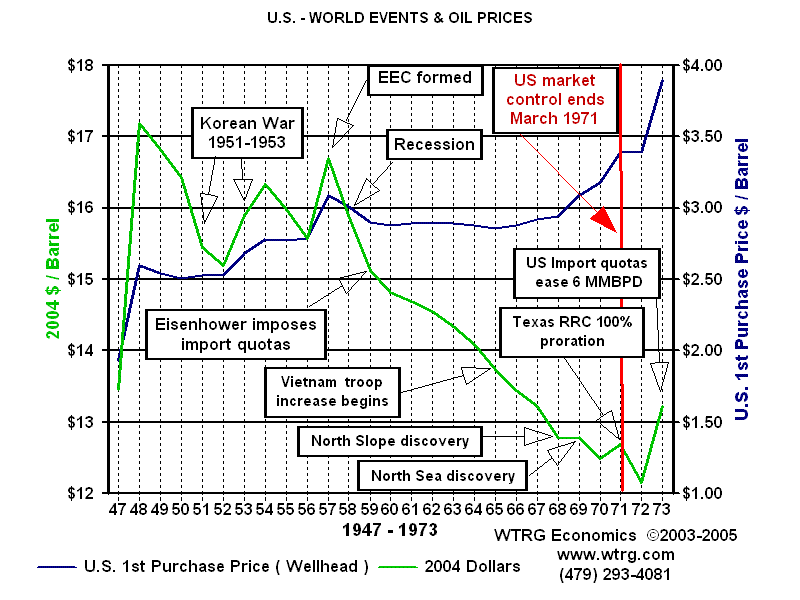
There are many excellent accounts of the history of oil and its pricing, and I can't possibly do justice to this subject in a brief blog posting. If you haven't read the book for which Daniel Yergin won the Pulitzer Prize in 1992, that would be a good place to start. Prior to the first oil crisis, the price of oil was effectively set by the Texas Railroad Commission, which published the monthly quota for production in the state. Together with import restrictions, this constrained supply enough to keep US oil prices between $2 and $4 per barrel. Once the Railroad Commission quota hit 100% in 1971, as a result of growing demand and the peaking of Texas oil output, its influence on prices ended. Oil from the Middle East and other big exporters in that period was sold mainly via long-term contracts, at prices that changed infrequently and that sometimes included "net-back" provisions, explicitly tying the price received by the producer to the revenue realized by refiners in key markets.

All of this changed in the 1970s, after OPEC consolidated its control and began raising the price. It ended net-back discounts and nationalized the holdings of the international oil companies. Between 1972 and 1978, the average price US refiners paid for imported crude oil quadrupled in dollars of the day. The US government intervened in the market by setting the price of "old" and "new" oil--trying to hold down prices while leaving incentives for new domestic production--and limiting imports. These distinctions were exploited by clever traders, and integrated refiners were forced to supply small, independent refiners, even if their own facilities were under-utilized. It was a mess. From 1978-81, in the aftermath of the Iranian Revolution, oil prices increased by another 150%. Over the next few years, OPEC's ability to set prices was eroded by a 10% reduction in global oil consumption and a tsunami of new non-OPEC output from the North Sea, the North Slope and elsewhere. In the ensuing battle for market share, the price of oil fell from its peak of around $40/bbl. to $13, requiring the 1990 Iraqi invasion of Kuwait finally to push it back above $20.

When I traded oil in the late 1980s, most of the US production I dealt with was bought and sold on the basis of the oil companies' posted prices, which solicited offers to sell them lease-level crude output. Alaskan North Slope crude was one of the few domestic grades I handled that was sometimes pegged to the price of West Texas Intermediate crude on the New York Mercantile Exchange (NYMEX.) The prices of the relatively few international cargoes I bought were typically negotiated for each cargo, without reference to other markets. Although I never bought Saudi oil, it was priced by Aramco on two formulas, one for "eastern" and one for "western" destinations. Transparency in that period depended on the ability of reporting services such as Platts to ferret out the details of the transactions that occurred each day. The fewer the transactions, the less reliable these reports were, especially for domestic grades outside the week or so prior to monthly pipeline scheduling, when most deals took place.

History is rarely a perfect guide, but in this case I think it offers some useful lessons concerning how oil might be priced, if the futures markets became less liquid or less influential. Although prices might not be as volatile, day to day, they would be no less prone to manipulation, or to sudden price spikes in response to changes in supply or demand. The pre-NYMEX oil market only yielded low prices when supply was abundant, a characteristic that has been absent since oil prices took off in 2003. Today's problems of transparency, involving the identity and motivation of market participants, pale in comparison to the former challenges of discerning precisely what the day's price was, in the absence of an open, visible exchange platform. I dislike clichés, but as the father of a small child the image of throwing out the baby with the bathwater resonates strongly, here.

Monday, June 23, 2008

Transition Time

The cover of this week's issue of The Economist is devoted to the future of energy, and to the proposition that large-scale change is "closer than you think." The magazine includes a 14-page special report providing a useful overview of the major technology options for replacing conventional sources of energy. Its editors are correct that it is now possible to imagine a world that relies much less on oil and coal than today's, and that the present demand-driven spike in energy prices and a generation's progress on alternative energy technology make that prospect much more realistic now than similar aspirations during the previous energy crisis. Unfortunately, the report is essentially mute on the crucial question of timing, thus avoiding the apparent paradox that the energy transformation eagerly anticipated by so many might require a significant further contribution from fossil fuels, in order to bring it to fruition.

I see two visions competing for share of mind with regard to energy: one paints a future world in which clean energy is plentiful and cheap enough to support sustained global economic growth, while in the other the urgency of dealing with climate change forces us to kill off the hydrocarbon economy quickly and build a low-emissions energy future on its ashes. As convinced as I am that our energy plans must address climate change, I do not find the latter view very motivating or convincing. Nor do I think it would be terribly appealing to anyone who is dismayed by the relatively modest economic slowdown now playing out as a result of high energy prices and the fallout from the subprime crisis--a pale shadow of what a true oil crash would look like.

How close are alternatives to being able to replace fossil fuels? The progress that has been made in the last 30 years is certainly encouraging. For example, the cost of producing electricity from wind was once a large multiple of the cost of conventional power. That gap has shrunk so much that a 2 cent-per-kilowatt renewable electricity tax credit--which is still in jeopardy--appears to be the difference between profit and loss. But in order for renewables to make serious inroads into the market shares of power produced from coal and natural gas, wind and solar power must first reach a scale at which their annual capacity additions can cover the average annual growth of electricity demand. In the US, that figure has varied between 1-2%, which amounts to roughly an additional 60 billion kWh of net generation each year. That means that, at an average capacity factor of 30%, we would need to add 29,000 MW of wind, solar and other renewable electrical capacity per year. According to the American Wind Energy Association, installed US wind power capacity grew by 5,244 MW last year, and should grow by at least that much this year. Grid-connected solar is still much smaller, though growing somewhat faster than wind.

Turning to liquid fuels, although demand growth in the US has stalled for the time being, due to high prices and lower economic growth, covering 1% annual growth in liquid fuels also looks challenging. Although US corn ethanol volume increased by 1.7 billion gallons last year and was on a pace to add at least that much new output this year, prior to the Midwest flooding, after adjusting for its lower energy content this amounts to 0.8% of US gasoline demand and only 0.3% of our total petroleum demand. Covering the 1% annual growth that would be consistent with stronger economic growth and lower energy prices would require the energy equivalent of an incremental 5.5 billion gallons per year of ethanol each year, without accounting for the significant quantities of oil and natural gas consumed in producing this fuel.

Conservation and efficiency can and should help to decrease the height of these goalposts, and we see that in the apparent shrinkage of US gasoline demand, as consumers adjust to the reality of $4 fuel. But whether needed to cover normal historical growth in energy demand, or merely as an important milestone along the path toward actually eroding the market shares of oil and coal, it will take wind, solar and biofuels several more years of sustained high growth rates to attain that scale. And that will still be the case, even if changes in consumer preferences speed up the planned improvement in US new-car fuel economy and bring more plug-in and all-electric vehicles and efficient homes and appliances into the market. For a system this large, massive change cannot happen overnight.

All of this makes for an uncomfortable transition period, during which we will remain frustratingly reliant on sources of energy that we know emit unsustainable quantities of greenhouse gases into the atmosphere, while leaving us vulnerable to unstable foreign suppliers. Although I am optimistic about the potential of alternative energy sources and improved efficiency to alleviate both of these problems in the longer term, I remain pragmatic about how much can be done right now. However viscerally satisfying the prospect might seem to many people, we cannot yet turn our backs on the fossil fuels that supply 85% of our energy needs today. Doing so prematurely would align us with the path of perpetual energy scarcity, rather than long-term clean energy abundance, just as much as if we abandoned the alternative energy technologies that are only now starting to produce on a scale that really matters. It's a shame The Economist didn't tackle the subject of managing our expectations during the energy transition they described so ably.

Wednesday, May 21, 2008

Sunshine in Germany

I'm still catching up on the news, after a long weekend in a remote location. Among the articles I missed was one in Friday's New York Times on Germany's subsidies for solar power. Although the country's system of "feed-in tariffs" and the rapid growth in solar power to which they have contributed are the envy of renewable energy advocates around the world, some German legislators have concluded that the structure is too expensive for the small amount of clean electricity it generates: 0.6% of a mix still dominated by coal. If you dissect the arguments and view the environmental elements rationally, the debate is essentially over industrial policy, rather than energy policy. It provides a lesson that we should study carefully, in light of ambitious proposals at the federal and state level to emulate the German approach.

Although the Times article included a wealth of data, it neglected to mention the magnitude of the subsidy embedded in Germany's solar feed-in structure, which obligates utilities to purchase power from various renewable energy technologies at a set price for 20 years. The current law reduces that rate each year, though a more aggressive decline has been deferred for a couple of years. The cost of acquiring this power is allocated across all rate-payers, and many analyses focus on the relatively modest impact on each household--just a few Euros per month, so far. But that allocated cost is only small because the amount of electricity being generated is quite small, not because the tariff is. In fact, the feed-in tariff for electricity generated from photovoltaic modules is eye-poppingly generous: about 50 €-cents per kWh, which at current exchange rates translates to $0.78/kWh. Compare that to the $0.06-0.08/kWh cost of US wind power cited in the recent DOE study. Even if coal-fired electricity cost as much as €0.10/kWh in Germany, the effective cost of the carbon emissions saved by solar power at these prices equates to a staggering €440/ton, or about 17 times the going rate for emissions credits on the European Climate Exchange.

The Times noted that Germany receives fewer hours of sunshine each year than many other places, calling the growth of solar power in spite of this deficiency "all the more remarkable." Other adjectives come to mind, "silly" being one of the kindest. It is sometimes easy to forget that even Munich, Germany's southernmost metropolis, is farther north than Bangor, Maine or Quebec City. The combination of high northern latitudes and frequent cloudy conditions results in very low annual "insolation", the amount of solar energy delivered per square meter. The best regions of Germany for solar power receive less than half the solar energy of the US Southwest, and the worst get about a third. Of all the forms of renewable energy that Germany might have chosen to subsidize so generously, solar power seems the least suited to the country's physical geography.

When taken together, these two factors suggest strongly that Germany's support for its solar power industry has very little to do with either energy or environmental policy and everything to do with national industrial policy--creating industrial champions and the so-called green-collar jobs about which we have heard so much during the US presidential campaign. However, even without a recession, Germans are apparently now beginning to wonder about the cost-effectiveness of such an approach, which has loaded up a cloudy, northern country with solar panels that rarely see the sun. The German PV miracle should be a cautionary tale for US politicians and regulators, not a model to copy.

Tuesday, May 20, 2008

Crossing the Rubicon?

Although I haven't made any great study of the history of shareholder revolts, I suspect that it is fairly unusual for one to occur when a company is enjoying record earnings, not only relative to its own past performance, but when compared against the performance of any firm in any industry at any time. And yet, that's where ExxonMobil finds itself today, with no less a group of stakeholders than the descendants of the firm's founding dynasty weighing in on the subject of its investment choices, particularly with regard to alternative energy. The Rockefellers have been joined in this effort by other investors and shareholder advisers. Whatever you may think about the shareholder resolutions in question, or indeed about the issues that they raise, the corporation's Annual Meeting is precisely the right venue for addressing them.

You might recall that when I wrote about a recent Congressional hearing on oil prices, I wasn't terribly sympathetic to the way that Chairman Markey pilloried ExxonMobil for pursuing alternative energy less enthusiastically than some of its competitors, or than the Congress might wish. When the Congress or the President can direct the portfolio decisions of publicly-traded companies on matters that do not involve their compliance with any known law or regulation, our political and economic system will have lost all resemblance to the one established by the Founders. However, the management and board of a corporation are still answerable on such issues to their shareholders, however silent the latter may be most of the time, especially when a company's fortunes are prospering.

Many of my readers regard investing in renewable energy as an obvious choice at this juncture, in light of the uncertainties of climate change and Peak Oil, more restrictive access to resources, and the rapid technological changes sweeping the global energy sector. I have long believed and advised that any integrated energy corporation that doesn't participate in the development of alternative energy puts its future success and image at risk. However, that doesn't mean that a company's management can't weigh all of these factors and conclude that it is still better off focusing on the areas in which it has excelled, a strategy that the landmark business text, "In Search of Excellence" referred to as "Sticking to the Knitting"--one of a handful of key lessons the authors gleaned from their study of successful companies. (Among other things, Peters and Waterman also extolled "A Bias for Action" and experimentation.)

The question that ExxonMobil's shareholders are effectively posing is whether its otherwise admirable capital discipline prevents management from seeing the long-term potential of a set of developments that could prove as significant as the original oil boom 150 years ago. John D. Rockefeller's vision of the growth of an oil-based economy, and how to capitalize on it, made Standard Oil--the precursor of the modern ExxonMobil--one of the most successful organizations in history, even after being broken up and only partially reassembled in the late 1990s. Even if you are skeptical, as I am, that we are on the verge of ending oil's key role as a source of primary energy and a superior energy carrier, it seems quite likely that the winners of the ongoing competition to crack the challenges of biofuels, solar power, and other alternatives will make new, Rockefeller-scale fortunes. A company should only turn its back on that kind of opportunity after some serious soul-searching and a frank discussion with its owners.

Some perspective seems necessary, as well. While the shareholder challenge to Exxon's management is a significant event within the larger trend of the greening of business, it would be a mistake to view it as a crusade. If the proposals currently being voted on by ExxonMobil's owners succeed, they will not end America's addiction to oil or bring the millennium. If they fail, that will not signify that we have passed the baton of moral or technological leadership to any other country or group of countries. The alternative energy revolution will stand or fall on its own merits, with or without Exxon. The company's shareholders must now decide whether or not the reverse is also true. Although I'm not endorsing any of these resolutions, I sincerely hope that both sides treat this as a unique and valuable opportunity to rethink their assumptions, scenarios and strategies concerning the future of energy.


I don't own any ExxonMobil stock, except in the manner in which millions of Americans do, as a component of various mutual funds.

Monday, February 25, 2008

The Tax Debate

It's not unusual for politics to focus more on perceptions than reality, but there are few areas in which those perceptions are more divorced from fact than on the subject of taxes, and that is particularly true in this election cycle. Various candidates propose tax cuts, the repeal of tax cuts, a "fair tax", and other options affecting taxation, but few of them begin by describing the magnitude of current taxation, its allocation between individuals and corporations, and the relative tax rates paid by these different segments. The resulting distortions are especially glaring when it comes to the taxes paid by the energy industry.

The debate over whether to tax the oil industry to fund subsidies for alternative energy and energy efficiency is a small aspect of the larger discussion over the appropriate level of taxation on businesses and individuals. The argument to withdraw certain tax benefits from the highly-profitable US oil industry is founded on the perception that the oil industry is under-taxed, violating Americans' sense of fairness. While it is indisputable that the domestic oil and gas industry has been making money hand over fist, the perception that it pays less tax than other industries is not only false but entirely contradicted by the government's own data in this regard.

The income tax on individuals raises about $1 Trillion annually, three times the amount collected from taxing corporate income. According to the Energy Information Agency of the Department of Energy, in 2006 the 29 companies included in its Financial Reporting System paid $90 billion in income tax--or 25% of all US corporate income tax receipts--on pre-tax income after adjustments of $222 billion. That yielded an effective tax rate of 40.7% before counting the $8 billion in production and other taxes they paid. This group of companies, which includes ExxonMobil, Chevron, ConocoPhillips, Valero, Tesoro and the US operations of BP and Shell, had combined revenues of $1.4 Trillion and accounted for about half of US oil and gas production and 80% of refining. By comparison, the effective tax rate on all US manufacturing companies was 22%. In other words, the oil and gas industry is already taxed about twice as heavily as all US industry.

It shouldn't surprise us that our perceptions about the tax burden on the energy industry are wrong, because commonly-heard assertions about the relative income taxation of individuals turn out to be equally flawed. In contrast to our sense that this burden falls mainly on middle-class Americans, the most recent data from the Congressional Budget Office show that the 2nd, 3rd and 4th quintiles of households by income, roughly corresponding to lower-middle, middle, and upper-middle income Americans, together earned 41.6% of all income and paid 16.6% of federal personal income tax liabilities in 2005, while the top 20% earned 55.1% of income and paid 86.3% of the personal income tax. The lowest quintile actually received a net credit. Nor is it true that this allocation has become less fair over time. Since 1980, the share of the income tax collected from the middle class has fallen by half, from 35%, and the load carried by the top quintile has increased by a third.

Now, it's possible to evaluate these figures and conclude that oil companies and wealthy individuals should pay out an even higher fraction of their incomes in taxes. The US still has a substantial budget deficit, and the likelihood of reducing expenditures by enough to close that gap seems low, when entitlements, defense spending and interest on the national debt account for most of the federal budget. But we need to understand that raising those taxes will have consequences, too. Energy companies already pay double the effective tax rate of all manufacturers, and raising their taxes will make them less competitive with other sectors of the economy, and with foreign firms, at a time when we claim to place a high premium on energy security.

We must also be realistic about how close alternatives and efficiency really are to being able to displace our oil imports. Domestic oil and gas still account for 45% of US energy production--eight times the contribution of the rapidly-growing non-hydroelectric renewable energy sector. Doubling our ethanol output over the next decade will only replace 3% of our net petroleum imports. In that light, penalizing our largest domestic energy sources to support our smallest, and basing the argument on a fundamental misunderstanding of how the country's tax burden is apportioned, seems unlikely to advance the cause of energy independence.

Friday, February 22, 2008

Oil's Geothermal Opportunity

Reading a recent article about the expansion of California's geothermal power capacity at the Geysers, northeast of San Francisco, I was again struck by how little geothermal energy resembles higher-profile, intermittent renewable sources such as wind and solar power, and how similar it is to the development and lifecycle management of large oil fields. That extends to dealing with a problem that wind and solar never face: although the wind will blow and the sun shine long after the last human is around to observe them, the type of geothermal reservoirs that we have successfully tapped gradually deplete, as their stored energy is carried away and their natural pressure declines--not unlike an oil or gas field. When you consider all the similarities, it is remarkable that more oil companies have not embraced this technology as the nearest alternative to their core business of finding hydrocarbons underground and bringing them to the surface.

Although I grew up less than 200 miles from the Geysers, I was surprised to see that in 2006 the field supplied almost 5% of California's electricity--more than wind and solar power combined--and it did so around the clock, operating in either baseload or load-following modes that wind and solar can't emulate without expensive energy storage. At the same time, despite significant investment in recent years, the area now produces about a quarter less power than it did at its peak a generation ago, because of the loss of steam pressure in the main reservoirs in contact with the hot rocks. A major project to recharge the water supply of the field recently restored about 10% of its generating capacity, and the new drilling and additional turbines described in the San Jose Mercury News article will increase that further, though with a finite, depleting life.

Geothermal is a natural fit for oil companies, because it capitalizes on existing oil and gas skills such as 3-D seismic interpretation, horizontal and directional drilling, reservoir management, and the extensive experience some companies have gained in reservoir heat management, which is a key aspect of enhanced oil recovery, ultra-heavy oil production, and in-situ oilsands development. The business model of a geothermal field, with its large up-front investment and gradually declining output--boosted at later stages by enhanced recovery projects--looks nearly identical to the established oil and gas model, with two exceptions, both of which make oil companies nervous. The market for the electrons it produces is quite different from those for oil and gas, and its economics are subject to the vagaries of government incentives, such as the renewable energy Production Tax Credit.

Of the large international oil companies, only Chevron (in which I own stock) seems to have a significant focus on geothermal energy, and much of that was inherited with its acquisition of Texaco, my former employer, and later Unocal. According to their corporate website, Chevron operates geothermal plants in Indonesia and Thailand generating a combined 1273 MW of power. As big as that is in geothermal terms, it only equates to about 5% of the company's daily production of natural gas. That proportion isn't limited by the size of the available geothermal resources, even in the US, but by the historically lower profitability of geothermal power, compared to upstream oil and gas projects. As access to new hydrocarbon reserves becomes increasingly constrained by geopolitics and other factors, and as legislation puts a higher premium on low-emissions energy sources, the relative attractiveness of geothermal opportunities should increase for all of these firms.

Friday, January 25, 2008

Renewable Energy and the Economy

Only a few weeks ago, 2008 promised to be a banner year for renewable energy, the companies that are developing it, and investors in those companies. Oil prices remain near historic highs, and the Energy Bill signed by the President in December boosted the country's ethanol mandate almost five-fold. Although the final legislation didn't include a national renewable electricity standard, 24 states plus the District of Columbia already have such standards in place. As a result, ethanol and wind and solar power have been expanding rapidly, with wind turbine installations in 2007 having grown at nearly double the rate for 2006. One might be forgiven for thinking this sector was essentially recession-proof, backed as it was by the happy alignment of fundamentals and regulations. But as the economy weakens, there are reasons to believe the story is not uniformly rosy, and the stock market seems to agree with that assessment.

At the end of 2007, the WilderHill New Energy Global Innovations Index (NEX), a composite of 86 new energy companies covering wind, solar, biofuels, efficiency, and hydrogen, was up by 58%, year-on-year. As of yesterday, however, it was off almost 20% for 2008 so far, compared to a drop of about 8% for the S&P 500. Why would a sector so favored by politicians, environmentalists, and socially-conscious investors suddenly appear to have diminished prospects, just when it seemed perfectly geared for growth? Unfortunately, renewables and the entire alternative energy sector are vulnerable to two of the same principal factors undermining confidence in the economy as a whole: the availability of credit and higher inflation at the wholesale level.

Ethanol and wind power provide two examples of these vulnerabilities. As I noted recently, the phase-in of the Renewable Portfolio Standard in the 2007 Energy Bill expands the domestic ethanol market from about 6.4 billion gallons per year (BGY) in 2007 to 9.0 BGY this year and 10.5 in 2009. But it also provides for refiners and blenders to receive waivers, if the required ethanol isn't available. If the companies building new distilleries cannot borrow enough to complete those facilities, then the capacity to meet the higher mandate may not exist. Meanwhile, rising corn prices, approaching $5 per bushel, will continue to squeeze the margins of new and existing producers. The final outcome of these trends, in a market created by regulations and subsidies, is uncertain.

Now consider wind power. Although developers had hoped the Energy Bill would extend the 2 cent/kWh Renewable Electricity Production Tax Credit (PTC) beyond the end of 2008, this benefit is at least available for projects completed this year. Its impending expiration might even accelerate some projects, as we've seen in previous years when the PTC was set to end. But a typical wind project receives financing in the range of 30-50%, and in recent years the sources of capital have grown more exotic, including Structured Investment Vehicles and "flip" structures. Wind power is thus vulnerable to some of the same credit risks affecting the entire economy, including the potential backwash from credit default swaps and institutional failures. These are hardly the problems you want to be dealing with, if you are scurrying to put steel on the ground before your tax break evaporates. Nor are wind turbine manufacturers immune to the escalating cost of raw materials, including commodities such as copper, which is at five-year highs. It also doesn't help that the price of natural gas, the fuel for wind power's main conventional competition, has recently uncoupled from the price of crude oil. While the oil futures price is 65% higher than one year ago, the same comparison for natural gas is only up by about 7%.

A weak economy has another, broader implication for green energy. As one of my readers mentioned recently, a deep or prolonged recession would very likely delay efforts to put a price on carbon emissions, whether through cap & trade or a carbon tax on fuel. Even if much of the revenue were redistributed to neutralize its regressive effects, anything that increased energy costs beyond their current levels would be a very tough sell. None of these specific or general concerns makes a meltdown in the renewable energy sector inevitable. But despite support from state and federal government, renewable energy companies could experience a disappointing 2008, particularly compared to the sector's performance last year.

Monday, January 07, 2008

The Biofuel Gap

When I was writing last Wednesday's posting on the year ahead, I was tempted to call 2008 the Year of Biofuel. That's wasn't because I think biofuel will necessarily be the most important energy development of the year, but because, of all of the provisions of the recently-enacted Energy Bill, its greatly expanded renewable fuel standard (RFS) will have the most immediate impact on domestic energy markets, and not all of it good. The new standard requires an increase in ethanol use in 2008 that could not be met by the domestic production facilities existing at the time of the bill's passage, or with current levels of imports, which already face a substantial tariff barrier. So while some ethanol producers struggled in 2007, with margins squeezed between rising corn prices and flat wholesale prices to blenders, it's hard to see how their fortunes could fail to improve this year.

The phase-in of the RFS in the Energy Bill instantaneously increased the size of the US ethanol market, starting on 1/1/08. The RFS previously in effect called for 5.4 billion gallons of renewable fuel to be used in 2008--well below the 6.4 billion gallons of ethanol the industry was on track to deliver in 2007. The new law hiked that to 9 billion gallons per year (GPY) of "conventional biofuel"--mostly corn ethanol--this year and 10.5 billion next year, increasing to 15 billion by 2015. With domestic production running at just over 7 billion GPY in October, the last month for which data is available, and imports contributing perhaps another half billion GPY, meeting the federal target this year will require a lot of new facilities to start up, or a lot more imports. In other words, demand suddenly exceeds supply, by mandate, and that ought to translate into a healthy increase in ethanol margins, once the EPA gears up to administer the new standard.

On the surface, this doesn't sound like much of a problem. After all, doesn't every additional gallon of ethanol reduce the amount of foreign energy we have to import and benefit the environment by reducing greenhouse gas emissions and local pollution? For a thorough answer to that question, I refer to you the excellent article on biofuels in the current issue of MIT's Technology Review, available in three parts on the Internet. But even if ethanol were as beneficial as its most ardent advocates claim, the Congress and President cannot sweep away with the stroke of a pen the logistical bottlenecks involved in getting ethanol from distilleries to gasoline blending terminals all over the country. Those problems helped depress ethanol prices last year and will have to be overcome on the ground, in order to expand the use of ethanol beyond the oxygenated fuel markets from which it has successfully displaced MTBE, which has fallen out of favor due to product liability concerns, or where its supply has been cheap and reliable enough to compete as a separate product, in the form of E-85 for "flexible-fuel vehicles."

As I understand it, companies unable to secure enough ethanol to meet their new quotas would have to purchase blending credits from other companies that blended in excess of their quotas--something that would only be possible if shortages were local, rather than national, and that could run afoul of the current 10% upper limit (E-10) on ethanol/gasoline blends into conventional cars. That would also increase the cost of fuel in areas that can't easily be supplied with ethanol. The alternative would be to apply for a waiver of the portion of the RFS that couldn't be filled practically. That could prove controversial, if the production from new ethanol facilities--however remote from the actual demand--were going begging. When I ponder what this is likely to mean for the business of getting motor fuel reliably to over 100,000 retail sites, I don't envy my former colleagues in the supply and distribution segment of the oil industry.

However unenthusiastic many of us are about corn ethanol, the new RFS is a fact, and our focus should be on minimizing the disruptions it could create in fuel markets. At least until the logistical problems can be addressed by new infrastructure, the best outcome would probably be for as much as possible of the incremental ethanol requirement to be consumed in the form of E-85 in the Midwest, where most corn ethanol will continue to be produced, thus minimizing the cost and constraints associated with distributing it to the most remote corners of the country for E-10 blending. One can only hope that the painful experience gained from this exercise will be useful in smoothing the way for the eventual introduction of cellulosic ethanol, which should be more economical and environmentally-beneficial, and for which a separate RFS quota starts to ramp up in 2010.