Showing posts with label refining margin. Show all posts

Wednesday, October 21, 2015

VW Scandal Puts Diesel's Future at Risk

  • If the VW scandal sours consumers on diesel cars, the potential winners and losers extend well beyond the auto industry.
  • European refineries look especially vulnerable to such a shift, while US refiners, along with manufacturers of electric vehicles, stand to gain.
Whether or not Volkswagen's diesel deception proves to be "worse than Enron," as a Yale business school dean commented, it is more than just the business scandal du jour. Its repercussions could affect other carmakers, especially those headquartered in Europe. And if it triggered a large-scale shift by consumers away from diesel passenger cars, that would have major consequences for the global oil refining industry, oil and gas producers, and sales of electric and other low-emission cars.

The scale of the problem ensures that it will not blow over quickly. Nearly 500,000 VW diesel cars in the US were equipped with software to circumvent federal and state emissions testing, and the company has indicated that 11 million vehicles are affected, worldwide. Even if Volkswagen's retrofit plan passes muster with regulators in the US, Europe and Asia, the resulting recall could take years to complete.

It's also still unclear whether VW's diesel models are unique in polluting significantly more under real-world conditions than in laboratory testing. Regulators in Europe appear to suspect the problem is more widespread. Other companies use similar emission-control technologies--from the same vendors--to control the NOx and particulates from smaller cars equipped with diesel engines. The French government announced plans to subject 100 diesel cars chosen at random from consumers and rental fleets to more realistic testing.

VW faces investigations and lawsuits in multiple countries. While those are underway, the claims of every carmaker selling "clean diesels" and the reputation of a technology that European governments have bet on as a crucial tool for reducing CO2 emissions and oil imports are likely to be under a cloud. How consumers react to all this will determine the future, not only of diesel cars, but of the future global mix of transportation fuels and vehicle types.

Start with oil refining. As long ago as the early 1990s, when I traded petroleum products in London, the European shift to diesel was creating a regional surplus of motor gasoline and a growing deficit of diesel fuel, or "gasoil" as it is often called outside North America. Initially, trade was the solution: The US was importing increasing volumes of gasoline to meet growing demand and had diesel to spare. The fuel imbalances of the US and EU were well-matched, in the short-to-medium term.

As this shift continued, the wholesale prices of diesel and gasoline in the global market adjusted, affecting refinery margins on both sides of the Atlantic. Marginal facilities in Europe shut down, while others invested in the hardware to increase their yield of diesel and reduce gasoline production. US refiners also invested in diesel-making equipment.

The aftermath of the financial crisis and recession increased the pressure on Europe's refiners, as did the rapid growth of "light tight oil" production in the US. Europe's biggest export market for gasoline dried up as fuels demand slowed and US refineries reinvented themselves as major exporters of gasoline.

Diesel cars still make up less than 1% of US new car sales but have accounted for around 50% of European sales for some time. If governments and consumers were now to lose their confidence in diesels and shift back toward gasoline, it would wrong-foot Europe's refineries and leave them with some big, underperforming investments in diesel hardware.  A persistent slowdown in diesel demand would alter corporate plans and strategies as refinery profits shifted. In the meantime, US refineries stand to benefit from a bigger outlet for their steadily rising gasoline output.   

If consumers did retreat from diesel passenger cars--trucks are unlikely to be affected--the shift back to gasoline is likely to be less than gallon-for-gallon, because competing technology hasn't stood still since 2007, when the US Congress enacted stricter fuel economy standards and the Environmental Protection Agency's tougher tailpipe NOx standard went into effect. New gasoline cars are closing the efficiency gap with diesels, thanks to direct injection, hybridization and other strategies. At the same time, the number of new electric vehicle (EV) models is growing rapidly, their cost is coming down, and infrastructure for EV charging is sprouting all over.

EVs still accounted for less than 1% of the US car market last year, but the combined sales of the Chevrolet Volt, Nissan Leaf, Tesla Model S and over a dozen other plug-in hybrid and battery-electric models nearly matched those of the standard Prius hybrid "liftback". EVs are still not cheap, despite generous government incentives that mainly benefit high-income taxpayers. Most still come with a dose of "range anxiety", but they are greatly improved and getting better with each new model year.

Even in Europe, where EVs haven't sold very well outside Norway, a big shift away from diesel would surely help EVs gain market share. If European consumers bought 9 gasoline cars and one EV for every 10 new diesels they avoided, European refiners would soon see not just a shift, but a net drop in total fuel sales. Nor would refineries be the only part of the petroleum value chain to be affected. Global oil demand would grow more slowly as well, bringing "peak demand" that much closer.

For now, this scenario is hypothetical. VW may yet solve its technical problem, bringing the 11 million affected vehicles into compliance with minimal impact on performing and fuel economy. Meanwhile, regulators could find that most other carmakers have been in compliance all along, particularly those selling cars that use the urea-based Selective Catalytic Reduction NOx technology; the rest might only need a few tweaks.

​In that case, the scandal might eventually die down without putting small diesel cars into the grave, as a mock obituary in the Financial Times suggested. Carmakers would have a hard time increasing diesel's penetration of markets like the US, but loyal diesel customers around the world might conclude that these cars still provide them the best combination of value, convenience and drivability. Having driven a number of diesels as rentals and at auto shows, I wouldn't dismiss that possibility too lightly. The jury is likely to be out for a while.

A different version of this posting was previously published on the website of Pacific Energy Development Corporation

Friday, September 12, 2014

Exporting US Oil to Mexico

  • Mexico could become a major export destination for surplus US light crude oil, despite being one of the largest oil suppliers to the US, mainly of heavy oil.
  • If structured as an exchange for other barrels, such exports might not require re-writing US oil export regulations, unlike sales to non-neighboring countries.
Two of the biggest energy stories of the last twelve months have been the reform of Mexico's oil sector after 75 years of state monopoly and the US oil industry's drive to gain approval to export a growing surplus of domestic light crude oil. The prospect of exporting US oil to Mexico connects these developments in a surprising way. It should make sense geographically and economically, though regulatory hurdles remain. Yet it could also increase tension between US oil producers and refiners over the merits of exporting crude versus refined products.

At first glance, the idea seems counterintuitive. Our southern neighbor was the third-largest exporter of oil to the US last year, consistently ranking above Venezuela. However, most of Mexico's oil is heavy and sour, in contrast to the light, low-sulfur "tight oil" (LTO) produced from US shale formations like the Eagle Ford of Texas.

Mexico has experienced supply and demand trends similar to what the US saw prior to our shale revolution. Total oil and gas liquids production has fallen by 25% since 2004, largely due to the declining output of Maya crude from the supergiant Cantarell field, while demand for refined products grew by around 20% in the same period. Lightening the crude oil slate of Pemex's oil refineries with LTO imported from the US could augment efforts to increase throughput and yields of transportation fuels.

The Commerce Department's recent approval for two US companies to export lightly-processed condensate, which despite its similarities is technically not crude oil, was followed by a hold on similar applications. These events have fueled both enthusiasm and confusion concerning US oil exports, which are still politically controversial, after decades of declining US production and periodic price spikes.

An easier sell might involve the exchange or "swap" of surplus LTO for imported heavy oil, and Mexico makes an ideal partner for this kind of transaction. Existing law at least recognizes the potential for such swaps with "adjacent countries", though it remains to be seen whether such a deal could be made to fit language specifying that the oil received be of "equal or better quality".

As a former oil trader, it strikes me that the best ways to close that gap might be to structure an LTO vs. Maya swap as a barrel-for-barrel exchange in which the US party would collect a financial premium in recognition of the quality difference--money being another measure of quality--or a "ratio exchange" in which every barrel of LTO delivered would be matched by a larger quantity of Maya, at a proportion determined by the refining values of the two oils. Either option would still require some regulatory finesse, but of a much different type than approving the outright, net export of US oil production.

The biggest stumbling block to an exchange of LTO for Mexican crude would probably be one of the same ones impeding the general lifting of a US oil export ban that the Washington Post has called "an economically incoherent policy." While US oil producers argue that allowing exports would enable their product to be sold for its global value and incentivize even higher future production, US oil refiners see exports as a threat to their margins and to the growth of their own exports of refined products. These have been crucial in sustaining arguably the world's best refining industry in the face of a weak economy and declining demand at home. 

Mexico is at the heart of this trend. Its imports of LPG, gasoline, diesel and other fuels from the US have increased to over 500,000 barrels per day (bpd) in recent years. Mexico accounted for 44% of all US gasoline and gasoline blending components exported last year, along with 10% of diesel fuel exports and 15% of LPG. I don't think it's controversial to suggest that exporting light crude oil to Mexico would come at least partly at the expense of our refined product exports to the country.

This boils down to the familiar economic dilemma of exporting raw materials versus capturing the value added from selling manufactured goods. I'm sympathetic to the refining industry's concerns, and not just as a former refinery engineer. However, those concerns would carry more weight if US refineries had the capacity to process all of the LTO the US is likely to produce in the years ahead, and to pay a world-market price for it. Refiners might benefit from access to lower-priced crude, but if driving down the value of LTO in a confined market choked production, net US oil imports would be higher than otherwise and the economy would be worse off.

Stepping back from the details of that debate, exporting US light crude oil in exchange for Mexican heavy crude looks attractive within a broader and increasingly credible vision of North American energy self-sufficiency. That wouldn't mean cutting North America off from the global oil market, but it would put us and our neighbors in the enviable position of being able to select imports based on opportunity rather than necessity. A reformed and revitalized Mexican oil industry, importing and exporting oil with its neighbors as it makes sense, could be a cornerstone of that vision.

A different version of this posting was previously published on the website of Pacific Energy Development Corporation.

Tuesday, January 28, 2014

The Pros and Cons of Exporting US Crude Oil

  • Calls for an end to the effective ban on exporting most crude oil produced in the US are based on a growing imbalance in domestic crude quality.
  • At least recently, the ban has likely benefited refiners more than consumers. Assessing the impact of its repeal on energy security requires further study. 
Senator Lisa Murkowski (R-AK), the ranking member of the Senate Energy & Natural Resources Committee, issued a white paper earlier this month calling for an end to the current ban on US crude oil exports. Her characterization of existing regulations in this area as "antiquated" is spot on; the policy is a legacy of the 1970s Arab Oil Embargo. However, not everyone sees it the same way, either in Congress or the energy industry.

This isn't just a matter of politics, or of self-interest on the part of those benefiting from the current rules. Questions of economics and energy security must also be considered. The main reason these restrictions are still in place is that for much of the last three decades US oil production was declining. The main challenges for the US oil industry were slowing that decline while ensuring that US refineries were equipped to receive and process the increasingly heavy and "sour" (high sulfur) crudes available in the global market. The shale revolution has sharply reversed these trends in just a few years.

No one would suggest that the US has more oil than it needs. Despite the recent revival of production, the US still imported around 48% of its net crude oil requirements last year. Even when production reaches its previous high of 9.6 million barrels per day (MBD) as the Energy Information Agency now projects to occur by 2017, the country is still expected to import a net 38% of refinery inputs, or 25% of total liquid fuel supply. The US is a long way from becoming a net oil exporter.

The driving force behind the current interest in exporting US crude oil is quality, not quantity, coupled with logistics. If the shale deposits of North Dakota and Texas yielded oil of similar quality to what most US refineries have been configured to process optimally, exports would be unnecessary; US refiners would be willing to pay as much for the new production as any non-US buyer might. Instead, the new production is mainly what Senator Murkowski's report refers to as "LTO"--light tight oil. It's too good for the hardware in many US refineries to handle in large quantities, and for most that can process it, its better yield of transportation fuels doesn't justify as large a price premium as for international refineries with less complex equipment.

As a result, and with exports to most non-US destinations other than Canada or a few special exceptions effectively barred, US producers of LTO must discount it to sell it to domestic refiners. Based on recent oil prices and market differentials, producers might be able to earn as much as $5-10 per barrel more by exporting it. Meanwhile the refiners currently processing this oil are enjoying something of a buyer's market and are able to expand their margins. The export issue thus pits shale oil producers and large, integrated companies (those with both production and refining) such as ExxonMobil against independent refiners like Valero.

Producers are justified in claiming that these regulations penalize them and threaten their growth as available domestic refining capacity for LTO becomes saturated. Additional production is forced to compete mainly with other LTO production, rather than with imports and OPEC.

I believe producers are also largely correct that claims that crude exports would raise US refined product prices are mistaken. The US markets for gasoline, diesel fuel, jet fuel and other refined petroleum products have long been linked to global markets, with prices especially near the coasts generally moving in sync with global product prices, plus or minus freight costs. I participated in that trade myself in the 1980s and '90s. What's at stake here isn't so much pump prices for consumers as US refinery margins and utilization rates.

Petroleum product exports have become a major factor in US refining profitability, and refiners are reportedly investing and reconfiguring to enhance their export capabilities. This provides a hedge against tepid domestic demand. Nationally, refined products have become the largest US export sector and contributed to shrinking the US trade deficit to its lowest level in four years.  If prices for light tight oil rose to world levels US refineries might be unable to sustain their current export pace. It's up to policymakers to assess whether that risk is merely of concern to the shareholders of refining companies or a potential threat to US GDP and employment.

The quest to capture the "value added"--the difference between the value of manufactured products and raw materials--from petroleum production is not new. It helped motivate the creation of the integrated US oil companies more than a century ago and impelled national oil companies such as Saudi Aramco, Kuwait Petroleum Company, and Venezuela's PdVSA to purchase or buy into refineries in Europe, North America and Asia in the 1980s and '90s.

On the whole, OPEC's producers probably would have been better off investing in T-bills or the stock market, because the return on capital employed in refining has frequently averaged at or below the cost of capital over the last several decades. It's no accident most of the major oil companies have reduced their exposure to this sector. When today's US refiners argue that it is in the national interest to preserve the advantage that discounted LTO gives them they are swimming against the tide of oil industry history.

The energy security case for crude exports looks harder to make. An excellent article from the Associated Press quoted Michael Levi of the Council on Foreign Relations as saying, "It runs against the conventional wisdom about what oil security means. Something seems upside-down when we say energy security means producing oil and sending it somewhere else."  The argument hinges on whether allowing US crude exports would simultaneously promote more production and increase the pressure on global oil prices. That makes sense to me as a former crude oil and refined products trader, but it will be a harder sell to Senators, Members of Congress, and their constituencies back home.

The politics of exports may be easing somewhat, though, as a Senate vacancy in Montana could lead to a new Chair at Energy & Natural Resources who would be a natural partner for Senator Murkowski on this issue. (That shift may incidentally be part of a strategy to help Democrats retain control of the Senate.) Will that be enough to overcome election-year inertia and the populist arguments arrayed against it?

As for logistics, the administration could ease the pressure on producers without opening the export floodgates by exempting the oil output from the Bakken, Eagle Ford and other shale deposits from the Jones Act requirement to use only US-flag tankers between US ports. That could open up new domestic markets for today's light tight oil, while allowing Congress the time necessary to debate the complex and thorny export question.

Senator Murkowski wasn't alone in calling for an end to the oil export ban. In his annual State of American Energy speech presented the day as the Senator's remarks, Jack Gerard, CEO of the American Petroleum Institute, noted, "We should consider and review quickly the role of crude exports along with LNG exports and finished products exports, because of the advantages it creates for this country and job creation and in our balance of payments." In a similar address on Wednesday, the head of the US Chamber of Commerce stated, "I want to lift the ban. It's not going to happen overnight, but it's going to happen."  I'd wager he at least has the timing right.

A different version of this posting was previously published on the website of Pacific Energy Development Corporation.

Thursday, October 11, 2012

Sacramento's Role in California's Gasoline Price Spike

How much higher were gasoline prices in California last week than elsewhere?  Enough to raise the national average price for unleaded regular by about $0.10 per gallon.  So while the rest of us were paying an average of $3.75/gal., down slightly from the previous week, gas prices in the Golden State went up by 48 cents, leaving Californians paying nearly a dollar a gallon more than other Americans.  In general the media have done a good job of explaining the direct causes for this spike: a pair of unexpected outages at large refineries in the Bay Area and L.A., combined with the difficulties of supplying the state's unique gasoline blend when local refiners fall short.  Robert Rapier does an even better job of explaining the intricacies of that blend.  But what's missing from all this commentary is an explanation for why the supply for the nation's largest gasoline market, with more than 11% of US sales, should be so tightly balanced that such disruptions would lead to economic hardship for consumers.

As I've indicated before, California is effectively a gasoline island. The product pipelines connecting it with neighboring Arizona and Nevada run out, not in, and the only routes between California and the other West Coast refining center north of Seattle travel over water.  So the principal refineries serving the California market are in California, and obtaining supply from elsewhere that hasn't been prearranged takes time for special batches of fuel to be blended up, tankers to be chartered, and for those vessels to complete their voyages from ports as far away as the Gulf Coast or Singapore.  That entails at least a couple of weeks.

In a posting I wrote in 2007 during a similar price spike in California, I referred to a 2003 study by the Energy Information Agency of the US Department of Energy, looking at an earlier California gasoline spike. (This is a recurring problem.) Among the major factors explaining the higher prices and volatility of the California gasoline market, they found,
"The California refinery system runs near its capacity limits, which means there is little excess capability in the region to respond to unexpected shortfalls."
That also means that there is typically no local surplus from which to rebuild inventories once refinery production returns to normal.  That's a crucial factor in the speed at which prices return to normal.

So much for the diagnosis, but what about the cause?  Tackling the local pollution from large, stationary sources like oil refineries, and from the tailpipes of the state's 31million cars and other vehicles has been a top priority for the state's Air Resources Board (CARB) since the 1970s, for good reason.  However, over the years, CARB's increasingly strict regulations made it harder and less attractive to operate refineries in the state, and more difficult to blend the fuel it allowed to be sold there.  As it happens, I saw much of this first-hand when I worked as an engineer in Texaco's Los Angeles refinery and later when I traded refined products, crude and feedstocks for the company's West Coast operations in the 1980s and early '90s.  I watched one small refinery after another go out of business, and the magnitude of periodic price spikes grow, as the market became more constrained and isolated. I also saw refining margins for the survivors improve relative to those on the Gulf Coast and other parts of the country.  These trends seemed related, since the state, by its actions, was turning California gasoline into a boutique product and effectively blocking competition from outside the state.

The normal response of companies operating in a market such as that, with growing demand and healthy margins, would have been to invest in more capacity--new refineries or major refinery expansions--and collectively to overshoot somewhat.  But by then the prospect of obtaining the permits necessary to build a new refinery in California had gone from difficult to impossible, and most refining investment was focused on the substantial upgrades required to keep up with the state's periodic tightening of product specifications.  And since those investments generally did little to increase output or improve product quality in ways a consumer might notice and pay a premium for, they had awful returns and dragged down the total return on investment for the entire facility. This contributed to refineries shutting down or being sold to independents with less capacity to make further such investments in the future. 

The net result of all these factors is a California refining system that today is 21% smaller than in 1982, at least in terms of crude processing capacity, but must meet gasoline demand that has grown by a third in the meantime, even after shrinking from its 2006 peak.  Now, when an unplanned refinery outage occurs, the result provides as classic and dramatic a demonstration as you'll ever see of the price response to a shift in the supply curve for a good with inelastic demand.

As an ex-Californian and ex-Angeleno there's no doubt in my mind that air quality, especially in Southern California, has improved as a result of many of the regulations imposed on industry and on fuels.  However, you'd have to ask the state's current residents whether that result is worth the high price they periodically pay at the gas pump, or whether some degree of compromise that would have allowed refineries to expand to keep pace with demand, while cleaning up the air almost as much, would have been preferable. 

Friday, April 06, 2012

Buying Your Own Refinery

Has the high cost of fuel got you down? Why not buy your own oil refinery? That's apparently what Delta Air Lines is considering. With jet fuel purchases constituting one of the largest operating costs for carriers like Delta, and with several refineries in the Northeast US facing permanent closure due to poor profitability, it's not hard to see why this idea would seem attractive, at least superficially. However, there are a host of reasons why most of the press I've seen on this story is negative, including today's Heard on the Street column in the Wall St. Journal, entitled, "Delta Chases Fuel's Gold." The fundamental problem is the same one that has made me skeptical about the benefits of airlines investing in the production of renewable aviation fuel: Any advantageous pricing they may choose to provide to their airline division must come at the expense of lost opportunities for the fuels business, because the value of that fuel is set by the market.

How a company should reflect such opportunity costs in its inter-departmental transfer pricing is an age-old problem. I dealt with this routinely when I traded refined products for Texaco's west coast refining and marketing business in the 1980s. The marketing department always wanted to receive the output of the refineries at a lower price than we were charging them, so that they could capture market share and justify investments in new and remodeled gas stations. But making them look good at the cost of the refineries just made it harder to justify the investments needed to keep the refineries operating efficiently and in compliance with current and future regulations. Delta might buy ConocoPhillips' Pennsylvania refinery at a low price today, but they could be forced to invest at least as much within a few years to meet new gasoline sulfur regulations or other changes. It doesn't trivialize the situation to put it into the category of no free lunches.

Then there's the question of reorienting a refinery to make a lot more jet fuel that it has done historically, as one article suggested Delta was considering. Modern refineries are fairly flexible, and it would be possible to do that to some degree, though within limits that would require significant investments to exceed, making the proposition look much less attractive. Moreover, refineries optimize their output every day to make the slate of products that yields the highest profit, as crude and product prices fluctuate. Steering a less flexible course would almost certainly make the facility less, not more profitable, and it's only on the market because it wasn't sufficiently profitable as it was.

The only scenario in which I could see this idea actually working to Delta's benefit is if the refinery closures now being planned tightened the supply of jet fuel into the New York market so significantly that Delta was able to effectively corner that market, forcing other airlines to pay it a significant premium, either in cash or in jet fuel supply in other locations, while artificially keeping costs for its own flight operations low and allowing it to expand its share of the important NY air market. But New York isn't some isolated inland location, and they'd always be competing with jet fuel cargoes brought in by vessel, or with fuel shipped from Gulf Coast refineries via the Colonial Pipeline, which is expanding to meet the new demand its faces in light of the pending refinery closures. They might eke out a few extra cents, but would that be enough to justify taking on the enormous capital and operating costs--not to mention the substantial operating risks--of owning a refinery? If Delta has discovered some enticing angle I've missed, I'd love to know what it is.

Monday, February 13, 2012

Biofuels Battle Value vs. Volume

I was only partially surprised to read in MIT's Technology Review that Amyris, a biotechnology company developing renewable diesel and jet fuel from sugar cane, was backing away from the biofuel market to pursue more lucrative products. Fuels are a highly competitive, low-margin business, and it's hard enough to make money refining them even with established technology and a ubiquitous feedstock like crude oil. This is a great, under-appreciated challenge facing every company that seeks to produce new, greener fuels from biomass using processes that haven't yet reached commercial scale or are only just arriving there. The key is either to produce something for which customers will pay better-than-commodity prices, yielding a high margin per gallon, or on such a vast scale that you can survive with a thin margin.

When I listened to the replay of the investor call Amyris held last week, I picked up some nuances missing from the Technology Review article. Confining its biofuels efforts to joint ventures with Total and with Cosan, a large Brazilian sugar and ethanol producer, probably makes sense for Amyris for many reasons. However, the discussion of value vs. volume segmentation on the call pointed to the need to attain a scale in fuels that would likely be beyond the wherewithal of a firm its size, investing on its own. As it is, the total cane ethanol production of its Brazilian partner Cosan--via the latter's JV with Shell--is still less than the throughput of all but a handful of US oil refineries, and only about one-tenth the volume by which Shell's Motiva joint venture is expanding its Port Arthur, TX refinery. Biofuel refineries needn't reach that scale--they probably couldn't due to the limitations of their feedstock logistics, in any case--but they still need to crack the challenge of repaying big capacity investments while making low-margin products, in addition to any technical challenges they face.

Last week I ran cross a clever plan to circumvent this challenge, in conjunction with meeting the 36 billion gallon per year US Renewable Fuel Standard (RFS). Jim Lane of Biofuels Digest proposed a scenario for meeting the 2022 RFS target using mainly existing corn ethanol and biodiesel facilities. He suggests converting the former to produce higher-value biobutanol, and then capturing and converting their CO2 emissions--after correcting a typo that pegs them at 90 million lb. per year instead of 90 billion lb.--into additional fuels using algae or solar energy. Mr. Lane gets full marks for ingenuity and for coming up with a pathway that doesn't depend on the widespread adoption of E15 and E85 ethanol blends that the public hasn't embraced and might never. However, in my view it relies too much on promising but unproven technologies and on the durability of a price premium for butanol in chemical markets that would be completely swamped by fuels-scale output. I'd expect any shift from ethanol to butanol to proceed only about as far as it took to crush the price differential between butanol and wholesale gasoline.

The advance biofuels industry has made enormous strides in the last decade and proved that you can start with biomass or even CO2 and produce fuels that are chemically identical or otherwise broadly compatible with the petroleum-based fuels that remain the world's primary source of energy for transportation. What it hasn't yet achieved is to prove that it can do so at a cost that competes with that of oil, even when the latter is over $100 per barrel, notwithstanding the cumulative trillions of cubic feet of rhetoric asserting that it can do so as soon as it scales up. The experience of companies like Amyris, which is refocusing its wholly-owned activities on high-margin speciality products, rather than fuel, and of cellulosic dropouts like Range Fuels, reminds us just how hard this will be.

Wednesday, September 28, 2011

The East Coast Refinery Gap

I see that ConocoPhillips has announced it will idle its 185,000 barrel-per-day Philadelphia area refinery, as a prelude to selling it or closing it permanently. Combined with the recent announcement that Sunoco would exit the refining business and sell or close its two refineries in Philadelphia, this amounts to just under half of the operating refining capacity on the US east coast, and that's counting PBF Energy's Delaware refinery, which is apparently in the process of starting up again after having been sold last year by Valero. If none of these three facilities finds a buyer, the resulting closures would leave a large gap in the east coast petroleum product market that must be filled either by shipping more products via pipeline from the Gulf Coast, to the extent capacity permits, or by means of increased imports from Europe and Canada. East coast gasoline and diesel prices could be higher for years to come.

The story in Reuters gives a good overview of the circumstances leading to Conoco's decision, and you've read about most of these factors in previous postings here. Topping the list is the persistent divergence of crude oil prices between the US mid-continent and the global oil market, due to a bottleneck at Cushing, OK resulting from several factors. Last week the gross margin ("3:2:1 crack") for importing crude priced at the level of UK Brent and turning it into gasoline and diesel or heating oil for the northeast market stood at a breakeven, and it's only a few dollars a barrel in the black today, after yesterday's market recovery. That's not much of an inducement to hang onto massively complex, capital-intensive facilities and to continue investing in them to keep them in compliance with ever more stringent regulations. Sometimes it just makes more sense to take a write-down and sell to someone else, who then starts with a lower capital base and has a better chance of making a return--not unlike the restaurant business. The problem in this environment is that it's not obvious who would step into the shoes of Sunoco and Conoco in Philadelphia. A few years ago buying refineries from integrated companies that wanted to redeploy their capital was a thriving game, with lots of players. Not so much, now.

Conoco's timing on this move is interesting, too. If it were only a question of margins, I'd think they'd wait to see how much profitability improved after Sunoco's plants shut down. Instead, it appears they are focused on a bigger picture. Even if they don't find a buyer, closing a marginal or money-losing facility will improve their overall refinery portfolio as they prepare to spin off the refining and marketing business, while allowing them to use the capital expenditures they won't have to put into the Trainer refinery for more lucrative opportunities like shale gas, which the company has been touting in a series of ads. That probably makes sense for the company's shareholders, though it won't do much for consumers in my neck of the woods, especially if the company's larger New Jersey refinery meets the same fate.

Oil refining has always been a tough business, with its occasional good years normally more than offset by years or decades in the doldrums. But the combination of reduced demand from the recession-weakened economy and the increased supply of biofuel--mainly corn ethanol, so far--has increased the pressure. When I ponder all this it makes me wonder why so many startups are so eager to get into the fuels manufacturing business, even if it will be based on biomass rather than oil, when they will ultimately be exposed to similar market forces.

Friday, April 09, 2010

Delaware Refinery Swims Against the Tide

When I saw this headline in today's Wall St. Journal, "Governor Stays Closure of Delaware Refinery," the first thought that crossed my mind was of King Canute and his order to stop the tide. Valero Energy Corp., which owns the Delaware City refinery, had announced last fall that it would be shut down and dismantled. That was a pretty remarkable turn of events, considering that not very long ago refining margins were at all-time highs, boosting the fortunes of independent refiners like Valero and causing politicians and energy experts to despair that the US didn't have enough refinery capacity to keep pace with future demand. But while I understand the state government's desire to preserve the jobs and tax base involved, it's worth asking whether Governor Markell and the firm that appears ready to buy the refinery for $220 million are making a good bet or merely postponing the inevitable. Two graphs of the key fundamentals for this sort of refinery raise serious doubts.

More than 100 US refineries have closed in the last several decades, but few of those were as large or sophisticated as the Delaware City Plant (DCP), which was originally built by Getty Oil to process heavy oil from the Neutral Zone between Kuwait and Saudi Arabia. My former employer, Texaco, owned it for a while, as a result of its acquisition of Getty, before putting it into its refining and marketing joint venture with Saudi Refining Inc., which later included Shell. That JV sold DCP to Premcor, Inc., an independent refiner then run by the current CEO of PBF Energy Partners, LP, the company that is now buying it from Valero, which has owned it since its purchase of Premcor in 2005. The number of times it changed hands probably says more about the evolution of the US refining industry than about any inherent shortcomings of the facility, which is a complex machine for turning low quality crude into lots of gasoline and other valuable light products. Unfortunately, that description encapsulates the two biggest challenges its new owners, creditors and employees face.

Start with gasoline, which remains the most important product for most US refineries, accounting for about half of all US petroleum product sales and roughly 60% of refinery yield on crude oil input. Historically, US gasoline consumption rose by a steady 1-2% per year, and refineries often struggled to keep pace with demand, resulting in significant imports of gasoline and blending components. Two factors have altered that relationship, perhaps permanently. First, rapidly-increasing ethanol production, backed by subsidies and a steadily-escalating mandate, is eroding the market share of the gasoline that refiners make from crude oil. So now even when "gasoline" sales go up, they include an increasing proportion of ethanol. And as a result of the recession, total gasoline sales--including the ethanol blended in--fell by 3.2% between 2007 and 2008. When you factor out the ethanol, the drop was more than 5%. So because of weak demand and increasing ethanol use, refineries like DCP have experienced a shrinking market for their most important product, as the graph below depicts.

Then there's the issue of refinery complexity, which is a two-edged sword. When both crude and product markets are tight, as they were in 2006 and 2007, complex refineries like DCP enjoy a cost advantage over less sophisticated competitors, because they can make the same products from cheaper, lower-quality crude oils--typically heavier and higher in sulfur and other contaminants. But when the global economy stalled in 2008 and oil demand plummeted, many of those low-quality crude streams were the first ones that producers cut back, because they yielded less profit at the well-head than lighter, sweeter crudes. With less supply, the discount for them relative to lighter crudes shrank, and with it the competitive edge of facilities like DCP. In the case of Saudi Heavy crude, shown below, it looks like that discount was cut in half starting in late 2008, which was probably the last time DCP made decent returns.
What must happen in order for DCP to become a viable proposition in the future, other than for PBF to buy the facility for a fraction of its replacement cost--even less than Mr. O'Malley paid Motiva for it in 2004? Number one would be for light/heavy crude differentials to widen again. That could reasonably be expected to occur when the global economy grows by enough to bump up against OPEC's spare capacity limits, again. With spare capacity currently standing at more than 5 million barrels per day, that's unlikely to happen soon. However, even with a wide enough discount for its preferred crude supply, DCP will still be pushing gasoline into a weak market, thanks at least in part to continued expansion of ethanol. One indication of that comes from Valero's earnings report for the fourth quarter of last year, in which its ethanol business earned operating profits of $94 million, while its refining business, with more than 40 times the throughput, lost $226 million.
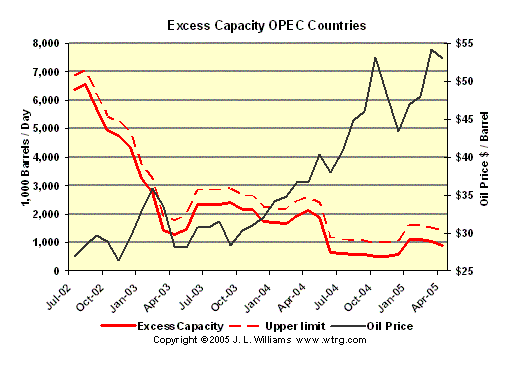
I would have been sorry to see the Delaware City Plant, with all its history, sold off for parts and scrap. After all, this is pretty much the kind of refinery that some were hoping the US would build, just a few years ago: large, complex, close to major markets and outside the hurricane belt of the Gulf Coast. However, the world changed in the interim. Will it change back enough to make DCP a going concern, again, or are the taxpayers of Delaware sinking more money into a facility that is destined to be a victim of Peak Demand, as more efficient cars and more prevalent biofuels squeeze enough petroleum products out of the market to ruin the economics of all but the most-efficient, lowest-cost refineries? We should know within a few years.

Wednesday, June 17, 2009

Food vs. Fuel and Ethanol Bankruptcies

A couple of weeks ago an editorial in the Wall St. Journal called attention to a study by the Congressional Budget Office entitled, "The Impact of Ethanol Use on Food Prices and Greenhouse Gas Emissions." I finally found time to read the report and was surprised that, in addition to its main topic, it provides a useful analysis of the economics of ethanol manufacturing. Application of the CBO's rule of thumb correlating ethanol profitability to gasoline and corn prices goes a long way toward explaining the dismal current state of the industry, which has experienced a long string of bankruptcies in the last year--enough to warrant an entire conference devoted to that topic. The underlying dynamic in the ethanol sector turns out to be quite similar to one that has taught the oil refining industry some painful lessons in the last couple of decades. Potential investors in ethanol plants, conventional or even cellulosic, would do well to consider this relationship.

The CBO study's headline findings merit more attention than they have received in the media, considering the intensity of the food vs. fuel controversy this time last year. We truly have the attention spans of ferrets, these days. The CBO examined the effect of rapidly rising ethanol production on the supply and demand for corn in all its uses, along with the relationship between corn prices and broader food prices, and the impact of energy prices on both. They concluded that between April 2007 and April 2008, ethanol accounted for 10-15% of the increase in food prices in that period. Even considering only the resulting increase in the cost of federal food assistance programs, that added an extra $600-900 million to the roughly $4.6 billion in direct ethanol blending subsidies paid out by the federal government last year. The Journal estimated the additional cost to consumers at between $5.5 and $8.8 billion. If you add those figures together and divide by the 9 billion gallons of ethanol produced in US distilleries in 2008, the hidden cost of every gallon of ethanol that comes out of a gasoline dispenser averages around $1.40.

Even more remarkably, despite this sizable "externality" and the truly extraordinary five-year growth run of the industry, ethanol processing appears to be a miserable, wealth-destroying business for its owners. The CBO report explains this in a text box starting on page 4, which concludes that unless the retail price of gasoline exceeds 90% of the price of corn before factoring in ethanol subsidies, or 70% after subsidies, an ethanol plant cannot cover its fixed and variable costs and turn a profit. The box includes a chart showing the precipitous decline of that ratio since 2005, from a high above 1.0 to below 0.6. When I calculated the current ratio based on this week's average retail gasoline price and yesterday's Chicago Board of Trade prompt corn contract, I came up with a figure of 0.65. That's still below breakeven, despite the recent spike in gasoline prices.

While I've never looked at it quite this way before, the CBO's rule of thumb makes perfect sense as an example of how capacity investments tend to destroy the margins that justified those investments. It's much the same as when an oil refiner sees high prices for gasoline and low prices for residual fuel and decides to invest in a new coking unit to convert the latter into the former. When the unit starts up, it increases the supply of gasoline and raises the demand for feedstock, squeezing its own operating margin from both ends--along with the margins of everyone else in the industry. In the case of the dozen or so ethanol companies that have gone into Chapter 11 or de-facto Chapter 7 lately, we must conclude that a lot of their expected profits never materialized, either, for a similar reason. All those new ethanol plants increased the supply of "gasoline" while simultaneously increasing the demand for their feedstock, corn.

US corn ethanol output is still expected to expand by another 50% or so before it bumps into the artificial ceiling the Congress and the EPA set for it in the revised Renewable Fuel Standard. Yet this is an industry that has raised food prices, destroyed billions of dollars in shareholder value, and according to the CBO reduced US greenhouse gas emissions by only about 0.2%, even if we ignore offsetting global land-use changes. The best thing that can be said for it is that it displaces around 420,000 barrels per day of mostly imported petroleum-based gasoline. That's hardly trivial, but I leave it to you to assess whether it has been worth the cost.

Thursday, January 29, 2009

The Ripple Effect

The fallout from the collapse of oil prices in the last quarter of 2008 is still rippling through the economy. Yesterday's announcement of a $34 billion write-off by ConocoPhillips, the third-largest US oil company, is the latest signpost of this phenomenon. It's not confined to the oil exploration and production segment, either. We've seen the earnings of non-integrated refining companies drop, along with the announcement by Valero, the largest US refiner, that it would idle its 225,000 barrel per day Texas City refinery for several weeks. At the same time, ethanol producers continue to struggle with low margins and financing problems. In short, only a quarter after fuel companies were reporting record earnings, the tables have turned and consumers are in the catbird seat, still paying less than half of last summer's pump prices.

Conoco's losses didn't surprise Wall Street, and they shouldn't have surprised my readers, either. In late December I examined the impact of low year-end prices on the oil and gas reserves carried on the books of the oil companies. The reasonable change in SEC regulations for calculating their value, which goes into effect next January, came a year too late to prevent massive accounting losses in the oil patch. However, I missed the impact on the value of acquisitions, to which ConocoPhillips may have been particularly vulnerable, having been assembled not just from one big merger, but from a long string of deals. The bones of Burlington Resources, Tosco, and Unocal's refining and marketing business are all buried in there, somewhere. Tomorrow we'll see whether ExxonMobil and Chevron report similar losses, though it's notable that Shell, which reports earnings under UK accounting standards, saw only a 28% drop in fourth quarter earnings, compared to 4Q07.

Meanwhile, the refining business has returned to a more normal situation, compared to the boom years of a few years ago and the dire straits of last month, when spot gasoline was selling for less than light sweet crude oil. The recent bounce in gasoline prices has put refiners back in the black. Since December, the calculated futures market "crack" spread, a simple estimate of the margin on making gasoline, has improved from a average loss for the month of $1.40/bbl to a profit of around $5.75/bbl, while the "3-2-1 crack", which includes the benefit of higher diesel fuel prices, has improved from about $5/bbl to roughly $10/bbl. Although this is a healthy margin, it won't result in banner profits, when US refineries are running at an average utilization of 82%. That's a lot of idle capacity, whether in the form of entire plant shutdowns, as at Texas City, or of reduced run rates at most plants. It's a reflection of just how far US gasoline demand has fallen that until this week, gasoline inventories continued to build, in spite of such low output.

Ethanol producers aren't faring much better. The operating margin, or "crush spread", that I calculate from today's Chicago Board of Trade corn and ethanol quotes is only $0.25/gal. That's a far cry from crush spreads over $1.00/gal that were routine in 2006 and 2007, and that helped fuel an ethanol plant construction boom that has now gone bust, at least temporarily. A growing number of ethanol producers have filed for Chapter 11 protection, and the largest of these, VeraSun Energy, has been forced by market conditions to idle 12 of its 16 "biorefineries." If it emerges from bankruptcy at all, VeraSun, which had been one of the most aggressive consolidators of the industry, will be much smaller. These are hardly the signs of a thriving biofuels industry, upon which a core strategy of US energy policy rests.

Any temptation to find morbid satisfaction in the diminished fortunes of the transportation fuels industry should be tempered by a clear understanding that its dips carry consequences that reverberate for years, because of the planning and construction lags inherent in its big projects. The oil platforms deferred or canceled this year will squeeze output in the mid-2010's, while the gas wells not drilled in 2009 and 2010 will tighten supplies much sooner. And even on the presumably greener side of the industry, an ethanol sector rocked by corporate bankruptcies and distilleries abandoned before they ever started up will be poorly positioned to deliver on the highly-ambitious renewable fuels targets set by the Congress in late 2007, and mooted for further expansion during last year's presidential campaign. The days of profits some regarded as unearned windfalls have clearly ended; however, if the fuels industry doesn't make "normal" profits this year and next, we will all pay for it down the road.

Thursday, November 13, 2008

A Growing Imbalance

This spring I reviewed Robert Bryce's book, "Gusher of Lies," a thorough debunking of the notion that America could or should become energy independent any time soon. In a provocative article in Slate, he has connected the dots between our steadily rising ethanol mandates and the current weirdness in the US petroleum products market, in which wholesale gasoline continues to sell for less than light sweet crude oil, while diesel fuel/heating oil commands large premiums over both. In the process, he explains the short-to-medium-term constraints on attempting to reduce crude oil imports by increasing ethanol production. Although these impediments could be overcome in the long run, doing so would require enormous additional investments in the fuels sector, because it would render obsolete the configuration of virtually every current US oil refinery.

Reading Robert's article triggered two related thoughts. The first was that our present ethanol policy, embodied in the Renewable Fuel Standard (RFS) and the decades-old system of ethanol blending credits and import tariffs, reflects an outdated set of assumptions about the nature of the US motor fuels market. These subsidies and mandates arose during a period in which US gasoline demand was growing steadily at 1-3% per year, US refineries were producing as much gasoline as they could, and US imports of finished gasoline and gasoline bending components were growing steadily. None of these factors has survived this summer's price spike and the ensuing financial and economic crisis. Nor are they likely to recover to their former levels when the economy does, because of the growing emphasis on conservation, fuel economy and alternative transportation fuels and vehicle types.

I've commented periodically on the shifting global balance between gasoline and diesel fuel, but without factoring in the influence of US ethanol output--which has more than doubled in the last two years alone--on this relationship. The Slate article identifies the problems created by pushing increasing quantities of ethanol into a stagnating gasoline market, with upstream consequences for refinery operations and the production of other necessary products such as diesel, heating oil and jet fuel, for which long-term demand looks more robust than for gasoline, both domestically and internationally. With US ethanol output currently running at a level equivalent to 7% of US gasoline demand, it compounds the global weakness of gasoline, at the same time ethanol producers are adversely affected by gasoline's slump.

Markets eventually adjust to such disruptions, and I see several paths by which the US refining industry could accommodate a national energy policy aimed at steadily expanding our use of biofuels from 10 billion gallons per year today to 36 billion gallons by 2022, and perhaps to the 60 billion gallons per year envisioned by the President-elect for 2030. But getting there won't be easy or cheap, and that's a big problem for a segment of the energy industry that, with the exception of a brief surge of profitability several years ago, has generally returned no more than the cost of capital.

To see why this would be so expensive and challenging, you need to know a bit about what happens inside a refinery. All oil refineries separate crude oil into its natural fractions of LPG, gasoline, jet fuel, diesel, and heavier oils. The heart of most US refineries, however, is the Fluid Catalytic Cracking Unit, or "cat cracker", a massive device for breaking down and reassembling the molecules found in "vacuum gas oil" and "coker gas oil"--some of those heavier oils I mentioned a moment ago. The result is high-octane gasoline for blending, along with the precursors for making "alkylate", a key constituent of California-type reformulated gasoline. These units also make some low-quality diesel that is typically either processed further or sold into the bunker fuel market.

A refinery with a big cat cracker is fundamentally a gasoline machine, and there's very little you can do to change that, short of shutting the unit down and replacing it with a big, expensive "hydrocracker", which uses hydrogen generated mainly from natural gas to turn those same heavy gas oils into jet fuel and diesel. The other possible end of the ethanol road for US refiners would involve a huge ramp-up in synthetic diesel production, from gas-to-liquids and/or biomass-to-liquids, followed by a wave of refinery closings to end the growing global gasoline surplus. Either route involves hundreds of billions of dollars of investment, in aggregate, and the usual problems in obtaining the necessary permits and environmental offsets.

The energy industry has often attracted unintended consequences, and this one looks like a dandy: We create incentives and mandates for ethanol to substitute for gasoline (and thus imported oil) and end up driving up not just the price of food from which we make ethanol--notwithstanding claims to the contrary in the latest PR and lobbying campaign from the ethanol industry--but also the price of diesel fuel and heating oil, while having much less net impact on oil imports than we imagined. Biofuels will be a fact of life from now on, and along with CNG and electrified vehicles, they are probably a necessity, with oil production looking unlikely to keep up with long-run demand. The oil industry is already getting on this bandwagon. However, the dislocations this creates would be a lot easier to justify, if the biofuels involved were at least produced from feedstocks and processes that didn't consume food and nearly as much energy as the fossil fuels they are intended to displace.

Tuesday, October 07, 2008

Oil Upside Down

Anyone thinking that oil would remain impervious to the financial uncertainties sweeping the globe received two wake-up calls in yesterday's energy futures market. It wasn't just that oil closed down by over $6 per barrel; the November gasoline futures contract actually settled below November light sweet crude. You don't have to know anything about the economics of oil refining or pipeline transportation to see that as unusual. It is even more remarkable, considering that for the last two weeks, US gasoline inventories have been at their lowest level since at least the 1980s. I'd hate to read too much into one data point, but it is consistent with the notion that the oil industry, like many other sectors of the US economy, is entering an extremely unsettled period.

When I saw yesterday's NYMEX closing prices, I had to do the math a couple of times to convince myself that gasoline had really ended the day below crude oil. I couldn't recall seeing that in the 10 years that I traded oil commodities, and a review of the futures price history at the Energy Information Agency website turned up only two other such instances in the last 28 years: once during Iraq's occupation of Kuwait in 1990, and again this September 22nd, as a consequence of a squeeze on the expiring October crude futures contract. Year-to-date through September, the differential between crude oil and gasoline futures, or "gas crack"--a proxy for refining margins--has averaged around $7 per barrel. That's half its average for 2006-7, when standalone refining companies such as Valero and Tesoro were the darlings of the stock market, but still enough to cover variable expenses. Anything below $1.50/bbl doesn't even cover the pipeline tariff from the Gulf Coast to New York. This looks unsustainable, and it is, but the normal mechanisms of self-correction are complicated by strong demand for diesel fuel and by the continuing penetration of ethanol into the gasoline market.

In 2007 US monthly gasoline demand was still growing, year-on-year, and ethanol accounted for just under 5% of the total. Since then, gasoline demand has fallen by 3-4%, while ethanol output has risen by more than 40%. As of July, ethanol accounted for 7% of finished US gasoline supply. This trend looks set to continue, with ethanol blending driven by a federal mandate based on ethanol volume, rather than a targeted fraction of gasoline sales. In other words, as a result of federal policy and a weak market, ethanol is squeezing out petroleum-based gasoline, precisely as the government intends. I believe this also explains part of the apparent inventory paradox: current gasoline inventories can't be compared to historical levels without adjusting for the growing share of ethanol, which isn't counted in gasoline inventory until it is blended in at the distribution terminal. While this situation doesn't contradict my comment yesterday that annual ethanol additions are still modest, relative to total US oil imports, they are certainly large enough to put pressure on refining margins, at a time when several companies are undertaking enormous refinery expansions.

Moreover, rising biofuel production is only one of the factors that have altered the environment oil companies face, as the global economy weakens. As this morning's Wall St. Journal notes, sub-$100/bbl prices and the credit crunch are disproportionately affecting smaller, exploration-oriented independent oil companies. Cash is king, and if you need it to drill and can't borrow, the choices look ugly. Big, cash-rich companies will find M&A opportunities more attractive than some of their expensive internal projects, and that will lead to more consolidation and slower production growth within a few years. So while slumping demand and the output inertia from projects undertaken after prices started rising earlier this decade may provide global spare capacity a chance to recover from its near-total depletion a few years ago, this will probably be a temporary respite.

Factor in a dollar that has appreciated by 17% vs. the Euro since July, along with the prospect of strong climate change regulations in the next administration--plus a possible windfall profits tax--and the oil company planners are in no better position to assess the next couple of years than their counterparts in any other manufacturing or consumer-products businesses. The same holds true for anyone investing in the sector. Will the long-term prospects of Peak Oil outweigh the patience-testing volatility that lies ahead?

Monday, September 15, 2008

The Storm Spike - Updated

If you're wondering why the price of gasoline at your local stations has suddenly spiked, despite little movement in crude oil prices, and even if you don't live anywhere near Texas or the path of Hurricane Ike, here are a few factors to keep in mind:
  1. Although the price of oil is a major component of the cost of a gallon of gasoline, the crude and refined product markets are separate and distinct, and if there aren't enough refineries to turn it into transportation fuel, the price of oil isn't very relevant to the price at the pump. In the short term, refineries without electricity matter more than damaged oil platforms.

  2. US gasoline inventories were already extremely low, before Ike made landfall, both in absolute terms and in days of supply. That's the result of months of high oil prices and weak gasoline demand, which together have crushed refining margins and made producing gasoline a break-even proposition.

  3. Prices are set by supply and demand. For the moment, with many Gulf Coast refineries shut down or running at reduced rates, we are a nation that uses 9 million barrels per day of gasoline but has less than 8 million barrels per day of supply, including the million barrels or so we routinely import. Extra supplies from Europe and elsewhere are at least 10 days away. When supply and demand are so mismatched and inventory so low, the only choices for rationing supply are higher prices or gas lines and run-outs, which we may yet see in some areas. In general, our gut instincts about "gouging"--fed by misinformed or cynical politicians--are deeply unhelpful in such circumstances. Panic buying is even worse, because it can create a shortage by itself.

  4. Service station owners have also been squeezed between weak demand and high prices this year. When they saw spot wholesale gasoline prices spike over $4/gal. on Friday, they knew their next deliveries were likely to cost them a lot more. Stretched by months of weak retail margins, they are in no position to absorb that hit without raising prices in anticipation of it.
As of Monday morning, it appears that the Texas refineries have not sustained major damage. Most should be able to restart within a week or two. Imports will increase in the meantime, and refineries not affected by the storm can run at higher rates, to make up for lost production and rebuild inventories, allowing prices to come back down pretty quickly.

Saturday, September 13, 2008

The Storm Spike

If you're wondering why the price of gasoline at your local stations has suddenly spiked, despite little movement in crude oil prices, and even if you don't live anywhere near Texas and the path of Hurricane Ike, here are a few factors to keep in mind:

1. Although the price of oil is a major component of the cost of a gallon of gasoline, the crude and refined product markets are separate and distinct, and if there aren't enough refineries to turn it into transportation fuel, the price of oil isn't very relevant to the price at the pump.

2. US gasoline inventories were already extremely low, before Ike made landfall, both in absolute terms and in days of supply. That's the result of months of high oil prices and weak gasoline demand, which together have crushed refining margins and made producing gasoline a break-even proposition.

3. Prices are set by supply and demand. At the moment, with many of the Gulf Coast refineries shut down, we are a nation that uses 9 million barrels per day of gasoline but has less than 8 million barrels per day of supply, including the million barrels or so we import every day, with any extra supplies from Europe and elsewhere at least 10 days away. When supply and demand are so mismatched and inventory so low, the only choices for rationing supply are rapid and significant price increases, or gas lines and run-outs, which we may yet see in some areas. Our gut instincts about "gouging"--fed by misinformed or cynical politicians--are deeply unhelpful right now.

4. Service station owners have also been squeezed between weak demand and high prices. When they saw spot wholesale gasoline prices spike over $4/gal. yesterday, they knew their next delivery was going to cost them a lot more. Stretched by months of weak retail margins, they are in no position to absorb that hit without raising prices in anticipation of it.

If the Texas refineries haven't sustained major damage, most should be able to restart within a week or two. Imports will increase in the meantime, and refineries not damaged by the storm can run at higher rates, to make up for lost production and rebuild inventories, allowing prices to come back down pretty quickly. If the damage turns out to be significant, however, we're going to be paying a lot more for gasoline and diesel fuel for a while, no matter what happens to crude oil prices.

Friday, July 18, 2008

Farewell to $4?

The price of oil on the New York Mercantile Exchange has dropped $15 per barrel in less than a week, bringing us the first closing price under $130 since June 5. It is premature to suggest that this marks the start of a major correction back to sub-$100 territory, but it's noteworthy that this appears to be happening largely due to the weakening of demand, particularly in the US, where gasoline sales are now down around 3% compared to the same time last year--even more if we adjust for the additional ethanol being blended in under this year's higher Renewable Fuel Standard target. If the oil price stabilized here and refining margins remained weak, the national average retail price of gasoline would shortly drop back below $4.00/gallon. Although that wouldn't mean we'd never again experience prices that high, it would be very interesting to see how a return to the mid-to-high $3 per gallon range would affect consumer psychology.

At the very least, this week's drop should deflate some of the recent oil market hysteria, which was making $200 oil and $6 or $7 gasoline seem like an immediate inevitability, on the strength of little more than self-fulfilling prophesies and jitters about a possible conflict with Iran--something that has had the market on edge since oil was under $50. But while that other mainstay of expensive oil, demand growth in the developing economies, continues apace, the market cannot for long ignore a 3% aggregate drop in petroleum demand from a country that still accounts for nearly a quarter of the world's oil imports. Small fractions of large numbers can have a big impact.

Refiners remain caught in the middle, as they have been for most of the last year. With demand responding to high prices and the soft US economy, refiners are making very little money turning oil into gasoline. Weak demand has forced them to absorb a large chunk of the recent increase in oil prices. Nor does it seem likely they will be able to hang onto more of the margin as oil prices drop, because US gasoline inventories are building at the rate of roughly 2 million barrels per week, despite refiners shifting their operations to produce record quantities of diesel, partly at the expense of gasoline output. Refiners have room to increase crude runs, but at these margins, they are probably better off maximizing distillate and purchasing any gasoline shortfall abroad. But while these conditions have benefited consumers in the short run, they could set the stage for higher product prices in the longer term, by making the economics of refinery expansions less attractive.

After Hurricanes Katrina and Rita, there was a spate of concern about the nation's refining system. No new refineries had been built since the 1970s, and too many were concentrated along the Gulf Coast. All that talk came to nothing, but the exceptional margins that existing refineries were earning for several years kicked off some significant refinery expansions, including the Motiva and Marathon projects in the Gulf Coast that will effectively add the equivalent of a brand new refinery inside the boundaries of two existing facilities--a model currently under consideration by some nuclear plant operators.

Now, this might seem like an odd time to build more refining capacity, with demand falling and over a third of the country convinced that we'll get most of our energy from renewable sources within a few years, according to a new API/Harris Interactive survey. But even if we don't end up using more oil in the future, the kind of oil US refineries can process matters greatly in the global market. Although some analysts are skeptical that Saudi Arabia can deliver on the sustained output increases they have promised, one of the main reasons the market has largely yawned at the prospect of another 2 million barrels per day of Saudi crude is that much of the incremental oil will be of low quality--just the kind that these refinery projects are designed to handle. If refining margins don't recover soon, projects like this could be slowed down or deferred, and additional heavy, sour crude oil production will have less impact on the global price of oil--and that would affect us all at the gas pump.

In the meantime, no one should become complacent, even if average gasoline prices soon fall below $4 for a while--though probably not in California. Global supply and demand remain pretty tightly balanced, and we're now never more than one or two events away from a big spike in oil prices or refining margins. While we might soon spend a bit less at the gas pump, we'd be better off pocketing any savings, rather than turning them into a rebound in fuel demand.

Monday, July 07, 2008

Oil Prices and Inventory

Oil prices set another record last week, closing above $145 per barrel for the first time, on the strength of heightened fears of an attack by Israel or the US on Iran, combined with a dip in US commercial oil inventories below 300 million barrels, their lowest level since the end of January and at the bottom of their seasonal historical average range. But although lower inventories are generally a bullish signal for the market, we shouldn't forget that the relationship between prices and inventories runs in both directions. Current and expected future prices, along with actual supply and demand, play a significant role in guiding companies in setting their desired inventory levels. Determining whether a drop in inventories reflects tight supplies or expected future weakness depends on a broader array of indicators, including how seriously the oil industry takes forecasts of oil prices reaching $170-200 per barrel later this year.

The Department of Energy defines "crude oil stocks" as including "domestic and Customs-cleared foreign crude oil stocks held at refineries, in pipelines, in lease tanks, and in transit to refineries" and excludes the oil held in the nation's Strategic Petroleum Reserve (SPR). Some of this oil is required to ensure the uninterrupted operation of US refineries and pipelines, while the rest ebbs and flows with shifts in supply and demand and changing expectations for future prices. Although last week's figure looks low compared to average US commercial oil inventories since 2005 of 323 million barrels (MB), it is still 15 MB higher than the average during 2003-2004, and well above the 264 MB seen in January 2004. If nothing else, that suggests that current inventories remain safely above the minimum level required to keep the US pipeline and refinery network operating smoothly. That is consistent with the calculated 19.5 equivalent days of refinery supply at current consumption, compared to a low of about 17 days in September 2004.

There are two reasons why higher prices might lead companies to hold lower inventories. The most basic has to do with the carrying cost of owning high-priced oil. If a 200,000 barrel per day refinery had 4.4 MB of oil on hand when the price of West Texas Intermediate crude oil was $100/bbl, then the spike to $140 has increased its carrying cost for that inventory by the equivalent of $0.19 per barrel of output, assuming a corporate cost of capital of 8%. At $140/bbl, reducing plant inventory by 10% would cut the total carrying cost by 6 cents per barrel. While that might appear trivial on the scale of the profits oil companies are making, it would look very significant indeed to refineries that have experienced a gross margin between gasoline and crude oil of only about $8.00 per barrel so far this year. For a refinery manager seeking to contain costs, running a bit closer to minimum operating inventories looks like a good option, particularly when gasoline demand is dropping.

The other reason to reduce inventories has to do with expectations of future prices. While the market seems to be locked into a "shortage psychology", bolstered by pessimistic production estimates and forecasts of ever higher demand in Asia, the industry itself seems skeptical that current prices will last, despite futures markets trading at $142/bbl all the way out to 2016. If companies were planning their investments based on a return to $100/bbl or less, it would be hard for refinery managers to justify deliberately adding to inventory at today's price. And although the risk of a new war in the Middle East might alter that calculation, it must contend with the near-certainty that the government would release oil from the SPR to counter any actual disruption of supplies that would follow such an event. Moreover, rumblings in the Congress to release SPR oil to deflate a perceived speculative bubble in oil act as an additional deterrent to holding any more inventory than absolutely necessary.

For the present, then, falling crude oil inventories constitute another ambiguous component of the mixed bag of fundamental signals the market must interpret, including comfortably stable US gasoline stocks and falling gasoline demand, recovering diesel and heating oil stocks, weak refining margins and rising biofuels production. In the absence of a clear indication that supply will soon exceed demand, every mildly bullish indicator will push the market toward fulfilling the views of the growing cadre of analysts engaged in an apparent arms race of escalating forecasts, egged on by the media attention this attracts. But despite scare stories of $7 gasoline--which at current refining margins would require light sweet crude oil to reach at least $250/bbl--no one knows where oil prices will be in six months. Six months ago, crude oil was trading under $90. Can anyone look at the fundamentals and determine conclusively that it couldn't be back there this winter, rather than continuing on to $200? This reality makes even tactical planning for companies that are big energy consumers an extremely challenging undertaking.