Out of the dozens of press releases that hit my email inbox in the last week, one that caught my eye was for a gathering of a group called the Northwest Advanced Renewables Alliance (NARA) in Missoula, Montana this Thursday. Their agenda is focused on "challenges to develop a residual woody biomass to jet fuel and valuable co-products industry in the Pacific Northwest." Somewhat more snappily, their website calls this "from wood to wing." With oil prices (UK Brent) persistently over $100 despite the weak global economy, the appeal of such an effort is not hard to understand. Whether it's feasible at an acceptable price remains to be seen.
Making fuels from waste or non-food crops is an attractive idea, and aviation fuels look like an especially promising market for bio- and synthetic fuels, for several reasons. Unlike the markets for motor fuels--gasoline and diesel--you wouldn't have to convince millions of customers of the efficacy of using a new fuel. You'd only have to convince the fuel buyers and chief engineers of a handful of airlines and aircraft leasing companies, along with the even smaller universe of engine suppliers. Certifying that your fuel meets all relevant specifications is a key step in that process, though in some respects that should also be easier than for gasoline and diesel engines. If you doubt that, just consider the current fuss over increasing the ethanol content of gasoline from 10 to 15%. Of course, having your car engine fail on the interstate is a very different proposition than having both engines shut down at 40.000 ft--or during take-off.
Fortunately, turbine engines are very reliable and fairly flexible. The best proof of the latter is that the turbine at the heart of a natural-gas-fired power plant is essentially just a bigger version of the ones hanging under the wings of a Boeing or Airbus aircraft, which burn a close cousin of kerosene, a simple distillate refined from a wide variety of crude oils. Turbines on ships burn a fuel similar to diesel. Many of the specifications that jet fuel must meet have more to do with the conditions under which aircraft operate than the specific sensitivities of jet engines. One example of that is the temperature at which a jet fuel becomes difficult to flow, just before it freezes solid. That's one reason that many oilseed-based biojet fuels require essentially oil-refinery levels of processing. Stepping back from such details, however, I'm skeptical that crop-based biofuels are the long-term solution to the fuel-diversification needs of aviation, for many of the same reasons we see playing out with regard to corn ethanol during the current drought.
Supporters of various biojet efforts often focus on two main benefits of renewable jet fuel. The first is the reduction of greenhouse gas emissions, since the principal alternative available to airlines or military aviation is further efficiency improvements, which face diminishing returns, or reduced operations. The other benefit that I often see cited is potential cost savings versus petroleum, though I regard this as largely illusory, at least on the level of the fuel customer. As I've described at length, the output of even a captive biojet facility is worth its price in the market--set by petroleum jet fuel--not its cost of production. That argument should also hold true for airlines buying oil refineries. However, to the extent that biojet could be scaled up enough to apply competitive pressure on the 6 million barrel per day global jet fuel market, or in isolated regional markets, that would benefit both airlines and consumers. Production at that scale will require feedstocks that are readily available in large quantities.
Many companies and researchers are pursuing renewable jet fuel pathways that don't rely on food- or food-competitive crops. The RenewableJetFuels.org website of the Carbon War Room provides a portal into some of these efforts, including fuels based on factory waste gases, algae, and various other approaches. Some of these have progressed to demonstration-stage production and fleet certification, though as we've seen with cellulosic motor fuels, scaling up to truly commercial production represents a much higher hurdle that could shake out many of these contenders. For that reason, it's encouraging to see the NARA effort, nor should they worry about being too late to the party.
Showing posts with label airlines. Show all posts
Showing posts with label airlines. Show all posts
Wednesday, September 12, 2012


Tuesday, July 21, 2009
How Much Per Gallon?
A book I recently received from a publisher makes an interesting contrast with last Friday's posting on how many cars our current oil production might eventually support. Its title of "$20 Per Gallon" demands attention, though the book proves to be less of an argument for how we might get there than for what things might be like if--the author would say when--we did. Rather than providing detailed arguments for the imminent arrival of Peak Oil, Mr. Steiner essentially accepts that premise and builds on it to offer a set of scenarios describing life in the US at gasoline prices escalating steadily in $2 increments between $4 and $20 per gallon. It makes for an entertaining and sobering set of "what ifs?" Unfortunately, despite a brief author's note dated from February of this year, the book is something of a victim of the collapse of oil prices late last year. While its premise might have been accepted eagerly and unquestioningly last summer, the world looks a bit different today. The challenges he describes appear somewhat less urgent, particularly after oil's recent surge past $70 per barrel was cut short when it turned out that all that talk of "green shoots" might have been a bit premature.
In a sense "$20 Per Gallon" seems like two books, one quite interesting and the other seriously flawed, at least as a document about our energy future. The interesting part lies in the author's exploration of what successively higher energy prices might mean for different aspects of the US economy and lifestyle. True to its subtitle, it's hardly a tale of uniform woe, unless you have the misfortune of working in one of the sectors he concludes is doomed, including anything connected to commercial air travel as we now know it. He points out the environmental, health and safety benefits that might ensue from our responses to progressively dearer petroleum-derived products. Many of these benefits sound quite appealing, though I would propose that they are neither as inevitable nor as neatly tied to oil use as Mr. Steiner suggests. The book is also filled with anecdotes accumulated from his travels researching its subject. I particularly liked his description of the airplane graveyard and his rides in various energy-efficient UPS trucks. If you come to this book already convinced that we are on the precipice of Peak Oil, I suspect you would find most of this not just entertaining, but riveting.
The book is less likely to appeal to anyone who is skeptical about the inevitability of Mr. Steiner's scenario assumptions. Start with his structural choice of using gasoline prices as a proxy for underlying oil prices, despite the fact that petroleum product markets experience supply and demand fluctuations that differ--sometimes markedly--from oil's. This choice also ignores the enormous influence of taxes and other government policies on gas prices. You don't need $300/bbl oil to reach $8 gasoline, as European drivers can attest. Last week the price of the average gallon of gas in the US fell to $2.46/gal., compared to the equivalent of $6.40/gal. in the UK and $6.77/gal. in Germany. The difference is almost entirely due to taxes. Despite this, daily life in those countries is not so far beyond the pale of recent American experience as to frighten small children. The implications of a world of high fuel prices resulting from the combination of moderate oil prices and high taxation look quite different from those arising from oil prices above last summer's peak of $145/bbl.
There's an even bigger issue lurking under the surface, and it relates to the author's conviction that in the long run oil prices can only go higher--much higher--due to Peak Oil. There's at least some truth to that, and I've posted periodically on the enormous difficulties involved in attempting to increase oil production in the face of constraints on access to resources--internationally and domestically--along with high interest rates, scarce capital, chronic project delays, and the inexorable depletion of mature oil fields. But oil prices are determined by more than supply, and while he eagerly describes all of the ways in which we would have to adjust our habits to a world of higher and higher gasoline prices, I don't get the sense that Mr. Steiner has considered the ways in which these responses would tend to retard the steady price advances he describes. We have only to look at the impact that a demand reduction of less than 4% since late 2007 has had on oil prices in the last 12 months. That responsiveness to lower demand is as inherent in a commodity with a steeply-sloped short-run supply curve as were the high prices that accompanied the steadily increasing demand we saw earlier. This behavior reflects two sides of the same coin.
The complexities of the various feedback mechanisms involved would also make some of the positive outcomes that Mr. Steiner sees more uncertain. Consider the drop in traffic fatalities that he posits as a consequence of higher gas prices. While you would generally expect people to drive less if gasoline were much more expensive, that response would probably be less pronounced in the long run than in the short run, because of the other ways in which consumers would react. $4 gasoline is painful if your current automobile gets 20 mpg. However, once you've traded it in on a 50 mpg hybrid, your cost per mile--and thus your monthly fuel bill--is lower even at $6/gal. than it was before at $3.
In addition to these concerns, I noticed a few basic errors and misleading comparisons along the way. Compared to the above, they are nit-picks, but anyone who reads the book ought to bear them in mind. First, Mr. Steiner suggests a pretty dramatic impact from high gasoline prices on all the plastics we consume, without delving deeply enough to determine that most of the ethylene- and propylene-derivative plastics in North America--including Saran Wrap--aren't sourced from oil but from the liquids produced with natural gas. That's a crucial distinction, with vast new gas resources available and with the prices of oil and gas having diverged rather dramatically, at least for now. He also makes several numerical comparisons between the response to last year's oil price spike and the aftermath of the oil crisis of the 1970s without taking into account the 42% increase in US population since 1974.
I have to believe that Mr. Steiner would have written a somewhat different book, had he begun the project this year rather than last. I don't doubt that some of the outcomes he describes are waiting on the sidelines until the economy climbs out of its current trough, even if oil prices don't quite reach the stratospheric heights he expects. For example, it wouldn't take the oil-price equivalent of $8/gal. to trigger a radical restructuring of the airline business, after what's it's been through. At the same time, though, I doubt we've seen the last oil price cycle, and the relationship between the prices of oil and alternative energy sources remains complex and dynamic. In some respects proposals such as cap & trade or a carbon tax are intended to evoke some of the same responses that Mr. Steiner imagines, but on a gradual basis and without having to pay an external supplier for the privilege of motivating us. I suggest reading "$20 Per Barrel" in that spirit, rather than as a firm prediction of the inevitable future of our oil-based world.
In a sense "$20 Per Gallon" seems like two books, one quite interesting and the other seriously flawed, at least as a document about our energy future. The interesting part lies in the author's exploration of what successively higher energy prices might mean for different aspects of the US economy and lifestyle. True to its subtitle, it's hardly a tale of uniform woe, unless you have the misfortune of working in one of the sectors he concludes is doomed, including anything connected to commercial air travel as we now know it. He points out the environmental, health and safety benefits that might ensue from our responses to progressively dearer petroleum-derived products. Many of these benefits sound quite appealing, though I would propose that they are neither as inevitable nor as neatly tied to oil use as Mr. Steiner suggests. The book is also filled with anecdotes accumulated from his travels researching its subject. I particularly liked his description of the airplane graveyard and his rides in various energy-efficient UPS trucks. If you come to this book already convinced that we are on the precipice of Peak Oil, I suspect you would find most of this not just entertaining, but riveting.
The book is less likely to appeal to anyone who is skeptical about the inevitability of Mr. Steiner's scenario assumptions. Start with his structural choice of using gasoline prices as a proxy for underlying oil prices, despite the fact that petroleum product markets experience supply and demand fluctuations that differ--sometimes markedly--from oil's. This choice also ignores the enormous influence of taxes and other government policies on gas prices. You don't need $300/bbl oil to reach $8 gasoline, as European drivers can attest. Last week the price of the average gallon of gas in the US fell to $2.46/gal., compared to the equivalent of $6.40/gal. in the UK and $6.77/gal. in Germany. The difference is almost entirely due to taxes. Despite this, daily life in those countries is not so far beyond the pale of recent American experience as to frighten small children. The implications of a world of high fuel prices resulting from the combination of moderate oil prices and high taxation look quite different from those arising from oil prices above last summer's peak of $145/bbl.
There's an even bigger issue lurking under the surface, and it relates to the author's conviction that in the long run oil prices can only go higher--much higher--due to Peak Oil. There's at least some truth to that, and I've posted periodically on the enormous difficulties involved in attempting to increase oil production in the face of constraints on access to resources--internationally and domestically--along with high interest rates, scarce capital, chronic project delays, and the inexorable depletion of mature oil fields. But oil prices are determined by more than supply, and while he eagerly describes all of the ways in which we would have to adjust our habits to a world of higher and higher gasoline prices, I don't get the sense that Mr. Steiner has considered the ways in which these responses would tend to retard the steady price advances he describes. We have only to look at the impact that a demand reduction of less than 4% since late 2007 has had on oil prices in the last 12 months. That responsiveness to lower demand is as inherent in a commodity with a steeply-sloped short-run supply curve as were the high prices that accompanied the steadily increasing demand we saw earlier. This behavior reflects two sides of the same coin.
The complexities of the various feedback mechanisms involved would also make some of the positive outcomes that Mr. Steiner sees more uncertain. Consider the drop in traffic fatalities that he posits as a consequence of higher gas prices. While you would generally expect people to drive less if gasoline were much more expensive, that response would probably be less pronounced in the long run than in the short run, because of the other ways in which consumers would react. $4 gasoline is painful if your current automobile gets 20 mpg. However, once you've traded it in on a 50 mpg hybrid, your cost per mile--and thus your monthly fuel bill--is lower even at $6/gal. than it was before at $3.
In addition to these concerns, I noticed a few basic errors and misleading comparisons along the way. Compared to the above, they are nit-picks, but anyone who reads the book ought to bear them in mind. First, Mr. Steiner suggests a pretty dramatic impact from high gasoline prices on all the plastics we consume, without delving deeply enough to determine that most of the ethylene- and propylene-derivative plastics in North America--including Saran Wrap--aren't sourced from oil but from the liquids produced with natural gas. That's a crucial distinction, with vast new gas resources available and with the prices of oil and gas having diverged rather dramatically, at least for now. He also makes several numerical comparisons between the response to last year's oil price spike and the aftermath of the oil crisis of the 1970s without taking into account the 42% increase in US population since 1974.
I have to believe that Mr. Steiner would have written a somewhat different book, had he begun the project this year rather than last. I don't doubt that some of the outcomes he describes are waiting on the sidelines until the economy climbs out of its current trough, even if oil prices don't quite reach the stratospheric heights he expects. For example, it wouldn't take the oil-price equivalent of $8/gal. to trigger a radical restructuring of the airline business, after what's it's been through. At the same time, though, I doubt we've seen the last oil price cycle, and the relationship between the prices of oil and alternative energy sources remains complex and dynamic. In some respects proposals such as cap & trade or a carbon tax are intended to evoke some of the same responses that Mr. Steiner imagines, but on a gradual basis and without having to pay an external supplier for the privilege of motivating us. I suggest reading "$20 Per Barrel" in that spirit, rather than as a firm prediction of the inevitable future of our oil-based world.
Friday, October 31, 2008
Understanding Southwest's Hedging
I don't normally pay much attention to the quarterly earnings reports of companies outside the energy sector, so I initially missed the confusion over the impact of fuel hedging on the third quarter results of Southwest Airlines. An article in yesterday's Washington Post brought this to light again, along with the effect of falling oil prices on the fuel hedging efforts of a diverse group of companies, including Coca Cola, Royal Caribbean Cruise Lines, and local heating oil distributors. The reporting on this subject illustrates two important points: commodities hedging is no free lunch, and understanding its full consequences requires more that a superficial look at the bottom line.
This morning I pored over Southwest's quarterly earnings press release to see what had happened. I was suspicious of the headlines suggesting that hedging had pushed Southwest into the red, because the average futures price of West Texas Intermediate crude oil for the quarter was $118 per barrel--hence ExxonMobil's record-breaking earnings--still well above the level at which Southwest was generally understood to have hedged its jet fuel. After some scrutiny, and to my considerable surprise, I concluded that both the Post and the Wall Street Journal in their earlier story on Southwest's earnings appeared to have misinterpreted some key aspects of the hedging results. Discerning that wasn't easy, since Southwest saw fit to report their earnings on both a GAAP (Generally Accepted Accounting Principles) and non-GAAP basis, and the intricacy of their "Reconciliation of Impact from Fuel Contracts" table forced me to jump-start some brain cells that have been dormant since my B-school financial accounting course.
Evaluating the benefit or cost of a hedge must include the result of the physical transactions it was intended to cover. In the case of Southwest, it appears that its unhedged fuel cost for the quarter--what it actually paid its fuel suppliers--was $1.387 billion. The hedges and related derivative contracts that settled in the quarter offset that by $448 million, reducing Southwest's effective fuel bill to $939 million. The problem that the Journal and Post focused on was related to future hedges, not those that unwound between July and September. Marking the company's total hedge portfolio to market resulted in an additional pre-tax cost of $247 million, reported as a special item. Factoring this in turned the company's modest operating profit of $69 million into a $120 million net loss, after tax. But it's not correct to say that hedging hurt Southwest. Had it not hedged at all, its after tax loss for the quarter would have been approximately $189 million, assuming it could have operated in the same manner. That seems unlikely, given the behavior of competitors with less active hedging programs.
But while the confusion over Southwest's earnings seems to arise from the requirement to recognize the reduced value of the future hedges still on its books as a loss to current income, this doesn't justify calls to set aside mark-to-market accounting. That special item should prompt investors to read the explanation Southwest has provided concerning its overall hedge portfolio, because it signals the prospect of further hedge-related losses in the future:
"In addition to our fourth quarter 2008 derivative position, we have derivative contracts for over 75 percent of our estimated 2009 fuel consumption at an average crude-equivalent price of approximately $73 per barrel; approximately 50 percent of our estimated 2010 fuel consumption at an average crude-equivalent price of approximately $90 per barrel; approximately 40 percent of our estimated 2011 fuel consumption at an average crude- equivalent price of approximately $93 per barrel; over 35 percent of our estimated 2012 fuel consumption at an average crude-equivalent price of approximately $90 per barrel; and have begun building a modest position for 2013."
That means that if oil prices remain between $60 and $70/bbl, then the effective cost Southwest will pay for jet fuel in future quarters could end up higher than that of competitors who didn't hedge or who hedged lower percentages of their expected fuel consumption than Southwest. Of course, that's not certain, either, because the price of oil might again rise above the level of their hedges.
The key to a successful hedging strategy is that companies shouldn't view it as a magician's hat out of which to pull larger profits, quarter after quarter. The benefit comes from reducing the volatility of earnings and enabling firms to continue operating more normally, when others have had to cut back drastically. Although this strategy could rebound on Southwest, if oil prices remain low for an extended period, falling prices may not hurt them as much as rising prices have hurt their less-hedged competitors, some of whom are now in a very poor position to capitalize on lower fuel costs.
Note: Energy Outlook will be on vacation next week, with postings resuming the week of November 10.
This morning I pored over Southwest's quarterly earnings press release to see what had happened. I was suspicious of the headlines suggesting that hedging had pushed Southwest into the red, because the average futures price of West Texas Intermediate crude oil for the quarter was $118 per barrel--hence ExxonMobil's record-breaking earnings--still well above the level at which Southwest was generally understood to have hedged its jet fuel. After some scrutiny, and to my considerable surprise, I concluded that both the Post and the Wall Street Journal in their earlier story on Southwest's earnings appeared to have misinterpreted some key aspects of the hedging results. Discerning that wasn't easy, since Southwest saw fit to report their earnings on both a GAAP (Generally Accepted Accounting Principles) and non-GAAP basis, and the intricacy of their "Reconciliation of Impact from Fuel Contracts" table forced me to jump-start some brain cells that have been dormant since my B-school financial accounting course.
Evaluating the benefit or cost of a hedge must include the result of the physical transactions it was intended to cover. In the case of Southwest, it appears that its unhedged fuel cost for the quarter--what it actually paid its fuel suppliers--was $1.387 billion. The hedges and related derivative contracts that settled in the quarter offset that by $448 million, reducing Southwest's effective fuel bill to $939 million. The problem that the Journal and Post focused on was related to future hedges, not those that unwound between July and September. Marking the company's total hedge portfolio to market resulted in an additional pre-tax cost of $247 million, reported as a special item. Factoring this in turned the company's modest operating profit of $69 million into a $120 million net loss, after tax. But it's not correct to say that hedging hurt Southwest. Had it not hedged at all, its after tax loss for the quarter would have been approximately $189 million, assuming it could have operated in the same manner. That seems unlikely, given the behavior of competitors with less active hedging programs.
But while the confusion over Southwest's earnings seems to arise from the requirement to recognize the reduced value of the future hedges still on its books as a loss to current income, this doesn't justify calls to set aside mark-to-market accounting. That special item should prompt investors to read the explanation Southwest has provided concerning its overall hedge portfolio, because it signals the prospect of further hedge-related losses in the future:
"In addition to our fourth quarter 2008 derivative position, we have derivative contracts for over 75 percent of our estimated 2009 fuel consumption at an average crude-equivalent price of approximately $73 per barrel; approximately 50 percent of our estimated 2010 fuel consumption at an average crude-equivalent price of approximately $90 per barrel; approximately 40 percent of our estimated 2011 fuel consumption at an average crude- equivalent price of approximately $93 per barrel; over 35 percent of our estimated 2012 fuel consumption at an average crude-equivalent price of approximately $90 per barrel; and have begun building a modest position for 2013."
That means that if oil prices remain between $60 and $70/bbl, then the effective cost Southwest will pay for jet fuel in future quarters could end up higher than that of competitors who didn't hedge or who hedged lower percentages of their expected fuel consumption than Southwest. Of course, that's not certain, either, because the price of oil might again rise above the level of their hedges.
The key to a successful hedging strategy is that companies shouldn't view it as a magician's hat out of which to pull larger profits, quarter after quarter. The benefit comes from reducing the volatility of earnings and enabling firms to continue operating more normally, when others have had to cut back drastically. Although this strategy could rebound on Southwest, if oil prices remain low for an extended period, falling prices may not hurt them as much as rising prices have hurt their less-hedged competitors, some of whom are now in a very poor position to capitalize on lower fuel costs.
Note: Energy Outlook will be on vacation next week, with postings resuming the week of November 10.
Friday, July 11, 2008
Airlines vs. Speculators
Yesterday a friend sent me a copy of an email letter she had received from an airline on which she is a frequent flyer. It made an urgent plea for public support to rein in oil market speculation, which it blamed for between $30 and $60 per barrel of the current oil price, which has been ruinous for the airline industry. Millions of Americans received the same letter--apparently I haven't flown enough, lately, to merit one--with a link to the "Stop Speculation Now" campaign website. Congress and the Commodity Futures Trading Commission have been grappling with this issue, and new energy futures market regulations should be forthcoming shortly. However, I hope that the chiefs of America's airlines are not banking on a speedy return to sub-$100 oil, and the $1.00 or more per gallon this would subtract from their jet fuel bills. Even if all speculation were eliminated tomorrow, the combination of a weak supply response and the low price elasticity of demand for oil make it unlikely that prices would quickly revert to last fall's $80-$95 per barrel price range.
For the last year, I have discussed the potential impact of speculation on oil prices. Investment in oil futures, options and derivatives as a new asset class has affected the market in ways that traditional speculation by financial players--a key ingredient of market liquidity--didn't. Even if these investors never take delivery of a single barrel of oil, they constitute a new segment of demand for oil futures and exert upward pressure on the market. I have also described at length the mechanism by which the resulting higher futures prices affect the prices that refineries pay for the physical barrels of oil they process, and why in that margin-based business, resistance to higher prices is likelier to come from end users, rather than refiners. But none of this alters the main facts governing the price of oil: The growth of global demand over the last five years has consumed most of the existing spare production capacity, and restrictions on access to resources--within OPEC and the US--combined with the time-lags inherent in bringing new supplies online have left the market balanced on a knife edge, setting up the conditions without which asset-class investments in oil futures would just be another complicated way to lose money, which may still be the ultimate result for many.
In a recent Wall Street Journal op-ed, Martin Feldstein, a former chairman of the Council of Economic Advisers, provided an exceptionally clear explanation of how small changes in supply and demand can translate into large price movements for commodities with very low short-term price elasticity, or sensitivity, of demand. Yesterday I discussed the recent demand response in the US. It took $4 per gallon pricing to halt the steady year-on-year rise of US gasoline consumption, a trend that was unbroken since 1991. And in the absence of serious refining problems, the only two paths to $4 gasoline were $130 oil or the imposition of a $1.00 per gallon surtax when oil was still under $100/bbl. Constraining the futures market now might provide some temporary relief, but it won't resolve the underlying problems that brought us to this point.
I don't blame the CEOs of the airlines for grasping at this straw. The signatories to the letter include my former boss at Texaco, Glenn Tilton, who understands the oil and airline businesses better than most. These executives know that a commercial aviation industry built on cheap fuel will emerge from a long period of sustained high oil prices as transformed as if it had been re-regulated, and that the mass access to cheap and convenient air travel that we have taken for granted could disappear. Their effort here may even pay off, but as I noted recently, the exact form of any new regulations on energy trading matters greatly, if the cure is not to be worse than the disease.
For the last year, I have discussed the potential impact of speculation on oil prices. Investment in oil futures, options and derivatives as a new asset class has affected the market in ways that traditional speculation by financial players--a key ingredient of market liquidity--didn't. Even if these investors never take delivery of a single barrel of oil, they constitute a new segment of demand for oil futures and exert upward pressure on the market. I have also described at length the mechanism by which the resulting higher futures prices affect the prices that refineries pay for the physical barrels of oil they process, and why in that margin-based business, resistance to higher prices is likelier to come from end users, rather than refiners. But none of this alters the main facts governing the price of oil: The growth of global demand over the last five years has consumed most of the existing spare production capacity, and restrictions on access to resources--within OPEC and the US--combined with the time-lags inherent in bringing new supplies online have left the market balanced on a knife edge, setting up the conditions without which asset-class investments in oil futures would just be another complicated way to lose money, which may still be the ultimate result for many.
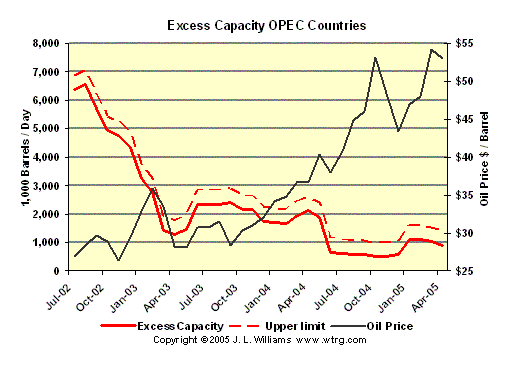
In a recent Wall Street Journal op-ed, Martin Feldstein, a former chairman of the Council of Economic Advisers, provided an exceptionally clear explanation of how small changes in supply and demand can translate into large price movements for commodities with very low short-term price elasticity, or sensitivity, of demand. Yesterday I discussed the recent demand response in the US. It took $4 per gallon pricing to halt the steady year-on-year rise of US gasoline consumption, a trend that was unbroken since 1991. And in the absence of serious refining problems, the only two paths to $4 gasoline were $130 oil or the imposition of a $1.00 per gallon surtax when oil was still under $100/bbl. Constraining the futures market now might provide some temporary relief, but it won't resolve the underlying problems that brought us to this point.
I don't blame the CEOs of the airlines for grasping at this straw. The signatories to the letter include my former boss at Texaco, Glenn Tilton, who understands the oil and airline businesses better than most. These executives know that a commercial aviation industry built on cheap fuel will emerge from a long period of sustained high oil prices as transformed as if it had been re-regulated, and that the mass access to cheap and convenient air travel that we have taken for granted could disappear. Their effort here may even pay off, but as I noted recently, the exact form of any new regulations on energy trading matters greatly, if the cure is not to be worse than the disease.
Subscribe to:
Posts (Atom)