Showing posts with label risk. Show all posts

Monday, January 06, 2014

Energy 2013: More Shifts Ahead?

  • 2013 was an eventful year for energy, though perhaps with fewer earth-shaking implications for the future than in other recent years.
  • Several developments concerning global oil production, when taken together, improved the odds of lower oil prices in the next several years.
Year-in-review posts have become standard fare for energy blogs; I've written my share in the past. However, while 2013 hardly lacked for interesting energy-related news and events to populate a top-ten list, most fell short of the potential to affect energy markets strongly for years to come.

For example, it is newsworthy that another year has passed without an indication of whether the White House will approve or reject the cross-border permit for the Keystone XL pipeline project. Yet the consequences of that decision are becoming less significant, at least in the reported view of Bakken shale pioneer Harold Hamm. That's due in large measure to the dramatic increase in the transportation of oil by rail, which should be on anyone's top-ten list. Nor is it clear that the EPA's proposal to scale back the Renewable Fuel Standard's (RFS) corn ethanol quota for 2014 will affect more than this year's fuel market, unlike pending Congressional legislation to reform the RFS.  California's adoption of an energy storage mandate for utilities is another notable event, but its long-term impact is contingent on the development of cost-effective storage technology and business models to enable much greater integration of renewable energy on the grid.

Instead of extending that list, I'd like to focus on three stories in which I see significant, related implications for oil markets. The first involves the temporary international agreement concerning Iran's pursuit of nuclear technology. Although relaxation of the sanctions limiting Iranian oil exports depends on a highly uncertain final agreement governing uranium enrichment, the  Arak reactor's plutonium potential, and a more intrusive inspections regime, the interim deal signals that around a million barrels per day of Iran's oil--and eventually more--could be back on the market in less than two years.

If that happens, it won't be because the Iranian government's repeated assurances of its aversion to nuclear weapons have suddenly become credible, but because most of the permanent members of the UN Security Council plus Germany--the "P5 + 1" negotiating with Iran--are tiring of the protracted confrontation and understandably have no appetite to address this in the same way that the collapsing UN sanctions regime for Iraq was resolved in 2003.

Next consider the stunning reversal of the Mexican government's 75-year-old nationalization of oil and gas. As a result of the reforms just enacted by their congress and ratified by a majority of Mexico's states, the state oil company Pemex will be run along more commercial lines, and foreign firms will be allowed to partner with Pemex in developing the country's large untapped hydrocarbon resources. If the terms prove attractive for international energy firms, the result will move North America even closer to net energy independence. Meanwhile the Transboundary Hydrocarbon Agreement between the US and Mexico that was just passed by the US Congress will simplify energy development that straddles the border.

Mexico's potential could be even more significant for oil markets than an unconstrained Iran. The former's production has declined by 24% since 2004--a loss of 900,000 bbl/day-- mainly due to limited reinvestment. Foreign investment can help to restore that output, but the upside potential is much bigger. Pemex has barely scratched the surface of its deepwater resources in the Gulf. Its proven and contingent reserves are estimated at 45 billion barrels, while US estimates put Mexico's shale oil, or "tight oil" resources at 13 billion barrels, slightly more than the country's proved conventional reserves. (Shale gas could exceed 500 trillion cubic feet.)

Mexico's oil output has grown dramatically before. In the decade following the Arab Oil Embargo of 1973 production increased from 500,000 bbl/day to around 3 million. A similar performance seems possible again from a higher starting point, but it's unlikely to happen overnight. As Dan Yergen pointed out in a recent Wall St. Journal op-ed, "exploration and development could take another five to 10 years" beyond the first bid rounds.

And that brings us to Saudi Arabia's options for dealing with a shifting market that will include projected US crude oil output of 9.6 million bbl/day by 2016, the recovery and growth of Iraqi production, possible exports from Canada to Asia, Mexico's potential, and the eventual return of full Iranian exports. Whether or not this wave of new or restored production will be sufficient to replace production declines elsewhere, it must undermine OPEC's control of pricing in this decade. In that light, it's hard to ignore reported indications that Saudi Arabia might abandon its role of swing producer, particularly when it comes to unilateral output cuts to balance new non-OPEC supplies.

Haven't we seen this movie before? After a dozen years of high prices and tight markets OPEC steadily lost market share in the 1980s as new fields in Alaska, Mexico and the North Sea came online. That trend culminated in Saudi Arabia's 1986 "netback pricing" decision, linking the price of its oil to the value of its customers' refined petroleum products. Following the price collapse that policy helped precipitate,  oil prices took 18 years to reach $30/bbl again, by which time the dollar had lost a third of its value.

I doubt we're in for anything that dramatic. Back then, most demand growth came from the developed countries of the OECD, rather than from the expanding middle classes of developing Asia and the Middle East itself. Moreover, today's new production has higher costs--up to $70-80 per barrel--ruling out a return to $20 oil. With many serious geopolitical risks still in play, an oil-price price correction or extended soft market seems likelier than another price collapse. In the meantime, if we're seeking $20 oil, we already have it in the form of US shale gas that averaged the equivalent of $21.64/bbl last year. And that's the early, odds-on favorite for the energy story of the decade.

A different version of this posting was previously published on the website of Pacific Energy Development Corporation.

Tuesday, November 15, 2011

Iran Oil Price Risk Returns

Between the Libyan revolution and the shaky US and European economies, oil markets hadn't been paying much attention to Iran's nuclear program until last week's release of a new report from the International Atomic Energy Agency (IAEA.) For the first time, the IAEA presented a detailed picture of a well-organized Iranian effort encompassing projects and technologies that go beyond what could reasonably be construed as having purely civilian purposes. Traders are once again talking about an "Iran risk premium," though the market's initial response has been sufficiently muted that it's hard to distinguish from other factors, such as the narrowing of the spread between West Texas Intermediate and Brent crude and worries about the Euro. As long as the international reaction to Iran remains confined to the well-worn pattern of diplomatic protests followed by incrementally tweaked sanctions that dampen speculation about military options, oil will probably just exhibit some extra volatility.

I've been following this issue for a long time, and almost from the start I've been skeptical of the Iranian government's insistence that their nuclear effort was aimed only at producing electricity. Iran has cheaper and less controversial energy options in abundance. Perhaps the biggest surprise in the IAEA report was that the agency would risk the controversy inherent in releasing a thorough accounting of Iran's efforts to develop capabilities unique to designing and building a nuclear warhead that could be mounted on a missile. Moreover, the report suggests that at least some of these activities did not end in 2003, as the controversial US National Intelligence Estimate of 2007 concluded, but "may still be ongoing."

The oil market risk has several dimensions, the most obvious of which relates to a preemptive attack by the US or Israel. Yet even a stepped-up sanctions regime might either directly impede oil exports from Iran or provoke an Iranian reaction having the same effect, at a time when oil prices are already relatively high. Either scenario might trigger an oil price spike that would largely undo recent efforts to revive the global economy. At the moment, however, neither outcome seems very likely to me.

Whatever the IAEA's findings indicate about Iran's intentions or proximity to becoming a nuclear weapons state, the US has little appetite for initiating an attack with such uncertain outcomes on the basis of intelligence that remains incomplete. The public is hardly clamoring for another war, and the administration seems understandably reticent to take such a step, particularly going into an election year. Israeli public opinion--and even its leaders--appear split on the advisability of independent action against Iran's nuclear complex. Even in terms of sanctions, I would expect a response with more bark than bite that stops short of antagonizing Iran's regime to the point at which it might use its oil weapon. Unfortunately, the longer this protracted confrontation over Iran's nuclear program drags out, the greater the risk of one or more parties miscalculating, with results that could spin out of anyone's control.

The Council on Foreign Relations has put out some useful interviews and analysis on the IAEA report and the possible responses to it. Have a look and draw your own conclusions.

Friday, March 12, 2010

Putting a Price on Risk

I spent most of the day in Richmond yesterday attending the first Summit on Virginia's Energy Future. I'll write more about the main topic of that session next week, but a statistic from one of the panelists stuck in my mind for the entire drive home. In describing the risks that utilities take on when investing in new power plants, the President and Chief Nuclear Officer of Dominion Virginia Power, David Heacock, explained that over the sixty year life of such a facility, the cumulative difference between their high and low long-term natural gas price forecasts amounted to $7 billion, equivalent to the entire up-front cost of a nuclear power plant. He also suggested that the value of the difference between their high and low forecasts for the price likely to be imposed on CO2 emissions was in the same ballpark. Despite the recent financial crisis and accompanying loss of confidence in sophisticated risk-monetizing mechanisms that failed so spectacularly to account for low-probability events, some businesses have no choice but to assess risk in terms of its dollar impact. And as government fills in for a number of hopefully-temporary gaps in various markets, it must also grapple with risk in this way.

The President's proposal to quadruple the total loan guarantees available for new nuclear power plants has raised some concerns about the cost of backing loans to an industry that has suffered spectacular defaults in the past. Doubtless many of my readers are too young to remember the WPPSS (or "Whoops") default in the early 1980s. The amount in question, $2.25 billion, would seem more like a rounding error in today's inflated terms, but that was a lot of money at the time, and it caused quite a stir. I don't believe the Whoops precedent is relevant to today's emerging nuclear renaissance, other than as a reminder--as if we needed one after the last couple of years--that the risk of default is never zero, and a loan guarantee always costs something.

I also find it interesting that worries about the cost of such guarantees have come up mainly in the context of nuclear power, while loan guarantees, loans and outright grants to a variety of "green" projects and firms have attracted little comment along these lines. A case in point is the widely-celebrated $529 million federal loan--that's loan, not loan guarantee--to Fisker Automotive. As with today's nukes vs. Whoops, there may be no direct analogies to the DeLorean experience or various other sorry episodes in the history of the car business, other than to remind us that the risk of default on that loan is also not zero.

As another speaker at yesterday's session pointed out, we are in an extraordinary time, in the aftermath of a financial crisis and with credit for many firms still frozen. At such times, the government may have to step into roles that are otherwise better left to the private sector, such as financing auto start-ups and backstopping loans to power plants. When that happens, our proper attitude towards the risk that we are taking on collectively is neither to sweep it under the carpet, as has largely been done with various green loans and loan guarantees, nor to assume it approaches 100%, as some seem to be doing in the case of nuclear power. The magnitude of these risks can be quantified and weighed against the cost of doing nothing. It can also potentially be reduced through judicious diversification--recognizing that the government itself controls some of the key risks of default through another of its powers, to regulate. With great power comes great responsibility, and those wielding it today should consider that carefully, as they would be called to account later should some recipient of one of these loans or loan guarantees ever default. Now, that's a 100% certainty.

Wednesday, September 30, 2009

Resolving Iran Oil-Price Risk

It hasn't been easy keeping up with all the recent developments related to Iran's nuclear program, which still looms as a large, unresolved risk embedded in the global price of oil--though you would never know it from the behavior of oil markets in the week since Iran's hidden nuclear enrichment site was revealed. It's not clear whether traders have concluded that the exposure of the Qom site strengthens the hand of the US, Britain, France and Germany sufficiently to make a diplomatic solution likelier--and conflict correspondingly less likely--or the impact of this story has been overwhelmed for the moment by weak market fundamentals. After all, this is merely the latest phase of a crisis that has been simmering for a number of years; a wait-and-see attitude looks prudent, particularly in light of the market's current capacity to adjust for the temporary loss of Iran's oil output, should that ensue. However, I believe that we are also approaching the point at which much of this uncertainty resolves, because fairly soon the US and its allies must choose either to act decisively to prevent Iran from acquiring nuclear arms, or relinquish those options and focus on containing the threat.

Our relative torpor on the subject of Iran's nuclear enrichment program and that country's ultimate nuclear ambitions has been jolted by a succession of events this month. First, President Obama announced his intention to abandon the development of land-based anti-ballistic-missile sites in Central Europe, the main purpose of which was to intercept Iranian ICBMs on their way to targets in Europe or the US, in favor of a sea-borne strategy focused on shorter-range missiles. Then came the announcement at the G-20 meeting in Pittsburgh that Iran was building a secret uranium enrichment site that could start operations as soon as next year, potentially capable of producing roughly one atomic bomb's worth of weapons-grade material a year. Neither the fact that the US and its allies have apparently known about the Qom site for several years nor the last-minute disclosure of the facility by Iran to the International Atomic Energy Agency seemed to dampen the shock effect of the announcement. After customarily glib excuses, the Iranian regime's next step was to test-fire short- and medium-range missiles. The US has demanded immediate inspections of the new facility, and the UN Security Council meets tomorrow to take up these matters.

So where does this leave us, other than with nerve-wracking reminders of the pre-war situation with Iraq? If we've been paying attention, the latest revelation shouldn't have come as much of a surprise. As I explained at length in 2005, the arguments that Iran's enrichment efforts were aimed at anything other than a nuclear weapons capability were always pretty weak. Stripping away the diplomatic language of the US and its allies and the lame obfuscations from Tehran, the uncovered Qom facility leaves scant room for doubt concerning the determination of the Iranian government to militarize its nuclear program. Whether or not it is also currently developing warheads that would use the uranium enriched at sites like the one at Qom, there is no other plausible reason for building a nuclear facility in secret under a military base. And common sense tells us that, as with mice, where there is one there are very likely others.

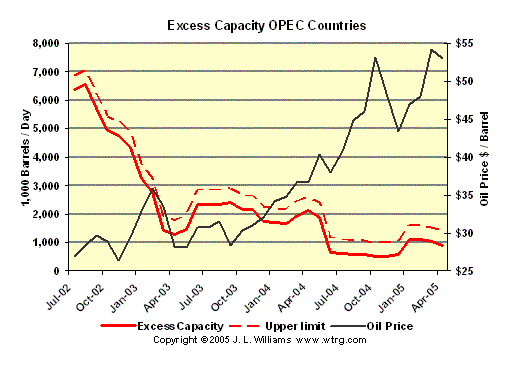
What I conclude from all this is that we are approaching a set of distinct decision points, after a long and intricate dance that probably served the interests of both parties. The passage of time has allowed Iran to make steady progress on enrichment and missile technology, but it has also opened up options for us. As I noted last fall, lower oil prices have created a window for a set of actions--truly crippling sanctions, a naval blockade, or air attack on the facilities in question--that would have been unthinkable when oil was marching steadily toward $100/bbl and beyond. That window will begin to close once the global economy resumes growing rapidly enough to erode the healthy cushion of spare global oil production capacity that now stands at 5.5 million barrels per day--a buffer that would also erode from the other direction if new oil projects fail to keep up with oil's intrinsic decline rates. In other words, if the situation isn't resolved one way or another within the next year or so, the strategy of containment of a nuclear-armed Iran in a new kind of Cold War could become the only viable option left to us.

Friday, June 27, 2008

The Baby and the Bath

Over the course of the last year, speculation has become a primary focus of concerns about the rapid increase in oil prices. For a Congress under intense pressure from constituents to address energy prices, regulating speculation in energy commodities could present the best prospect for appearing to deal decisively with the current energy crisis prior to the November election. Nor would I rule out the possibility that it might even provide some genuine price relief, although there are ample fundamental reasons for oil to be much dearer than it was just a few years ago. However, if Congress is going to take on the energy markets, it is imperative that it does so in a measured way, to avoid impeding their legitimate functions--some of which might be considered as speculative as the "commodity index" investment that has come in for the most severe criticism. Overkill could ultimately cost businesses, and eventually consumers, as much as inaction.

There's no shortage of conflicting opinions on this topic. A number of academics and financial experts have dismissed the possibility that speculation in oil futures could have much influence on the price of the physical commodity, pointing instead to the very real contribution of rapid demand growth in the developing world, slower production growth, particularly among non-OPEC producers, and the disappearance of global spare production capacity. Others have highlighted the recent and substantial flow of funds into the market from a new class of commodity investors, including pension funds and other institutions. They spot a cause-and-effect relationship in the accompanying rise in oil prices and find worrying parallels to the high-tech and housing bubbles. For my own part, I worry about the systematic linkages between the impact of this additional demand on futures prices and the mechanisms by which the price of oil purchased by refineries is set. But while I see a connection between speculation and higher fuel prices, I am skeptical of attempts to quantify it.

My background gives me a unique vantage point on this debate. After my graduate training in business and economics, I acquired a hands-on education in markets during a decade spent trading energy commodities for Texaco, Inc. This included a two-year stint trading international petroleum products from London, involving extensive dealings with our futures trading group and external floor broker. When I returned to Los Angeles, I was responsible for managing the commodity risk profile of the company's West Coast refining and marketing operations. Although this experience wasn't recent, I have no conflicts of interest in this area that would constrain my objectivity about the various proposals for regulating oil market speculation.

Some of the recent suggestions for regulating energy futures and derivatives trading might do more good than harm. This includes raising margin requirements, which might decrease liquidity, but also ought to reduce volatility by deterring investors from putting on enormous positions in hopes of turning small per-unit margins into huge aggregate gains, a strategy that hedge funds have employed in many markets. Shrinking volatility would be bad for traders, who thrive on it, but good for the economy. Closing the so-called "Enron Loophole" probably falls into a similar category of positive benefit vs. cost.

Other ideas seem likely to do much more harm to non-financial firms seeking to manage their business risks. For example, one of Senator Obama's recent anti-speculation proposals would force all energy commodities to trade on regulated exchanges. If this shut down the over-the-counter "swap" transactions that are used to bridge the price gaps between the small selection of crude and products traded on the NYMEX and the actual grades that companies buy and sell, it would make it much harder for businesses to hedge their risks. Airlines come to mind, here. Because there is no futures contract for jet fuel, an airline hedging its fuel supplies by buying crude oil or heating oil futures/options often also executes a swap covering the difference in price between jet and crude or jet and diesel. Otherwise, it runs the risk that when it purchase its jet fuel later, the hedge will have only appreciated by a fraction of the increase in the price of the physical product, or worse yet, might have lost money, while jet fuel prices continued to climb due to local or global scarcity. But as important as this transaction has become to airlines, it seems unlikely to generate the scale and liquidity required to merit launching an exchange-traded futures contract to cover it.

An even worse notion making the rounds on Capitol Hill would require anyone buying a futures contract to take physical delivery of the oil or product. As sensible as this might sound to the public, it would be catastrophic for the market and for the vast majority of participants, large and small, who use these markets to manage the enormous price risks associated with real-world energy activities. Even the small minority of players who rely on the NYMEX for physical supply in the New York Harbor would suffer, as liquidity for these contracts dried up. Consumers used to buying heating oil at a fixed-price for the season or year would probably lose this option, as all but the largest suppliers would be unable to offer this service.

Even the basic principle of limiting futures market activity to entities that produce or consume oil or its products is fundamentally flawed. On any given day, the producers and end-users wouldn't be active enough to make a real, liquid market. I experienced this first hand trading refined products on the West Coast. Top management preferred us to deal mainly with other oil companies, but when our own output fell short, the other refiners weren't always in the mood to sell. Without being able to buy from risk-taking independent traders who had previously taken a bet on the market, we would have run out of product on many occasions, and consumers would ultimately have been harmed.

Speculation plays an important role in lubricating the wheels of commerce, although it may also be contributing to higher oil prices, as investors increasingly turn to these markets as an inflation hedge or as another long-term asset class. My advice to Congress is to err on the side of caution in regulating energy commodity trading, and to specify very precisely which activities they want to rein in, rather than designing indirect and intricate rules that would ultimately entangle many participants that are essential to the efficient functioning of these markets. If Congress disrupted the entire energy market, just to constrain speculation by pension funds and other portfolio investors, the resulting chaos would hardly benefit consumers.