Showing posts with label Iraq. Show all posts

Tuesday, December 29, 2015

Has OPEC Lost Control of the Price of Oil?

  • The shale revolution effectively sidelined OPEC's control over global oil prices, but the consequences of a year of low prices are shifting power back to the cartel.
In the aftermath of another inconclusive meeting of the Organization of Petroleum Exporting Countries, oil prices have been testing their lows from the 2008-9 financial crisis,  For all the attention and speculation devoted to OPEC-watching whenever they meet, the question we should be asking about OPEC is whether the current situation shares enough of the elements that defined those periods in the past when the cartel's actual market control lived up to its reputation.

That reputation was established during the twin oil crises of the 1970s. US oil production peaked in late 1970, and to the extent there was then a global oil market, the key influence in setting its supply--and thus prices--passed from the Texas Railroad Commission to OPEC, which had been around since 1960.  From 1972 to 1980, the nominal price of a barrel of oil imported from the Persian Gulf increased roughly ten-fold, with disastrous effects on the global economy.

Just a few years later, however, oil prices collapsed.  OPEC's control was undermined by new non-OPEC production from places like the North Sea and Alaskan North Slope and a remarkable 10% contraction in global oil demand. The turning point came in 1985. Saudi Arabia, which had successively cut its output from 10 million barrels per day (MBD) in 1981 to just 3.6 MBD, introduced  "netback pricing" as a way to protect and recover market share.

That move helped set up nearly 20 years of moderate oil prices, during which OPEC's most successful intervention came in response to the Asian Economic Crisis of the late 1990s, when together with Mexico, Norway, Oman and Russia, it sharply curtailed production to pull the oil market out of a tailspin.

The proponents of today's "lower for longer" view of oil prices may see compelling parallels in the circumstances of the mid-1980s, compared to today's. Production from new sources, mainly US "tight oil" from shale, has created another global oil surplus. In the 1980s nuclear power and coal were pushing oil out of its established role in power generation. Now, renewables and electricity are beginning to erode oil's share of transportation energy, while the slowdown of China's economic growth and concerns about CO2 emissions raise doubts about the future growth of oil demand.

However, these similarities break down on some fundamental points. First, the production profile of shale wells is radically different from that of large, conventional onshore oil fields or offshore platforms. Once drilled, the latter produce at substantial rates for decades, while tight oil wells may deliver two-thirds of their lifetime output in just the first three years of operation. Sustaining shale production requires continuous drilling. In fact, new non-shale projects similar to the ones that underpinned oil-price stability from 1986-2003 make up the bulk of the $200 billion of industry investment that has reportedly been cancelled in response to the current price slump.

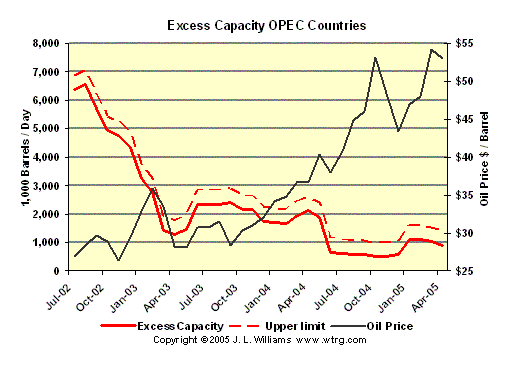
Another major difference relates to spare capacity. During most of the 1980s and '90s, OPEC maintained significant spare oil production capacity, much of it in Saudi Arabia. That wasn't necessarily by choice, but it was what enabled OPEC to absorb the loss of around 3.5 MBD from Kuwait and Iraq in 1990-91 while continuing to meet the needs of a growing global market. The virtual disappearance of that spare capacity was a key trigger of the oil price spike of 2004-8. (See chart below.)  A little-discussed consequence of OPEC's current strategy to maintain, and in the case of Saudi Arabia to increase output has been a decline in OPEC's effective spare capacity, to just over 2 MBD, compared to 3.5 MBD in the spring of 2014.

As a result, global spare oil production capacity is essentially shifting from Saudi Arabia, which historically was willing to tap it to alleviate market disruptions, to Iran, Iraq and US shale. The responsiveness of all of these is subject to large uncertainties. Iran's production capacity has atrophied under sanctions, and it isn't clear how quickly it can ramp back up once sanctions are fully lifted. Iraq's capacity and output have increased rapidly, but key portions are threatened by ISIS.

Meanwhile, US tight oil production is falling, although numerous wells have been drilled but not completed, presumably enabling them to be brought online quickly, later--perhaps mimicking spare capacity. How that would work in practice remains to be seen. One uncertainty that was recently resolved was whether such oil could be exported from the US. As part of its recent budget compromise, Congress voted to lift the 1970s-vintage oil export restrictions. Even with US oil exports as a potential stabilizing factor, a world of lower or more uncertain spare capacity is likely be a world of higher and more volatile oil prices.

Oil prices were largely unshackled from OPEC's influence last year, after Saudi Arabia engineered a new OPEC strategy aimed at maximizing market share. However, with oil demand continuing to grow and millions of barrels per day of future non-OPEC production having been canceled--and unlikely to be reinstated any time soon--and with OPEC's spare capacity approaching its low levels of the mid-2000s, the potential price leverage of a cut in OPEC's output quota is arguably greater than it has been in some time.
 
In 2016 we will see whether OPEC finally pulls that trigger, or instead chooses to remain on a "lower for longer" path that raises big questions about the long-term aims of its biggest producers.
 
A different version of this posting was previously published on the website of Pacific Energy Development Corporation

Thursday, March 05, 2015

IEA Sees Fundamental Shifts in the Current Oil Price Drop

  • The IEA's latest medium-term oil forecast is a useful update to the thinking behind its current long-term outlook, which predated much of the current price drop.
  • They expect shale output to be relatively resilient and rely on Iraq's capacity to expand output in spite of significant security risks.
When the International Energy Agency issued its most recent long-term energy forecast last November 12th, Brent crude oil traded just above $80 per barrel. At that point it had fallen only half as far as it would by January 2015, compared to its June 2014 high of $115. As a result, the IEA's assessment of the price drop in its 2015 World Energy Outlook was incomplete, to say the least. The agency's Medium-Term Oil Market Report, issued in February, provides a necessary update and some interesting insights about how--and how far--they envision the oil market recovering.

Anyone expecting the IEA to provide a detailed oil-price forecast for the next five years will be disappointed. The current report reproduces recent oil futures price curves and generally endorses the consensus that prices won't rise as high as the level from which they have just fallen, at least by the end of the decade. At the same time, in the Executive Summary they remind their audience, "The futures market's record as price forecaster is of course notoriously mixed."  Six months ago West Texas Intermediate Crude for delivery in April 2015 was selling for around $90/bbl; yesterday it closed under $52. So much for the predictive power of futures markets, as most participants are aware.

The report's analysis of the factors influencing the oil supply and demand balance over the next five years is more useful. First and foremost, it recognizes that the factors contributing to this price correction bear little resemblance to the price drops of 1998 and 2008, and share only a few common threads with the big correction of 1986, chiefly involving OPEC's behavior. The biggest differences relate to the nature of the North American shale sector, which drove strong non-OPEC supply growth for the last several years, and the economic and policy factors--slowing growth in China, subsidy phaseouts, and currency depreciation-- likely to dampen the global demand response to cheaper oil.

With regard to shale, the IEA suggests that the current pressures on the US oil industry will prove temporary. They apparently expect the growth of unconventional production from both shale and oil sands to slow but remain the largest source of non-OPEC supply increases through 2020, outstripping increases in OPEC's capacity and offsetting declines elsewhere. Those declines include a 500,000 bbl/day drop in Russian production, mainly due to the effect of sanctions over Russia's involvement in Ukraine.

The agency even suggests that North American shale could emerge from this experience stronger, because of its inherent resiliency. The same factors that should see shale output slow sooner than that from big conventional projects taking years to develop would allow it to ramp up faster, once the current global oil surplus has been consumed. Meanwhile, with larger projects delayed or canceled, conventional production would take longer to return to net growth above normal decline rates. 

That could become the factor that dispels the current skepticism concerning shale oil opportunities outside North America, as apparently exemplified in BP's latest long-term outlook. Companies looking for growth opportunities in a few years might regard developing the shale resources of China, Argentina and Russia--assuming sanctions on the latter end--as lower-cost, lower-risk investments than some deepwater or other big-ticket projects.

As for OPEC, its production growth through 2020 seems to come down to a single country. The report assesses the current situation in Iraq and concludes that despite the threat from the Islamic State and the country's ongoing internal frictions, output should continue to grow by another million bbl/day or so. That strikes me as optimistic, particularly considering the proximity of ISIS forces to Kirkuk, which formerly accounted for around 10% of Iraqi production. Postwar development has focused on the big fields in southern Iraq, which have so far proved to be beyond the reach of ISIS, but a further deterioration of security in the Kurdish north could jeopardize future expansion plans.

The wild card on the supply side is Iran, which under international sanctions has seen its oil exports cut by roughly half. The Medium-Term Oil Market Report explicitly assumes that sanctions will continue. However, if current nuclear talks reached an agreement, sales could ramp up by a million bbl/day over the next year, if buyers could be found. That would alter the IEA's supply/demand calculations substantially.

And that leads us to demand, which at this point is still a key uncertainty. I concur with the report's general assessment that the world has changed since previous oil price drops and rebounds in ways that make a sharp rise in oil use less likely. US demand is up, but as I described in a recent post large groups of consumers around the world have seen little or no relief at the gas pump that might stimulate more consumption.

When I wrote about the IEA's World Energy Outlook last December, I focused on its themes of stress and the potential for a false sense of security. In the short time since then the oil and gas industry has experienced a large dose of stress, but I've seen few signs of complacency on the part of consumers beyond a recovery in the US sales of SUVs and light trucks. That may change if low oil prices persist for a few years.

A different version of this posting was previously published on the website of Pacific Energy Development Corporation

Wednesday, July 09, 2014

ISIS Threatens Iraq's Oil Upside

  • Even if its threat to Iraq's oil exports can be contained, the newly asserted "Islamic State of Iraq and Syria" has altered the political risk of projects there.
  • That could hamper future production that was expected to be a major factor in meeting growing oil demand later this decade.
Last month's blitzkrieg advance of Al Qaeda spinoff ISIS in northwestern Iraq rattled global oil markets and politicians. Oil prices have risen by only a few dollars, reflecting the remoteness of the current threat from Iraq's main producing region and validating OPEC's recent characterization of the global oil market as "adequately supplied." Yet even as the rebel offensive appears to stall, the escalation of risk in Iraq and its neighbors could affect geopolitics, oil supplies and fuel prices for the rest of the decade.

Iraq currently exports around 2.7 million barrels per day (MBD) of oil, or 7% of global oil exports. It is effectively the number two producer in OPEC. Having recovered beyond pre-war levels, Iraq's oil industry has been growing, while Iran's exports are constrained by international sanctions and Libya's output has become highly erratic following that country's revolution.

In the International Energy Agency's latest Medium-Term Oil Market Report Iraq accounts for 60% of OPEC's incremental production capacity through 2019 (see chart below) and nearly a fifth of all new barrels expected to come to market in that period. This is a more conservative view of Iraq's growth potential than in previous scenarios, but it still leaves Iraqi oil, together with " tight oil" in the US and elsewhere, as the bright spots of the IEA's supply forecast.

Picture
Following ISIS's capture of Mosul in northern Iraq, the Heard on the Street column in the Wall St. Journal painted a stark picture of how the destabilization of Iraq could limit investment in the country's oil industry, truncating its expansion. That would increase longer-term oil price volatility and make investments elsewhere more attractive, not just in North American tight oil but also in energy efficiency and alternatives to oil.

Warning signs seem ample. The "Islamic State in Iraq and Syria" might never capture Baghdad or directly threaten the giant oil fields of southern Iraq that are reviving with help from international firms like BP, ExxonMobil and Shell. However, ISIS's actions in the territory they now control, and the fears they incite across a much larger swath of Iraq, are sparking renewed sectarian violence and prompting foreign companies to evacuate personnel. This undermines the IEA's medium-term forecast, which despite being "laden with downside risk" will apparently not be revised in light of recent events. It also raises the potential for jumps in nearer-term oil and petroleum product prices.

It is noteworthy that oil prices haven't gone up significantly, as they did when Libya's revolution began. From February 15 to April 15, 2011 the price of UK Brent Crude jumped 22%.  Iraq's troubles added about 5% to the Brent price, some of which has already dissipated. However, average US gasoline prices are $0.21 per gallon ahead of their level for the same week last year, in part because tensions in Iraq and elsewhere have forestalled the typical post-Memorial Day price drop.

The market's relatively muted response could change abruptly if the Iraqi military suffered further setbacks at the hands of ISIS and its allies, or if ISIS turned its attention to the oil infrastructure of central and southern Iraq. They attacked the country's largest refinery at Baiji, north of Baghdad, and I have seen conflicting reports of its current status.

As several analysts have noted, anything that threatened the country's oil exports, most of which pass through the Gulf port of Basra, could send oil prices substantially higher. That's because other supply outages have reduced usable spare production capacity elsewhere--oil that isn't now being produced but could ramp up quickly--to less than 4 MBD, a narrower margin than in several years. Even if lost Iraqi output were made up by Saudi Arabia and the UAE, the further contraction of spare capacity would drastically increase price volatility and boost oil prices from today's level, until Iraq's exports--or Iran's--were restored.

Nor would booming domestic oil and gas-liquids production, which is surely helping to hold down global oil prices, insulate US consumers from increases at the gas pump. The oil that US refineries process and the products they sell are still priced based on the global market. If Brent crude spikes, so will US gasoline and diesel. That would have less impact on the US economy than in the past, when imports made up a much higher share of supply, but shifting money from the pockets of consumers to those of oil company shareholders is rarely popular.

An Iraq-driven oil price spike would affect politics and geopolitics, too. An unstable Iraq makes it more difficult to maintain the sanctions pressure on Iran, particularly if the US and Iran ended up coordinating their responses  in Iraq. It's even harder to envision a consensus on keeping  more than 1 MBD of Iran's oil bottled up if oil prices returned to $150/bbl.

That could also complicate the debate over exporting US crude oil, already a tough sell for politicians who came up during the era of energy scarcity. As a practical matter, if exports began while prices were rising sharply for other reasons, convincing US voters that the two factors were unrelated would be challenging. A full-blown oil crisis in Iraq or the wider Middle East would likely result in the idea being tabled for an extended period.

It's tempting to view the success of ISIS in seizing territory on both sides of the Iraq/Syria border as a temporary outgrowth of Syria's civil war. If that were the case, the situation might revert to the status quo ante, once the Iraqi army--with some outside help--mopped up ISIS.

Even if this genie could be rebottled, however, the aftermath of the Iraq War and the "Arab Spring" revolutions is exerting  great stresses on the post-World War I regional order, overlaid on 13 centuries of animosity between Sunnis and Shi'ites.  An accident of history and geology has made this area home to much of the world's undeveloped conventional onshore oil reserves. Can its stability be restored with a few deft military and diplomatic moves, or might that require a complete rethinking of boundaries and nations, as recently suggested by the foreign affairs columnist of the Washington Post?

A different version of this posting was previously published on the website of Pacific Energy Development Corporation.

Monday, January 06, 2014

Energy 2013: More Shifts Ahead?

  • 2013 was an eventful year for energy, though perhaps with fewer earth-shaking implications for the future than in other recent years.
  • Several developments concerning global oil production, when taken together, improved the odds of lower oil prices in the next several years.
Year-in-review posts have become standard fare for energy blogs; I've written my share in the past. However, while 2013 hardly lacked for interesting energy-related news and events to populate a top-ten list, most fell short of the potential to affect energy markets strongly for years to come.

For example, it is newsworthy that another year has passed without an indication of whether the White House will approve or reject the cross-border permit for the Keystone XL pipeline project. Yet the consequences of that decision are becoming less significant, at least in the reported view of Bakken shale pioneer Harold Hamm. That's due in large measure to the dramatic increase in the transportation of oil by rail, which should be on anyone's top-ten list. Nor is it clear that the EPA's proposal to scale back the Renewable Fuel Standard's (RFS) corn ethanol quota for 2014 will affect more than this year's fuel market, unlike pending Congressional legislation to reform the RFS.  California's adoption of an energy storage mandate for utilities is another notable event, but its long-term impact is contingent on the development of cost-effective storage technology and business models to enable much greater integration of renewable energy on the grid.

Instead of extending that list, I'd like to focus on three stories in which I see significant, related implications for oil markets. The first involves the temporary international agreement concerning Iran's pursuit of nuclear technology. Although relaxation of the sanctions limiting Iranian oil exports depends on a highly uncertain final agreement governing uranium enrichment, the  Arak reactor's plutonium potential, and a more intrusive inspections regime, the interim deal signals that around a million barrels per day of Iran's oil--and eventually more--could be back on the market in less than two years.

If that happens, it won't be because the Iranian government's repeated assurances of its aversion to nuclear weapons have suddenly become credible, but because most of the permanent members of the UN Security Council plus Germany--the "P5 + 1" negotiating with Iran--are tiring of the protracted confrontation and understandably have no appetite to address this in the same way that the collapsing UN sanctions regime for Iraq was resolved in 2003.

Next consider the stunning reversal of the Mexican government's 75-year-old nationalization of oil and gas. As a result of the reforms just enacted by their congress and ratified by a majority of Mexico's states, the state oil company Pemex will be run along more commercial lines, and foreign firms will be allowed to partner with Pemex in developing the country's large untapped hydrocarbon resources. If the terms prove attractive for international energy firms, the result will move North America even closer to net energy independence. Meanwhile the Transboundary Hydrocarbon Agreement between the US and Mexico that was just passed by the US Congress will simplify energy development that straddles the border.

Mexico's potential could be even more significant for oil markets than an unconstrained Iran. The former's production has declined by 24% since 2004--a loss of 900,000 bbl/day-- mainly due to limited reinvestment. Foreign investment can help to restore that output, but the upside potential is much bigger. Pemex has barely scratched the surface of its deepwater resources in the Gulf. Its proven and contingent reserves are estimated at 45 billion barrels, while US estimates put Mexico's shale oil, or "tight oil" resources at 13 billion barrels, slightly more than the country's proved conventional reserves. (Shale gas could exceed 500 trillion cubic feet.)

Mexico's oil output has grown dramatically before. In the decade following the Arab Oil Embargo of 1973 production increased from 500,000 bbl/day to around 3 million. A similar performance seems possible again from a higher starting point, but it's unlikely to happen overnight. As Dan Yergen pointed out in a recent Wall St. Journal op-ed, "exploration and development could take another five to 10 years" beyond the first bid rounds.

And that brings us to Saudi Arabia's options for dealing with a shifting market that will include projected US crude oil output of 9.6 million bbl/day by 2016, the recovery and growth of Iraqi production, possible exports from Canada to Asia, Mexico's potential, and the eventual return of full Iranian exports. Whether or not this wave of new or restored production will be sufficient to replace production declines elsewhere, it must undermine OPEC's control of pricing in this decade. In that light, it's hard to ignore reported indications that Saudi Arabia might abandon its role of swing producer, particularly when it comes to unilateral output cuts to balance new non-OPEC supplies.

Haven't we seen this movie before? After a dozen years of high prices and tight markets OPEC steadily lost market share in the 1980s as new fields in Alaska, Mexico and the North Sea came online. That trend culminated in Saudi Arabia's 1986 "netback pricing" decision, linking the price of its oil to the value of its customers' refined petroleum products. Following the price collapse that policy helped precipitate,  oil prices took 18 years to reach $30/bbl again, by which time the dollar had lost a third of its value.

I doubt we're in for anything that dramatic. Back then, most demand growth came from the developed countries of the OECD, rather than from the expanding middle classes of developing Asia and the Middle East itself. Moreover, today's new production has higher costs--up to $70-80 per barrel--ruling out a return to $20 oil. With many serious geopolitical risks still in play, an oil-price price correction or extended soft market seems likelier than another price collapse. In the meantime, if we're seeking $20 oil, we already have it in the form of US shale gas that averaged the equivalent of $21.64/bbl last year. And that's the early, odds-on favorite for the energy story of the decade.

A different version of this posting was previously published on the website of Pacific Energy Development Corporation.

Friday, August 02, 2013

Oil's Eastern Hemisphere is Shifting, Too

  • OPEC's exports earned record revenue last year, but the pressure on the cartel is increasing as Eastern Hemisphere production expands, along with higher unconventional oil production in North America.
  • Increasing supply doesn't guarantee lower oil prices in the future, but it will help accommodate growing demand from the developing world, reducing the risk of price spikes such as we saw in 2008.
No one should be surprised that the turmoil in Egypt has caused jitters in the oil markets.  Although Egypt has recently become a net oil importer, the possibility of extended violence or even civil war poses risks to the tanker traffic through the Suez Canal. This has helped to push UK Brent crude to its highest level since April and contributed to higher prices for West Texas Intermediate (WTI) crude than we've seen in over a year.  Yet while these events provide the latest of many prods to nudge oil prices higher, underlying long-term supply trends look favorable.  That's not just because of surging US oil output, which is largely attributable to shale or "tight oil."

US production of crude oil and natural gas liquids grew by roughly 2 million barrels per day (MBD) from 2008-12, with a similar increase expected by 2020, even in the relatively conservative forecast of the US Energy Information Administration.  As a result, US oil imports are shrinking, scrambling long-established supply patterns in the Atlantic Basin. However, North America isn't the only place where supply is expanding, nor is the shale revolution responsible for the production growth in the Eastern Hemisphere, at least not yet.

The big story there is Iraq. Thanks to the development contracts its government negotiated with international firms after the fall of Saddam Hussein, Iraqi production is growing and might eventually reach the potential suggested by its enormous conventional oil reserves. Whether or not Iraq really has 150 billion barrels of oil in the ground-- this figure ratcheted up over the years in an odd two-step with its historical rival Iran--the consensus is that it has ample scope to boost output at relatively low cost. 

As the Financial Times reported, Iraq's plans to increase oil production capacity from around 3 MBD to 12 MBD, which would put it in the same league with Saudi Arabia, are now in doubt due to multiple concerns.  But even with companies seeking to renegotiate service contracts that looked too lean when they were set, and the Kurdistan Regional Government in the north of Iraq signing deals independently of Baghdad, Iraq produced more oil last year than it had since the outbreak of the Iran-Iraq War in 1980. The International Energy Agency apparently expects Iraqi production to nearly double to 6.1 MBD by the end of the decade.

If this comes to pass, it will significantly alter the dynamics within the Organization of Petroleum Exporting Countries, and possibly change OPEC's role in the market. It would lift Iraq well above other producers like Iran, Kuwait, the UAE, and Venezuela--all clustered around 2-3 MBD--and leave it second only to Saudi Arabia. Given recent Saudi domestic consumption trends, the race for future export leadership could be even tighter.

Despite record oil revenue last year, tensions are growing within OPEC, which had welcomed post-war Iraq back into its ranks and didn't constrain its output with an official production quota.  This accommodation is even simpler today, with OPEC operating without country-specific quotas. Yet in the absence of a large increase in demand for OPEC's oil in the developing world, a steadily expanding Iraq will either force painful adjustments on other members or bust the cartel's quota entirely.  Whether that results in rising inventories or merely higher spare production capacity, it would exert downward pressure on oil prices and on OPEC members' national budgets.

Another important shift is associated with the growth of oil output in Kazakhstan, the second-largest oil producer to emerge from the breakup of the Soviet Union.  Production has increased steadily since the 1990s, reaching 1.7 MBD last year. With the startup of the supergiant Kashagan field later this year, the country's production should exceed 3 MBD by 2020, with exports over 2 MBD. That would make Kazakhstan a bigger factor in global oil markets than Iran, as long as the latter continues to be hemmed in by sanctions. 

No one can predict oil prices in 2020 with any certainty. However, the combination of significant supply growth in North America, Iraq and the Former Soviet Union with flat or shrinking demand in the US and Europe provides headroom for further demand growth in Asia and the Middle East itself.  That doesn't necessarily augur a big drop in prices ahead--much of this new production isn't exactly cheap--but it could signal a period of greater price stability than we've experienced for a while.  That's assuming none of the various crisis scenarios erupts in the meantime.

A different version of this posting was previously published on the website of Pacific Energy Development Corporation.

Thursday, December 06, 2012

IEA Expects Global Energy Focus to Shift Eastward

Last month the International Energy Agency (IEA) released its annual long-term forecast, the World Energy Outlook (WEO). Its projection that US oil output would exceed that of Saudi Arabia within five years was featured in numerous headlines, although some of the report's other findings look equally consequential. That includes the continued strong growth of energy demand in China, India and other Asian countries, and the linkages between that growth and a dramatic expansion of Iraqi oil production. The agency also set a cautionary tone concerning the increase in global greenhouse gas emissions accompanying all this growth.

In the IEA's primary "New Policies" scenario, the US overtakes Saudi Arabia in oil production by 2017, adding 4 million barrels per day (MBD) of unconventional output, mainly from shale (tight oil) deposits such as the Bakken in North Dakota. US oil imports decline significantly, due in roughly equal measure to higher production and the implementation of strict vehicle fuel economy regulations. As a consequence, the need for imports from the Middle East approaches zero within 10 years. When this change is combined with the growth in oil demand in Asia, where China alone accounts for half the forecasted global growth in oil consumption in this period, the IEA envisions Asia becoming the recipient of 90% of Middle East oil exports by 2035.

The detailed assumptions behind the IEA's conclusions weren't provided in the public release. These include crucial questions such as the assumed status of US rules barring most crude oil exports. As noted in a Reuters op-ed at the time, maximizing the potential of US unconventional resources may depend on allowing higher quality unconventional oil to seek global markets, while continuing to import oil from Latin America and the Middle East into Gulf Coast refineries geared to these heavier, higher-sulfur feedstocks. The op-ed's author also reminded us that the natural gas liquids included in the headline comparison with Saudi production are useful but quite different from crude oil, yielding little gasoline and diesel fuel.

The expected growth of energy demand in China remains extraordinary, even with the country's economic growth slowing from the levels seen a few years ago. To put this in context, when Dr. Fatih Birol, Chief Economist of the IEA, presented the new WEO to the media in London on November 12th, he suggested that China's electricity demand would grow by the equivalent of "one US and one Japan of today" by 2035. Much of that additional electricity generation is projected to come from renewables, nuclear power and domestic gas. Nevertheless, and in spite of significant increases in China's unconventional gas production, the IEA forecasts that import dependence will grow from about 15% for gas and 50% for oil today, to 40% for gas and over 80% for oil by 2035. That increase in imports would equate to additional hundreds of millions of dollars per year of outflows for energy.

In the view of the IEA, much of the extra oil demanded in Asia will be supplied by Iraq, which they project will increase its output from around 3 MBD today to 6.1 MBD in 2020 and 8.3 MBD in 2035, in the process becoming the world's second-largest oil exporter, after Russia. Since the reserves to support that growth have already been identified, with much lower production costs than many other basins, the uncertainties involved are mainly political and structural. Resolution of the current standoff with Iran over its nuclear program would provide even more Middle East oil for Asian markets.

As in its earlier "Golden Age of Gas" scenario, the IEA expects large increases in global natural gas consumption. Unconventional sources, mainly in the US, China and Australia, would contribute around half the additional production required to meet expanded demand. However, at the launch presentation in London Dr. Birol also stressed that unconventional oil and gas are still at an early stage, with significant uncertainties about the eventual magnitude of their resources. This seemed to be a particular issue for the agency's post-2020 forecast of oil production in the US and gas production in China.

Despite the rigorous analysis and level of detail involved in producing the IEA's World Energy Outlook, long-term energy forecasting should always be taken with a grain of salt. Yet whether or not the highlighted trends mature precisely in line with these projections, the shifts that the IEA identified are significant and already becoming evident in current data for energy production, consumption and trade. Even if North America failed to become a net oil exporter--which many equate with energy independence--by 2030, the movement of the center of gravity of global energy trade towards Asia is essentially pre-determined: baked in by differences in economic growth rates and resource opportunities. The economic, geopolitical and environmental consequences of that shift are just starting to take shape.

A slightly different version of this posting was previously published on the website of Pacific Energy Development Corporation.

Thursday, June 24, 2010

Where's the Peak?

I've been going through the International Energy Agency's new forecast for medium-term oil and natural gas markets, issued yesterday. In contrast to the IEA's warnings of last summer concerning an imminent oil supply crunch, the agency now sees ample supplies to accommodate the level of demand growth it anticipates for the next five years. Yet while this scenario does not envision a peak in global oil supplies before 2015, its components offer ample cause for concern about the growing market power of OPEC and the risk of geopolitical disruptions. It also signals the growing importance of non-traditional sources of liquid fuels, including natural gas liquids (NGLs) and biofuels, which are included in the IEA's oil supply & demand balance.

The headline features of the IEA's oil forecast include continued growth in global oil capacity from 91 million barrels per day (MBD) in 2009 to 96.5 MBD in 2015. This is driven by the growth of OPEC's capacity, the NGL output of a global natural gas expansion that the US shale gas boom has accelerated, and increased production of ethanol and other biofuels. IEA sees this combination as more than sufficient to counteract a roughly 3.5% annual decline in the output of existing oil fields, including a peak and net decline in non-OPEC production within the next year or two. The latter won't surprise anyone who's been following the Peak Oil issue, but it's all the more worrying when you consider that it doesn't include the impact of project delays owing to the on-again, off-again US deepwater drilling moratorium, which the administration seems determined to switch back on.

This picture is fraught with risks and vulnerabilities, including the prominent role of Iraqi oil revitalization projects, which appear to account for half of the growth in OPEC crude oil capacity in the period. Although there's ample scope to stimulate more output from Iraq's mature fields, and the potential of its undeveloped fields represents the largest conventional oil opportunity in the world, none of it will come to fruition if the county doesn't remain quasi-stable. This might be one area in which the reassignment of General Petraeus to Afghanistan from his CentCom post, where he retained oversight of the Iraq security situation, might not look so positive.

Then there's that shift toward NGLs and biofuels, including the IEA's somewhat surprising prediction that while biofuels will continue to grow globally, the rate of growth will slow, with US output reaching a plateau long before it has attained the targets of the Renewable Fuels Standard. They also appear to be even more skeptical than I am that cellulosic ethanol is on the verge of scaling up rapidly. The larger problem is that both of these sources constitute what I would call "hamburger helper" for oil. Neither ethanol nor first-generation biodiesel (FAME) constitutes an effective gallon-for-gallon substitute for petroleum products, except in blends limited by both infrastructure and legacy vehicle fleets not equipped to handle more than small percentages of these fuels. NGLs provide propane and butane essentially indistinguishable from crude-sourced LPG and just as useful for petrochemicals and heating fuel, but they yield much less in the way of gasoline components, and the ones they do require significant processing to boost their octane, now that tetra-ethyl lead is out of the picture.

On the demand side, things look pretty much as we'd expect in the aftermath of a global recession that hit the developed world harder than the big developing countries--BICs, if not BRICs. As was true before the financial crisis, however, the Middle East contributes the second-biggest source of new demand, after Asia. That means continued growth in domestic demand within some of today's largest oil exporters. Even if that doesn't lead to "peak exports", it buttresses the fundamental shift in global market power underpinning a forecast that might otherwise appear calming to markets.

Anyone looking to the IEA for signs of an imminent peak in global oil supplies won't find it in their Medium Term Oil and Gas Markets 2010 report. What I see instead is a continuation of the world we are already in, with OPEC holding the trump cards. Traders tend to focus on the weekly fluctuations of oil market inventories and indications that supply or demand may grow or shrink in the months and years ahead. Yet while the release of this report, together with another build in US crude inventories this week, reportedly contributed to the $2/bbl drop in oil prices in the last two days, these reactions seem oblivious to a larger reality. With more than 5 million barrels per day of OPEC production capacity shut in, the main reason that oil is trading in the mid-to-high $70s, rather than the mid-to-high $40s, is that OPEC is functioning as a truly effective cartel that is much happier with higher prices. Politicians looking for another economic stimulus might consider the anti-stimulus that oil prices are currently providing, and the consequences of policies that could hand even more power to OPEC in the short-to-midterm.

Wednesday, December 16, 2009

The Other Countdown

I missed commenting on the latest round of oil deals in Iraq, which could see that country's output quickly double and eventually quadruple, causing no small amount of anxiety within OPEC. It's looking increasingly likely that the world may need that oil sooner rather than later, though. While the backdrops of photos from Copenhagen display the "tck tck tck" mantra symbolizing the conference as our last, best chance to avert catastrophic climate change, we shouldn't forget that another clock with a shorter timeline is also ticking down on our last chances to prevent Iran from developing nuclear weapons.

Business leaders are often advised not to let the urgent drive out the important. Although climate change has been billed as having both attributes, so do Iran's nuclear ambitions, and their implications in the next decade take urgency to a higher level. Yesterday's Washington Post featured a chilling analysis of the progress Iran has been making on fronts other than the Uranium enrichment that has attracted so much attention. This includes a leaked memo from the International Atomic Energy Agency assessing Iran's capabilities and another purportedly from inside Iran showing that the government is working on a "neutron initiator." If these assessments are right, then the controversial National Intelligence Estimate of 2007 placed far too much faith in indications that the regime had decided to cancel work on a warhead. Our subsequent patience with them--and with our Security Council partners--has provided Iran with crucial time in which to advance its goals.

While we were in a poor position to ratchet up the pressure sufficiently in 2007 or 2008, when Iran's oil exports made the difference between high oil prices and a crippling oil shock, that constraint disappeared last fall. The combination of OPEC's current spare capacity of at least 6 million barrels per day and the prospect of Iraqi output increases that could dwarf Iran's exports has largely neutralized the threat of an Iranian embargo, perhaps permanently.

Now, it's still possible that the visible parts of Iran's nuclear efforts are a sham mounted mainly for our benefit, similar to the double feint concocted by Saddam Hussein, in which he claimed not to be doing something while doing just enough behind partially-closed doors to make that claim look false. In retrospect that strategy made a certain amount of sense for Iraq, which after its defeat by Coalition forces in the Gulf War could not have defended against a conventional attack from the larger neighbor it had fought to a standstill a decade earlier. However, it makes little sense for Iran, which already has powerful defenses and a wide array of weapons and allies with which to retaliate in case of an attack by the US, the only power that could seriously threaten it at this point.

If the op-ed in the same issue of the Post is correct about the difficulties of mounting effective deterrence once Iran has the Bomb, then we don't have much time left to exercise the remaining diplomatic and economic options in our playbook. That means assessing the positions of Russia and China with a gimlet eye and determining for ourselves whether they would ever sacrifice their trade and security connections with the Islamic Republic, in order to forestall nuclear developments that they likely see as not aimed against them in any case. As weak as our hand looks now, it will only get worse later. In the context of this countdown, today's relatively high inventories of crude oil and refined products look like a very good thing.

Friday, November 06, 2009

Cheap Oil

When the US invaded Ba'athist Iraq, many ascribed that action to a desire to seize the country's vast oil reserves and develop them on terms favorable to us, presumably to keep the days of cheap oil rolling on. After six years of oil prices far above their pre-war level, the last vestiges of that theory should be laid to rest by a careful reading of today's headlines concerning the announced production deal between the Iraqi government and ExxonMobil and Shell. The terms looks anything but lucrative for the Supermajors, which have won the opportunity to revamp output at one of Iraq's largest mature oil fields, West Qurna. However paltry the returns might look for the firms involved, this development could have a bigger impact on oil price--and sooner--than some of the splashier recent announcements concerning big oil finds off Brazil and West Africa.

The reported terms of the deal struck by Exxon and Shell in Iraq continue the trend of allowing access only on the basis of working as contractors, rather than as partners with an ownership interest in the underlying resource via a typical production-sharing contract. According to the story in today's Wall St. Journal, the companies will receive just $1.90 per barrel for their efforts to boost the flagging output of the super-giant West Qurna field, the output of which could increase by more than the current oil production of Texas (including the Gulf of Mexico.) Moreover, because the project entails virtually no exploration risk--the reserves are well-established--and minimal technical risk, and is already connected to infrastructure, the only real limitation on how fast it could begin ramping up is the local security environment and the ability of the firms to line up equipment and workers. This will still require several years, but it should happen a lot quicker than the time required to develop a new field with tricky geology in deep water.

So what does this mean? Well, for ExxonMobil and Shell it offers a relatively quick boost in production and revenue. $1.90/bbl is skimpy compared to what companies can make on their own discoveries, but over volumes this large it could translate into an extra $700 million of annual cash flow for the next 20 years. As attractive as that sounds, though, it comes without the ability to book new reserves, which are so critical to the valuations of oil companies.

The implication for oil prices will depend on many other factors, but the steady growth of Iraq's oil production from the current 2.5 million bbl/day to a level commensurate with the country's reported 115 billion bbls of reserves could at least compensate for some large declines elsewhere and help maintain a reasonable cushion of spare production capacity as the global economy gets back on track. This hardly bodes a return to $20 oil prices--an eventuality that would be much less welcome in the carbon-constrained world we're entering than just a few years ago--but it could buy us enough time for fuel efficiency and vehicle electrification to match Peak Demand to an inevitable peak in global production.

Monday, March 17, 2008

The Road Not Taken

This week marks the fifth anniversary of the start of the Iraq War. With the outcome of November's US presidential election hinging at least in part on the judgment to go to war in 2003, and in light of the release of a new book by a Nobel-winning economist assessing the cost of the war, it seems appropriate to spend a moment reflecting on the road not taken, at least in terms of its energy aspects. Although we will never know what would have ultimately happened, had the US decided not to invade Iraq, we can make some educated guesses about the level of oil prices in such a world. Just as the war itself cannot properly be characterized as a war for oil--though it has certainly been about oil--today's oil price of $110 per barrel reflects the results of that decision, though it has not been directly caused by it.

In gauging the impact of the Iraq War on oil prices, we need to evaluate two broad areas: the relative importance of Iraqi under-production, compared to all the other factors that have contributed to oil's dramatic rise from the mid-$20s per barrel, and the nature of Iraq's status quo ante, with regard to oil. Let's start with the latter, since after five years of war, most commentators have forgotten about the way that Saddam Hussein's behavior regularly roiled the market.

In the aftermath of the 1991 Gulf War and leading up to our invasion in 2003, Iraq was under UN sanctions that inhibited its oil trade, among other things. Foreign firms could not enter into new development deals with the Iraqi government, and the country's oil exports were capped and managed under the Oil for Food Program, which was later revealed to have been rife with corruption and used by Saddam as an ATM to fund his pet projects. Between 1992 and 2003, Iraq suspended its oil exports several times--most recently in 2002--and threatened to do so on many other occasions, temporarily driving oil prices higher. If the war had never happened and the sanctions regime remained in place today, the combination of UN restrictions and Saddam's pattern of using oil exports as a geopolitical tool would be contributing to market instability, not lower prices.

I would argue that the likelier scenario was not a continuation of the pre-war status quo, but the gradual disintegration of the sanctions regime--a process already apparent in 2002--as oil companies from Security Council countries such as France and Russia pressed for commercial access to Iraq's enormous untapped oil reserves. Still, it takes time to bring new oil fields on line, even when exploration risk is very low and geology quite favorable, as it is in Iraq. Had sanctions collapsed entirely in 2004 or 2005, we still would not have any contribution from such projects at this point, and Iraq's exports would be about what they averaged between 1999 (when the dollar-cap on Oil for Food exports was eliminated) and 2002: 1.9 million barrels per day (bpd.) It's also likely, however, that these exports would have been interrupted by Iraqi politics and periodic military confrontations with the US, such as Operation Desert Fox in late 1998. In other words, other than the cumulative loss of perhaps a billion barrels of oil exports from 2003-2006, Iraq's current exports absent the Iraq War would probably be about the same as they are today.

Nor has the Iraq War been the only factor applying pressure on oil prices since 2003. You've heard the litany many times: the growth of Asia and especially China, turmoil in Nigeria, resource nationalism, tensions with Iran, Hurricane Katrina, and so on. Is there any reason to think these wouldn't have been just as significant--except for the risk of conflict with Iran --had the Iraq War never occurred? If anything, global economic growth, and oil consumption with it, might have been even higher, if the US hadn't embarked on a major war financed largely by foreign debt. The largest direct contribution of the Iraq War to oil prices probably occurred in 2003-2004, when Iraq's curtailed output helped drive OPEC's spare capacity below 1 million bpd, and sent prices soaring past $50/bbl for the first time. That impact has largely abated, as Iraq's oil exports have gradually been restored.

On balance, then, the effect of the Iraq War on current oil prices has been largely indirect. I believe it is attributable more to mismanagement of the war, and particularly to our choices about how to finance it, than with the 2003 decision to invade. The alternative scenario is less a function of how much oil Iraq might now be producing than of the relative health of a US economy that was only engaged in one foreign war, not two. Spending hundreds of billions of dollars on a war, without raising taxes to support it, has expanded our fiscal and external financing deficits, weakening the US dollar and feeding speculation in commodities--a lesson we should have learned from the Vietnam War. Had the dollar maintained its 2003 pre-war level against the Euro of about $1.08, oil might today be closer to $75/bbl than $110.

Thursday, September 13, 2007

What About Iraq's Oil?

Congressional hearings are often as interesting for what is not said as for what is. After watching hours of C-SPAN's coverage of the House and Senate hearings on Iraq this week, I only heard the subject of oil come up a few times, and only in the context of how oil revenue was being shared between the central government and provinces. If you didn't know that this war was being fought in the heart of the world's largest concentration of oil and gas, you'd never have guessed it. Perhaps it has become impolite to mention the importance of Iraq's oil, when so many critics have convinced themselves that the whole war was about oil in the first place. Or maybe it's just assumed to be understood as part of the shorthand reference to "vital interests in the region." Either way, the result of the war in Iraq will have a significant influence on global oil markets, and part of my interest in the hearings was in trying to glean whatever I could about the likely outcome.

In his column in today's Washington Post, David Ignatius asks how this war will end, echoing a question that General Petraeus apparently asked in 2003. It's still the right question today, of course, and not just because of the Americans and Iraqis who are being killed or maimed. At the risk of seeming insensitive to those much greater costs, oil remains the lifeblood of global civilization, at least for now, and we can't ignore the pressure that the Iraq War has exerted on oil markets since it began. That pressure has short and long-term components.

At least part of today's $80/barrel price is the result of production lost to sabotage and corruption, and the Iraqi industry's inability to restore production to pre-war levels, along with the risk the war represents to the broader producing region across the Middle East. But in the long run, it is the delay in developing Iraq's enormous untapped reserves that matters most. Few countries have the potential to double or triple their current production, and as long as global oil demand continues to grow, incremental output from the few places with both the resources and the willingness to provide access to them is essential. That won't happen without the appropriate national and provincial legal framework--even if oil revenue is being shared equitably on an ad hoc basis, as Ambassador Crocker indicated--and certainly not until the violence has subsided to the point at which international geoscientists and engineers can work there safely. Hunt Oil's recently-announced agreement in the Kurdish north of Iraq is a special case, rather than a signpost, even if it stands up to scrutiny.

Many analogies have been drawn between the Vietnam War and Iraq, but the one that seems most relevant lately has both positive and ominous overtones. When General Creighton Abrams replaced William Westmoreland as commander of US forces in Vietnam in 1968, he altered the failed strategy of his predecessor and replaced unwarranted optimism with pragmatism. Unfortunately, although his new strategy largely succeeded on the ground, it came too late to redeem the war in the eyes of the media, public and politicians back home. Too much American blood and treasure had been spent learning what didn't work. In many ways General Petraeus looks like the General Abrams of this war, at a point when the country's patience has worn similarly thin.

The possible outcomes in Iraq, however, look very different from any Vietnam comparison, for energy if for nothing else. If Iraq collapses after we leave, and its 1.6 million barrel per day oil exports cease, $80 oil will look cheap. If it stabilizes, reconciles its "ethnosectarian" groupings, and starts to develop new oil fields, prices could start dropping, and no one can say for sure where they'd land. And if Iraq became a satellite of an expansionist Iran, all bets would be off, and the current "risk premium" on oil could expand even further. Whatever this Administration, the Congress and all the presidential candidates imagine about the ultimate end of the Iraq War, they cannot lose sight of its enormous energy implications.

Friday, April 27, 2007

Timing Is Everything

Two news items about oil caught my attention this week, and both of them illustrate the pitfalls of poor timing. If the windfall profits tax bill introduced by Senator Casey and seven of his freshman Democratic colleagues had been proposed at the front end of the current industry cycle, it would have at least been chasing a genuine price-spike windfall, rather than the profits from increasingly expensive new projects. And had the report that Iraq's oil reserves may be double their officially-reported 115 billion barrels--with the increment mostly in the Sunni western part of the country--come out a year or two ago, it might have helped Iraq's feuding factions find common ground. Instead, these two items merely contribute to a bleak picture of the future facing the major oil companies.

Because Iraq is still immersed in sectarian and terrorist violence, with no end in sight, it's going to be a long time before any of the country's newly-discovered oil gets to market. For that matter, any increase in production above pre-war levels would require a dramatic realignment of OPEC quotas, or Iraq's departure from the cartel. But if the new oil is anything like the old oil, distributed in a small number of large deposits with straightforward geology and low development and production costs, then Iraq's long-term future potential isn't 4-6 million barrels per day, as many have thought: it's another Saudi Arabia capable of similar volumes to what the Kingdom puts out. That needs to be factored into considerations of Peak Oil timing and the future oil price with which alternative energy projects must compete. It also serves as a reminder of just how much of the world's future energy supplies belongs to state oil companies in the Middle East.

As to a windfall profits tax on oil companies, this is never a good a idea, but at no time worse than when the industry is facing a serious profit squeeze--caught between rising global construction costs and more assertive national oil companies, both upstream and downstream. Our energy companies need to develop enormous quantities of new oil to replace reserves they are consuming, while investing in new refinery capacity to keep product supplies growing; all of that is going to cost hundreds of billions of dollars. Siphoning off a large slice of that money to fund new poverty programs is a good way to derail those projects and keep the prices we pay for petroleum products high indefinitely.

Taxing oil companies makes for great populist sound-bites, but it is directly contrary to any realistic notion of enhancing our energy security, when the state oil companies are getting bigger and more powerful.

Tuesday, March 13, 2007

Resource Nationalism

Every now and again you run across an article that presents such a topsy-turvy view of reality, so compellingly, that you just have to nod in admiration of its author. Today's New York Times includes such an op-ed, lambasting Iraq's proposed Oil and Gas Law as the tool of evil, resource-grabbing US oil companies, the Seven Sisters (now four.) She paints a picture that would be comfortingly familiar to those who thought that the film "Syriana" (10/12/06) portrayed the real world of oil: a vast conspiracy between big corporations and the US government to invade Iraq and strip its people of their rightful oil wealth. Like all effective propaganda, it is grounded in fact, but its departures from reality speak volumes about the author's transparently anti-globalist and anti-capitalist agenda. The fulfillment of this ideology would leave the Iraqi people even worse off than they already are.

Ms. Juhasz more or less accurately describes the global shift that put most of the world's oil reserves under the control of national oil companies (NOCs), and out of reach of the international oil companies (IOCs), except on a low-margin, service-contract basis. And she is correct that the terms of the Oil and Gas Law, about which the Iraqis have been arguing for the last three years, would avoid re-creating a similar state monopoly within Iraq, thus putting it out of step with its neighbors. Iran, Kuwait and Saudi Arabia all run their oil industries as arms of government, with minimal foreign participation. Factual enough, so far. Where the fantasy begins is in Ms. Juhasz's notion that Iraq is in a position to establish its oil industry along similar lines, without enormous infusions of foreign capital and expertise--and without the incentives necessary to attract them.

It's worth recalling how and why those neighboring national oil companies took control of the foreign oil ventures on their soil. In the 1960s and early 1970s, international oil prices were low and stable, and the international companies that controlled production--paying taxes and royalties to the host nations--were intent on steadily increasing production to keep prices low and demand growing. These countries saw an opportunity to nationalize these holdings, assume direct control, and limit supplies, to their great financial benefit. I'm sure Ms. Juhasz sees the resulting transfer of wealth to OPEC's members as entirely proper. But there are crucial differences between those circumstances and today's Iraq. In the 1970s, the NOCs took over a slate of relatively new assets and were positioned to thrive from day one. In contrast, the Iraqi oil industry lies prostrate, struggling to sustain production from facilities that were maintained with spit and bailing wire during the long sanctions that kept Saddam's ambitions contained, and then further damaged by war and sabotage. Even if the civil war ended tomorrow, Iraq would require years of assistance just to maintain its energy status quo.

Iraq's oil fields hold great promise, and every IOC in the world must salivate at the prospect of being invited in to develop the country's enormous untapped reserves. But today's industry is a far cry from that of the 1960s. None of these companies, which are much more international than they were then, expects to be handed ownership of all this oil, or to run Iraq as an oil-fiefdom. Whether the ultimate contractual terms end up resembling those in fellow OPEC members Nigeria or Angola, or more like those in the UK--hardly an exploited third-world country--they need to be commercial and mutually agreeable. If in the future Iraq doesn't see the benefits it expects, or believes it was taken advantage of in a period of weakness, it would not be surprising for them to renegotiate those terms. Every company looking at Iraq understands that perfectly well, from long experience elsewhere. They have a large incentive to strike deals that will endure, rather than going up in smoke just after the big investments have been made, but before they have paid out.

Whatever the ultimate basis for international participation in the Iraqi industry, all of Ms. Juhasz's concerns are moot until the civil war subsides, a strong government emerges, and the persistent sabotage of energy infrastructure ends. Once that happens, the interests of the Iraqi people will be served best by an energy industry that can attract foreign capital and expand its output, providing employment opportunities and a growing stream of royalties and taxes, rather than being starved and hobbled by an inefficient and corrupt bureaucracy.

Tuesday, February 20, 2007

The Shrinking Pie

Now that oil has settled into a more comfortable range--never mind that it is still double the price at which it traded in 2003--the controversy over Peak Oil seems to have receded, somewhat. Yet although we've gone months without a major headline on Peak Oil in the Wall Street Journal or New York Times, the idea of a Peak--a point beyond which global oil production will start to shrink, instead of continuing to grow--has been percolating into the public consciousness in much the same way that the Limits to Growth meme did in the 1970s. That's certainly good for those in the alternative energy business, because it underpins the energy security concerns that are helping to stimulate technology investment. Today's Wall Street Journal included two articles that ought to cheer up alternative energy investors, because they remind us that a strict geological peak in production isn't necessary to create serious constraints on the future oil exports necessary to meet growing demand in the US and Asia.

On the Journal's front page, we read about the squeeze that Iran's growing internal oil consumption is putting on that country's exports. Iran currently consumes a third of its own production, leaving 2.5 million barrels per day (MBD) available for sale to others. A companion article suggests that the combination of growing demand and stagnating production could end Iranian oil exports within 10-15 years. Nor is Iran the only exporting country with similar concerns. Indonesia has already become a net importer, and Mexico and the UK, at least, seem headed in the same direction over the next decade. The US Department of Energy's base-case forecast indicates total oil production rising from the current 84 MBD to nearly 120 MBD by 2030, with OPEC production increasing from the current 34 MBD to 45 MBD. But even if these optimistic projections can be achieved, world oil markets would tighten, as the pool of exporters shrinks, while the demand for imports goes up.

This is complicated by another key factor, illustrated in the Journal's report on the difficulties in developing a petroleum law in Iraq. Not only can the parties not agree on what constitutes an equitable allocation of oil revenues among Shia, Sunni and Kurdish areas, but they also apparently disagree on the future philosophy of development. And while these issues have received prominent attention, because of our understandable focus on the Iraq War, similar problems are simmering in Nigeria, and Indonesia has only recently resolved a low-level civil war in Aceh, with oil at its heart. These sorts of disputes amplify the political risk of oil projects in countries that are already problematic, and they remind us that the interests of the ultimate resource owners may be quite different from ours, as consumers.

While these two articles illustrate larger, generic problems in the industry, the occurrence of these problems in Iran and Iraq is significant in itself. Together, these two countries hold 250 billion barrels of estimated proved reserves, representing the second and third largest national reserves of conventional oil after Saudi Arabia, with roughly 20% of the world total. If Iran and Iraq aren't going to contribute materially to the required expansion of global oil exports, it will put that much more pressure on the Saudis and their desire to stretch out their production for many decades. It also puts more power in the handful of countries, including Russia, with realistic possibilities of growing their oil exports.

To what degree do current oil markets reflect this impending collision between export supply and the demand for oil imports? In theory, efficient markets "bake in" this sort of information. I'd love some reassurance on that from someone who currently trades the long-dated end of the oil market. From my own extensive but outdated experience in this area, I'm skeptical. I just don't believe that the market is moving based on abstract discussions like this; I see it driven primarily by near-term supply and demand fundamentals and the perceptions of how those are likely to shift over the next few years. And that's why I don't believe we can wait for the market to tell us it's time for alternative energy. Whether the future discontinuity is the arrival of a Peak, or simply the consequence of the trends we can see today, I doubt the market will forecast the crunch, any more than it foretold today's conditions four years ago.