Showing posts with label gas shale. Show all posts

Monday, May 04, 2015

US Energy Independence in Sight?

  • The data analysis arm of the US Department of Energy is forecasting that despite low oil prices, the US will become energy independent within a decade. 
  • That result depends on frugality as much as resource abundance, and it includes substantial volumes of energy trade with the rest of the world.
The US Energy Information Administration's latest Annual Energy Outlook features the key finding that the US is on track to reduce its net energy imports to essentially zero by 2030, if not sooner. That might seem surprising, in light of the recent collapse of oil prices and the resulting significant slowdown in drilling. EIA has covered that base, as well, in a side-case in which oil prices remain under $80 per barrel through 2040, and net imports bottom out at around 5% of total energy demand. Either way, this is as close to true US energy independence as I ever expected to see.

It wasn't that many years ago that such an outcome seemed ludicrously unattainable. I recall patiently explaining to various audiences that we simply couldn't drill our way to energy independence. The forecast of self-sufficiency that EIA has assembled depends on a lot more than just drilling, but without the development of previously inaccessible oil and gas resources through advanced drilling technology and hydraulic fracturing, a.k.a. "fracking", it couldn't be made at all. The growing contributions of various renewables are still dwarfed by oil and natural gas, for now.

Every forecast depends on assumptions, and it's important to understand what would be necessary in order for conditions to turn out as the EIA now expects in its "reference case", or main scenario. This includes a gradual but pronounced oil-price recovery, to average just over $70/bbl next year, $80 within five years, and back to around $100 by the end of the 2020s. That helps support a resumption of oil production growth next year, followed by a plateau just above 10 million bbl/day--surpassing 1971's peak output--for the next decade and a gradual decline thereafter. EIA also expects natural gas prices to head back towards $5 per million BTUs by the end of this decade, in tandem with a further 34% expansion of US gas production by 2040.  

However, attainment of zero net imports also depends on the continuation of some important trends, including energy consumption that grows at a rate well below that of population, and a continued decoupling of energy and GDP growth. This is crucial, because through 2040 EIA assumes the US population will grow by another 20% and GDP by 85%, while total energy consumption increases by just 10%. That has important implications for greenhouse gas emissions, too. Energy-related emissions barely grow at all in this scenario.

Renewable energy output is also expected to continue growing, with US electricity generated from wind surpassing that from hydropower in the late 2030s and solar power in 2040 yielding roughly as many megawatt-hours as wind did in 2008.

Finally, reaching a balance between US energy imports and exports also depends on the continued contribution of nuclear power at roughly current levels. That suggests that new reactors in other locations will replace those that are retired, including for economic reasons.

In last month's rollout presentation at the Center for Strategic & International Studies (CSIS) in Washington, EIA Administrator Sieminski also emphasized what is not included in the Outlook's assumptions, notably the EPA's "Clean Power Plan" that is currently under review.  It would be hard to imagine US coal consumption remaining essentially unchanged at 18% of the total energy mix in 2040, if EPA's plan to reduce emissions from the electricity sector by 30% by 2030 were fully implemented. EIA will apparently issue its analysis of the impact of the Clean Power Plan this month.

It's also worth comparing EIA's view of zero net energy imports with popular notions of what energy independence. It certainly does not mean that the US would no longer import any oil, natural gas, or other fuels from other countries. Even as the US approaches zero net imports, routine imports and exports of various energy streams will remain necessary to address imbalances between regions and fuel types.

Because EIA's forecast is predicated on current laws and regulations, it does not include any significant growth in oil exports. As a result, exports of refined products such as propane, gasoline and diesel fuel would continue to expand, eventually exceeding 6 million bbl/day gross and 4 million net of imports. In its "High Oil and Gas Resource" case the constraint on US oil exports forces an expansion of refined product exports that seems nearly incredible when refinery capacity in Asia and the Middle East is also slated for expansion, while refined product demand growth slows globally. Perhaps this is EIA's subtle way of focusing attention on the US's outdated oil export regulations. 

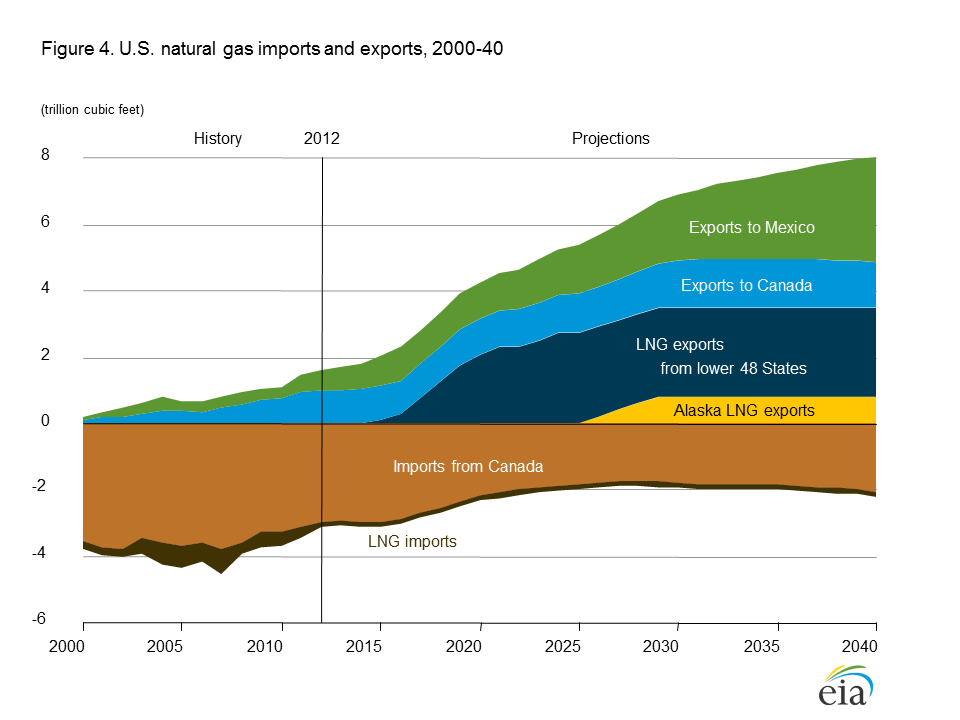
Exports of liquefied natural gas (LNG) would also take off, accounting for around 9% of US production by 2040, while imports of pipeline gas from Canada would shrink but not disappear. In the high resource case, US LNG exports would grow dramatically until the late 2030s, reaching 20% of a much bigger supply.

The report provides a few surprises, including one that won't be welcomed by advocates of biofuels and a continuation of the current federal Renewable Fuels Standard, the reform of which has gradually become a topic of lively debate in the US Congress. EIA's figures show total US biofuel consumption growing by less than 1% per year, with ethanol's only real growth coming in the form of a modest increase in sales of E85, a mixture of 85% ethanol and 15% gasoline, to around 3% of gasoline demand in 2040.

Overall, I'm struck by several things. First, the value of the EIA's forecasts comes mainly from identifying the implications of current trends and policies, rather than accurately predicting the future. Administrator  Sieminski seemed appropriately humble about the latter task in his remarks at CSIS. Yet the reference case this time suggests an eventual reversion to pre-oil-crash conditions, ending in 2040 at the same oil price in 2013 dollars as last year's forecast--a level that would exceed the 2008 peak by a sizeable margin. That seems inconsistent with a world of expanding energy options, improved drilling efficiency, at least for shale, and a growing focus on the decarbonization of energy.

There also appears to be a disconnect between the forecast's rising real price of natural gas, with implications for the cost of electricity generation, and its virtual flatlining of solar power's expansion after the scheduled expiration of the current solar tax credit in 2016. This looks like a bet against further solar cost reductions and technology improvements, along with structural changes that are already occurring in some electricity markets.

Despite these reservations, I wouldn't dispute the headline finding of steady progress toward a version of US energy independence featuring large volumes of energy trade with both North America and the rest of the world. The combination of resource growth and steady energy efficiency improvements looks like a recipe for finally putting the US on an energy footing that politicians of both major parties have only dreamed of for the last 40 years.
 
A different version of this posting was previously published on the website of Pacific Energy Development Corporation

Tuesday, July 29, 2014

Bakken Shale Gas Flaring Highlights Global Problem

  • High rates of natural gas flaring in the Bakken shale formation are symptomatic of infrastructure limitations that prevent this gas from reaching a market.
  • Although various technical options could reduce flaring from high-output well sites, none matches the benefits of developing large-scale outlets for the gas.
The Wall St. Journal recently reported on the high rate at which excess natural gas from wells in North Dakota's Bakken shale formation is burned off, or "flared."  The Journal cited state data indicating 10.3 billion cubic feet (BCF) of gas were flared there during April 2014. That represented 30% of total gas production in the state for the month.

North Dakota's governor attributed the high volume of gas flared in his state to the great speed at which the Bakken shale has been developed, outpacing gas recovery efforts. Oil output ramped up from 200,000 barrels per day five years ago to just over a million today, in a region lacking the dense oil and gas infrastructure of Texas and other states with a legacy of high production.

Nor is this situation unique to the Bakken. The World Bank has estimated that around 14 BCF of gas is flared every day, globally. Such flaring is a problem for more than governments and other mineral-rights owners that worry about missing potential royalties.  Aside from our natural aversion to waste, flaring natural gas has environmental consequences.

The tight oil produced from the Bakken shale is quite low in sulfur, and so is most of the associated gas, but some of it contains relatively high percentages of hydrogen sulfide (H2S). When that gas is flared, rather than processed, the resulting SOx emissions can affect local or even regional air quality.

Gas flaring also contributes to the greenhouse gas emissions implicated in global warming, although it must be noted that flaring is 28-84 times less climate-altering, pound for pound, than venting the same quantity of methane to the atmosphere.  When annualized, and assuming complete combustion of the gas, North Dakota's recent level of flaring equates to around 6.7 million metric tons of CO2 emissions, or nearly a fifth of total estimated US CO2 emissions from natural gas systems in 2012. That means this one source accounts for around 0.1% of total US greenhouse gas emissions, or somewhat less than US ammonia production.

Why would anyone flare gas in the first place? As the Journal pointed out, the oil produced from Bakken wells is worth significantly more than the gas, although the energy-equivalent price ratio favors oil by more like 4:1 than the 20:1 cited in the article. Still, the economics of Bakken drilling are mainly driven by oil that can be sold at the lease and delivered by pipeline or rail, and not by the associated gas, particularly after tallying the cost of capturing and processing it, and then hoping capacity will be available to deliver it to a market that in the case of the Bakken might be hundreds or thousands of miles away. The characteristics of shale wells, with their steep decline curves, raise this hurdle even higher: Shale gas infrastructure at the well must pay for itself quickly, before output tails off.

There is no shortage of technical options for putting this gas to use, instead of flaring it. An industry conference in Bismarck, ND this spring featured an excellent presentation on this subject from the Energy & Environmental Research Center (EERC) of the University of North Dakota. Among the options listed by the presenter were onsite removal of gas liquids (NGLs), using gas to displace diesel fuel in drilling operations, and compressing it for use by local trucking or delivery to fleet fueling locations. However,  contrary to the intuition of the rancher interviewed by the Journal, none of these options would reduce high-volume flaring by more than a fraction, despite investment costs in the tens or hundreds of thousands of dollars per site.

Even in the case of the most technically interesting option, small-scale gas-to-liquids conversion to produce synthetic diesel or high-quality synthetic crude, EERC estimated this would divert only 8% of the output from a multi-well site flaring 300 million cubic feet per day, while requiring an investment of $250 million. And to make this option yet more challenging to implement, of the 200-plus such locations EERC identified in the state, fewer than two dozen flared consistently at that level over a six-month period. The problem moves around as older wells tail off and new ones are drilled.

Significantly reducing or eliminating natural gas flaring ultimately requires a large-scale market for the hydrocarbons being burned off. That's as true in North Dakota as in Nigeria. While various technical options could incrementally reduce gas flaring from Bakken wells, the highest-impact solutions would be those that promote market creation. That would include fast-tracking long-distance gas pipeline projects or building gas-fired power plants nearby. Absent large new customers for Bakken gas, additional regulations on flaring will either be ineffective or impede the region's strategically important oil output.

A different version of this posting was previously published on the website of Pacific Energy Development Corporation.

Friday, July 18, 2014

Condensate Pries Open the Oil Export Lid

  •  A US ruling to allow limited exports of condensate, a light hydrocarbon mix similar to light crude oil, has implications for both producers and refiners, though not consumers.

  • Whether or not it leads to wider US exports of condensate and crude, it signals just how much the US energy situation has changed since the oil export ban was first imposed.

Last month we learned that the US Commerce Department gave two US companies permission to export condensate that would otherwise be trapped here under a 1970s-vintage ban on US oil exports. This validates the view, as described in a white paper from the office of Senator Lisa Murkowski (R-AK) earlier this year, that the administration has the statutory authority necessary to allow such exports. An entire session at this week's annual EIA Energy Conference was devoted to the details of this ruling, and whether it paves the way for broader exports of a growing US surplus of condensate and light sweet crude oil.

Over the past several decades US refineries invested an estimated $100 billion to enable them to process the increasingly heavy and sour crude oil types available for import. As a result, most US refineries, particularly on the Gulf and west coasts, are no longer equipped to run large volumes of the extremely light condensates and oils now coming from onshore shale deposits. Allowing producers to achieve world-market prices for their output should boost the economy and raise tax receipts, yet is unlikely to harm consumers.

Condensates are a class of hydrocarbons distinct from crude oil, though they share enough oil-like characteristics frequently to be lumped in with the latter, as in US export regulations. The technical definition of condensates encompasses both the “natural gasoline” extracted during the processing of natural gas produced from oil fields (“associated gas”,) as well as the heaviest liquids separated from “non-associated” gas, i.e. from gas fields, rather than oil fields.

The condensate being exported in this case comes mainly from liquids-rich shale deposits like the Eagle Ford in Texas, which produces varying proportions of dry gas, “wet” gas containing NGLs and condensate, and crude oil, depending on well location. Condensate apparently accounts for around 20-40% of Eagle Ford “tight oil” output.

Condensate mainly consists of natural gas liquids like ethane, propane and butane, along with substantial quantities of naphtha, a low-octane mix of hydrocarbons that boils in the gasoline range, plus much smaller proportions of diesel and heavier “gas oils” than would be typical of crude oil. The naphtha in condensate can sometimes be blended into gasoline, depending on its specific qualities, or processed in a refinery to yield higher-quality gasoline components.

Subsequent to the phase-out of tetraethyl lead, most gasoline from US refineries has been a blend of higher-octane naphtha produced by catalytic cracking units and the “reformate” from catalytic reforming units, with provision for further blending during distribution with up to 10% ethanol. Last month US refineries set an all-time record for gasoline production, at over 10 million barrels per day. They are unlikely to miss the naphtha exported in condensate.

Historically, the global market for condensate has had important distinctions from the broader crude oil market, based on the inherent characteristics of these liquids and the end-users seeking them. Refiners running mainly heavy oils sometimes buy condensate for blending, to lighten their average inputs and fill gaps in their processing capacities.

With the Gulf Coast now drowning in light “tight oil” from shale, this is becoming too much of a good thing, as refiners increasingly have more light material in their feedstock than their facilities can easily handle. One presenter at the EIA conference described the situation as building toward a "day of reckoning", when the discounts required to induce US refiners to process excess light crude instead of imported heavier crude would reach the level at which producers must throttle back oil production. Another expert with whom I spoke was adamant that that day of reckoning has already arrived. One result is investment in new facilities to provide minimal processing–really just distillation–for condensate.

By contrast, petrochemical producers, particularly in Asia, are expected to import growing volumes of condensate for use in the production of olefins like ethylene and propylene, and aromatics like toluene and benzene, from which to make plastics, solvents and other petrochemicals. In that market, US condensate will compete with condensate from other gas producing nations, and with exports of refinery naphtha from Europe and elsewhere. This looks like a good opportunity for US producers.

Some advocates of lifting the ban on crude oil exports see the Commerce Department’s ruling as a precedent for allowing exports of all types of oil, or at least a good first step. However, other reports have focused on this ruling as an end-run around the export rules by redefining minimally processed condensates as a petroleum product, and thus exempt from the ban. In that view, the resulting precedent from condensates for exports of true crude oil may be weaker than that from ongoing, permitted oil exports to Canada.

Either way, allowing condensate exports is a smart move that, if continued, should ease crude congestion on the Gulf Coast and reduce the discounts that could make domestic oil less economical to produce, to the benefit of foreign suppliers. It might even push the problem beyond the current election year and enable Congress to consider normalizing all oil exports without the inhibiting effect of populist pressures at the polls. In the meantime, you can bet these condensate exports will be closely scrutinized for any noticeable effects, good or bad.

A different version of this posting was previously published on Energy Trends Insider.

Thursday, June 19, 2014

EPA's New CO2 Rules Create Opportunities for Natural Gas, for Now

  • EPA's proposed rule for reducing CO2 emissions from power plants could increase natural gas demand in the utility sector by as much as 50%, at the expense of coal.
  • Cutting emissions by regulation rather than legislation entails legal and political uncertainties that could hamper the investment necessary to meet EPA's targets.
Earlier this month the Environmental Protection Agency announced its proposal for regulating the greenhouse gas emissions from all currently operating US power plants. Unsurprisingly, initial assessments suggested it favors the renewable energy, energy efficiency and nuclear power industries--and especially natural gas--all at the expense of coal. However, the longer-term outcome is subject to significant uncertainties, because of the way this policy is being implemented.

EPA's proposed "Clean Power Plan" regulation would reduce CO2 emissions from the US electric power sector by 25% by 2020 and 30% by 2030, compared to 2005. Although it does not specify that the annual reduction of over 700 million metric tons of CO2--half of which had already been achieved by 2012--must all come from coal-burning power plants, such plants accounted for 75% of 2012 emissions from power generation.

It's worth recalling how we got here. In the last decade the US Congress made several attempts to enact comprehensive climate legislation, based on an economy-wide cap on CO2 and a system of trading emissions allowances: "cap and trade." In 2009 the House of Representatives passed the Waxman-Markey bill, with its rather distorted version of cap and trade. It died in the US Senate, where the President's party briefly held a filibuster-proof supermajority.

The Clean Power Plan is the culmination of the administration's efforts to regulate the major CO2 sources in the US economy, in the absence of comprehensive climate legislation. Although Administrator McCarthy touted the flexibility of the plan in her enthusiastic rollout speech and suggested that its implementation might include state or regional cap and trade markets for emissions, the net result will look very different than an economy-wide approach.

For starters, there won't be a cap on overall emissions, but rather a set of state-level performance targets for emissions per megawatt-hour generated in 2020 and 2030. If electricity demand grew 29% by 2040, as recently forecast by the Energy Information Administration of the US Department of Energy, the CO2 savings in the EPA plan might even be largely negated. EPA is banking on the widespread adoption of energy efficiency measures to avoid such an outcome.

Since we have many technologies for generating electricity, with varying emissions all the way down to nearly zero, many different future generating mixes could achieve the plan's goals, though not at equal cost or reliability. Ironically, since coal's share of power generation has declined from 50%  in 2005 to 39% as of last year, it could be done by replacing all the older coal-fired power plants in the US with state of the art plants using either ultra-supercritical pulverized coal combustion (USC ) or integrated gasification combined cycle (IGCC). 

That won't happen for a variety of reasons, not least of which is EPA's "New Source Performance Standards" published last November. That rule effectively requires new coal-fired power plants to emit around a third less CO2 than today's most efficient coal plant designs. That's only possibly if they capture and sequester (CCS) at least some of their emissions, a feature found in only a couple of power plants now under construction globally.

It's also questionable how the capital required to upgrade the entire US coal generating fleet could be raised. Returns on such facilities have fallen, due to competition from shale gas and from renewables like wind power with very low marginal costs--sometimes negative after factoring in tax credits. Some are interpreting EPA's aggressive CO2 target for 2020 and relatively milder 2030 step as an indication that the latter target could be made much more stringent, later.

So while coal is likely to remain an important  part of the US power mix in 2030, as the EPA's administrator noted, meeting these goals in the real world will likely entail a significant shift from coal to gas and renewable energy sources, while preserving roughly the current nuclear generating fleet, including those units now under construction.

If the entire burden of the shift fell to gas, it would entail increasing the utilization of existing natural gas combined cycle power plants (NGCC) and likely building new units in some states. In the documentation of its draft rules, EPA cited average 2012 NGCC utilization of 46%. Increasing utilization up to 75% would deliver over 600 million additional MWh from gas annually--a 56% increase over total 2013 gas-fired generation, exceeding the output of all US renewables last year--at an emissions reduction of around 340 million metric tons vs. coal. That would be just sufficient to meet the 30% emissions reduction target for the electricity demand and generating mix we had in 2013.

The incremental natural gas required to produce this extra power works out to about 4.4 trillion cubic feet (TCF) per year. That would increase gas consumption in the power sector by just over half, compared to 2013, and boost total US gas demand by 17%. To put that in perspective, US dry natural gas production has grown by 4.1 TCF/y since 2008.

EPA apparently anticipates power sector gas consumption increasing by just 1.2 TCF/y by 2020, and falling thereafter as end-use efficiency improves.  Fuel-switching is only one of the four Best System of Emission Reduction "building blocks" EPA envisions states using, including efficiency improvements at existing power plants, increased penetration of renewable generation, and demand-side efficiency measures. The ultimate mix will vary by state and be influenced by changes in gas, coal and power prices.

I mentioned uncertainties at the beginning of this post. Aside from the inevitable legal challenges to EPA's regulation of power plant CO2 under the 1990 Clean Air Act, its imposition by executive authority, rather than legislation, leaves future administrations free to strengthen, weaken, or even abandon this approach.

Since EPA's planned emission reductions from the power sector are large on a national scale (10% of total US 2005 emissions) but still small on a global scale (2% of 2013 world emissions) their long-term political sustainability may depend on the extent to which they succeed in prompting the large developing countries to follow suit in reducing their growing emissions.

A different version of this posting was previously published on the website of Pacific Energy Development Corporation.

Wednesday, June 11, 2014

Will Russia's Gas Deal with China Block Other Suppliers?


  • The recent natural gas deal between Russia and China involves volumes comparable to the gas production of the US Gulf of Mexico.
  • Barring a major economic slowdown, meeting China's projected growth in gas demand will require this Russian gas, more LNG imports, and China's own shale gas.
 
$400 billion deals aren't announced every week--even by heads of state--although the new natural gas supply agreement between Russia and China had been in the works for some time. However, the crucial element of price apparently wasn't agreed until a negotiating session that lasted until 4:00 AM, Shanghai time. "Our Chinese friends are difficult, hard negotiators," said President Putin. They certainly waited for the right moment, with Russia pressed by sanctions in the aftermath of its annexation of Crimea.

The numbers are all impressive: After investing more than $50 billion in gas field and pipeline development in Eastern Siberia, Russia will sell 38 billion cubic meters (BCM) of gas per year to China for 30 years, and China will reportedly invest $20 billion for gas infrastructure and market development within its borders. Deliveries are set to start in 2018 and could eventually ramp up to 60 BCM/yr.

To put that in perspective, 38 BCM/yr equates to 3.7 billion cubic feet (BCF) per day. That's on par with the entire natural gas production of the Eagle Ford shale formation in south Texas, or the federal waters of the Gulf of Mexico.  Of greater relevance is that it's also nearly twice the output of Australia's Gorgon LNG project, which is expected to begin production in 2015. So from the perspective of the regional gas market and alternative supplies, this is a very significant quantity of gas, especially with a number of new Australian LNG projects under development or consideration.

As of 2012 China's gas market was already the largest in Asia, ahead of Japan, based on BP's annual Statistical Review of World Energy. This deal represents 27% of China's current gas demand, so it's tempting to conclude that squeezing Russian gas into China must come at the expense of other potential suppliers. If China's gas market were mature, such a zero-sum view could not be ignored, particularly by marginal LNG projects in Australia, Indonesia and the US that have not yet begun construction.

Competition with Russian gas could also impede development funding and access to infrastructure for China's nascent shale gas industry. The US Energy Information Administration's 2013 global survey of technically recoverable shale resources found that China could have over a quadrillion cubic feet--1,115 TCF--of shale gas in the ground, or nearly twice as much as the US. Yet China's progress in tapping this resource has been slow, and hardly a week goes by without another article explaining why it will be difficult if not impossible for others to replicate the US shale gas boom any time soon.

The growth of demand will largely shape the competitive environment for gas in China. In 2012 natural gas accounted for less than 5% of the country's total primary energy consumption, compared to 13% for Taiwan, 17% for South Korea and 22% for Japan, none of which are significant gas producers. From 2007-12 China's gas market grew at a compound average rate of 15% per year. In their just-released Medium-Term Gas Market Report, the International Energy Agency (IEA) forecasts China's gas demand growing by 90% by 2019, while their latest World Energy Outlook anticipated it tripling by 2025 and quadrupling by 2035, eventually reaching 11% of energy consumption. Achieving that would require the equivalent of ten gas deals the size of this one.

That outcome isn't a certainty, for many reasons. Having all that gas turn up at the right time poses a massive logistical and capital investment challenge, and China's economy might slow further. Meanwhile, the price implied in the media coverage of the Russia/China deal is around $350 per 1000 cubic meters ($10 per million BTUs) or more than double the current US wellhead price. That's a lot cheaper than most of the LNG delivered to Asia, but it won't outcompete Chinese coal on economics alone, and it won't jump-start new, gas-reliant industries the way the US shale gas revolution is beginning to do.

The scale of market development implicit in the IEA's forecasts for China would require a substantial expansion of gas-fired power generation, which in any case is the logical complement to China's aggressive expansion of wind and solar power installations. It also entails a significant shift from solid and liquid heating and cooking fuels to gas, where at least in the case of liquids, $10 gas would have the edge over products derived from $100 oil. It might even encompass gas-based distributed power generation using fuel cells, which is still in its infancy in the US. Such developments will benefit all potential suppliers, not just Russia.

It's also worth considering what this deal means for Russia. While many reports have suggested it provides a counterweight to Russia's dependence on the European gas market, that's really only true in a financial sense. The deal represents a major growth opportunity for Gazprom, Russia's majority-state-owned natural gas company, but this isn't the same gas that now supplies the EU. It will mainly be production from new gas fields. The potential upside for Russia may depend on its ability to leverage the infrastructure built for this deal into a larger gas network for supplying growth throughout Asia--in competition with US and other LNG projects eyeing that market.

"Milestone" is an over-used term, but it fits this deal. If the parties can iron out all the remaining details and proceed to construction and ultimately delivery, it could prove to be a key step in giving gas a much bigger role in fueling Asia's growth. That would have important environmental benefits, in both mitigating the air pollution in Asia's major cities and reducing carbon emissions, perhaps by enough to bend the curve of the region's greenhouse gas growth.
 
A different version of this posting was previously published on the website of Pacific Energy Development Corporation.

Tuesday, April 15, 2014

ABCs of LNG

  • Current debates over LNG export often ignore its primary benefits, such as enabling gas to be produced for sale to markets beyond the realistic reach of pipelines.
  • It also allows gas to compete with petroleum liquids where energy density is important, such as in powering ships, trains and land vehicles.  
The international reaction to Russia's annexation of Ukraine's Crimean peninsula has put a spotlight on liquefied natural gas (LNG), which was already under debate in the US as a mechanism for exporting increasingly abundant shale gas. Meanwhile, LNG is emerging as a fuel in its own right, rather than just a means of transporting gas from source to market. What links these trends is LNG's capability to enable natural gas to approach the convenience and energy density of petroleum.

The big driver for this is economic: UK Brent crude is currently over $100 per barrel, while natural gas in the US Gulf Coast trades at the energy equivalent of around $25 per barrel. That creates a significant incentive to build LNG plants, despite the recent escalation in their cost. Even after adding the equivalent of $20-30/bbl in expenses for liquefaction, shipping, and regasification to convert the LNG back into pipeline gas at its destination, the opportunity is significant. In Asia, where LNG sells for $14 or $15 per million BTUs, that's still less than $90 per equivalent barrel. And because gas can only be produced if it can be connected to a market, LNG enables more gas to compete in more markets, while providing customers a cleaner and cheaper fuel.

This is not a new technology. Early demonstrations in the 1940s and '50s were followed by commercial-scale plants built to export LNG from Alaska, Algeria and Indonesia, establishing what has since become a global industry. Every LNG plant is designed to take advantage of the fact that at atmospheric pressure natural gas becomes a liquid at -259 °F ( -161 °C)--about 60°F warmer than liquid nitrogen--shrinking by a factor of 600:1 in the process. As long as it is kept below that temperature, it can be stored and transported as a liquid.

That has important advantages over the alternative of compressing natural gas to create a denser fuel. For example, a gallon of LNG has around 2.2 times as much energy (based on lower heating values) as the same volume of compressed natural gas (CNG) at 3,000-3,600 pounds per square inch (psi). A gallon of LNG also has 98% of the energy of ethanol, and 64% that of gasoline. This makes LNG dense enough to transport economically over long distances, unlike CNG.

These differences have a practical impact on the gradual penetration of the transportation fuel market by natural gas. While most natural gas passenger cars are based on the simpler CNG approach, LNG is gaining a foothold in trucking, particularly where the combination of low emissions and denser fuel--yielding longer range--is important.

LNG is also emerging as an option for transportation modes that have had few viable alternative to oil-based fuels, such as in shipping and even rail where electrification is impractical. Replacing ships' bunker fuel with LNG could be a key strategy for responding to increasingly strict international regulations on sulfur and nitrogen oxide pollution from ocean-going vessels.

The environmental benefits of LNG can be significant, when it replaces higher-emitting fuels like coal and fuel oil. Even after accounting for the energy consumed in the liquefaction process-- equivalent to 8% or less of the gas input to a new LNG plant--and in storage and transportation, lifecycle emissions from LNG in power generation are 40-60% lower than those from coal. Its advantage in marine engines is smaller, but still positive at around 8%, while reducing local pollution significantly.

LNG isn't without drawbacks, including "boil-off", the gradual tendency of LNG in storage to evaporate due to heating from the environment outside the insulated tank. In stationary facilities the resulting gas can either be re-liquefied or delivered to meet local gas demand. In vehicles, it is vented after a specified holding time of around a week or more. That makes it more suitable for vehicles that are used frequently, rather than sitting idle for extended periods.

It's worth noting that while LNG is increasingly linked to shale gas in North America, nearly all the LNG currently marketed around the world is produced from conventional gas reservoirs, such as the supergiant North Field in Qatar, or the gas fields of Australia's North West Shelf. That would also be the case for a new LNG plant based on Alaskan North Slope gas, as described in a post here in 2012.

Only a few years ago, government and industry forecasts were unanimous in projecting a large and growing US LNG import requirement, as domestic gas production declined. The number of US LNG import facilities expanded to meet this new demand, but the combination of the recession and the shale gas revolution has resulted in imports shrinking substantially since 2007. The Energy Information Administration now expects the US to become a net exporter of LNG in 2016, including exports from repurposed import facilities. They will join a market that now supplies around 10% of global natural gas consumption and accounts for a third of global gas trade.

A different version of this posting was previously published on the website of Pacific Energy Development Corporation.

Wednesday, April 09, 2014

Fuel Cell Cars and the Shale Revolution

  • Although fuel cell cars have perpetually seemed to be the technology of tomorrow, carmakers’ persistence with them could still pay off, as a dividend from shale gas.

  • Significant obstacles remain, including inadequate hydrogen infrastructure and competition from greatly improved vehicle batteries. However, the race is far from over.

As I was working off my reading backlog, I ran across an article in the Washington Post’s “Capitol Business” edition on “Are We Ready for Hydrogen Cars?” Published in conjunction with this year’s DC Auto Show, which I missed, it mentioned a new fuel cell model from Hyundai for the California market, while providing some background on a technology that looked much more like the next big thing a decade ago than it does to many, now.

Any evaluation of the prospects for fuel cell cars to become practical requires discussing the cost of fuel cell components, the infrastructure to deliver H2 to vehicles, and the suitability of various options for storing it safely onboard. However, I was surprised the article failed to mention a new factor that might do more than anything else to improve the odds for this technology: shale gas.

In the mid-1990s, when fuel cell vehicles (FCVs) first appeared on my radar, they seemed like an ideal alternative to the gasoline engines in most passenger cars, offering zero tailpipe emissions and very low lifecycle, or well-to-wheels emissions of all types. Onboard hydrogen (H2) storage, whether as a gas, liquid or chemically adsorbed in another material, enabled higher energy density than then-current batteries, giving an FCV significantly greater potential range than a comparable electric vehicle (EV). And like electric cars, they also provided a useful pathway for bringing energy from a wide variety of sources into the transportation market, which was and still is dominated by petroleum products. Cost and technology readiness were big barriers, along with non-existent retail H2 infrastructure.

Energy remains the key to FCVs, because H2 is an energy carrier, not an energy source. Standing up a competitive fleet of FCV models thus requires plentiful and preferably low-cost energy sources from which sufficient H2 can be produced and distributed. As recently as just a few years ago, this looked like a very tough challenge.

Most H2 used industrially is generated by chemically reforming natural gas. Until recently, US gas production was in decline, resulting in high and volatile gas prices. Generating H2 from electricity looked even worse, because power prices were climbing and seemed likely to increase steadily in the future, as natural gas prices rose and higher-cost renewables were phased in. And with US electricity generation dominated by coal, H2 from electrolysis–cracking water into its components using electricity–looked like a recipe for merely shifting, rather than reducing vehicle emissions.

Like many other aspects of the North American energy scene, this picture has changed radically in the last several years, mainly due to the shale gas revolution. We now have abundant gas at reasonable prices, and this is holding down electricity costs. (Renewables are also reducing wholesale electricity prices, though not necessarily the full cost of electricity, because they still depend on subsidies and mandates that don’t show up in wholesale prices.)

These developments create the potential for cheaper H2 sources than fuel cell developers expected. Moreover, US natural gas prices have diverged from oil prices and are now at a significant discount to oil. Wellhead gas today trades for the equivalent of $25 per barrel, compared to oil at over $100. Gas-derived H2 could end up with advantages in both cost and end-use efficiency over gasoline.

Of course the availability of natural gas isn’t the only thing that has changed for fuel cells in the last decade, from a competitive perspective. Automakers such as GM, Toyota and Honda have introduced various new fuel cell models. The most recent one I had an opportunity to drive was a fuel-cell version of the Chevrolet Equinox compact SUV in late 2007. In the meantime, though, EV models are proliferating.

Unfortunately for fuel cell developers, H2 distribution has had a somewhat checkered history, as the Washington Post article notes. Providing fuel for FCVs is a much more involved and expensive undertaking than setting up a network of recharging points for EVs. How many H2 stations will suppliers build before FCVs appear in large numbers, and how many FCVs can carmakers sell before sufficient infrastructure is available to serve them? California still has just a handful of public H2 stations, after years of development.

Energy trade-offs dominate the competition between FCVs and EVs. The former have longer ranges between refueling than moderately-priced EVs–the Tesla Model S has excellent range–and can be refueled in much less time than even high-voltage EV recharging can achieve. However, FCVs are much more dependent on refueling infrastructure than EVs, which can recharge at home. And thanks to robust federal support for battery R&D and production, including from the 2009 stimulus, along with extremely generous federal and state EV tax credits, EVs have gained significant awareness and initial market penetration since the current administration took office and scaled back federal support for fuel cells.

EVs may have an edge over fuel cell cars, for now, but EV sales remain disappointing and they must compete with more convenient, mainstream hybrid cars, with and without plug-in capability. They must also compete with conventional gasoline and diesel cars that are becoming more efficient every year, reducing EVs’ advantages in operating costs and lifecycle environmental impacts. Given all that, there’s still ample time for another technology like FCVs–or natural gas vehicles (NGVs)–to scale up, if they can reduce costs quickly enough and overcome infrastructure hurdles. Those are big ifs.

Nor is it the case that EVs and FCVs are mutually exclusive in the automotive market. Fuel cell cars are fundamentally electric vehicles, too, and most will likely be offered as hybrids, with regenerative braking and traction batteries. So advances in EV architecture, battery capacity and cost, and safety also benefit FCVs. That makes it seem even likelier that our future vehicle mix will be quite diverse, with EVs and FCVs coexisting with NGVs, various hybrids, and much more efficient gasoline and diesel models than today’s.

A different version of this posting was previously published on Energy Trends Insider.

Thursday, April 03, 2014

Environmental Groups Gear Up to Stop US LNG Exports

  • The Sierra Club and other groups are taking on US LNG exports just when LNG is gaining support as a key response to Russia's aggressive behavior in Ukraine.

  • The science behind their claims does not withstand scrutiny, and their timing couldn't be worse, geopolitically.

A collection of environmental groups, including the Sierra Club, Friends of the Earth and 350.org recently wrote to President Obama, urging him to require a Keystone-XL-style environmental review--presumably entailing similar delays--for the proposed Cove Point, Maryland liquefied natural gas (LNG) export terminal. Given the President’s explicit support for wider natural gas use and the administration's new commitment to our European allies to enable LNG exports, the hyperbole-laden letter seems likelier to rev up the groups’ activist bases than to influence the administration’s policies.

Either way, its timing could hardly be coincidental, coming just as opinion leaders across the political spectrum have seized on LNG exports as a concrete strategy for countering Russian energy leverage over Europe in the aftermath of President Putin’s seizure of Crimea. If, as the Washington Post and energy blogger Robert Rapier have suggested, the Keystone XL pipeline is the wrong battle for environmentalists, taking on LNG exports now is an even more misguided fight, at least on its merits.

Referring to unspecified ”emerging and credible analysis”, the letter evokes the thoroughly discredited argument that shale gas, pejoratively referred to here as “fracked gas”, is as bad or worse for the environment as coal. In fact, in a similar letter sent to Mr. Obama one year ago, some of the same groups cited a 2007 paper in Environmental Science & Technology that clearly showed that, even when converted into LNG, the greenhouse gas (GHG) emissions of natural gas in electricity generation are still significantly lower than those of coal, despite the extra emissions of the liquefaction and regasification processes.

The current letter also implies that emissions from shale gas are higher than those for conventional gas, a notion convincingly dispelled by last year’s University of Texas study, sponsored by the Environmental Defense Fund, that measured actual, rather than estimated or modeled, emissions from hundreds of gas wells at dozens of sites in the US.

It’s also surprising that the letter’s authors would choose to cite the International Energy Agency’s 2011 scenario report on a potential “Golden Age of Gas” in support of their claims. That’s because the IEA’s analysis found that the expanded use of gas foreseen in that scenario would reduce global emissions by 160 million CO2-equivalent tons annually by 2035, mainly through competition with coal in power generation in developing countries, addressing the principal source of global greenhouse gas emissions growth today.

The groups take another wrong turn in suggesting that President Obama increase support for wind and solar power instead of supporting gas. The contribution of new renewables to the US energy mix has grown rapidly, thanks to significant federal and state support, but it remains small. Despite record US wind turbine and solar power additions, shale gas and shale oil added more than 20 times as much energy output on an equivalent basis in 2012, and last year’s gains look similarly disproportional. Simply put, the US isn’t enjoying a return to energy security or becoming a major energy exporter because of renewables. It is counterproductive for renewables to pit them against gas as they have done here.

Experts disagree on how much and how quickly US LNG exports can influence gas markets in Europe and elsewhere. Yet while none of the currently permitted or proposed LNG facilities will be ready to ship cargoes until at least late next year, the knowledge that they are coming will inevitably have an impact on traders and contracts, including contracts for Russian gas in the EU. Whether or not US natural gas molecules ever reach Europe, they can serve a useful role in the necessary response to Russia’s aggression in Ukraine. Attempting to block this for spurious reasons puts opponents in jeopardy of becoming what Mr. Putin in his previous career might have called “useful idiots.”

It’s tempting to speculate on what this new campaign says about the participating groups’ perceptions of how the Keystone XL fight is going. Win or lose, they might soon need a new cause, or face the dispersal of the protesters and financial contributors it has galvanized. Blocking LNG may look conveniently similar--even if similarly mistaken--but I can’t help feeling these groups would gain more traction with their fellow citizens by focusing on what they are for, rather than expending so much energy in opposition.

A different version of this posting was previously published on Energy Trends Insider.

Friday, March 28, 2014

How Can US Natural Gas Reduce Europe's Dependence on Russia?

  • The EU's dependence on Russian natural gas is directly linked to its own gas production, which has fallen faster than EU member countries' demand for gas.
  • While US LNG exports aren't an immediate remedy, due to permitting and construction time lags, the prospect of their availability is already affecting the gas market.
Russia's annexation of Ukraine's Crimean Peninsula has drawn new attention to Europe's reliance on energy supplies from Russia, particularly for natural gas. Lacking the means to force Russia's president to back down, US politicians and leading newspapers have latched onto the idea of exporting shale gas to reduce the EU's vulnerability to an accidental or intentional disruption of these supplies.  The efficacy of this strategy depends on more than the logistics and timing of US liquefied natural gas (LNG) projects.

The European Union is expected to import 15.5 billion cubic feet (BCF) per day of natural gas from Russia this year, roughly half of which would normally be transported by pipelines passing through Ukraine. Worries about the security of these supplies in the current crisis are compounded by Europe's increasing reliance on gas imports from all sources.

While EU gas consumption, based on the union's 28 current member countries, has been essentially flat over the last decade, its production has declined by more than a third, as shown in the chart below. As of the end of 2012, EU self-sufficiency in gas stood at just 35%. The widening of the gap between EU gas demand and production bears a close resemblance to the situation in which the US found itself with regard to crude oil prior to the shale revolution, and it is the main source of Europe's vulnerability in natural gas.

After Russia, the EU's main gas suppliers are Norway and Algeria, primarily by pipeline, followed by LNG sourced from Qatar, Nigeria and other countries.  Russia's leading role in supplying Europe's gas is consistent with its status as the world's second-largest gas producer and largest gas exporter, its proximity to the EU, and its pipeline network developed over multiple decades. Europe's gas supply mix includes ample political risk, but none of the EU's other suppliers are geopolitical rivals like Russia.

The EU has three main options for reducing its dependence on gas imports from Russia. It could shrink natural gas consumption, which is already happening to a modest degree as pricey gas-fired power generation is being squeezed out between subsidized wind and solar power and cheaper coal power, in a mirror image of US trends of the last several years.  This seems inconsistent with the EU's long-term emission goals and its need for gas to back up intermittent renewable electricity generation, so the further scope for this option appears limited, at least for the next decade.

EU countries could also attempt to revive domestic gas production. Europe's conventional gas fields may be in decline, other than in non-EU Norway, but its shale gas potential was estimated at 470 trillion cubic feet (TCF) in the US Energy Information Administration's global shale assessment last year. That's about 40% bigger than Europe's reserves and technically recoverable resources of conventional gas. Uncertainties on this estimate are still large, but it's in the same ballpark with the Marcellus shale in the eastern US, which currently produces over 14 BCF/day.

Unfortunately, initial efforts in Poland's shale have been disappointing, while Germany, France, and other countries have imposed explicit or implicit moratoria on shale gas development. Unless these policies are reversed in the aftermath of the Ukraine crisis, the EU will be unable to grow its way out of its dependence on Russia.

That leaves import diversification as the likeliest path for weaning Europe off Russian gas. This process is underway incrementally, hastened by previous Russian gas brinksmanship. Interest in US gas is understandable on many levels, not least because even after increasing production by around 17 BCF/day since 2006, US shale resources are expected to add another 13 BCF/day by 2020.

Energy experts have been quick to point out that the first US LNG exports won't be available for at least several years, and that companies, rather than governments, are the main parties involved in gas contracts. Customers in Europe will have to compete for US and other LNG supplies with customers elsewhere, especially in Asia, where China's gas demand is growing and Japan's post-Fukushima nuclear shutdowns have dramatically increased LNG imports.

These constraints are real. However, they ignore the ways in which changing the market's expectations about future LNG supplies--and potentially prices--could affect the calculations of Europe's gas buyers today and limit the political leverage that Russia's dominant gas export position conveys. Anecdotal reports suggest that US LNG is already a factor in contract renegotiations in Eastern Europe. As Amy Myers Jaffe of UC Davis and formerly the Baker Institute tweeted a few weeks ago, "it isn't about physical LNG cargo to Europe; it is about US exports promoting market liberalization (and) greater liquidity." 

 A decision by the US government to streamline the permitting and development of LNG facilities wouldn't enable US exports to displace Russian gas in Europe this year or next, but it would put Russia on notice that in the future it must compete in a market in which gas customers in Europe and elsewhere will have much greater choice. That would certainly complicate President Putin's plans.
 
A different version of this posting was previously published on the website of Pacific Energy Development Corporation.

Monday, January 20, 2014

Converting Coal to Synthetic Natural Gas in China

  •  With so much attention focused on China's shale gas potential, its growing synthetic natural gas industry is a wild card.

  • In light of China's severe air quality problems,  trading smog for higher CO2 emissions is an understandable choice, but one with global implications.

In its latest Medium-Term Coal Market Report the International Energy Agency (IEA) forecasts a slowing of coal demand growth but no retreat in its global use. That won’t surprise energy realists, but the item I wasn’t expecting was the reference in the IEA press release to growing efforts in China to convert coal into liquid fuels and especially synthetic natural gas (SNG).  It’s not hard to imagine China’s planners viewing SNG as a promising avenue for addressing the severe local air pollution in that country’s major cities, but the resulting increase in CO2 emissions could be substantial. It could also affect the economics of natural gas projects around the Pacific Rim.

Air quality in China’s cities has fallen to levels not seen in developed countries for many decades. There’s even a smartphone app to help residents and visitors avoid the worst exposures. Much of this pollution, in the form of oxides of sulfur and nitrogen and particulate matter, is the result of coal combustion in power plants. Although China is adding wind and solar power capacity at a rapid clip, after years of exporting most of their solar panel output, the scale of the country’s coal use doesn’t lend itself to easy or quick substitution by these renewables.

Natural gas offers a lower-emitting alternative to coal on a larger scale than renewables. Existing coal-fired power plants could be converted to run on gas or replaced with modern combined-cycle gas turbine power plants. Gas-fired power plants emit up to 99% fewer local, or “criteria” pollutants than coal plants, especially those with minimal exhaust scrubbing.

Unfortunately, China doesn’t have enough domestic natural gas to go around. Despite potentially world-class shale gas resources and the rapid growth of coal-bed methane and more conventional gas sources, natural gas supplies only 4% of China’s energy needs. Imported LNG can help fill the gap, but it isn’t cheap. What China has in abundance is coal. Converting some of it to SNG could boost China’s gas supply relatively quickly–perhaps faster than the country’s shale gas infrastructure and expertise can gear up.

SNG is hardly a new idea; the Great Plains Synfuels Plant has been producing it in North Dakota since the 1980s. When that facility was built, natural gas prices were volatile and rising, and greenhouse gas emissions appeared on no one’s radar. The process for making SNG from coal is straightforward, and its primary building block, the gasification unit, is off-the-shelf technology. I worked with this technology briefly in the 1980s, and my former employer, Texaco, licensed dozens of gasification units in China before the technology was eventually purchased by GE. Other vendors offer similar processes.

Gasifying coal adds a layer of complexity, compared to gasifying liquid hydrocarbons but this, too, has been demonstrated in commercial operations. Most of the output of the facilities Texaco sold to China was used to make chemicals, but the chemistry of turning syngas (hydrogen plus carbon monoxide) into pipeline-quality methane is no more challenging.

This effort is already under way in China. Last October Scientific American reported that the first of China’s SNG facilities had started shipping gas to customers, with four more plants in various stages of construction and another five approved earlier this year. The combined capacity of China’s nine identified SNG projects comes to around 3.5 billion cubic feet per day, or a bit more than the entire Barnett Shale near Dallas, Texas produced in 2007 as US shale gas production was ramping up. It’s also just over a quarter of China’s total natural gas consumption in 2012, including imported LNG.

To put that in perspective, if that quantity of SNG were converted to electricity in efficient combined cycle plants their output would be roughly double that of China’s 75,000 MW of installed wind turbines in 2012, when wind generated around 2% of the country’s electricity.

The appeal of converting millions of tons a year of dirty coal into clean-burning natural gas, in facilities located far from China’s population centers, is clear. This strategy even has some similarities to one pursued by southern California’s utilities, which for years imported power from the big coal-fired plants at Four Corners.  For that matter, the gasification process has some key advantages over the standard coal power plant technologies in the ease with which criteria pollutants can be addressed. Generating power from coal-based SNG might actually reduce total criteria pollutants, rather than just relocating them.

However, wherever these plants are built they would add around 500 million metric tons per year of CO2, or around 5% of China’s 2012 emissions, a figure that dwarfs even the most pessimistic estimates of the emissions consequences of building the Keystone XL pipeline. That’s because the lifecycle emissions for SNG-generated power have been estimated at seven times those from natural gas, and 36-82% higher than simply burning the coal for power generation.

What could possibly lead China’s government to pursue such an option, in spite of widespread concerns about climate change and China’s own commitments to reduce the emissions intensity of its economy? Having lived in Los Angeles when it was still experiencing frequent first-stage smog alerts and occasional second-stage alerts, I have some sympathy for their problem. China’s air pollution causes even more serious health and economic impacts and has been blamed for over a million premature deaths each year. By comparison the consequences of greenhouse gas emissions are more indirect, remote and uncertain. Any rational system of governance would have to put a higher priority on air pollution at China’s current levels than on CO2 emissions.

It might even turn out to be a reasonable call on emissions, if China’s planners envision carbon capture and sequestration (CCS) becoming economical within the next decade. It’s much easier to capture high-purity, sequestration-ready CO2 from a gasifier than a pulverized coal power plant. (At one time I sold the 99% pure CO2 from the gasifier at what was then Texaco’s Los Angeles refinery to companies that produced food-grade dry ice.) It should also be much easier and cheaper to retrofit a gasifier for CCS than a power plant.

In an internal context the trade-off that China is choosing in converting coal into synthetic natural gas is understandable. However, that perspective is unlikely to be shared by other countries that won’t benefit from the resulting improvement in local air quality and view China’s rising CO2 emissions with alarm. I would be surprised if the emissions from SNG were factored into anyone’s projections, and nine SNG plants could be just the camel’s nose under the tent.

In an environment that the IEA has described as a potential Golden Age of Natural Gas, large-scale production of SNG could also constitute an unexpected wild card for energy markets. When added to China’s shale gas potential, it’s another trend for LNG developers and exporters in North America and elsewhere to monitor closely.

A different version of this posting was previously published on Energy Trends Insider.