In a presidential debate focused on foreign policy and the ongoing financial crisis, it was entirely appropriate that the subject of energy came up as often as it did. The two Senators discussed energy in at least three different contexts: the consequences of past energy legislation, policies to promote future energy independence, and the geopolitics of energy. Both expressed support for a broad mix of alternatives, fossil fuels, and nuclear power. The differences in their priorities might have been clearer, had either provided more details of his respective energy programs. Surprisingly, however, only Senator Obama referred directly to energy independence, a goal both men have mentioned frequently throughout their campaigns.
Longtime readers of this blog know that I regard energy independence, in its strictest definition, as an unattainable distraction from sound national energy policy in an inter-connected world. That concern is less relevant here, because the scope of Senator Obama's vision for energy independence appears to have been reduced to a goal of freeing ourselves from "dependence on Middle Eastern oil" within 10 years. Numerically, at least, that might just be feasible, since oil from the Persian Gulf accounted for only one-fifth of net US oil imports last year. The 17 billion gallons per year of additional biofuel mandated by 2018 under the current Renewable Fuels Standard would get us more than a third of the way there, after factoring in differences in energy content and refining efficiency. The phase-in of higher fuel economy standards over that period might deliver the rest, with a bit of help from the lifestyle changes that have contributed to this year's drop in demand. But that assumes that domestic US oil production would not continue to drop in the meantime. That is far from certain, and it has as much to do with government policies as it does with geology.
Between 1997 and 2007, US production of crude oil and natural gas liquids fell by 1.1 million barrels per day, an average net decline of 1.5% per year. Over the next decade, the continuation of that trend could slice another million barrels per day from our current output, making the achievement of Senator Obama's goal much harder, possibly putting it out of reach. That's why this year's drilling debate and the proposed new taxes on the oil industry are so important. Even if we can't drill our way to energy independence, we can certainly non-drill our way into even greater dependence, despite our best efforts on alternatives and fuel economy.
Senator Obama's citation Friday of the oft-quoted, though highly-misleading "3% of reserves but 25% of consumption" factoid suggests that he and his advisers should examine the dynamics of US oil production a little more closely. Perhaps they are encouraged by DOE forecasts of a modest resurgence of oil production, though history suggests those might be as optimistic as the same agency's estimate of only 200,000 barrels per day of production from the off-limits portions of the offshore seems overly pessimistic. But whether we are considering the production potential of current leases or the prospects of the estimated 18 billion barrels of additional oil that have been placed off-limits, the US oil industry's task of maintaining output at levels at least comparable to today's--amounting to 10% of the world's supply, not 3%--will be much harder, if it faces lawsuits attempting to block every new lease, or if it is subjected to new excise or windfall-profits taxes.
I look forward to hearing more about the candidates' visions for energy in the debates ahead, including more details from Senator McCain on the cost and feasibility of constructing another 45 nuclear power plants in this country. I'd also like to learn more about the role each of them sees for energy conservation, which I didn't hear mentioned last Friday. In addition, in the next few weeks I intend to take another look at each Senator's published energy plans, since I haven't reviewed these (McCain; Obama) since the primaries.
Monday, September 29, 2008

Friday, September 26, 2008
Conference Highlights
I spent the last three days at the annual energy investment conference held by the sponsor of this blog, John S. Herold, Inc. Many of the panels I attended were overshadowed by the enormous uncertainty about the US financial system and pending bailout proposals, along with the Presidential election, the dynamics of which appear to have shifted again. However, the sessions provided some very interesting insights into an important unfolding natural resource play, along with showcasing some nifty applications of existing technology that could help to narrow the gap between growing global energy demand and the stagnating supply of conventional oil.
The two words that I heard most frequently this week were “shale gas”, the development of which just might facilitate achieving some of Mr. Pickens’s ideas about energy security. This is not the kind of shale that has been touted as a nearly unlimited source of unconventional oil, but rather a layer of natural gas-bearing rock that until recently was very difficult to tap. But as several panelists explained, companies have “cracked the code” for drilling into these deposits and producing flows that compete favorably with conventional gas fields in both output and cost. The result could be a modest gas bubble—a period of relatively abundant US natural gas supplies—though it comes with an inherent price floor not far below current levels. So while it is unlikely to rejuvenate struggling gas-based industries such as fertilizer production, for which $7/MMBTU is still quite dear, it could support expanded natural gas use in both transportation and power generation, where it could yield significant environmental and cost benefits.
One of the two technologies that impressed me was featured on the Alternative Energy panel I moderated. One of the founders of DKRW Advanced Fuels described a clever application of off-the-shelf technology that turns Wyoming coal into unleaded gasoline without releasing the vast quantities of CO2 that have made coal liquefaction look unpalatable. This trick is accomplished by marrying GE’s gasification technology (the old Texaco Coal Gasification Process on which I worked briefly as a young engineer) with ExxonMobil’s methanol-to-gasoline process that operated for 10 years in New Zealand, until the natural gas field feeding it was depleted. The output is 87 Octane unleaded gasoline and a pure CO2 stream that will supply the region’s extensive enhanced oil recovery projects, which will effectively sequester it. This scheme creates a double energy benefit: mainstream liquid fuel from America’s most abundant energy resource, and increased output at some of our aging oil fields. Even better, it looks like this can be accomplished with lifecycle greenhouse gas emissions no worse than from conventional oil.
The other technology that caught my attention was presented by an old friend and former Texaco colleague, who is now the CEO of Compact GTL. Instead of using proven gas-to-liquids technology to unlock “stranded” natural gas reserves—non-associated gas deposits far from infrastructure or markets—he aims to apply it to the problem of “distressed gas.” He defines that as natural gas produced in conjunction with oil in projects for which the cost and logistics of traditional methods for handling the gas have become an obstacle to developing the oil field. Previously, such gas would be flared, but that practice is being phased out on environmental grounds. Turning it into synthetic oil could prove cheaper than re-injecting it into the ground, while also shortening the development cycle of some large oil fields. Another double win, if it proves practical.
With the country still debating the merits of expanded oil drilling and looking to renewable energy sources that have not yet achieved the scale necessary to wean us off imported oil and slash our greenhouse gas emissions, the approaches described above can provide a valuable bridge. They could also be real money-spinners, at a time when other parts of the economy are looking pretty sick.
The two words that I heard most frequently this week were “shale gas”, the development of which just might facilitate achieving some of Mr. Pickens’s ideas about energy security. This is not the kind of shale that has been touted as a nearly unlimited source of unconventional oil, but rather a layer of natural gas-bearing rock that until recently was very difficult to tap. But as several panelists explained, companies have “cracked the code” for drilling into these deposits and producing flows that compete favorably with conventional gas fields in both output and cost. The result could be a modest gas bubble—a period of relatively abundant US natural gas supplies—though it comes with an inherent price floor not far below current levels. So while it is unlikely to rejuvenate struggling gas-based industries such as fertilizer production, for which $7/MMBTU is still quite dear, it could support expanded natural gas use in both transportation and power generation, where it could yield significant environmental and cost benefits.

One of the two technologies that impressed me was featured on the Alternative Energy panel I moderated. One of the founders of DKRW Advanced Fuels described a clever application of off-the-shelf technology that turns Wyoming coal into unleaded gasoline without releasing the vast quantities of CO2 that have made coal liquefaction look unpalatable. This trick is accomplished by marrying GE’s gasification technology (the old Texaco Coal Gasification Process on which I worked briefly as a young engineer) with ExxonMobil’s methanol-to-gasoline process that operated for 10 years in New Zealand, until the natural gas field feeding it was depleted. The output is 87 Octane unleaded gasoline and a pure CO2 stream that will supply the region’s extensive enhanced oil recovery projects, which will effectively sequester it. This scheme creates a double energy benefit: mainstream liquid fuel from America’s most abundant energy resource, and increased output at some of our aging oil fields. Even better, it looks like this can be accomplished with lifecycle greenhouse gas emissions no worse than from conventional oil.
The other technology that caught my attention was presented by an old friend and former Texaco colleague, who is now the CEO of Compact GTL. Instead of using proven gas-to-liquids technology to unlock “stranded” natural gas reserves—non-associated gas deposits far from infrastructure or markets—he aims to apply it to the problem of “distressed gas.” He defines that as natural gas produced in conjunction with oil in projects for which the cost and logistics of traditional methods for handling the gas have become an obstacle to developing the oil field. Previously, such gas would be flared, but that practice is being phased out on environmental grounds. Turning it into synthetic oil could prove cheaper than re-injecting it into the ground, while also shortening the development cycle of some large oil fields. Another double win, if it proves practical.
With the country still debating the merits of expanded oil drilling and looking to renewable energy sources that have not yet achieved the scale necessary to wean us off imported oil and slash our greenhouse gas emissions, the approaches described above can provide a valuable bridge. They could also be real money-spinners, at a time when other parts of the economy are looking pretty sick.
Monday, September 22, 2008
The Low-Growth Scenario
Who would have guessed as recently as two years ago that the story that finally pushed the energy crisis off the front page would turn out to be a major global financial crisis? Of course, energy--specifically its environmental consequences, along with high oil prices--remains just as important as it was, but it must now be viewed in an entirely different economic context, the ultimate shape of which remains to be seen. The slowing of global economic growth has already resulted in lower oil prices. But if that slowdown becomes a recession, particularly one triggered by a significant tightening of credit, the expansion of both conventional and alternative energy supplies could be affected, along with investments in improved energy efficiency, including more fuel-efficient automobiles.
I've led a number of scenario projects in the last decade, many of them examining various aspects of the future of energy. One of the key steps in developing scenarios involves the identification and ranking of the main uncertainties affecting the outcome of the proposition in question. Participants will often highlight economic conditions such as growth rates and inflation, but in my experience, these have usually been trumped by other factors, including environmental regulations, energy prices, and technology. As fundamental as economic growth is to demand for energy and the capital to invest in new forms of energy, the prospect of a protracted period of low growth and tight capital simply didn't seem credible to most people, even though the last major slowdown in energy investment followed the collapse of oil prices in the late 1990s, which was triggered in part by the Asian Economic Crisis.
There are numerous ways in which a credit crunch would affect energy investment, though the notion that I keep hearing, that it would enforce an either/or choice between investing in traditional energy sources--oil, gas and coal--versus renewables is almost certainly wrong. If oil investment slows, it likely won't be because oil companies can't borrow for projects, but because falling demand and resulting lower prices make marginal projects unattractive. Particularly for the largest oil companies, who after several years of high prices have lots of cash and little remaining debt, decisions will boil down to hurdle rates and forecasts of future oil, natural gas, and refined product prices--and to their effective tax rate on profits, which is already around 40%. Most alternative energy companies are in a very different position, with large recent investments and much smaller cash flows, a significant fraction of which depend on government subsidies and mandates. A credit crunch could slow their expansion dramatically.
Nor would this effect be confined to companies and large alternative energy projects. If consumers can't obtain attractive financing for more efficient appliances, heating systems, or rooftop solar power installations, the markets for those products will languish, and their aggregate impact on energy consumption and greenhouse gas emissions will be less than hoped, at least for the next few years. That also applies to more efficient cars, especially those involving technologies that add significant up-front costs. Lavish tax credits for plug-ins and other hybrids might not help their sales much, if buyers can't qualify for the loans to buy them. Getting up to $5,000 off your taxes the following April--assuming that doesn't exceed your net tax liability--may seem very attractive, but only if you can float that amount in the interim, or reduce your withholding accordingly. (Based on recent effective average federal income tax rates, anyone earning less than about $80,000 per year might not qualify for the full credit.) As US new car sales fall, it will take longer for the fleet to turn over, and for overall fuel economy to improve.
It's still not certain that we'll be living the low-growth scenario. Much depends on the success of the emergency measures developed by the Treasury and Federal Reserve Bank and now under urgent consideration by the Congress. But even if a $700 billion "bailout" shores up the value of weak assets, the deterioration of which has sickened both the firms that lent against them and the other firms that entered into derivative contracts tied to them--the formerly-obscure but now infamous Credit Default Obligations (CDOs)--it is unlikely that everything will rapidly revert to the status quo ante normal. Confidence may be restored, but our financial sector will end up smaller, and that will mean less availability of easy credit. Unless energy prices spike much higher, again, that would work against measures to overturn the energy status quo. I think we're going to hear a lot more about this in the weeks and months ahead.
I've led a number of scenario projects in the last decade, many of them examining various aspects of the future of energy. One of the key steps in developing scenarios involves the identification and ranking of the main uncertainties affecting the outcome of the proposition in question. Participants will often highlight economic conditions such as growth rates and inflation, but in my experience, these have usually been trumped by other factors, including environmental regulations, energy prices, and technology. As fundamental as economic growth is to demand for energy and the capital to invest in new forms of energy, the prospect of a protracted period of low growth and tight capital simply didn't seem credible to most people, even though the last major slowdown in energy investment followed the collapse of oil prices in the late 1990s, which was triggered in part by the Asian Economic Crisis.
There are numerous ways in which a credit crunch would affect energy investment, though the notion that I keep hearing, that it would enforce an either/or choice between investing in traditional energy sources--oil, gas and coal--versus renewables is almost certainly wrong. If oil investment slows, it likely won't be because oil companies can't borrow for projects, but because falling demand and resulting lower prices make marginal projects unattractive. Particularly for the largest oil companies, who after several years of high prices have lots of cash and little remaining debt, decisions will boil down to hurdle rates and forecasts of future oil, natural gas, and refined product prices--and to their effective tax rate on profits, which is already around 40%. Most alternative energy companies are in a very different position, with large recent investments and much smaller cash flows, a significant fraction of which depend on government subsidies and mandates. A credit crunch could slow their expansion dramatically.
Nor would this effect be confined to companies and large alternative energy projects. If consumers can't obtain attractive financing for more efficient appliances, heating systems, or rooftop solar power installations, the markets for those products will languish, and their aggregate impact on energy consumption and greenhouse gas emissions will be less than hoped, at least for the next few years. That also applies to more efficient cars, especially those involving technologies that add significant up-front costs. Lavish tax credits for plug-ins and other hybrids might not help their sales much, if buyers can't qualify for the loans to buy them. Getting up to $5,000 off your taxes the following April--assuming that doesn't exceed your net tax liability--may seem very attractive, but only if you can float that amount in the interim, or reduce your withholding accordingly. (Based on recent effective average federal income tax rates, anyone earning less than about $80,000 per year might not qualify for the full credit.) As US new car sales fall, it will take longer for the fleet to turn over, and for overall fuel economy to improve.
It's still not certain that we'll be living the low-growth scenario. Much depends on the success of the emergency measures developed by the Treasury and Federal Reserve Bank and now under urgent consideration by the Congress. But even if a $700 billion "bailout" shores up the value of weak assets, the deterioration of which has sickened both the firms that lent against them and the other firms that entered into derivative contracts tied to them--the formerly-obscure but now infamous Credit Default Obligations (CDOs)--it is unlikely that everything will rapidly revert to the status quo ante normal. Confidence may be restored, but our financial sector will end up smaller, and that will mean less availability of easy credit. Unless energy prices spike much higher, again, that would work against measures to overturn the energy status quo. I think we're going to hear a lot more about this in the weeks and months ahead.
Friday, September 19, 2008
Missing the Boat
When I consider what happened in the House of Representatives this week, passing a "drilling bill" that appears highly unlikely to stimulate more exploration and production--and might actually result in less--I look at two factors. Aside from the influence of those for whom the very idea of oil & gas drilling represents an affront to their sensibilities, I see a fundamental misunderstanding among many in Congress of the relative contribution of different energy sources and our structural requirements for them. More importantly, the nation still lacks a coherent energy strategy, which would serve as a guide to the tactics we should pursue. Absent such a plan, the result could hardly be anything but the grab-bag of discrete measures we observe.
Without the least bit of condescension, we should recognize that it isn't easy to compare different forms of energy, or to assess the remaining resource potential of the US. It takes a pretty solid background in science or engineering to be able to put barrels, BTUs, cubic feet, megawatts, and kilowatt-hours onto a consistent energy basis, and that still ignores the effective firewalls between the chemical-fuel economy and the electrical economy, with all their nuances. Few of our elected representatives have that background or experience, and as busy as they are with the numerous problems before them, there is a natural tendency to latch onto handy soundbites, such as the oft-repeated factoid that the US consumes 25% of the world's oil while possessing only 3% of global oil reserves. Unfortunately, this reasonably accurate comparison turns out to be entirely meaningless, because it ignores three much more relevant factors:
Without the least bit of condescension, we should recognize that it isn't easy to compare different forms of energy, or to assess the remaining resource potential of the US. It takes a pretty solid background in science or engineering to be able to put barrels, BTUs, cubic feet, megawatts, and kilowatt-hours onto a consistent energy basis, and that still ignores the effective firewalls between the chemical-fuel economy and the electrical economy, with all their nuances. Few of our elected representatives have that background or experience, and as busy as they are with the numerous problems before them, there is a natural tendency to latch onto handy soundbites, such as the oft-repeated factoid that the US consumes 25% of the world's oil while possessing only 3% of global oil reserves. Unfortunately, this reasonably accurate comparison turns out to be entirely meaningless, because it ignores three much more relevant factors:
- Even after steady declines over the last 20 years, the US still produced 10% of the world's petroleum output last year. (That includes natural gas liquids.)
- US proved reserves figures are not a reliable predictor of future production. This is amply demonstrated by the fact that in 1997 our proved oil reserves stood at 22.5 billion barrels, compared to 20.9 billion today. Yet in the interim, we have produced 20.4 billion barrels. Coincidentally, this is roughly the quantity of oil estimated to lie under the off-limits portions of the offshore.
- Many of the foreign reserves included in the denominator of that widely-quoted 3% figure would not withstand the same scrutiny to which US reserves figures are subjected. In particular, they include some notably suspicious "adjustments" to reserves in key OPEC countries during a period in which OPEC quotas were based in part on each member's relative share of reserves within that body.
In effect, then, our current strategy for future US oil production rests on the interpretation of a marginally-relevant, though satisfyingly-pithy statistic as a verdict of futility. The result is a "drilling bill" that would ensure that drilling can't contribute to reducing US oil imports, by opening up only a fraction of the off-limits portions of our Outer Continental Shelf--and only the most technically-challenging ones, at that--while imposing a permanent drilling ban on everything within 50 miles of the coast, aside from the heavily-explored Western and Central Gulf of Mexico. This is like putting half your net worth into a safe deposit box and then throwing the keys into the ocean.
For a hint of what a real energy strategy might look like, you have only to read yesterday's Washington Post op-ed by Henry Kissinger and Martin Feldstein. They suggest a coordinated response by the large oil-consuming countries to our own out-of-control demand growth and to OPEC's manipulation of the global oil market. Among other things, Drs. Feldstein and Kissinger recognize that opportunities to displace oil with other energy sources are greatest where oil is used to produce heat and electricity, rather than transportation energy and chemicals. While it's not quite an energy strategy in itself, their short essay could provide the guiding principles for an energy bill that would address the economic and geopolitical dimensions of this energy crisis, rather than merely creating the appearance of action prior to a critical election.
Wednesday, September 17, 2008
What Compromise?
I can't think of a single occasion on which I've reviewed the details of a piece of pending Congressional legislation when I haven't regretted the unintended civics lesson the experience provided. Poring over the text of the House Leadership's proposed "energy compromise" bill, HR.6899, the "Comprehensive American Energy Security and Consumer Protection Act" was no exception. Although the bill contains a version of the expected headline deal relating to offshore drilling and renewable energy credits, it also includes a hodgepodge of leftovers from the negotiations for last year's Energy Bill, along with some poison-pill measures such as the coerced, retro-active renegotiation of royalty relief on those late-1990s deepwater leases, plus an utterly half-baked idea to sell light crude oil out of the Strategic Petroleum Reserve and buy back heavier oil. Falling short of any dictionary definition of "compromise", this bill epitomizes my concerns about mixing energy policy with election-year politics.
Let's start with its few unambiguously positive measures. The bill would extend the expiring Production Tax Credit (PTC) for wind energy by one year, and for other renewables such as geothermal and wave power by three years, while extending the Investment Tax Credit (ITC) for solar installations through 2016. It would also create a new credit of $3,000 to $5,000 for purchasers of plug-in hybrid cars, such as the upcoming Chevrolet Volt. This credit appears to phase out once each manufacturer reaches cumulative sales of 60,000 units. Some of the other provisions, including building efficiency standards and accelerated depreciation for smart electricity meters, which I didn't delve into in detail, probably also fall into this general category. Otherwise, the benefits of the bill's remaining provisions seem to be largely in the eye of the beholder. That includes the House's hastily-drawn response to the Royalty-in-Kind scandal.
Since this bill was intended as a compromise that would bridge the efforts of those seeking to expand US production of oil and gas with those who have been pushing for more renewables and efficiency--though I still reject the notion that these must be mutually exclusive--let's turn to drilling. About the best thing I see here for expanded domestic hydrocarbon output is accelerated leasing of the Naval Petroleum Reserve-Alaska (not to be confused with ANWR), though even this is diminished by revoking a previous rule allowing Alaskan oil to be exported. Given our large net oil imports, the latter won't do anything for the American public other than to make any oil found in the NPR-A less valuable and thus less likely to be produced under the tough conditions found near the North Slope.
That brings us to the much-touted expansion of access for offshore drilling in areas currently subject to drilling bans. By excluding the eastern Gulf of Mexico and by setting an arbitrary 50-mile-from-shore limitation, while also requiring the consent of the adjacent state--thus almost certainly excluding the California and Oregon coastlines--the Leadership has effectively ruled out over 80% of the 18 billion barrels and more than half of the 77 trillion cubic feet of the "technically recoverable undiscovered oil & gas resources" estimated by the Minerals Management Service in the off-limits areas. In the process, they have also left out the Destin Dome gas field--one of the few geological structures in the off-limits areas that has actually been explored and partially delineated.
In exchange for this paltry expansion of access, the industry loses royalty relief on the 1998 and 1999 leases, loses the Section 199 tax deduction originally extended to all US manufacturers, and loses a benefit related to foreign production that was intended to protect US companies from double taxation and allow them to compete with non-US firms, including the big national oil companies. It has been clear for some time that the Congress was determined to fund the extension of the PTC and ITC by taxing the oil & gas industry, or, as specifically singled out in this bill, the integrated major oil companies, plus Citgo and Motiva. No one other than oil company employees or shareholders (I am one) will shed tears over these measures, though we might all come to regret their long-term implications for reduced US energy production, and that goes to the heart of my objections to this bill.
My long-time readers might recall that I've been suggesting a "grand compromise" on energy for years. I have consistently supported a bi-partisan and indeed non-partisan approach to energy, because of the scale of our energy problems and the shortcomings of both major parties' prescriptions for addressing them. But a true compromise must offer something for something: a win-win deal. Unfortunately, the wins here are either one-sided or self-canceling: Renewable energy wins, while conventional energy loses. We win as taxpayers, but not as consumers. And because renewable energy still operates on a much smaller scale than oil & gas, with the latter providing more than 40 times as much energy as wind, solar and geothermal power combined, the nation as a whole gains much less than it would under a genuine compromise that included a meaningful share of our off-limits oil and gas resources. With the bill having passed the House last night by 236-189, it goes to the Senate, which is trying its own hand at compromise. If the House bill is any indication, the spirit and substance of the original bargain attempted by the Gang of 10 seem most unlikely to survive.
Let's start with its few unambiguously positive measures. The bill would extend the expiring Production Tax Credit (PTC) for wind energy by one year, and for other renewables such as geothermal and wave power by three years, while extending the Investment Tax Credit (ITC) for solar installations through 2016. It would also create a new credit of $3,000 to $5,000 for purchasers of plug-in hybrid cars, such as the upcoming Chevrolet Volt. This credit appears to phase out once each manufacturer reaches cumulative sales of 60,000 units. Some of the other provisions, including building efficiency standards and accelerated depreciation for smart electricity meters, which I didn't delve into in detail, probably also fall into this general category. Otherwise, the benefits of the bill's remaining provisions seem to be largely in the eye of the beholder. That includes the House's hastily-drawn response to the Royalty-in-Kind scandal.
Since this bill was intended as a compromise that would bridge the efforts of those seeking to expand US production of oil and gas with those who have been pushing for more renewables and efficiency--though I still reject the notion that these must be mutually exclusive--let's turn to drilling. About the best thing I see here for expanded domestic hydrocarbon output is accelerated leasing of the Naval Petroleum Reserve-Alaska (not to be confused with ANWR), though even this is diminished by revoking a previous rule allowing Alaskan oil to be exported. Given our large net oil imports, the latter won't do anything for the American public other than to make any oil found in the NPR-A less valuable and thus less likely to be produced under the tough conditions found near the North Slope.
That brings us to the much-touted expansion of access for offshore drilling in areas currently subject to drilling bans. By excluding the eastern Gulf of Mexico and by setting an arbitrary 50-mile-from-shore limitation, while also requiring the consent of the adjacent state--thus almost certainly excluding the California and Oregon coastlines--the Leadership has effectively ruled out over 80% of the 18 billion barrels and more than half of the 77 trillion cubic feet of the "technically recoverable undiscovered oil & gas resources" estimated by the Minerals Management Service in the off-limits areas. In the process, they have also left out the Destin Dome gas field--one of the few geological structures in the off-limits areas that has actually been explored and partially delineated.
In exchange for this paltry expansion of access, the industry loses royalty relief on the 1998 and 1999 leases, loses the Section 199 tax deduction originally extended to all US manufacturers, and loses a benefit related to foreign production that was intended to protect US companies from double taxation and allow them to compete with non-US firms, including the big national oil companies. It has been clear for some time that the Congress was determined to fund the extension of the PTC and ITC by taxing the oil & gas industry, or, as specifically singled out in this bill, the integrated major oil companies, plus Citgo and Motiva. No one other than oil company employees or shareholders (I am one) will shed tears over these measures, though we might all come to regret their long-term implications for reduced US energy production, and that goes to the heart of my objections to this bill.
My long-time readers might recall that I've been suggesting a "grand compromise" on energy for years. I have consistently supported a bi-partisan and indeed non-partisan approach to energy, because of the scale of our energy problems and the shortcomings of both major parties' prescriptions for addressing them. But a true compromise must offer something for something: a win-win deal. Unfortunately, the wins here are either one-sided or self-canceling: Renewable energy wins, while conventional energy loses. We win as taxpayers, but not as consumers. And because renewable energy still operates on a much smaller scale than oil & gas, with the latter providing more than 40 times as much energy as wind, solar and geothermal power combined, the nation as a whole gains much less than it would under a genuine compromise that included a meaningful share of our off-limits oil and gas resources. With the bill having passed the House last night by 236-189, it goes to the Senate, which is trying its own hand at compromise. If the House bill is any indication, the spirit and substance of the original bargain attempted by the Gang of 10 seem most unlikely to survive.
Tuesday, September 16, 2008
Climate Change and Unconventional Oil
While Americans are focused on the debate over expanded oil drilling, which might eventually add up to a million barrels per day of incremental oil production, a much larger expansion is underway north of the border, tapping Canada's oil sands reserves. Today's Financial Times (subscription required for full access) reports that environmentalists and socially-responsible investment funds are meeting today with Shell and BP, concerning the environmental and financial risks of the greenhouse gas emissions inherent in oil sands production. This has important implications for future oil supplies, particularly with oil prices falling to a level that might threaten further investment in oil sands, even without considering the cost of mitigating or offsetting the sector's CO2 emissions.
Worries about the greenhouse gas (GHG) emissions from oil sands operations are not new. Ten years ago my former company approached one of the large Canadian producers about employing Texaco's (now GE's) gasification technology to turn byproduct petroleum coke into gas to fuel the oil sands extraction process, incidentally creating an option for the CO2 to be sequestered in depleted oil and gas reservoirs. Neither the economics nor the consensus for action on climate change was sufficient to move ahead, at the time. But with Canada imposing stricter rules for industrial sources of CO2, and with a new global agreement on climate change in prospect at the end of 2009, that perspective may be shifting.
According to the FT, the groups in today's meeting in London are focused on the financial risks associated with emissions from oil sands--emissions that are several times larger than those from conventional oil production. Some are calling for a moratorium on new oil sands and oil shale projects. If oil were still over $120/bbl, that argument would carry little weight. Even if the most extreme estimate provided by Greenpeace were correct, suggesting that oil sands extraction emits 100kg more CO2 per barrel than conventional oil production, that would equate to under $4/bbl of extra cost, based on the price of 2012 emissions credits on the European Climate Exchange at current exchange rates.
Two factors render that figure more significant than it might appear. Falling oil prices are pushing new oil sands projects close to their breakeven point, according to Total, hampering the industry's ability to mitigate emissions. At the same time, the sheer magnitude of the oil sands expansion makes these emissions too large to ignore. The latest forecast from the Canadian Association of Petroleum Producers indicates that oil sands output should increase from 1.2 million barrels per day (MBD) last year to 2.8 MBD in 2015 and 3.5 MBD in 2020. Without making expensive changes in operations to reduce emissions and capture and store CO2, or buying emissions offsets, oil sands operations could increase Canada's current GHG emissions by as much as 10%. As a signatory to the Kyoto Protocol, the Canadian government cannot just look the other way, while these emissions mount.
There are many areas in which the goal of improving energy security aligns with reducing GHG emissions, including improved efficiency and more use of renewable energy. But oil sands--and by extension oil shale--represents a clear conflict between our desire to reduce our dependence on Middle Eastern oil and the need to halt the accumulation of greenhouse gases in the atmosphere. And with oil nearing $90/bbl, a $4 increase in production costs to manage CO2 could stall new development and reduce future oil output by enough to tip the global supply and demand balance even further in favor of OPEC and Russia. Unless the next administration is willing to sit down with our NAFTA partners to discuss a comprehensive North American approach to both energy and emissions, this matter will ultimately be settled in Ottowa, where neither the US Congress nor President can offer more than friendly advice.
Worries about the greenhouse gas (GHG) emissions from oil sands operations are not new. Ten years ago my former company approached one of the large Canadian producers about employing Texaco's (now GE's) gasification technology to turn byproduct petroleum coke into gas to fuel the oil sands extraction process, incidentally creating an option for the CO2 to be sequestered in depleted oil and gas reservoirs. Neither the economics nor the consensus for action on climate change was sufficient to move ahead, at the time. But with Canada imposing stricter rules for industrial sources of CO2, and with a new global agreement on climate change in prospect at the end of 2009, that perspective may be shifting.
According to the FT, the groups in today's meeting in London are focused on the financial risks associated with emissions from oil sands--emissions that are several times larger than those from conventional oil production. Some are calling for a moratorium on new oil sands and oil shale projects. If oil were still over $120/bbl, that argument would carry little weight. Even if the most extreme estimate provided by Greenpeace were correct, suggesting that oil sands extraction emits 100kg more CO2 per barrel than conventional oil production, that would equate to under $4/bbl of extra cost, based on the price of 2012 emissions credits on the European Climate Exchange at current exchange rates.
Two factors render that figure more significant than it might appear. Falling oil prices are pushing new oil sands projects close to their breakeven point, according to Total, hampering the industry's ability to mitigate emissions. At the same time, the sheer magnitude of the oil sands expansion makes these emissions too large to ignore. The latest forecast from the Canadian Association of Petroleum Producers indicates that oil sands output should increase from 1.2 million barrels per day (MBD) last year to 2.8 MBD in 2015 and 3.5 MBD in 2020. Without making expensive changes in operations to reduce emissions and capture and store CO2, or buying emissions offsets, oil sands operations could increase Canada's current GHG emissions by as much as 10%. As a signatory to the Kyoto Protocol, the Canadian government cannot just look the other way, while these emissions mount.
There are many areas in which the goal of improving energy security aligns with reducing GHG emissions, including improved efficiency and more use of renewable energy. But oil sands--and by extension oil shale--represents a clear conflict between our desire to reduce our dependence on Middle Eastern oil and the need to halt the accumulation of greenhouse gases in the atmosphere. And with oil nearing $90/bbl, a $4 increase in production costs to manage CO2 could stall new development and reduce future oil output by enough to tip the global supply and demand balance even further in favor of OPEC and Russia. Unless the next administration is willing to sit down with our NAFTA partners to discuss a comprehensive North American approach to both energy and emissions, this matter will ultimately be settled in Ottowa, where neither the US Congress nor President can offer more than friendly advice.
Monday, September 15, 2008
The Storm Spike - Updated
If you're wondering why the price of gasoline at your local stations has suddenly spiked, despite little movement in crude oil prices, and even if you don't live anywhere near Texas or the path of Hurricane Ike, here are a few factors to keep in mind:
- Although the price of oil is a major component of the cost of a gallon of gasoline, the crude and refined product markets are separate and distinct, and if there aren't enough refineries to turn it into transportation fuel, the price of oil isn't very relevant to the price at the pump. In the short term, refineries without electricity matter more than damaged oil platforms.
- US gasoline inventories were already extremely low, before Ike made landfall, both in absolute terms and in days of supply. That's the result of months of high oil prices and weak gasoline demand, which together have crushed refining margins and made producing gasoline a break-even proposition.
- Prices are set by supply and demand. For the moment, with many Gulf Coast refineries shut down or running at reduced rates, we are a nation that uses 9 million barrels per day of gasoline but has less than 8 million barrels per day of supply, including the million barrels or so we routinely import. Extra supplies from Europe and elsewhere are at least 10 days away. When supply and demand are so mismatched and inventory so low, the only choices for rationing supply are higher prices or gas lines and run-outs, which we may yet see in some areas. In general, our gut instincts about "gouging"--fed by misinformed or cynical politicians--are deeply unhelpful in such circumstances. Panic buying is even worse, because it can create a shortage by itself.
- Service station owners have also been squeezed between weak demand and high prices this year. When they saw spot wholesale gasoline prices spike over $4/gal. on Friday, they knew their next deliveries were likely to cost them a lot more. Stretched by months of weak retail margins, they are in no position to absorb that hit without raising prices in anticipation of it.
Saturday, September 13, 2008
The Storm Spike
If you're wondering why the price of gasoline at your local stations has suddenly spiked, despite little movement in crude oil prices, and even if you don't live anywhere near Texas and the path of Hurricane Ike, here are a few factors to keep in mind:
1. Although the price of oil is a major component of the cost of a gallon of gasoline, the crude and refined product markets are separate and distinct, and if there aren't enough refineries to turn it into transportation fuel, the price of oil isn't very relevant to the price at the pump.
2. US gasoline inventories were already extremely low, before Ike made landfall, both in absolute terms and in days of supply. That's the result of months of high oil prices and weak gasoline demand, which together have crushed refining margins and made producing gasoline a break-even proposition.
3. Prices are set by supply and demand. At the moment, with many of the Gulf Coast refineries shut down, we are a nation that uses 9 million barrels per day of gasoline but has less than 8 million barrels per day of supply, including the million barrels or so we import every day, with any extra supplies from Europe and elsewhere at least 10 days away. When supply and demand are so mismatched and inventory so low, the only choices for rationing supply are rapid and significant price increases, or gas lines and run-outs, which we may yet see in some areas. Our gut instincts about "gouging"--fed by misinformed or cynical politicians--are deeply unhelpful right now.
4. Service station owners have also been squeezed between weak demand and high prices. When they saw spot wholesale gasoline prices spike over $4/gal. yesterday, they knew their next delivery was going to cost them a lot more. Stretched by months of weak retail margins, they are in no position to absorb that hit without raising prices in anticipation of it.
If the Texas refineries haven't sustained major damage, most should be able to restart within a week or two. Imports will increase in the meantime, and refineries not damaged by the storm can run at higher rates, to make up for lost production and rebuild inventories, allowing prices to come back down pretty quickly. If the damage turns out to be significant, however, we're going to be paying a lot more for gasoline and diesel fuel for a while, no matter what happens to crude oil prices.
1. Although the price of oil is a major component of the cost of a gallon of gasoline, the crude and refined product markets are separate and distinct, and if there aren't enough refineries to turn it into transportation fuel, the price of oil isn't very relevant to the price at the pump.
2. US gasoline inventories were already extremely low, before Ike made landfall, both in absolute terms and in days of supply. That's the result of months of high oil prices and weak gasoline demand, which together have crushed refining margins and made producing gasoline a break-even proposition.
3. Prices are set by supply and demand. At the moment, with many of the Gulf Coast refineries shut down, we are a nation that uses 9 million barrels per day of gasoline but has less than 8 million barrels per day of supply, including the million barrels or so we import every day, with any extra supplies from Europe and elsewhere at least 10 days away. When supply and demand are so mismatched and inventory so low, the only choices for rationing supply are rapid and significant price increases, or gas lines and run-outs, which we may yet see in some areas. Our gut instincts about "gouging"--fed by misinformed or cynical politicians--are deeply unhelpful right now.
4. Service station owners have also been squeezed between weak demand and high prices. When they saw spot wholesale gasoline prices spike over $4/gal. yesterday, they knew their next delivery was going to cost them a lot more. Stretched by months of weak retail margins, they are in no position to absorb that hit without raising prices in anticipation of it.
If the Texas refineries haven't sustained major damage, most should be able to restart within a week or two. Imports will increase in the meantime, and refineries not damaged by the storm can run at higher rates, to make up for lost production and rebuild inventories, allowing prices to come back down pretty quickly. If the damage turns out to be significant, however, we're going to be paying a lot more for gasoline and diesel fuel for a while, no matter what happens to crude oil prices.
Friday, September 12, 2008
Royalties in Kind
It almost reads like the latest thriller. Just as the Congress is about to consider compromise legislation to expand the portions of the US offshore that are available for oil and gas drilling, and with another major hurricane headed directly for the center of gravity of the nation's energy industry, we learn of a scandal involving government employees responsible for collecting oil & gas royalties. The only element that doesn't fit the plot is that oil prices continue to falter, despite a big decline in US inventories, resulting from most of the production in the Gulf of Mexico having been shut in in preparation for Hurricane Gustav, two weeks ago. I'll reserve my comments on the energy compromise until I see the text of an actual bill, but the MMS scandal demands attention, because of its perceived relevance to the drilling debate.
The subject of oil and gas royalties is not one that ordinarily conjures up images of licentious behavior; it's normally the realm of accountants and auditors. I'm sure millions of Americans are wondering why a group of MMS employees in Denver was even in a position to have been offered lavish entertainment and allegedly to have engaged in conduct unbecoming to a public servant. Historically, most federal royalties were collected in the form of a check, based on the deemed market value at the wellhead of the portion of oil or gas--typically either 1/8th or 1/6th--to which the government was entitled under the terms of a specific production lease. (A notable exception is the late-1990s leases that waived royalties, in order to encourage companies to take the risk of drilling in very deep water, at a time when oil prices had fallen nearly to single digits.) But the problem with verifying the royalty amounts on oil is that the fair market value isn't always obvious, particularly for fields that differ in quality from West Texas Intermediate, or are not accessible by pipeline. The principle behind the Royalty in Kind Program is that if the government takes title to the oil, with volumes verified by a Lease Area Custody Transfer meter, and then sells it itself, there should be no dispute about fair market value.
It is thus ironic that the problems cited by the Inspector General of the Department of the Interior should have arisen from a policy that was designed to reduce the risk of the government receiving less than the full royalty amounts to which it is entitled, for oil and natural gas produced on federal lands or in the federal portions of the offshore. In fact, the Minerals Management Service (MMS) had just reported to Congress that RIK generated $63 million of additional revenue for the Treasury in FY 2007, over and above what it would have collected, had it taken these royalties in cash.
Participating in the oil market to the extent of 190,000 barrels per day, around 4% of total US production, made the MMS a very big player in a segment of the energy business that is highly social. You need to trust the people you do business with, because you must be able to rely on their help when you have a problem, and vice versa. Often, that trust is built by getting to know them over a meal, or at a sporting event. As I've mentioned many times, I traded oil and petroleum products for Texaco on the West Coast during the 1980s and early 1990s. Although I certainly never witnessed or heard of the kind of excesses noted by the Inspector General, I believe that in the absence of a strict organizational and personal code of conduct, the opportunities for someone to go seriously astray in that environment remain significant.
Every year, Texaco's legal department would meet with the company's traders and pipeline schedulers to warn us about conflicts of interest and the requirements of anti-trust law and other regulations. One of our best lawyers would sternly advise us, "Avoid the appearance of evil!" by which he meant, never engage in anything, the legitimacy of which we could not easily explain in a court of law without requiring the benefit of the doubt. Some of the MMS folks and their oil company counterparts might have benefited from such a speech.
My purpose in this posting is not to excuse misbehavior--not a bit of it. However, the stakes in the current energy crisis are too high to permit this incident or the broad generalizations it will spawn to influence the policies that determine how much energy the US will produce for itself in the years ahead, and how much we must continue to import, to the detriment of our trade balance and financial health. The events in question, however distasteful, by no means prove that royalties cannot be collected properly, or that oil companies can't be trusted to deal fairly with the government. All that is required for RIK to work on an arms-length and professional basis is clear and frequently-articulated policies and determined oversight. So by all means, ferret out those responsible, punish anyone who broke the public's trust, and ensure that the Treasury collected what it was due. But exploiting this incident to hold back domestic oil and gas production will cost the US public far more in the long run than any malfeasance that might be uncovered in the MMS.
The subject of oil and gas royalties is not one that ordinarily conjures up images of licentious behavior; it's normally the realm of accountants and auditors. I'm sure millions of Americans are wondering why a group of MMS employees in Denver was even in a position to have been offered lavish entertainment and allegedly to have engaged in conduct unbecoming to a public servant. Historically, most federal royalties were collected in the form of a check, based on the deemed market value at the wellhead of the portion of oil or gas--typically either 1/8th or 1/6th--to which the government was entitled under the terms of a specific production lease. (A notable exception is the late-1990s leases that waived royalties, in order to encourage companies to take the risk of drilling in very deep water, at a time when oil prices had fallen nearly to single digits.) But the problem with verifying the royalty amounts on oil is that the fair market value isn't always obvious, particularly for fields that differ in quality from West Texas Intermediate, or are not accessible by pipeline. The principle behind the Royalty in Kind Program is that if the government takes title to the oil, with volumes verified by a Lease Area Custody Transfer meter, and then sells it itself, there should be no dispute about fair market value.
It is thus ironic that the problems cited by the Inspector General of the Department of the Interior should have arisen from a policy that was designed to reduce the risk of the government receiving less than the full royalty amounts to which it is entitled, for oil and natural gas produced on federal lands or in the federal portions of the offshore. In fact, the Minerals Management Service (MMS) had just reported to Congress that RIK generated $63 million of additional revenue for the Treasury in FY 2007, over and above what it would have collected, had it taken these royalties in cash.
Participating in the oil market to the extent of 190,000 barrels per day, around 4% of total US production, made the MMS a very big player in a segment of the energy business that is highly social. You need to trust the people you do business with, because you must be able to rely on their help when you have a problem, and vice versa. Often, that trust is built by getting to know them over a meal, or at a sporting event. As I've mentioned many times, I traded oil and petroleum products for Texaco on the West Coast during the 1980s and early 1990s. Although I certainly never witnessed or heard of the kind of excesses noted by the Inspector General, I believe that in the absence of a strict organizational and personal code of conduct, the opportunities for someone to go seriously astray in that environment remain significant.
Every year, Texaco's legal department would meet with the company's traders and pipeline schedulers to warn us about conflicts of interest and the requirements of anti-trust law and other regulations. One of our best lawyers would sternly advise us, "Avoid the appearance of evil!" by which he meant, never engage in anything, the legitimacy of which we could not easily explain in a court of law without requiring the benefit of the doubt. Some of the MMS folks and their oil company counterparts might have benefited from such a speech.
My purpose in this posting is not to excuse misbehavior--not a bit of it. However, the stakes in the current energy crisis are too high to permit this incident or the broad generalizations it will spawn to influence the policies that determine how much energy the US will produce for itself in the years ahead, and how much we must continue to import, to the detriment of our trade balance and financial health. The events in question, however distasteful, by no means prove that royalties cannot be collected properly, or that oil companies can't be trusted to deal fairly with the government. All that is required for RIK to work on an arms-length and professional basis is clear and frequently-articulated policies and determined oversight. So by all means, ferret out those responsible, punish anyone who broke the public's trust, and ensure that the Treasury collected what it was due. But exploiting this incident to hold back domestic oil and gas production will cost the US public far more in the long run than any malfeasance that might be uncovered in the MMS.
Wednesday, September 10, 2008
Allergic to Climate Change
An item on the ABC World News the other night linking allergies and climate change caught my attention. It referred to a paper in the current issue of The Journal of Allergy and Clinical Immunology describing a connection between climate change and increased levels of pollen production, and thus higher expected incidences of asthma and other allergic maladies. Although the focus of the article was mainly on the future consequences of continued global warming and other environmental impacts, it also looked at changes that are already evident today. That's the angle ABC picked up on, tying the study's findings to a particularly bad allergy season that millions of Americans are experiencing. The key message: if you suffer from pollen allergies, climate change will very likely make them worse--perhaps a lot worse.
Compared with more dramatic outcomes such as droughts, heat waves, rising sea levels, and increased numbers of highly-destructive hurricanes, a bit of hay fever doesn't sound so bad. Having been plagued by allergies for my entire life, I'm not sure I'd agree with that assessment. For many of the one in five Americans who suffer seasonal allergies, it's an important quality of life issue, and for the 20 million afflicted with asthma, this is potentially life-threatening. It's also an anticipated consequence of climate change that could affect people who live far from any coastline or hurricane-affected areas and might otherwise only notice that it's getting a bit warmer. And although hay fever remedies have improved, the good ones are not cheap and still have side effects, while the permanent cure, immunotherapy, requires a significant commitment of time and can trigger some unpleasant allergic reactions along the way.
The mechanisms underlying the study's finding of increased seasonal allergies are pretty simple. Higher atmospheric CO2 levels cause vegetation to grow faster and larger--though apparently not to the degree previously thought. Unfortunately, that also seems to apply to plants like ragweed, resulting in bigger weeds emitting more pollen. Now throw in warming average temperatures, bringing earlier spring-like conditions and longer growing seasons. Whatever that combination might do for crop productivity, we should also expect to apply to less desirable plants and their pollen counts.
While that prospect merits concern, it's also important to understand the limitations of this study. A glance at its contents reveals that it was not a clinical report on allergy patients over time, but rather a literature search on the mechanisms of climate change, plant biology, and allergic and asthmatic responses to various allergens. It draws many of its assumptions about the expected course of climate change from the Fourth Assessment Report of the Intergovernmental Panel on Climate Change, of Nobel Peace Prize-sharing fame. That won't satisfy all critics, but we ought to be relieved that the four MDs who authored the paper didn't attempt to reinvent climate theory for themselves.
I'm well aware from the comments I receive that my readers are not uniformly worried about climate change. Some remain skeptical of the evidence for human responsibility, and a few doubt we are even warming in any discernible way, or think the globe might now be cooling. But whether you buy the whole enchilada, or only part of it, it's worth considering that climate change is beginning to alter our world in ways large and small, predictable and surprising, and that even if it doesn't drown all our coastal cities and dry up our crops, it could still make the earth into a much less hospitable place than the environment that enabled our ancestors to move beyond hunting & gathering, build cities and civilizations, and expand our population a thousandfold. More severe allergies aren't the worst alteration we can imagine, but this looks like yet another factor to which we and our descendants must adapt, if we don't get our emissions under control.
Compared with more dramatic outcomes such as droughts, heat waves, rising sea levels, and increased numbers of highly-destructive hurricanes, a bit of hay fever doesn't sound so bad. Having been plagued by allergies for my entire life, I'm not sure I'd agree with that assessment. For many of the one in five Americans who suffer seasonal allergies, it's an important quality of life issue, and for the 20 million afflicted with asthma, this is potentially life-threatening. It's also an anticipated consequence of climate change that could affect people who live far from any coastline or hurricane-affected areas and might otherwise only notice that it's getting a bit warmer. And although hay fever remedies have improved, the good ones are not cheap and still have side effects, while the permanent cure, immunotherapy, requires a significant commitment of time and can trigger some unpleasant allergic reactions along the way.
The mechanisms underlying the study's finding of increased seasonal allergies are pretty simple. Higher atmospheric CO2 levels cause vegetation to grow faster and larger--though apparently not to the degree previously thought. Unfortunately, that also seems to apply to plants like ragweed, resulting in bigger weeds emitting more pollen. Now throw in warming average temperatures, bringing earlier spring-like conditions and longer growing seasons. Whatever that combination might do for crop productivity, we should also expect to apply to less desirable plants and their pollen counts.
While that prospect merits concern, it's also important to understand the limitations of this study. A glance at its contents reveals that it was not a clinical report on allergy patients over time, but rather a literature search on the mechanisms of climate change, plant biology, and allergic and asthmatic responses to various allergens. It draws many of its assumptions about the expected course of climate change from the Fourth Assessment Report of the Intergovernmental Panel on Climate Change, of Nobel Peace Prize-sharing fame. That won't satisfy all critics, but we ought to be relieved that the four MDs who authored the paper didn't attempt to reinvent climate theory for themselves.
I'm well aware from the comments I receive that my readers are not uniformly worried about climate change. Some remain skeptical of the evidence for human responsibility, and a few doubt we are even warming in any discernible way, or think the globe might now be cooling. But whether you buy the whole enchilada, or only part of it, it's worth considering that climate change is beginning to alter our world in ways large and small, predictable and surprising, and that even if it doesn't drown all our coastal cities and dry up our crops, it could still make the earth into a much less hospitable place than the environment that enabled our ancestors to move beyond hunting & gathering, build cities and civilizations, and expand our population a thousandfold. More severe allergies aren't the worst alteration we can imagine, but this looks like yet another factor to which we and our descendants must adapt, if we don't get our emissions under control.

Monday, September 08, 2008
When Is Cheaper Oil Bad?
Talk about a reversal of fortunes. A mere two months since oil was flirting with $150 per barrel, OPEC is considering production cuts to defend a $100 price floor and reputable journals are suggesting that $80 could soon be in sight. Whether this is interpreted as the popping of a speculative commodities bubble or the market's rational response to slowing demand from a weakening global economy, cheaper oil would present policy makers with a dilemma. In particular, it could force some of them to consider unpopular steps to rein in demand, since the market may stop doing that for them.
Cheap is in the eye of the beholder. Not many years ago, forecasts of $80/bbl oil seemed unrealistically high, and $100 belonged in the realm of fantasy. The inflation-adjusted high from the last energy crisis equates to around $94/bbl in 2008 dollars, so until oil finally crossed the $100 mark, we could comfort ourselves with comparisons suggesting that our problems hadn't yet attained the same scale as in the 1970s and '80s. When crude oil approached $120 in April, the average US gasoline pump price hit $3.50/gallon, and US demand began to drop with a vengeance, compared to the prior year. The shock waves from $4 gasoline in June and July are still reverberating. Yet if crude continued its slide and ended up near $80, and refining margins remained as weak as they have been, we would shortly see pump prices beginning with a "2", again.
The benefits for the US economy would be substantial. At $80/bbl, our national oil import bill would be more than $150 billion per year lower than with $120 oil. Gasoline at $2.75/gal., instead of $3.75, represents a $140 billion boost for consumers, larger than the proposed second stimulus package. Lower prices, however, would also inevitably lead to higher demand. That might begin to strengthen oil prices again, creating something of a roller-coaster effect. More importantly for those concerned about climate change, it might reduce the urgency of the switch to more fuel-efficient vehicles, putting a greater burden on other planned policies to manage US greenhouse gas emissions.
Some of the other implications of a respite from high oil prices look helpful and less politically stressful. US carmakers need a couple of years to retool to produce more efficient cars here, similar to the ones they already make in Europe. As long as the oil-price decline was broadly viewed as temporary, resulting from factors likely to reverse again, once the global economy resumed strong growth, they wouldn't be tempted to ease up on their efforts. And they must still meet a 35 mile-per-gallon fleet-average fuel economy standard within a few years. The same logic would probably hold for airlines that need time--and profits--to bring more fuel-efficient planes into their fleets and reconfigure their route systems.
Nor would lower oil prices necessarily be bad for the alternative energy sector. Ethanol makers are expanding production to fill a federal mandate, and their sales to refiners and gasoline blenders wouldn't be hurt much if ethanol reverted to costing more than wholesale unleaded gasoline. And renewable electricity technologies such as wind or solar power should be largely unaffected, since their output doesn't compete with oil, and their funding doesn't derive from it--yet.
On balance, then, the negatives of falling oil prices might be felt most severely by two groups with as little in common as one could possibly imagine: oil companies and politicians. As long as oil prices were going up, Senators, Representatives and presidential candidates could support measures to reduce greenhouse gas emissions, while simultaneously arguing that fuel prices were too high. Now, if oil prices keep dropping, the disconnect between lower fuel prices and lower emissions will become more evident. Environmental groups would push harder for Congress to enact measures to control CO2, such as cap & trade or a carbon tax, either of which would translate into higher prices at the gas pump. That would confront our leaders with the stark choice between publicly supporting steps that would certainly raise gasoline prices, or setting aside concerns about climate change in the interests of helping a weak US economy. I take no delight in that prospect.
Cheap is in the eye of the beholder. Not many years ago, forecasts of $80/bbl oil seemed unrealistically high, and $100 belonged in the realm of fantasy. The inflation-adjusted high from the last energy crisis equates to around $94/bbl in 2008 dollars, so until oil finally crossed the $100 mark, we could comfort ourselves with comparisons suggesting that our problems hadn't yet attained the same scale as in the 1970s and '80s. When crude oil approached $120 in April, the average US gasoline pump price hit $3.50/gallon, and US demand began to drop with a vengeance, compared to the prior year. The shock waves from $4 gasoline in June and July are still reverberating. Yet if crude continued its slide and ended up near $80, and refining margins remained as weak as they have been, we would shortly see pump prices beginning with a "2", again.
The benefits for the US economy would be substantial. At $80/bbl, our national oil import bill would be more than $150 billion per year lower than with $120 oil. Gasoline at $2.75/gal., instead of $3.75, represents a $140 billion boost for consumers, larger than the proposed second stimulus package. Lower prices, however, would also inevitably lead to higher demand. That might begin to strengthen oil prices again, creating something of a roller-coaster effect. More importantly for those concerned about climate change, it might reduce the urgency of the switch to more fuel-efficient vehicles, putting a greater burden on other planned policies to manage US greenhouse gas emissions.
Some of the other implications of a respite from high oil prices look helpful and less politically stressful. US carmakers need a couple of years to retool to produce more efficient cars here, similar to the ones they already make in Europe. As long as the oil-price decline was broadly viewed as temporary, resulting from factors likely to reverse again, once the global economy resumed strong growth, they wouldn't be tempted to ease up on their efforts. And they must still meet a 35 mile-per-gallon fleet-average fuel economy standard within a few years. The same logic would probably hold for airlines that need time--and profits--to bring more fuel-efficient planes into their fleets and reconfigure their route systems.
Nor would lower oil prices necessarily be bad for the alternative energy sector. Ethanol makers are expanding production to fill a federal mandate, and their sales to refiners and gasoline blenders wouldn't be hurt much if ethanol reverted to costing more than wholesale unleaded gasoline. And renewable electricity technologies such as wind or solar power should be largely unaffected, since their output doesn't compete with oil, and their funding doesn't derive from it--yet.
On balance, then, the negatives of falling oil prices might be felt most severely by two groups with as little in common as one could possibly imagine: oil companies and politicians. As long as oil prices were going up, Senators, Representatives and presidential candidates could support measures to reduce greenhouse gas emissions, while simultaneously arguing that fuel prices were too high. Now, if oil prices keep dropping, the disconnect between lower fuel prices and lower emissions will become more evident. Environmental groups would push harder for Congress to enact measures to control CO2, such as cap & trade or a carbon tax, either of which would translate into higher prices at the gas pump. That would confront our leaders with the stark choice between publicly supporting steps that would certainly raise gasoline prices, or setting aside concerns about climate change in the interests of helping a weak US economy. I take no delight in that prospect.
Friday, September 05, 2008
Turning Black into Green
For too much of the lengthy debate over expanded access to oil & gas resources, participants on both sides have sought to pit renewable energy against conventional energy. There is nothing at all mutually-exclusive in our need to increase US energy supplies from both of these sources, and an op-ed in today's Washington Post suggests a way explicitly to align them to the ultimate benefit of companies, the country, and of the environment. The concept involved is not new, but it is significant to see it coming from two Congressmen, one a Democrat and the other a Republican. Taken together with the pending "Gang of 10" compromise proposal, it is heartening to see energy beginning to be treated as the enormous bi-partisan challenge it is.
The suggestion of Representatives Marshall (D-GA) and Bartlett (R-MD) looks quite simple, compared to the kind of detailed, more tactical proposals that have been swirling around in the last year or two. It describes a strategic approach to converting the value of oil and gas on federal lands and offshore into the means of funding a large ramp-up in non-fossil energy sources, including renewables and nuclear power. As I understand it, it consists of these steps:
The current federal royalty rate on leases in the Outer Continental Shelf of the Gulf of Mexico takes a flat 16.7% of the oil and gas revenue at the wellhead, in value or "in-kind". If the government's mean estimate of 18 billion barrels of untapped oil under federal waters proves correct, then at current oil prices the clean energy fund proposed in the op-ed would stand to capture as much as $330 billion over the producing life of these fields. Even if only a tenth of this resource could actually be developed, consistent with the pessimistic forecasts adopted by drilling opponents, that is still a sizable sum to invest in clean energy today.
Messrs. Bartlett and Marshall would also like to see royalty rates rise further, though part of their justification for that appears to rest on the flawed assumption that current royalty rates provide such lavish returns that companies are encouraged to slow development to defer their earnings. What is needed, I suspect, is royalty reform, not just higher royalty rates. Royalties ought to take into account the entire applicable tax regime on oil & gas producers. It seems reasonable for the government's share of oil revenue to rise when prices are high and fall when prices decline. Otherwise, we risk either seeing production shut in at prices at which it should still be economical, or blocking development entirely. Royalty structures must also contemplate all possible future price scenarios, not just current prices; that is the clear lesson of the royalty-relief debacle of a few years ago. Higher royalties will inevitably reduce lease bids, so that trade-off must be incorporated, as well. This is the sort of problem that seems well-suited to a bi-partisan commission to resolve.
The spirit of energy compromise is in the air, perhaps just for this brief interval before the November election. Representatives Marshall and Bartlett's plan deserves serious attention, either as part of the Gang of 10 initiative or separately. While I might dispute their assertion that we have benefited from locking away the contested resources for a generation, I certainly concur that tapping them now is timely, coinciding as it would with reduced US energy demand growth. Any effective plan for achieving our collective vision of greater US energy security must ultimately reduce to the simplicity of using less while producing more, ourselves. Capitalizing on our remaining "black gold" to grow more green energy--while also generating more of the other kind of green to reduce our trade and fiscal deficits--looks very smart, indeed.
The suggestion of Representatives Marshall (D-GA) and Bartlett (R-MD) looks quite simple, compared to the kind of detailed, more tactical proposals that have been swirling around in the last year or two. It describes a strategic approach to converting the value of oil and gas on federal lands and offshore into the means of funding a large ramp-up in non-fossil energy sources, including renewables and nuclear power. As I understand it, it consists of these steps:
- Establish a national strategic plan for energy with aggressive but attainable goals for greatly reducing our reliance on fossil fuels in general and imported oil in particular.
- Utilize the royalty revenue from expanded drilling to fund this transition, rather than sharing it with states or channeling it into the general fund, as is the case for revenue from current leases.
- Increase the government's share of the market value of this oil and gas by boosting royalty rates.
- Front-load the investment in alternative energy by issuing government bonds backed and repaid by future royalty revenues from the new leases.
The current federal royalty rate on leases in the Outer Continental Shelf of the Gulf of Mexico takes a flat 16.7% of the oil and gas revenue at the wellhead, in value or "in-kind". If the government's mean estimate of 18 billion barrels of untapped oil under federal waters proves correct, then at current oil prices the clean energy fund proposed in the op-ed would stand to capture as much as $330 billion over the producing life of these fields. Even if only a tenth of this resource could actually be developed, consistent with the pessimistic forecasts adopted by drilling opponents, that is still a sizable sum to invest in clean energy today.
Messrs. Bartlett and Marshall would also like to see royalty rates rise further, though part of their justification for that appears to rest on the flawed assumption that current royalty rates provide such lavish returns that companies are encouraged to slow development to defer their earnings. What is needed, I suspect, is royalty reform, not just higher royalty rates. Royalties ought to take into account the entire applicable tax regime on oil & gas producers. It seems reasonable for the government's share of oil revenue to rise when prices are high and fall when prices decline. Otherwise, we risk either seeing production shut in at prices at which it should still be economical, or blocking development entirely. Royalty structures must also contemplate all possible future price scenarios, not just current prices; that is the clear lesson of the royalty-relief debacle of a few years ago. Higher royalties will inevitably reduce lease bids, so that trade-off must be incorporated, as well. This is the sort of problem that seems well-suited to a bi-partisan commission to resolve.
The spirit of energy compromise is in the air, perhaps just for this brief interval before the November election. Representatives Marshall and Bartlett's plan deserves serious attention, either as part of the Gang of 10 initiative or separately. While I might dispute their assertion that we have benefited from locking away the contested resources for a generation, I certainly concur that tapping them now is timely, coinciding as it would with reduced US energy demand growth. Any effective plan for achieving our collective vision of greater US energy security must ultimately reduce to the simplicity of using less while producing more, ourselves. Capitalizing on our remaining "black gold" to grow more green energy--while also generating more of the other kind of green to reduce our trade and fiscal deficits--looks very smart, indeed.
Wednesday, September 03, 2008
Natural Gas Limelight
A decade ago, natural gas looked like the certain winner of a shift to lower-emission energy sources, as concerns about greenhouse gas emissions grew. The path to that outcome has been much bumpier than expected, however. Rising natural gas prices and supply concerns coincided with another shift, this one among environmentalists who identified gas as a key element of a "carbon economy" they were driven to transform, rather than the least-emitting fossil fuel. These dynamics are shifting again, and the future again looks positive for the US gas industry, thanks in part to the increased visibility created by the Pickens Plan and a new industry PR campaign. Its improved supply outlook and relative pricing against oil are helping, as well.
Since 1998 demand for natural gas in the power sector has grown by 50%, and gas-fired turbines now account for 41% of US generating capacity and 21% of net generation. But by 2004 US gas production had dipped by about 5% from its recent high in 2001--a slump that was deepened in 2005 and 2006 by the lingering effects of Hurricane Katrina. As a result, natural gas prices are running at about four times their 1998 level of around $2 per million BTUs, and winter spikes to $10 or higher have become the norm. As recently as a couple of years ago, many analysts saw natural gas as the country's quiet energy crisis, with our import dependence beginning to mirror that of oil.
Today, that perspective has been dramatically altered by the success of the US gas industry in tapping unconventional sources, including coal-bed methane and the shale plays that are driving the success of companies such as Chesapeake Energy. BP is purchasing a 25% interest in Chesapeake's Fayettville Shale assets. Although it comes too late to save many of the gas-intensive industries that moved offshore in search of lower input costs, and while I'm skeptical of claims that the US might become a net natural gas exporter, the resurgence in US gas production could not come at a better time, given our intertwined concerns about energy security and climate change.
The greenhouse gas advantage of natural gas for power generation looks significant, compared to coal. In 2000 the average US gas-fired power plant emitted nearly 40% less CO2 per kilowatt-hour than the average coal-fired plant. But with wind and solar power booming, this glass was increasingly viewed by environmentalists as 60% full, rather than 40% empty. That did not stop gas from gaining market share at the expense of coal, but its green image hasn't held up as well as its supporters expected. Some of that luster is being restored by the attention generated by Mr. Pickens, who casts gas as an environmentally-friendly bulwark of US energy security. Recent remarks by Speaker Pelosi and Senator Obama suggest that this approach is working.
It also helps that the Pickens Plan focuses on increasing natural gas consumption in transportation, where its emissions benefits and cost savings align nicely. A natural gas vehicle emits about 25% less CO2 per mile, measured from "well-to-wheels", than the comparable gasoline car, and it appears to be slightly greener than a flexible-fuel vehicle running on E85. Factor in the substantial price discount for compressed natural gas, compared to gasoline, and this ought to be a winning proposition for consumers, particularly if legislation to provide incentives for buying or converting a car to run on compressed natural gas passes.
Let's put all of this in perspective. Higher US natural gas production should provide economic and environmental benefits for the entire country, even if it doesn't result in a gas glut, but it is still no panacea. At 23 trillion cubic feet (TCF) per year and growing, US gas consumption still exceeds the highest previous level of US production, 22.6 TCF in 1973. And with US electricity demand having grown by 78 million MWh last year--a multiple of the additions from wind and solar power--and with new coal-fired plants being canceled left and right, natural gas consumption in the power sector seems likely to increase, not decrease, at least for the next several years. That means that in order for gas use for transportation to grow large enough to have an impact on US greenhouse gas emissions, it must compete for its share of growing production, or rely on imports, undermining its perceived energy security benefit. Moreover, politicians tempted to nudge the market in the direction of more natural gas cars should keep in mind that much of the nation's gas is consumed in ways that would have a large and fairly direct impact on consumers' wallets, should increased competition for it drive up its price.
Since 1998 demand for natural gas in the power sector has grown by 50%, and gas-fired turbines now account for 41% of US generating capacity and 21% of net generation. But by 2004 US gas production had dipped by about 5% from its recent high in 2001--a slump that was deepened in 2005 and 2006 by the lingering effects of Hurricane Katrina. As a result, natural gas prices are running at about four times their 1998 level of around $2 per million BTUs, and winter spikes to $10 or higher have become the norm. As recently as a couple of years ago, many analysts saw natural gas as the country's quiet energy crisis, with our import dependence beginning to mirror that of oil.
Today, that perspective has been dramatically altered by the success of the US gas industry in tapping unconventional sources, including coal-bed methane and the shale plays that are driving the success of companies such as Chesapeake Energy. BP is purchasing a 25% interest in Chesapeake's Fayettville Shale assets. Although it comes too late to save many of the gas-intensive industries that moved offshore in search of lower input costs, and while I'm skeptical of claims that the US might become a net natural gas exporter, the resurgence in US gas production could not come at a better time, given our intertwined concerns about energy security and climate change.
The greenhouse gas advantage of natural gas for power generation looks significant, compared to coal. In 2000 the average US gas-fired power plant emitted nearly 40% less CO2 per kilowatt-hour than the average coal-fired plant. But with wind and solar power booming, this glass was increasingly viewed by environmentalists as 60% full, rather than 40% empty. That did not stop gas from gaining market share at the expense of coal, but its green image hasn't held up as well as its supporters expected. Some of that luster is being restored by the attention generated by Mr. Pickens, who casts gas as an environmentally-friendly bulwark of US energy security. Recent remarks by Speaker Pelosi and Senator Obama suggest that this approach is working.
It also helps that the Pickens Plan focuses on increasing natural gas consumption in transportation, where its emissions benefits and cost savings align nicely. A natural gas vehicle emits about 25% less CO2 per mile, measured from "well-to-wheels", than the comparable gasoline car, and it appears to be slightly greener than a flexible-fuel vehicle running on E85. Factor in the substantial price discount for compressed natural gas, compared to gasoline, and this ought to be a winning proposition for consumers, particularly if legislation to provide incentives for buying or converting a car to run on compressed natural gas passes.
Let's put all of this in perspective. Higher US natural gas production should provide economic and environmental benefits for the entire country, even if it doesn't result in a gas glut, but it is still no panacea. At 23 trillion cubic feet (TCF) per year and growing, US gas consumption still exceeds the highest previous level of US production, 22.6 TCF in 1973. And with US electricity demand having grown by 78 million MWh last year--a multiple of the additions from wind and solar power--and with new coal-fired plants being canceled left and right, natural gas consumption in the power sector seems likely to increase, not decrease, at least for the next several years. That means that in order for gas use for transportation to grow large enough to have an impact on US greenhouse gas emissions, it must compete for its share of growing production, or rely on imports, undermining its perceived energy security benefit. Moreover, politicians tempted to nudge the market in the direction of more natural gas cars should keep in mind that much of the nation's gas is consumed in ways that would have a large and fairly direct impact on consumers' wallets, should increased competition for it drive up its price.
Tuesday, September 02, 2008
Checking the Baseline
To the relief of the residents of New Orleans and the entire Gulf Coast, Hurricane Gustav has been much less destructive than Katrina. Although the region's oil & gas infrastructure appears largely intact, it's a bit too soon to assess the full impact. In the interim, with the storm having momentarily displaced politics as the principal focus of the nation, this looks like a good opportunity to review the energy baseline from which the competing energy proposals of the two presidential candidates must take off. Contrary to the impression left by a remark in Hillary Clinton's speech at last week's Democratic Convention, that the last eight years have resulted in "less alternative energy", we have seen truly remarkable growth in this area. That's not a tribute to the current administration, but to the emergence of alternative energy as an attractive investment sector, aided by high energy prices and by bi-partisan efforts in the Congress that pushed through two major energy bills in the last three years.
Start with some macro-level figures. Between the last quarter of 2000 and the second quarter of 2008, the US economy grew by 18.7%, measured in terms of real (inflation-adjusted) gross domestic product. Consistent with recent energy efficiency trends, that economic growth pulled up energy demand, but at a somewhat slower rate. In the last seven years, total petroleum demand increased by 5%--not counting the roughly 4% drop so far this year, compared to the first six months of 2007--while US electricity consumption grew by a cumulative 9.6% through the end of last year. In spite of this growth in both the economy and energy consumption, US greenhouse gas emissions were essentially flat, at least through 2006, the latest year for which the national inventory report is complete.
Start with some macro-level figures. Between the last quarter of 2000 and the second quarter of 2008, the US economy grew by 18.7%, measured in terms of real (inflation-adjusted) gross domestic product. Consistent with recent energy efficiency trends, that economic growth pulled up energy demand, but at a somewhat slower rate. In the last seven years, total petroleum demand increased by 5%--not counting the roughly 4% drop so far this year, compared to the first six months of 2007--while US electricity consumption grew by a cumulative 9.6% through the end of last year. In spite of this growth in both the economy and energy consumption, US greenhouse gas emissions were essentially flat, at least through 2006, the latest year for which the national inventory report is complete.
During that same period, electricity generated from renewable sources, excluding hydropower, grew by 27%, according to the Energy Information Agency. Within that, wind power generation grew by nearly 500%, as wind capacity expanded from 2,554 MW at the end of 2000 to 16,818 MW by the end of 2007--averaging annual growth above 30%. The growth of solar power has also been dramatic, with US shipments of photovoltaic modules growing more than tenfold. While the DOE figures indicate that grid-connected solar power is still under 500 MW, total US solar power installations are perhaps twice that large. In addition, geothermal power, though growing more slowly, produces roughly 20 times as much electricity as current photovoltaic capacity.
Turning to liquid fuels, which are more relevant to the displacement of imported oil, ethanol and biodiesel have grown by equally impressive increments. Despite the emergence of concerns about competition between food and fuel, US ethanol production has quadrupled since 2000, growing at an annual average rate of 22%, with another 35% increase looking likely for this year alone. But as strong as that growth has been over the course of the current administration, ethanol this year will account for less than 7% of gasoline demand, with total biofuels supplying at most 3% of US liquid fuels demand. Fossil fuels still provide 72% of our electricity and 85% of our total energy consumption, and those figures have changed hardly at all since 2000. Displacing all fossil fuels in the next 10 years wouldn't just be a stretch objective; it would be a practical impossibility, no matter how urgent that goal might seem to many.
So as we approach the election and consider the energy proposals of Senators McCain and Obama and their respective parties, I believe we should evaluate them on the basis of which will be likelier to foster the continued rapid growth of wind, solar, biofuels and other forms of renewable energy, without prompting a collapse in conventional energy production or a spike in demand, either of which would overwhelm those efforts, because of the enormous difference in relative scales that still prevails. At the same time, the next administration must not merely hold greenhouse gas emissions at their present level, but begin to reduce them aggressively, in order to contribute to stabilizing atmospheric CO2 concentrations at a level that will stave off the worst effects of climate change. These are daunting challenges, and you should regard any suggestions that they can be addressed easily and painlessly with appropriate skepticism.Thursday, August 28, 2008
The Path of Least Resistance, Revisited
Three years ago, in the aftermath of Hurricane Katrina, I posted some remarks concerning the concentration of our energy infrastructure in the Gulf Coast. As we head into the Labor Day weekend with Tropical Storm Gustav bearing in a similarly threatening direction, and with the nation embroiled in a debate about expanded offshore drilling and refineries, many of these points still seem timely, with a few updated comments in italics below:
There are natural reasons why the Gulf Coast should be home to a large concentration of the country's energy infrastructure. Nature has provided a bounty of hydrocarbon reserves in this area, with sizable fractions of our oil and natural gas production coming from the coastline between Brownsville, TX and Mobile, AL. It was natural that so much of our refining system and crude and product pipelines would be concentrated in the same area, given their access to domestic, and later imported crude oil. But we need to talk about the additional concentration that is due, not to the natural incidence of resources, but to the difficulties entailed in building energy facilities elsewhere in the country.
When a company looks to add refinery capacity to its network, it is logical to add on to an existing facility, rather than build a new one from scratch, incurring extra investment in basic infrastructure, including water and power. But for the last two decades, there has been little choice available to oil companies, even if it made more economic and logistical sense to start a new refinery elsewhere. Environmental regulations and permitting bureaucracy simply foreclosed this option. Refiners were forced to take the path of least resistance.
The result is that 10% of the country's refinery capacity was sitting in the path of Hurricane Katrina, and even this was a stroke of luck. Had the storm tracked further west and barreled down the Houston Ship Channel, instead of the Mississippi basin, the damage to our refined products infrastructure might have been worse. Houston and the nearby Texas coast are home to nearly 4 million barrels per day of refining capacity, in contrast to the 1.8 MBD or so that Katrina shut down in Louisiana. That was still enough to boost the US average regular gasoline price by 45 ¢ per gallon in one week, giving most of us our first taste of $3 gasoline.
Katrina knocked out nearly 20% of the country's natural gas production, due to the high proportion of supply coming from shallow and deep water gas platforms in the Gulf. It also took 900,000 barrels per day of oil production offline. Most of that came back, gradually, but for the year after Katrina, Gulf Coast output averaged 300,000 bbl/day less than the previous year. A number of new projects were also delayed, including BP's giant Thunder Horse platform. This is nature's part of the equation, and we can't change where the oil and gas reserves are found. However, we can rethink the default option for natural gas imports in the form of liquefied natural gas, along with the offshore drilling bans that have contributed to the concentration of our supply.
We've made some progress since 2005. The Gulf's share of US natural gas production has dropped to about 12% today, partly due to the decline of offshore gas fields, but also to the rapidly-increasing output of unconventional gas from sources such as the Barnett Shale. Biofuels and other dispersed forms of alternative energy also contribute to diversification, although it will be some time before they scale up to a magnitude comparable to oil and gas. Unfortunately, our tendency to follow the path of least resistance remains largely intact. Even the Congressional "Gang of 10" energy compromise exhibits this trait: expanded offshore drilling, yes, but mainly in the eastern Gulf of Mexico. And despite years of talk about new refineries outside the hurricane belt, when the expansion of Motiva's Port Arthur, TX refinery and Marathon's Garyville, LA facility are completed, the Gulf Coast will account for a larger share of US refining capacity than when hurricanes Katrina and Rita came though.
There are natural reasons why the Gulf Coast should be home to a large concentration of the country's energy infrastructure. Nature has provided a bounty of hydrocarbon reserves in this area, with sizable fractions of our oil and natural gas production coming from the coastline between Brownsville, TX and Mobile, AL. It was natural that so much of our refining system and crude and product pipelines would be concentrated in the same area, given their access to domestic, and later imported crude oil. But we need to talk about the additional concentration that is due, not to the natural incidence of resources, but to the difficulties entailed in building energy facilities elsewhere in the country.
When a company looks to add refinery capacity to its network, it is logical to add on to an existing facility, rather than build a new one from scratch, incurring extra investment in basic infrastructure, including water and power. But for the last two decades, there has been little choice available to oil companies, even if it made more economic and logistical sense to start a new refinery elsewhere. Environmental regulations and permitting bureaucracy simply foreclosed this option. Refiners were forced to take the path of least resistance.
The result is that 10% of the country's refinery capacity was sitting in the path of Hurricane Katrina, and even this was a stroke of luck. Had the storm tracked further west and barreled down the Houston Ship Channel, instead of the Mississippi basin, the damage to our refined products infrastructure might have been worse. Houston and the nearby Texas coast are home to nearly 4 million barrels per day of refining capacity, in contrast to the 1.8 MBD or so that Katrina shut down in Louisiana. That was still enough to boost the US average regular gasoline price by 45 ¢ per gallon in one week, giving most of us our first taste of $3 gasoline.
Katrina knocked out nearly 20% of the country's natural gas production, due to the high proportion of supply coming from shallow and deep water gas platforms in the Gulf. It also took 900,000 barrels per day of oil production offline. Most of that came back, gradually, but for the year after Katrina, Gulf Coast output averaged 300,000 bbl/day less than the previous year. A number of new projects were also delayed, including BP's giant Thunder Horse platform. This is nature's part of the equation, and we can't change where the oil and gas reserves are found. However, we can rethink the default option for natural gas imports in the form of liquefied natural gas, along with the offshore drilling bans that have contributed to the concentration of our supply.
We've made some progress since 2005. The Gulf's share of US natural gas production has dropped to about 12% today, partly due to the decline of offshore gas fields, but also to the rapidly-increasing output of unconventional gas from sources such as the Barnett Shale. Biofuels and other dispersed forms of alternative energy also contribute to diversification, although it will be some time before they scale up to a magnitude comparable to oil and gas. Unfortunately, our tendency to follow the path of least resistance remains largely intact. Even the Congressional "Gang of 10" energy compromise exhibits this trait: expanded offshore drilling, yes, but mainly in the eastern Gulf of Mexico. And despite years of talk about new refineries outside the hurricane belt, when the expansion of Motiva's Port Arthur, TX refinery and Marathon's Garyville, LA facility are completed, the Gulf Coast will account for a larger share of US refining capacity than when hurricanes Katrina and Rita came though.
Tuesday, August 26, 2008
The Back Door on CO2
When the Supreme Court ruled in Massachusetts v. Environmental Protection Agency that carbon dioxide was a pollutant, the implications were clear. Rather than waiting for the Congress and President to agree on federal climate change policy, presumably built around an economy-wide cap & trade system or a carbon tax, the Court told the EPA that it had all the authority it needed under the Clean Air Act to order emitters of greenhouse gases to cut back--regardless of the wider repercussions. Now a lawsuit filed by the Attorneys General of New York and eleven other states seeks to force the EPA to implement this ruling on emissions from US oil refineries. But unlike a comprehensive approach, such a selective effort would greatly worsen the nation's energy security, while having very little impact on overall US greenhouse gas emissions.
The US emitted a net 6.2 billion tons of CO2-equivalent greenhouse gases (GHG) last year. Reducing those emissions has become a high priority, and pending a federal response along the lines of the Boxer-Lieberman-Warner cap & trade legislation that failed to pass the Congress earlier this year, the states have largely taken the lead. New York's suit to force the EPA to implement the High Court's ruling on CO2 as a pollutant is just one example of this trend. But in singling out oil refining, the states have chosen a target with enormous negative leverage on US imports of petroleum products--and thus on US energy security. Moreover, oil refining contributes a very small share of total US GHG emissions. California, which joined New York in filing this suit, is home to nearly 12% of US refining capacity, but its refineries account for only about 3% of the state's emissions, despite processing some of the nation's most challenging crude oil. 3% is small beer, compared to the 39% of US emissions attributable to electricity generation, or the 30% associated with our use of all transportation fuels. (Input from a chemist at the Air Resources Board suggests that refinery emissions may be closer to 7% of the state's total, although that includes co-generated electricity, some of which is sold.)
To appreciate why the cost/benefit ratio of this effort is so poor, you have to understand where GHG emissions occur along the petroleum value chain. End use, not processing, is the biggest source by a long shot. With their raw material priced over $100/bbl, and their other main energy input, natural gas, costing about half that on a barrel-equivalent basis, refiners have ample incentives to be efficient. Every BTU they burn in the course of making gasoline, diesel, jet fuel and other products is a BTU they can't sell. The latest analysis by Argonne National Laboratory found that the average oil refinery operates at 88% efficiency. Since emissions follow energy use, that means that while burning a gallon of gasoline in your car releases 19.4 lb. of CO2, only 2.6 lb. were emitted refining it. Reducing refinery CO2 emissions by 20% would have no more impact on climate than improving the fuel efficiency of the average car by 0.5 miles per gallon--less, in fact, because the US already imports a million barrels per day of gasoline and gasoline blending components. And there's the rub.
Because CO2 emissions from refineries are tied directly to their energy consumption, the only way refiners have to reduce those emissions is to process less oil, or to process it less intensively. Either option reduces their output of the high-quality transportation fuels the US demands--think reformulated gasoline and ultra-low-sulfur diesel--and forces us to import more of them from overseas, from refineries that won't be subject to the EPA's regulations on emissions. Sure, refiners can buy some renewable electricity, but that won't produce any net GHG reductions for the economy. With most US electricity still generated from fossil fuels, they would just compete with whoever is buying that output today, and drive up the premium on green electrons. And with the economics of wind and solar power still depending more on incentives than on the price of electricity, it would be hard to argue this would lead to additional renewable electricity capacity being built.
No one expects the refining industry to be handed a Get Out of Jail Free card on its greenhouse gas emissions. However, singling out refineries for enforcement of air-pollution-style regulations on their emissions will yield minimal net CO2 reductions and merely shift its emissions offshore, while further eroding the employment and profits of this strategic manufacturing sector. In addition, increasing US imports of refined product would worsen our trade deficit by their margin over crude oil. In the case of diesel fuel, which is in short supply globally, that has averaged $22 per barrel so far this year. The suit by New York, California, and the other states thus reflects a poor grasp of both energy economics and environmental priorities. If we want to reduce the GHG emissions from our use of petroleum, we must focus on squeezing demand for it, not the US companies that process it into fuels.
By the way, The Economist is hosting an interesting debate on whether existing technologies are sufficient to solve our energy problems.
The US emitted a net 6.2 billion tons of CO2-equivalent greenhouse gases (GHG) last year. Reducing those emissions has become a high priority, and pending a federal response along the lines of the Boxer-Lieberman-Warner cap & trade legislation that failed to pass the Congress earlier this year, the states have largely taken the lead. New York's suit to force the EPA to implement the High Court's ruling on CO2 as a pollutant is just one example of this trend. But in singling out oil refining, the states have chosen a target with enormous negative leverage on US imports of petroleum products--and thus on US energy security. Moreover, oil refining contributes a very small share of total US GHG emissions. California, which joined New York in filing this suit, is home to nearly 12% of US refining capacity, but its refineries account for only about 3% of the state's emissions, despite processing some of the nation's most challenging crude oil. 3% is small beer, compared to the 39% of US emissions attributable to electricity generation, or the 30% associated with our use of all transportation fuels. (Input from a chemist at the Air Resources Board suggests that refinery emissions may be closer to 7% of the state's total, although that includes co-generated electricity, some of which is sold.)
To appreciate why the cost/benefit ratio of this effort is so poor, you have to understand where GHG emissions occur along the petroleum value chain. End use, not processing, is the biggest source by a long shot. With their raw material priced over $100/bbl, and their other main energy input, natural gas, costing about half that on a barrel-equivalent basis, refiners have ample incentives to be efficient. Every BTU they burn in the course of making gasoline, diesel, jet fuel and other products is a BTU they can't sell. The latest analysis by Argonne National Laboratory found that the average oil refinery operates at 88% efficiency. Since emissions follow energy use, that means that while burning a gallon of gasoline in your car releases 19.4 lb. of CO2, only 2.6 lb. were emitted refining it. Reducing refinery CO2 emissions by 20% would have no more impact on climate than improving the fuel efficiency of the average car by 0.5 miles per gallon--less, in fact, because the US already imports a million barrels per day of gasoline and gasoline blending components. And there's the rub.
Because CO2 emissions from refineries are tied directly to their energy consumption, the only way refiners have to reduce those emissions is to process less oil, or to process it less intensively. Either option reduces their output of the high-quality transportation fuels the US demands--think reformulated gasoline and ultra-low-sulfur diesel--and forces us to import more of them from overseas, from refineries that won't be subject to the EPA's regulations on emissions. Sure, refiners can buy some renewable electricity, but that won't produce any net GHG reductions for the economy. With most US electricity still generated from fossil fuels, they would just compete with whoever is buying that output today, and drive up the premium on green electrons. And with the economics of wind and solar power still depending more on incentives than on the price of electricity, it would be hard to argue this would lead to additional renewable electricity capacity being built.
No one expects the refining industry to be handed a Get Out of Jail Free card on its greenhouse gas emissions. However, singling out refineries for enforcement of air-pollution-style regulations on their emissions will yield minimal net CO2 reductions and merely shift its emissions offshore, while further eroding the employment and profits of this strategic manufacturing sector. In addition, increasing US imports of refined product would worsen our trade deficit by their margin over crude oil. In the case of diesel fuel, which is in short supply globally, that has averaged $22 per barrel so far this year. The suit by New York, California, and the other states thus reflects a poor grasp of both energy economics and environmental priorities. If we want to reduce the GHG emissions from our use of petroleum, we must focus on squeezing demand for it, not the US companies that process it into fuels.
By the way, The Economist is hosting an interesting debate on whether existing technologies are sufficient to solve our energy problems.
Monday, August 25, 2008
Pay-Go for Renewable Energy Credits
While Congress and the Presidential candidates are busily debating far-reaching energy proposals, the existing tax credits for wind and solar power and other renewable energy are still slated to expire at the end of the year. The uncertainty about their continuation is apparently beginning to slow down new installations and may be putting some of those vaunted "green collar" jobs at risk, at least temporarily. Although a broad consensus supports their renewal, the hang-up is over funding. I'd like to offer an alternative that at least makes policy sense, if not political sense. Its appeal will be limited by the reticence of both sides of this debate to be seen explicitly raising the price Americans pay for energy.
I've lost count of the number of times the Senate has missed extending the Renewable Electricity Production Tax Credit (PTC) and the Solar Investment Tax Credit (ITC) this year. Six? Seven? One of the latest such efforts was S.3335, the "Jobs, Energy, Families, and Disaster Relief Act of 2008". Voting against something with that title must have felt like voting against motherhood and apple pie, although the bill should more accurately have been designated the "Renewable Energy and Comprehensive Pork Act of 2008," including as it did such diverse provisions as a "Seven Year Cost Recovery Period for Motorsports Racing Track Facility," "Provisions Related to Film and Television Productions," and my favorite, the "Modification of Rate of Excise Tax on Certain Wooden Arrows Designed for Use by Children." I wish I were making this up. Having previously failed to satisfy the requirement for revenue neutrality, also known as "Pay-Go", by singling out the oil & gas industry for loss of a manufacturing tax credit--an idea resurrected in the proposed "Gang of 10 Compromise"--the revenue provisions of this bill focused on tax changes on deferred income and securities transactions.
All of this seems unnecessarily convoluted. If the Congress wishes to adhere to the principal of revenue neutrality with regard to incentives for renewable energy, the most sensible place to seek funding is one that also encourages energy demand reduction, to complement the PTC's and ITC's supply and efficiency contributions: a tax on the forms of energy these renewables are intended to displace. Contrary to a widely-held misunderstanding, oil accounts for less than 2% of the US electricity supply, so wind , solar, and other forms of renewable electricity displace virtually no petroleum. But even as Americans are driving less and consuming less gasoline, thanks to high fuel prices, electricity demand continues to grow steadily. From April 2007 through March 2008, US electricity demand was running 2% ahead of the previous 12 month period, on a par with its five-year average growth rate of 1.6%. Considering that last year 72% of our power was generated from the combustion of fossil fuels, taxing electricity consumption to pay for the extension of the PTC and ITC would reduce both demand and emissions, while hastening our widely-desired conversion to renewable energy sources.
I've seen a wide range of estimates of the cost of renewing the PTC and ITC. At last year's installation rate for wind power alone, extending the PTC indefinitely would add roughly $300 million each year to the federal deficit, compounded. That aggregates to about $17 billion in lost federal tax revenue over 10 years. A tax of 0.1 ¢/kWh on sales of fossil-fuel-generated electricity would raise more than $25 billion over that period, while increasing the average consumer's monthly bill by only about $1 per month. If we're looking for "Pay-Go" that aligns policy with purpose, that seems like a much better candidate than taxing other forms of energy production and potentially leaving us even less energy-secure than we were.
I've lost count of the number of times the Senate has missed extending the Renewable Electricity Production Tax Credit (PTC) and the Solar Investment Tax Credit (ITC) this year. Six? Seven? One of the latest such efforts was S.3335, the "Jobs, Energy, Families, and Disaster Relief Act of 2008". Voting against something with that title must have felt like voting against motherhood and apple pie, although the bill should more accurately have been designated the "Renewable Energy and Comprehensive Pork Act of 2008," including as it did such diverse provisions as a "Seven Year Cost Recovery Period for Motorsports Racing Track Facility," "Provisions Related to Film and Television Productions," and my favorite, the "Modification of Rate of Excise Tax on Certain Wooden Arrows Designed for Use by Children." I wish I were making this up. Having previously failed to satisfy the requirement for revenue neutrality, also known as "Pay-Go", by singling out the oil & gas industry for loss of a manufacturing tax credit--an idea resurrected in the proposed "Gang of 10 Compromise"--the revenue provisions of this bill focused on tax changes on deferred income and securities transactions.
All of this seems unnecessarily convoluted. If the Congress wishes to adhere to the principal of revenue neutrality with regard to incentives for renewable energy, the most sensible place to seek funding is one that also encourages energy demand reduction, to complement the PTC's and ITC's supply and efficiency contributions: a tax on the forms of energy these renewables are intended to displace. Contrary to a widely-held misunderstanding, oil accounts for less than 2% of the US electricity supply, so wind , solar, and other forms of renewable electricity displace virtually no petroleum. But even as Americans are driving less and consuming less gasoline, thanks to high fuel prices, electricity demand continues to grow steadily. From April 2007 through March 2008, US electricity demand was running 2% ahead of the previous 12 month period, on a par with its five-year average growth rate of 1.6%. Considering that last year 72% of our power was generated from the combustion of fossil fuels, taxing electricity consumption to pay for the extension of the PTC and ITC would reduce both demand and emissions, while hastening our widely-desired conversion to renewable energy sources.
I've seen a wide range of estimates of the cost of renewing the PTC and ITC. At last year's installation rate for wind power alone, extending the PTC indefinitely would add roughly $300 million each year to the federal deficit, compounded. That aggregates to about $17 billion in lost federal tax revenue over 10 years. A tax of 0.1 ¢/kWh on sales of fossil-fuel-generated electricity would raise more than $25 billion over that period, while increasing the average consumer's monthly bill by only about $1 per month. If we're looking for "Pay-Go" that aligns policy with purpose, that seems like a much better candidate than taxing other forms of energy production and potentially leaving us even less energy-secure than we were.
Thursday, August 21, 2008
Defining Speculation
Oil market speculation is back in the news, because Vitol S.A., one of the world's largest oil-trading firms, has apparently been re-classified as a "non-commercial" market participant by the Commodity Futures Trading Commission (CFTC). That marks them as a speculator, this year's scarlet letter. Before we pass judgment on the influence of such firms on the price of oil, and thus on the petroleum products consumers buy, it's worth considering what we really mean by speculation, and how this might be distinct from the activities of the participants that the CFTC deems "commercial", i.e. those conducting futures, options and swap transactions in conjunction with their physical production or consumption of various forms of energy. More importantly, we should evaluate whether speculation is an important enough factor in the oil market to merit distracting us from the urgent pursuit of solutions that would expand energy supplies and shrink demand.
As big as they are, Vitol hardly fits the profile of the kind of speculators that stand accused of driving up the price of oil and everything connected to it to unprecedented levels. Vitol has been trading oil since the 1960s, and I did my first deal with them in the 1980s, when I traded petroleum products for Texaco's West Coast refining and marketing subsidiary. I got a much better sense for just how large a player they were in the physical markets for oil, feedstocks and refined products when I traded international products in London in 1989-91. There were few markets in which Vitol didn't participate, and a few niches that they dominated. Although I haven't had any contact with them in at least 14 years, their growth during that interval has been impressive. So I was hardly shocked to learn that they had apparently accounted for a significant fraction of the open interest in crude oil on the New York Mercantile Exchange (NYMEX) earlier this year. Any non-producer transacting the volumes of physical oil and products deals they do could not manage their business properly without extensive use of futures, options and over-the-counter swaps, little of which could fairly be called speculation.
Texaco's trading division had very firm rules about speculation on futures or options, which it defined as long or short positions that weren't directly linked to a like quantity of physical oil or products we were buying, selling, or holding in inventory, contemporaneously. Even for a group focused on "wet" cargoes--actual liquids on ships, barges, or in pipelines--that was sometimes limiting, because it meant we had to do the physical transaction first, and then scramble to hedge it. But while we couldn't take "naked" long or short positions in the market, we could transact "spreads" that were basically bets on some aspect of the market, such as a widening or narrowing of the price difference between futures contract months, or between different products, or different locations. While we weren't speculating on the absolute price, risking large swings in profit and loss, we were certainly risking smaller amounts on these other market attributes. I think most people would consider that speculation, since we didn't have to do it to support our physical trading or the company's much larger producing and refining businesses. But aside from some modest, inconsistent profits it gave us insights into market trends that passive observers don't usually gain: if you really want to understand a market, you have to be in the market.
Now consider Vitol, buying and selling oil and product cargoes all over the world and owning interests in oil terminals on three continents, a few oil fields, and a small refinery in the Persian Gulf. That doesn't put them in the same league as ExxonMobil--which, unless things have changed a great deal since the Exxon-Mobil merger in 1999, doesn't trade on the NYMEX at all--or legitimize every position they take as non-speculative. However, it's a far cry from the stereotypical view of asset-class commodity speculation by pension funds and hedge funds, executed by twenty-somethings who wouldn't know an octane from an antelope. That's important, because long-established oil trading firms like Vitol have institutional memories that span many up and down cycles of the oil market and know that a trend can turn when you least expect it. It doesn't mean they wouldn't risk a big loss to make a big profit, but in my estimation it makes them poor candidates to be the driving force behind a wave of speculation perceived to have pushed the price of oil beyond the level that could be explained by the fundamentals alone.
The roughly 20% drop in oil prices since the beginning of July should calibrate our estimates of the influence of such speculation. It was clearly not sufficient to maintain momentum in the face of weakening fundamentals of demand, supply and risk. At the same time, our response ought to distinguish between the kind of speculation represented by oil market neophytes hoping to cash in on an attractive investment trend, and the speculation that is an absolute requirement of a smoothly-functioning commodities market. Anyone who thinks the oil market would work just fine with only producers, refiners and end-users has never spent a day trading, or seen liquidity vanish just when a specific transaction was most desirable or necessary, because there was no middleman willing to take it on as a bet. But regardless of whether one variety of speculation should concern us more than another, the market's dramatic response to sliding demand serves notice to policy makers that their best and most productive avenue for addressing the impact of high oil prices is surely prompt and meaningful action on supply and demand, rather than rounding up today's version of the usual suspects.
As big as they are, Vitol hardly fits the profile of the kind of speculators that stand accused of driving up the price of oil and everything connected to it to unprecedented levels. Vitol has been trading oil since the 1960s, and I did my first deal with them in the 1980s, when I traded petroleum products for Texaco's West Coast refining and marketing subsidiary. I got a much better sense for just how large a player they were in the physical markets for oil, feedstocks and refined products when I traded international products in London in 1989-91. There were few markets in which Vitol didn't participate, and a few niches that they dominated. Although I haven't had any contact with them in at least 14 years, their growth during that interval has been impressive. So I was hardly shocked to learn that they had apparently accounted for a significant fraction of the open interest in crude oil on the New York Mercantile Exchange (NYMEX) earlier this year. Any non-producer transacting the volumes of physical oil and products deals they do could not manage their business properly without extensive use of futures, options and over-the-counter swaps, little of which could fairly be called speculation.
Texaco's trading division had very firm rules about speculation on futures or options, which it defined as long or short positions that weren't directly linked to a like quantity of physical oil or products we were buying, selling, or holding in inventory, contemporaneously. Even for a group focused on "wet" cargoes--actual liquids on ships, barges, or in pipelines--that was sometimes limiting, because it meant we had to do the physical transaction first, and then scramble to hedge it. But while we couldn't take "naked" long or short positions in the market, we could transact "spreads" that were basically bets on some aspect of the market, such as a widening or narrowing of the price difference between futures contract months, or between different products, or different locations. While we weren't speculating on the absolute price, risking large swings in profit and loss, we were certainly risking smaller amounts on these other market attributes. I think most people would consider that speculation, since we didn't have to do it to support our physical trading or the company's much larger producing and refining businesses. But aside from some modest, inconsistent profits it gave us insights into market trends that passive observers don't usually gain: if you really want to understand a market, you have to be in the market.
Now consider Vitol, buying and selling oil and product cargoes all over the world and owning interests in oil terminals on three continents, a few oil fields, and a small refinery in the Persian Gulf. That doesn't put them in the same league as ExxonMobil--which, unless things have changed a great deal since the Exxon-Mobil merger in 1999, doesn't trade on the NYMEX at all--or legitimize every position they take as non-speculative. However, it's a far cry from the stereotypical view of asset-class commodity speculation by pension funds and hedge funds, executed by twenty-somethings who wouldn't know an octane from an antelope. That's important, because long-established oil trading firms like Vitol have institutional memories that span many up and down cycles of the oil market and know that a trend can turn when you least expect it. It doesn't mean they wouldn't risk a big loss to make a big profit, but in my estimation it makes them poor candidates to be the driving force behind a wave of speculation perceived to have pushed the price of oil beyond the level that could be explained by the fundamentals alone.
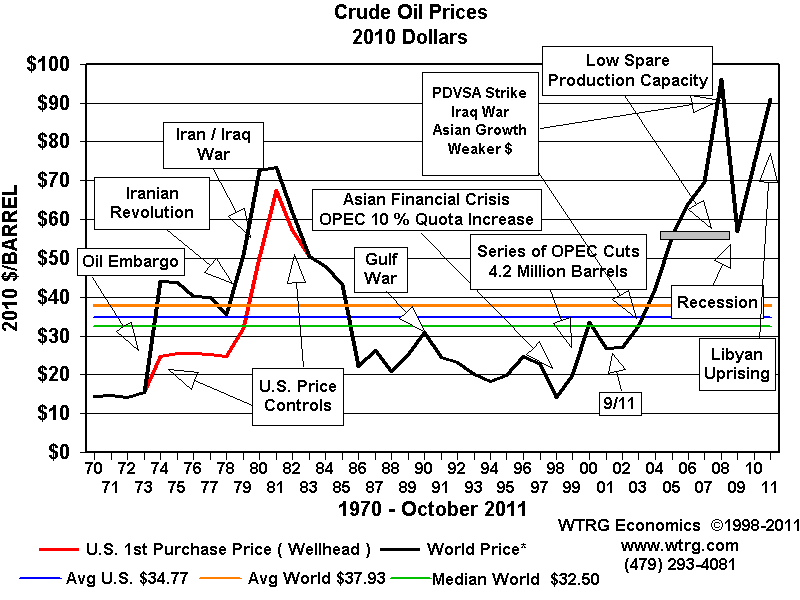
The roughly 20% drop in oil prices since the beginning of July should calibrate our estimates of the influence of such speculation. It was clearly not sufficient to maintain momentum in the face of weakening fundamentals of demand, supply and risk. At the same time, our response ought to distinguish between the kind of speculation represented by oil market neophytes hoping to cash in on an attractive investment trend, and the speculation that is an absolute requirement of a smoothly-functioning commodities market. Anyone who thinks the oil market would work just fine with only producers, refiners and end-users has never spent a day trading, or seen liquidity vanish just when a specific transaction was most desirable or necessary, because there was no middleman willing to take it on as a bet. But regardless of whether one variety of speculation should concern us more than another, the market's dramatic response to sliding demand serves notice to policy makers that their best and most productive avenue for addressing the impact of high oil prices is surely prompt and meaningful action on supply and demand, rather than rounding up today's version of the usual suspects.
Tuesday, August 19, 2008
The Persistence of Change
Weakening demand appears to be the main oil market driver these days, with the US having just tallied its 12th consecutive monthly decline in gasoline demand, year-on-year. For the moment, at least, good old supply and demand have displaced imminent Peak Oil and a perceived commodity bubble as the dominant narrative. If we needed further evidence of that, the market's collective yawn at Russia's threat to the Caspian pipelines passing through Georgia ought to serve nicely. But how much of the recent decline in consumption is attributable to the price elasticity of demand, and how much to the weakening US economy? The answer is of more than passing interest, signifying whether we're likely to see a bounce in demand once the pump price catches up with the 20% decline in the price of West Texas Intermediate crude oil since the 4th of July.
The US average retail gasoline price has fallen for six weeks and currently stands at $3.74 per gallon. Barring an unexpected oil-price rally or a major refining problem, unleaded regular prices beginning with a "4" should soon disappear at all but the most expensive stations, even in California. Perhaps this is just a case of the August doldrums, but the price of oil is currently stuck in a range that defies the principal explanations for its behavior earlier this year. With the market clearly responding to fundamentals, its path from here will depend heavily on whether consumers continue to drive less, and that depends on the relative importance of the psychological impact of $4 gasoline, compared to a broad range of economic factors including falling home prices, tightening credit and surging inflation--some of which is attributable to high fuel prices.
The last stretch in which US gasoline demand declined for 12 consecutive months occurred in 1990-91, a period that also coincided with a spike in fuel prices--thanks to Saddam Hussein--and a recession. The Gulf Coast hurricanes of 2005, which gave the country its first taste of $3 gasoline, caused only a brief drop in demand. Within 3 months of Katrina's landfall monthly US gasoline demand had resumed its year-on-year growth, consistent with the robust economic growth (helped by the housing bubble) that we were experiencing at the time. Nor did the recession of 2000-2001 prevent gasoline demand from growing by 1.6%, with only a few months exhibiting declines versus the same month of the previous year. Of course, gasoline was well under $2 at the time.
It seems to require an unusual combination of low growth and high prices to overcome the inherent gasoline demand trend of the US economy and shock consumers into conservation mode. Since the economy seems unlikely to recover soon, the persistence of the recent changes in consumer behavior concerning fuel consumption and new car selection thus hinges on just how cheap $3.50 gas will seem to America's drivers after a couple of months over $4.00 per gallon. In the absence of more dramatic events, this could also determine the price of oil on Election Day, a parameter that could influence that contest's outcome.
The US average retail gasoline price has fallen for six weeks and currently stands at $3.74 per gallon. Barring an unexpected oil-price rally or a major refining problem, unleaded regular prices beginning with a "4" should soon disappear at all but the most expensive stations, even in California. Perhaps this is just a case of the August doldrums, but the price of oil is currently stuck in a range that defies the principal explanations for its behavior earlier this year. With the market clearly responding to fundamentals, its path from here will depend heavily on whether consumers continue to drive less, and that depends on the relative importance of the psychological impact of $4 gasoline, compared to a broad range of economic factors including falling home prices, tightening credit and surging inflation--some of which is attributable to high fuel prices.
The last stretch in which US gasoline demand declined for 12 consecutive months occurred in 1990-91, a period that also coincided with a spike in fuel prices--thanks to Saddam Hussein--and a recession. The Gulf Coast hurricanes of 2005, which gave the country its first taste of $3 gasoline, caused only a brief drop in demand. Within 3 months of Katrina's landfall monthly US gasoline demand had resumed its year-on-year growth, consistent with the robust economic growth (helped by the housing bubble) that we were experiencing at the time. Nor did the recession of 2000-2001 prevent gasoline demand from growing by 1.6%, with only a few months exhibiting declines versus the same month of the previous year. Of course, gasoline was well under $2 at the time.
It seems to require an unusual combination of low growth and high prices to overcome the inherent gasoline demand trend of the US economy and shock consumers into conservation mode. Since the economy seems unlikely to recover soon, the persistence of the recent changes in consumer behavior concerning fuel consumption and new car selection thus hinges on just how cheap $3.50 gas will seem to America's drivers after a couple of months over $4.00 per gallon. In the absence of more dramatic events, this could also determine the price of oil on Election Day, a parameter that could influence that contest's outcome.
Monday, August 18, 2008
The Drilling vs. Alternatives Contradiction
F. Scott Fitzgerald once said, "The test of a first-rate intelligence is the ability to hold two opposed ideas in the mind at the same time, and still retain the ability to function." By that measure, the present debate over energy policy in the Congress looks truly impressive, incorporating a number of such "opposed ideas." A prime example is the arguments against expanded domestic oil and gas drilling, many of which look equally applicable to increasing our production of ethanol from grain. In particular, if expanded drilling can be dismissed as not worth the effort or associated trade-offs, based on a curiously-low DOE projection of future production from US oil resources currently off-limits to drilling, then the US grain ethanol program should be subject to the same criterion. However, in the absence of any single, all-encompassing solution to our energy problems, can we afford to reject any of these options, or worse yet, to pit them against each other as though they were somehow mutually exclusive? We need fewer such contradictions, if we are to make real progress in reducing our geostrategic and financial exposure to oil imports.
Start with the energy contribution of that off-limits oil. I find it extraordinary that the DOE's estimate of 200,000 barrels per day from this resource has been so widely accepted without question--mainly by those, the extent of whose expertise concerning oil generally begins and ends with the business end of a gasoline dispenser. But set aside for a moment the apparent disconnect with the government's own estimate of 18 billion barrels of oil resource in the off-limits portions of the US offshore, a quantity a dozen times larger than the DOE's forecasted cumulative yield from these resources over 20 years. Let's stipulate that paltry-sounding 200,000 bbl/day and convert it into BTUs. It works out to roughly 0.4 quadrillion BTUs/year (quads), or 0.4% of our annual energy consumption, coincidentally about the same quantity of energy we currently get from wind power, based on the natural gas it displaces. Now translate that energy content into its equivalent in ethanol, and you get a figure of 5.2 billion gallons per year, equal to the entire increase in ethanol output mandated between 2007 and 2010--a mandate that was just upheld by the EPA against an appeal from the Governor of Texas. But if it is not worth increasing domestic oil production by the equivalent of 5 billion gallons per year of ethanol, creating US employment and providing the federal government with significant royalty and tax revenues, while displacing $8 billion per year in energy imports at current prices, then what possible rationale can there be for mandating and subsidizing an increase in our ethanol output by a like amount and risking its uncertain impact on the price of grains and other foods?
But wait, you say, ethanol is renewable and good for the environment, while oil is a depleting resource and bad for the environment. The grain of truth in this argument is more than offset by the significant environmental costs associated with corn ethanol production, including high water consumption, fertilizer runoff that contributes to a growing Dead Zone in the Gulf Coast, and greenhouse gas emissions that may actually exceed those of oil, when the global impact on land use for agriculture is considered. Nor is the depletion argument very compelling. After all, it's not as though the opponents of drilling intend to save our untapped offshore oil for future generations, who they probably hope will be even more averse to drilling, and who may lack a domestic oil industry capable of undertaking such a project, in any case.
Long-time readers of this blog know that I am not exactly enamored with our current policy towards biofuels produced from foodstuffs, and particularly with the manner in which subsidies for them are handed out. Ethanol is no panacea, and it consumes vast quantities of natural gas, pushing up the latter's imports and price in the process, but at least it displaces much more oil than it consumes and makes a useful contribution to reducing our oil imports. The severity of this energy crisis requires that we pursue every such source we can, including new supplies of conventional and alternative energy, along with the savings from improved efficiency. If it is necessary to hold our noses to the extent of accepting that we need conventional ethanol in our energy mix, at least for now, and that we must have tens of thousands of wind turbines--which some consider a blot on the landscape--then the same logic ought to apply to exploiting the domestic oil resources to which we have restricted access for reasons that have been superseded by events. Loving renewables and hating domestic oil is a contradiction that only benefits OPEC and America's economic competitors.
Start with the energy contribution of that off-limits oil. I find it extraordinary that the DOE's estimate of 200,000 barrels per day from this resource has been so widely accepted without question--mainly by those, the extent of whose expertise concerning oil generally begins and ends with the business end of a gasoline dispenser. But set aside for a moment the apparent disconnect with the government's own estimate of 18 billion barrels of oil resource in the off-limits portions of the US offshore, a quantity a dozen times larger than the DOE's forecasted cumulative yield from these resources over 20 years. Let's stipulate that paltry-sounding 200,000 bbl/day and convert it into BTUs. It works out to roughly 0.4 quadrillion BTUs/year (quads), or 0.4% of our annual energy consumption, coincidentally about the same quantity of energy we currently get from wind power, based on the natural gas it displaces. Now translate that energy content into its equivalent in ethanol, and you get a figure of 5.2 billion gallons per year, equal to the entire increase in ethanol output mandated between 2007 and 2010--a mandate that was just upheld by the EPA against an appeal from the Governor of Texas. But if it is not worth increasing domestic oil production by the equivalent of 5 billion gallons per year of ethanol, creating US employment and providing the federal government with significant royalty and tax revenues, while displacing $8 billion per year in energy imports at current prices, then what possible rationale can there be for mandating and subsidizing an increase in our ethanol output by a like amount and risking its uncertain impact on the price of grains and other foods?
But wait, you say, ethanol is renewable and good for the environment, while oil is a depleting resource and bad for the environment. The grain of truth in this argument is more than offset by the significant environmental costs associated with corn ethanol production, including high water consumption, fertilizer runoff that contributes to a growing Dead Zone in the Gulf Coast, and greenhouse gas emissions that may actually exceed those of oil, when the global impact on land use for agriculture is considered. Nor is the depletion argument very compelling. After all, it's not as though the opponents of drilling intend to save our untapped offshore oil for future generations, who they probably hope will be even more averse to drilling, and who may lack a domestic oil industry capable of undertaking such a project, in any case.
Long-time readers of this blog know that I am not exactly enamored with our current policy towards biofuels produced from foodstuffs, and particularly with the manner in which subsidies for them are handed out. Ethanol is no panacea, and it consumes vast quantities of natural gas, pushing up the latter's imports and price in the process, but at least it displaces much more oil than it consumes and makes a useful contribution to reducing our oil imports. The severity of this energy crisis requires that we pursue every such source we can, including new supplies of conventional and alternative energy, along with the savings from improved efficiency. If it is necessary to hold our noses to the extent of accepting that we need conventional ethanol in our energy mix, at least for now, and that we must have tens of thousands of wind turbines--which some consider a blot on the landscape--then the same logic ought to apply to exploiting the domestic oil resources to which we have restricted access for reasons that have been superseded by events. Loving renewables and hating domestic oil is a contradiction that only benefits OPEC and America's economic competitors.
Subscribe to:
Posts (Atom)