Showing posts with label energy density. Show all posts

Tuesday, April 15, 2014

ABCs of LNG

  • Current debates over LNG export often ignore its primary benefits, such as enabling gas to be produced for sale to markets beyond the realistic reach of pipelines.
  • It also allows gas to compete with petroleum liquids where energy density is important, such as in powering ships, trains and land vehicles.  
The international reaction to Russia's annexation of Ukraine's Crimean peninsula has put a spotlight on liquefied natural gas (LNG), which was already under debate in the US as a mechanism for exporting increasingly abundant shale gas. Meanwhile, LNG is emerging as a fuel in its own right, rather than just a means of transporting gas from source to market. What links these trends is LNG's capability to enable natural gas to approach the convenience and energy density of petroleum.

The big driver for this is economic: UK Brent crude is currently over $100 per barrel, while natural gas in the US Gulf Coast trades at the energy equivalent of around $25 per barrel. That creates a significant incentive to build LNG plants, despite the recent escalation in their cost. Even after adding the equivalent of $20-30/bbl in expenses for liquefaction, shipping, and regasification to convert the LNG back into pipeline gas at its destination, the opportunity is significant. In Asia, where LNG sells for $14 or $15 per million BTUs, that's still less than $90 per equivalent barrel. And because gas can only be produced if it can be connected to a market, LNG enables more gas to compete in more markets, while providing customers a cleaner and cheaper fuel.

This is not a new technology. Early demonstrations in the 1940s and '50s were followed by commercial-scale plants built to export LNG from Alaska, Algeria and Indonesia, establishing what has since become a global industry. Every LNG plant is designed to take advantage of the fact that at atmospheric pressure natural gas becomes a liquid at -259 °F ( -161 °C)--about 60°F warmer than liquid nitrogen--shrinking by a factor of 600:1 in the process. As long as it is kept below that temperature, it can be stored and transported as a liquid.

That has important advantages over the alternative of compressing natural gas to create a denser fuel. For example, a gallon of LNG has around 2.2 times as much energy (based on lower heating values) as the same volume of compressed natural gas (CNG) at 3,000-3,600 pounds per square inch (psi). A gallon of LNG also has 98% of the energy of ethanol, and 64% that of gasoline. This makes LNG dense enough to transport economically over long distances, unlike CNG.

These differences have a practical impact on the gradual penetration of the transportation fuel market by natural gas. While most natural gas passenger cars are based on the simpler CNG approach, LNG is gaining a foothold in trucking, particularly where the combination of low emissions and denser fuel--yielding longer range--is important.

LNG is also emerging as an option for transportation modes that have had few viable alternative to oil-based fuels, such as in shipping and even rail where electrification is impractical. Replacing ships' bunker fuel with LNG could be a key strategy for responding to increasingly strict international regulations on sulfur and nitrogen oxide pollution from ocean-going vessels.

The environmental benefits of LNG can be significant, when it replaces higher-emitting fuels like coal and fuel oil. Even after accounting for the energy consumed in the liquefaction process-- equivalent to 8% or less of the gas input to a new LNG plant--and in storage and transportation, lifecycle emissions from LNG in power generation are 40-60% lower than those from coal. Its advantage in marine engines is smaller, but still positive at around 8%, while reducing local pollution significantly.

LNG isn't without drawbacks, including "boil-off", the gradual tendency of LNG in storage to evaporate due to heating from the environment outside the insulated tank. In stationary facilities the resulting gas can either be re-liquefied or delivered to meet local gas demand. In vehicles, it is vented after a specified holding time of around a week or more. That makes it more suitable for vehicles that are used frequently, rather than sitting idle for extended periods.

It's worth noting that while LNG is increasingly linked to shale gas in North America, nearly all the LNG currently marketed around the world is produced from conventional gas reservoirs, such as the supergiant North Field in Qatar, or the gas fields of Australia's North West Shelf. That would also be the case for a new LNG plant based on Alaskan North Slope gas, as described in a post here in 2012.

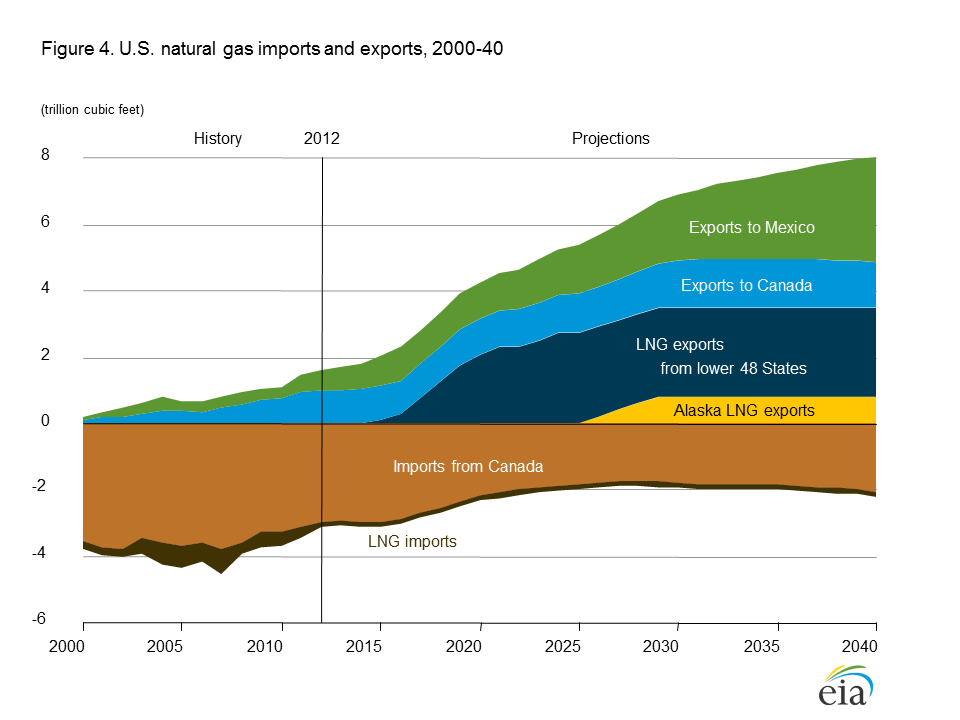
Only a few years ago, government and industry forecasts were unanimous in projecting a large and growing US LNG import requirement, as domestic gas production declined. The number of US LNG import facilities expanded to meet this new demand, but the combination of the recession and the shale gas revolution has resulted in imports shrinking substantially since 2007. The Energy Information Administration now expects the US to become a net exporter of LNG in 2016, including exports from repurposed import facilities. They will join a market that now supplies around 10% of global natural gas consumption and accounts for a third of global gas trade.

A different version of this posting was previously published on the website of Pacific Energy Development Corporation.

Monday, December 06, 2010

Turning Biomass into Power or Fuel

This morning I ran across a news item indicating that Dow Chemical was installing a biomass cogeneration unit at its facility in Aratu, Brazil to provide process steam with minimal greenhouse gas emissions. It's a good example of another way to convert biomass into energy that hasn't attracted nearly as much interest as advanced biofuels have. That's somewhat surprising, since biomass power shares most of the logistical limitations but few of the technical challenges that have made the production of biofuel from non-food biomass so difficult. Perhaps the relative neglect of biomass power results more from motivation than outcomes.

I'm sure I paid more attention to this story because of Dow's choice of eucalyptus as the biomass source. I grew up under the spreading limbs of a giant eucalyptus tree in California--limbs that periodically fell off in storms, including a 9-ton monster that practically cut our house in half. In the years before that tree was finally cut down I raked up enormous quantities of the eucalyptus leaves and nuts that bombarded our yard. It would be fair to say that I developed a strong distaste for the species, at least for the ornamental and wind-break purposes for which many Californians had chosen this Australian import. However, many of these same features, including its fast growth and dense, oily wood, seem to be good attributes for biomass supply.

As noted in a recent Wall St. Journal article, the Achilles heel of biomass power is logistics. The lower the energy density of the biomass, relative to the fossil fuels it is intended to replace, the closer the source must be to the facility where it will be used, before transportation erodes any cost benefits, even after considering emissions reductions. Wood chips provide about 2/3 as much energy per pound as bituminous coal, but they can take up more than six times as much volume, unless they are first dried and turned into pellets. As is the case for cellulosic biofuels, these supply-chain considerations limit the scale of biomass power application and impose an additional constraint of sustainability: It doesn't pay to build a biomass power plant (or a cellulosic biofuel plant) unless you can be sure of a long-term supply of the raw material. The Journal article included examples of projects that paid a high price for miscalculations in this regard. One strategy for mitigating this limitation is co-firing, which relies on biomass for only a portion of a power plant's fuel needs.

The lower energy density of biomass also makes it essential to extract as much energy as possible from each pound or cubic foot. One of the reasons for the high efficiency of the Brazilian ethanol industry is that many of its mills turn the bagasse, the waste left over after extracting the juice from sugar cane, into process heat and power and need little or no fossil energy. Burning biomass in a high-efficiency combined heat and power application, as the Dow project appears to do--based on the scant information I could find--provides another way to get the most bang for the biomass buck.

That brings us back to motivation. One of the main justifications for the pursuit of cellulosic biofuels is that we have relatively few practical, cost-effective alternative fuels that could replace more than a small fraction of our petroleum use. On the other hand, we have many ways to generate electricity, including more than a few that emit little or no greenhouse gas, one of the main benefits of biomass power--though this point is not without controversy. However, I can't help wondering whether in the long run the best way to turn non-food biomass into energy for vehicles is to turn it into electricity first, rather than working so hard to break down plant structures that have evolved over millions of years to resist easy conversion into chemical energy. Resolving that dilemma depends on a lot more than engineering considerations, however, since we still don't know much about how consumer preferences will play into it. In the meantime, projects like Dow's provide another option for reducing emissions from facilities that must meet increasingly stringent sustainability criteria.

Wednesday, August 18, 2010

Scaling the Energy Transition

The August 13 issue of Science, the journal of the American Association for the Advancement of Science (AAAS), devotes a special section to "Scaling Up Alternative Energy". Most of the section, including some nifty comparative infographics, can be accessed free of charge until August 27, requiring only a free site registration. I encourage you to read it while it's available. The articles cover topics such as the prospects for cellulosic ethanol and the challenges of siting renewable energy projects. Another entitled, "Do We Have the Energy for the Next Transition?" particularly caught by attention. I've been focused on this issue from the inception of this blog in 2004 and long before that. This is an issue that's not about to go away or be solved overnight, no matter how much wishfulness we apply to it.

I know I've been beating this drum for a long time, but here's a clear and concise explanation from the top science journal in the country on why the transition to alternative energy won't--and can't--be quick, cheap or easy, as well as why it's necessary to pursue in spite of these limitations. The low energy and power density, intermittency, and uneven geographic distribution of renewables aren't just talking points; they're genuine technical problems that must be overcome. The author compares the transition that's now underway to previous energy transitions and finds fundamental reasons why such shifts take a long time, and why the transition to renewables can't be as quick as many would like. He quotes one expert as saying, "They don't offer new services; they just cost more."

That's a crucial point for anyone who sees this energy transition driven not just by concerns about energy security and greenhouse gas emissions, but by notions of clean energy as the next big wealth-creating global trend, akin to the computer revolution. A kilowatt-hour or BTU does the same work, regardless of its source, so unless it can be produced for significantly less than from conventional sources, greener energy offers no productivity gains of the kind that have fueled the global infotech transformation. As the article notes, using current technologies it is likely to reduce productivity, at least in the energy sector, unless it addresses cost-effective energy efficiency.

And while it's certainly true that the current price of conventional energy omits a number of important externalities, including those relating to climate change, monetizing them by increasing the price of energy will not improve productivity in the sense of creating new wealth; it will merely transfer of wealth from one sector to another. We may still have to do that, but we shouldn't harbor illusions about the ultimate source of the earnings this will create for green energy companies and entrepreneurs, until someone comes up with an energy source that is truly better/faster/cheaper than what it's replacing (without subsidies.)

Although the article doesn't dismiss the potential of renewables to supply a much larger proportion of our energy needs, it suggests that the greatest near-term potential lies in reducing energy consumption, which would simultaneously stretch out our conventional energy resources, reduce their impact, increase the leverage of the renewables we have, and provide more time to improve them. It also points to a transition that looks more like a gradual shift in our energy mix than a sudden displacement of one set of sources by another. That doesn't sound nearly as radical or glamorous as what some pundits have suggested is possible, but it still provides renewable energy businesses with the enviable prospect of making steady inroads into a vast market, the potential of which they couldn't exhaust for decades, as long as they've got a proposition that makes economic sense in light of current and anticipated regulations and incentives.

Tuesday, May 26, 2009

The Green Lawnmower

I have a new, unexpected hobby: mowing the lawn. For our first few years here in Virginia we opted to have a lawn service cut our grass, so my wife and I could focus on other things, including establishing our respective businesses in a new location. When the economy and stock market tanked, this became an obvious source of savings in our monthly budget, complicated by my determination not to buy a gasoline-powered lawn mower. Since our yard is a little too big for either a corded electric mower or a manual push mower to be practical, I focused on finding a suitable rechargeable mower. My experience so far has left me with decidedly mixed feelings about this relatively new technology. Some of these issues look applicable to plug-in electric cars, as well.

It might seem odd that someone with my industry background would shy away from a gas-powered mower. Among other reasons, small engines produce a disproportionate share of local air pollution, even after the implementation a few years ago of the EPA's Phase I rules for small spark-ignition engines. (Phase II and III are coming along in a few years.) I also gained a healthy respect for this fuel and its properties during my stint in Texaco's Los Angeles refinery (now owned by Tesoro) at the beginning of my career. I am a firm believer that the safest place to store gasoline at home is in your car's fuel tank, particularly in a warm climate. Second-best would be in a lockable shed a safe distance from the house. Lacking one of those and concerned mainly about my young and inquisitive child, I concluded that if I couldn't find a satisfactory rechargeable mower I would grit my teeth and continue to pay the lawn service. Happily, it turned out that several manufacturers now offer rechargeable mowers that aren't just toys.

After reading many reviews I chose the Solaris S21HB, made in Canada by Linamar Consumer Products. It is a beast, weighing about 110 lb. with batteries. Several family members remarked that pushing it around our yard would provide a nice alternative to one of my weekly gym workouts. I suspected that would be true even before I acquired my current familiarity with the actual grade of much of our lot. The main reason this machine is so heavy is directly relevant to a periodic topic on this blog: our old friend energy density. The Solaris's two 24V lead-acid batteries contribute about 30 lb. (The only Lithium-ion battery mower I could find, made by Bosch, is not yet sold in the US.) Their combined 40 Amp-hours of storage equate to the energy content of less than 4 ounces of gasoline. Even if it uses its stored energy 3-4 times more efficiently than a gasoline engine, the mower's range is still substantially less than from the typical 1-quart fuel capacity of a gas mower. As a result, I must adapt my lawn mowing to the limitations of my new, green device. Since I can't cut all the grass in one session, I have to split it into two tasks at least 8 hours apart, to allow enough time to recharge the batteries. My alternative is to invest $100 in a second set of batteries, which are currently out of stock.

As much as I enjoy the relatively quiet and odor-free operation of the battery mower, I sometimes find myself envying my neighbor's gas mower and wondering if I made the right choice. While mowing the lawn recently it occurred to me that this situation appears similar to that of owning a plug-in electric car without an onboard backup engine. Battery technology is still not up to providing a driving range comparable to a car powered by liquid fuels at an acceptable cost or weight premium. Buyers of such cars face a choice between adapting their lifestyles to match these limitations or relying on future services such as the on-the-fly battery swapping model envisioned by Better Place. As a consumer, I doubt I'm up for either one. Barring the overnight commercialization of the latest fast-charging battery technology--which would still require truly enormous currents and voltages to deliver as much effective energy in a comparable interval as filling 10 gallons of gasoline--I'll lay odds that my next car will be either a diesel or a conventional hybrid. At this point, like it or not, petroleum remains the best energy carrier we have.