While Congress and the Presidential candidates are busily debating far-reaching energy proposals, the existing tax credits for wind and solar power and other renewable energy are still slated to expire at the end of the year. The uncertainty about their continuation is apparently beginning to slow down new installations and may be putting some of those vaunted "green collar" jobs at risk, at least temporarily. Although a broad consensus supports their renewal, the hang-up is over funding. I'd like to offer an alternative that at least makes policy sense, if not political sense. Its appeal will be limited by the reticence of both sides of this debate to be seen explicitly raising the price Americans pay for energy.
I've lost count of the number of times the Senate has missed extending the Renewable Electricity Production Tax Credit (PTC) and the Solar Investment Tax Credit (ITC) this year. Six? Seven? One of the latest such efforts was S.3335, the "Jobs, Energy, Families, and Disaster Relief Act of 2008". Voting against something with that title must have felt like voting against motherhood and apple pie, although the bill should more accurately have been designated the "Renewable Energy and Comprehensive Pork Act of 2008," including as it did such diverse provisions as a "Seven Year Cost Recovery Period for Motorsports Racing Track Facility," "Provisions Related to Film and Television Productions," and my favorite, the "Modification of Rate of Excise Tax on Certain Wooden Arrows Designed for Use by Children." I wish I were making this up. Having previously failed to satisfy the requirement for revenue neutrality, also known as "Pay-Go", by singling out the oil & gas industry for loss of a manufacturing tax credit--an idea resurrected in the proposed "Gang of 10 Compromise"--the revenue provisions of this bill focused on tax changes on deferred income and securities transactions.
All of this seems unnecessarily convoluted. If the Congress wishes to adhere to the principal of revenue neutrality with regard to incentives for renewable energy, the most sensible place to seek funding is one that also encourages energy demand reduction, to complement the PTC's and ITC's supply and efficiency contributions: a tax on the forms of energy these renewables are intended to displace. Contrary to a widely-held misunderstanding, oil accounts for less than 2% of the US electricity supply, so wind , solar, and other forms of renewable electricity displace virtually no petroleum. But even as Americans are driving less and consuming less gasoline, thanks to high fuel prices, electricity demand continues to grow steadily. From April 2007 through March 2008, US electricity demand was running 2% ahead of the previous 12 month period, on a par with its five-year average growth rate of 1.6%. Considering that last year 72% of our power was generated from the combustion of fossil fuels, taxing electricity consumption to pay for the extension of the PTC and ITC would reduce both demand and emissions, while hastening our widely-desired conversion to renewable energy sources.
I've seen a wide range of estimates of the cost of renewing the PTC and ITC. At last year's installation rate for wind power alone, extending the PTC indefinitely would add roughly $300 million each year to the federal deficit, compounded. That aggregates to about $17 billion in lost federal tax revenue over 10 years. A tax of 0.1 ¢/kWh on sales of fossil-fuel-generated electricity would raise more than $25 billion over that period, while increasing the average consumer's monthly bill by only about $1 per month. If we're looking for "Pay-Go" that aligns policy with purpose, that seems like a much better candidate than taxing other forms of energy production and potentially leaving us even less energy-secure than we were.
Monday, August 25, 2008

Thursday, August 21, 2008
Defining Speculation
Oil market speculation is back in the news, because Vitol S.A., one of the world's largest oil-trading firms, has apparently been re-classified as a "non-commercial" market participant by the Commodity Futures Trading Commission (CFTC). That marks them as a speculator, this year's scarlet letter. Before we pass judgment on the influence of such firms on the price of oil, and thus on the petroleum products consumers buy, it's worth considering what we really mean by speculation, and how this might be distinct from the activities of the participants that the CFTC deems "commercial", i.e. those conducting futures, options and swap transactions in conjunction with their physical production or consumption of various forms of energy. More importantly, we should evaluate whether speculation is an important enough factor in the oil market to merit distracting us from the urgent pursuit of solutions that would expand energy supplies and shrink demand.
As big as they are, Vitol hardly fits the profile of the kind of speculators that stand accused of driving up the price of oil and everything connected to it to unprecedented levels. Vitol has been trading oil since the 1960s, and I did my first deal with them in the 1980s, when I traded petroleum products for Texaco's West Coast refining and marketing subsidiary. I got a much better sense for just how large a player they were in the physical markets for oil, feedstocks and refined products when I traded international products in London in 1989-91. There were few markets in which Vitol didn't participate, and a few niches that they dominated. Although I haven't had any contact with them in at least 14 years, their growth during that interval has been impressive. So I was hardly shocked to learn that they had apparently accounted for a significant fraction of the open interest in crude oil on the New York Mercantile Exchange (NYMEX) earlier this year. Any non-producer transacting the volumes of physical oil and products deals they do could not manage their business properly without extensive use of futures, options and over-the-counter swaps, little of which could fairly be called speculation.
Texaco's trading division had very firm rules about speculation on futures or options, which it defined as long or short positions that weren't directly linked to a like quantity of physical oil or products we were buying, selling, or holding in inventory, contemporaneously. Even for a group focused on "wet" cargoes--actual liquids on ships, barges, or in pipelines--that was sometimes limiting, because it meant we had to do the physical transaction first, and then scramble to hedge it. But while we couldn't take "naked" long or short positions in the market, we could transact "spreads" that were basically bets on some aspect of the market, such as a widening or narrowing of the price difference between futures contract months, or between different products, or different locations. While we weren't speculating on the absolute price, risking large swings in profit and loss, we were certainly risking smaller amounts on these other market attributes. I think most people would consider that speculation, since we didn't have to do it to support our physical trading or the company's much larger producing and refining businesses. But aside from some modest, inconsistent profits it gave us insights into market trends that passive observers don't usually gain: if you really want to understand a market, you have to be in the market.
Now consider Vitol, buying and selling oil and product cargoes all over the world and owning interests in oil terminals on three continents, a few oil fields, and a small refinery in the Persian Gulf. That doesn't put them in the same league as ExxonMobil--which, unless things have changed a great deal since the Exxon-Mobil merger in 1999, doesn't trade on the NYMEX at all--or legitimize every position they take as non-speculative. However, it's a far cry from the stereotypical view of asset-class commodity speculation by pension funds and hedge funds, executed by twenty-somethings who wouldn't know an octane from an antelope. That's important, because long-established oil trading firms like Vitol have institutional memories that span many up and down cycles of the oil market and know that a trend can turn when you least expect it. It doesn't mean they wouldn't risk a big loss to make a big profit, but in my estimation it makes them poor candidates to be the driving force behind a wave of speculation perceived to have pushed the price of oil beyond the level that could be explained by the fundamentals alone.
The roughly 20% drop in oil prices since the beginning of July should calibrate our estimates of the influence of such speculation. It was clearly not sufficient to maintain momentum in the face of weakening fundamentals of demand, supply and risk. At the same time, our response ought to distinguish between the kind of speculation represented by oil market neophytes hoping to cash in on an attractive investment trend, and the speculation that is an absolute requirement of a smoothly-functioning commodities market. Anyone who thinks the oil market would work just fine with only producers, refiners and end-users has never spent a day trading, or seen liquidity vanish just when a specific transaction was most desirable or necessary, because there was no middleman willing to take it on as a bet. But regardless of whether one variety of speculation should concern us more than another, the market's dramatic response to sliding demand serves notice to policy makers that their best and most productive avenue for addressing the impact of high oil prices is surely prompt and meaningful action on supply and demand, rather than rounding up today's version of the usual suspects.
As big as they are, Vitol hardly fits the profile of the kind of speculators that stand accused of driving up the price of oil and everything connected to it to unprecedented levels. Vitol has been trading oil since the 1960s, and I did my first deal with them in the 1980s, when I traded petroleum products for Texaco's West Coast refining and marketing subsidiary. I got a much better sense for just how large a player they were in the physical markets for oil, feedstocks and refined products when I traded international products in London in 1989-91. There were few markets in which Vitol didn't participate, and a few niches that they dominated. Although I haven't had any contact with them in at least 14 years, their growth during that interval has been impressive. So I was hardly shocked to learn that they had apparently accounted for a significant fraction of the open interest in crude oil on the New York Mercantile Exchange (NYMEX) earlier this year. Any non-producer transacting the volumes of physical oil and products deals they do could not manage their business properly without extensive use of futures, options and over-the-counter swaps, little of which could fairly be called speculation.
Texaco's trading division had very firm rules about speculation on futures or options, which it defined as long or short positions that weren't directly linked to a like quantity of physical oil or products we were buying, selling, or holding in inventory, contemporaneously. Even for a group focused on "wet" cargoes--actual liquids on ships, barges, or in pipelines--that was sometimes limiting, because it meant we had to do the physical transaction first, and then scramble to hedge it. But while we couldn't take "naked" long or short positions in the market, we could transact "spreads" that were basically bets on some aspect of the market, such as a widening or narrowing of the price difference between futures contract months, or between different products, or different locations. While we weren't speculating on the absolute price, risking large swings in profit and loss, we were certainly risking smaller amounts on these other market attributes. I think most people would consider that speculation, since we didn't have to do it to support our physical trading or the company's much larger producing and refining businesses. But aside from some modest, inconsistent profits it gave us insights into market trends that passive observers don't usually gain: if you really want to understand a market, you have to be in the market.
Now consider Vitol, buying and selling oil and product cargoes all over the world and owning interests in oil terminals on three continents, a few oil fields, and a small refinery in the Persian Gulf. That doesn't put them in the same league as ExxonMobil--which, unless things have changed a great deal since the Exxon-Mobil merger in 1999, doesn't trade on the NYMEX at all--or legitimize every position they take as non-speculative. However, it's a far cry from the stereotypical view of asset-class commodity speculation by pension funds and hedge funds, executed by twenty-somethings who wouldn't know an octane from an antelope. That's important, because long-established oil trading firms like Vitol have institutional memories that span many up and down cycles of the oil market and know that a trend can turn when you least expect it. It doesn't mean they wouldn't risk a big loss to make a big profit, but in my estimation it makes them poor candidates to be the driving force behind a wave of speculation perceived to have pushed the price of oil beyond the level that could be explained by the fundamentals alone.
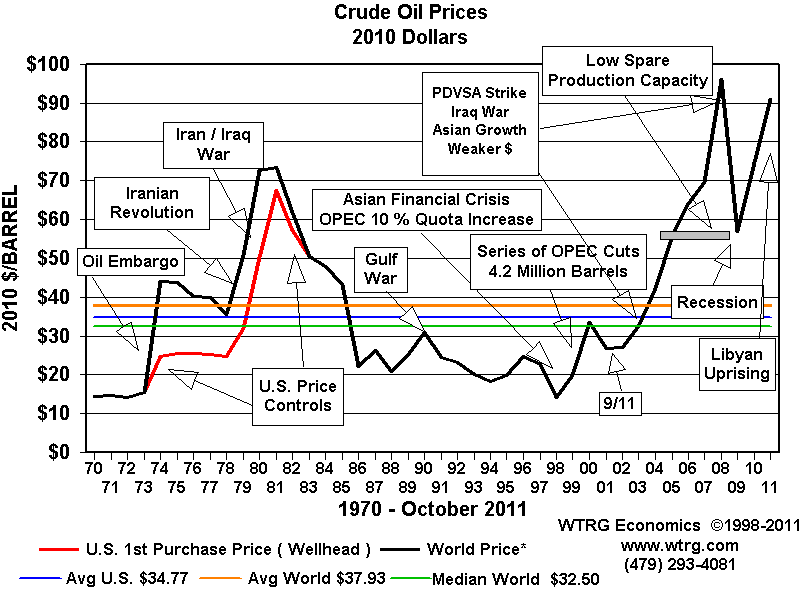
The roughly 20% drop in oil prices since the beginning of July should calibrate our estimates of the influence of such speculation. It was clearly not sufficient to maintain momentum in the face of weakening fundamentals of demand, supply and risk. At the same time, our response ought to distinguish between the kind of speculation represented by oil market neophytes hoping to cash in on an attractive investment trend, and the speculation that is an absolute requirement of a smoothly-functioning commodities market. Anyone who thinks the oil market would work just fine with only producers, refiners and end-users has never spent a day trading, or seen liquidity vanish just when a specific transaction was most desirable or necessary, because there was no middleman willing to take it on as a bet. But regardless of whether one variety of speculation should concern us more than another, the market's dramatic response to sliding demand serves notice to policy makers that their best and most productive avenue for addressing the impact of high oil prices is surely prompt and meaningful action on supply and demand, rather than rounding up today's version of the usual suspects.
Tuesday, August 19, 2008
The Persistence of Change
Weakening demand appears to be the main oil market driver these days, with the US having just tallied its 12th consecutive monthly decline in gasoline demand, year-on-year. For the moment, at least, good old supply and demand have displaced imminent Peak Oil and a perceived commodity bubble as the dominant narrative. If we needed further evidence of that, the market's collective yawn at Russia's threat to the Caspian pipelines passing through Georgia ought to serve nicely. But how much of the recent decline in consumption is attributable to the price elasticity of demand, and how much to the weakening US economy? The answer is of more than passing interest, signifying whether we're likely to see a bounce in demand once the pump price catches up with the 20% decline in the price of West Texas Intermediate crude oil since the 4th of July.
The US average retail gasoline price has fallen for six weeks and currently stands at $3.74 per gallon. Barring an unexpected oil-price rally or a major refining problem, unleaded regular prices beginning with a "4" should soon disappear at all but the most expensive stations, even in California. Perhaps this is just a case of the August doldrums, but the price of oil is currently stuck in a range that defies the principal explanations for its behavior earlier this year. With the market clearly responding to fundamentals, its path from here will depend heavily on whether consumers continue to drive less, and that depends on the relative importance of the psychological impact of $4 gasoline, compared to a broad range of economic factors including falling home prices, tightening credit and surging inflation--some of which is attributable to high fuel prices.
The last stretch in which US gasoline demand declined for 12 consecutive months occurred in 1990-91, a period that also coincided with a spike in fuel prices--thanks to Saddam Hussein--and a recession. The Gulf Coast hurricanes of 2005, which gave the country its first taste of $3 gasoline, caused only a brief drop in demand. Within 3 months of Katrina's landfall monthly US gasoline demand had resumed its year-on-year growth, consistent with the robust economic growth (helped by the housing bubble) that we were experiencing at the time. Nor did the recession of 2000-2001 prevent gasoline demand from growing by 1.6%, with only a few months exhibiting declines versus the same month of the previous year. Of course, gasoline was well under $2 at the time.
It seems to require an unusual combination of low growth and high prices to overcome the inherent gasoline demand trend of the US economy and shock consumers into conservation mode. Since the economy seems unlikely to recover soon, the persistence of the recent changes in consumer behavior concerning fuel consumption and new car selection thus hinges on just how cheap $3.50 gas will seem to America's drivers after a couple of months over $4.00 per gallon. In the absence of more dramatic events, this could also determine the price of oil on Election Day, a parameter that could influence that contest's outcome.
The US average retail gasoline price has fallen for six weeks and currently stands at $3.74 per gallon. Barring an unexpected oil-price rally or a major refining problem, unleaded regular prices beginning with a "4" should soon disappear at all but the most expensive stations, even in California. Perhaps this is just a case of the August doldrums, but the price of oil is currently stuck in a range that defies the principal explanations for its behavior earlier this year. With the market clearly responding to fundamentals, its path from here will depend heavily on whether consumers continue to drive less, and that depends on the relative importance of the psychological impact of $4 gasoline, compared to a broad range of economic factors including falling home prices, tightening credit and surging inflation--some of which is attributable to high fuel prices.
The last stretch in which US gasoline demand declined for 12 consecutive months occurred in 1990-91, a period that also coincided with a spike in fuel prices--thanks to Saddam Hussein--and a recession. The Gulf Coast hurricanes of 2005, which gave the country its first taste of $3 gasoline, caused only a brief drop in demand. Within 3 months of Katrina's landfall monthly US gasoline demand had resumed its year-on-year growth, consistent with the robust economic growth (helped by the housing bubble) that we were experiencing at the time. Nor did the recession of 2000-2001 prevent gasoline demand from growing by 1.6%, with only a few months exhibiting declines versus the same month of the previous year. Of course, gasoline was well under $2 at the time.
It seems to require an unusual combination of low growth and high prices to overcome the inherent gasoline demand trend of the US economy and shock consumers into conservation mode. Since the economy seems unlikely to recover soon, the persistence of the recent changes in consumer behavior concerning fuel consumption and new car selection thus hinges on just how cheap $3.50 gas will seem to America's drivers after a couple of months over $4.00 per gallon. In the absence of more dramatic events, this could also determine the price of oil on Election Day, a parameter that could influence that contest's outcome.
Monday, August 18, 2008
The Drilling vs. Alternatives Contradiction
F. Scott Fitzgerald once said, "The test of a first-rate intelligence is the ability to hold two opposed ideas in the mind at the same time, and still retain the ability to function." By that measure, the present debate over energy policy in the Congress looks truly impressive, incorporating a number of such "opposed ideas." A prime example is the arguments against expanded domestic oil and gas drilling, many of which look equally applicable to increasing our production of ethanol from grain. In particular, if expanded drilling can be dismissed as not worth the effort or associated trade-offs, based on a curiously-low DOE projection of future production from US oil resources currently off-limits to drilling, then the US grain ethanol program should be subject to the same criterion. However, in the absence of any single, all-encompassing solution to our energy problems, can we afford to reject any of these options, or worse yet, to pit them against each other as though they were somehow mutually exclusive? We need fewer such contradictions, if we are to make real progress in reducing our geostrategic and financial exposure to oil imports.
Start with the energy contribution of that off-limits oil. I find it extraordinary that the DOE's estimate of 200,000 barrels per day from this resource has been so widely accepted without question--mainly by those, the extent of whose expertise concerning oil generally begins and ends with the business end of a gasoline dispenser. But set aside for a moment the apparent disconnect with the government's own estimate of 18 billion barrels of oil resource in the off-limits portions of the US offshore, a quantity a dozen times larger than the DOE's forecasted cumulative yield from these resources over 20 years. Let's stipulate that paltry-sounding 200,000 bbl/day and convert it into BTUs. It works out to roughly 0.4 quadrillion BTUs/year (quads), or 0.4% of our annual energy consumption, coincidentally about the same quantity of energy we currently get from wind power, based on the natural gas it displaces. Now translate that energy content into its equivalent in ethanol, and you get a figure of 5.2 billion gallons per year, equal to the entire increase in ethanol output mandated between 2007 and 2010--a mandate that was just upheld by the EPA against an appeal from the Governor of Texas. But if it is not worth increasing domestic oil production by the equivalent of 5 billion gallons per year of ethanol, creating US employment and providing the federal government with significant royalty and tax revenues, while displacing $8 billion per year in energy imports at current prices, then what possible rationale can there be for mandating and subsidizing an increase in our ethanol output by a like amount and risking its uncertain impact on the price of grains and other foods?
But wait, you say, ethanol is renewable and good for the environment, while oil is a depleting resource and bad for the environment. The grain of truth in this argument is more than offset by the significant environmental costs associated with corn ethanol production, including high water consumption, fertilizer runoff that contributes to a growing Dead Zone in the Gulf Coast, and greenhouse gas emissions that may actually exceed those of oil, when the global impact on land use for agriculture is considered. Nor is the depletion argument very compelling. After all, it's not as though the opponents of drilling intend to save our untapped offshore oil for future generations, who they probably hope will be even more averse to drilling, and who may lack a domestic oil industry capable of undertaking such a project, in any case.
Long-time readers of this blog know that I am not exactly enamored with our current policy towards biofuels produced from foodstuffs, and particularly with the manner in which subsidies for them are handed out. Ethanol is no panacea, and it consumes vast quantities of natural gas, pushing up the latter's imports and price in the process, but at least it displaces much more oil than it consumes and makes a useful contribution to reducing our oil imports. The severity of this energy crisis requires that we pursue every such source we can, including new supplies of conventional and alternative energy, along with the savings from improved efficiency. If it is necessary to hold our noses to the extent of accepting that we need conventional ethanol in our energy mix, at least for now, and that we must have tens of thousands of wind turbines--which some consider a blot on the landscape--then the same logic ought to apply to exploiting the domestic oil resources to which we have restricted access for reasons that have been superseded by events. Loving renewables and hating domestic oil is a contradiction that only benefits OPEC and America's economic competitors.
Start with the energy contribution of that off-limits oil. I find it extraordinary that the DOE's estimate of 200,000 barrels per day from this resource has been so widely accepted without question--mainly by those, the extent of whose expertise concerning oil generally begins and ends with the business end of a gasoline dispenser. But set aside for a moment the apparent disconnect with the government's own estimate of 18 billion barrels of oil resource in the off-limits portions of the US offshore, a quantity a dozen times larger than the DOE's forecasted cumulative yield from these resources over 20 years. Let's stipulate that paltry-sounding 200,000 bbl/day and convert it into BTUs. It works out to roughly 0.4 quadrillion BTUs/year (quads), or 0.4% of our annual energy consumption, coincidentally about the same quantity of energy we currently get from wind power, based on the natural gas it displaces. Now translate that energy content into its equivalent in ethanol, and you get a figure of 5.2 billion gallons per year, equal to the entire increase in ethanol output mandated between 2007 and 2010--a mandate that was just upheld by the EPA against an appeal from the Governor of Texas. But if it is not worth increasing domestic oil production by the equivalent of 5 billion gallons per year of ethanol, creating US employment and providing the federal government with significant royalty and tax revenues, while displacing $8 billion per year in energy imports at current prices, then what possible rationale can there be for mandating and subsidizing an increase in our ethanol output by a like amount and risking its uncertain impact on the price of grains and other foods?
But wait, you say, ethanol is renewable and good for the environment, while oil is a depleting resource and bad for the environment. The grain of truth in this argument is more than offset by the significant environmental costs associated with corn ethanol production, including high water consumption, fertilizer runoff that contributes to a growing Dead Zone in the Gulf Coast, and greenhouse gas emissions that may actually exceed those of oil, when the global impact on land use for agriculture is considered. Nor is the depletion argument very compelling. After all, it's not as though the opponents of drilling intend to save our untapped offshore oil for future generations, who they probably hope will be even more averse to drilling, and who may lack a domestic oil industry capable of undertaking such a project, in any case.
Long-time readers of this blog know that I am not exactly enamored with our current policy towards biofuels produced from foodstuffs, and particularly with the manner in which subsidies for them are handed out. Ethanol is no panacea, and it consumes vast quantities of natural gas, pushing up the latter's imports and price in the process, but at least it displaces much more oil than it consumes and makes a useful contribution to reducing our oil imports. The severity of this energy crisis requires that we pursue every such source we can, including new supplies of conventional and alternative energy, along with the savings from improved efficiency. If it is necessary to hold our noses to the extent of accepting that we need conventional ethanol in our energy mix, at least for now, and that we must have tens of thousands of wind turbines--which some consider a blot on the landscape--then the same logic ought to apply to exploiting the domestic oil resources to which we have restricted access for reasons that have been superseded by events. Loving renewables and hating domestic oil is a contradiction that only benefits OPEC and America's economic competitors.
Monday, August 11, 2008
Oil in the Crosshairs
For the last several years, the oil market has focused on the risk of a new conflict in the Persian Gulf, evolving from earlier fears of a direct US/Iranian confrontation to recent worries that Israel might attack Iran's nuclear program. I suspect that little of that oft-cited "risk premium" was devoted to the chances of a shooting war breaking out in the Caucasus, virtually on top of a key oil export route from the Caspian Sea. Yet here we are, with Russia intervening Friday on behalf of one of Georgia's breakaway regions, South Ossetia, and bombs apparently falling near the Baku-Tblisi-Ceyhan Pipeline (BTC) that carries oil to the Mediterranean from the giant "ACG" oilfields of Azerbaijan. If the pipeline, which suffered an unrelated fire last week, were forced to shut down for an extended period, about 1% of the world's oil production could go off line, at least until some portion of it could be re-routed. The market shrugged off this prospect initially, with WTI falling $5 to end last week at $115. I would be surprised if the reaction this week proved quite so blasé.
Georgia was occupied by Russia for nearly 200 years prior to the collapse of the USSR, and the Caucasus is at least as strategic today as it was in the time of the czars, considering its role in the transit of the hydrocarbon resources of the Caspian Sea region. Prime Minister Putin, who appears to be calling the shots in this matter, likely regards Georgia as a rightful part of Russia's sphere of influence, but that doesn't give us many clues about the true extent of Russia's war aims. Given the preparations apparent in the current offensive, these could extend to annexation of South Ossetia into the Russian Federation, regime change in Tblisi, or merely putting a good scare into any former Soviet territories flirting with the idea of NATO membership. Although Russia was hardly pleased with the selection of an export route for Caspian oil that deliberately avoided its territory and control, and has gone to great lengths to regain state control over its own oil industry, oil isn't necessary to explain the events in Georgia.
Unfortunately, the implications for oil supplies go beyond the immediate disruption of the roughly 800,000 bbl/day the BTC line was carrying prior to last week's accident. In its latest Oil Market Report, the International Energy Agency cited expected additions to Azeri production of 200,000 bbl/day this year and a like quantity in 2009. As tightly balanced as the oil market remains, with demand destruction largely responsible for the current slump in prices, it would be bad news if those extra supplies could not be accommodated via the BTC or other export routes. Even if the Caspian hasn't quite delivered the oil gusher some expected a decade ago, it is one of a small number of regions in which production trends have been going the right way.
Whoever threw the first punch--and so far neither side seems terribly credible concerning this--the timing of the conflict favors Russia's attaining its goals in this affair. The combination of high energy prices and a highly-distracted America shrinks the odds that either the US or EU will take on Russia in defense of a former Soviet republic, beyond issuing statements asking Mr. Putin to respect Georgia's territorial integrity. Even if the BTC pipeline survives unscathed and quickly resumes deliveries, political risk in the entire region has increased, and future development from this crucial non-OPEC source could slow. That would keep oil prices higher, for longer than otherwise. With roughly $300 billion per year in oil export revenues at current prices, Russia sits near the top of the list of beneficiaries from such an outcome.
Georgia was occupied by Russia for nearly 200 years prior to the collapse of the USSR, and the Caucasus is at least as strategic today as it was in the time of the czars, considering its role in the transit of the hydrocarbon resources of the Caspian Sea region. Prime Minister Putin, who appears to be calling the shots in this matter, likely regards Georgia as a rightful part of Russia's sphere of influence, but that doesn't give us many clues about the true extent of Russia's war aims. Given the preparations apparent in the current offensive, these could extend to annexation of South Ossetia into the Russian Federation, regime change in Tblisi, or merely putting a good scare into any former Soviet territories flirting with the idea of NATO membership. Although Russia was hardly pleased with the selection of an export route for Caspian oil that deliberately avoided its territory and control, and has gone to great lengths to regain state control over its own oil industry, oil isn't necessary to explain the events in Georgia.
Unfortunately, the implications for oil supplies go beyond the immediate disruption of the roughly 800,000 bbl/day the BTC line was carrying prior to last week's accident. In its latest Oil Market Report, the International Energy Agency cited expected additions to Azeri production of 200,000 bbl/day this year and a like quantity in 2009. As tightly balanced as the oil market remains, with demand destruction largely responsible for the current slump in prices, it would be bad news if those extra supplies could not be accommodated via the BTC or other export routes. Even if the Caspian hasn't quite delivered the oil gusher some expected a decade ago, it is one of a small number of regions in which production trends have been going the right way.
Whoever threw the first punch--and so far neither side seems terribly credible concerning this--the timing of the conflict favors Russia's attaining its goals in this affair. The combination of high energy prices and a highly-distracted America shrinks the odds that either the US or EU will take on Russia in defense of a former Soviet republic, beyond issuing statements asking Mr. Putin to respect Georgia's territorial integrity. Even if the BTC pipeline survives unscathed and quickly resumes deliveries, political risk in the entire region has increased, and future development from this crucial non-OPEC source could slow. That would keep oil prices higher, for longer than otherwise. With roughly $300 billion per year in oil export revenues at current prices, Russia sits near the top of the list of beneficiaries from such an outcome.
Friday, August 08, 2008
Alternative Energy for Shipping
Last Sunday's New York Times carried an interesting article on the implications of high energy prices for the sustained globalization of supply chains. The reporter described how rising shipping costs were forcing manufacturers and retailers to rethink fundamental aspects of their business models, ultimately threatening the continuing expansion of world trade. Higher oil prices are responsible for much of the rise in freight rates, particularly for products carried by sea and air. Marine and aviation fuels are taxed very lightly, so they are more sensitive to changes in oil prices than motor fuels. But while airlines are hoping--perhaps in vain--for long-term fuel price relief from biofuels, cargo ship operators are likely to experience more competition from other uses for bunker fuel, and may need to seek solutions involving more exotic energy sources.
Earlier this year, I mentioned an idea for deploying small, high-tech sails to reduce the fuel consumption of cargo ships. But if world oil supplies fall seriously short of meeting potential demand in the years ahead--an easy prospect to imagine, given the rate at which Chinese and Indian consumers are buying automobiles--ocean freight lines may need to look elsewhere for their primary energy source, not just for ways to supplement it. In 2004, the residual fuel burned by ships and power plants accounted for 1 out of every 8 barrels of global oil demand. If competition for crude oil increases, refiners may be more interested in turning the long, complex molecules in fuel oil into higher-value products such as diesel and jet fuel, rather than selling them as-is. Thanks to heavy investment in upgrading hardware, US refineries produce less than a quarter of the "resid" volumes they did in the late 1970s, and their scope for further "resid destruction" is limited. Globally, however, upgrading 10 million barrels per day of resid output could ultimately prove more attractive than producing the same quantity of hydrocarbons from oil sands, shale, or coal-to-liquids. Where would that leave the shipping industry?
Two large-scale alternatives come to mind, assuming that biofuels will remain focused on the highest-value fuels segments, substituting for gasoline, diesel and jet fuel. Between the late 1970s and early 1990s, nuclear power and coal displaced most petroleum liquids from the US power generation sector. Either could provide a long-term substitute for residual fuel in ocean-going vessels. Nuclear power has obvious advantages in terms of its low emissions and extensive experience in naval fleets, plus a few civilian icebreakers. Unfortunately, the disadvantages will appear equally obvious to nuclear critics, in terms of the risks of proliferation and terrorism, which at sea may be less manageable than onshore. However, if it proved cost-effective, this is one way that nuclear power could directly displace more oil, and it might be achieved faster than we could build a new generation of land-based nuclear power plants.
A return to coal for ships' fuel might seem an odd and untimely suggestion, in light of concerns about greenhouse gases and the other emissions from burning coal. However, if this were done using small onboard gasification units fueling efficient gas turbines, rather than coal-fired boilers, the CO2 output from such a system might be no worse than from today's ships. And with the right equipment, sulfate and nitrate emissions that contribute significantly to urban air pollution in busy ports could also be scrubbed, at least for limited durations. The practicality of such an approach would have to be demonstrated, but the underlying driving force is clear. Despite the recent spike in coal prices, the BTUs in thermal coal still cost less than half as much as those in bunker fuel, at current prices.
A global retrenchment in trade due to the impact of high energy costs on freight rates would affect shipowners as much as their customers. A generation ago, the world's cargo fleets converted from steam turbines burning the lowest-quality bunker fuel available to the powerful, reliable marine diesel engines that dominate today's commercial shipping. The cost of operating these engines--and thus global shipping rates--depends on the price of the heavy fuel oils they consume. Although shipping firms lack a practical alternative fuel today, there's no reason the next generation of ships couldn't be built around entirely different energy sources. That would be on a par with the shift from coal to oil early last century, and far less dramatic than the switch from sail to steam.
Earlier this year, I mentioned an idea for deploying small, high-tech sails to reduce the fuel consumption of cargo ships. But if world oil supplies fall seriously short of meeting potential demand in the years ahead--an easy prospect to imagine, given the rate at which Chinese and Indian consumers are buying automobiles--ocean freight lines may need to look elsewhere for their primary energy source, not just for ways to supplement it. In 2004, the residual fuel burned by ships and power plants accounted for 1 out of every 8 barrels of global oil demand. If competition for crude oil increases, refiners may be more interested in turning the long, complex molecules in fuel oil into higher-value products such as diesel and jet fuel, rather than selling them as-is. Thanks to heavy investment in upgrading hardware, US refineries produce less than a quarter of the "resid" volumes they did in the late 1970s, and their scope for further "resid destruction" is limited. Globally, however, upgrading 10 million barrels per day of resid output could ultimately prove more attractive than producing the same quantity of hydrocarbons from oil sands, shale, or coal-to-liquids. Where would that leave the shipping industry?
Two large-scale alternatives come to mind, assuming that biofuels will remain focused on the highest-value fuels segments, substituting for gasoline, diesel and jet fuel. Between the late 1970s and early 1990s, nuclear power and coal displaced most petroleum liquids from the US power generation sector. Either could provide a long-term substitute for residual fuel in ocean-going vessels. Nuclear power has obvious advantages in terms of its low emissions and extensive experience in naval fleets, plus a few civilian icebreakers. Unfortunately, the disadvantages will appear equally obvious to nuclear critics, in terms of the risks of proliferation and terrorism, which at sea may be less manageable than onshore. However, if it proved cost-effective, this is one way that nuclear power could directly displace more oil, and it might be achieved faster than we could build a new generation of land-based nuclear power plants.
A return to coal for ships' fuel might seem an odd and untimely suggestion, in light of concerns about greenhouse gases and the other emissions from burning coal. However, if this were done using small onboard gasification units fueling efficient gas turbines, rather than coal-fired boilers, the CO2 output from such a system might be no worse than from today's ships. And with the right equipment, sulfate and nitrate emissions that contribute significantly to urban air pollution in busy ports could also be scrubbed, at least for limited durations. The practicality of such an approach would have to be demonstrated, but the underlying driving force is clear. Despite the recent spike in coal prices, the BTUs in thermal coal still cost less than half as much as those in bunker fuel, at current prices.
A global retrenchment in trade due to the impact of high energy costs on freight rates would affect shipowners as much as their customers. A generation ago, the world's cargo fleets converted from steam turbines burning the lowest-quality bunker fuel available to the powerful, reliable marine diesel engines that dominate today's commercial shipping. The cost of operating these engines--and thus global shipping rates--depends on the price of the heavy fuel oils they consume. Although shipping firms lack a practical alternative fuel today, there's no reason the next generation of ships couldn't be built around entirely different energy sources. That would be on a par with the shift from coal to oil early last century, and far less dramatic than the switch from sail to steam.
Tuesday, August 05, 2008
Loophole Whiplash
The Corporate Average Fuel Economy (CAFE) standard is back in the news. One of the main results of the Energy Independence and Security Act of 2007 (EISA) was to increase the overall US new car fleet CAFE target to 35 miles per gallon by 2020. Now the National Highway Traffic Safety Administration, which administers the CAFE program, must establish the milestones for stimulating and measuring progress toward that goal. Today's Wall St. Journal reports that auto manufacturers that had previously embraced last year's CAFE compromise are now objecting to a 2015 interim standard of 31.6 mpg. As obtuse as this may seem, in light of consumers' recent and dramatic shift toward more efficient cars, it is a consequence of two past regulatory failures associated with CAFE: the well-known "SUV Loophole" and the much more obscure rules promoting the manufacture of "Flexible Fuel Vehicles" (FFVs.) Carmakers haven't just been slammed by high fuel prices; they also have a bad case of loophole whiplash.
To the surprise of many observers, last year's energy legislation finally closed the much-debated SUV Loophole, which had subjected "light trucks" to a different, lower fuel economy standard, compared to "passenger cars." This was a classic case of good regulatory intentions gone wrong. When the CAFE standard was originally established in 1975, Congress and the Ford administration recognized that the pickup trucks and delivery vans used by businesses could not attain the same fuel economy as personal cars using the technology of the day. Forcing them to do so would have made a bad US economy worse. Without rehashing how this sensible policy morphed into the SUV fad, the result is that 33 years later, the 2008 model (scroll down to March 2008 report) passenger car fleet came within 0.2 mpg of meeting the proposed 2015 target, while new SUVs and pickups still averaged only 23.4 mpg. So not only have SUVs become albatrosses on cardealers' lots, thanks to $4 gasoline, but the same federal program that promoted them in the first place has now turned them into a huge regulatory liability.
A less-publicized aspect of the 2007 energy bill has a bearing on this problem, as well. Previously, FFVs were treated as an even more privileged category under CAFE, and an FFV SUV was a precious commodity. As NHTSA's CAFE FAQ page explains, a model getting 13 mpg on E85 and 16 mpg on gasoline would be counted towards a carmaker's CAFE quota as though it were a sort of 50 mpg hybrid on paper. An automaker could meet up to 1.2 mpg of its overall fleet target this way, in another example of US alternative fuel policy gone awry. Under EISA 2007, this benefit will be phased out between 2014 and 2019. The result only amplifies the SUV pain for US carmakers.
Although the timing of all this could not have been worse for Detroit, it was never going to be otherwise. Only another energy crisis could produce the political coalition necessary to close these loopholes, guaranteeing that this would coincide with market conditions that would punish US carmakers for the past success they enjoyed by taking advantage of them in the first place. There is no doubt that GM and Ford, at least, can field entire new car fleets capable of meeting the 35 mpg standard. The technology exists today, and their 2006 European models already delivered the equivalent of the ultimate US target. In the EU they will be required to beat 40 mpg by 2012. The question is whether they can retool quickly enough to pull off the same trick, here, with a sales mix reflecting the expectations of US car-buyers--expectations that are currently in flux but still differ markedly from those of consumers in the UK or Germany.
To the surprise of many observers, last year's energy legislation finally closed the much-debated SUV Loophole, which had subjected "light trucks" to a different, lower fuel economy standard, compared to "passenger cars." This was a classic case of good regulatory intentions gone wrong. When the CAFE standard was originally established in 1975, Congress and the Ford administration recognized that the pickup trucks and delivery vans used by businesses could not attain the same fuel economy as personal cars using the technology of the day. Forcing them to do so would have made a bad US economy worse. Without rehashing how this sensible policy morphed into the SUV fad, the result is that 33 years later, the 2008 model (scroll down to March 2008 report) passenger car fleet came within 0.2 mpg of meeting the proposed 2015 target, while new SUVs and pickups still averaged only 23.4 mpg. So not only have SUVs become albatrosses on cardealers' lots, thanks to $4 gasoline, but the same federal program that promoted them in the first place has now turned them into a huge regulatory liability.
A less-publicized aspect of the 2007 energy bill has a bearing on this problem, as well. Previously, FFVs were treated as an even more privileged category under CAFE, and an FFV SUV was a precious commodity. As NHTSA's CAFE FAQ page explains, a model getting 13 mpg on E85 and 16 mpg on gasoline would be counted towards a carmaker's CAFE quota as though it were a sort of 50 mpg hybrid on paper. An automaker could meet up to 1.2 mpg of its overall fleet target this way, in another example of US alternative fuel policy gone awry. Under EISA 2007, this benefit will be phased out between 2014 and 2019. The result only amplifies the SUV pain for US carmakers.
Although the timing of all this could not have been worse for Detroit, it was never going to be otherwise. Only another energy crisis could produce the political coalition necessary to close these loopholes, guaranteeing that this would coincide with market conditions that would punish US carmakers for the past success they enjoyed by taking advantage of them in the first place. There is no doubt that GM and Ford, at least, can field entire new car fleets capable of meeting the 35 mpg standard. The technology exists today, and their 2006 European models already delivered the equivalent of the ultimate US target. In the EU they will be required to beat 40 mpg by 2012. The question is whether they can retool quickly enough to pull off the same trick, here, with a sales mix reflecting the expectations of US car-buyers--expectations that are currently in flux but still differ markedly from those of consumers in the UK or Germany.
Monday, August 04, 2008
Rate of Change
For how much longer will the US depend on petroleum as our primary source of the energy we use for transportation? Conflicting beliefs about the answer to that question lie at the heart of the current debates about offshore drilling and additional support for alternative energy programs. If it is only a few more years, as some assert, then indeed, the production from oil fields in tracts currently off-limits would likely arrive after the greatest need for them has passed. If, on the other hand, we will still be importing oil 20 years from now, then we need to keep our oil project pipeline full, to ensure that we don’t open an even larger window of import vulnerability, on our way to greater energy self-reliance.
Answering this question involves a number of large uncertainties, including the persistence of Americans’ current conservation efforts, particularly if energy prices stabilize or fall farther; whether and how soon non-food-based biofuels can be produced on an industrial, rather than boutique scale; how rapidly plug-in hybrids and other electric vehicles can capture significant market share; and how our response to climate change will re-prioritize our use of other energy resources, and in particular whether we preferentially back out oil or coal first. The future availability of oil itself will also play a role, depending on how close we really are to a permanent peak in global production.
It’s good to have a vision of the end result we desire, presumably a world that is much less reliant on fossil fuels and in which renewable energy sources power electrified cars via a modernized power grid, augmented by nuclear power and liquid biofuels. But planning our journey to that outcome requires a clear understanding of the incremental changes that must occur along the way. In order to make progress toward such a goal, every year the output of that year’s additions to our renewable energy sources must exceed the net result of the growth of demand, moderated by efficiency and conservation, and any changes in the output of other energy sources. If, for example, domestic oil production declines by more than the net new contribution from biofuels, conservation and vehicle electrification, we will lose ground and import more foreign oil.
Last year we did pretty well on the liquid fuels front. In 2007, US ethanol production increased by 1.65 billion gallons per year, the energy equivalent of 71,000 bbl/day of gasoline, about 0.8% of demand, while gasoline consumption grew by less than 0.4%. This year, with gasoline consumption down and ethanol likely to add over 2 billion gallons of additional production, ethanol should capture more market share from petroleum-based gasoline. But in light of concerns about competition between food and fuel, and new questions about the environmental benefits of grain ethanol, that kind of growth cannot be sustained for much longer, without a large contribution from cellulosic biofuels that are still in the demonstration phase.
Progress was less impressive last year with regard to electricity, despite sustained high growth rates for both wind and solar power. The US added a record 5,244 MW of wind capacity, contributing approximately 14 billion kWh of generation, or 0.3% of electricity demand. That backed out the equivalent of 100 billion cubic feet of natural gas, equating to about 50,000 bbl/day of oil. Solar power grew by approximately 270 MW, covering another 0.01% or so of demand, or the equivalent of an extra 2,000 bbl/day of oil. However, US electricity demand grew by 2.3%, while hydropower, our largest renewable energy source, declined in output. As a result, the market shares of coal and nuclear power were stable, while natural gas actually gained ground at the expense of all renewables.
Based on these figures, renewable energy must expand by about a factor of ten before its annual growth will be large enough to make a significant dent in our reliance on fossil fuels in the electricity sector, even without considering the growth in electricity demand that would follow from the addition of millions of plug-in hybrids and EVs to our car fleet. Nor are biofuels likely to eliminate our oil imports in the meantime. At the Congressionally-mandated rate of 36 billion gallons per year in 2022, they will displace the equivalent of 1.5 million bbl/day of gasoline, while the US today imports between 11 and 12 million bbl/day of crude oil and petroleum products, net of exports.
The bottom line is that renewable energy is not yet in a position to make fossil fuels obsolete, and anyone suggesting otherwise is engaging in as much wishful thinking as someone who asserts we can “drill our way to energy independence”—a proposition I have only ever heard as a straw man offered up by opponents of drilling. Renewables have ample scope for further growth, but they also face important obstacles. Even with an increased focus on conservation and efficiency, the chances that we will not still need to import significant quantities of oil ten years from now look very slim, particularly if US oil production continues to decline at the 2-3% per year rate we have experienced over the last decade. Against that backdrop, the current energy compromise suggested by the “Gang of 10” senators looks pragmatic and prudent.
Answering this question involves a number of large uncertainties, including the persistence of Americans’ current conservation efforts, particularly if energy prices stabilize or fall farther; whether and how soon non-food-based biofuels can be produced on an industrial, rather than boutique scale; how rapidly plug-in hybrids and other electric vehicles can capture significant market share; and how our response to climate change will re-prioritize our use of other energy resources, and in particular whether we preferentially back out oil or coal first. The future availability of oil itself will also play a role, depending on how close we really are to a permanent peak in global production.
It’s good to have a vision of the end result we desire, presumably a world that is much less reliant on fossil fuels and in which renewable energy sources power electrified cars via a modernized power grid, augmented by nuclear power and liquid biofuels. But planning our journey to that outcome requires a clear understanding of the incremental changes that must occur along the way. In order to make progress toward such a goal, every year the output of that year’s additions to our renewable energy sources must exceed the net result of the growth of demand, moderated by efficiency and conservation, and any changes in the output of other energy sources. If, for example, domestic oil production declines by more than the net new contribution from biofuels, conservation and vehicle electrification, we will lose ground and import more foreign oil.
Last year we did pretty well on the liquid fuels front. In 2007, US ethanol production increased by 1.65 billion gallons per year, the energy equivalent of 71,000 bbl/day of gasoline, about 0.8% of demand, while gasoline consumption grew by less than 0.4%. This year, with gasoline consumption down and ethanol likely to add over 2 billion gallons of additional production, ethanol should capture more market share from petroleum-based gasoline. But in light of concerns about competition between food and fuel, and new questions about the environmental benefits of grain ethanol, that kind of growth cannot be sustained for much longer, without a large contribution from cellulosic biofuels that are still in the demonstration phase.
Progress was less impressive last year with regard to electricity, despite sustained high growth rates for both wind and solar power. The US added a record 5,244 MW of wind capacity, contributing approximately 14 billion kWh of generation, or 0.3% of electricity demand. That backed out the equivalent of 100 billion cubic feet of natural gas, equating to about 50,000 bbl/day of oil. Solar power grew by approximately 270 MW, covering another 0.01% or so of demand, or the equivalent of an extra 2,000 bbl/day of oil. However, US electricity demand grew by 2.3%, while hydropower, our largest renewable energy source, declined in output. As a result, the market shares of coal and nuclear power were stable, while natural gas actually gained ground at the expense of all renewables.
Based on these figures, renewable energy must expand by about a factor of ten before its annual growth will be large enough to make a significant dent in our reliance on fossil fuels in the electricity sector, even without considering the growth in electricity demand that would follow from the addition of millions of plug-in hybrids and EVs to our car fleet. Nor are biofuels likely to eliminate our oil imports in the meantime. At the Congressionally-mandated rate of 36 billion gallons per year in 2022, they will displace the equivalent of 1.5 million bbl/day of gasoline, while the US today imports between 11 and 12 million bbl/day of crude oil and petroleum products, net of exports.
The bottom line is that renewable energy is not yet in a position to make fossil fuels obsolete, and anyone suggesting otherwise is engaging in as much wishful thinking as someone who asserts we can “drill our way to energy independence”—a proposition I have only ever heard as a straw man offered up by opponents of drilling. Renewables have ample scope for further growth, but they also face important obstacles. Even with an increased focus on conservation and efficiency, the chances that we will not still need to import significant quantities of oil ten years from now look very slim, particularly if US oil production continues to decline at the 2-3% per year rate we have experienced over the last decade. Against that backdrop, the current energy compromise suggested by the “Gang of 10” senators looks pragmatic and prudent.
Friday, August 01, 2008
Petro Profits
This energy crisis has given rise to a new American ritual: every quarter, after ExxonMobil's earnings are announced, the media breaks them down into dollars per hour, minute and second, and then cues to reaction shots of consumers expressing outrage that any company should benefit so much from their pain at the gas pump. Although I'm not suggesting we should all feel warm and cozy about oil company profits, we might be better served to focus our fulminating on the dog that doesn't bark. If the largest US oil company produces only 3% of the world's oil and still made nearly $12 billion last quarter, what did the national oil companies that own most of the world's oil make, and who paid for that?
Considering the average price of oil in the 2nd quarter, no one should be surprised that Exxon had stellar results, in spite of earning 54% less on refining and marketing and a third less on chemicals than they did last year at the same time. Allocated over the 26 billion gallons of petroleum products they sold around the world in the quarter, these profits equate to an average of 45¢ per gallon, with 87% coming from finding and producing the oil that went into making those products. It's not unreasonable for consumers paying roughly $4 per gallon to grouse about that, though it does say something about our current national mood that the media chooses to highlight that reaction, rather than someone seeing the results enjoyed by Exxon's shareholders and wanting a piece of the action, no matter how small. But whatever the US oil companies, including Chevron, ConocoPhillips, Marathon, and numerous others make, at least most of their profits get recycled into the US economy, in the form of new investments and the savings and spending of the millions of us who collect their dividends, directly or indirectly. The same can't be said for the profits of Saudi Aramco, the National Iranian Oil Co. (NIOC), Kuwait Petroleum Co., PdVSA, Rosneft, and so on.
Consider NIOC, the second-largest producer among national oil companies, at 4.15 million barrels per day, about 60% of which is exported. Iran is a relatively low-cost producer, though probably not as low as Saudi Arabia. If their total costs per barrel averaged more than $15 per barrel, I'd be surprised. So at an average price for Iranian Heavy for 2Q08 of $113.85/bbl., that works out to a quarterly gross profit just on exports in the neighborhood of $22 billion, excluding NIOC's earnings from domestic sales, refining and its substantial production of natural gas. Those might add another $10 billion to the total. Lop off a billion or so for overhead, and NIOC is probably reporting to its sole shareholder second-quarter results north of $30 billion. That'll buy a few centrifuges.
So go ahead and grumble about big US oil companies making record profits, while we pay near-record prices at the pump. But don't forget that we import 12 million barrels per day of oil and petroleum products, for which each and every quarter we must send roughly $135 billion outside the country, at current prices. Mr. Pickens is right to bemoan this enormous and unsustainable transfer of wealth. In that context, a smart national energy policy would not bog down in trying to choose among expanded drilling, conservation, and renewable energy, as though these were mutually exclusive options; it would pursue all of them, vigorously, and without vilifying companies for wanting to produce more energy here in the US.
Considering the average price of oil in the 2nd quarter, no one should be surprised that Exxon had stellar results, in spite of earning 54% less on refining and marketing and a third less on chemicals than they did last year at the same time. Allocated over the 26 billion gallons of petroleum products they sold around the world in the quarter, these profits equate to an average of 45¢ per gallon, with 87% coming from finding and producing the oil that went into making those products. It's not unreasonable for consumers paying roughly $4 per gallon to grouse about that, though it does say something about our current national mood that the media chooses to highlight that reaction, rather than someone seeing the results enjoyed by Exxon's shareholders and wanting a piece of the action, no matter how small. But whatever the US oil companies, including Chevron, ConocoPhillips, Marathon, and numerous others make, at least most of their profits get recycled into the US economy, in the form of new investments and the savings and spending of the millions of us who collect their dividends, directly or indirectly. The same can't be said for the profits of Saudi Aramco, the National Iranian Oil Co. (NIOC), Kuwait Petroleum Co., PdVSA, Rosneft, and so on.
Consider NIOC, the second-largest producer among national oil companies, at 4.15 million barrels per day, about 60% of which is exported. Iran is a relatively low-cost producer, though probably not as low as Saudi Arabia. If their total costs per barrel averaged more than $15 per barrel, I'd be surprised. So at an average price for Iranian Heavy for 2Q08 of $113.85/bbl., that works out to a quarterly gross profit just on exports in the neighborhood of $22 billion, excluding NIOC's earnings from domestic sales, refining and its substantial production of natural gas. Those might add another $10 billion to the total. Lop off a billion or so for overhead, and NIOC is probably reporting to its sole shareholder second-quarter results north of $30 billion. That'll buy a few centrifuges.
So go ahead and grumble about big US oil companies making record profits, while we pay near-record prices at the pump. But don't forget that we import 12 million barrels per day of oil and petroleum products, for which each and every quarter we must send roughly $135 billion outside the country, at current prices. Mr. Pickens is right to bemoan this enormous and unsustainable transfer of wealth. In that context, a smart national energy policy would not bog down in trying to choose among expanded drilling, conservation, and renewable energy, as though these were mutually exclusive options; it would pursue all of them, vigorously, and without vilifying companies for wanting to produce more energy here in the US.
Wednesday, July 30, 2008
Offsets and Behavior
It took a while for US petroleum product demand to respond to high oil prices, but once gasoline neared $4 per gallon in a slowing economy that no longer afforded consumers the opportunity to translate home equity appreciation into purchasing power, it set up the first absolute decline in gasoline use since 1991. But would this response have been so dramatic, if the majority of consumers had already locked in their fuel costs, or hedged them financially? That question has interesting parallels with regard to climate change, for which emissions offsets can provide individuals with a cost-effective temporary alternative to more difficult or expensive changes.
Having just received a renewal notice from my emissions-offset provider, it seemed like a good time to recap my family's fuel consumption for the past year, in order to calculate how much CO2 our two cars emitted. I won't pretend the Styles household is typical in its gasoline consumption. Since neither adult commutes to work, we drive less than the national average. That's just as well, since our cars' fuel economy is nothing special: the station wagon and the sports sedan both get around the national average fuel economy of roughly 22 mpg. Together they consumed 705 gallons of gasoline in the last 12 months.
Tallying our fuel use also provided an opportunity to assess the actual impact of higher fuel prices on our family budget. At an average price increase since last July of 63 cents per gallon, we spent $450 more on gasoline than in the previous year. Although that result fell short of my perceptions, it still represents money we could have spent on other goods and services, or saved. Yet I also knew I couldn't view it isolation, without considering the impact of the natural hedge provided by the oil company stock I retain as a result of my previous employment. Although its performance has been disappointing since oil began its retreat from $145 per barrel, over the last four years it has more than offset the approximately $2 per gallon increase in fuel prices we've experienced. But that isn't just a benefit of being an ex-oil company executive; anyone could have created such a hedge, if they had a spare few thousand dollars to invest.
Four years ago the average US price for regular gasoline stood at $1.90 per gallon. This week it's $3.95. Although its rise has hardly been smooth, that works out to roughly an extra 50 cents per gallon each year, compounded. For a typical car consuming 500 gallons per year, that equates to a cumulative fuel-expense increase of $2,500 over the entire period. As it turns out, $2,900 invested in a fund tracking the Amex Oil Index (XOI), a basket of oil equities, on August 1, 2004 would have grown to $5,750 by now, enough to cover the entire increase in gasoline prices and still pay a 3% return on the principal, though not without significant risk and volatility. Since oil equities are hardly a perfect proxy for fuel prices, a bolder investor might have achieved the same hedge by investing directly in a commodity fund. Alternatively, anyone lacking the capital or the inclination to tie it up this way could have locked in his or her gas purchases using a service such as MyGallons.com. (I haven't tried it and can't vouch for it in any way; caveat emptor.) And never forget that hedges can lose money; if you hedge but the price falls, you will be worse off than if you had done nothing.
Even without our natural hedge, I doubt that we'd seriously be considering trading in our pair of 4-year-old cars on new, more efficient models, in order to save that $450 per year. We don't drive enough to justify taking the resulting hit on depreciation, even if we doubled our fuel economy. Nor does our desire to reduce our greenhouse emissions alter that calculation by much. The gasoline we've burned since last July produced 7 tons of CO2. Based on the rates charged by TerraPass, we can offset that for $83.30, getting us effectively to zero emissions, rather than the reduction of 1/3 to 1/2 we might expect from newer, thriftier cars--and at a much lower cost.
Now, I've heard all the arguments about "buying indulgences" instead of making real changes in our lifestyles. Although my family has effectively negated the personal impact of higher oil prices and our vehicles' CO2 emissions, the world as a whole might be better off if we had bought a pair of hybrids, instead. However, that argument contains two fallacies, one arising from the inappropriate application of a pollution mindset to greenhouse gases, and the other reflecting the limited supply of highly fuel-efficient cars and the benefit of allocating them first to the highest-intensity users. As long as my offset provider is really investing in projects that truly reduce emissions--emissions that are equivalent in impact regardless of where on the planet they occur, and that wouldn't be cut otherwise--then for less than $100 per year we have the climate equivalent of two EVs running on wind power, minus their cachet. And we aren't competing for a hybrid with someone who drives 20,000 miles per year.
That isn't an excuse for perpetual indulgence, of course. When we do buy new cars, they will be much more efficient: diesels or hybrids, at least. And if the US hasn't enacted economy-wide cap & trade or carbon taxation by then, we'd pay to offset the remaining emissions. Similar calculations by millions of Americans may help to explain the fuel economy inertia of the US vehicle fleet, and why it will only improve incrementally within the next five years, no matter how efficient the new-car fleet becomes.
Having just received a renewal notice from my emissions-offset provider, it seemed like a good time to recap my family's fuel consumption for the past year, in order to calculate how much CO2 our two cars emitted. I won't pretend the Styles household is typical in its gasoline consumption. Since neither adult commutes to work, we drive less than the national average. That's just as well, since our cars' fuel economy is nothing special: the station wagon and the sports sedan both get around the national average fuel economy of roughly 22 mpg. Together they consumed 705 gallons of gasoline in the last 12 months.
Tallying our fuel use also provided an opportunity to assess the actual impact of higher fuel prices on our family budget. At an average price increase since last July of 63 cents per gallon, we spent $450 more on gasoline than in the previous year. Although that result fell short of my perceptions, it still represents money we could have spent on other goods and services, or saved. Yet I also knew I couldn't view it isolation, without considering the impact of the natural hedge provided by the oil company stock I retain as a result of my previous employment. Although its performance has been disappointing since oil began its retreat from $145 per barrel, over the last four years it has more than offset the approximately $2 per gallon increase in fuel prices we've experienced. But that isn't just a benefit of being an ex-oil company executive; anyone could have created such a hedge, if they had a spare few thousand dollars to invest.
Four years ago the average US price for regular gasoline stood at $1.90 per gallon. This week it's $3.95. Although its rise has hardly been smooth, that works out to roughly an extra 50 cents per gallon each year, compounded. For a typical car consuming 500 gallons per year, that equates to a cumulative fuel-expense increase of $2,500 over the entire period. As it turns out, $2,900 invested in a fund tracking the Amex Oil Index (XOI), a basket of oil equities, on August 1, 2004 would have grown to $5,750 by now, enough to cover the entire increase in gasoline prices and still pay a 3% return on the principal, though not without significant risk and volatility. Since oil equities are hardly a perfect proxy for fuel prices, a bolder investor might have achieved the same hedge by investing directly in a commodity fund. Alternatively, anyone lacking the capital or the inclination to tie it up this way could have locked in his or her gas purchases using a service such as MyGallons.com. (I haven't tried it and can't vouch for it in any way; caveat emptor.) And never forget that hedges can lose money; if you hedge but the price falls, you will be worse off than if you had done nothing.
Even without our natural hedge, I doubt that we'd seriously be considering trading in our pair of 4-year-old cars on new, more efficient models, in order to save that $450 per year. We don't drive enough to justify taking the resulting hit on depreciation, even if we doubled our fuel economy. Nor does our desire to reduce our greenhouse emissions alter that calculation by much. The gasoline we've burned since last July produced 7 tons of CO2. Based on the rates charged by TerraPass, we can offset that for $83.30, getting us effectively to zero emissions, rather than the reduction of 1/3 to 1/2 we might expect from newer, thriftier cars--and at a much lower cost.
Now, I've heard all the arguments about "buying indulgences" instead of making real changes in our lifestyles. Although my family has effectively negated the personal impact of higher oil prices and our vehicles' CO2 emissions, the world as a whole might be better off if we had bought a pair of hybrids, instead. However, that argument contains two fallacies, one arising from the inappropriate application of a pollution mindset to greenhouse gases, and the other reflecting the limited supply of highly fuel-efficient cars and the benefit of allocating them first to the highest-intensity users. As long as my offset provider is really investing in projects that truly reduce emissions--emissions that are equivalent in impact regardless of where on the planet they occur, and that wouldn't be cut otherwise--then for less than $100 per year we have the climate equivalent of two EVs running on wind power, minus their cachet. And we aren't competing for a hybrid with someone who drives 20,000 miles per year.
That isn't an excuse for perpetual indulgence, of course. When we do buy new cars, they will be much more efficient: diesels or hybrids, at least. And if the US hasn't enacted economy-wide cap & trade or carbon taxation by then, we'd pay to offset the remaining emissions. Similar calculations by millions of Americans may help to explain the fuel economy inertia of the US vehicle fleet, and why it will only improve incrementally within the next five years, no matter how efficient the new-car fleet becomes.
Monday, July 28, 2008
NIMBY vs. TANSTAAFL
It is encouraging that our reaction to the current energy crisis has reached the stage at which we are beginning to see concrete plans for addressing it systematically, rather than via the grab-bag approach employed in last year's energy bill. The same applies to the related, but not quite parallel problem of climate change. But whether voters ultimately gravitate towards the Pickens Plan or to Mr. Gore's more dramatic goal of eliminating fossil fuels, such approaches are likely to run afoul of the same factors that have hampered the ability of the US conventional energy sector to keep pace with demand. Real progress in this area will require us to confront the collision between our desire for abundant energy and our distaste for the means of providing it.
The current debate over offshore drilling exemplifies many of the same obstacles that renewable energy sources will face, as we attempt to scale them up to a level that can compete with oil, gas and coal. Too many advocates of alternative energy cite our inability to drill our way out of this energy crisis--kicking a dead dog, if there ever was one--without realizing that the sensibility that opposes oil exploration off our coasts or in Alaska is not so different from the one raising lawsuits against the transmission of concentrated solar power from the desert to coastal markets.
Whether we are talking about oil wells, refineries, wind farms, or uranium mines, most Americans would prefer them to be far enough away from us that we can't see, hear or smell them. Until recently, it has been just barely possible to satisfy both our demand for energy and our state of denial about its origins, because the energy sources we have relied on are so concentrated. One mid-sized offshore oil platform contributes as much net energy production as the entire US ethanol program did in 2006. But as we shift toward renewable energy, it will become increasingly difficult to shield our sources of energy from our view. Generating the electricity necessary to displace natural gas from the power sector into transportation, as Mr. Pickens suggests, would require between 90,000 and 200,000 wind turbines, using current technology. In order the make that a reality, the viewscapes of millions more Americans must include either wind turbines or the new transmission lines necessary to bring their output to market.
Breaking this tension between NIMBY and TANSTAAFL--the popular acronym about free lunches that restates the Laws of Thermodynamics--will require a willingness to set clear national priorities and make the compromises necessary to turn them into practical reality. Does our desire to become energy independent, or at least reduce our reliance on unstable oil suppliers and the financial drain that accompanies it, exceed our preference for keeping big, ugly infrastructure out of sight and out of mind? Does our concern about the potential consequences of climate change trump the ability of small, vocal minorities to block essentially any project that doesn't fit their vision? Or has this energy crisis finally become painful enough to force us to grapple pragmatically with the consequences of solving it?
The current debate over offshore drilling exemplifies many of the same obstacles that renewable energy sources will face, as we attempt to scale them up to a level that can compete with oil, gas and coal. Too many advocates of alternative energy cite our inability to drill our way out of this energy crisis--kicking a dead dog, if there ever was one--without realizing that the sensibility that opposes oil exploration off our coasts or in Alaska is not so different from the one raising lawsuits against the transmission of concentrated solar power from the desert to coastal markets.
Whether we are talking about oil wells, refineries, wind farms, or uranium mines, most Americans would prefer them to be far enough away from us that we can't see, hear or smell them. Until recently, it has been just barely possible to satisfy both our demand for energy and our state of denial about its origins, because the energy sources we have relied on are so concentrated. One mid-sized offshore oil platform contributes as much net energy production as the entire US ethanol program did in 2006. But as we shift toward renewable energy, it will become increasingly difficult to shield our sources of energy from our view. Generating the electricity necessary to displace natural gas from the power sector into transportation, as Mr. Pickens suggests, would require between 90,000 and 200,000 wind turbines, using current technology. In order the make that a reality, the viewscapes of millions more Americans must include either wind turbines or the new transmission lines necessary to bring their output to market.
Breaking this tension between NIMBY and TANSTAAFL--the popular acronym about free lunches that restates the Laws of Thermodynamics--will require a willingness to set clear national priorities and make the compromises necessary to turn them into practical reality. Does our desire to become energy independent, or at least reduce our reliance on unstable oil suppliers and the financial drain that accompanies it, exceed our preference for keeping big, ugly infrastructure out of sight and out of mind? Does our concern about the potential consequences of climate change trump the ability of small, vocal minorities to block essentially any project that doesn't fit their vision? Or has this energy crisis finally become painful enough to force us to grapple pragmatically with the consequences of solving it?
Thursday, July 24, 2008
Leveraging the SPR
Election-year politics and prudent energy policy do not mix well. The combination is even worse when the election cycle coincides with a genuine energy crisis, and both parties seek to curry favor through short-sighted proposals aimed at producing votes, rather than BTUs or kilowatt-hours. We saw this earlier in the year with suggestions by Senator Clinton and Senator McCain to suspend the federal tax on motor fuels for the summer, and we are seeing it again in calls by the Speaker of the House and others to release oil from the Strategic Petroleum Reserve to drive down fuel prices.
It's remarkable how quickly the debate over the Strategic Petroleum Reserve (SPR) has shifted from halting additions to it, to draining it. The former was eminently sensible, in light of the cost of the program and the possibility that diverting small quantities of light, sweet crude into storage was having a disproportionate impact on the price of all oil. The balance of risks strongly favored suspending additions to the SPR; quite the contrary is true for using SPR oil to create a brief, convenient slump in the oil market, while diverting attention from the more serious discussion of increasing supply and reducing demand--both sides of which would be harmed by a non-emergency release from the SPR.
Make no mistake: the current SPR is a relic of the energy crisis of the 1970s that merits serious re-thinking about its fundamental purpose and the best way to achieve it in a very different economic and geopolitical environment. It is also possible to conceive of ways in which oil in the SPR could be used to speed up the contribution of production from new oil fields, once they are identified and under development, via SPR vs. reservoir exchanges. However, such considerations are quite different from simply dumping SPR oil into the market--volumes that under the policy passed by this Congress could not be replaced as long as oil remains expensive--for no purpose other than to provide some relief at the gas pump, where prices are already likely to fall by another 25-35 cents per gallon, based on the past week's drop in the crude oil and gasoline futures markets.
The problems with releasing SPR oil now are straightforward. Inventory is not production. The proposed draw-down is not sustainable, while the production that new drilling could add would contribute to our energy supplies for a generation. Moreover, oil prices are a classic stock-and-flow system, reflecting the current balance between actual supply and actual demand, and the difference between actual inventory and desired inventory. Although the flow of SPR oil into the market would create a temporary glut and drive down the price of oil for prompt delivery, the subsequent lower inventory levels--even for an emergency back-up such as the SPR--could result in even higher prices after the release program ended than before it began. At the same time, this signal--not just from lower current prices but also from the demonstrated willingness of the government to use the SPR to manipulate the market--would deter new energy projects, including those for alternative fuels that are more attractive when oil prices are high, while impeding our transition to more efficient vehicles.
The world has changed in many ways since the SPR was first opened, and some of those changes make it even more essential for the US to have quick access to large volumes of oil in extremis. Among other things, our net oil imports have doubled since President Ford signed the SPR into law in 1975. Although oil prices remain high, supply still meets demand. Yet it is far too easy to envision plausible scenarios in which that would not be the case, involving terrorism, expanded conflict in the Middle East, or the effects of Peak Oil. In any of those cases, we might find that the SPR's current 160 days of supply at its 4.4 million barrel per day maximum delivery rate are not nearly as ample as they seem.
Aside from expediency, the theory behind releasing SPR oil now is based on a flawed narrative involving a bubble in oil prices. If the evidence were clear that supply and demand would balance at a much lower oil price, and that speculators were responsible for a large fraction of the current oil price, then I could support using a brief release from the SPR to crush speculation. The reality appears much different. Oil prices have fallen since this debate started, largely because of the extraordinary reduction in demand that high prices and a weak economy have triggered--and not because the market sees a realistic prospect of a SPR release this year. Oil is trading today below $125 per barrel for delivery in September 2008, as well as for delivery in December of 2010, 2011 and 2012. That could change tomorrow, due to some event, but it suggests that the impact of speculation is more like the foam in a glass of beer than a steadily-inflating bubble. The interests of the nation would be better served by a Congressional commission on re-engineering the SPR for the 21st century, than by Congressional legislation to fritter away this $88 billion asset in the pursuit of short-term goals.
It's remarkable how quickly the debate over the Strategic Petroleum Reserve (SPR) has shifted from halting additions to it, to draining it. The former was eminently sensible, in light of the cost of the program and the possibility that diverting small quantities of light, sweet crude into storage was having a disproportionate impact on the price of all oil. The balance of risks strongly favored suspending additions to the SPR; quite the contrary is true for using SPR oil to create a brief, convenient slump in the oil market, while diverting attention from the more serious discussion of increasing supply and reducing demand--both sides of which would be harmed by a non-emergency release from the SPR.
Make no mistake: the current SPR is a relic of the energy crisis of the 1970s that merits serious re-thinking about its fundamental purpose and the best way to achieve it in a very different economic and geopolitical environment. It is also possible to conceive of ways in which oil in the SPR could be used to speed up the contribution of production from new oil fields, once they are identified and under development, via SPR vs. reservoir exchanges. However, such considerations are quite different from simply dumping SPR oil into the market--volumes that under the policy passed by this Congress could not be replaced as long as oil remains expensive--for no purpose other than to provide some relief at the gas pump, where prices are already likely to fall by another 25-35 cents per gallon, based on the past week's drop in the crude oil and gasoline futures markets.
The problems with releasing SPR oil now are straightforward. Inventory is not production. The proposed draw-down is not sustainable, while the production that new drilling could add would contribute to our energy supplies for a generation. Moreover, oil prices are a classic stock-and-flow system, reflecting the current balance between actual supply and actual demand, and the difference between actual inventory and desired inventory. Although the flow of SPR oil into the market would create a temporary glut and drive down the price of oil for prompt delivery, the subsequent lower inventory levels--even for an emergency back-up such as the SPR--could result in even higher prices after the release program ended than before it began. At the same time, this signal--not just from lower current prices but also from the demonstrated willingness of the government to use the SPR to manipulate the market--would deter new energy projects, including those for alternative fuels that are more attractive when oil prices are high, while impeding our transition to more efficient vehicles.
The world has changed in many ways since the SPR was first opened, and some of those changes make it even more essential for the US to have quick access to large volumes of oil in extremis. Among other things, our net oil imports have doubled since President Ford signed the SPR into law in 1975. Although oil prices remain high, supply still meets demand. Yet it is far too easy to envision plausible scenarios in which that would not be the case, involving terrorism, expanded conflict in the Middle East, or the effects of Peak Oil. In any of those cases, we might find that the SPR's current 160 days of supply at its 4.4 million barrel per day maximum delivery rate are not nearly as ample as they seem.
Aside from expediency, the theory behind releasing SPR oil now is based on a flawed narrative involving a bubble in oil prices. If the evidence were clear that supply and demand would balance at a much lower oil price, and that speculators were responsible for a large fraction of the current oil price, then I could support using a brief release from the SPR to crush speculation. The reality appears much different. Oil prices have fallen since this debate started, largely because of the extraordinary reduction in demand that high prices and a weak economy have triggered--and not because the market sees a realistic prospect of a SPR release this year. Oil is trading today below $125 per barrel for delivery in September 2008, as well as for delivery in December of 2010, 2011 and 2012. That could change tomorrow, due to some event, but it suggests that the impact of speculation is more like the foam in a glass of beer than a steadily-inflating bubble. The interests of the nation would be better served by a Congressional commission on re-engineering the SPR for the 21st century, than by Congressional legislation to fritter away this $88 billion asset in the pursuit of short-term goals.
Wednesday, July 23, 2008
Setting Oil Prices
As the Congress moves ahead with legislation aimed at reducing the contribution of speculation to high oil prices, it's worth taking a moment to reflect on how oil was priced before the influence of the futures markets became so pervasive, or before they even existed. A quick review reveals that any nostalgia for this earlier, simpler era is largely misplaced. Today's oil markets, for all their faults, are models of transparency and efficiency by comparison. Let's hope that our government can discover the right formula for curbing their excesses, without destroying the liquidity and highly-visible price discovery that they provide to producers and consumers, alike.
I've devoted a fair amount of space to the question of oil market speculation. I don't see the signs of a housing or Dot-Com-style bubble, but I also don't dismiss the effect of demand from long-biased asset-class investors on the market. As we often hear from skeptics of the influence of speculation, buyers and sellers must indeed be evenly matched, but higher demand for long futures can only be met by bidding up the price. That tends to drive up the price of the physical commodity bought by refiners, because of the mechanisms by which physical oil is priced. However much this has contributed to pushing oil beyond the $70-$80 per barrel that some industry experts suggest more reasonably fits the market fundamentals, a return to the way oil prices were formerly determined would not guarantee lower prices.
There are many excellent accounts of the history of oil and its pricing, and I can't possibly do justice to this subject in a brief blog posting. If you haven't read the book for which Daniel Yergin won the Pulitzer Prize in 1992, that would be a good place to start. Prior to the first oil crisis, the price of oil was effectively set by the Texas Railroad Commission, which published the monthly quota for production in the state. Together with import restrictions, this constrained supply enough to keep US oil prices between $2 and $4 per barrel. Once the Railroad Commission quota hit 100% in 1971, as a result of growing demand and the peaking of Texas oil output, its influence on prices ended. Oil from the Middle East and other big exporters in that period was sold mainly via long-term contracts, at prices that changed infrequently and that sometimes included "net-back" provisions, explicitly tying the price received by the producer to the revenue realized by refiners in key markets.
All of this changed in the 1970s, after OPEC consolidated its control and began raising the price. It ended net-back discounts and nationalized the holdings of the international oil companies. Between 1972 and 1978, the average price US refiners paid for imported crude oil quadrupled in dollars of the day. The US government intervened in the market by setting the price of "old" and "new" oil--trying to hold down prices while leaving incentives for new domestic production--and limiting imports. These distinctions were exploited by clever traders, and integrated refiners were forced to supply small, independent refiners, even if their own facilities were under-utilized. It was a mess. From 1978-81, in the aftermath of the Iranian Revolution, oil prices increased by another 150%. Over the next few years, OPEC's ability to set prices was eroded by a 10% reduction in global oil consumption and a tsunami of new non-OPEC output from the North Sea, the North Slope and elsewhere. In the ensuing battle for market share, the price of oil fell from its peak of around $40/bbl. to $13, requiring the 1990 Iraqi invasion of Kuwait finally to push it back above $20.
When I traded oil in the late 1980s, most of the US production I dealt with was bought and sold on the basis of the oil companies' posted prices, which solicited offers to sell them lease-level crude output. Alaskan North Slope crude was one of the few domestic grades I handled that was sometimes pegged to the price of West Texas Intermediate crude on the New York Mercantile Exchange (NYMEX.) The prices of the relatively few international cargoes I bought were typically negotiated for each cargo, without reference to other markets. Although I never bought Saudi oil, it was priced by Aramco on two formulas, one for "eastern" and one for "western" destinations. Transparency in that period depended on the ability of reporting services such as Platts to ferret out the details of the transactions that occurred each day. The fewer the transactions, the less reliable these reports were, especially for domestic grades outside the week or so prior to monthly pipeline scheduling, when most deals took place.
History is rarely a perfect guide, but in this case I think it offers some useful lessons concerning how oil might be priced, if the futures markets became less liquid or less influential. Although prices might not be as volatile, day to day, they would be no less prone to manipulation, or to sudden price spikes in response to changes in supply or demand. The pre-NYMEX oil market only yielded low prices when supply was abundant, a characteristic that has been absent since oil prices took off in 2003. Today's problems of transparency, involving the identity and motivation of market participants, pale in comparison to the former challenges of discerning precisely what the day's price was, in the absence of an open, visible exchange platform. I dislike clichés, but as the father of a small child the image of throwing out the baby with the bathwater resonates strongly, here.
I've devoted a fair amount of space to the question of oil market speculation. I don't see the signs of a housing or Dot-Com-style bubble, but I also don't dismiss the effect of demand from long-biased asset-class investors on the market. As we often hear from skeptics of the influence of speculation, buyers and sellers must indeed be evenly matched, but higher demand for long futures can only be met by bidding up the price. That tends to drive up the price of the physical commodity bought by refiners, because of the mechanisms by which physical oil is priced. However much this has contributed to pushing oil beyond the $70-$80 per barrel that some industry experts suggest more reasonably fits the market fundamentals, a return to the way oil prices were formerly determined would not guarantee lower prices.
There are many excellent accounts of the history of oil and its pricing, and I can't possibly do justice to this subject in a brief blog posting. If you haven't read the book for which Daniel Yergin won the Pulitzer Prize in 1992, that would be a good place to start. Prior to the first oil crisis, the price of oil was effectively set by the Texas Railroad Commission, which published the monthly quota for production in the state. Together with import restrictions, this constrained supply enough to keep US oil prices between $2 and $4 per barrel. Once the Railroad Commission quota hit 100% in 1971, as a result of growing demand and the peaking of Texas oil output, its influence on prices ended. Oil from the Middle East and other big exporters in that period was sold mainly via long-term contracts, at prices that changed infrequently and that sometimes included "net-back" provisions, explicitly tying the price received by the producer to the revenue realized by refiners in key markets.
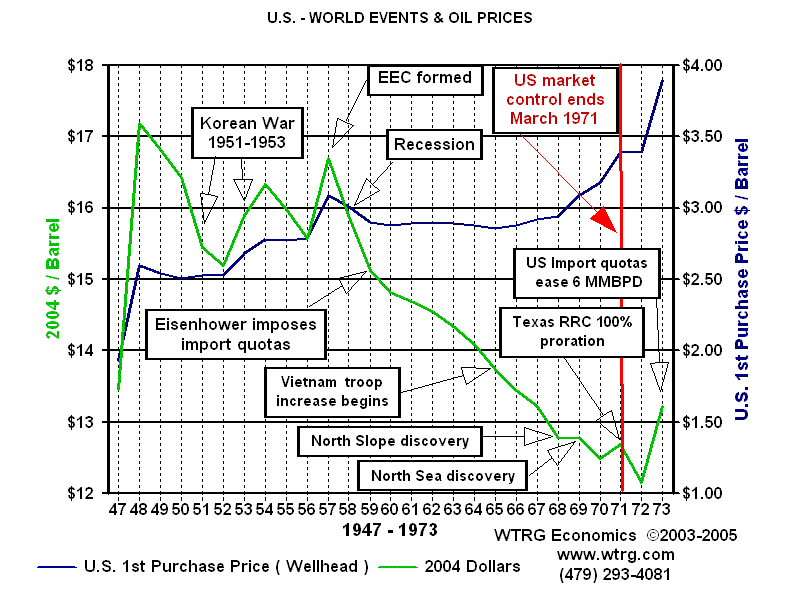
All of this changed in the 1970s, after OPEC consolidated its control and began raising the price. It ended net-back discounts and nationalized the holdings of the international oil companies. Between 1972 and 1978, the average price US refiners paid for imported crude oil quadrupled in dollars of the day. The US government intervened in the market by setting the price of "old" and "new" oil--trying to hold down prices while leaving incentives for new domestic production--and limiting imports. These distinctions were exploited by clever traders, and integrated refiners were forced to supply small, independent refiners, even if their own facilities were under-utilized. It was a mess. From 1978-81, in the aftermath of the Iranian Revolution, oil prices increased by another 150%. Over the next few years, OPEC's ability to set prices was eroded by a 10% reduction in global oil consumption and a tsunami of new non-OPEC output from the North Sea, the North Slope and elsewhere. In the ensuing battle for market share, the price of oil fell from its peak of around $40/bbl. to $13, requiring the 1990 Iraqi invasion of Kuwait finally to push it back above $20.
When I traded oil in the late 1980s, most of the US production I dealt with was bought and sold on the basis of the oil companies' posted prices, which solicited offers to sell them lease-level crude output. Alaskan North Slope crude was one of the few domestic grades I handled that was sometimes pegged to the price of West Texas Intermediate crude on the New York Mercantile Exchange (NYMEX.) The prices of the relatively few international cargoes I bought were typically negotiated for each cargo, without reference to other markets. Although I never bought Saudi oil, it was priced by Aramco on two formulas, one for "eastern" and one for "western" destinations. Transparency in that period depended on the ability of reporting services such as Platts to ferret out the details of the transactions that occurred each day. The fewer the transactions, the less reliable these reports were, especially for domestic grades outside the week or so prior to monthly pipeline scheduling, when most deals took place.
History is rarely a perfect guide, but in this case I think it offers some useful lessons concerning how oil might be priced, if the futures markets became less liquid or less influential. Although prices might not be as volatile, day to day, they would be no less prone to manipulation, or to sudden price spikes in response to changes in supply or demand. The pre-NYMEX oil market only yielded low prices when supply was abundant, a characteristic that has been absent since oil prices took off in 2003. Today's problems of transparency, involving the identity and motivation of market participants, pale in comparison to the former challenges of discerning precisely what the day's price was, in the absence of an open, visible exchange platform. I dislike clichés, but as the father of a small child the image of throwing out the baby with the bathwater resonates strongly, here.
Monday, July 21, 2008
Changing Our Energy Diet
Over the weekend I participated in a panel discussion on space-based solar power (SSP) at a space-development conference, for the second time in as many months. My presentation focused on what it would take for a new source such as SSP to find a place in our energy diet, which will be changing at the same time that the technology for producing power in space and sending it to markets here on earth develops. The audience of entrepreneurs and space professionals was quite engaged by the idea that SSP couldn't just be a space project; it had to be a viable energy project, too. These same challenges apply to any new energy technology with a long development period, including some that are much more established than SSP. But with politicians, pundits, and experts of all stripes telling us we must rapidly shed our addiction to fossil fuels, the inertia of our present energy diet remains the under-appreciated elephant in the room.
I began my brief remarks with a simple pie-chart showing US energy consumption for 2007, based on data from the Energy Information Agency of the US Department of Energy. As replicated below, it showed the breakdown of our primary energy supply--the raw energy going into power plants, factories, and oil refineries for further processing into fuels, electricity and materials, along with the contribution from nuclear power plants and those energy sources that produce electricity directly, such as hydroelectric dams, solar panels and wind turbines. Despite the recent, breathtakingly-fast growth of wind and solar, and the tremendous success of the nuclear industry at squeezing more output from its 104 existing reactors, the low-emission portion of our energy diet only accounts for 15% of our primary energy needs, and less than a third of our electricity demand, with 93% of that coming from mature hydropower and nuclear sources.
I began my brief remarks with a simple pie-chart showing US energy consumption for 2007, based on data from the Energy Information Agency of the US Department of Energy. As replicated below, it showed the breakdown of our primary energy supply--the raw energy going into power plants, factories, and oil refineries for further processing into fuels, electricity and materials, along with the contribution from nuclear power plants and those energy sources that produce electricity directly, such as hydroelectric dams, solar panels and wind turbines. Despite the recent, breathtakingly-fast growth of wind and solar, and the tremendous success of the nuclear industry at squeezing more output from its 104 existing reactors, the low-emission portion of our energy diet only accounts for 15% of our primary energy needs, and less than a third of our electricity demand, with 93% of that coming from mature hydropower and nuclear sources.
US Primary Energy Supply

As in a diet, not all calories are equal or interchangeable. The 39% of this diet supplied by oil cannot be replaced by renewable sources of electricity without a lengthy and dramatic change in our vehicle fleets, because oil accounts for less than 2% of our electricity generation, and there's very little of it left to displace from the power sector. Nuclear power and natural gas already accomplished that task over the last several decades. The much bigger challenge now is to shift the roughly 97% of transportation energy currently derived from oil to other sources--either electricity in the view of Al Gore, Dr. Andrew Grove and others, or natural gas, as suggested by T. Boone Pickens. But as we make that shift, we can't leave the portions of our economy that will still depend on oil high and dry. We must continue to provide enormous quantities of petroleum, even as we work aggressively to shrink its share of our diet and expand the portion supplied by sources that don't emit greenhouse gases or contribute to our trade deficit. It is fundamental to the nature of oil production that if you don't keep drilling, its supply quickly dwindles.
Tom Friedman's column in Sunday's New York Times drew a parallel between Mr. Gore's ten-year goal for ending our use of fossil fuels and President Kennedy's commitment to reach the moon in a decade. Unfortunately, this analogy breaks down once it gets past the R&D stage. I regard our accomplishment of landing two men on the moon 39 years ago yesterday as the pinnacle of the 20th century. It was a remarkable feat, requiring billions of dollars and hundreds of thousands of scientists, engineers, and support staff of every description, yet it ultimately only put 12 Americans on the lunar surface. We're talking about displacing 85% of the current energy diet of a nation of 300 million people that accounts for between a fifth and a quarter of global GDP. Doing that within a decade wouldn't just be moonshot-impressive; it would require a flat-out miracle.
Friday, July 18, 2008
Farewell to $4?
The price of oil on the New York Mercantile Exchange has dropped $15 per barrel in less than a week, bringing us the first closing price under $130 since June 5. It is premature to suggest that this marks the start of a major correction back to sub-$100 territory, but it's noteworthy that this appears to be happening largely due to the weakening of demand, particularly in the US, where gasoline sales are now down around 3% compared to the same time last year--even more if we adjust for the additional ethanol being blended in under this year's higher Renewable Fuel Standard target. If the oil price stabilized here and refining margins remained weak, the national average retail price of gasoline would shortly drop back below $4.00/gallon. Although that wouldn't mean we'd never again experience prices that high, it would be very interesting to see how a return to the mid-to-high $3 per gallon range would affect consumer psychology.
At the very least, this week's drop should deflate some of the recent oil market hysteria, which was making $200 oil and $6 or $7 gasoline seem like an immediate inevitability, on the strength of little more than self-fulfilling prophesies and jitters about a possible conflict with Iran--something that has had the market on edge since oil was under $50. But while that other mainstay of expensive oil, demand growth in the developing economies, continues apace, the market cannot for long ignore a 3% aggregate drop in petroleum demand from a country that still accounts for nearly a quarter of the world's oil imports. Small fractions of large numbers can have a big impact.
Refiners remain caught in the middle, as they have been for most of the last year. With demand responding to high prices and the soft US economy, refiners are making very little money turning oil into gasoline. Weak demand has forced them to absorb a large chunk of the recent increase in oil prices. Nor does it seem likely they will be able to hang onto more of the margin as oil prices drop, because US gasoline inventories are building at the rate of roughly 2 million barrels per week, despite refiners shifting their operations to produce record quantities of diesel, partly at the expense of gasoline output. Refiners have room to increase crude runs, but at these margins, they are probably better off maximizing distillate and purchasing any gasoline shortfall abroad. But while these conditions have benefited consumers in the short run, they could set the stage for higher product prices in the longer term, by making the economics of refinery expansions less attractive.
After Hurricanes Katrina and Rita, there was a spate of concern about the nation's refining system. No new refineries had been built since the 1970s, and too many were concentrated along the Gulf Coast. All that talk came to nothing, but the exceptional margins that existing refineries were earning for several years kicked off some significant refinery expansions, including the Motiva and Marathon projects in the Gulf Coast that will effectively add the equivalent of a brand new refinery inside the boundaries of two existing facilities--a model currently under consideration by some nuclear plant operators.
Now, this might seem like an odd time to build more refining capacity, with demand falling and over a third of the country convinced that we'll get most of our energy from renewable sources within a few years, according to a new API/Harris Interactive survey. But even if we don't end up using more oil in the future, the kind of oil US refineries can process matters greatly in the global market. Although some analysts are skeptical that Saudi Arabia can deliver on the sustained output increases they have promised, one of the main reasons the market has largely yawned at the prospect of another 2 million barrels per day of Saudi crude is that much of the incremental oil will be of low quality--just the kind that these refinery projects are designed to handle. If refining margins don't recover soon, projects like this could be slowed down or deferred, and additional heavy, sour crude oil production will have less impact on the global price of oil--and that would affect us all at the gas pump.
In the meantime, no one should become complacent, even if average gasoline prices soon fall below $4 for a while--though probably not in California. Global supply and demand remain pretty tightly balanced, and we're now never more than one or two events away from a big spike in oil prices or refining margins. While we might soon spend a bit less at the gas pump, we'd be better off pocketing any savings, rather than turning them into a rebound in fuel demand.
At the very least, this week's drop should deflate some of the recent oil market hysteria, which was making $200 oil and $6 or $7 gasoline seem like an immediate inevitability, on the strength of little more than self-fulfilling prophesies and jitters about a possible conflict with Iran--something that has had the market on edge since oil was under $50. But while that other mainstay of expensive oil, demand growth in the developing economies, continues apace, the market cannot for long ignore a 3% aggregate drop in petroleum demand from a country that still accounts for nearly a quarter of the world's oil imports. Small fractions of large numbers can have a big impact.
Refiners remain caught in the middle, as they have been for most of the last year. With demand responding to high prices and the soft US economy, refiners are making very little money turning oil into gasoline. Weak demand has forced them to absorb a large chunk of the recent increase in oil prices. Nor does it seem likely they will be able to hang onto more of the margin as oil prices drop, because US gasoline inventories are building at the rate of roughly 2 million barrels per week, despite refiners shifting their operations to produce record quantities of diesel, partly at the expense of gasoline output. Refiners have room to increase crude runs, but at these margins, they are probably better off maximizing distillate and purchasing any gasoline shortfall abroad. But while these conditions have benefited consumers in the short run, they could set the stage for higher product prices in the longer term, by making the economics of refinery expansions less attractive.
After Hurricanes Katrina and Rita, there was a spate of concern about the nation's refining system. No new refineries had been built since the 1970s, and too many were concentrated along the Gulf Coast. All that talk came to nothing, but the exceptional margins that existing refineries were earning for several years kicked off some significant refinery expansions, including the Motiva and Marathon projects in the Gulf Coast that will effectively add the equivalent of a brand new refinery inside the boundaries of two existing facilities--a model currently under consideration by some nuclear plant operators.
Now, this might seem like an odd time to build more refining capacity, with demand falling and over a third of the country convinced that we'll get most of our energy from renewable sources within a few years, according to a new API/Harris Interactive survey. But even if we don't end up using more oil in the future, the kind of oil US refineries can process matters greatly in the global market. Although some analysts are skeptical that Saudi Arabia can deliver on the sustained output increases they have promised, one of the main reasons the market has largely yawned at the prospect of another 2 million barrels per day of Saudi crude is that much of the incremental oil will be of low quality--just the kind that these refinery projects are designed to handle. If refining margins don't recover soon, projects like this could be slowed down or deferred, and additional heavy, sour crude oil production will have less impact on the global price of oil--and that would affect us all at the gas pump.
In the meantime, no one should become complacent, even if average gasoline prices soon fall below $4 for a while--though probably not in California. Global supply and demand remain pretty tightly balanced, and we're now never more than one or two events away from a big spike in oil prices or refining margins. While we might soon spend a bit less at the gas pump, we'd be better off pocketing any savings, rather than turning them into a rebound in fuel demand.
Wednesday, July 16, 2008
Deferring Climate Action
Depending on one's perspective on climate change, last week's events provided either a series of predictable disappointments or a temporary breather, before our expected plunge into a world of constrained emissions. The statement on climate change from the G8 Summit in Hokkaido, Japan, and the subsequent "Major Economies Meeting" reflected only incremental progress since 2005's Gleneagles G-8 meeting and last year's Bali Climate Conference. And although the announcement that the EPA would effectively defer regulating greenhouse gas emissions under the Clean Air Act until the next administration was overshadowed by allegations that Vice President Cheney had interfered with Congressional testimony on the health risks of climate change, the former should not have shocked anyone. On the heels of the latest failure of US cap & trade legislation, it was not in the cards for 2008 to be more than a transition year for action on climate change, and that view has been borne out.
Lacking the time or space to comment on all of the implications of these actions, I'd like to focus on the principal complaint I've seen concerning the G8's contribution, to the effect that their stated target of cutting global greenhouse gas emissions in half by 2050 falls far short of what would be necessary to stabilize the climate. I would suggest that at this point setting any global emissions target and then starting to work towards it is more important than the absolute level of the goal. Stabilizing atmospheric concentrations of CO2 and other greenhouse gases at their current level would apparently require reductions on the order of 80%, but whatever target we set now for 2050 is unlikely to be the last word, and even more unlikely to be achieved with precision. We will ultimately either undershoot, because global emissions are now growing so rapidly that it will take longer and cost more to halt and reverse this trend than we hope, or we will overshoot, because the world will change so much in the next 42 years that a 50% reduction will prove to have been ridiculously timid.
Consider 1966, removed from us by the same interval as the world of 2050, and the sorts of predictions that were then current regarding the 21st century--predictions rooted firmly in the dominant technologies and institutions of the day. By now all air travel should take place in sumptuous luxury aboard supersonic aircraft. Rather than lumbering along with gasoline engines, our cars should zoom down the roads on nuclear batteries and occasionally even fly. Recessions and credit crises should be a relic of the past, as gigantic mainframe computers guide the economy with total accuracy. And don't forget the colony on the moon. For good or ill, we didn't get those outcomes. Instead, we got ubiquitous real-time information and communications via wireless PCs, cellphones and the Internet, and the beginnings of unprecedented medical and materials revolutions based on DNA-level biotech and nanotechnology. In addition, the world's population has grown by about a half billion fewer people than once expected, making some of our current problems less severe than they would have been. I see little reason to conclude that the next four decades will be any less surprising and prediction-thwarting than the last four. That doesn't mean we should punt on climate change and wait for a miracle, but it does suggest that focusing our first steps firmly on the next 10-20 years makes more sense than bogging down in arguments about a longer-term future we can't forecast.
Few things about climate change are certain, including the level of our emissions in 2050. However, at this point we do know that the roadmap set forth in Bali last December, and resting on the findings of the Fourth Assessment Report of the Intergovernmental Panel on Climate Change, continues to guide the negotiations on a new global climate agreement. Although the shape of the ultimate compromise between the developed and developing economies--the sine qua non of a meaningful successor to the Kyoto Protocol--remains unclear, the key parties at least seem to be willing to tackle it. And we know that on January 20, 2009, a new US administration will take office with climate change as a top priority from day one.
Lacking the time or space to comment on all of the implications of these actions, I'd like to focus on the principal complaint I've seen concerning the G8's contribution, to the effect that their stated target of cutting global greenhouse gas emissions in half by 2050 falls far short of what would be necessary to stabilize the climate. I would suggest that at this point setting any global emissions target and then starting to work towards it is more important than the absolute level of the goal. Stabilizing atmospheric concentrations of CO2 and other greenhouse gases at their current level would apparently require reductions on the order of 80%, but whatever target we set now for 2050 is unlikely to be the last word, and even more unlikely to be achieved with precision. We will ultimately either undershoot, because global emissions are now growing so rapidly that it will take longer and cost more to halt and reverse this trend than we hope, or we will overshoot, because the world will change so much in the next 42 years that a 50% reduction will prove to have been ridiculously timid.
Consider 1966, removed from us by the same interval as the world of 2050, and the sorts of predictions that were then current regarding the 21st century--predictions rooted firmly in the dominant technologies and institutions of the day. By now all air travel should take place in sumptuous luxury aboard supersonic aircraft. Rather than lumbering along with gasoline engines, our cars should zoom down the roads on nuclear batteries and occasionally even fly. Recessions and credit crises should be a relic of the past, as gigantic mainframe computers guide the economy with total accuracy. And don't forget the colony on the moon. For good or ill, we didn't get those outcomes. Instead, we got ubiquitous real-time information and communications via wireless PCs, cellphones and the Internet, and the beginnings of unprecedented medical and materials revolutions based on DNA-level biotech and nanotechnology. In addition, the world's population has grown by about a half billion fewer people than once expected, making some of our current problems less severe than they would have been. I see little reason to conclude that the next four decades will be any less surprising and prediction-thwarting than the last four. That doesn't mean we should punt on climate change and wait for a miracle, but it does suggest that focusing our first steps firmly on the next 10-20 years makes more sense than bogging down in arguments about a longer-term future we can't forecast.
Few things about climate change are certain, including the level of our emissions in 2050. However, at this point we do know that the roadmap set forth in Bali last December, and resting on the findings of the Fourth Assessment Report of the Intergovernmental Panel on Climate Change, continues to guide the negotiations on a new global climate agreement. Although the shape of the ultimate compromise between the developed and developing economies--the sine qua non of a meaningful successor to the Kyoto Protocol--remains unclear, the key parties at least seem to be willing to tackle it. And we know that on January 20, 2009, a new US administration will take office with climate change as a top priority from day one.
Monday, July 14, 2008
Energy Resilience
In an important op-ed in yesterday's Washington Post the former CEO of Intel, Andrew Grove, issued a rebuttal to all the slogans we've been hearing lately promoting energy independence. Without ever mentioning it by name, he also offered a practical alternative to the recently-proposed Pickens Plan. In the process, he has introduced a phrase that might catch on as more precise and pragmatic than either energy independence or energy security: "energy resilience." This notion relies on extending the dominance of electricity into transportation, and on producing this energy carrier from many different primary energy sources, including fossil fuels, various renewable flows, and nuclear energy. An energy economy entirely mediated by electricity would be much less vulnerable to disruptions or price spikes in any one commodity, such as oil.
When confronted with the overwhelming challenges preventing the US from achieving true energy independence in the foreseeable future, many of the advocates of this goal respond that we ought not be overly literal in interpreting it. Independence is a matter of degree, and what they really intend is that we become more energy independent, despite the arrow having pointed steadily in the opposite direction since the early 1980s. If that isn't merely rhetoric, then perhaps they'd be willing to trade in this imprecise slogan for one that represents an equally desirable, yet more achievable goal. Energy resilience could be just what a nation reeling from the inflationary impact of the quadrupling of oil prices in five years is seeking: an economy with the ability to absorb an oil (or natural gas or coal) price shock and keep on growing.
So what might a transition to a more resilient energy economy entail, with electricity powering most transportation, in addition to its other roles? As Dr. Grove notes, shifting our transportation systems to electricity wouldn't be easy, because it will require much new infrastructure and the turnover of most of our vehicle fleet. Powering half of the energy needs of the current US fleet of cars and light trucks would require an additional 40 1,000 MW nuclear power plants or 125,000 MW of additional wind and solar capacity--a seven-fold expansion from current levels--or some combination. In the early years of this transition, we might also consume more natural gas for power generation, not less, because natural gas turbines provide much of the existing base of spare overnight electrical generating capacity that would be used to recharge the first wave of electric cars. In addition, we'll need to upgrade our electrical infrastructure to accommodate more generation from intermittent and cyclical sources, and more sharing between regional grids.
Then there are the cars themselves. Here I think Dr. Grove may be overly optimistic in his estimate of a decade to make this shift. It has taken conventional hybrids, which don't plug into the grid, 9 years to capture 3% of the US car market, though until recently their sales depended more on government incentives and green cachet than on fuel economics. The first original-equipment plug-in hybrid models should reach the market within one to two years, depending on whether Toyota or GM launches first, and until then electric cars such as the Tesla and Aptera will occupy a small niche. Replacing half the 240 million cars and light trucks now on the road by 2020 with plug-ins hybrids and pure EVs would require them to attain a 50% market share within about five years and essentially 100% a few years after that. Dr. Grove suggests retrofitting existing cars to shorten the transition, though I wonder how attractive consumers will find such options. Nor will plug-ins and EVs be the only efficient models vying for market share.
During such a transition our demand for liquid fuels would fall gradually at first, and then more dramatically, while demand for natural gas for power generation would probably rise initially and then level out, depending on how climate change legislation affects the output of our existing coal-fired power plants. Increasing domestic oil and gas production and expanding biofuels output have an important role to play in reducing our net energy imports in the early years of a transition to a strategy of energy resilience. In any case, US oil demand would continue at reduced levels for many years to come, as the long tail of our vehicle fleet turned over, and liquid fuels continued to underpin long-distance travel.
The approach suggested by Dr. Grove has many advantages, and the most important is avoiding the trap of becoming overly reliant on any one source of primary energy, imported or domestic, in the future. In this respect, his idea has an edge over the plan put forward by T. Boone Pickens, though the latter might be simpler to execute. Energy resilience also has thermodynamic efficiency on its side. Because fossil fuels can be used to generate electricity at least twice as efficiently as burning them in internal combustion engines, a US vehicle fleet made up mostly of electric cars would require much less primary energy than the current one, without reducing annual vehicle miles traveled. That would have very beneficial implications for the long-term price of energy, and it would greatly reduce our energy imports. That still might not get us to energy independence, but the combined price and volume effects would shrink our oil import bill to much more manageable proportions.
When confronted with the overwhelming challenges preventing the US from achieving true energy independence in the foreseeable future, many of the advocates of this goal respond that we ought not be overly literal in interpreting it. Independence is a matter of degree, and what they really intend is that we become more energy independent, despite the arrow having pointed steadily in the opposite direction since the early 1980s. If that isn't merely rhetoric, then perhaps they'd be willing to trade in this imprecise slogan for one that represents an equally desirable, yet more achievable goal. Energy resilience could be just what a nation reeling from the inflationary impact of the quadrupling of oil prices in five years is seeking: an economy with the ability to absorb an oil (or natural gas or coal) price shock and keep on growing.
So what might a transition to a more resilient energy economy entail, with electricity powering most transportation, in addition to its other roles? As Dr. Grove notes, shifting our transportation systems to electricity wouldn't be easy, because it will require much new infrastructure and the turnover of most of our vehicle fleet. Powering half of the energy needs of the current US fleet of cars and light trucks would require an additional 40 1,000 MW nuclear power plants or 125,000 MW of additional wind and solar capacity--a seven-fold expansion from current levels--or some combination. In the early years of this transition, we might also consume more natural gas for power generation, not less, because natural gas turbines provide much of the existing base of spare overnight electrical generating capacity that would be used to recharge the first wave of electric cars. In addition, we'll need to upgrade our electrical infrastructure to accommodate more generation from intermittent and cyclical sources, and more sharing between regional grids.
Then there are the cars themselves. Here I think Dr. Grove may be overly optimistic in his estimate of a decade to make this shift. It has taken conventional hybrids, which don't plug into the grid, 9 years to capture 3% of the US car market, though until recently their sales depended more on government incentives and green cachet than on fuel economics. The first original-equipment plug-in hybrid models should reach the market within one to two years, depending on whether Toyota or GM launches first, and until then electric cars such as the Tesla and Aptera will occupy a small niche. Replacing half the 240 million cars and light trucks now on the road by 2020 with plug-ins hybrids and pure EVs would require them to attain a 50% market share within about five years and essentially 100% a few years after that. Dr. Grove suggests retrofitting existing cars to shorten the transition, though I wonder how attractive consumers will find such options. Nor will plug-ins and EVs be the only efficient models vying for market share.
During such a transition our demand for liquid fuels would fall gradually at first, and then more dramatically, while demand for natural gas for power generation would probably rise initially and then level out, depending on how climate change legislation affects the output of our existing coal-fired power plants. Increasing domestic oil and gas production and expanding biofuels output have an important role to play in reducing our net energy imports in the early years of a transition to a strategy of energy resilience. In any case, US oil demand would continue at reduced levels for many years to come, as the long tail of our vehicle fleet turned over, and liquid fuels continued to underpin long-distance travel.
The approach suggested by Dr. Grove has many advantages, and the most important is avoiding the trap of becoming overly reliant on any one source of primary energy, imported or domestic, in the future. In this respect, his idea has an edge over the plan put forward by T. Boone Pickens, though the latter might be simpler to execute. Energy resilience also has thermodynamic efficiency on its side. Because fossil fuels can be used to generate electricity at least twice as efficiently as burning them in internal combustion engines, a US vehicle fleet made up mostly of electric cars would require much less primary energy than the current one, without reducing annual vehicle miles traveled. That would have very beneficial implications for the long-term price of energy, and it would greatly reduce our energy imports. That still might not get us to energy independence, but the combined price and volume effects would shrink our oil import bill to much more manageable proportions.
Friday, July 11, 2008
Airlines vs. Speculators
Yesterday a friend sent me a copy of an email letter she had received from an airline on which she is a frequent flyer. It made an urgent plea for public support to rein in oil market speculation, which it blamed for between $30 and $60 per barrel of the current oil price, which has been ruinous for the airline industry. Millions of Americans received the same letter--apparently I haven't flown enough, lately, to merit one--with a link to the "Stop Speculation Now" campaign website. Congress and the Commodity Futures Trading Commission have been grappling with this issue, and new energy futures market regulations should be forthcoming shortly. However, I hope that the chiefs of America's airlines are not banking on a speedy return to sub-$100 oil, and the $1.00 or more per gallon this would subtract from their jet fuel bills. Even if all speculation were eliminated tomorrow, the combination of a weak supply response and the low price elasticity of demand for oil make it unlikely that prices would quickly revert to last fall's $80-$95 per barrel price range.
For the last year, I have discussed the potential impact of speculation on oil prices. Investment in oil futures, options and derivatives as a new asset class has affected the market in ways that traditional speculation by financial players--a key ingredient of market liquidity--didn't. Even if these investors never take delivery of a single barrel of oil, they constitute a new segment of demand for oil futures and exert upward pressure on the market. I have also described at length the mechanism by which the resulting higher futures prices affect the prices that refineries pay for the physical barrels of oil they process, and why in that margin-based business, resistance to higher prices is likelier to come from end users, rather than refiners. But none of this alters the main facts governing the price of oil: The growth of global demand over the last five years has consumed most of the existing spare production capacity, and restrictions on access to resources--within OPEC and the US--combined with the time-lags inherent in bringing new supplies online have left the market balanced on a knife edge, setting up the conditions without which asset-class investments in oil futures would just be another complicated way to lose money, which may still be the ultimate result for many.
In a recent Wall Street Journal op-ed, Martin Feldstein, a former chairman of the Council of Economic Advisers, provided an exceptionally clear explanation of how small changes in supply and demand can translate into large price movements for commodities with very low short-term price elasticity, or sensitivity, of demand. Yesterday I discussed the recent demand response in the US. It took $4 per gallon pricing to halt the steady year-on-year rise of US gasoline consumption, a trend that was unbroken since 1991. And in the absence of serious refining problems, the only two paths to $4 gasoline were $130 oil or the imposition of a $1.00 per gallon surtax when oil was still under $100/bbl. Constraining the futures market now might provide some temporary relief, but it won't resolve the underlying problems that brought us to this point.
I don't blame the CEOs of the airlines for grasping at this straw. The signatories to the letter include my former boss at Texaco, Glenn Tilton, who understands the oil and airline businesses better than most. These executives know that a commercial aviation industry built on cheap fuel will emerge from a long period of sustained high oil prices as transformed as if it had been re-regulated, and that the mass access to cheap and convenient air travel that we have taken for granted could disappear. Their effort here may even pay off, but as I noted recently, the exact form of any new regulations on energy trading matters greatly, if the cure is not to be worse than the disease.
For the last year, I have discussed the potential impact of speculation on oil prices. Investment in oil futures, options and derivatives as a new asset class has affected the market in ways that traditional speculation by financial players--a key ingredient of market liquidity--didn't. Even if these investors never take delivery of a single barrel of oil, they constitute a new segment of demand for oil futures and exert upward pressure on the market. I have also described at length the mechanism by which the resulting higher futures prices affect the prices that refineries pay for the physical barrels of oil they process, and why in that margin-based business, resistance to higher prices is likelier to come from end users, rather than refiners. But none of this alters the main facts governing the price of oil: The growth of global demand over the last five years has consumed most of the existing spare production capacity, and restrictions on access to resources--within OPEC and the US--combined with the time-lags inherent in bringing new supplies online have left the market balanced on a knife edge, setting up the conditions without which asset-class investments in oil futures would just be another complicated way to lose money, which may still be the ultimate result for many.
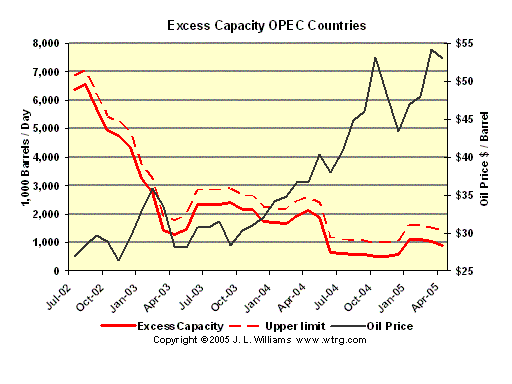
In a recent Wall Street Journal op-ed, Martin Feldstein, a former chairman of the Council of Economic Advisers, provided an exceptionally clear explanation of how small changes in supply and demand can translate into large price movements for commodities with very low short-term price elasticity, or sensitivity, of demand. Yesterday I discussed the recent demand response in the US. It took $4 per gallon pricing to halt the steady year-on-year rise of US gasoline consumption, a trend that was unbroken since 1991. And in the absence of serious refining problems, the only two paths to $4 gasoline were $130 oil or the imposition of a $1.00 per gallon surtax when oil was still under $100/bbl. Constraining the futures market now might provide some temporary relief, but it won't resolve the underlying problems that brought us to this point.
I don't blame the CEOs of the airlines for grasping at this straw. The signatories to the letter include my former boss at Texaco, Glenn Tilton, who understands the oil and airline businesses better than most. These executives know that a commercial aviation industry built on cheap fuel will emerge from a long period of sustained high oil prices as transformed as if it had been re-regulated, and that the mass access to cheap and convenient air travel that we have taken for granted could disappear. Their effort here may even pay off, but as I noted recently, the exact form of any new regulations on energy trading matters greatly, if the cure is not to be worse than the disease.
Thursday, July 10, 2008
Driving Less
The signs that Americans are driving less are everywhere. From headlines such as, "Gas Prices Spur Drivers to Cut Use to Five-Year Low", to increasing ridership on mass-transit systems and TV news segments on the growing numbers of folks bicycling to work, we see $4 gasoline doing what $3 fuel didn't: deliver a meaningful conservation response. But before we pat ourselves on the back for the DOE report that gasoline demand has fallen by 3% compared to last year, we should review a somewhat longer stretch of our recent history of fuel consumption and vehicle miles traveled. It suggests that the current decline, abetted by a weak economy, barely scratches the surface of our per-capita fuel consumption increase since 1995.
Conventional wisdom blames the SUV fad for most of the increase in US oil consumption in the last decade or so. But while rising sales of large SUVs in that period certainly helped to stall the positive trend of passenger car fuel economy, the bigger culprit has been the heretofore steady growth in vehicle miles traveled (VMT.) Between 1995 and 2005 this statistic grew by 23%, slightly more than the 21% increase in gasoline and diesel fuel consumption, and ahead of the 19% expansion of our car and light truck fleet. By comparison, during this period the US population grew by about 13%. In other words, Americans have been driving more cars, and on average driving them farther each year, than in 1995, accounting for more of the accompanying increase in fuel consumption than SUVs. This year's 2% decline in VMT compared to last year's record figure only erases part of the roughly 10% per capita growth of average annual miles driven since 1995. If we unraveled the rest of that growth, we could reduce US gasoline consumption by another 8% without any contribution from the higher fuel economy of the new cars consumers are now choosing. That equates to more than twice as much oil as our use of ethanol will save this year.
I don't pretend that conservation on that scale would be easy or costless. Some portion of the increase in VMT is structural, in the form of workers traveling longer distances from communities beyond the traditional suburbs. Much of the rest is associated with some sort of economic activity, including delivering goods and taking children to daycare or activities. The main advantage of this kind of conservation is that, at least in principle, it can occur much more rapidly than the efficiency gains from the gradual turnover of the vehicle fleet to smaller cars and a larger number of hybrids and alternative fuel vehicles.
It remains to be seen whether the fuel savings we are now observing will persist and expand, level out, or rebound. The first appearances of $2 gasoline in 2004 and $3 gasoline in 2005 delivered milder shocks to a healthier economy, slowing the growth of gasoline demand but not reversing it in the way that sustained $4 fuel has. That result could be put to the test, if oil prices continue to slide from their $145 high last week, or once the economy finally starts to improve. In the meantime, the scope for further behavior-based conservation remains significant.
Conventional wisdom blames the SUV fad for most of the increase in US oil consumption in the last decade or so. But while rising sales of large SUVs in that period certainly helped to stall the positive trend of passenger car fuel economy, the bigger culprit has been the heretofore steady growth in vehicle miles traveled (VMT.) Between 1995 and 2005 this statistic grew by 23%, slightly more than the 21% increase in gasoline and diesel fuel consumption, and ahead of the 19% expansion of our car and light truck fleet. By comparison, during this period the US population grew by about 13%. In other words, Americans have been driving more cars, and on average driving them farther each year, than in 1995, accounting for more of the accompanying increase in fuel consumption than SUVs. This year's 2% decline in VMT compared to last year's record figure only erases part of the roughly 10% per capita growth of average annual miles driven since 1995. If we unraveled the rest of that growth, we could reduce US gasoline consumption by another 8% without any contribution from the higher fuel economy of the new cars consumers are now choosing. That equates to more than twice as much oil as our use of ethanol will save this year.
I don't pretend that conservation on that scale would be easy or costless. Some portion of the increase in VMT is structural, in the form of workers traveling longer distances from communities beyond the traditional suburbs. Much of the rest is associated with some sort of economic activity, including delivering goods and taking children to daycare or activities. The main advantage of this kind of conservation is that, at least in principle, it can occur much more rapidly than the efficiency gains from the gradual turnover of the vehicle fleet to smaller cars and a larger number of hybrids and alternative fuel vehicles.
It remains to be seen whether the fuel savings we are now observing will persist and expand, level out, or rebound. The first appearances of $2 gasoline in 2004 and $3 gasoline in 2005 delivered milder shocks to a healthier economy, slowing the growth of gasoline demand but not reversing it in the way that sustained $4 fuel has. That result could be put to the test, if oil prices continue to slide from their $145 high last week, or once the economy finally starts to improve. In the meantime, the scope for further behavior-based conservation remains significant.
Subscribe to:
Posts (Atom)