Showing posts with label vehicle miles traveled. Show all posts

Thursday, February 13, 2014

US Oil Demand Returns to Growth

  • Early estimates indicate that US oil demand grew by 2% last year, after several years of declining consumption.
  • Although superficially consistent with recent GDP data, it's not yet clear whether this reflects a new trend or the results of non-recurring factors. 
After three straight years of declining oil consumption and a substantial net reduction since 2005, preliminary estimates suggest that US demand for petroleum and its products grew by 2% last year. In the estimation of the International Energy Agency (IEA) US demand growth in 2013 even outstripped that of China.  However, it strikes me as an exaggeration--or at least premature--to see signs, as a recent headline in the Financial Times suggested, that "America returns to gas-guzzling oil demand."  Is this a new trend, or just another blip?

The Energy Information Agency (EIA) of the US Department of Energy won't issue final figures on 2013 consumption for a few more weeks. In the interim, the American Petroleum Institute (API) released its estimates for December and the Fourth Quarter, showing a 5.8% year-on-year uptick for the month and a 4.6% increase for the quarter, compared to the final quarter of 2012. API's Chief Economist John Felmy cited "continued progress in domestic manufacturing as well as the broader economy."

The US economy has shown unexpected strength recently but continues to disappoint a sizable majority of Americans, based on recent polling. The economy added just under 200,000 jobs per month last year, while total employment remains  below its pre-recession peak. The government's first estimate at the end of January indicated that US gross domestic product grew by 3.2% in the fourth quarter of 2013, slower than the third quarter's relatively strong 4.1% pace. That puts full-year growth at 1.9%, or less than the 2.8% rate for the 2012 when US oil consumption shrank by 2% from the year before.

In any case, the  linkage between economic growth and oil demand has weakened over time, falling by more than 60% since the mid-1970s and by 20% just since 2000. In fact, following the peak in US oil demand in 2005, estimated oil and natural gas consumption per dollar of real GDP has declined by an average of 1.7% per year, only a little less than the average of post-recession US GDP growth. So annual efficiency gains come close to offsetting the impact of economic growth on US oil demand.

Some of this is the result of specific efficiency improvements, such as the 1.0 mile-per-gallon increase in the fuel economy of vehicles sold in 2013, compared to the previous year. Tracking data from the University of Michigan indicate a 16% improvement in the fuel economy of new cars since the 2008 model year. Of course it takes time for the impact of new higher-mpg vehicles to make a dent in the demand of a fleet of roughly 235 million cars and light trucks. That's even true of plug-in electric vehicles that use no liquid fuel at all. With cumulative US sales of around 160,000, EVs are displacing less than 5,000 barrels per day (bpd) of gasoline at this point, in a 9 million bpd market.

Because the primary use of oil in the US is in transportation, with less than 1% of it going to generate electricity, we should look at indicators of transportation activity for signals about changes in oil demand. The Federal Highway Administration's tally of US vehicle miles traveled (VMT) for 2013 was just 0.6% higher than 2012, through November, and remained more than 2% below its 2007 peak, only slightly more than a decade ago. If there's been a recent shift in driving habits, it's either well-hidden or involves a switch back to putting more miles on less-efficient vehicles--countering the anecdotal trend of the last few years. In the longer term, VMT growth will face headwinds from the changes in driver demographics I described last August.

In seeking explanations for last year's higher demand, we also can't ignore one-time factors like weather. Heating-degree-day data for the northeast during the fourth quarter shows a nearly 10% increase compared to 4Q2012. That indicates more days when the average temperature was farther below 65 F, and presumably more consumption of heating fuel as a result--a trend that seems to be continuing this quarter.

Scrutinizing EIA's detailed data on product supplied reveals that around two-thirds of the roughly 300,000 bpd annual increase in demand in 2013 (through October) was in the categories of liquefied petroleum gases (LPG) and low-sulfur distillate, both used for heating. For that matter, much of the growth in LPG demand is being met from the processing of shale gas, rather than crude oil refining, so its inclusion as part of "oil demand" is somewhat misleading. Nor do growing US net exports of refined products, at  around a million barrels per day last year according to API, have any bearing on this discussion, since they aren't included in the figures on which US consumption is gauged.

Another factor to consider when evaluating changes in oil demand is pricing. US retail gasoline prices averaged $0.11 per gallon less in 2013 than 2012, while retail diesel averaged around $0.05/gal. less. Those don't seem like big enough changes to affect demand, but the fourth quarter comparison is more dramatic, with gasoline and diesel $0.22 and $0.15/gal., respectively, less than a year earlier. That, together with a cooler fall, might help explain the fourth quarter bump in API's figures, which showed gasoline demand up by 3.7% year-on-year, and diesel up 5.3%.

Indications of a resurgence in US oil demand growth depend heavily on a single quarter's results, following a quarter of above-trend GDP growth--partially offset by efficiency gains that are expected to grow--and reinforced by cooler weather.  While I can easily imagine that a return to robust US economic growth, combined with persistently weaker fuel prices, could put US oil consumption on an ascending path again, I'd like to see a few more data points before discerning larger implications for global oil demand and prices.

A different version of this posting was previously published on the website of Pacific Energy Development Corporation.

Wednesday, August 28, 2013

Will Fewer Young Drivers Today Mean Lower Fuel Demand Tomorrow?

  • Driver's licenses for those under 40 years of age are down in several large, developed countries, including the US. This is only partially explained by a weak economy.
  • If this shift in attitudes towards driving persists, future demand for both cars and fuel could be permanently reduced.
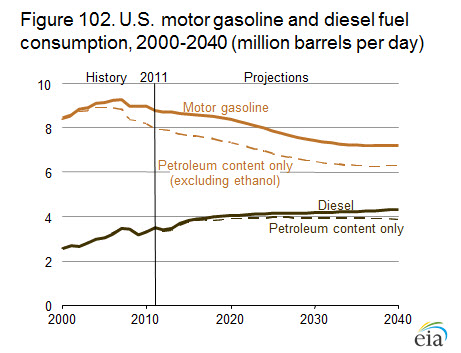
Current forecasts from the Energy Information Administration indicate that US gasoline demand peaked in 2007 and is expected to decline steadily for at least the next two decades.  One of the most intriguing factors aligned with this shift, which would have been almost unthinkable only a few years ago, involves a surprising reduction in the number of licensed drivers under 40 years of age.  A new study from the Transportation Research Institute (TRI) at the University of Michigan helps to explain a trend that is apparently not unique to the US.

Prior to the Great Recession, US gasoline demand had grown by 1-2% per year, with few interruptions. Since the recession, it has been shrinking for reasons that don't appear to be temporary. New cars are becoming more fuel-efficient, and Americans are consistently driving less than before the recession,  as indicated in the latest statistics on vehicle miles traveled.  To some extent this is an understandable response to gasoline prices that have remained significantly higher in real dollars than they were from 1982-2006. However, there may be other, deeper shifts underway.  If a segment of younger Americans has not only delayed getting a driver's license, but may never get one, then the decline in motor fuel demand is likelier to be permanent.

Once I started reading the survey results in the new study by the TRI's Brandon Schoettle and Dr. Michael Sivak, I knew I also needed the context of their 2011 paper on "Recent Changes in the Age Composition of Drivers in 15 Countries." That study showed that from 1983 to 2008 the number of licensed drivers in the US as a percentage of each age group up to 40 had dropped significantly, while the opposite was true for those over 50. (See chart below.) The authors found similar shifts in 7 other developed countries, including Canada, the UK, Germany and Japan, with a 2012 update indicating a further decline in US pre-40 licensing through 2010. Interestingly, Spain, Poland, Israel and several other countries exhibited increases in licensing among both younger and older drivers.
 
In their current paper, the authors used an online, non-random survey of 618 under-40 non-drivers to explore the reasons for their status. The top reasons their respondents gave for not having a driver's license seemed mainly practical, rather than philosophical. Many of those under 30 reported being "too busy or not enough time to get a driver's license",  or "able to get transportation from others." The "cost of owning and maintaining a vehicle" was the second-most common reason among all respondents, and as the authors noted, that is consistent with the relatively high unemployment or full-time student status of this group--46% and 21%, respectively.
 
Other common responses suggest that at least some of those without licenses are in that position by intention, rather than necessity. Nearly 40%--likely including some overlap--reported a preference for biking, walking or public transportation as a primary or secondary reason, while 9% cited environmental concerns and 8% mentioned online alternatives to driving.

Having grown up in a time and place where obtaining a driver's license as close as possible to one's 16th birthday was both a rite of passage and a practical necessity, this is that rare energy issue that's hard for me even to relate to. Yet when I look at the above chart, with its mirror-image shifts, I'm struck by the similarity between recent under-40 driver's license data and those for the cohorts born between the World Wars.  Are the current license rates of Millennials and late-Gen-X'ers the anomaly, or will those of my Baby Boomer and early Generation X peers turn out to be uniquely high? Only the passage of time can clarify such questions.

While the authors stopped short of assigning cause and effect, it seems reasonable to conclude that at least part of what we're seeing here is the result of the stubbornly persistent youth unemployment of a tepid recovery and the "New Normal" economy. A few years of much stronger economic growth might shrink the gap shown in Figure 1, by addressing the reasons that many of those surveyed gave for not having a driver's license, particularly since only 6% of them reported they never learned to drive.  Of course that doesn't explain why more than a third of those in the 30-39 age group, who ought to be the most financially settled, indicated they planned never to get a license.

The survey's results and their implications ought to be of great interest to producers of conventional and alternative fuels, established auto manufacturers, car rental firms, as well as transportation planners and policy makers.  Even electric-vehicle startups like Tesla might wonder whether for a significant segment of their natural future market, the choice won't be between an EV and a conventional car, but between a car and not driving at all. This is a trend that bears watching.
 
A different version of this posting was previously published on the website of Pacific Energy Development Corporation.

Friday, July 17, 2009

Going Farther on Oil

As I was perusing my UC Davis alumni magazine last night I ran across a short article mentioning a new book from a professor, Dan Sperling, who directs Davis's well-regarded Institute of Transportation Studies. I know him slightly from his participation as in invited expert in a scenario workshop many years ago, so this caught my eye. His book, which I haven't read yet, examines the impact and implications of the rapidly growing global vehicle population, which he sees reaching the two billion mark within the next 20 years. In the article he suggested that this would require an entirely new transportation energy mix, made up of hydrogen, electricity, and advanced biofuels. That certainly fit my own long-standing expectations, as well. However, it occurred to me to wonder just how far we might be able to stretch the transportation fuels we get from oil, and just how far short they would fall as the global car-park expands. To my surprise, it doesn't require very aggressive assumptions concerning improvements in fuel economy, reductions in vehicle miles traveled, and additional oil supplies to cover the needs of a significantly larger number of cars in the world.

The starting point for such an analysis is current oil supplies and the way we process them. Global oil output in 2008 reached 86.5 million barrels per day (MBD), including crude oil, natural gas liquids, and the volumetric gain that occurs when you run them through a modern refinery. Roughly 60% of that input is currently turned into gasoline, diesel and jet fuel. Improvements in refining technology should make it possible to push that fraction to perhaps 70%, at the expense of heavy fuel oil displaced from power generation and shipping. So even if global oil output plateaued at only 90 MBD, a scenario that would probably seem optimistic to the adherents of Peak Oil and pessimistic to some industry experts, it could still yield 63 MBD of liquid transportation fuels. Set aside 7 MBD of that for jet fuel and kerosene and another 26 MBD for trucking and home heating oil, and we're left with 30 MBD of gasoline and diesel for passenger cars. That's roughly 25% more than current global consumption in light-duty vehicles, including the couple of MBD of diesel fuel that power Europe's popular diesel cars.

That doesn't seem to get us nearly far enough, until we consider that in the near future, cars will become much more efficient than they have been, particularly in the US, where an improvement from the current notional average of 25 mpg to the required 35.5 should eventually reduce average fuel consumption per mile by 30%. If the recent reversal in annual vehicle miles traveled persists after the recession ends, that would compound future fuel savings. When we consider that new cars in Europe currently average about 35 mpg and are required to reach approximately 43 mpg by 2015, based on a standard of 130 grams of CO2 emitted per kilometer, and that China has also introduced stricter fuel economy standards, it's not hard to imagine the average world car getting 40 mpg by 2020. That doesn't even require the majority of cars to be hybrids, let alone plug-in hybrids. If that average car drove 9,000 miles per year, it would consume 225 gallons of fuel annually. Following this back-of-the-envelope calculation to its conclusion, our 30 MBD of petroleum-based fuel for light-duty vehicles would be sufficient to cover Dr. Sperling's 2 billion cars with a little bit left over.

I'm not for a moment suggesting that this is the likeliest scenario, or that it means we don't need any of the advanced biofuels or electric vehicle technology currently under development. As I've pointed out frequently, fleet turnover in the developed world has slowed, thanks to the recession, and we can expect a long "tail" of older vehicles to persist for some time. However, the results of this simple exercise surprised me; I had expected the final number of cars that could be supplied by oil to be much lower. So while our transportation energy mix in the next couple of decades is still likely to include a much greater variety of fuels and an increasing penetration of electricity, we should not lose sight of the potential for realistically-achievable fuel economy improvements and non-efficiency conservation--driving personal cars less and relying more on mass transit and electronic trip substitution--to be the most important "transition fuel" in our arsenal, as we reduce our present reliance on oil, in order to tackle energy security and climate change.

Thursday, July 10, 2008

Driving Less

The signs that Americans are driving less are everywhere. From headlines such as, "Gas Prices Spur Drivers to Cut Use to Five-Year Low", to increasing ridership on mass-transit systems and TV news segments on the growing numbers of folks bicycling to work, we see $4 gasoline doing what $3 fuel didn't: deliver a meaningful conservation response. But before we pat ourselves on the back for the DOE report that gasoline demand has fallen by 3% compared to last year, we should review a somewhat longer stretch of our recent history of fuel consumption and vehicle miles traveled. It suggests that the current decline, abetted by a weak economy, barely scratches the surface of our per-capita fuel consumption increase since 1995.

Conventional wisdom blames the SUV fad for most of the increase in US oil consumption in the last decade or so. But while rising sales of large SUVs in that period certainly helped to stall the positive trend of passenger car fuel economy, the bigger culprit has been the heretofore steady growth in vehicle miles traveled (VMT.) Between 1995 and 2005 this statistic grew by 23%, slightly more than the 21% increase in gasoline and diesel fuel consumption, and ahead of the 19% expansion of our car and light truck fleet. By comparison, during this period the US population grew by about 13%. In other words, Americans have been driving more cars, and on average driving them farther each year, than in 1995, accounting for more of the accompanying increase in fuel consumption than SUVs. This year's 2% decline in VMT compared to last year's record figure only erases part of the roughly 10% per capita growth of average annual miles driven since 1995. If we unraveled the rest of that growth, we could reduce US gasoline consumption by another 8% without any contribution from the higher fuel economy of the new cars consumers are now choosing. That equates to more than twice as much oil as our use of ethanol will save this year.

I don't pretend that conservation on that scale would be easy or costless. Some portion of the increase in VMT is structural, in the form of workers traveling longer distances from communities beyond the traditional suburbs. Much of the rest is associated with some sort of economic activity, including delivering goods and taking children to daycare or activities. The main advantage of this kind of conservation is that, at least in principle, it can occur much more rapidly than the efficiency gains from the gradual turnover of the vehicle fleet to smaller cars and a larger number of hybrids and alternative fuel vehicles.

It remains to be seen whether the fuel savings we are now observing will persist and expand, level out, or rebound. The first appearances of $2 gasoline in 2004 and $3 gasoline in 2005 delivered milder shocks to a healthier economy, slowing the growth of gasoline demand but not reversing it in the way that sustained $4 fuel has. That result could be put to the test, if oil prices continue to slide from their $145 high last week, or once the economy finally starts to improve. In the meantime, the scope for further behavior-based conservation remains significant.