Last night the US House of Representatives passed the compromise tax bill without any amendments and by a healthy margin, though narrower than the 81-19 vote in the Senate on Wednesday. The bill now goes to the President for his signature. The provisions added after the initial negotiations between the White House and Republican leadership delivered a substantial Christmas present to the nation's renewable energy industry, including several key items on the industry's wish list: extension of the ethanol blenders' tax credit at its current rate of $0.45 per gallon; extension of the Treasury Renewable Energy Grants, which provide cash in lieu of investment tax credits; and a retroactive extension of the $1.00 per gallon biodiesel tax credit, which had lapsed at the end of 2009. However, as with many Christmas presents, the bill that will come due next year is also substantial. And the one-year extensions granted to these incentives leaves their long-term fate in the hands of the new Congress, which is widely expected to be more focused on deficit reduction than on stimulus.
This result constitutes a remarkable trifecta. As recently as a week ago it seemed likely that the Treasury Grant program would expire on schedule, and that the ethanol credit, if not actually allowed to expire, would at least be reduced to reflect its redundancy with the Renewable Fuel Standard (RFS), which requires refiners and fuel blenders to add biofuel to gasoline. As for the biodiesel tax credit, it looked like a lost cause all year, having failed on multiple previous attempts to reinstate it. The US ethanol industry even prevailed in having the $0.54 per gallon duty on imported ethanol extended for another year, in order to shield taxpayers from paying incentives to foreign producers and the industry from cheaper competition--though I'm not sure how competitive Brazilian cane ethanol really is these days, with sugar trading at around $0.30/lb ex duty. (As I understand the tradeoff, a gallon of cane ethanol consumes roughly the same raw materials as 10 lb. of cane sugar.)
It's a tribute to the greatly expanded scale of renewable energy that the price tag for the one-year extension of these three incentives is as high as it will be. This year, even with US wind turbine installations running well behind their record pace in 2009, the Treasury has spent $3.9 billion on the grant program for projects installing geothermal, solar, wind and other renewable electricity equipment. With continued strong growth in both solar thermal and photovoltaic projects and even a modest uptick in wind installations, the tab for 2011 could easily break $4 B. (A separate manufacturers tax credit, which had a better claim on creating green jobs here in the US, was not extended.) Meanwhile, with conventional ethanol and biodiesel blended at the mandated rates for next year, they should account for around $5.9B and $0.8 B, respectively. That comes to $10.7 billion for all three programs.
Although the tax compromise has extended the energy policy status quo for another year, change is in the air. With continued, though narrower bi-partisan support, the ethanol industry's argument that its tax credit is still necessary after 32 years--even with a steadily increasing RFS mandate--is losing credibility. Part of the industry would prefer this money to be spent encouraging infrastructure for E85 and other higher-percentage blends that represent ethanol's future growth opportunity, if any. As for the Treasury Grants, a temporary stimulus measure intended to make up for the disappearance of the tax equity market during the financial crisis, the defensibility of treating the investment tax credit on which it is based differently from any other credit in the tax code is waning. This mechanism looks increasingly exposed as the broader category of "tax expenditures" becomes an obvious target for deficit cutters, and the justification for extending it beyond next year would probably vanish if the Congress enacted legislation along the lines of Senator Graham's Clean Energy Standard. The industry should make the most of the current Christmas package, because the odds are against a repetition of it turning up under next year's tree.
Showing posts with label tax bill. Show all posts
Showing posts with label tax bill. Show all posts
Friday, December 17, 2010

Thursday, February 14, 2008
Adversaries or Allies?
The final version of the Energy Bill that passed last December omitted several provisions that were near and dear to the hearts of its original sponsors and their supporters. One of those measures, the repeal of specific tax benefits for oil and gas companies, has just been reintroduced in the House of Representatives, sponsored by Congressman Rangel (D-NY.) Unfortunately this bill, which would also extend the renewable energy production tax credit (PTC) that is due to expire at the end of the year, repeats the error of pitting a key component of our current energy supplies against a growing segment of future supply. That is hardly a recipe for achieving energy independence, or in any way enhancing our energy security. I believe the impetus behind this urge to rob Peter to pay Paul stems from a misunderstanding of basic oil industry economics, distorted by the enormous profits that the big firms are earning in the current high-price environment.
Let's begin by acknowledging that the PTC should be renewed, and not just for another year or two. We can argue about whether it should eventually be phased out, as renewable energy becomes more competitive with conventional energy, but our all-or-nothing approach to this subsidy plays havoc with the pace of development of wind power and other alternatives. But that does not mean that the funding for the PTC should come at the expense of critically-needed supplies of oil and gas. With the US already reliant on imports for two-thirds of our crude oil needs and a growing share of our natural gas consumption, that is folly.
No one can argue that oil companies are suffering today, though it is also clear that US-based companies face enormous obstacles to remain globally competitive, when the vast majority of the world's oil reserves are controlled by national oil companies. Viewing the pending tax bill as counterproductive doesn't require justifying the industry's record profits or arguing that they are over-taxed already. Rather, it requires the simple recognition that today's huge profits are not being generated by projects currently under construction or in the planning stages, but by projects that were completed in the past, when oil prices and construction costs were much lower. Projects that were approved in the 1980s and 1990s with the expectation of earning a few dollars per barrel of profit are now generating margins in the tens of dollars per barrel. However, many of those mature producing projects also experienced years such as the late 1990s, when those returns were nonexistent or negative.
Other than helping to determine the total size of a company's capital and exploratory budget, the current profits on existing projects have nothing to do with decisions about which new projects to develop and which to put on hold. Those decisions are made based on calculations of expected net present value, after paying all relevant royalties and taxes, foreign and domestic. That's why the provision of HR.5351 that would limit the ability of companies to deduct foreign production taxes from their US income is so insidious. At a time when foreign governments are increasing royalties and taxes on new production, and with project costs having spiked dramatically in the last five years, anything that makes the incremental economics of new oil projects less attractive will result in lower future supplies, and still higher prices.
Every year, oil producers must replace the amount by which their annual output has declined, as a result of the depletion of mature reservoirs. A recent study by CERA put that rate at around 4.5%, though many believe it is higher. At a 4.5% decline rate, the US must replace the equivalent of over 200,000 barrels per day, just to stay even. That's equivalent to the net energy contribution of 14 billion gallons per year of ethanol, or the average output of 42,000 MW of wind power capacity. At that scale, anything that promotes renewables at the expense of the new oil projects needed to maintain output seems unlikely to result in a net energy gain for the country. In reality, we need both, if we're going to make a dent in our oil imports, as everyone seems to desire.
I know this is a tough sell, after a year in which ExxonMobil made $40.6 billion--after paying $30 billion in tax--and my old company, Chevron, reported $18.7 billion in after-tax income. But the real issue is not how much of those profits their shareholders (including me) should get to keep, but how to ensure that any additional tax burden is not added in a way that makes new production less attractive. Ultimately, we need the contribution of the new forms of energy that HR.5351 is seeking to promote via the extension of the PTC and other subsidies, but we still need the steady stream of oil and gas production that its funding mechanism would put at risk, if we want to get to a greener energy future without increasing our dependence on OPEC in the process.
Let's begin by acknowledging that the PTC should be renewed, and not just for another year or two. We can argue about whether it should eventually be phased out, as renewable energy becomes more competitive with conventional energy, but our all-or-nothing approach to this subsidy plays havoc with the pace of development of wind power and other alternatives. But that does not mean that the funding for the PTC should come at the expense of critically-needed supplies of oil and gas. With the US already reliant on imports for two-thirds of our crude oil needs and a growing share of our natural gas consumption, that is folly.
No one can argue that oil companies are suffering today, though it is also clear that US-based companies face enormous obstacles to remain globally competitive, when the vast majority of the world's oil reserves are controlled by national oil companies. Viewing the pending tax bill as counterproductive doesn't require justifying the industry's record profits or arguing that they are over-taxed already. Rather, it requires the simple recognition that today's huge profits are not being generated by projects currently under construction or in the planning stages, but by projects that were completed in the past, when oil prices and construction costs were much lower. Projects that were approved in the 1980s and 1990s with the expectation of earning a few dollars per barrel of profit are now generating margins in the tens of dollars per barrel. However, many of those mature producing projects also experienced years such as the late 1990s, when those returns were nonexistent or negative.
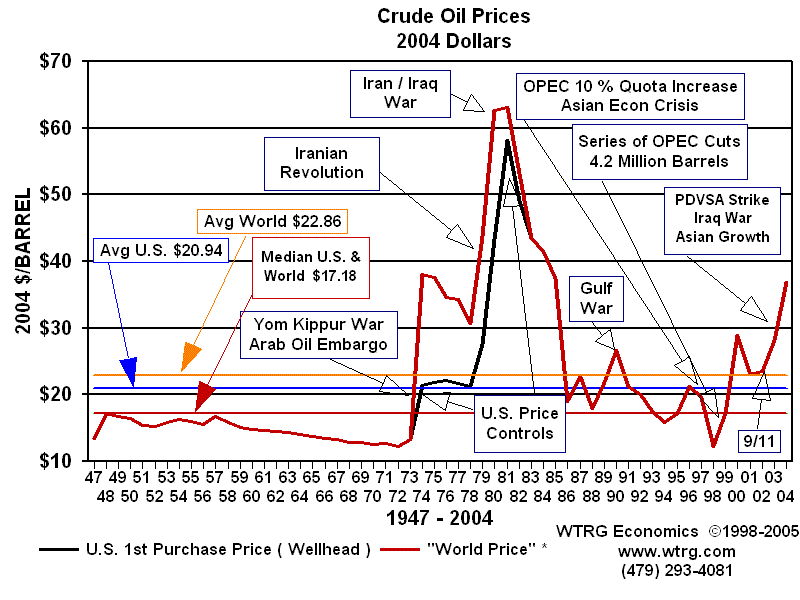
Other than helping to determine the total size of a company's capital and exploratory budget, the current profits on existing projects have nothing to do with decisions about which new projects to develop and which to put on hold. Those decisions are made based on calculations of expected net present value, after paying all relevant royalties and taxes, foreign and domestic. That's why the provision of HR.5351 that would limit the ability of companies to deduct foreign production taxes from their US income is so insidious. At a time when foreign governments are increasing royalties and taxes on new production, and with project costs having spiked dramatically in the last five years, anything that makes the incremental economics of new oil projects less attractive will result in lower future supplies, and still higher prices.
Every year, oil producers must replace the amount by which their annual output has declined, as a result of the depletion of mature reservoirs. A recent study by CERA put that rate at around 4.5%, though many believe it is higher. At a 4.5% decline rate, the US must replace the equivalent of over 200,000 barrels per day, just to stay even. That's equivalent to the net energy contribution of 14 billion gallons per year of ethanol, or the average output of 42,000 MW of wind power capacity. At that scale, anything that promotes renewables at the expense of the new oil projects needed to maintain output seems unlikely to result in a net energy gain for the country. In reality, we need both, if we're going to make a dent in our oil imports, as everyone seems to desire.
I know this is a tough sell, after a year in which ExxonMobil made $40.6 billion--after paying $30 billion in tax--and my old company, Chevron, reported $18.7 billion in after-tax income. But the real issue is not how much of those profits their shareholders (including me) should get to keep, but how to ensure that any additional tax burden is not added in a way that makes new production less attractive. Ultimately, we need the contribution of the new forms of energy that HR.5351 is seeking to promote via the extension of the PTC and other subsidies, but we still need the steady stream of oil and gas production that its funding mechanism would put at risk, if we want to get to a greener energy future without increasing our dependence on OPEC in the process.
Subscribe to:
Posts (Atom)