When the US invaded Ba'athist Iraq, many ascribed that action to a desire to seize the country's vast oil reserves and develop them on terms favorable to us, presumably to keep the days of cheap oil rolling on. After six years of oil prices far above their pre-war level, the last vestiges of that theory should be laid to rest by a careful reading of today's headlines concerning the announced production deal between the Iraqi government and ExxonMobil and Shell. The terms looks anything but lucrative for the Supermajors, which have won the opportunity to revamp output at one of Iraq's largest mature oil fields, West Qurna. However paltry the returns might look for the firms involved, this development could have a bigger impact on oil price--and sooner--than some of the splashier recent announcements concerning big oil finds off Brazil and West Africa.
The reported terms of the deal struck by Exxon and Shell in Iraq continue the trend of allowing access only on the basis of working as contractors, rather than as partners with an ownership interest in the underlying resource via a typical production-sharing contract. According to the story in today's Wall St. Journal, the companies will receive just $1.90 per barrel for their efforts to boost the flagging output of the super-giant West Qurna field, the output of which could increase by more than the current oil production of Texas (including the Gulf of Mexico.) Moreover, because the project entails virtually no exploration risk--the reserves are well-established--and minimal technical risk, and is already connected to infrastructure, the only real limitation on how fast it could begin ramping up is the local security environment and the ability of the firms to line up equipment and workers. This will still require several years, but it should happen a lot quicker than the time required to develop a new field with tricky geology in deep water.
So what does this mean? Well, for ExxonMobil and Shell it offers a relatively quick boost in production and revenue. $1.90/bbl is skimpy compared to what companies can make on their own discoveries, but over volumes this large it could translate into an extra $700 million of annual cash flow for the next 20 years. As attractive as that sounds, though, it comes without the ability to book new reserves, which are so critical to the valuations of oil companies.
The implication for oil prices will depend on many other factors, but the steady growth of Iraq's oil production from the current 2.5 million bbl/day to a level commensurate with the country's reported 115 billion bbls of reserves could at least compensate for some large declines elsewhere and help maintain a reasonable cushion of spare production capacity as the global economy gets back on track. This hardly bodes a return to $20 oil prices--an eventuality that would be much less welcome in the carbon-constrained world we're entering than just a few years ago--but it could buy us enough time for fuel efficiency and vehicle electrification to match Peak Demand to an inevitable peak in global production.
Showing posts with label Iraq War. Show all posts
Showing posts with label Iraq War. Show all posts
Friday, November 06, 2009

Monday, March 17, 2008
The Road Not Taken
This week marks the fifth anniversary of the start of the Iraq War. With the outcome of November's US presidential election hinging at least in part on the judgment to go to war in 2003, and in light of the release of a new book by a Nobel-winning economist assessing the cost of the war, it seems appropriate to spend a moment reflecting on the road not taken, at least in terms of its energy aspects. Although we will never know what would have ultimately happened, had the US decided not to invade Iraq, we can make some educated guesses about the level of oil prices in such a world. Just as the war itself cannot properly be characterized as a war for oil--though it has certainly been about oil--today's oil price of $110 per barrel reflects the results of that decision, though it has not been directly caused by it.
In gauging the impact of the Iraq War on oil prices, we need to evaluate two broad areas: the relative importance of Iraqi under-production, compared to all the other factors that have contributed to oil's dramatic rise from the mid-$20s per barrel, and the nature of Iraq's status quo ante, with regard to oil. Let's start with the latter, since after five years of war, most commentators have forgotten about the way that Saddam Hussein's behavior regularly roiled the market.
In the aftermath of the 1991 Gulf War and leading up to our invasion in 2003, Iraq was under UN sanctions that inhibited its oil trade, among other things. Foreign firms could not enter into new development deals with the Iraqi government, and the country's oil exports were capped and managed under the Oil for Food Program, which was later revealed to have been rife with corruption and used by Saddam as an ATM to fund his pet projects. Between 1992 and 2003, Iraq suspended its oil exports several times--most recently in 2002--and threatened to do so on many other occasions, temporarily driving oil prices higher. If the war had never happened and the sanctions regime remained in place today, the combination of UN restrictions and Saddam's pattern of using oil exports as a geopolitical tool would be contributing to market instability, not lower prices.
I would argue that the likelier scenario was not a continuation of the pre-war status quo, but the gradual disintegration of the sanctions regime--a process already apparent in 2002--as oil companies from Security Council countries such as France and Russia pressed for commercial access to Iraq's enormous untapped oil reserves. Still, it takes time to bring new oil fields on line, even when exploration risk is very low and geology quite favorable, as it is in Iraq. Had sanctions collapsed entirely in 2004 or 2005, we still would not have any contribution from such projects at this point, and Iraq's exports would be about what they averaged between 1999 (when the dollar-cap on Oil for Food exports was eliminated) and 2002: 1.9 million barrels per day (bpd.) It's also likely, however, that these exports would have been interrupted by Iraqi politics and periodic military confrontations with the US, such as Operation Desert Fox in late 1998. In other words, other than the cumulative loss of perhaps a billion barrels of oil exports from 2003-2006, Iraq's current exports absent the Iraq War would probably be about the same as they are today.
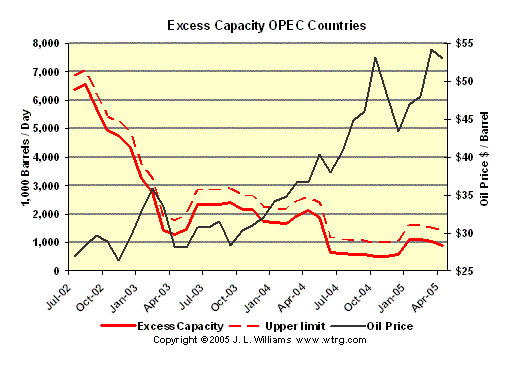
Nor has the Iraq War been the only factor applying pressure on oil prices since 2003. You've heard the litany many times: the growth of Asia and especially China, turmoil in Nigeria, resource nationalism, tensions with Iran, Hurricane Katrina, and so on. Is there any reason to think these wouldn't have been just as significant--except for the risk of conflict with Iran --had the Iraq War never occurred? If anything, global economic growth, and oil consumption with it, might have been even higher, if the US hadn't embarked on a major war financed largely by foreign debt. The largest direct contribution of the Iraq War to oil prices probably occurred in 2003-2004, when Iraq's curtailed output helped drive OPEC's spare capacity below 1 million bpd, and sent prices soaring past $50/bbl for the first time. That impact has largely abated, as Iraq's oil exports have gradually been restored.
On balance, then, the effect of the Iraq War on current oil prices has been largely indirect. I believe it is attributable more to mismanagement of the war, and particularly to our choices about how to finance it, than with the 2003 decision to invade. The alternative scenario is less a function of how much oil Iraq might now be producing than of the relative health of a US economy that was only engaged in one foreign war, not two. Spending hundreds of billions of dollars on a war, without raising taxes to support it, has expanded our fiscal and external financing deficits, weakening the US dollar and feeding speculation in commodities--a lesson we should have learned from the Vietnam War. Had the dollar maintained its 2003 pre-war level against the Euro of about $1.08, oil might today be closer to $75/bbl than $110.
In gauging the impact of the Iraq War on oil prices, we need to evaluate two broad areas: the relative importance of Iraqi under-production, compared to all the other factors that have contributed to oil's dramatic rise from the mid-$20s per barrel, and the nature of Iraq's status quo ante, with regard to oil. Let's start with the latter, since after five years of war, most commentators have forgotten about the way that Saddam Hussein's behavior regularly roiled the market.
In the aftermath of the 1991 Gulf War and leading up to our invasion in 2003, Iraq was under UN sanctions that inhibited its oil trade, among other things. Foreign firms could not enter into new development deals with the Iraqi government, and the country's oil exports were capped and managed under the Oil for Food Program, which was later revealed to have been rife with corruption and used by Saddam as an ATM to fund his pet projects. Between 1992 and 2003, Iraq suspended its oil exports several times--most recently in 2002--and threatened to do so on many other occasions, temporarily driving oil prices higher. If the war had never happened and the sanctions regime remained in place today, the combination of UN restrictions and Saddam's pattern of using oil exports as a geopolitical tool would be contributing to market instability, not lower prices.
I would argue that the likelier scenario was not a continuation of the pre-war status quo, but the gradual disintegration of the sanctions regime--a process already apparent in 2002--as oil companies from Security Council countries such as France and Russia pressed for commercial access to Iraq's enormous untapped oil reserves. Still, it takes time to bring new oil fields on line, even when exploration risk is very low and geology quite favorable, as it is in Iraq. Had sanctions collapsed entirely in 2004 or 2005, we still would not have any contribution from such projects at this point, and Iraq's exports would be about what they averaged between 1999 (when the dollar-cap on Oil for Food exports was eliminated) and 2002: 1.9 million barrels per day (bpd.) It's also likely, however, that these exports would have been interrupted by Iraqi politics and periodic military confrontations with the US, such as Operation Desert Fox in late 1998. In other words, other than the cumulative loss of perhaps a billion barrels of oil exports from 2003-2006, Iraq's current exports absent the Iraq War would probably be about the same as they are today.
Nor has the Iraq War been the only factor applying pressure on oil prices since 2003. You've heard the litany many times: the growth of Asia and especially China, turmoil in Nigeria, resource nationalism, tensions with Iran, Hurricane Katrina, and so on. Is there any reason to think these wouldn't have been just as significant--except for the risk of conflict with Iran --had the Iraq War never occurred? If anything, global economic growth, and oil consumption with it, might have been even higher, if the US hadn't embarked on a major war financed largely by foreign debt. The largest direct contribution of the Iraq War to oil prices probably occurred in 2003-2004, when Iraq's curtailed output helped drive OPEC's spare capacity below 1 million bpd, and sent prices soaring past $50/bbl for the first time. That impact has largely abated, as Iraq's oil exports have gradually been restored.
On balance, then, the effect of the Iraq War on current oil prices has been largely indirect. I believe it is attributable more to mismanagement of the war, and particularly to our choices about how to finance it, than with the 2003 decision to invade. The alternative scenario is less a function of how much oil Iraq might now be producing than of the relative health of a US economy that was only engaged in one foreign war, not two. Spending hundreds of billions of dollars on a war, without raising taxes to support it, has expanded our fiscal and external financing deficits, weakening the US dollar and feeding speculation in commodities--a lesson we should have learned from the Vietnam War. Had the dollar maintained its 2003 pre-war level against the Euro of about $1.08, oil might today be closer to $75/bbl than $110.
Subscribe to:
Posts (Atom)