Showing posts with label alaska. Show all posts

Tuesday, February 17, 2015

A Lesson in Oil Pricing

  • The recent oil-price collapse confirms what we should have learned in 2007-8 about the influence of the last increments of supply and demand on price.
  • This also means that future oil prices should be largely independent of the size of the oil market, even in a decarbonizing world.
In 2008, near the peak of a historic oil-price spike, the US Energy Information Administration (EIA) published a study projecting that opening the Arctic National Wildlife Refuge (ANWR) for drilling would reduce oil prices by no more than $1.44 per barrel, compared to their forecast without ANWR. Adding up to 1.5 million barrels per day to US production by 2028 would thus save motorists less than 4¢ per gallon. That result appeared during a Presidential election campaign that featured the slogan, "Drill, baby, drill!" and received significant attention.  I hope the authors of that study have been watching the current oil price collapse, because it provides some useful lessons in how oil prices are determined.

Oil traders and most economists understand that oil prices are ultimately set by the last few million barrels per day of supply and demand in the market, and resulting changes in inventory. The oil price spike of 2007-8 provided firm evidence for this phenomenon, as rapidly growing demand and production problems eroded global spare production capacity to a level of around 2 million barrels per day (MBD) compared to more than 5 MBD in late 2002, prior to the Venezuelan oil strike and the start of the Iraq War. This may have been obscured by the rise of the widely publicized Peak Oil meme, which provided a more viscerally appealing explanation for high oil prices until it ran out of steam recently.

A chart from one of the International Energy Agency's recent Oil Market Reports provides a neat illustration of the main factors leading to the recent price collapse. (See below.) Here, the emergence of a sustained surplus of 1-1.5 MBD starting in early 2014--less than 2% of the global oil market of around 93 MBD--was instrumental in depressing oil prices by more than half. Another factor was that, contrary to a key assumption of the 2008 EIA study, OPEC elected not to "neutralize any potential price impact of (additional US) oil production by reducing its oil exports." While shale technology has expanded US oil output by a multiple of what the EIA expected ANWR might add, the benefit for consumers isn't just pennies per gallon, but more than a dollar, at least for now.


Since the price of oil is set at the margin, it is also essentially independent of the total size of the oil market. That has important implications for how we envision the future of the oil market, especially in a world that is increasingly concerned about greenhouse gas emissions and transitioning to cleaner sources of energy. Even if future oil production were to be increasingly constrained by energy efficiency improvements and environmental policies, it doesn't necessarily follow that future oil prices must be low. That would only be the case if producers mistakenly invested in more production capacity than the market actually ended up needing.

As things stand today, there is a significant risk that the industry will not invest enough in future capacity, and that prices will again rise sharply before electric vehicles and other alternatives could scale up sufficiently to fill the gap, particularly if low oil prices also deter their growth. That's because without large investments in new oil output, current production will eventually decline from today's levels. Field-level decline rates range from just a few percent to 65% per year, depending on whether we're looking at the conventional oil reservoirs that make up over 90% of global supply, or at US shale production, which accounts for less than 5% of world oil.

Perhaps the bottom-line lesson is that we should never become complacent about the potential price volatility of what is still, at this point, an indispensable commodity. The shale revolution and OPEC's current behavior don't guarantee that oil prices must remain depressed, any more than previous concerns about Peak Oil meant they would remain high indefinitely.


Tuesday, April 15, 2014

ABCs of LNG

  • Current debates over LNG export often ignore its primary benefits, such as enabling gas to be produced for sale to markets beyond the realistic reach of pipelines.
  • It also allows gas to compete with petroleum liquids where energy density is important, such as in powering ships, trains and land vehicles.  
The international reaction to Russia's annexation of Ukraine's Crimean peninsula has put a spotlight on liquefied natural gas (LNG), which was already under debate in the US as a mechanism for exporting increasingly abundant shale gas. Meanwhile, LNG is emerging as a fuel in its own right, rather than just a means of transporting gas from source to market. What links these trends is LNG's capability to enable natural gas to approach the convenience and energy density of petroleum.

The big driver for this is economic: UK Brent crude is currently over $100 per barrel, while natural gas in the US Gulf Coast trades at the energy equivalent of around $25 per barrel. That creates a significant incentive to build LNG plants, despite the recent escalation in their cost. Even after adding the equivalent of $20-30/bbl in expenses for liquefaction, shipping, and regasification to convert the LNG back into pipeline gas at its destination, the opportunity is significant. In Asia, where LNG sells for $14 or $15 per million BTUs, that's still less than $90 per equivalent barrel. And because gas can only be produced if it can be connected to a market, LNG enables more gas to compete in more markets, while providing customers a cleaner and cheaper fuel.

This is not a new technology. Early demonstrations in the 1940s and '50s were followed by commercial-scale plants built to export LNG from Alaska, Algeria and Indonesia, establishing what has since become a global industry. Every LNG plant is designed to take advantage of the fact that at atmospheric pressure natural gas becomes a liquid at -259 °F ( -161 °C)--about 60°F warmer than liquid nitrogen--shrinking by a factor of 600:1 in the process. As long as it is kept below that temperature, it can be stored and transported as a liquid.

That has important advantages over the alternative of compressing natural gas to create a denser fuel. For example, a gallon of LNG has around 2.2 times as much energy (based on lower heating values) as the same volume of compressed natural gas (CNG) at 3,000-3,600 pounds per square inch (psi). A gallon of LNG also has 98% of the energy of ethanol, and 64% that of gasoline. This makes LNG dense enough to transport economically over long distances, unlike CNG.

These differences have a practical impact on the gradual penetration of the transportation fuel market by natural gas. While most natural gas passenger cars are based on the simpler CNG approach, LNG is gaining a foothold in trucking, particularly where the combination of low emissions and denser fuel--yielding longer range--is important.

LNG is also emerging as an option for transportation modes that have had few viable alternative to oil-based fuels, such as in shipping and even rail where electrification is impractical. Replacing ships' bunker fuel with LNG could be a key strategy for responding to increasingly strict international regulations on sulfur and nitrogen oxide pollution from ocean-going vessels.

The environmental benefits of LNG can be significant, when it replaces higher-emitting fuels like coal and fuel oil. Even after accounting for the energy consumed in the liquefaction process-- equivalent to 8% or less of the gas input to a new LNG plant--and in storage and transportation, lifecycle emissions from LNG in power generation are 40-60% lower than those from coal. Its advantage in marine engines is smaller, but still positive at around 8%, while reducing local pollution significantly.

LNG isn't without drawbacks, including "boil-off", the gradual tendency of LNG in storage to evaporate due to heating from the environment outside the insulated tank. In stationary facilities the resulting gas can either be re-liquefied or delivered to meet local gas demand. In vehicles, it is vented after a specified holding time of around a week or more. That makes it more suitable for vehicles that are used frequently, rather than sitting idle for extended periods.

It's worth noting that while LNG is increasingly linked to shale gas in North America, nearly all the LNG currently marketed around the world is produced from conventional gas reservoirs, such as the supergiant North Field in Qatar, or the gas fields of Australia's North West Shelf. That would also be the case for a new LNG plant based on Alaskan North Slope gas, as described in a post here in 2012.

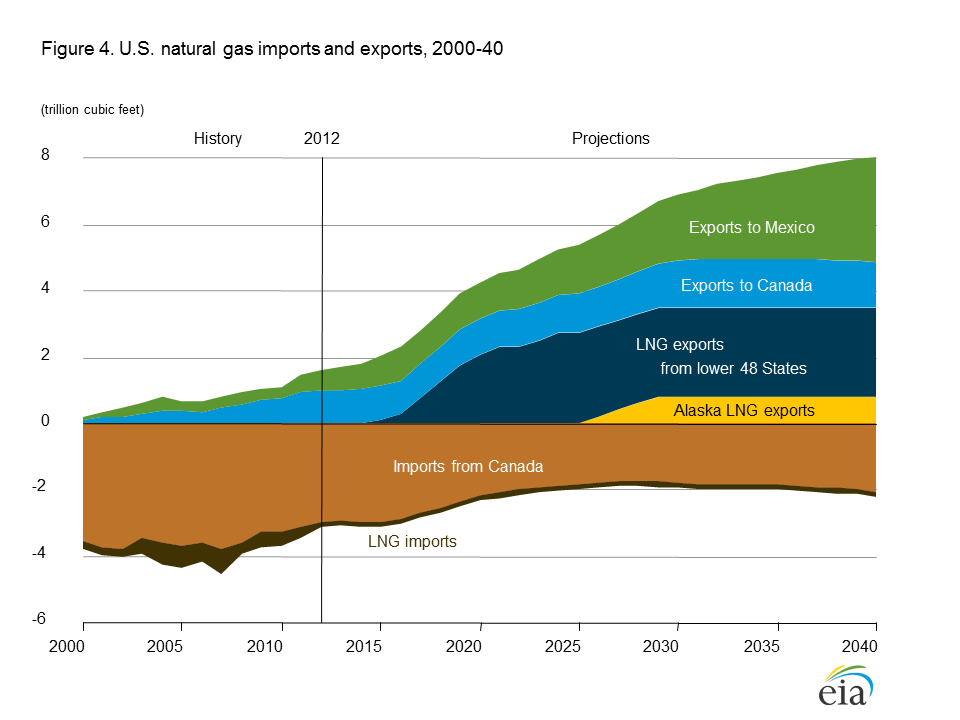
Only a few years ago, government and industry forecasts were unanimous in projecting a large and growing US LNG import requirement, as domestic gas production declined. The number of US LNG import facilities expanded to meet this new demand, but the combination of the recession and the shale gas revolution has resulted in imports shrinking substantially since 2007. The Energy Information Administration now expects the US to become a net exporter of LNG in 2016, including exports from repurposed import facilities. They will join a market that now supplies around 10% of global natural gas consumption and accounts for a third of global gas trade.

A different version of this posting was previously published on the website of Pacific Energy Development Corporation.

Thursday, October 03, 2013

As US Oil Production Revives, New Vulnerabilities Appear

  • The expansion of US oil production is centered in a handful of states, and in particular two whose gains more than offset declines in two former production leaders.
  • For various reasons the West Coast has missed out on this revival, straining infrastructure and creating new vulnerabilities that should be addressed.
On the front page of today's Wall St. Journal I see that "US Rises To No. 1 Energy Producer." This news builds on a number of recent headlines such as, "US oil production reaches highest level in 24 years." Stories like these aren't as attention-grabbing as they were when this streak began more than a year ago, once shale oil production ramped up dramatically.  What occurred to me this time, however, was how different the current distribution of US oil output is than it was in the late 1980s.

A handful of states still account for the lion's share of US oil production. Then and now, Texas tops the list, exceeding its 1989 output by 37%. At nearly 2.6 million barrels per day (MBD) in the most recent reported month --140% above at its low point in 2007--its share of US oil production had grown to around 35% by June. However, beneath Texas  the list of top oil states has been jumbled in ways few would have anticipated two decades ago.

Alaska, California and Louisiana, the second-, third- and fourth-ranked producers in 1989, then supplied 41% of total US crude oil output. After decades of decline, the same three states now contribute just 17%, excluding production from the federal waters off Louisiana's coast.

Meanwhile, thanks to the development of the Bakken shale, North Dakota has jumped from the number  6 spot just five years ago to number two, eclipsing Alaska early in 2012.  Traditional mid-tier producers like Colorado, Oklahoma and New Mexico are also contributing to the overall US oil revival. This surge of highly productive drilling in roughly the middle third of the country, on top of a million-plus barrels per day from the Gulf of Mexico --mainly from deepwater rigs--has scrambled existing oil transportation arrangements. 
When onshore production in Texas and the rest of the mid-Continent shrank in the 1990s and 2000s, the region's pipeline network gradually evolved into the country's principal oil-import conduit. The growth of production in the federal waters of the Gulf of Mexico, which had reached 1.6 MBD at the time of the Deepwater Horizon accident in 2010 but subsequently declined to about 1.2 MBD, meshed well with that model.

Today's big challenge goes against that grain: moving the growing surplus of oil in the upper plains states to markets on the West, Gulf and East Coasts, increasingly by rail. Much of the turbulence we've seen in the US oil market  in the last two years reflects the delays inherent in realigning and expanding that network to accommodate newly abundant domestic supplies.

Yet on the other side of the Rockies, the picture looks very different. When I was trading crude oil for Texaco's west coast refining system in the late 1980s, balancing the crude oil surplus on the Pacific coast required shipping multiple tankers a month of Alaskan North Slope oil to the Gulf, where production was shrinking, and prompted the construction of a new pipeline to send surplus oil to east Texas over land. After two decades of decline from mature fields, along with moratoria on tapping new offshore fields, imports now make up roughly half of west coast refinery supply, even though regional petroleum demand is essentially back to 1989 levels. It remains unclear whether and when California will allow producers to tap the state's potentially game-changing oil resources in the Monterey shale deposit.

Barring further change, the regional nature of these shifts means that the energy security benefits accompanying the revival of US oil production are a party to which the West Coast has not been invited, or has perhaps declined the invitation. That's significant, because it leaves residents of California, Oregon, Nevada and Washington much more exposed to any disruptions in global oil trade, since the existing US Strategic Petroleum Reserve was never intended to provide coverage west of the Rockies. In this light, the appetite of west coast refiners for trainloads of Bakken and Eagle Ford crude looks strategic, rather than just a temporary response to market conditions.

A different version of this posting was previously published on the website of Pacific Energy Development Corporation.

Wednesday, December 12, 2012

Should Alaska Export More LNG to Asia?

The Governor of Alaska reportedly met this week with officials from the South Korean national gas company to discuss exports of liquefied natural gas (LNG). Ever since crude oil production on Alaska's North Slope ramped up in the 1980s, industry observers have speculated about the ultimate disposition of the significant associated natural gas reserves found with the oil. In a letter filed with the state of Alaska, BP, ConocoPhillips and ExxonMobil, the three main North Slope producers, together with pipeline company Transcanada, recently confirmed their plans for a potential liquefied natural gas (LNG) project, instead of the long-mooted pipeline to deliver the gas to America's lower-48 states. The contemplated megaproject would validate both the scale of Asia's future LNG market and the long-term nature of the US shale gas revolution.

Alaska's North Slope has already yielded
15 billion barrels of oil. Production peaked at over 2 million barrels per day in 1988 and subsequently declined to less than 600,000 barrels per day last year. With around 6 billion barrels of remaining reserves, it's still a very significant field but well past its prime. While the public has focused on its oil output, the producers and the state have long had their eyes on how best to harvest the value of the 35 trillion cubic feet (TCF) of gas dissolved in the oil. In fact, the North Slope complex has produced several TCF per year
of gas for years, ranking it among the largest gas fields in the world, but almost all of that gas has been reinjected into the formation to aid oil recovery--and for lack of a market in an isolated and sparsely-populated state.

For decades the default assumption was that
a pipeline would eventually be built across Alaska and Canada to link this gas to the existing network feeding the contiguous US. That idea gained traction when US marketed gas production stalled around 2000 and then began to decline. The economics of an Alaskan gas pipeline compared poorly with gas produced along the Gulf Coast, but competing with rising LNG imports looked much more feasible. Then along came unconventional gas, starting with coal-bed methane and culminating with the surge of shale production since 2005. The US gas market now has enough domestic supply to shrink coal's contribution to US power generation by 7% since 2008
and revive gas-intensive industries.

If shale gas were only a short-term phenomenon, as some have suggested, it would be of little relevance to the plans of the North Slope producers. All they'd need to do would be to delay their pipeline for a few more years, and the market would come to them. However, estimates put US shale gas resources at between
482 and 686 TCF--a 60-90 year supply at current shale production rates. And the fact that all three of the main North Slope producers have invested in significant acreage positions and production in US shale basins
surely gives them insights into the longevity of those resources.
Nor is time on the side of the Alaskan producers. As oil production declines the economics of the North Slope operation will deteriorate, while keeping the Trans Alaska Pipeline full becomes more problematic. Finding an attractive outlet for the North Slope "gas cap" wouldn't just provide a new revenue source; it could keep oil production going for additional decades.


The LNG option offers several advantages, despite its estimated $45-65 billion price tag and technical complexity. For starters, it cuts roughly 1,000 miles of difficult terrain off the distance that the gas must be pipelined, in this case to a site on the southern Alaskan coast. That location is much closer to Asia, the world's largest LNG market, than export projects intended to ship LNG from the US Gulf Coast. The Asian market is also growing, thanks in part to Japan's post-Fukushima reassessment of nuclear power. The Japanese government has backed away, at least for now, from plans for a firm nuclear phase-out, but it seeks to diversify its energy sources. Among other steps taken in the aftermath of the Sendai quake and nuclear disaster, it has instituted the world's most attractive solar power incentives. Yet Japan's solar resources provide just a few hours of peak output per day, on average, requiring substantial fossil fuel generation to fill in the gaps. Power plants burning LNG are well-suited to that task.

China presents a more complex picture, with its own significant
shale gas potential and an energy market expected to add as much
natural gas demand by 2035 as all the world's developed countries put together. Considering the scale of eventual demand and the infrastructure necessary to bring China's shale gas to market, it seems likely that the growth of the market in the interim must depend heavily on LNG imports.

Assuming that the state of Alaska presents no obstacles and that US export permits would be forthcoming, because Alaskan LNG exports wouldn't impact US natural gas prices, the main questions that will determine the future of this project can't be answered definitively today. Among these are whether the numerous competing LNG projects being planned and built around the Pacific Rim and elsewhere will saturate the global market in the meantime, and whether the market will provide an attractive price for Alaskan LNG, influenced more by crude oil prices than by US shale gas. The North Slope producers are already immersed in these issues via their other activities, including ConocoPhillips' small
LNG plant in Kenai, Alaska, which has been shipping LNG to Asia for more than 40 years. The project timeline provided to the state includes at least three go/no-go decisions along the way as the answers to these questions unfold.


A slightly different version of this posting was previously published on the website of Pacific Energy Development Corporation.

Wednesday, July 18, 2012

Should the US Become An Oil Exporter, Again?

Last week I missed attending a fascinating panel on the growth of US oil production, hosted by  the New America Foundation in Washington, D.C. Fortunately, I was able to catch most of the live webcast, which is still available for replay. Much of the discussion focused on the potential of new "tight oil" production techniques, similar to those used to extract shale gas, to help usher in a new period of relative oil abundance.  If this comes to pass, among other things it could challenge long-established views about exporting US oil.  The politics of oil exports look absolutely dire at the moment, but the economic and logistical benefits--not just for oil companies but to the nation--are such that we shouldn't dismiss the possibility lightly.

Two hours was not enough time to do justice to all the ramifications of resurgent US oil production, and I know from following the Twitter feed for the event that some in the web audience were frustrated by the limited attention given to the climate implications of these developments.  However, if you'd like an overview of the possible economic and geopolitical impact of the US becoming more self-sufficient in petroleum for at least the next decade or two, this stellar panel was highly informative and worth your time.  Much of the discussion focused on tight oil, liquid hydrocarbons trapped in rocks that can't be economically tapped by conventional drilling, but that have proved susceptible to combinations of horizontal drilling and hydraulic fracturing similar to those that have unleashed the current shale gas boom. Although the full potential of this resource hasn't been reflected in the latest forecasts from the Energy Information Agency (EIA) of the US Department of Energy, the results from the Bakken shale in the Dakotas and the Eagle Ford shale in Texas are instructive.  Together these two fields now produce around 750,000 barrels per day, or 12% of current US crude oil output, up from just a trickle a few years ago.  They also hold billions, and possibly tens of billions of barrels of recoverable resources.

I was a little surprised that the first panelist to mention the possibility of exporting some of this oil--with appropriate caveats--was Adam Sieminski, the newly confirmed EIA Administrator. After all, current US law restricts the export of most US crude oil production, with special exceptions for some oil from Alaska, California, and near the Canadian border.  In practice, crude exports from those fields have declined to very low levels.  Despite that, and even after significant reductions in imports since the onset of the recession, the US is still a major net oil importer.  If that's the case, and if US refineries can benefit from the increasing domestic output, why would we even consider exporting any of this new oil?

Unfortunately, the answer doesn't reduce to a neat soundbite; it depends on two key factors that require a bit of explanation.  The first issue is the quality of the oil coming out of these tight oil plays, which at least so far has been very high. Oil from different fields varies as much as fingerprints, even when we consider only a few characteristics of concern to refiners, and these differences strongly influence the market values of the various grades of oil.  Light crudes refine easily into valuable products like gasoline, diesel and jet fuel, while heavier crudes require more processing, using more expensive hardware, and often yield large quantities of low-value products like petroleum coke, even after intensive refining. There's also sulfur content--the sweet to sour spectrum that overlays the light/heavy distinctions--as well as other impurities.  Eagle Ford crude is light and sweet, as is the North Dakota Sweet crude produced from the Bakken. These crudes compare favorably with West Texas Intermediate (WTI), Brent and other premium crude streams.

The second, related factor involves the complexity of US oil refineries and the crude diet they've evolved to run. As production of high quality crudes in the continental US declined over the last four decades, many refiners invested billions of dollars to enable their facilities to run some of the heaviest, most sour crudes from around the world, because these were more readily available and usually significantly cheaper than the light sweet crudes.  This trend was particularly evident on the West Coast and Gulf Coast. The addition of complex processing hardware like hydrocrackers, delayed or fluid cokers, and residuum fluid catalytic crackers has given these refineries tremendous flexibility, but it also increased their operating costs and made it harder for them to go back to a diet of much lighter crudes.  As a result, while many of them could handle significant quantities of light crude from the tight oil fields, this would be less than optimal, resulting in economic penalties and perhaps eroding the advantages that have recently enabled gulf coast refiners to capitalize on export markets for their products. Those penalties would translate into discounts for the tight oil grades, compared to similar international crudes, much like the large gap in value we currently see for WTI compared to Brent, though for different reasons as discussed previously.

At current production levels, the mismatch of quality and capabilities isn't as big a problem as the lack of infrastructure for transporting these crudes to market.  That has resulted in discounts so large that it makes sense for private equity firm Carlyle to plan to ship large quantities of Bakken crude by rail from North Dakota to the Philadelphia refinery they've just acquired from Sunoco.  However, if tight oil output grows in line with forecasts such as those in a recent analysis from Citibank, domestic sweet crude refiners will have more than enough supply and the excess must either be sold to heavy crude refineries at a discount or left in the ground.  That's where exports come in. 

The last time exporting domestic crude became a big issue was in the late 1980s, when output from Alaska's North Slope (ANS) field reached peak levels of roughly 2 million barrels per day, far more than west coast refineries could absorb. I was trading crude on the West Coast at the time, and I observed first-hand the effects of the export restrictions that had been put in place when the Trans Alaska Pipeline was originally approved.  Those restrictions didn't just depress the price of ANS crude; they also depressed the price of the California crudes with which ANS competed, and made both types less attractive to produce. West coast consumers benefited from a few years of lower gasoline prices than they would have otherwise paid, but the net result was less industry investment and probably higher oil imports in the long run.  By the time ANS exports were finally approved in 1996, the field was already in decline and the biggest opportunity had been missed. 

The advantages of allowing a portion of these new tight-oil streams to be exported would derive from the difference between the global market premium for crude of this quality and the typical discount paid for the lower-quality crudes that gulf coast refiners would continue to import in order to optimize their product yields and costs.  A difference of just $5 per barrel across a million barrels per day of exports would translate into a nearly $2 billion per year improvement in the US trade balance.  The benefits might also include higher tax revenues and royalties if exports supported higher production.  The biggest drawback I see is that in the event of a global supply disruption, some domestic crude would be committed to non-US buyers, reducing our emergency cushion.  However, that problem might be circumvented by requiring exporters to include provisions in their contracts allowing them to suspend deliveries whenever the US government released oil from the Strategic Petroleum Reserve, or a similar contingency.

Perhaps the best summary of the benefits that US oil exports could provide was given by President Clinton, when he authorized exports from the Alaskan North Slope: "Permitting this oil to move freely in international commerce will contribute to economic growth, reduce dependence on imported oil and create new jobs for American workers."  It's probably premature to provide a similar exemption for tight oil now, but it's certainly not too soon to start the national debate that should precede such a decision.