Thursday, October 31, 2013

Is An Ethanol Compromise on the Horizon?

  • The RFS ethanol mandate increasingly benefits farmers and ethanol producers at the expense of motorists, small-engine users, food producers and restaurants.
  • Repeal of the RFS looks unlikely, but equitable reforms addressing the needs of all affected groups are possible, if Congress is willing to compromise.
Earlier this month, National Journal hosted an event on the “Biofuels Mandate: Defend, Reform, or Repeal” from Washington, DC. I encourage you to skim through the replay. The session highlighted a wide range of views concerning the US Renewable Fuels Standard (RFS), including those of the corn ethanol and advanced biofuels industries, poultry growers, chain restaurants, environmentalists, and small engine manufacturers. Although these broke down pretty sharply along pro- and anti-RFS lines, I thought I detected hints of the kind of compromise that might resolve this issue. I’d like to focus on the elements of such a deal, rather than rehashing the positions of all of the participants, with one necessary exception.

The most disappointing contributions to the discussion occurred during the interview with Representative Steve King (R, IA) by National Journal’s Amy Harder. If we accept Mr. King’s perspective, we should embrace the RFS as being as relevant today as when it was conceived, with no changes required. That flies in the face of the serious market distortions now manifesting in the “blend wall” at 10% ethanol content in gasoline.

Among other things, Mr. King claimed that a 2008 reduction of $0.06 per gallon in the now-expired ethanol blenders tax credit brought the expansion of the corn ethanol industry to a standstill. The industry’s own statistics tell a very different story, with US ethanol production capacity having grown by a further 86% since that point.

Rep. King also characterized “food vs. fuel” concerns as a bumper sticker issue, with no basis in fact. That issue might be controversial, but it is far too substantive to dismiss so cavalierly. The latest evidence of that is a vote by the European Parliament to cap the contribution of conventional biofuel — ethanol and biodiesel derived from food crops — at 6% of transportation energy out of a 2020 target of 10%, based on concerns about sustainability and competition with food. It seemed fairly clear that the Congressman views the RFS more as a farm support measure than an energy program.

The only one of Mr. King’s comments that seemed to find traction with the other pro-RFS panelists was his odd suggestion that without a mandate for biofuels, the only federal mandate in place would be one for petroleum-based fuels. Certainly, gasoline and diesel have advantages in terms of infrastructure, energy density and the legacy fleet, but he appeared to have something else in mind. From the way others picked up on this, perhaps it was his earlier reference to the tax benefits that conventional fuel producers have long enjoyed. This is the first and easiest element on which to compromise.

If ethanol producers and advanced biofuels developers are convinced that fossil fuels get a better deal from the federal government than the one they have under the RFS and the $1.01 per gallon producer tax credit for second-generation biofuels, it would be a simple matter to replace these programs with the same incentives received by oil and gas producers and petroleum refiners. After all, the biofuel industry already benefits from the Section 199 tax deduction that accounts for a third of budgeted federal tax benefits for the oil industry, and it shouldn’t be hard to devise an accelerated depreciation benefit analogous to “percentage depletion” and the expensing of intangible drilling expenses. Combined, the value of these tax benefits is about 1.3¢ per equivalent gallon of oil or natural gas produced this year.

Other concerns came across clearly. Despite the endorsement of 15% ethanol blends by the Environmental Protection Agency, blending more than 10% ethanol in gasoline creates serious risks for the US’s 500 million existing gasoline engines, large and small. The scale of corn diversion necessary to go beyond 10% is also distorting the US agricultural economy and food value chain, all the way to the restaurants in our communities. However, those engaged in developing new biofuels that don’t rely on edible crops, or that are fully compatible with existing infrastructure and engines, are legitimately worried that the repeal of the entire mandate would strand the significant investments in new technology that have already been made, and possibly smother their industry just as it nears its first commercial-scale deployments. All these points of view struck me as eminently reconcilable within a reformed RFS that recognizes that most of the assumptions of the 2007 mandate are no longer valid.

The starting point for reform of the RFS should be a 10% cap on ethanol from all sources in mass-market gasoline — excluding E85 — combined with measures to give ethanol from non-food sources priority within that cap over ethanol produced from corn or other food crops. The advanced biofuel targets of the RFS should also be scaled back significantly to reflect the reality that the 2007 targets were wildly optimistic. Ideally, they should be adjusted each year based on the previous year’s actual output. In return, the current producer tax credit for cellulosic and other second-generation biofuels could be extended beyond its scheduled expiration at the end of this year, and then phased out over a reasonable, predictable period, perhaps tied to cumulative output.

Finally, since few on the panel seemed impressed by the EPA’s exercise to date of its statutory power to adjust the RFS to fit changing circumstances, that authority should be transferred to another agency, along with clearer guidelines on when adjustments would become mandatory.

I’d be the first to admit that the reforms I’ve outlined above fall well short of the outright repeal of the RFS that many, including myself, would prefer. That’s the essence of compromise. Having just experienced a government shutdown and debt ceiling crisis brought on by the clash of two intransigent positions, this might be preferable to an impasse that leaves an unsustainable status quo untouched. And if the assessment of Representative Welch (D-VT) concerning the appetite of the Congress to take up this matter is accurate, something along these lines might just be achievable.

Reform of the RFS would leave in place for a while longer the outlines of a mechanism that one of the session's panelists accurately described as a Rube Goldberg construction. Short of a guarantee to bail out everyone who invested in biofuels production or research on the basis of the RFS that Congress put in place in 2007, should they fail in a post-repeal market, I’m not sure there’s another course that would be sufficiently equitable to all parties involved.

A different version of this posting was previously published on Energy Trends Insider. 

Wednesday, October 23, 2013

UK Nuclear Deal Is A Bet on Baseload Power

  • An agreement to build the UK's first new nuclear power plants since 1995 endorses the role of baseload generation in the future low-emission energy mix.
  • Rather than constituting a choice of nuclear instead of renewables, this looks like nuclear plus renewables as a hedge on rising UK natural gas prices.
Monday's agreement between the UK government and French utility EDF and a pair of Chinese firms marks the start of the long-awaited turnover of the country's aging nuclear power infrastructure. The deal is controversial, not least for the power price of £92.50 per megawatt-hour (MWh) guaranteed to the developers. That's equivalent to about $0.15 per kilowatt-hour (kWh) at today's exchange rates. It's also strikingly different from the choices Germany and France itself have made recently.

The UK has a long history with nuclear power, having started up the world's first commercial-scale civilian reactor in 1956, following demonstration units in the US and USSR a few years earlier. Many of the plants built in the construction wave that followed have already been retired, and none has been started up since 1995. Another 40% of the country's remaining 10,000 MW of nuclear capacity is due to shut down by the end of this decade, with all but the newest, largest nuclear plant at Sizewell scheduled for retirement by the early 2020s. Even if the two new reactors that EDF and its partners will build at the Hinkley Point site in Somerset--adjacent to two 1970s-vintage reactors still in service--are completed on schedule, Britain's nuclear output is likely to shrink before it grows again.

The Hinkley C deal hinged on a question that can still only be answered theoretically today: What is the most effective future electric generating mix for achieving the necessary combination of affordability, reliability and low greenhouse gas emissions? In the aftermath of the Fukushima accident the German government decided that nuclear had no place in that mix and doubled down on its commitment to renewable energy, particularly wind and solar power, though that shift appears to require an increase in coal-fired generation to pull off. Meanwhile, France, which currently gets 75% of its electricity from nuclear, has embarked on a plan to reduce its share to 50% while expanding renewables.

The electricity mix in the UK is already changing as large offshore wind projects and onshore wind farms come online, and as the country's inexplicable flirtation with solar power increases. The gas turbines that dominated the previous wave of power plant construction are becoming more expensive to operate as waning UK North Sea gas output must increasingly be replaced by imported gas, while more coal plants shut down. All of this is underpinned by a legally binding commitment to reduce greenhouse gas emissions by 80%, compared to 1990, by 2050.

The UK's options for devising a reliable low-emission electricity mix are limited. If it wanted to build that mix around the combination of gas and renewables that California has chosen, then it would need a cheaper source of gas. That explains the government's interest in shale gas, although the outcome--both in terms of the rate of development and the future extent and cost of shale gas production--remains uncertain. It also can't rely nearly as much on solar, since it receives on average around half as much sunlight as the Golden State. Coal won't fit without carbon capture and sequestration (CCS) that is still expensive, and large-scale hydropower potential appears to be limited. That leaves nuclear as the largest-scale low-emission baseload option to anchor the energy mix, with quick-reacting natural gas turbines left to even out the fluctuations of offshore and onshore wind, and possible future wave and tidal installations.

In that context, it was surprising that the UK energy minister apparentlhy chose to frame this week's transaction as a choice for nuclear over the "blight" of the tens of thousands of wind turbines required to generate the same electricity, annually. Configuring wind power to provide enough reliable baseload energy to make nuclear unnecessary would require more overcapacity, grid upgrades and energy storage than even California's legislators could imagine. That would cost far more than the £92.50/MWh price tag for new nuclear.

And that brings us back to the price guarantee, or "strike price", which was apparently the key to getting EDF and its partners to commit to proceed on Hinkley Point. Since the UK's coalition partners had previously determined to provide no subsidies for nuclear power, arrangements such as the loan guarantees offered to US nuclear developers were out of the question. Whether the "contract for difference" scheme chosen to support Hinkley Point's future revenue--funded by ratepayers rather than taxpayers--constitutes a subsidy by another name, it is functionally similar to the Feed-In Tariffs (FITs) offered to wind, solar and other renewables in Germany and elsewhere. For comparison, the current German solar FIT guarantees utility-scale installations the equivalent of £84/MWh for a period extending past the planned start-up of Hinkley C.

Solar and nuclear power aren't interchangeable on the grid, but the spread between them highlights the financial risks involved in the current deal. The UK is placing a potentially expensive bet on low-emission baseload power from nuclear energy, while its biggest neighbors on the Continent are turning away from nuclear to pursue steadily rising shares of intermittent wind and solar power, the cost of which keeps falling. The government's call looks justifiable today for reasons of reliability and as a long-term investment--Hinkley C should still be producing billions of kilowatt-hours a year when the wind turbines and solar panels installed in Britain this year are rust and dust. However, if the UK's Bowland shale turns out to be the first Marcellus-like play outside the US, that price guarantee could cost future British ratepayers hundreds of millions of pounds per year.

Thursday, October 17, 2013

Study Sheds Light on the Environmental Impact of Shale Gas

  • The view that methane leaks render shale gas "worse than coal" has been further undermined by the release of a new study based on actual measurements at hundreds of gas wells.
  • Previous estimates of methane leakage relied on modeling or extrapolation from remote measurements. The University of Texas study addresses these shortcomings.
Since the late 1990s natural gas has been identified by both energy experts and environmentalists as a likely "bridge fuel" to facilitate the transition to cleaner energy sources. This view has recently been challenged by suggestions that methane leakage from natural gas systems--particularly from shale gas development--might be significant enough to negate the downstream climate benefits of switching to natural gas. The results of a new study from the University of Texas, sponsored by the Environmental Defense Fund (EDF) and nine energy companies, should alleviate many of those concerns.

In order to understand why indications of potential natural gas leakage rates well above the previously assumed level of around 1% would cast doubt on the environmental benefits of gas, a brief primer on greenhouse gases (GHGs) is necessary. When present in the atmosphere, these gases contribute to global warming by trapping infrared radiation that would otherwise be emitted to space. Carbon dioxide is the primary GHG implicated in climate change. It currently makes up roughly 400 parts per million (ppm)--equivalent to 0.04%--of earth's atmosphere and is increasing by around 2 ppm per year.

The main constituent of natural gas is methane. Although atmospheric concentrations of methane are much lower than that of CO2, totaling less than 2 ppm, pound for pound it is a much stronger GHG. Its "global warming potential" is 25 times higher than CO2's over a 100-year time horizon, and even higher on a shorter time span. While most atmospheric methane has been traced to natural or agricultural sources, a large increase in atmospheric methane from natural gas production could overwhelm the undisputed downstream emissions benefits of gas in  electricity generation, compared to coal.

Several academic studies raised precisely this concern with regard to natural gas produced from shale by hydraulic fracturing, or "fracking", starting with a widely-publicized paper from a professor at Cornell University in 2010. This work relied on estimates and limited data from early shale production to arrive at a conclusion that shale gas wells leak 3.6-7.9% of their cumulative output. A more recent series of studies from the National Oceanic and Atmospheric Administration (NOAA) and the University of Colorado Boulder used airborne remote sensing techniques to calculate leakage rates similar to Professor Howarth's.

Other studies from groups as diverse as IHS CERA, Carnegie Mellon University, and Worldwatch Institute and Deutsche Bank addressed the same question but arrived at much lower leakage rates and impacts. And earlier this year the US Environmental Protection Agency reduced its previous estimate of overall natural gas leakage to a figure equivalent to 1.7%.

However, until now all scientific studies of this issue--on both sides--were based on limited data, or on indirect measurements obtained at a significant distance from actual production sites. They relied heavily on assumptions about what was happening at large numbers of gas wells, in the absence of direct observations at these sites.

That's what makes the UT study so significant; it is based on a wealth of data from actual, on-site measurements at "190 production sites throughout the US, with access provide by nine participating energy companies." That translates to roughly 500 shale gas wells in different stages of development and production. 

Overall, for the segment of the gas lifecycle they investigated, the UT team found methane emissions that were lower than EPA's latest estimates.  Emissions from "completion flowbacks" were  98% lower, partially offset by somewhat higher observed leaks from valves and other equipment. Although this study did not measure emissions from the entire gas lifecycle, including pipelines, it would be very hard to reconcile their observed average leakage rate of 0.4% of gross gas production with leakage estimates as high as those embraced by many of shale's critics.

Immediate criticisms of this study also missed several crucial points. First, without the industry involvement that they characterized as a "fatal flaw", access on this scale for direct measurements at production sites--surely the gold standard for emissions studies compared to estimates based on assumption-laden models--would have been difficult or impossible to obtain. More importantly, they also ignored the fact that the principal sources of methane emissions found by the UT team involved valves and equipment by no means unique to shale development, many of which should be amenable to hardware improvements or different technology choices.

While the UT team and their sponsors at EDF stated clearly that more work needs to be done to measure methane emissions from other parts of the gas value chain, the current paper convincingly dispels the notion that the emissions from shale gas development are inherently much higher than those for gas produced from vertical wells in conventional oil and gas reservoirs. Since shale gas already accounts for over a third of US natural gas production and is widely expected to dominate future production, that result has large implications for the environmental benefits of further fuel switching and other applications for natural gas.

A different version of this posting was previously published on the website of Pacific Energy Development Corporation.

Thursday, October 03, 2013

As US Oil Production Revives, New Vulnerabilities Appear

  • The expansion of US oil production is centered in a handful of states, and in particular two whose gains more than offset declines in two former production leaders.
  • For various reasons the West Coast has missed out on this revival, straining infrastructure and creating new vulnerabilities that should be addressed.
On the front page of today's Wall St. Journal I see that "US Rises To No. 1 Energy Producer." This news builds on a number of recent headlines such as, "US oil production reaches highest level in 24 years." Stories like these aren't as attention-grabbing as they were when this streak began more than a year ago, once shale oil production ramped up dramatically.  What occurred to me this time, however, was how different the current distribution of US oil output is than it was in the late 1980s.

A handful of states still account for the lion's share of US oil production. Then and now, Texas tops the list, exceeding its 1989 output by 37%. At nearly 2.6 million barrels per day (MBD) in the most recent reported month --140% above at its low point in 2007--its share of US oil production had grown to around 35% by June. However, beneath Texas  the list of top oil states has been jumbled in ways few would have anticipated two decades ago.

Alaska, California and Louisiana, the second-, third- and fourth-ranked producers in 1989, then supplied 41% of total US crude oil output. After decades of decline, the same three states now contribute just 17%, excluding production from the federal waters off Louisiana's coast.

Meanwhile, thanks to the development of the Bakken shale, North Dakota has jumped from the number  6 spot just five years ago to number two, eclipsing Alaska early in 2012.  Traditional mid-tier producers like Colorado, Oklahoma and New Mexico are also contributing to the overall US oil revival. This surge of highly productive drilling in roughly the middle third of the country, on top of a million-plus barrels per day from the Gulf of Mexico --mainly from deepwater rigs--has scrambled existing oil transportation arrangements. 
When onshore production in Texas and the rest of the mid-Continent shrank in the 1990s and 2000s, the region's pipeline network gradually evolved into the country's principal oil-import conduit. The growth of production in the federal waters of the Gulf of Mexico, which had reached 1.6 MBD at the time of the Deepwater Horizon accident in 2010 but subsequently declined to about 1.2 MBD, meshed well with that model.

Today's big challenge goes against that grain: moving the growing surplus of oil in the upper plains states to markets on the West, Gulf and East Coasts, increasingly by rail. Much of the turbulence we've seen in the US oil market  in the last two years reflects the delays inherent in realigning and expanding that network to accommodate newly abundant domestic supplies.

Yet on the other side of the Rockies, the picture looks very different. When I was trading crude oil for Texaco's west coast refining system in the late 1980s, balancing the crude oil surplus on the Pacific coast required shipping multiple tankers a month of Alaskan North Slope oil to the Gulf, where production was shrinking, and prompted the construction of a new pipeline to send surplus oil to east Texas over land. After two decades of decline from mature fields, along with moratoria on tapping new offshore fields, imports now make up roughly half of west coast refinery supply, even though regional petroleum demand is essentially back to 1989 levels. It remains unclear whether and when California will allow producers to tap the state's potentially game-changing oil resources in the Monterey shale deposit.

Barring further change, the regional nature of these shifts means that the energy security benefits accompanying the revival of US oil production are a party to which the West Coast has not been invited, or has perhaps declined the invitation. That's significant, because it leaves residents of California, Oregon, Nevada and Washington much more exposed to any disruptions in global oil trade, since the existing US Strategic Petroleum Reserve was never intended to provide coverage west of the Rockies. In this light, the appetite of west coast refiners for trainloads of Bakken and Eagle Ford crude looks strategic, rather than just a temporary response to market conditions.

A different version of this posting was previously published on the website of Pacific Energy Development Corporation.

Thursday, September 26, 2013

Would An Emissions Deal Break the Keystone XL Deadlock?

  • A Canadian proposal to facilitate US approval of the Keystone XL pipeline by committing to greenhouse gas reductions gets to the essence of principled objections to the project.
  • The offer provides a chance for defined, quantifiable emissions reductions, instead of the highly uncertain emissions consequences of rejecting the permit for this pipeline. 
A couple of weeks ago Bloomberg and others reported that the Canadian Prime Minister had sent a letter to President Obama, proposing to work with the US to reduce greenhouse gas emissions from the oil and gas sector as a way to facilitate US approval of the Keystone XL pipeline (KXL.) It seemed an obvious way to break the current deadlock . If opposition to the pipeline is based mainly on the greenhouse gas emissions profile of Canadian oil sands crude--accurately or not--then environmentalists should have welcomed this overture. Instead, environmental groups have urged the President to reject both the offer and the pipeline.

You would never know it from protest slogans conflating all types of air pollution as if they were identical, but the characteristics and effects of greenhouse gases (GHGs) like CO2 are very different from the smog-forming emissions from automobile tailpipes or the sulfate pollution from coal power plants. For that matter, air containing 400 ppm of CO2 (0.04%) is no more harmful to breathe than pre-industrial air with 280 ppm of CO2. More importantly, the climate consequences of each ton of CO2 emitted to the atmosphere are effectively the same as for every other ton, regardless of where they are emitted or from what source. While scientists can distinguish CO2 from fossil fuel combustion from the CO2 you just exhaled, based on differences in the ratio of carbon isotopes they carry, their effect on global warming is essentially identical.

That sounds trivial, yet it has great value for expanding our options for managing the accumulation of these gases in earth’s atmosphere. Not only don’t we have to treat GHGs the way we do local air pollutants, but it can be more effective not to. In practical terms, that means that unlike the well-established approaches for mitigating smog, it isn’t necessary to tackle all GHG emissions at the source, particularly when it’s expensive or impractical to do so. Saving a ton of CO2 by preventing deforestation or improving vehicle fuel economy is exactly equivalent in its effect on the climate to reducing a ton of CO2 emitted from producing oil, which accounts for less than 20% of the emissions from the oil value chain.

Prime Minister Harper’s proposal has been greeted with skepticism by some environmental groups, including a representative of Sierra Club Canada who expressed doubt that Mr. Harper was serious. I am in no position to comment on that, other than to point out that entering into negotiations on a proposal such as this one would be an excellent test of his government’s seriousness about reducing emissions.

In fact, a proposal to approve Keystone in exchange for reducing emissions provides a test of the seriousness of all the parties involved. If the project is worth pursuing for the Canadian government and Canada’s oil sands producers, then it should be worth additional efforts on their part, over and above those already undertaken, to reduce emissions from oil sands production and to find suitable emissions offsets elsewhere. Of course it’s also a test of how serious President Obama was when he  explicitly linked approval for KXL to “whether or not this is going to significantly contribute to carbon in our atmosphere.” And because the administration’s protracted delays in approving or rejecting the project can fairly be attributed to political considerations, the proposal also tests the seriousness of “movement” organizations like 350.org that influence the politics of Keystone within the President’s political base.

Opponents of the Keystone XL project who are genuinely concerned about addressing climate change ought to at least be willing to consider a framework that links approval of this project to quantifiable and verifiable reductions in greenhouse gas emissions on a comparable scale. Since the determination of such reductions depends on the assumptions governing the alternative state of the world against which these reductions would be compared, that would require a willingness to accept a reasonable set of baseline assumptions about what would happen if this pipeline were not permitted to cross the US border. While I don’t pretend that would be easy, I have trouble seeing how one could reject such a concept outright and still claim to adhere to sound science and consensus policies.

This strikes me as an opportunity to embrace the kind of constructive and responsible compromise, the absence of which in our government so many Americans have lamented. Or, to put it bluntly, is opposition to Keystone really about greenhouse gas emissions, or is it just about symbolism?

The beauty of this offer, if it has actually been made and depending on its details, is that it provides President Obama with a potential two-fer: a pathway for approving a project that would please a large majority of Americans, along with a way to obtain significant greenhouse gas reductions--also pleasing many Americans--without requiring the highly unlikely enactment by Congress of comprehensive climate legislation. If we can do a deal with Russia over Syrian chemical weapons, there should be no impediment to doing a deal with Canada over CO2 emissions.

A different version of this posting was previously published on Energy Trends Insider. 

Wednesday, September 18, 2013

How Falling Oil Imports Doubled the US Strategic Petroleum Reserve

  • Falling oil imports have greatly expanded the capability of the US Strategic Petroleum Reserve to replace oil imports in a crisis, although prices would still rise.

  • The SPR remains an imperfect backstop. Post-Syria, it is high time for Congress and the White House to address its gaps after four decades of change.

Last week's deal between the US and Russia defused the threat of an attack on Syria's military installations, along with the risks of unintended consequences for Mideast oil exports. However, we shouldn't lose sight of an important energy-related observation in the Wall St. Journal's “Heard on the Street” column as the crisis was peaking. It concerned the extraordinary degree to which reviving US oil production and weaker US energy demand have boosted the effectiveness of US oil inventories, including the US Strategic Petroleum Reserve (SPR).

Without adding a drop — the SPR actually shrank a bit in 2011 — the reserve’s potential to replace daily oil imports in a crisis has soared as those imports have declined. This could prove extremely helpful should the complex talks over securing Syria's chemical weapons break down, and the US and France proceed with missile or air strikes. Longer term, it serves as a further reminder that the existing SPR was designed for another era and is overdue for a major rethink.

Having 700 million barrels of oil available in federal facilities along the Gulf Coast has tempted presidents and other politicians, who saw opportunities to benefit from using it to attempt to crush periodic gasoline price spikes. However, the recent situation came much closer to the scenarios the SPR was intended to address when it was begun during the Ford administration, to provide a backstop for our vital energy supplies in emergencies involving the physical interruption of supply. When it comes to uses of the SPR, I’ve always been a purist, perhaps because I can recall sitting in gas lines and participating involuntarily in the bizarre “odd-even” rationing-by-license-plate scheme introduced during the oil crisis following the Iranian Revolution in 1979.

Here’s how the benefits of tapping the SPR in an actual crisis have improved, based on the rapid recent drop in US oil imports. In 2007, the SPR could have replaced just over half of our crude oil imports from countries other than Canada or Mexico for 165 days, at its maximum draw-down rate of 4.25 million barrels per day. With its current inventory and this year’s average crude oil imports through June running at around 7.6 million barrels per day, the SPR could substitute for 100% of our non-North American imports for 163 days. The value of such an insurance policy is rarely appreciated until it is needed.

Of course in practice the situation would be more complicated, mainly for reasons that support the case for rethinking the current 1970s-vintage reserve. One problem is that the oil stored in caverns near the Gulf of Mexico wouldn’t provide much immediate assistance for east coast refineries or for the West Coast, which has become increasingly dependent on imports as production in both Alaska and California declined steadily. Then there’s the issue of quality. Nearly 40% of the SPR oil is light and sweet (low in sulfur), while much of the oil we still import is heavy and sour (higher sulfur), to match the requirements of current refinery configurations. With production of light sweet crude in Texas and North Dakota booming, releasing sweet crude from the SPR could compound regional imbalances and possibly result in reduced refinery utilization. Any redesign of the SPR should take these important shifts into account.

Oil prices jumped just at the thought of a cruise missile attack on Syria, so it’s worth recalling what a back-up supply from the SPR can and can’t do. It can buffer the US economy from the impact of a serious interruption in the flow of crude oil cargoes from the Middle East or elsewhere, for some months. US refineries would continue to operate, as would the planes, trains, trucks and ships they fuel, and on which commerce depends. However, consumers wouldn’t be insulated from the price increases that would accompany any major disruption in Middle East oil exports, because the SPR oil must be auctioned to refiners at market prices. The resulting situation at gas stations might look a lot like price-gouging, with social media rapidly spreading outrage and conspiracy theories. The fallout from that could be disruptive, too, if somewhat less so than widespread fuel shortages and “out of gas” signs.

A different version of this posting was previously published on Energy Trends Insider.

Friday, September 13, 2013

Energy Projects Seem Less Urgent in A Post-Energy-Crisis World

  • Rather than being another component of an ongoing energy crisis, opposition to various energy projects points to the alleviation of a decades-long string of US energy crises.
  • The audience for concerns about pipelines and fracking would be much smaller if oil were still at $145 per barrel and natural gas over $10 per million BTUs.
To someone living in 1974, during the first energy crisis of the last 40 years, the idea of mass protests to block a pipeline for importing crude oil from Canada would have seemed incomprehensible.  Our environmental awareness has expanded in the interim, along with new channels for exchanging information, including "enduring misconceptions".  Yet the current opposition to so many different energy projects--natural gas drilling, long-distance transmission lines and even wind farms--can also be viewed as an unintended consequence of recent energy successes on a broad front.

The alleviation of what seemed to many a permanent energy crisis might not be obvious, because it has crept up on us. But consider a few of the big-picture elements that have changed:

In crisis mode, US energy security was focused on steadily rising oil and later natural gas imports, while "energy independence" was a goal embraced by politicians but rarely energy experts. Cars offering better fuel economy were available but entailed trade-offs in size and performance. Today, oil imports are falling, the US is a net exporter of refined petroleum products, and public concern about Peak Oil is waning, as measured by internet search activity. Ethanol from corn supplies 10% of US gasoline demand, while other forms of renewable energy are growing rapidly, from a small base. The big question for the federal government this summer is how many natural gas export facilities to allow. Meanwhile, the threshold for fuel-efficient cars has shifted from 30 mpg to 40 mpg, offered in numerous attractive models.

Another way to gauge the success of technologies like hydraulic fracturing, or "fracking", in shifting our energy landscape is to remind ourselves how bad we thought today's situation would be, just a few years ago.  In 2005 the official US annual energy forecast projected oil imports to increase from 11 million barrels per day (MBD) in 2003 to nearly 15 MBD by this year, due to rising demand and domestic production that was expected to remain flat, at best (see below chart.)


The Energy Information Agency (EIA) also expected US natural gas imports to increase steadily, reaching 3.5 trillion cubic feet  (TCF) of LNG imports this year, on their way to 6 TCF per year by 2022. As a consequence, in 2005 the EIA forecast that coal would still generate 48% of US electricity by 2013.
 

Now imagine energy prices in that alternative 2013. With US natural gas suppliers importing an average of 90 LNG tankers per month, would the wellhead price of gas still be under $4 per million BTUs, or closer to the $16 price paid in some international markets? And with US refiners importing up to twice as much crude oil as they are actually on track to do this year, in the context of sanctions on Iran and turmoil in North Africa, how likely does it seem that oil would be at $105-110/bbl, instead of much higher? $100 oil is a drag on the economy, but US consumers have adjusted to gasoline priced around $3.50-3.75/gal., on average. Every $1 per gallon above that would take another $130 billion per year away from other purchases, with adverse effects on the US economy.

More to the point, in such an environment how much tolerance would there be for opposition to oil pipelines or gas drilling that had the potential to lower energy prices, or at least reduce imports and enhance energy security? If oil were above its 2008 high of $145/bbl, and gasoline flirting with $5 per gallon, it would surely be much harder for elected officials to delay approving projects like the Keystone XL pipeline, or to sustain gas drilling moratoria. Ironically then, the successful large-scale application of shale drilling techniques, which has resulted in a 29% increase in US natural gas production and 33% rise in oil production since 2004, helped make it possible for opponents of Keystone or fracking to be heard, rather than dismissed out of hand.

I was recently struck by a reported remark by a pipeline executive. "Shale is everywhere," he said, but it won't be produced everywhere because "people make choices." I agree with that insight, while recognizing that such choices are available mainly because altered economic conditions and the same technologies to which some now object have enabled us to shed an energy crisis mindset.  This situation might have future parallels for other technologies that have escaped much pushback, so far. 

A different version of this posting was previously published on the website of Pacific Energy Development Corporation.

Wednesday, September 04, 2013

Do Crude Oil Shipments Make Rail Less Safe?

  • The movement of crude oil by rail is expanding rapidly but still represents a small fraction of the hazardous goods transported by rail in North America.
  • The devastation caused by an oil train accident in Lac-Megantic, Quebec should galvanize railroads, shippers and regulators to improve rail safety for all hazardous freight. However, it does not justify banning oil-by-rail.
It’s been nearly two months since a train loaded with crude oil from North Dakota derailed and exploded in the Canadian town of Lac-Megantic, Quebec, killing an estimated 47 residents. In the interval since the accident, the relevant authorities have focused on ascertaining the cause of the accident and determining how best to improve rail safety. However, there has also been another, less-customary conversation about whether oil in general, and the specific oil on this train, might be too dangerous to transport by rail at all. That conversation would benefit from some context that appears to be absent.

Both conversations began with a tragedy in a place I recognized immediately. Ten years ago my wife and I passed through Lac-Megantic and drove along the Chaudière river that originates there, on its way to the St. Lawrence. It’s an area of natural beauty and historical significance. The images of destruction and of oil spilled in the river were gut-wrenching.

The investigation is still underway, but it seems significant that the Federal Railroad Administration (FRA) of the US Department of Transportation has already issued an Emergency Order banning the practice of leaving such trains unattended, pending the development of better procedures for securing them safely. Canadian authorities are reviewing their regulations and enforcement, as well as revisiting questions about the specific type of tank car in which the oil was carried. The Wall St. Journal reported that the FRA is also  looking into the testing and classification of crude oil shipments, to ensure that the tank cars used to transport different crude oils are suited to the task. Meanwhile, the rail operator involved in the accident has filed for bankruptcy on both sides of the border.

The second conversation, apparently based on a belief that it is possible to cease our use of petroleum entirely if we only have the will, is occurring in a fact vacuum. Understanding why that particular batch of crude oil was on that specific track on that day requires unpacking a nested set of factors that starts with the fact that oil still accounts for 33% of total global energy consumption, but more importantly supplies 93% of transportation energy. Numerous forecasts, including the latest from the US Department of Energy, anticipate no reduction in global oil use through 2040. Although we’ve displaced much of the oil formerly used to generate electricity and have greatly improved vehicle fuel efficiency, our most successful alternative transportation fuel, ethanol--no stranger to rail accidents--accounted for just 3% of US liquid fuel use last year, when adjusted for its lower energy content.

Although global oil movements are dominated by pipelines, tankers and barges, rail remains an important mode because of its flexibility. It’s also usually cheaper and more efficient than trucking for all but short distances--and safer, too, despite accidents like this one. Although the rapid recent growth of crude-oil-by-rail and its role in the Keystone XL pipeline debate have attracted significant attention, last year’s 234,000 tank-car loads of crude made up less than half of total US petroleum rail shipments and were dwarfed by over 1.5 million tank-car loads of chemicals hauled by rail in 2012.

Crude oil, especially light crudes like those produced from the Bakken and Eagle Ford shales, is flammable, and thus constitutes hazardous cargo. However, railroads routinely carry a wide variety of flammable and otherwise hazardous materials, including propane, gasoline, benzene, ethanol, chlorine gas, sulfuric acid and a range of other chemicals. Safety is not  determined by the cargo--if it was, none of these substances would be on trains--but by the combination of the equipment used to carry it, the rules and processes that dictate how to handle it, and the people who operate these systems. It’s no coincidence that these are the areas on which the investigations and preliminary regulatory responses have focused.

Then there are the market and logistical circumstances that resulted in a St. John, New Brunswick refinery that supplies both Canadian and US consumers and normally processes oil imported by tanker, acquiring oil produced in North Dakota and shipped halfway across the continent by rail. North American oil production is expanding rapidly, with significant economic and energy security benefits. Much of this new oil is found in places not adequately served by the large network of existing pipelines. That situation may eventually be rectified, but in the meantime the mismatch between growing landlocked oil supplies and limited pipeline outlets for them has created an opportunity for rail operators reeling from the much larger shale-gas-induced decline in coal shipments. Serving that need keeps people and trains employed. And that, ultimately, is why a train carrying Bakken crude was on a track in Lac-Megantic this July.

I can scarcely imagine what the survivors of the Lac-Megantic disaster and the families of the victims have been going through for the last two months. Their lives will never be the same. But whatever the cause of the accident is determined to have been--human error, mechanical failure, aging infrastructure or something else--it was not caused by the oil in those tank cars.

In the aftermath of an accident like this, the best thing we can do is to determine why it happened and apply those lessons to make rail transport of all hazardous cargoes safer.  Attempting to use the tragedy to advance a social cause such as “ending our reliance on oil” might be alluring to some, but the communities through which such freight travels in the course of keeping our economy running will benefit much more from the former course of action.

A different version of this posting was previously published on Energy Trends Insider. 

Wednesday, August 28, 2013

Will Fewer Young Drivers Today Mean Lower Fuel Demand Tomorrow?

  • Driver's licenses for those under 40 years of age are down in several large, developed countries, including the US. This is only partially explained by a weak economy.
  • If this shift in attitudes towards driving persists, future demand for both cars and fuel could be permanently reduced.
Current forecasts from the Energy Information Administration indicate that US gasoline demand peaked in 2007 and is expected to decline steadily for at least the next two decades.  One of the most intriguing factors aligned with this shift, which would have been almost unthinkable only a few years ago, involves a surprising reduction in the number of licensed drivers under 40 years of age.  A new study from the Transportation Research Institute (TRI) at the University of Michigan helps to explain a trend that is apparently not unique to the US.

Prior to the Great Recession, US gasoline demand had grown by 1-2% per year, with few interruptions. Since the recession, it has been shrinking for reasons that don't appear to be temporary. New cars are becoming more fuel-efficient, and Americans are consistently driving less than before the recession,  as indicated in the latest statistics on vehicle miles traveled.  To some extent this is an understandable response to gasoline prices that have remained significantly higher in real dollars than they were from 1982-2006. However, there may be other, deeper shifts underway.  If a segment of younger Americans has not only delayed getting a driver's license, but may never get one, then the decline in motor fuel demand is likelier to be permanent.

Once I started reading the survey results in the new study by the TRI's Brandon Schoettle and Dr. Michael Sivak, I knew I also needed the context of their 2011 paper on "Recent Changes in the Age Composition of Drivers in 15 Countries." That study showed that from 1983 to 2008 the number of licensed drivers in the US as a percentage of each age group up to 40 had dropped significantly, while the opposite was true for those over 50. (See chart below.) The authors found similar shifts in 7 other developed countries, including Canada, the UK, Germany and Japan, with a 2012 update indicating a further decline in US pre-40 licensing through 2010. Interestingly, Spain, Poland, Israel and several other countries exhibited increases in licensing among both younger and older drivers.
 
In their current paper, the authors used an online, non-random survey of 618 under-40 non-drivers to explore the reasons for their status. The top reasons their respondents gave for not having a driver's license seemed mainly practical, rather than philosophical. Many of those under 30 reported being "too busy or not enough time to get a driver's license",  or "able to get transportation from others." The "cost of owning and maintaining a vehicle" was the second-most common reason among all respondents, and as the authors noted, that is consistent with the relatively high unemployment or full-time student status of this group--46% and 21%, respectively.
 
Other common responses suggest that at least some of those without licenses are in that position by intention, rather than necessity. Nearly 40%--likely including some overlap--reported a preference for biking, walking or public transportation as a primary or secondary reason, while 9% cited environmental concerns and 8% mentioned online alternatives to driving.

Having grown up in a time and place where obtaining a driver's license as close as possible to one's 16th birthday was both a rite of passage and a practical necessity, this is that rare energy issue that's hard for me even to relate to. Yet when I look at the above chart, with its mirror-image shifts, I'm struck by the similarity between recent under-40 driver's license data and those for the cohorts born between the World Wars.  Are the current license rates of Millennials and late-Gen-X'ers the anomaly, or will those of my Baby Boomer and early Generation X peers turn out to be uniquely high? Only the passage of time can clarify such questions.

While the authors stopped short of assigning cause and effect, it seems reasonable to conclude that at least part of what we're seeing here is the result of the stubbornly persistent youth unemployment of a tepid recovery and the "New Normal" economy. A few years of much stronger economic growth might shrink the gap shown in Figure 1, by addressing the reasons that many of those surveyed gave for not having a driver's license, particularly since only 6% of them reported they never learned to drive.  Of course that doesn't explain why more than a third of those in the 30-39 age group, who ought to be the most financially settled, indicated they planned never to get a license.

The survey's results and their implications ought to be of great interest to producers of conventional and alternative fuels, established auto manufacturers, car rental firms, as well as transportation planners and policy makers.  Even electric-vehicle startups like Tesla might wonder whether for a significant segment of their natural future market, the choice won't be between an EV and a conventional car, but between a car and not driving at all. This is a trend that bears watching.
 
A different version of this posting was previously published on the website of Pacific Energy Development Corporation.

Wednesday, August 21, 2013

Will the Keystone XL Decision Be Based on Incorrect Assumptions?

  • Some of the facts about the Keystone XL pipeline project that President Obama cited in an interview last month turned out to be wrong. That's significant, if he is the ultimate decision-maker on this question.
  • Whatever his assessment of the pros and cons of the project, the politics of Keystone are trumping the facts, indicating the decision is likely to be deferred as long as possible. 
When President Obama commented on the merits of the Keystone XL pipeline project in an interview in the New York Times last month, the Washington Post suggested that his remarks “give opponents reason for hope.” Although he confirmed that the White House’s main objective criterion for making this decision was still the pipeline’s greenhouse gas impact, the President also speculated about the project’s job-creation potential and the ultimate destination of the crude oil it would carry. This appeared to endorse arguments raised by opponents of the project. These issues deserve more than the dismissive treatment they received in the interview.

With regard to the number of direct construction jobs that the northern leg of the Keystone XL Pipeline (KXL) might create, I don’t know whether the right number is the 2,000 the President cited or the tens of thousands estimated in an earlier State Department study. However, fact checking by both PolitiFact and AP concluded he was wrong.

In any case, this administration lacks credibility on counting such jobs. Consider the White House's metric of “jobs created or saved” for assessing the impact of the 2009 stimulus, or the routine touting of projects with “green jobs” potential, not just in terms of their direct employment gains, but also their indirect job creation estimated via generous multiplier effects. Either indirect jobs are always relevant, in which case KXL would create far more jobs across the economy than the President seems willing to admit, or they also aren’t relevant to justifying clean energy and other, more favored infrastructure projects.

The more interesting issue Mr. Obama brought up relates to the disposition of the oil-sands crude that the KXL would ultimately carry from Alberta to the Gulf Coast. For starters, this isn’t relevant for whatever volume of North Dakota production the pipeline might also carry, since current rules prohibit its export to anywhere except Canada. Of the pipeline’s planned capacity of 830,000 barrels per day, some would be used to ship US crude to US destinations, some would carry Canadian  oil destined for US refineries in the mid-continent, while an unspecified remainder would arrive at the Gulf Coast.  However large the latter figure might be, it’s doubtful that much of it would ever leave these shores. To understand why, you need to consider the quantity of US oil imports of similar quality currently coming into the Gulf.

Overall, Gulf Coast crude oil imports have fallen by around a third since 2007, but they still amount to around 4 million barrels per day – 5x the total capacity of the KXL. Unsurprisingly, much of the crude imported into the Gulf is either sour or heavy, since the refineries in the region have invested billions of dollars in the hardware required to process such crudes, which are typically cheaper than lighter, sweeter grades. A quick glance at the countries of origin of the import mix confirms this, with suppliers such as Mexico, Saudi Arabia, Venezuela, and Iraq dominating recent imports. Imports from Algeria, Angola, and Nigeria have been slashed by surging production of light, sweet crude in Texas and other states.

In the interview, President Obama said, “So what we also know is, is that that oil is going to be piped down to the Gulf to be sold on the world oil markets, so it does not bring down gas prices here in the United States.” For him to be right about that, we must believe that the current importers of around 2.7 million barrels per day of generally similar crude from South America and the Middle East would ignore the arrival in their market of new supplies from Canada and continue to buy from existing suppliers, and that those other suppliers would be able to continue to charge the same prices as before, despite significant new competition. Although I wouldn’t argue that oil sands crude would never be exported from the Gulf, imagining that most of it would simply sail right by the closest and largest global refining center equipped to handle this type of crude oil reflects a remarkably superficial view of how oil markets actually work.

The Keystone XL decision process clearly encompasses both factual and political considerations.  On the facts alone and the criteria set by the administration, the pipeline would eventually have to be approved, since even in the worst realistic case its impact on global greenhouse gases would be minimal--on the order of 0.4% of global emissions--while it offers clear benefits including reliability of supply. The protracted delays in approving this project provide all the evidence needed to confirm that political considerations outweigh the facts. Deciding now in favor of either side offers limited political benefits but carries huge risks; continuing to leave the issue in suspense has paid dividends at little apparent political cost.

A different version of this posting was previously published on Energy Trends Insider. 

Monday, August 12, 2013

Unlocking the UK's Shale Gas Potential

  • Following estimates of substantial shale gas resources underlying parts of Britain, the UK government is proposing incentives for companies and local communities to encourage its timely development.
  • Even if it ultimately proved less transformative than in the US, shale gas could balance the UK's future energy mix, while setting an example that other shale-rich EU countries could follow
Shale gas development has been slow out of the starting blocks in Europe, for reasons that have been widely discussed.  These include differences in mineral rights ownership, smaller onshore oil and gas service sectors, and significantly fewer onshore wells drilled in the past, compared to the US.  Local opposition to hydraulic fracturing also plays a role in some countries. Last month the UK government announced new proposals intended to address some of these challenges and make shale gas more attractive to produce there. The Prime Minister underlined these proposals in an op-ed in Sunday's Telegraph.

The UK's natural gas market has been experiencing problems similar to those the US encountered in the last decade, prior to wide-scale development of shale gas resources.  Natural gas production from the offshore fields of the UK sector of the North Sea, which provided an energy surplus until about ten years ago, has declined rapidly. As a result, the Interconnector UK, a bi-directional gas pipeline linking Britain to continental Europe, has recently operated mainly in import mode. UK natural gas prices have been correspondingly high and volatile, spiking briefly to around $17 per million BTUs this March. Prices in excess of $10/MMBTU are typical.

Against this background, the UK government is understandably interested in pursuing the exploration of the country's potentially enormous shale gas deposits.  In June the British Geological Survey released its detailed estimate for the Bowland shale in the north of England.  With a range of 822-2,281 trillion cubic feet (TCF) of gas-in-place, and a "central estimate" of 1,329 TCF, this looks like a significant resource. Even at the low end of the BGS assessment, and using a conservative figure of 15% recovery based on relevant US shale gas recovery rates, the Bowland could provide 120 TCF or more of technically recoverable gas, the equivalent of over 40 years of current UK consumption.

Two aspects of the government's proposals caught my attention.  First, the Chancellor of the Exchequer indicated his plan to make development attractive for producers with a new tax structure that he intends to be "the most generous for shale in the world." Earnings from shale would be taxed at 30%, compared to 62% for other hydrocarbon projects.  With only a few companies currently exploring for shale, that should attract additional drillers, along with the service companies that perform many of the key activities at the well site. 

I was more intrigued by the proposal--apparently originating with industry--to provide local communities with a benefit of at least £100,000 per well-site that is hydraulically fractured, or "fracked", plus a small share of gas revenue. In a country where the government owns the sub-surface property rights, this could be a crucial step in gaining local support for projects that, in addition to significant economic activity and eventually local employment, will also result in unavoidable increases in noise, traffic and other intrusions in daily life during the weeks or months in which each site is being prepared, drilled, completed and brought on-line, and for the longer periods that crews would be operating in the area.

We've certainly seen the importance of local benefits in promoting receptiveness towards gas drilling in the US, where most shale development has occurred on private land, and where royalties from production provide property owners with regular payments ranging from helpful to lifestyle-altering, depending on production rates and the ownership interests. Sharing financial benefits from shale production at the community level, rather than with individuals, might even galvanize broader-based support than in some parts of the US. Much will depend on whether British communities consider the offered compensation sufficiently generous.

UK shale development still faces significant above- and below-ground uncertainties that only time and drilling can resolve.  Nor is it clear whether development of the Bowland shale would have as large an impact on the UK gas market as shale gas has had here.  Skeptics can be found among opposition politicians and respected energy analysts, though I must say their arguments about high costs and low production rates sound very similar to those that I heard in energy conferences in the US not many years ago.  Signposts to watch include the number of drilling companies moving into the north of England and emulation of the UK government's pro-development policies by other countries.

A different version of this posting was previously published on the website of Pacific Energy Development Corporation.

Wednesday, August 07, 2013

Crashing into the Ethanol Blend Wall

  • The long-anticipated arrival of the ethanol "blend wall" for gasoline is the inevitable result of a federal policy designed for a world of expanding gasoline sales that no longer exists.
  • This is not just another arbitrary crisis; it is already costing consumers at the pump, and those costs will increase unless the Renewable Fuel Standard is reformed or repealed.
The Energy and Commerce Committee of the US House of Representatives held hearings late last month on the Renewable Fuel Standard (RFS). It’s otherwise known as the ethanol mandate, although it covers biodiesel, as well. The hearings were timely, since at least two bills have been introduced to reform or repeal the RFS.  During the session on July 23rd, Rep. Waxman (D-CA) referred to the “gasoline blend wall, which may be around the corner.” In fact, a review of current gasoline sales and this year’s final ethanol target--just issued yesterday!--confirms that the ethanol “blend wall” has arrived, at least for some of the nation’s refiners. That explains the urgency of the debate about the future of the RFS.

The blend wall is simply the threshold at which the RFS requires more ethanol to be blended into US gasoline than the quantity necessary to dose essentially all of it with the maximum 10% ethanol content for which most cars on the road were designed. Because the Environmental Protection Agency, which administers the RFS, has been unwilling to exercise its flexibility under existing law, the fuels industry must now choose from a set of unattractive options: It can limit mainstream gasoline to 10% ethanol content and absorb substantial RIN costs (see below) or statutory penalties for failing to blend the required volumes of biofuel. It can produce less gasoline than the country needs, or export more of its production, to reduce its renewable fuel obligations. Or it can produce higher-ethanol blends such as E15 and risk the integrity of millions of cars and large portions of the country’s fuels infrastructure, including all but the newest gas station pumps and tanks. All of these choices affect the price consumers pay at the pump.

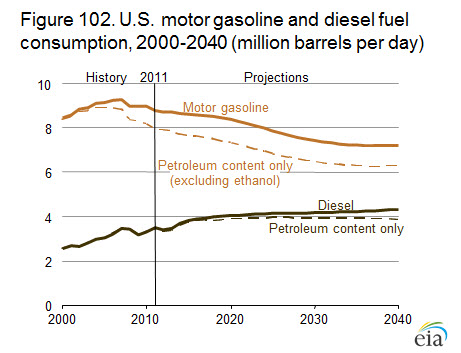
In order to understand why the blend wall is a serious problem, rather than another arbitrary crisis, we need to examine its two main elements. The first is fairly straightforward, relating to the mechanical integrity of the pumps and seals in automobile engines and fuel systems, as well as refueling infrastructure. While most of these function acceptably with blends of up to 10% ethanol in gasoline, there’s significant controversy about what happens above that threshold. As I noted in June, this issue has become relevant much sooner than the 2007 law anticipated, because US gasoline sales have declined instead of continuing to grow by 1-2% per year, while sales of E85 remain small and mainly regional.

As the head of the American Automobile Association (AAA) indicated in his testimony before Congress, any new product like E15, which consists of 15% ethanol and 85% petroleum gasoline, should have been tested thoroughly before release. Although the EPA conducted extensive testing before certifying E15 for use in 2001 and later model cars, as best I could tell their focus was on vehicle emissions systems, rather than mechanical integrity. Other tests conducted at the behest of the fuels industry identified problems with higher ethanol blends in vehicles not specifically designed as “flexible fuel vehicles” (FFVs) which can use up to 85% ethanol. UL previously tested existing service station product dispensers (gas pumps) and observed leaks and other failures above 10% ethanol. The uncertainties that have been raised by independent testing may not be conclusive, but they can only be resolved by a lot more testing on actual vehicles, not by rhetoric. The bottom line for consumers is that most carmakers won’t warrant any but their latest models for use with E15.

Another important but more obscure aspect of the blend wall relates to a feature of the RFS called Renewable Identification Numbers, or “RINs”. The RFS regulations created RINs for tracking purposes, to provide “the basic framework for ensuring that the statutorily required volumes of renewable fuel are used as transportation fuel in the U.S.” But they also have another purpose. RINs can be separated from the physical gallons of renewable fuel and traded in the market, effectively becoming paper ethanol. Enabling this RIN market, which includes both “obligated parties” — mainly refiners and importers of finished gasoline — and non-obligated parties such as gasoline blenders and traders, provides some flexibility in the RFS compliance system. It allows refiners that cannot blend any more ethanol into their direct fuel sales — or cover their typically larger sales of pre-ethanol product — to satisfy their legal obligations under the RFS by presenting a certificate, instead.

This worked reasonably well when the annual blending target was lower and refiners and marketers could bank RINs for future use by blending more ethanol than required, while remaining under the 10% limit. However, only 20% of the RINs generated in that manner last year could be carried over into 2013, restricting the supply just when the market approached the overall 10% blend wall. My understanding from those who follow this market is that this “bank” will become insolvent sometime next year, limiting new RINs largely to those generated from sales of E85 in the Midwest.

Now, with the blend wall a reality, the limited stock of RINs from past blending is being drawn down at prices that have spiked from a few cents per gallon-equivalent at the start of the year to well over $1.00 recently. Some refiners are spending hundreds of millions of dollars on RINs. It’s hard to determine how much of that is being passed on to consumers in fuel prices, because of the complexities of the RIN market and the agreements that various participants have made concerning the allocation of RINs. If 100% of their cost were passed on, then RINs at $1.00 would add $0.10 per gallon to the price of gasoline at the pump. The higher the annual RFS target ratchets, the higher RIN prices could go, with a recent estimate setting the potential impact on gasoline prices in 2014 at $0.19/gal, with the possibility of even larger increases in diesel prices.

Another potential outcome mirrors a comment made the hearings by the CEO of Cumberland Gulf Group, a large gasoline distributor. He characterized the functioning of the RFS and its RIN provisions as “subsidizing exports and taxing imports.” Refiners that don’t have enough RINs to cover their gasoline production will weigh current RIN prices against the profit they could generate by exporting more of their output to other countries, thus reducing the volume that must be covered by RINs. This could have an even bigger impact on the US gasoline market than merely passing through the cost of RINs. That's because gasoline prices are set by the last increments of supply and demand, and small shortfalls can translate into large price increases. That’s exactly what seems to be happening now in the artificial market the EPA has created in RINs.

The original purpose of the RFS and the law that established it was to reduce US reliance on imported oil, along with reducing greenhouse gas emissions. Because of its lower energy content the ethanol blended into US gasoline this year displaces about 540,000 barrels per day of gasoline produced from petroleum, though with questionable environmental benefits. That’s almost exactly the average quantity of finished gasoline and gasoline blending components exported from the US in the last 12 months reported.  Although that might be at least partly coincidental, it’s a further indication of just how much our national energy situation has changed since the legislation establishing the current RFS was passed in 2007.

One of the experts appearing before Congress characterized ethanol as an additive, rather than a replacement fuel. Until and unless E85 sales grow dramatically, that seems apt. Our elected representatives should now be asking themselves whether it makes sense — in light of altered circumstances and the EPA's decision to defer any administrative adjustments in the RFS until next year — to subject the US motor fuels market and consumers to a new and entirely artificial source of price volatility for the sake of an additive that the CEO of Growth Energy, a major ethanol trade association, testified would continue to be produced and sold in the absence of the mandate. When considered together with serious questions about its impact on food supplies and prices, the case for at least reform of the Renewable Fuel Standard is compelling.

A different version of this posting was previously published on Energy Trends Insider.