Showing posts with label hydraulic fracturing. Show all posts

Wednesday, March 19, 2014

Making Oil-by-Rail Safer

  • A series of rail accidents involving trains carrying crude oil has focused attention on safety procedures and even the tank cars used in this service.
  • Another concern is the variable characteristics of the "light tight oil "now shipped by rail in large quantities. That isn't the result of "fracking", but of the oil's inherent chemistry.   
The growth of North American oil production from unconventional sources has resulted in a dramatic expansion in the volume of crude oil shipped by rail. Unfortunately, as crude oil rail traffic has increased, so have rail accidents involving crude oil, including the tragic explosion and fire in Lac-Megantic, Quebec last July. That event and subsequent accidents have focused railroads, regulators and shippers on the need to improve the safety of oil-by-rail as quickly as possible.

In the immediate aftermath of Lac-Megantic, the Federal Railroad Administration issued an emergency order on procedures railroads must follow when transporting flammable and other hazardous materials. And on February 21, 2014 railroads reached a voluntary agreement with the US Department of Transportation (DOT) on additional steps, including reduced speed limits for oil trains passing through cities, increased track inspection, and upgraded response plans. These steps have the highest priority, because crude oil loaded in tank cars doesn't cause rail accidents. Every incident I've seen reported in the last year began with a derailment or similar event.

At the same time, the packaging and characteristics of the oil can affect the severity of an accident.  Investigators have focused on two specific issues in this regard, starting with the structural integrity of the tank cars carrying the oil. The vast majority of tank cars in this service are designated as DOT-111--essentially unpressurized and normally non-insulated cylinders on wheels. These cars routinely carry a variety of cargoes aside from crude oil, including gasoline and other petroleum products, ethanol, caustic soda, sulfuric acid, hydrogen peroxide, and other chemicals and petrochemicals.

Their basic design goes back decades, and even the older DOT-111s incorporate learnings from earlier accidents. A growing proportion of the US fleet of around 37,000 DOT-111 tank cars in oil service consists of post-2011, upgraded cars that have been strengthened to resist punctures, but the majority is still made up of older, unreinforced models. The Pipeline and Hazardous Materials Safety Administration (PHMSA) is studying whether to make upgrades mandatory, but some railroads and shippers aren't waiting. Last month Burlington Northern Santa Fe Railway, owned by Warren Buffet's Berkshire Hathaway, announced it would buy up to 5,000 new, more accident-resistant tank cars.

Another issue that has received much attention since Lac-Megantic concerns the flammability of the light crude from shale formations like North Dakota's Bakken crude, which accounts for over 700,000 barrels per day of US crude-by-rail. The Wall Street Journal published the results of its own investigation, reporting that Bakken crude had a higher vapor pressure--a  measure of volatility and an indicator of flammability--than many other common crude oil types.

The Journal apparently based its findings on crude oil assay test data assembled by the Capline Pipeline.  Although a Reid Vapor Pressure of over 8 pounds per square inch (psi) for Bakken crude is higher than for typical US crudes, it's not unusual for oil as light as this. That's especially true where, due to lack of field infrastructure, only the co-produced natural gas is separated out, leaving all liquids in the crude oil stream.

What makes this situation unfamiliar in the US is that domestic production of oil as light as Bakken had nearly disappeared before the techniques of precision horizontal drilling and hydraulic fracturing were applied to the Bakken shale and similar "source rock" deposits. (Note: High vapor pressures are characteristic of the naturally-occurring mix of hydrocarbons in very light crudes, rather than a result of the "fracking" process.) Nor is the reported vapor pressure for Bakken or Eagle Ford crude higher than that of gasoline, a product that is federally certified for transportation in the same DOT-111 tank cars that carry crude oil.

The variability of the vapor pressure data that the Journal's reporters identified for Bakken crude may result from another unfamiliar feature of such "light tight oil". Crude produced from conventional reservoirs, which are much more porous than the Bakken shale, tends to be relatively homogeneous. However, because the Bakken and other shales are so much less porous, limiting diffusion within the source rock reservoir, the composition of their liquids can vary much more between wells.

In any case, vapor pressure isn't the preferred measure of fuel flammability. Actual rail cargo classifications are based on flash point and initial boiling point. These routine quality tests aren't included in Capline's publicly available data. PHMSA initiated "Operation Classification" to ensure that manifests and tank car placards for crude oil shipments accurately reflect the potential hazards of each cargo, based on such measurements. The agency has determined that it hasn't always been done consistently, and DOT issued another emergency order requiring shippers to test oil for proper classification.

As mentioned in an oil-by-rail webinar yesterday, hosted by Argus Media, assigning the proper classification to oil shipments may seem like a bureaucratic concern--it doesn't necessarily affect the tank car type chosen to transport the crude--but it can have a significant impact on operational factors such as routing and the notification of first responders along the route.

There's no quick and simple way to make the transportation of crude oil by rail as safe as hauling a dry bulk cargo like grain. Tank car fleets can't be replaced overnight, not just because of the cost involved, but due to limited manufacturing capacity. However, in the meantime significant improvements can be achieved through a combination of government attention and sustained industry initiatives. Since the new crude streams traveling by rail play a key role in increasing North America's energy security, this is in the interest of everyone involved--producers, shippers, railroads, and not least the communities through which this oil travels.

A different version of this posting was previously published on the website of Pacific Energy Development Corporation.
 

Friday, September 13, 2013

Energy Projects Seem Less Urgent in A Post-Energy-Crisis World

  • Rather than being another component of an ongoing energy crisis, opposition to various energy projects points to the alleviation of a decades-long string of US energy crises.
  • The audience for concerns about pipelines and fracking would be much smaller if oil were still at $145 per barrel and natural gas over $10 per million BTUs.
To someone living in 1974, during the first energy crisis of the last 40 years, the idea of mass protests to block a pipeline for importing crude oil from Canada would have seemed incomprehensible.  Our environmental awareness has expanded in the interim, along with new channels for exchanging information, including "enduring misconceptions".  Yet the current opposition to so many different energy projects--natural gas drilling, long-distance transmission lines and even wind farms--can also be viewed as an unintended consequence of recent energy successes on a broad front.

The alleviation of what seemed to many a permanent energy crisis might not be obvious, because it has crept up on us. But consider a few of the big-picture elements that have changed:

In crisis mode, US energy security was focused on steadily rising oil and later natural gas imports, while "energy independence" was a goal embraced by politicians but rarely energy experts. Cars offering better fuel economy were available but entailed trade-offs in size and performance. Today, oil imports are falling, the US is a net exporter of refined petroleum products, and public concern about Peak Oil is waning, as measured by internet search activity. Ethanol from corn supplies 10% of US gasoline demand, while other forms of renewable energy are growing rapidly, from a small base. The big question for the federal government this summer is how many natural gas export facilities to allow. Meanwhile, the threshold for fuel-efficient cars has shifted from 30 mpg to 40 mpg, offered in numerous attractive models.

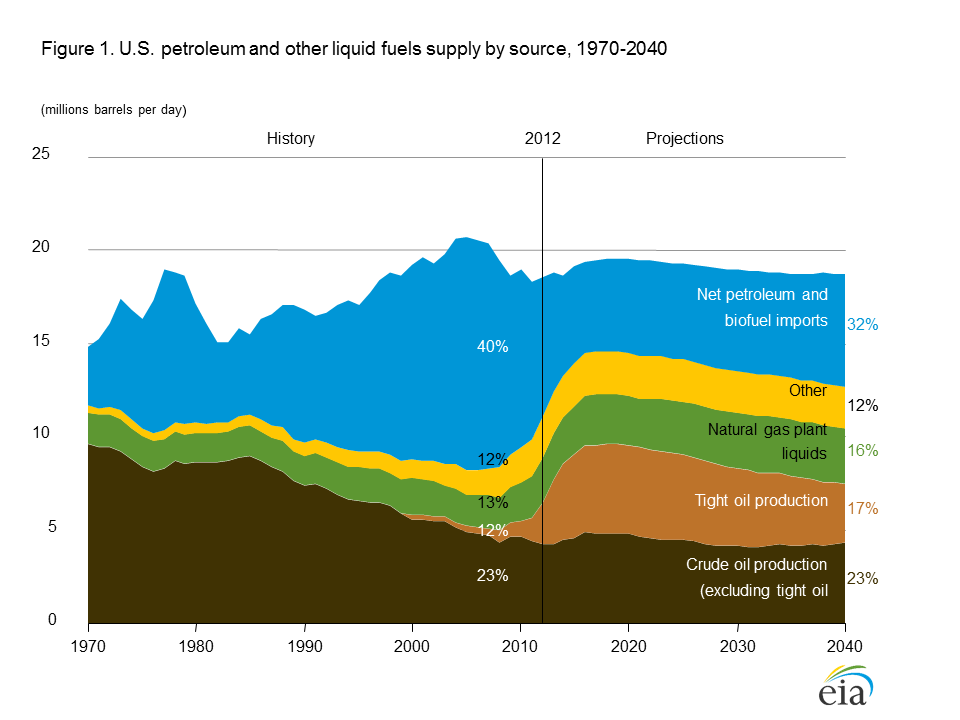
Another way to gauge the success of technologies like hydraulic fracturing, or "fracking", in shifting our energy landscape is to remind ourselves how bad we thought today's situation would be, just a few years ago.  In 2005 the official US annual energy forecast projected oil imports to increase from 11 million barrels per day (MBD) in 2003 to nearly 15 MBD by this year, due to rising demand and domestic production that was expected to remain flat, at best (see below chart.)


The Energy Information Agency (EIA) also expected US natural gas imports to increase steadily, reaching 3.5 trillion cubic feet  (TCF) of LNG imports this year, on their way to 6 TCF per year by 2022. As a consequence, in 2005 the EIA forecast that coal would still generate 48% of US electricity by 2013.
 

Now imagine energy prices in that alternative 2013. With US natural gas suppliers importing an average of 90 LNG tankers per month, would the wellhead price of gas still be under $4 per million BTUs, or closer to the $16 price paid in some international markets? And with US refiners importing up to twice as much crude oil as they are actually on track to do this year, in the context of sanctions on Iran and turmoil in North Africa, how likely does it seem that oil would be at $105-110/bbl, instead of much higher? $100 oil is a drag on the economy, but US consumers have adjusted to gasoline priced around $3.50-3.75/gal., on average. Every $1 per gallon above that would take another $130 billion per year away from other purchases, with adverse effects on the US economy.

More to the point, in such an environment how much tolerance would there be for opposition to oil pipelines or gas drilling that had the potential to lower energy prices, or at least reduce imports and enhance energy security? If oil were above its 2008 high of $145/bbl, and gasoline flirting with $5 per gallon, it would surely be much harder for elected officials to delay approving projects like the Keystone XL pipeline, or to sustain gas drilling moratoria. Ironically then, the successful large-scale application of shale drilling techniques, which has resulted in a 29% increase in US natural gas production and 33% rise in oil production since 2004, helped make it possible for opponents of Keystone or fracking to be heard, rather than dismissed out of hand.

I was recently struck by a reported remark by a pipeline executive. "Shale is everywhere," he said, but it won't be produced everywhere because "people make choices." I agree with that insight, while recognizing that such choices are available mainly because altered economic conditions and the same technologies to which some now object have enabled us to shed an energy crisis mindset.  This situation might have future parallels for other technologies that have escaped much pushback, so far. 

A different version of this posting was previously published on the website of Pacific Energy Development Corporation.

Monday, August 12, 2013

Unlocking the UK's Shale Gas Potential

  • Following estimates of substantial shale gas resources underlying parts of Britain, the UK government is proposing incentives for companies and local communities to encourage its timely development.
  • Even if it ultimately proved less transformative than in the US, shale gas could balance the UK's future energy mix, while setting an example that other shale-rich EU countries could follow. 
Shale gas development has been slow out of the starting blocks in Europe, for reasons that have been widely discussed.  These include differences in mineral rights ownership, smaller onshore oil and gas service sectors, and significantly fewer onshore wells drilled in the past, compared to the US.  Local opposition to hydraulic fracturing also plays a role in some countries. Last month the UK government announced new proposals intended to address some of these challenges and make shale gas more attractive to produce there. The Prime Minister underlined these proposals in an op-ed in Sunday's Telegraph.

The UK's natural gas market has been experiencing problems similar to those the US encountered in the last decade, prior to wide-scale development of shale gas resources.  Natural gas production from the offshore fields of the UK sector of the North Sea, which provided an energy surplus until about ten years ago, has declined rapidly. As a result, the Interconnector UK, a bi-directional gas pipeline linking Britain to continental Europe, has recently operated mainly in import mode. UK natural gas prices have been correspondingly high and volatile, spiking briefly to around $17 per million BTUs this March. Prices in excess of $10/MMBTU are typical.

Against this background, the UK government is understandably interested in pursuing the exploration of the country's potentially enormous shale gas deposits.  In June the British Geological Survey released its detailed estimate for the Bowland shale in the north of England.  With a range of 822-2,281 trillion cubic feet (TCF) of gas-in-place, and a "central estimate" of 1,329 TCF, this looks like a significant resource. Even at the low end of the BGS assessment, and using a conservative figure of 15% recovery based on relevant US shale gas recovery rates, the Bowland could provide 120 TCF or more of technically recoverable gas, the equivalent of over 40 years of current UK consumption.

Two aspects of the government's proposals caught my attention.  First, the Chancellor of the Exchequer indicated his plan to make development attractive for producers with a new tax structure that he intends to be "the most generous for shale in the world." Earnings from shale would be taxed at 30%, compared to 62% for other hydrocarbon projects.  With only a few companies currently exploring for shale, that should attract additional drillers, along with the service companies that perform many of the key activities at the well site. 

I was more intrigued by the proposal--apparently originating with industry--to provide local communities with a benefit of at least £100,000 per well-site that is hydraulically fractured, or "fracked", plus a small share of gas revenue. In a country where the government owns the sub-surface property rights, this could be a crucial step in gaining local support for projects that, in addition to significant economic activity and eventually local employment, will also result in unavoidable increases in noise, traffic and other intrusions in daily life during the weeks or months in which each site is being prepared, drilled, completed and brought on-line, and for the longer periods that crews would be operating in the area.

We've certainly seen the importance of local benefits in promoting receptiveness towards gas drilling in the US, where most shale development has occurred on private land, and where royalties from production provide property owners with regular payments ranging from helpful to lifestyle-altering, depending on production rates and the ownership interests. Sharing financial benefits from shale production at the community level, rather than with individuals, might even galvanize broader-based support than in some parts of the US. Much will depend on whether British communities consider the offered compensation sufficiently generous.

UK shale development still faces significant above- and below-ground uncertainties that only time and drilling can resolve.  Nor is it clear whether development of the Bowland shale would have as large an impact on the UK gas market as shale gas has had here.  Skeptics can be found among opposition politicians and respected energy analysts, though I must say their arguments about high costs and low production rates sound very similar to those that I heard in energy conferences in the US not many years ago.  Signposts to watch include the number of drilling companies moving into the north of England and emulation of the UK government's pro-development policies by other countries.

A different version of this posting was previously published on the website of Pacific Energy Development Corporation.

Tuesday, July 30, 2013

A First-Hand View of Fracking in Pennsylvania's Marcellus Shale

  • Producing shale gas requires drilling numerous wells, often in regions that have seen little or no oil & gas activity for decades. Addressing environmental and other community concerns is crucial to acceptance.
  • On a recent visit to a shale operation in Lycoming County, PA, I was impressed by the rigorous attention I saw to safety, spill prevention, soil conservation, and other impacts. 
It’s easy to talk about the shale gas revolution in the abstract and forget that it is the cumulative result of thousands of operations in locations across the country. It combines the technological marvel of precisely planned and executed drilling more than a mile below ground with the efforts of teams of skilled workers on the surface, and affects the surrounding community in many ways. Last month I had my first opportunity to visit one of these sites, near Williamsport in north-central Pennsylvania. I also saw several nearby sites in different stages of development. Although I was consistently impressed, I also tried to observe with the concerns of shale gas critics in mind.

Anadarko Williamsport 001Anadarko Williamsport 004

The Anadarko Petroleum well site, or “pad” that I toured is located in Cogan House Township in rural Lycoming County, atop the Marcellus shale formation. API arranged this site visit for bloggers and other media and paid for accommodations in Williamsport. Anadarko provided experts from its local engineering and public affairs staffs and hosted a dinner with members of the community the evening before the site tour. No one paid me to write about the visit, nor was there any expectation that I would report anything other than my candid, objective opinion of what I saw.

I’m no stranger to industrial sites or oil fields. I’ve also invested countless hours researching and discussing shale drilling and hydraulic fracturing. When it comes to complex technical subjects like this, however, no amount of reading or Youtube videos can substitute for seeing the real thing and being able to talk to the people actually doing the job about how it all works.

One example of that is safety. Safety plans, targets and slogans are important, but it carries more weight when the site engineer looks you in the eye and says emphatically in his own words, “The most important thing is that everyone goes home at night,” and then proceeds to explain the stop-work rules, the “red zones” that have to be clear of workers when the fracking pumps are running, and other aspects of onsite safety. We were constantly reminded to watch where we stepped and to make sure we had multiple points of contact with the ground whenever we looked at something or photographed it.

Concern for environmental impacts was similarly thorough. I consider surface spills a much bigger potential risk to groundwater than fracturing a layer of shale thousands of feet below any aquifer. The first thing I noticed at the site, all five wells of which had already been drilled and prepared for fracturing, was the floor. The entire pad was covered with a three-layer mat of black felt, HDPE plastic and fabric, to isolate any spills from the ground. The pad was also surrounded by a berm to contain any spills, which would promptly be vacuumed up by a waiting truck. They even vacuum up rainwater. Yet the real key to spill control is prevention, which in Anadarko’s case is reinforced by its “Eyes On” program. This requires an extra observer any time a liquid other than fresh water is being handled or transferred. Soil conservation efforts looked similarly scrupulous.

Another issue I asked about was noise. I couldn’t gauge it for myself, because aside from trucks delivering supplies the site was shut down during our visit. It’s not prudent to have untrained people wandering around when 30,000 HP of truck-mounted pumps are running, injecting fluids down a well at nearly 10,000 psi. When I inquired, I was told that the pumps themselves were loud, requiring ear protection nearby but not at the perimeter of the site. How far the sound carries beyond the site is a function of terrain, foliage and weather conditions.

Then there were the fluids themselves. An Anadarko engineer described the company’s approach to the five wells at this site as minimal and “green”. The fracking fluid was a simple “slickwater frac”. The main ingredients consisted of around 4 million gallons of water per well--much of it filtered and recycled from nearby gas wells--and 4-6 million pounds of sand, to prop open the fractures created by high-pressure water. The formula also includes a little hydrochloric acid for downhole cleanup, and two other ingredients: a low dose of “biocide” to prevent corrosion from bacterial growth in the well, and a friction reducer, without which significantly higher fracking pressure would be required. The details of the chemicals used at the pad will be available on the public disclosure site www.FracFocus.org once the wells are complete.

I also inquired about methane emissions during well completion. Some critics claim--incorrectly, per independent analysis--that such emissions, along with other leakage, negate the climate benefits of shale gas. Although I was told Anadarko wasn’t specifically employing “green completion” techniques at this site, it was taking steps to minimize emissions, starting with having the gas gathering pipeline ready to go. As each well is completed, it’s hooked up to production so no methane escapes. That maximizes revenue. The site also had a temporary flare to burn off any excess gas from operations before the well could be connected to the pipeline. That sounds wasteful but is environmentally preferable to venting gas.

Of course for all the precautions and evident best practices there’s no disguising that while it is being prepared, drilled, fractured and completed, each drilling site is a compact industrial operation and hub of activity. Numerous trucks carry water, sand, chemicals and equipment back and forth. Anadarko has improved over 200 miles of country roads to handle this traffic, while minimizing freshwater haulage by the use of water pipelines connecting its sites.

The consolation for the neighbors is that the entire process runs its course like any construction project. A few weeks or months of intense activity are followed by years of unobtrusive operation, during which gas flows into pipelines and royalties into the community. The employment and other local economic benefits this creates are significant, especially for communities that have lost many of the industries that sustained their economies in the past.

Anadarko well

Several of the participants at the dinner the evening before drew comparisons to wind turbines, which are much taller than the drilling rigs used for gas wells, and remain on-site for decades. That got me thinking about relative energy contributions. At Anadarko's estimated lifetime gas production (EUR) of 8 billion cubic feet each well could generate more than 1.1 billion kilowatt-hours (kWh) of electricity in an efficient gas-fired power plant. By comparison, a 1.5 MW wind turbine would normally generate less than 80 million kWh over 20 years. So when brought online the five wells on the one pad I visited will together produce energy equivalent to a wind farm of more than 70 turbines.

Even if the ultimate recoveries from these wells turned out to be closer to the lower figures estimated by third parties from the limited data available to them, compared to those used in Anadarko's calculations, it would still represent a very substantial energy yield for such a small site.

I came away from the tour with a strong impression of a well-trained and experienced team, focused on doing the job right — safely and with minimal impacts, because this is where they and their families live; the landowners from whom they lease their sites are their neighbors. And for all the truly impressive technology deployed, what really counts is the people using it.I can understand skepticism about the balance of risks and benefits from shale gas development--this is a skeptical age--but nothing I observed in Williamsport would validate such concerns. Instead, I saw a well-tuned operation that is a microcosm of the biggest US energy revolution of the last 40 years.

A different version of this posting was previously published on Energy Trends Insider.

Monday, April 22, 2013

Will Water Limit Fracking in Arabia?

  • Poor water availability could hamper efforts to develop Saudi Arabia's shale gas resources, in order to meet growing gas demand from Saudi industry.
  • Water recycling and alternative fracking fluids could provide the solution.  

Recent comments by Saudi Arabia's oil minister, Ali Al-Naimi, indicated that Saudi Aramco would soon begin exploring the country's shale gas resources. As another means of reducing oil consumption in the Kingdom's electricity sector, in order to preserve oil exports, this appears to make both practical and economic sense. However, as noted by the Wall St. Journal, compared to the US Saudi Arabia has much less water available for the hydraulic fracturing of shale and tight gas reservoirs. Absent a reallocation of its substantial conventional gas production, Saudi shale gas could become a key factor in global energy security. However, the techniques employed to extract it might be different from those that currently dominate the US shale gas scene.

It must seem odd that Saudi Arabia would even be interested in shale gas, a resource that wasn't exploited in the US until conventional gas production was declining steadily. Saudi Arabia might still be the world's largest oil producer, at least for now, but it is not the "Saudi Arabia of natural gas". Although the country has proved gas reserves comparable to those of the US, it apparently didn't win nature's gas lottery on the Arabian Peninsula. Saudi gas reserves and production amount to only about 10% and 19%, respectively, of the Middle East's gas totals. Iran and Qatar are far ahead. And while Saudi gas production has doubled since 2000, output in neighboring Qatar has expanded by a factor of six in the same interval.

Much of the Kingdom's conventional gas reserves are associated with oil production and are often required to be reinjected to maintain reservoir pressure and oil output. Available Saudi gas has been preferentially allocated to industrial projects, such as petrochemicals expansion. As a result, little new gas was supplied for power generation, so the Saudi electricity sector has been burning large and increasing quantities of oil that could otherwise be exported. The need for additional gas has become acute, but exploration in the vast Empty Quarter has not yielded the expected gas bonanza, while the internal price of natural gas has been constrained at levels well below even recent low US natural gas prices--too low to make most new production attractive on its own merits.

As if the economics of shale gas development weren't challenging enough in such an environment, the key ingredient that has fueled the US shale revolution, water, is in short supply in Saudi Arabia. The needs of cities and industry in this arid country exceed the water supply from aquifers to such an extent as to require 27 desalination facilities, delivering nearly 300 billion gallons annually. At several million gallons of water per hydraulically fractured shale gas well, the logic of burning oil to desalinate water to produce gas looks questionable. Fortunately, there are multiple emerging pathways for reducing or eliminating net water consumption in "fracking".

For starters, many US producers now routinely recycle the 10-30% of injected water that typically flows back from the well after hydraulic fracturing, for use in subsequent wells. Recycling has become the standard in places like Pennsylvania's portion of the Marcellus shale, reducing the call on fresh water for fracking. The oil services industry offers various techniques for cleaning "flowback" water, and new ones are under development, including the use of algae.

Drillers can further reduce freshwater consumption through the use of nitrogen in foam or other forms. ERDA, a precursor of the US Department of Energy, conducted research on that technique in the 1970s, and it has been refined since then. Nitrogen is readily available from air separation plants and does not depend on water, though it does require energy.

Another approach for waterless fracking has been field-tested in Canada, using gelled propane. A blog post in Scientific American described some of the pros and cons of this method, which is more expensive where water is cheap but might fit the bill in dry regions where LPG is readily available. For that matter, it might make sense in New Mexico if the Mancos Shale of the San Juan Basin turns out to be another viable tight oil play.

The upshot is that a shortage of fresh water shouldn't constitute an insurmountable obstacle to exploiting Saudi Arabia's unconventional gas resources, which Mr. Al-Naimi cited at 600 trillion cubic feet. However, it remains to be seen whether shale gas development is the best answer to a problem that has been created by selling natural gas to industry for as little as $0.75 per million BTUs, while burning $100 oil ($17 per million BTU) to generate electricity. Whether the ultimate solution is shale gas or something else, resolving this gap in Saudi industrial policy could have a significant impact on future oil prices.

A slightly different version of this posting was previously published on the website of Pacific Energy Development Corporation.  

Tuesday, March 05, 2013

A Secretary of Energy for a Leaner DOE?

I've read a number of stories on President Obama's nomination of MIT physicist Ernest Moniz to be the next Secretary of Energy.  This overview of his background from the Washington Post is as good a place as any to start.  Although I haven't met Dr. Moniz, I've seen him on various panels and am familiar with some of his department's work, such as MIT's reports on the Future of Natural Gas, Future of Coal and Future of Nuclear Power.  As many comments since his announcement have suggested, it would be hard to find a more ideal steward of an all-of-the-above energy strategy. At the same time, this choice also reflects many of the key challenges facing the Department of Energy at this moment, not least the preservation of its R&D activities and other capabilities in a post-sequestration environment.  This is likely to be a different Department of Energy (DOE) than the one that Dr. Chu guided for the last four years. 

If I thought it likely that the DOE would continue to pursue large-scale industrial policy, such as the expanded energy loan guarantee program and other renewable energy deployment-focused activities that originated in the 2009 stimulus bill, I would be a lot more concerned that the President has selected another scientist and academic administrator to lead the DOE, instead of someone who has actually run a large energy business.  Lack of commercial experience was arguably a key factor in the DOE's decision to fund Solyndra even as its main business proposition was unraveling, along with promoting a premature and excessive expansion of US electric vehicle battery manufacturing capacity. 

However, the federal budget sequester is now in place and Congress has little appetite for expensive new programs.  Business acumen seem less critical for a department that must make do with less for the foreseeable future while remaining relevant in an administration focused on advancing renewable energy and reducing greenhouse gas emissions.  From the relatively little I know of Dr. Moniz, his prior experience in government--including a stint as an undersecretary of energy--and prominent role in a first-class research institution should equip him well for this task.

Dr. Moniz faces criticism from environmentalists for his views on nuclear power, natural gas and hydraulic fracturing ("fracking.")  It's hard to imagine any nominee for this job who wouldn't spark some level of controversy, given the conflicting energy goals we've pursued over the years.  I don't give much credence to the Post's inclusion of the views of Professor Howarth of Cornell on the Moniz nomination, considering that much of Dr. Howarth's widely-disseminated analysis of shale gas emissions has subsequently failed to withstand scrutiny.  In any case I prefer the choice of a Secretary of Energy who has some appreciation of the importance of the energy sources that still supply roughly 90% of our energy needs, and possesses a clear understanding of the complexities of the long transition to cleaner sources, rather than one exclusively focused on the latter. 

Tuesday, August 07, 2012

Are Films the Answer to Understanding Energy's Complexities?

The issues and choices surrounding our use of energy have rarely been more complex than today, yet our main channels for information about them are discouragingly shallow.  The web is often more effective at spreading misperceptions than fact-based analysis.  When our visual media focus on energy, it's usually to flash bad news before flitting on to the next story, leaving behind images of burning oil platforms or blacked-out cities.  One bright spot is the recent wave of documentary films on energy topics.  Films engage us on a deeper level, and the energy challenges we face deserve such longer-form treatment. August seems like a perfect time to suggest a few of them to you.  If you're reading this blog, then I'm betting you might at least consider watching a movie about energy instead of the latest summer blockbuster.   

Although it was hardly the first serious film about energy, the recent trend seemed to start with "Gasland". For all its inaccuracies, which have been documented by groups outside industry, that film helped start a national conversation about the right way to develop the enormous unconventional oil and gas resources that new combinations of technology have unlocked. In the spirit of making that dialog more constructive and even-handed, you should also know about two other documentaries covering the same topic and region from a different angle.  To many of the farmers and other landowners in depressed counties of New York and Pennsylvania, fracking is not a curse but an actual or potential lifeline. Seeing "Truthland" and "Empire State Divide" might not convert fracking skeptics into gas industry supporters, but it should at least fill in some of the gaps left by the "Gasland's" starkly one-sided portrayal of shale gas.

Another energy film I recently ran across, "spOILed", offers a timely reminder that despite oil's many problems it remains an essential ingredient of our global civilization, providing affordable mobility and a host of products that have made our lives much easier than those of our ancestors--or of people in countries that still lack reliable access to energy.  "spOILed" is also very much a movie about the dangers of Peak Oil, which envisions a world in which declining oil production, rising demand in developing countries, and geopolitical risks create persistent and growing shortages of oil.  This is particularly sobering when combined with a sense of just how challenging it will be to obtain the services that oil now provides from other energy sources.   Unfortunately, the film's message was undermined by occasionally jarring choices of visuals, some hyperbolic claims--no indoor plumbing without oil?--and by political overtones that might limit its effectiveness with the wider audience it appears to target. 

The energy film project that I'm most excited about is one aimed consciously at finding and cultivating "The Rational Middle" in the energy debate.  According to its director, Gregory Kallenberg, it started with a TED talk following his previous film, "Haynesville", which examined the impact of shale gas in Northern Louisiana.  As I understand it, the current project consists of 10 short videos on energy, four of which have been released on the group's website so far.  From the episodes I've seen, Mr. Kallenberg's team assembled an impressive group of experts, including Amy Myers Jaffe of the Baker Institute at Rice University, Michael Levi of the Council on Foreign Relations, former Energy Information Agency Administrator Richard Newell, and Dr. Michael Webber of the University of Texas. The series is being launched with a road show featuring panels of some of the same experts interviewed in the films, starting with a session at this year's Aspen Ideas Festival.  The films are focused on information and process, rather than on selling one point of view. Aside from a few assertions in a couple of interviews, the factual presentation in the initial videos was very sound.  I expect to have more to say about The Rational Middle as additional episodes become available. 

If the we are to develop effective energy policies for the 21st century, the public's desire for clean, secure, reliable and affordable energy must be grounded in facts and figures that help us to differentiate realistic expectations from wish fulfilment.   I'm encouraged that a growing number of filmmakers seems willing to explore energy issues in the depth they deserve, with production values that will connect with today's audiences, rather than turning them off. Enjoy!

Wednesday, January 25, 2012

State of the Union: "All-Out, All-of-the-Above Energy"

Anyone expecting the announcement of big new energy initiatives in this year's State of the Union address was disappointed last night. What was new, however, was a welcome shift in the President's emphasis on conventional energy--the fuels he referred to as "yesterday's energy" in last year's speech. Never mind that the resurgent oil production for which Mr. Obama took credit is demonstrably the result of events and policies that preceded his inauguration, or that his administration has pursued policies that have held back faster development. If his remarks signal a return to federal energy policy that expends more than 10% of its effort on the sources that account for more than 80% of the energy we use, we should applaud him. The other new ingredient last night was an effort to ground the rationale for greater support for renewable energy in the argument that it took federally sponsored R&D to make the shale gas revolution possible--R&D that ironically wouldn't have occurred under the research priorities this President has set for the Department of Energy. I hope President Obama is serious about an "all-out, all-of-the-above strategy" for energy, because that's precisely what we need.

The best way to put that in perspective is with the figures in the 2012 Early Release of the Annual Energy Outlook from the Energy Information Agency of the DOE. It was released just in time for the President's speech, and there are few coincidences in today's Washington. The reference case of their forecast for 2035 shows the US consuming 10% more energy within 24 years--an improvement from the 16% predicted in last year's Outlook. It also shows the contribution of renewable energy in the mix increasing from 6.7% today to 8.3%, including mature hydropower. So even after two more decades of strong emphasis on clean energy, oil, gas and coal would continue to provide 80% of our energy. It's clear that there's a disconnect between the lofty rhetoric of last night's speech and the analysis of the government's energy experts. I'll leave it to you to assess whether the discrepancy is due to unrealistic expectations, inadequately ambitious forecasting, or some combination of the two.

A couple of other points from the State of the Union are worth noting. The President called for Congress to "Pass clean energy tax credits," presumably a reference to the Production Tax Credit (PTC) for wind and other renewables that expires at the end of this year. Yet he didn't devote a word to whether the PTC should be restructured and gradually phased out in light of the steadily narrowing competitive gap between renewable and conventional power, let alone the kind of major tax reform he alluded to later in the speech. Mr. Obama also called for a Clean Energy Standard in lieu of a comprehensive climate bill. This is small beer when most of the states with attractive renewable energy resources already have fairly aggressive state-level Renewable Portfolio Standards. Meanwhile, the development of 3 million homes' worth of clean energy sources on public lands that he is directing his administration to allow equates to less than 1% of US electricity demand--helpful, though hardly transformational.

With little likelihood of a divided Congress enacting much that is new on energy this year, the President's remarks last night are mainly interesting for what they suggest about the energy platform on which he will run for reelection this fall. In terms of clean energy, that seems to mean more of the same from 2008 and the last three years, but with much less emphasis on climate change than we heard in his last campaign. The new element is his pivot to embrace rising oil production and the possibilities created by shale gas, even as he cautiously distances himself from the technologies (hydraulic fracturing and horizontal drilling) that make these two trends possible. Although this might appeal to independent voters, it's also vulnerable to deflation by fact-checking and stands in tension with his rejection--for now--of the Keystone XL pipeline. And if tensions in the Persian Gulf or some other oil hot spot were to increase, so would the scrutiny applied to the administration's energy policies. I'll take a much closer look at those policies when the campaign heats up.

Thursday, December 01, 2011

Why Does Gazprom Oppose Shale Gas?

I see that Russia's national gas company, Gazprom, is warning Europeans about the environmental risks of shale gas development. Aside from the hypocrisy stemming from a Russian legacy of environmental disregard that rivals the worst excesses committed anywhere, along with the likelihood of Gazprom profiting if it can deter competition from proliferating shale drilling technologies like hydraulic fracturing (a.k.a "fracking") and horizontal drilling, this looks quite clever. Environmental concerns--exaggerated or not--are the Achilles heel of shale drilling. We've seen how how effective environmental opposition to fracking has been in places like New York state. The mere fact of Gazprom's warning about shale drilling doesn't constitute a winning argument either for or against the practice, but the reasons they would be moved to comment might shed further light on shale's potential, which they publicly dismiss as a temporary phenomenon.

If Russia's leaders have anything to fear from the development of shale gas in Europe, much of the blame rests with their own behavior. Gazprom alone has access to the largest conventional natural gas reserves on earth--more than the entire natural gas reserves of Iran--and it has built the pipelines necessary to make Russia the dominant gas supplier to Europe. The latest addition to that network, the Nordstream pipeline--a source of some controversy of its own a few years back--opened just last month. They are also almost certainly correct that European shale gas would be more expensive than Russian gas, at least initially, if you ignore its value in providing Europe with some much-needed leverage with a supplier that hasn't hesitated to play hardball in the past, to the point of cutting off gas shipments during contractual disputes--in winter.

Since Gazprom's credibility on the economic and commercial merits of shale gas development is effectively nil, it makes perfect sense that they would pick up on the environmental arguments that have slowed development elsewhere and in some cases brought it to a standstill. The effectiveness of these arguments is enhanced because they contain a grain of truth: Like all other industrial-scale activities, shale gas drilling is not risk-free. It is possible for a drilling contractor to fail to cement a well properly, creating a chance of contaminating nearby water wells, although some presumed instances of this turned out to have other causes. It's also possible for a driller to mishandle fracking fluid or produced water above ground and affect surface water supplies. Then there are the allegations that leaking methane from shale gas wells negates any emissions benefits and renders the gas at least as bad as coal for climate change--never mind that these claims have been comprehensively examined and disproved.

Although I expect debate on these points to continue for some time, I believe that ultimately shale gas drilling will proceed on a large scale in the US and globally, with some minor tweaks to a regulatory system that already does a pretty good job of monitoring the activity and weeding out those producers that aren't diligent enough about protecting the public and environment. I would also argue that this scenario must be exactly what Gazprom's management believes will happen in Europe, absent a lot more support for those who oppose shale gas for a variety of reasons, including its competition with the more expensive forms of renewable energy. That doesn't automatically make European opponents of shale drilling convenient tools for the resource nationalism of an increasingly authoritarian neighbor, but it certainly ought to make them exercise great caution before entering into any "strange bedfellows" alliances with as self-interested a party as Russia's state energy complex.

Wednesday, December 01, 2010

Is Shale Gas Too Good to Be True?

Yesterday I participated in a webinar examining the sustainability aspects of the shale gas revolution. The online audience asked good, probing questions, and if there was a theme to them, it seemed to be that somehow the sudden abundance of natural gas resulting from a novel combination of shale-exploitation technologies--as well as the technologies themselves--must at a minimum be considered a mixed blessing, if not actually too bitter a pill to swallow, because of its perceived shortcomings and the potential threat it poses to other, favored energy technologies. I find that simultaneously understandable and unfortunate.

I came of age just as US attitudes concerning energy shifted from the assumption of perpetual abundance to perennial insecurity and periodic scarcity. Energy security has been a consistent theme of public discourse for my entire adult life, varying only in intensity as we lurched from crisis to crisis with long respites in between. If the shale gas revolution had arrived thirty years earlier, I'm confident it would have been embraced as a national windfall--a jackpot lottery win. After all, we're talking about a newly accessible resource that is equivalent to finding an Iraq's worth of hydrocarbons under our feet, not deep offshore or in some distant country. Yet despite boosting US gas production to levels unseen since the early 1970s and resetting gas prices to pre-2000 levels, after adjusting for inflation, the reception of shale gas has been decidedly mixed, as witnessed by yesterday's vote by the New York legislature to impose a six-month moratorium on gas drilling in a state overlying a portion of one of the largest gas reservoirs in the world.

Shale gas isn't the silver bullet for our energy and emissions problems, but it can contribute significantly towards alleviating both. Combined-cycle power plants burning gas emit only about 45% as much greenhouse gases as best-in-class coal-fired power plants, and comparisons to the oldest, least-efficient US coal plants are even more favorable. At current gas prices, which are mainly the result of the shale gas boom, the resulting power is cheaper than from any renewable source without substantial subsidies, and than most even after subsidies. In the last several years gas-fired power plants have taken market share from coal equivalent to the entire output of all US wind farms, and there's no wait for scaling-up.

At the same time, the concerns about shale gas reflected in some of yesterday's questions are entirely understandable, particularly in an era dominated by low trust in all institutions. For example, is it possible that unreported natural gas leaks are releasing enough methane, which is a strong greenhouse gas, to offset all the emissions benefits from gas-fired generation? Perhaps, even though the gas leaks identified in a new GAO report amount to just 0.2% of US marketed production, and thus equate to only about 6% of the CO2-equivalent emissions associated with US gas consumption. But as I noted in the webinar, even if the leaks are in fact much larger they are controllable; they are not an inherent feature of shale gas production in the way coal's CO2 emissions are inherent in coal combustion.

Concerns about water consumption and safety hit even closer to home. Having reviewed the list of fracking chemicals on Halliburton's website, I wouldn't want them in my drinking water, either, any more than I'd want my family consuming any of the various household chemicals under our kitchen sink or elsewhere in our home. However, there's nothing about the process of hydraulically fracturing shale strata thousands of feet deeper underground than the deepest aquifers that puts our drinking water at any greater risk than many routine industrial or agricultural operations. As a technology fracking is neither newer nor riskier than many other things to which we don't give the slightest thought. Much of the attention it has gained is the result of its application in unaccustomed places--a reaction shared by wind turbines, utility-scale solar plants, and long-distance transmission lines.

The biggest uncertainties associated with shale gas don't concern the size of the resource or our ability to extract it safely, but whether we will decide to allow this to be done on a scale that would make a meaningful difference in our energy and emissions balances, or under such tight restrictions that we will forgo its game-changing potential. Like anything, shale gas drilling and fracking must be done responsibly, in accordance with state and local regulations and to industry standards that are constantly improving. Post-Deepwater Horizon, that's a much tougher sell, but it doesn't make it any less important. Shale gas isn't perfect energy, not because of any unique imperfections, but because there is no perfect energy source. It requires mature, reasonable assessments of its risks that don't assume that there is.

Tuesday, February 23, 2010

Shale Gas and Drinking Water

Life is full of unintended consequences, and the energy industry is currently dealing with a significant one related to the step-change in US natural gas reserves and production made possible by exploiting gas resources locked up in deposits of a sedimentary rock called shale. The very success of these efforts has placed a decades-old, widely-used drilling technique called "hydraulic fracturing" at the center of a major controversy. In fact, it's hard to find references to fracturing (often called "frac'ing" or "fracking") that don't describe it as a "controversial drilling practice." As best I can tell from delving into the technology involved, the controversy around fracking is largely an artificial one, though that hasn't deterred Congress from holding hearings on it or introducing legislation to regulate it further at the federal level, on top of the state level where it already appears currently well-regulated.

I should preface my comments on fracking by pointing out that I haven't had any direct experience with the practice, either during my time at Texaco or in my studies of chemical engineering, a field that overlaps petroleum engineering extensively, though not in the specifics of this subject. My analysis and conclusions are the result of some research and a lengthy conversation with a former mentor who knows more about fracking from first-hand experience than most of us ever will.

The main concerns about fracking today involve its potential risk to our supplies of drinking water and the adequacy of current regulations to address this. Understanding whether these concerns are justified requires knowing a bit about how fracking works, as well as where drinking water comes from. I could fill up several postings exploring each of those topics, but for the purposes of this discussion let's take a quick look at one of the shale regions at the heart of this controversy, the Marcellus Shale in the Appalachian region of New York, Pennsylvania and the Virginias. In the course of my research I ran across a handy document on groundwater from Penn State. Aside from surface water (lakes, rivers and streams), it identifies the various aquifers in Pennsylvania by type in Figure 4. The key fact from the perspective of fracking safety is that the deepest of these aquifers lies no more than about 500 ft. below the surface, and typically less than a couple of hundred feet down. By contrast, the Marcellus Shale is found thousands of feet down--in many areas more than a mile below-ground--with a thickness of 250 feet or less. In addition, the gas-bearing layers are sealed in by impermeable rock, or the gas would eventually have migrated somewhere else. In other words, the shale gas reservoirs are isolated by geology and depth from the shallower layers where our underground drinking water is found.

Now consider what happens during drilling. As illustrated in this video from the American Petroleum Institute, the drill must go through the layers that might connect to a drinking water source on its way to the gas-prone shale far below. However, before the deeper horizontal portions of the well are fractured to create fissures in the shale through which the gas can flow, the vertical well is cased in steel pipe and cemented to the rock. This, by the way, is already required by law, and it seals off any possible connection with a drinking-water aquifer before the first gallon of fracturing fluid is pumped into the well. That fluid is mainly water, plus a few chemicals, such as surfactants (detergent) and gel to carry the sand used to prop open the fractured fissures. Some of that water remains in the reservoir--isolated from drinking water--and most of it is returned to the surface where it is captured for treatment and either disposal or re-use in another fracking job. As long as the well was completed in accordance with standard practices, the primary risk to water supplies is from surface activities that are already thoroughly regulated and have been for years. Accidental contamination of surface or groundwater would be handled by the appropriate authorities, and a driller would be liable for any damages.

The more I learned about fracking, the more puzzled I became that it has attracted so much criticism recently. After all, the practice was developed in the late 1940s and has been used since then in hundreds of thousands of wells to produce literally billions of barrels of domestic oil and trillions of cubic feet of domestic natural gas. That wouldn't be the case if this were some new, risky practice. In fact, it is an entirely mainstream industry practice that has become so vital to the ongoing production of oil & gas from the highly-mature resources of the United States that a study by Global Insight suggested that restrictions on fracking could cut US gas production by anywhere from 10-50% within this decade, depending on their severity. Similar consequences for oil production would follow. The only thing new here is the clever application of fracking with state-of-the-art horizontal drilling to shale reservoirs that couldn't economically produce useful quantities of gas without them.

The fracking controversy also involves a surprising irony: While many of us recall the old cliché about oil and water not mixing, it turns out that oil, natural gas and water are often found together deep underground--and this is not drinking water I'm talking about. Water is also routinely injected into producing oil & gas wells, either as liquid or as steam, in order to enhance recovery, and many wells produce a lot more water than oil. As a result, the oil & gas industry handles staggering volumes of water every day. By comparison fracking, in which water is only used to prepare a well and is not part of the ongoing production process, accounts for just a tiny fraction of the industry's involvement with water--all already regulated, I might add.

So how do we explain the current ruckus over hydraulic fracturing? Perhaps one reason this old practice is attracting new scrutiny is because it's being applied in parts of the country that haven't seen a drilling rig in decades, where it provokes a similar reaction to the arrival of 300-ft. wind turbines, utility-scale solar arrays, and long-distance transmission lines. But rather than just writing this off as yet another manifestation of NIMBY, I'm truly sympathetic to concerns about the integrity of our drinking water. My family drinks water out of the tap, and I would be irate if I thought we were being exposed to something dangerous. When you examine the science behind fracking and see that, if anything, these wells are drilled and isolated with more care than many water wells (which I understand often aren't cased and cemented to protect the water source from contact with other sedimentary layers) it becomes clear that the biggest potential exposure occurs not underground but at the surface, where fracking is just one of many other regulated industrial water uses, and a fairly small one at that. Thus, whether intentionally or as a result of a basic misunderstanding of how this technology works, we are being presented with a false dichotomy concerning shale gas and fracking. The real choice here isn't between energy and drinking water, as critics imply, but between tapping an abundant source of lower-emission domestic energy and what looked like a perpetually-increasing reliance on imported natural gas just a few years ago.