Showing posts with label lng export. Show all posts

Tuesday, April 15, 2014

ABCs of LNG

  • Current debates over LNG export often ignore its primary benefits, such as enabling gas to be produced for sale to markets beyond the realistic reach of pipelines.
  • It also allows gas to compete with petroleum liquids where energy density is important, such as in powering ships, trains and land vehicles.  
The international reaction to Russia's annexation of Ukraine's Crimean peninsula has put a spotlight on liquefied natural gas (LNG), which was already under debate in the US as a mechanism for exporting increasingly abundant shale gas. Meanwhile, LNG is emerging as a fuel in its own right, rather than just a means of transporting gas from source to market. What links these trends is LNG's capability to enable natural gas to approach the convenience and energy density of petroleum.

The big driver for this is economic: UK Brent crude is currently over $100 per barrel, while natural gas in the US Gulf Coast trades at the energy equivalent of around $25 per barrel. That creates a significant incentive to build LNG plants, despite the recent escalation in their cost. Even after adding the equivalent of $20-30/bbl in expenses for liquefaction, shipping, and regasification to convert the LNG back into pipeline gas at its destination, the opportunity is significant. In Asia, where LNG sells for $14 or $15 per million BTUs, that's still less than $90 per equivalent barrel. And because gas can only be produced if it can be connected to a market, LNG enables more gas to compete in more markets, while providing customers a cleaner and cheaper fuel.

This is not a new technology. Early demonstrations in the 1940s and '50s were followed by commercial-scale plants built to export LNG from Alaska, Algeria and Indonesia, establishing what has since become a global industry. Every LNG plant is designed to take advantage of the fact that at atmospheric pressure natural gas becomes a liquid at -259 °F ( -161 °C)--about 60°F warmer than liquid nitrogen--shrinking by a factor of 600:1 in the process. As long as it is kept below that temperature, it can be stored and transported as a liquid.

That has important advantages over the alternative of compressing natural gas to create a denser fuel. For example, a gallon of LNG has around 2.2 times as much energy (based on lower heating values) as the same volume of compressed natural gas (CNG) at 3,000-3,600 pounds per square inch (psi). A gallon of LNG also has 98% of the energy of ethanol, and 64% that of gasoline. This makes LNG dense enough to transport economically over long distances, unlike CNG.

These differences have a practical impact on the gradual penetration of the transportation fuel market by natural gas. While most natural gas passenger cars are based on the simpler CNG approach, LNG is gaining a foothold in trucking, particularly where the combination of low emissions and denser fuel--yielding longer range--is important.

LNG is also emerging as an option for transportation modes that have had few viable alternative to oil-based fuels, such as in shipping and even rail where electrification is impractical. Replacing ships' bunker fuel with LNG could be a key strategy for responding to increasingly strict international regulations on sulfur and nitrogen oxide pollution from ocean-going vessels.

The environmental benefits of LNG can be significant, when it replaces higher-emitting fuels like coal and fuel oil. Even after accounting for the energy consumed in the liquefaction process-- equivalent to 8% or less of the gas input to a new LNG plant--and in storage and transportation, lifecycle emissions from LNG in power generation are 40-60% lower than those from coal. Its advantage in marine engines is smaller, but still positive at around 8%, while reducing local pollution significantly.

LNG isn't without drawbacks, including "boil-off", the gradual tendency of LNG in storage to evaporate due to heating from the environment outside the insulated tank. In stationary facilities the resulting gas can either be re-liquefied or delivered to meet local gas demand. In vehicles, it is vented after a specified holding time of around a week or more. That makes it more suitable for vehicles that are used frequently, rather than sitting idle for extended periods.

It's worth noting that while LNG is increasingly linked to shale gas in North America, nearly all the LNG currently marketed around the world is produced from conventional gas reservoirs, such as the supergiant North Field in Qatar, or the gas fields of Australia's North West Shelf. That would also be the case for a new LNG plant based on Alaskan North Slope gas, as described in a post here in 2012.

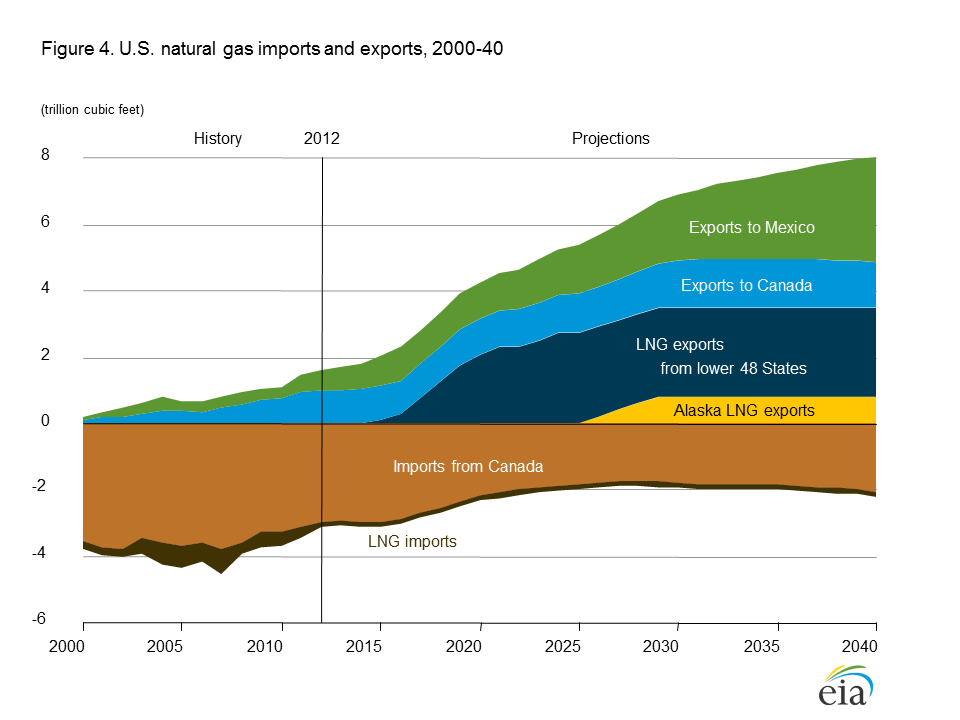
Only a few years ago, government and industry forecasts were unanimous in projecting a large and growing US LNG import requirement, as domestic gas production declined. The number of US LNG import facilities expanded to meet this new demand, but the combination of the recession and the shale gas revolution has resulted in imports shrinking substantially since 2007. The Energy Information Administration now expects the US to become a net exporter of LNG in 2016, including exports from repurposed import facilities. They will join a market that now supplies around 10% of global natural gas consumption and accounts for a third of global gas trade.

A different version of this posting was previously published on the website of Pacific Energy Development Corporation.

Thursday, April 03, 2014

Environmental Groups Gear Up to Stop US LNG Exports

  • The Sierra Club and other groups are taking on US LNG exports just when LNG is gaining support as a key response to Russia's aggressive behavior in Ukraine.

  • The science behind their claims does not withstand scrutiny, and their timing couldn't be worse, geopolitically.

A collection of environmental groups, including the Sierra Club, Friends of the Earth and 350.org recently wrote to President Obama, urging him to require a Keystone-XL-style environmental review--presumably entailing similar delays--for the proposed Cove Point, Maryland liquefied natural gas (LNG) export terminal. Given the President’s explicit support for wider natural gas use and the administration's new commitment to our European allies to enable LNG exports, the hyperbole-laden letter seems likelier to rev up the groups’ activist bases than to influence the administration’s policies.

Either way, its timing could hardly be coincidental, coming just as opinion leaders across the political spectrum have seized on LNG exports as a concrete strategy for countering Russian energy leverage over Europe in the aftermath of President Putin’s seizure of Crimea. If, as the Washington Post and energy blogger Robert Rapier have suggested, the Keystone XL pipeline is the wrong battle for environmentalists, taking on LNG exports now is an even more misguided fight, at least on its merits.

Referring to unspecified ”emerging and credible analysis”, the letter evokes the thoroughly discredited argument that shale gas, pejoratively referred to here as “fracked gas”, is as bad or worse for the environment as coal. In fact, in a similar letter sent to Mr. Obama one year ago, some of the same groups cited a 2007 paper in Environmental Science & Technology that clearly showed that, even when converted into LNG, the greenhouse gas (GHG) emissions of natural gas in electricity generation are still significantly lower than those of coal, despite the extra emissions of the liquefaction and regasification processes.

The current letter also implies that emissions from shale gas are higher than those for conventional gas, a notion convincingly dispelled by last year’s University of Texas study, sponsored by the Environmental Defense Fund, that measured actual, rather than estimated or modeled, emissions from hundreds of gas wells at dozens of sites in the US.

It’s also surprising that the letter’s authors would choose to cite the International Energy Agency’s 2011 scenario report on a potential “Golden Age of Gas” in support of their claims. That’s because the IEA’s analysis found that the expanded use of gas foreseen in that scenario would reduce global emissions by 160 million CO2-equivalent tons annually by 2035, mainly through competition with coal in power generation in developing countries, addressing the principal source of global greenhouse gas emissions growth today.

The groups take another wrong turn in suggesting that President Obama increase support for wind and solar power instead of supporting gas. The contribution of new renewables to the US energy mix has grown rapidly, thanks to significant federal and state support, but it remains small. Despite record US wind turbine and solar power additions, shale gas and shale oil added more than 20 times as much energy output on an equivalent basis in 2012, and last year’s gains look similarly disproportional. Simply put, the US isn’t enjoying a return to energy security or becoming a major energy exporter because of renewables. It is counterproductive for renewables to pit them against gas as they have done here.

Experts disagree on how much and how quickly US LNG exports can influence gas markets in Europe and elsewhere. Yet while none of the currently permitted or proposed LNG facilities will be ready to ship cargoes until at least late next year, the knowledge that they are coming will inevitably have an impact on traders and contracts, including contracts for Russian gas in the EU. Whether or not US natural gas molecules ever reach Europe, they can serve a useful role in the necessary response to Russia’s aggression in Ukraine. Attempting to block this for spurious reasons puts opponents in jeopardy of becoming what Mr. Putin in his previous career might have called “useful idiots.”

It’s tempting to speculate on what this new campaign says about the participating groups’ perceptions of how the Keystone XL fight is going. Win or lose, they might soon need a new cause, or face the dispersal of the protesters and financial contributors it has galvanized. Blocking LNG may look conveniently similar--even if similarly mistaken--but I can’t help feeling these groups would gain more traction with their fellow citizens by focusing on what they are for, rather than expending so much energy in opposition.

A different version of this posting was previously published on Energy Trends Insider.

Friday, March 28, 2014

How Can US Natural Gas Reduce Europe's Dependence on Russia?

  • The EU's dependence on Russian natural gas is directly linked to its own gas production, which has fallen faster than EU member countries' demand for gas.
  • While US LNG exports aren't an immediate remedy, due to permitting and construction time lags, the prospect of their availability is already affecting the gas market.
Russia's annexation of Ukraine's Crimean Peninsula has drawn new attention to Europe's reliance on energy supplies from Russia, particularly for natural gas. Lacking the means to force Russia's president to back down, US politicians and leading newspapers have latched onto the idea of exporting shale gas to reduce the EU's vulnerability to an accidental or intentional disruption of these supplies.  The efficacy of this strategy depends on more than the logistics and timing of US liquefied natural gas (LNG) projects.

The European Union is expected to import 15.5 billion cubic feet (BCF) per day of natural gas from Russia this year, roughly half of which would normally be transported by pipelines passing through Ukraine. Worries about the security of these supplies in the current crisis are compounded by Europe's increasing reliance on gas imports from all sources.

While EU gas consumption, based on the union's 28 current member countries, has been essentially flat over the last decade, its production has declined by more than a third, as shown in the chart below. As of the end of 2012, EU self-sufficiency in gas stood at just 35%. The widening of the gap between EU gas demand and production bears a close resemblance to the situation in which the US found itself with regard to crude oil prior to the shale revolution, and it is the main source of Europe's vulnerability in natural gas.

After Russia, the EU's main gas suppliers are Norway and Algeria, primarily by pipeline, followed by LNG sourced from Qatar, Nigeria and other countries.  Russia's leading role in supplying Europe's gas is consistent with its status as the world's second-largest gas producer and largest gas exporter, its proximity to the EU, and its pipeline network developed over multiple decades. Europe's gas supply mix includes ample political risk, but none of the EU's other suppliers are geopolitical rivals like Russia.

The EU has three main options for reducing its dependence on gas imports from Russia. It could shrink natural gas consumption, which is already happening to a modest degree as pricey gas-fired power generation is being squeezed out between subsidized wind and solar power and cheaper coal power, in a mirror image of US trends of the last several years.  This seems inconsistent with the EU's long-term emission goals and its need for gas to back up intermittent renewable electricity generation, so the further scope for this option appears limited, at least for the next decade.

EU countries could also attempt to revive domestic gas production. Europe's conventional gas fields may be in decline, other than in non-EU Norway, but its shale gas potential was estimated at 470 trillion cubic feet (TCF) in the US Energy Information Administration's global shale assessment last year. That's about 40% bigger than Europe's reserves and technically recoverable resources of conventional gas. Uncertainties on this estimate are still large, but it's in the same ballpark with the Marcellus shale in the eastern US, which currently produces over 14 BCF/day.

Unfortunately, initial efforts in Poland's shale have been disappointing, while Germany, France, and other countries have imposed explicit or implicit moratoria on shale gas development. Unless these policies are reversed in the aftermath of the Ukraine crisis, the EU will be unable to grow its way out of its dependence on Russia.

That leaves import diversification as the likeliest path for weaning Europe off Russian gas. This process is underway incrementally, hastened by previous Russian gas brinksmanship. Interest in US gas is understandable on many levels, not least because even after increasing production by around 17 BCF/day since 2006, US shale resources are expected to add another 13 BCF/day by 2020.

Energy experts have been quick to point out that the first US LNG exports won't be available for at least several years, and that companies, rather than governments, are the main parties involved in gas contracts. Customers in Europe will have to compete for US and other LNG supplies with customers elsewhere, especially in Asia, where China's gas demand is growing and Japan's post-Fukushima nuclear shutdowns have dramatically increased LNG imports.

These constraints are real. However, they ignore the ways in which changing the market's expectations about future LNG supplies--and potentially prices--could affect the calculations of Europe's gas buyers today and limit the political leverage that Russia's dominant gas export position conveys. Anecdotal reports suggest that US LNG is already a factor in contract renegotiations in Eastern Europe. As Amy Myers Jaffe of UC Davis and formerly the Baker Institute tweeted a few weeks ago, "it isn't about physical LNG cargo to Europe; it is about US exports promoting market liberalization (and) greater liquidity." 

 A decision by the US government to streamline the permitting and development of LNG facilities wouldn't enable US exports to displace Russian gas in Europe this year or next, but it would put Russia on notice that in the future it must compete in a market in which gas customers in Europe and elsewhere will have much greater choice. That would certainly complicate President Putin's plans.
 
A different version of this posting was previously published on the website of Pacific Energy Development Corporation.

Tuesday, March 04, 2014

Energy Risks of the Ukraine Crisis

  • Russia's intervention in the Crimean Peninsula poses few risks to Europe's energy supplies, but escalation or Western sanctions could change that assessment.
  • If the crisis expanded to mainland Ukraine, the integrity of that country's pipelines and the natural gas they carry to EU members would be the most immediate energy concern.
Although Ukraine's energy assets don't appear to be a major focus of Russia's occupation of the Crimean peninsula, any escalation of the crisis could have serious energy consequences, regionally and globally. The initial reaction of energy markets has been cautious, with Monday's jump of around 2% for Brent crude and nearly 10% for European gas futures largely erased in Tuesday's trading. While some of Russia's oil exports to Europe transit through Ukraine, the latter's natural gas pipelines are the bigger worry, especially in light of Russia's past use of the "gas weapon."

It's always dicey commenting on an unfolding event of this magnitude, which various observers have nominated as the most serious geopolitical crisis in post-Cold War Europe. I've spent the last few days following developments, listening to conference calls, and speaking with a Russia expert of my acquaintance. Dismissing the current events as out of tune with the 21st century ignores the complex history of a region that has seen multiple episodes of great-power conflict, just as trying to impose a Western mindset on President Putin's intentions is likely to come up short.

His latest reported comments suggest that he may have achieved his initial goals, at least insofar as giving him, rather than the new government in Kiev, control over Russia's access to the strategic Black Sea naval installations. Any broader goals are unclear at this point, and as a military expert highlighted in a media call hosted by the Council on Foreign Relations, the current confrontation in Crimea runs the risk of "unintended escalation." Wars have started this way.

So what's at stake, in energy terms? An infographic from Business Insider puts the gas situation in perspective. Russia's share of Europe's gas supply has fallen to 22% as EU members diversified their sources of supply in the aftermath of past interruptions in Russian gas deliveries. Still, roughly two-thirds of Russian gas sent to the EU passes through Ukraine's territory, and the pipelines that transit Belarus and the Baltic Sea lack sufficient capacity to reroute the entire volume should Ukraine's pipelines be disrupted.

Whether that occurred as an intentional reaction by Russia to steps that the US and EU are considering in response to its intervention in Crimea, or as a result of armed conflict in mainland Ukraine, natural gas prices in Europe would spike, even with ample gas in storage after a relatively warm winter. That would adversely affect EU economies still recovering from recession and the EU's financial crisis.

European natural gas prices are already much higher than those in the US, and any further increase would ratchet up the pressure on the EU's manufacturing sector. Nor is there nearly as much LNG available globally to make up any shortfall as there will be in just a few years, once US exports gear up and several large Australian LNG projects come onstream. Ironically, Ukraine is building its own LNG import facility to diversity its supplies--luckily not sited in Crimea.

The threat to oil deliveries seems less acute, short of an embargo that would hurt Russia as much as its customers. In 2012 Russia exported around 6 million barrels per day of oil and condensate to European refineries by various routes, including the southern leg of the Druzhba pipeline that crosses Ukraine on its way to the Czech Republic, Hungary and Slovakia. While a disruption of this flow could force refiners in those countries to scramble for alternative supplies, Russian oil would probably still find its way to world markets via other routes, including to the Baltic ports. Ensuing world oil price increases would likelier reflect an overall risk premium than a more localized physical shortfall.

Even if the situation doesn't progress beyond its current state, longer-term energy impacts could still follow. These include a recognition of heightened political risk for investments in Russia and its "near abroad" neighbors, along with the results of any financial sanctions that might be imposed.

If Mr. Putin is satisfied to engineer greater Crimean autonomy or independence from a more EU-oriented government in Kiev, and if the EU/US response is limited to financial measures to prop up that government, then the consequences--similar to those for Russia's ongoing occupation of part of Georgia--could be minimal. The EU can't go any farther than Germany will support, and thanks to the Nordstream gas pipeline led by its former Chancellor, Germany has less at stake in Ukraine than some of its neighbors. It has already distanced itself from suggestions of evicting Russia from the G8 group of nations. In that context, the US administration seems unlikely to sustain a harder line than Brussels.

Tuesday, January 28, 2014

The Pros and Cons of Exporting US Crude Oil

  • Calls for an end to the effective ban on exporting most crude oil produced in the US are based on a growing imbalance in domestic crude quality.
  • At least recently, the ban has likely benefited refiners more than consumers. Assessing the impact of its repeal on energy security requires further study. 
Senator Lisa Murkowski (R-AK), the ranking member of the Senate Energy & Natural Resources Committee, issued a white paper earlier this month calling for an end to the current ban on US crude oil exports. Her characterization of existing regulations in this area as "antiquated" is spot on; the policy is a legacy of the 1970s Arab Oil Embargo. However, not everyone sees it the same way, either in Congress or the energy industry.

This isn't just a matter of politics, or of self-interest on the part of those benefiting from the current rules. Questions of economics and energy security must also be considered. The main reason these restrictions are still in place is that for much of the last three decades US oil production was declining. The main challenges for the US oil industry were slowing that decline while ensuring that US refineries were equipped to receive and process the increasingly heavy and "sour" (high sulfur) crudes available in the global market. The shale revolution has sharply reversed these trends in just a few years.

No one would suggest that the US has more oil than it needs. Despite the recent revival of production, the US still imported around 48% of its net crude oil requirements last year. Even when production reaches its previous high of 9.6 million barrels per day (MBD) as the Energy Information Agency now projects to occur by 2017, the country is still expected to import a net 38% of refinery inputs, or 25% of total liquid fuel supply. The US is a long way from becoming a net oil exporter.

The driving force behind the current interest in exporting US crude oil is quality, not quantity, coupled with logistics. If the shale deposits of North Dakota and Texas yielded oil of similar quality to what most US refineries have been configured to process optimally, exports would be unnecessary; US refiners would be willing to pay as much for the new production as any non-US buyer might. Instead, the new production is mainly what Senator Murkowski's report refers to as "LTO"--light tight oil. It's too good for the hardware in many US refineries to handle in large quantities, and for most that can process it, its better yield of transportation fuels doesn't justify as large a price premium as for international refineries with less complex equipment.

As a result, and with exports to most non-US destinations other than Canada or a few special exceptions effectively barred, US producers of LTO must discount it to sell it to domestic refiners. Based on recent oil prices and market differentials, producers might be able to earn as much as $5-10 per barrel more by exporting it. Meanwhile the refiners currently processing this oil are enjoying something of a buyer's market and are able to expand their margins. The export issue thus pits shale oil producers and large, integrated companies (those with both production and refining) such as ExxonMobil against independent refiners like Valero.

Producers are justified in claiming that these regulations penalize them and threaten their growth as available domestic refining capacity for LTO becomes saturated. Additional production is forced to compete mainly with other LTO production, rather than with imports and OPEC.

I believe producers are also largely correct that claims that crude exports would raise US refined product prices are mistaken. The US markets for gasoline, diesel fuel, jet fuel and other refined petroleum products have long been linked to global markets, with prices especially near the coasts generally moving in sync with global product prices, plus or minus freight costs. I participated in that trade myself in the 1980s and '90s. What's at stake here isn't so much pump prices for consumers as US refinery margins and utilization rates.

Petroleum product exports have become a major factor in US refining profitability, and refiners are reportedly investing and reconfiguring to enhance their export capabilities. This provides a hedge against tepid domestic demand. Nationally, refined products have become the largest US export sector and contributed to shrinking the US trade deficit to its lowest level in four years.  If prices for light tight oil rose to world levels US refineries might be unable to sustain their current export pace. It's up to policymakers to assess whether that risk is merely of concern to the shareholders of refining companies or a potential threat to US GDP and employment.

The quest to capture the "value added"--the difference between the value of manufactured products and raw materials--from petroleum production is not new. It helped motivate the creation of the integrated US oil companies more than a century ago and impelled national oil companies such as Saudi Aramco, Kuwait Petroleum Company, and Venezuela's PdVSA to purchase or buy into refineries in Europe, North America and Asia in the 1980s and '90s.

On the whole, OPEC's producers probably would have been better off investing in T-bills or the stock market, because the return on capital employed in refining has frequently averaged at or below the cost of capital over the last several decades. It's no accident most of the major oil companies have reduced their exposure to this sector. When today's US refiners argue that it is in the national interest to preserve the advantage that discounted LTO gives them they are swimming against the tide of oil industry history.

The energy security case for crude exports looks harder to make. An excellent article from the Associated Press quoted Michael Levi of the Council on Foreign Relations as saying, "It runs against the conventional wisdom about what oil security means. Something seems upside-down when we say energy security means producing oil and sending it somewhere else."  The argument hinges on whether allowing US crude exports would simultaneously promote more production and increase the pressure on global oil prices. That makes sense to me as a former crude oil and refined products trader, but it will be a harder sell to Senators, Members of Congress, and their constituencies back home.

The politics of exports may be easing somewhat, though, as a Senate vacancy in Montana could lead to a new Chair at Energy & Natural Resources who would be a natural partner for Senator Murkowski on this issue. (That shift may incidentally be part of a strategy to help Democrats retain control of the Senate.) Will that be enough to overcome election-year inertia and the populist arguments arrayed against it?

As for logistics, the administration could ease the pressure on producers without opening the export floodgates by exempting the oil output from the Bakken, Eagle Ford and other shale deposits from the Jones Act requirement to use only US-flag tankers between US ports. That could open up new domestic markets for today's light tight oil, while allowing Congress the time necessary to debate the complex and thorny export question.

Senator Murkowski wasn't alone in calling for an end to the oil export ban. In his annual State of American Energy speech presented the day as the Senator's remarks, Jack Gerard, CEO of the American Petroleum Institute, noted, "We should consider and review quickly the role of crude exports along with LNG exports and finished products exports, because of the advantages it creates for this country and job creation and in our balance of payments." In a similar address on Wednesday, the head of the US Chamber of Commerce stated, "I want to lift the ban. It's not going to happen overnight, but it's going to happen."  I'd wager he at least has the timing right.

A different version of this posting was previously published on the website of Pacific Energy Development Corporation.

Monday, January 13, 2014

Canada: From Energy Supplier to Competitor?

  • In addition to its impact on global oil and natural gas pricing and trade, the shale revolution is altering the energy relationship between the US and Canada.
  • This long-standing supplier/customer relationship is becoming more complex as producers in both countries seek new markets outside North America.
In remarks last month the Canadian Natural Resources Minister, Joe Oliver, suggested that with the continued growth of unconventional oil production in the US, "Our only customer will become a competitor." Considering plans for liquefied natural gas export facilities on both sides of the border, he might have included LNG in that comment, too. Let's take a look at the kind of competition he might have had in mind.

Canada has long been an important supplier of crude oil to US refineries, since at least the 1950s. For much of the 1980s and '90s it was in a virtual three-way tie with Mexico and Venezuela for the #2 spot on the list of top oil exporters to the US, behind Saudi Arabia. Since 2004 Canada has claimed first place on that list as its production expanded, while Mexican and Venezuelan output declined and some Saudi oil went to other markets. From 2010 to 2012 exports of Canadian crude oil to the US, including oil sands crude, increased by 23% to over 2.4 million barrels per day (bpd). This has provided Canada with a reliable outlet for its production and the US with additional supplies not exposed--except for price--to ongoing instability in the Middle East and other regions.

However, with or without the Keystone XL Pipeline, the competition to feed US refineries is becoming more intense.  Canada's growing crude exports, including significant quantities of heavy and/or sour crude oil, must displace similar crudes imported into the US from  Latin America and the Middle East without losing ground to the expanded light oil production from US shale plays such as the Bakken and Eagle Ford, and the otherwise mature Permian Basin of Texas and New Mexico. Each of these areas now yields a million bpd. These dynamics are compounded by 1970s-vintage US oil-export rules that keep domestic crude bottled up in the Gulf Coast and weaken the economics of oil production throughout much of North America. 

If it seems odd for a Canadian official to talk about competition within the US market in this way, consider that the main country exempted from current US oil export restrictions is Canada. US oil exports to eastern Canada by rail and by tanker have grown rapidly in the last two years and are likely to expand beyond the current 100,000 bpd level, if export license applications are any indication. US oil exports to Canada may be displacing non-North American crudes today, but they likely also have an adverse effect on the economics of projects intended to ship more western Canadian crude eastward. So Canada now understandably looks towards Asia, home to the world's fastest oil-demand growth, as the logical destination for at least some of its future oil production.

 Natural gas creates another, perhaps more plausible arena for export competition between Canada and the US. Canada envisions a resurgence in gas production similar to what the US has experienced, based on a combination of conventional gas discoveries, such as in the Mackenzie Delta of the Northwest Territories, as well as the shales of Alberta and British Columbia. It also stands to gain additional gas reserves if it is successful in its bid to claim more of the Arctic. As Canadian gas is displaced from its long-standing export market in the US by the shale boom in the lower-48, LNG exports from B.C. are looking more attractive. The province lists five projects in different stages of development and highlights B.C.'s advantageous shipping route to Asia.

Many more LNG export projects have been proposed for the US, with at least four having received approval to sell to countries with which the US does not have free-trade agreements. A number of these are based on existing, or at least previously permitted, LNG import facilities, giving developers a head-start on construction. The US also has a big edge in proved natural gas reserves and technically recoverable gas resources, including shale gas.

Despite these US advantages, aspiring Canadian LNG exporters won't have to contend with an enormous domestic market for their gas, in which many industries are competing to use more gas in power generation, chemicals and other manufacturing, and different paths for displacing oil from transportation, including CNG, LNG, methanol, ethanol or gas-to-liquids fuels. As a result, I suspect that a Canadian LNG plant could count on a more stable long-term cost of gas than one on the US Gulf Coast.

The protracted controversy over the Keystone XL Pipeline project has focused a great deal of public attention on a single aspect of our energy relationship with Canada, while obscuring other aspects that are beginning to shift. Adding a new competitive overlay to our long-standing energy supply chains could ultimately increase North American leverage on OPEC's pricing power, while helping to develop a deeper and more flexible global market for LNG, with resulting environmental benefits. While this might result in winners and losers at the project and company level, the overall effect should be positive for both countries.

A different version of this posting was previously published on the website of Pacific Energy Development Corporation.

Thursday, December 12, 2013

The LPG Echo of the Shale Gas Boom

  • Increased US production of LPG and natural gas liquids is an outgrowth of the shale gas revolution and a key ingredient for translating its benefits into industrial growth.
  • The infrastructure investments, export opportunities and price relationships for these liquids represent a microcosm of the similar issues for shale gas and LNG.
An article in the Wall St. Journal last month on the impact of a Midwest propane shortage on farmers trying to dry their corn harvest caught my attention. How could propane be in short supply, when US production is soaring due to shale gas? While it turns out that the shortfall in question was localized and temporary, it prompted me to take a closer look at LPG supply and demand than I have in many years. I found yet another market that is being transformed by the shale gas revolution.

Like most Americans--except for those in the roughly 5% of US homes heated with it-- I normally think about LPG only when I have to change the tank on my barbecue grill. That wasn't always the case; early in my career I traded LPGs for Texaco's west coast refining system. I'm happy to see that some of my former colleagues from that period are still involved and frequently quoted as experts on it. Although the LPG market is obscure to many, it represents a microcosm of the issues of reindustrialization and product exports arising from the recent turnaround in US energy output trends.

In order to follow these developments, we first need to clarify some confusingly similar acronyms, starting with LPG. Although often used synonymously with propane, it actually stands for "liquefied petroleum gas" and covers mainly propane and butane, though some in the industry include ethane in this category. The term reflects the oil refinery source of much of their supply, both historically and to an important extent today.  LPG overlaps with natural gas liquid (NGL)--ethane, propane, butane, isobutane and "natural gasoline"-- that has been separated from "wet" ( liquids-rich) natural gas during processing. NGLs are entirely distinct from the anagrammatical LNG, or liquefied natural gas, which consists mainly of methane that has been chilled until it becomes a liquid. By contrast, NGLs and LPG are typically stored at or near ambient temperature but under pressure to keep them in the liquid state.

LPG and NGLs make up a distinct segment of US and global energy markets, falling between the markets for natural gas and refined petroleum products. They are also linked to these larger markets, both logistically and economically. For example, gas marketers vary the amount of liquids they leave in "dry gas" to meet pipeline natural gas specifications based on price and other factors, and oil refiners blend varying quantities of butane into gasoline, depending on seasonal requirements. Propane and butane are mainly used as fuels, while ethane and isobutane are chiefly chemical feedstocks.

The development of shale gas in the US and Canada has affected the supply of NGLs and LPG in several important ways. First, starting around 2007 increasing shale gas output helped to halt and then reverse the decline in US natural gas production from which US NGLs are sourced. Then, following the financial crisis, diverging natural gas and crude oil/liquids prices pushed shale drillers toward the liquids-rich portions of shale basins like the Eagle Ford in Texas, in order to maximize their revenue. The resulting surge of US NGL production in late 2009 reinforced the decline of US LPG imports that began with the recession. According to US Energy Information Administration data, the US became a fairly consistent net exporter of LPG in 2011.

The current US LPG surplus is around 100,000 bbl/day, out of total production of around 2.7 million bbl/day. That surplus and its expected growth provides the basis for a number of announced LPG  export projects, as well as the anticipated development of new domestic chemical facilities such as ethylene crackers that would consume substantial portions of new supply, particularly of ethane.

The success of those projects depends on significant investments in new infrastructure, including gas processing, NGL fractionators to split the raw NGL into its components, and pipelines to deliver NGL to fractionators and LPG to markets. This is particularly true for the Marcellus and Utica shale gas in the Northeast, from which little or no ethane has been extracted due to limited local demand. Not only is that a missed manufacturing opportunity, but it constitutes a potential constraint on further liquids-rich gas development, since leaving too much ethane in the marketed gas would cause it to exceed pipeline BTU specifications.

In the meantime we're left with a situation that's analogous to the growth of tight oil production from the Bakken  shale. New sources of production have come on-stream faster than the infrastructure necessary to deliver them efficiently to where they can be processed or consumed. That puts a growing US surplus of propane and other NGLs in tension with tight regional markets for these fuels in the Midwest and Northeast, where residential propane prices are running well ahead of last year's at this time.  The resolution of this apparent paradox will depend on which infrastructure and demand projects are eventually completed, and how soon.

A different version of this posting was previously published on the website of Pacific Energy Development Corporation.
Friday, September 13, 2013

Energy Projects Seem Less Urgent in A Post-Energy-Crisis World

  • Rather than being another component of an ongoing energy crisis, opposition to various energy projects points to the alleviation of a decades-long string of US energy crises.
  • The audience for concerns about pipelines and fracking would be much smaller if oil were still at $145 per barrel and natural gas over $10 per million BTUs.
To someone living in 1974, during the first energy crisis of the last 40 years, the idea of mass protests to block a pipeline for importing crude oil from Canada would have seemed incomprehensible.  Our environmental awareness has expanded in the interim, along with new channels for exchanging information, including "enduring misconceptions".  Yet the current opposition to so many different energy projects--natural gas drilling, long-distance transmission lines and even wind farms--can also be viewed as an unintended consequence of recent energy successes on a broad front.

The alleviation of what seemed to many a permanent energy crisis might not be obvious, because it has crept up on us. But consider a few of the big-picture elements that have changed:

In crisis mode, US energy security was focused on steadily rising oil and later natural gas imports, while "energy independence" was a goal embraced by politicians but rarely energy experts. Cars offering better fuel economy were available but entailed trade-offs in size and performance. Today, oil imports are falling, the US is a net exporter of refined petroleum products, and public concern about Peak Oil is waning, as measured by internet search activity. Ethanol from corn supplies 10% of US gasoline demand, while other forms of renewable energy are growing rapidly, from a small base. The big question for the federal government this summer is how many natural gas export facilities to allow. Meanwhile, the threshold for fuel-efficient cars has shifted from 30 mpg to 40 mpg, offered in numerous attractive models.

Another way to gauge the success of technologies like hydraulic fracturing, or "fracking", in shifting our energy landscape is to remind ourselves how bad we thought today's situation would be, just a few years ago.  In 2005 the official US annual energy forecast projected oil imports to increase from 11 million barrels per day (MBD) in 2003 to nearly 15 MBD by this year, due to rising demand and domestic production that was expected to remain flat, at best (see below chart.)


The Energy Information Agency (EIA) also expected US natural gas imports to increase steadily, reaching 3.5 trillion cubic feet  (TCF) of LNG imports this year, on their way to 6 TCF per year by 2022. As a consequence, in 2005 the EIA forecast that coal would still generate 48% of US electricity by 2013.
 

Now imagine energy prices in that alternative 2013. With US natural gas suppliers importing an average of 90 LNG tankers per month, would the wellhead price of gas still be under $4 per million BTUs, or closer to the $16 price paid in some international markets? And with US refiners importing up to twice as much crude oil as they are actually on track to do this year, in the context of sanctions on Iran and turmoil in North Africa, how likely does it seem that oil would be at $105-110/bbl, instead of much higher? $100 oil is a drag on the economy, but US consumers have adjusted to gasoline priced around $3.50-3.75/gal., on average. Every $1 per gallon above that would take another $130 billion per year away from other purchases, with adverse effects on the US economy.

More to the point, in such an environment how much tolerance would there be for opposition to oil pipelines or gas drilling that had the potential to lower energy prices, or at least reduce imports and enhance energy security? If oil were above its 2008 high of $145/bbl, and gasoline flirting with $5 per gallon, it would surely be much harder for elected officials to delay approving projects like the Keystone XL pipeline, or to sustain gas drilling moratoria. Ironically then, the successful large-scale application of shale drilling techniques, which has resulted in a 29% increase in US natural gas production and 33% rise in oil production since 2004, helped make it possible for opponents of Keystone or fracking to be heard, rather than dismissed out of hand.

I was recently struck by a reported remark by a pipeline executive. "Shale is everywhere," he said, but it won't be produced everywhere because "people make choices." I agree with that insight, while recognizing that such choices are available mainly because altered economic conditions and the same technologies to which some now object have enabled us to shed an energy crisis mindset.  This situation might have future parallels for other technologies that have escaped much pushback, so far. 

A different version of this posting was previously published on the website of Pacific Energy Development Corporation.

Thursday, December 20, 2012

2012: The Year in Energy

As in most recent years, energy was constantly in the news in 2012. A post attempting to catalog every noteworthy story or event would be quite long.  However, a few big trends stand out. For starters, it's a near-certainty that the average US gasoline price will set a new record for the second year running, in both real and nominal terms. Americans are responding by choosing more fuel efficient cars. Meanwhile, fundamental shifts emerged from obscurity into the awareness of policy makers and the public.  US energy exports have become a mainstream topic of conversation, and the goal of energy independence--a concept with debatable meanings--has acquired renewed respectability after spending a couple of decades on the fringes of energy policy debate.  Perhaps more significantly, our views of climate change and future oil supplies--once aligned--have diverged. 

For renewable energy it has been the best and worst of years.  Global overcapacity in solar equipment manufacturing drove down the costs of solar panels, at least partly counteracting reductions in government incentives, especially in Europe, and making solar power more competitive.  The US is on track to add a record 3,200 MW of solar capacity this year, while China could add 5,000 MW.  However, solar manufacturers' rapid expansion depressed their margins and extended last year's string of solar bankruptcies, with firms like Abound Solar, Konarka, Solarwatt, Q-Cells and others forced to restructure or liquidate in 2012.  A similar, if less dramatic wave is working through the more mature onshore wind industry, which faces the expiration of a key US incentive, the Production Tax Credit, or PTC on December 31.  In anticipation of that loss, wind developers have added 4,728 MW of new capacity in the US through the first three quarters of 2012, the most since 2009.

Energy played a complex and possibly decisive role in the US presidential election.  Remarkably, President Obama successfully co opted his opponent's energy platform by embracing an oil and gas revival that his administration had done little to help and much to hinder, even though it appeared to conflict with his emphasis on renewable energy and climate change mitigation.  Meanwhile, the shale gas revolution was creating hundreds of thousands of direct and indirect jobs and lowering energy costs across the economy, contributing to US manufacturing competitiveness.  The resulting economic growth, while still below the level of other post-war recoveries, apparently helped the President make his case for a second term.

The inherent tension between surging US oil and natural gas production and concerns about climate change--fanned by Hurricane Sandy--reflects a major shift that occurred this year, at least as an influence on future energy policy.  Recall that until recently, memories of past energy crises, combined with the influential Peak Oil perspective, shaped our expectations of resource availability and future production.  This narrative of hydrocarbon scarcity complemented prescriptions for a rapid transition away from fossil fuels as the only viable solution to climate change, supporting a shared goal of a more sustainable energy economy based on renewable energy, smart grids and electric vehicles.   The exploitation of unconventional oil and gas resources in previously inaccessible source rock--shale gas and "tight" or shale oil--poses significant challenges to both strands of that argument.

First, it undermines the notion of energy scarcity for at least the next decade, and probably well beyond.  US natural gas production set a new record this year, and US oil production returned to levels not seen since 1997, putting increased pressure on OPEC's control over global oil pricing. Nor does the US have a monopoly on these unconventional resources. Canada looks like the next big shale gas play, with China and South Africa possibly not be far behind.  The technologies that enabled the US shale gas revolution and its oil offspring are being transferred around the world.

Yet we also learned that US energy-related CO2 emissions have fallen back to 1992 levels, largely because of a dramatic reduction in the use of coal in power generation.  While renewable energy sources like wind and solar power deserve some of the credit, natural gas-fired turbines--driven by cheap shale gas--have added three times as much net generation since 2007 as non-hydro renewables.

Shale gas and oil might not provide a long-term solution to global warming, but they could at least buy us the time to develop the innovations like improved electric vehicle batteries and low-cost grid-storage that will be necessary if renewables are to displace fossil fuels across the entire spectrum of their use--and dominance.  They could also provide the time to develop and deploy the next generation of nuclear power, including small modular reactors.

I'd like to thank my readers for your continued interest and encouragement and wish you a happy holiday season.

Wednesday, December 12, 2012

Should Alaska Export More LNG to Asia?

The Governor of Alaska reportedly met this week with officials from the South Korean national gas company to discuss exports of liquefied natural gas (LNG). Ever since crude oil production on Alaska's North Slope ramped up in the 1980s, industry observers have speculated about the ultimate disposition of the significant associated natural gas reserves found with the oil. In a letter filed with the state of Alaska, BP, ConocoPhillips and ExxonMobil, the three main North Slope producers, together with pipeline company Transcanada, recently confirmed their plans for a potential liquefied natural gas (LNG) project, instead of the long-mooted pipeline to deliver the gas to America's lower-48 states. The contemplated megaproject would validate both the scale of Asia's future LNG market and the long-term nature of the US shale gas revolution.

Alaska's North Slope has already yielded
15 billion barrels of oil. Production peaked at over 2 million barrels per day in 1988 and subsequently declined to less than 600,000 barrels per day last year. With around 6 billion barrels of remaining reserves, it's still a very significant field but well past its prime. While the public has focused on its oil output, the producers and the state have long had their eyes on how best to harvest the value of the 35 trillion cubic feet (TCF) of gas dissolved in the oil. In fact, the North Slope complex has produced several TCF per year
of gas for years, ranking it among the largest gas fields in the world, but almost all of that gas has been reinjected into the formation to aid oil recovery--and for lack of a market in an isolated and sparsely-populated state.

For decades the default assumption was that
a pipeline would eventually be built across Alaska and Canada to link this gas to the existing network feeding the contiguous US. That idea gained traction when US marketed gas production stalled around 2000 and then began to decline. The economics of an Alaskan gas pipeline compared poorly with gas produced along the Gulf Coast, but competing with rising LNG imports looked much more feasible. Then along came unconventional gas, starting with coal-bed methane and culminating with the surge of shale production since 2005. The US gas market now has enough domestic supply to shrink coal's contribution to US power generation by 7% since 2008
and revive gas-intensive industries.

If shale gas were only a short-term phenomenon, as some have suggested, it would be of little relevance to the plans of the North Slope producers. All they'd need to do would be to delay their pipeline for a few more years, and the market would come to them. However, estimates put US shale gas resources at between
482 and 686 TCF--a 60-90 year supply at current shale production rates. And the fact that all three of the main North Slope producers have invested in significant acreage positions and production in US shale basins
surely gives them insights into the longevity of those resources.
Nor is time on the side of the Alaskan producers. As oil production declines the economics of the North Slope operation will deteriorate, while keeping the Trans Alaska Pipeline full becomes more problematic. Finding an attractive outlet for the North Slope "gas cap" wouldn't just provide a new revenue source; it could keep oil production going for additional decades.


The LNG option offers several advantages, despite its estimated $45-65 billion price tag and technical complexity. For starters, it cuts roughly 1,000 miles of difficult terrain off the distance that the gas must be pipelined, in this case to a site on the southern Alaskan coast. That location is much closer to Asia, the world's largest LNG market, than export projects intended to ship LNG from the US Gulf Coast. The Asian market is also growing, thanks in part to Japan's post-Fukushima reassessment of nuclear power. The Japanese government has backed away, at least for now, from plans for a firm nuclear phase-out, but it seeks to diversify its energy sources. Among other steps taken in the aftermath of the Sendai quake and nuclear disaster, it has instituted the world's most attractive solar power incentives. Yet Japan's solar resources provide just a few hours of peak output per day, on average, requiring substantial fossil fuel generation to fill in the gaps. Power plants burning LNG are well-suited to that task.

China presents a more complex picture, with its own significant
shale gas potential and an energy market expected to add as much
natural gas demand by 2035 as all the world's developed countries put together. Considering the scale of eventual demand and the infrastructure necessary to bring China's shale gas to market, it seems likely that the growth of the market in the interim must depend heavily on LNG imports.

Assuming that the state of Alaska presents no obstacles and that US export permits would be forthcoming, because Alaskan LNG exports wouldn't impact US natural gas prices, the main questions that will determine the future of this project can't be answered definitively today. Among these are whether the numerous competing LNG projects being planned and built around the Pacific Rim and elsewhere will saturate the global market in the meantime, and whether the market will provide an attractive price for Alaskan LNG, influenced more by crude oil prices than by US shale gas. The North Slope producers are already immersed in these issues via their other activities, including ConocoPhillips' small
LNG plant in Kenai, Alaska, which has been shipping LNG to Asia for more than 40 years. The project timeline provided to the state includes at least three go/no-go decisions along the way as the answers to these questions unfold.


A slightly different version of this posting was previously published on the website of Pacific Energy Development Corporation.