Showing posts with label rail. Show all posts

Monday, January 05, 2015

2014 in Review: Shale Energy's First Price Cycle

2014 was an extraordinary year in energy, vividly illustrating both sides of the Chinese proverb about interesting times. Oil market volatility was the big story for much of the year, with the dominance of geopolitical risks finally yielding to surging supplies. Of the two energy revolutions underway, shale wields the bigger stick for now, while the growth of renewables gathers momentum. All of this has implications for 2015 and beyond.
The US remained the epicenter of the shale revolution this year, with development elsewhere still subject to uncertainties about economic production potential, infrastructure, and the rules of the road. A comparison of oil-equivalent additions to US energy supplies from oil, gas and non-hydro renewables for the first nine months of the year highlights both the significance of shale and the differences in relative scale that impede a rapid shift to renewables.
Picture
 
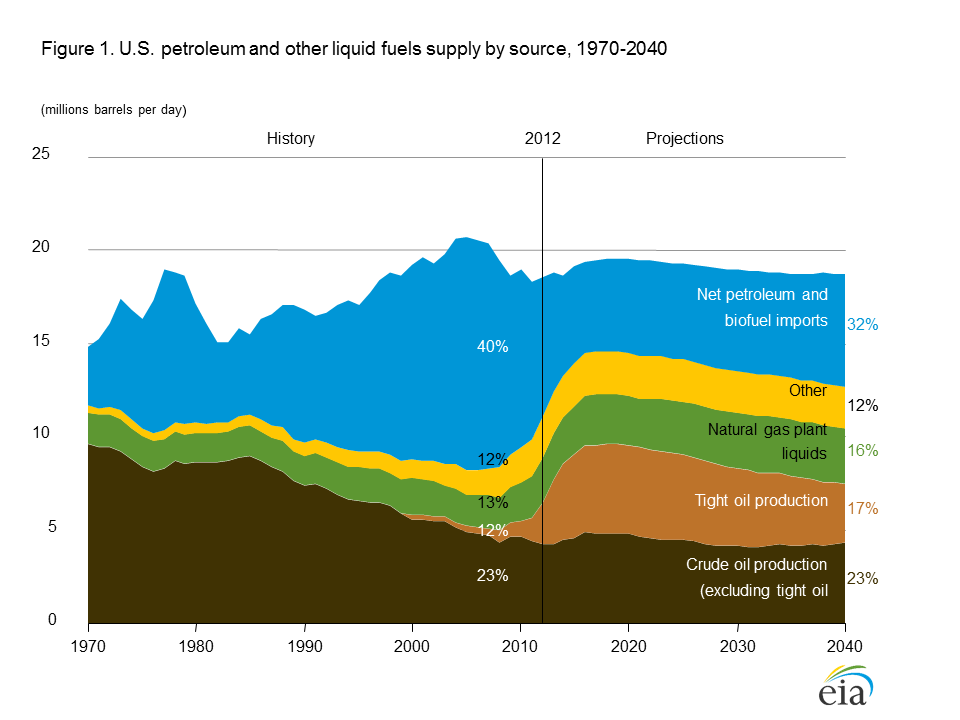
US shale drilling added over a million barrels per day of "light tight oil" (LTO) production, compared to 2013, based on US Energy Information Administration data for the first nine months of the year. That brings cumulative gains since 2011 to nearly 3 million bbl/day. This hasn't just upended the global oil market; it has also revolutionized the way oil moves across North America. Over a million bbl/day now moves by rail, a figure recently projected to peak at 1.5 million by 2016. Nor is that entirely the result of delays to pipeline projects like Keystone XL. One proposed pipeline for Bakken LTO was reportedly canceled due to a lack of interest from shippers. Rail is expensive but provides producers and refiners with greater flexibility in both volume and destinations than fixed pipelines.

The collapse of oil prices has prompted many producers to reassess drilling plans, although it has been a boon for refiners and consumers.  Refining margins look relatively healthy, at least based on the proxy of "crack spreads", the difference between the wholesale prices of gasoline and diesel and the oil from which they are made. Some refiners also anticipate that low prices will spur demand growth, as described in a fascinating Wall St. Journal interview with Tom O'Malley, who has turned a succession of castoff refineries into profitable businesses. 

We may already be seeing the demand response to lower prices. November US volumes were at a 7-year high, according to API. This is unlikely to be replicated quickly elsewhere, however, for the same reasons that global oil demand was slow to moderate when prices rose over the last several years: In many countries the influence of oil prices on consumer behavior is overwhelmed by fuel taxes or subsidies. With prices now falling, some developing countries are capitalizing on the opportunity to unwind billions of dollars in consumption subsidies, offsetting market drops. That could have important implications for future oil demand and greenhouse gas emissions.

Meanwhile US consumers have watched retail gasoline prices fall by $1.39 per gallon since July and by over a dollar compared to a year ago. If sustained, the effective stimulus could exceed $100 billion annually, ignoring the effect of lower prices for jet fuel, diesel and other products. It's not surprising that half of respondents in last month's Wall St. Journal/NBC poll indicated this was important for their families.

While oil has been making headlines, shale gas without much fanfare added the equivalent of another half-million bbl/day to US production. That explains why despite enormous drawdowns of gas during last winter's "Polar Vortex", gas inventories began this winter much closer to normal levels than was widely expected in the  spring. Gas has lost a little ground in electricity generation to coal in the last two years, but few reading the EPA's proposed Clean Power Plan regulation would expect that trend to continue.

Shale gas remains controversial in some areas due to perceived environmental and community impacts. New York state is apparently making its temporary ban on hydraulic fracturing ("fracking") permanent, preferring to rely on shale gas supplies from neighboring Pennsylvania. Yet while shale drilling in North Dakota has led to an increase in gas flaring--burning off gas that can't economically reach a market--the latest findings from the University of Texas and Environmental Defense Fund measured methane leakage from gas wells at an average of 0.43%. That shrinks gas's emissions footprint and enhances its potential role in climate change mitigation.

Turning to renewables, wind energy now provides a little over 4% of US electricity. However, its growth has slowed due to uncertainty about continued federal subsidies. The wind production tax credit, or PTC, had previously been extended through 2013 in a way that allowed projects brought online later to benefit from the extension. It was just extended again through the end of 2014, along with a broad package of other expiring tax benefits. This late revival might be a gift to a few projects already under construction, but it seems unlikely to spur additional projects without further legislative action in the new Congress.

Solar power has also made great strides, with costs falling rapidly and US additions in 2014 expected to reach 6,500 MW, likely outpacing wind additions. This is happening despite the ongoing trade dispute between the US and China over imported solar modules. Utilities are already experiencing solar's impact on their traditional business model. Yet as important as wind and solar power are likely to be in the future energy mix, their impact in 2014, at least in the US, was still dwarfed by the growth of shale resources. Drilling is already slowing down, however, so renewables could take the lead in 2015 as shale is expected to post smaller gains.

Looking ahead, the global focus on greenhouse gas emissions will increase in the run-up to the Paris climate conference in December.  It remains to be seen whether enough progress was made in the recently completed talks in Lima, Peru, to resolve the significant remaining obstacles to a new global climate agreement. And while oil supply gains trumped geopolitics in 2014, a list of risk hot-spots from the Council on Foreign Relations includes several scenarios with major implications for oil and/or natural gas prices. Meanwhile we can expect the new Congress to take up Keystone XL, oil exports, EPA regulations, and other energy-related issues. I'd bet on another lively year.

A different version of this posting was previously published on the website of Pacific Energy Development Corporation.

Thursday, November 06, 2014

Will Falling Prices Shift Oil Industry's Focus to Cost Reduction?

  • Lower oil prices may have less impact on US oil production from shale than competitors in Saudi Arabia and elsewhere appear to assume.
  • The cost of  producing tight oil is not static, and US producers have various options for cost reduction, including optimizing their logistics. The newly elected Congress can help.
Oil prices have dropped by more than 20% since July, based on futures contracts for UK Brent crude. Some expect prices to rebound relatively quickly, apparently including at least one large oil services company. However, indications that the official policy of Saudi Arabia may have shifted away from its customary role of "swing producer" raise the possibility of an extended period of lower prices. This is new territory for the relatively young US shale industry.

From the end of 2010 to the first half of this year, as the rapid development of light tight oil (LTO) from shale deposits was adding more than 2.9 million barrels per day (bpd) to US output, the benchmark price of West Texas Intermediate crude oil (WTI) averaged $96/bbl. The global oil price, represented by UK Brent, averaged $110/bbl for the same period. Having now fallen to the $80s, if prices were to stay here or lower for long, we should expect to learn a great deal about the actual cost structure of new and existing LTO production in the Bakken, Eagle Ford, Permian Basin and other shale plays.

Based on my experience of several oil-price declines from the inside during my time at Texaco, Inc., I'm skeptical that many LTO producers would be inclined to trim output from currently producing wells, other than as a last resort. From late 1997 to the end of '98, WTI prices fell by almost half, from around $20/bbl to under $11--equivalent to roughly $15 today.  Prices for heavier grades of oil fell to single digits. After months of that, revenues from some oil fields no longer covered variable costs, and upstream management took the decision to shut in high-cost production. Once prices revived, they discovered that some of that capacity had been lost essentially permanently.

I suspect there would be even greater uncertainty and hesitation today about shutting in producing shale wells for any significant period, especially in light of the limited experience with such wells. The bigger question is whether the drilling of new wells would slow or stop, resulting in a gradual slide in output as existing wells decline.

Then and presumably now, however, the first option in a situation like this is generally to cut costs, rather than output. I saw this in the mid-1980s, when oil prices fell by nearly 60% and took more than a decade to recover fully, then again in the late '90s, and during periodic, smaller market corrections. Suppliers were squeezed, big projects deferred, and employees saw travel, raises and benefits curtailed. Similar actions now could make a difference in keeping new shale drilling going.

Even for relatively efficient operators, it can be surprising how much expense can be reduced without affecting near-term productivity, and many of those savings would persist if prices recovered. LTO producers might ultimately become more profitable after weathering a period of weak prices.

A heightened focus on costs would also likely extend beyond producing company budgets and supplier agreements. One of the biggest non-production costs for LTO is transportation, whether paid directly by the producer or deducted by the purchaser from the market price.  Because of its rapid growth and the constraints of existing infrastructure, a high proportion of LTO output must currently be shipped by rail--up to one million bpd in the second quarter of 2014.

Rail offers flexibility and can reach many destinations, but it is expensive.  For example, if it costs over $10/bbl to ship Bakken crude to the Gulf Coast by rail, that means that with WTI at $78/bbl the producer might realize less than $70/bbl at the wellhead.  Pipelines are often cheaper to use, though not in all cases. The current tariff on the existing Keystone Pipeline for taking oil from the Canadian border to Cushing, OK, the storage hub for WTI, works out to around $4/bbl. If oil prices stayed low for a while, that might increase interest in the proposed Bakken Marketlink Project. It would connect the Bakken shale operations to the Keystone XL pipeline, the prospects for which look decidedly better after the outcome of Tuesday's mid-term election.

Another aspect of transportation costs that could come under a different kind of pressure relates to federal restrictions on shipping oil and petroleum products by vessel between US ports. Under the "Jones Act", only US-flagged, -owned and -crewed ships can perform such deliveries, even though the rates for such shipments are normally significantly higher than on foreign-flag tankers in comparable service. This is a significant factor in current petroleum trade patterns, in which refined products from Gulf Coast refineries are often shipped halfway around the world, while blenders and marketers on the east and west coasts must import gasoline and other products from outside North America.

And as long as US crude oil exports are prohibited, with a few exceptions, the combination of the Jones Act and the export ban effectively keep LTO bottled up on the Gulf Coast--depressing its price--or force it onto rail. Amending the Jones Act to exempt LTO, or the issuance of a waiver to that effect from the Executive Branch, could increase producers' margins while expanding the supply options for US refineries on the other coasts. I wouldn't be surprised to see this taken up by the new Congress early next year.

 Based on the current behavior of oil markets, the global impact of the US shale oil boom has been greater than many expected and seems very much in the national interest of the US--and of US consumers--to keep it going. It remains to be seen whether measures such as new pipeline infrastructure and reform of shipping regulations, together with more traditional forms of expense reduction, could boost producers' returns on LTO sufficiently to sustain drilling at roughly current rates while oil prices are weak. 

Even if both drilling and tight oil production slowed for a while, this price correction won't spell the end of the shale boom. As the Heard on the Street column in the Wall Street Journal put it recently, "Once someone has cracked it, it can't be unlearned. Barring a prolonged period of very low prices, the US oil industry isn't about to disintegrate." Rather than an existential crisis, the current weakness in oil markets looks like a test of adaptability for this new but important energy sector.

A different version of this posting was previously published on the website of Pacific Energy Development Corporation.

Wednesday, March 19, 2014

Making Oil-by-Rail Safer

  • A series of rail accidents involving trains carrying crude oil has focused attention on safety procedures and even the tank cars used in this service.
  • Another concern is the variable characteristics of the "light tight oil "now shipped by rail in large quantities. That isn't the result of "fracking", but of the oil's inherent chemistry.   
The growth of North American oil production from unconventional sources has resulted in a dramatic expansion in the volume of crude oil shipped by rail. Unfortunately, as crude oil rail traffic has increased, so have rail accidents involving crude oil, including the tragic explosion and fire in Lac-Megantic, Quebec last July. That event and subsequent accidents have focused railroads, regulators and shippers on the need to improve the safety of oil-by-rail as quickly as possible.

In the immediate aftermath of Lac-Megantic, the Federal Railroad Administration issued an emergency order on procedures railroads must follow when transporting flammable and other hazardous materials. And on February 21, 2014 railroads reached a voluntary agreement with the US Department of Transportation (DOT) on additional steps, including reduced speed limits for oil trains passing through cities, increased track inspection, and upgraded response plans. These steps have the highest priority, because crude oil loaded in tank cars doesn't cause rail accidents. Every incident I've seen reported in the last year began with a derailment or similar event.

At the same time, the packaging and characteristics of the oil can affect the severity of an accident.  Investigators have focused on two specific issues in this regard, starting with the structural integrity of the tank cars carrying the oil. The vast majority of tank cars in this service are designated as DOT-111--essentially unpressurized and normally non-insulated cylinders on wheels. These cars routinely carry a variety of cargoes aside from crude oil, including gasoline and other petroleum products, ethanol, caustic soda, sulfuric acid, hydrogen peroxide, and other chemicals and petrochemicals.

Their basic design goes back decades, and even the older DOT-111s incorporate learnings from earlier accidents. A growing proportion of the US fleet of around 37,000 DOT-111 tank cars in oil service consists of post-2011, upgraded cars that have been strengthened to resist punctures, but the majority is still made up of older, unreinforced models. The Pipeline and Hazardous Materials Safety Administration (PHMSA) is studying whether to make upgrades mandatory, but some railroads and shippers aren't waiting. Last month Burlington Northern Santa Fe Railway, owned by Warren Buffet's Berkshire Hathaway, announced it would buy up to 5,000 new, more accident-resistant tank cars.

Another issue that has received much attention since Lac-Megantic concerns the flammability of the light crude from shale formations like North Dakota's Bakken crude, which accounts for over 700,000 barrels per day of US crude-by-rail. The Wall Street Journal published the results of its own investigation, reporting that Bakken crude had a higher vapor pressure--a  measure of volatility and an indicator of flammability--than many other common crude oil types.

The Journal apparently based its findings on crude oil assay test data assembled by the Capline Pipeline.  Although a Reid Vapor Pressure of over 8 pounds per square inch (psi) for Bakken crude is higher than for typical US crudes, it's not unusual for oil as light as this. That's especially true where, due to lack of field infrastructure, only the co-produced natural gas is separated out, leaving all liquids in the crude oil stream.

What makes this situation unfamiliar in the US is that domestic production of oil as light as Bakken had nearly disappeared before the techniques of precision horizontal drilling and hydraulic fracturing were applied to the Bakken shale and similar "source rock" deposits. (Note: High vapor pressures are characteristic of the naturally-occurring mix of hydrocarbons in very light crudes, rather than a result of the "fracking" process.) Nor is the reported vapor pressure for Bakken or Eagle Ford crude higher than that of gasoline, a product that is federally certified for transportation in the same DOT-111 tank cars that carry crude oil.

The variability of the vapor pressure data that the Journal's reporters identified for Bakken crude may result from another unfamiliar feature of such "light tight oil". Crude produced from conventional reservoirs, which are much more porous than the Bakken shale, tends to be relatively homogeneous. However, because the Bakken and other shales are so much less porous, limiting diffusion within the source rock reservoir, the composition of their liquids can vary much more between wells.

In any case, vapor pressure isn't the preferred measure of fuel flammability. Actual rail cargo classifications are based on flash point and initial boiling point. These routine quality tests aren't included in Capline's publicly available data. PHMSA initiated "Operation Classification" to ensure that manifests and tank car placards for crude oil shipments accurately reflect the potential hazards of each cargo, based on such measurements. The agency has determined that it hasn't always been done consistently, and DOT issued another emergency order requiring shippers to test oil for proper classification.

As mentioned in an oil-by-rail webinar yesterday, hosted by Argus Media, assigning the proper classification to oil shipments may seem like a bureaucratic concern--it doesn't necessarily affect the tank car type chosen to transport the crude--but it can have a significant impact on operational factors such as routing and the notification of first responders along the route.

There's no quick and simple way to make the transportation of crude oil by rail as safe as hauling a dry bulk cargo like grain. Tank car fleets can't be replaced overnight, not just because of the cost involved, but due to limited manufacturing capacity. However, in the meantime significant improvements can be achieved through a combination of government attention and sustained industry initiatives. Since the new crude streams traveling by rail play a key role in increasing North America's energy security, this is in the interest of everyone involved--producers, shippers, railroads, and not least the communities through which this oil travels.

A different version of this posting was previously published on the website of Pacific Energy Development Corporation.
 

Wednesday, February 05, 2014

Interpreting the State Department's Latest Assessment of the Keystone XL Pipeline

Earlier today, I participated in a webchat hosted by The Energy Collective on the subject of the emissions and market impact of the Keystone XL Pipeline (KXL). It was prompted by last week's release of the State Department's "Final Supplemental Environmental Impact Statement" (SEIS) on the project. I encourage you to view the Youtube video of the event, but I thought I should also share some of what I learned in the course of preparing for the webchat, along with a few thoughts there wasn't time to discuss online.

The full SEIS runs around 2,000 pages. I focused on the 38-page Executive Summary and referred to the relevant sections of the longer document when I needed more detail. In particular, I wanted to understand how the authors of the report had assessed the project's impact on greenhouse gas emissions (GHGs), including how they went about trying to gauge how the market would behave with and without the controversial northern leg of the pipeline, linking the Alberta oil sands developments to the main US oil storage and trading hub in Cushing, OK. (The southern segment of the pipeline, from Cushing to the Gulf Coast, is already in operation, because it didn't require a permit to cross an international border.)

President Obama's stated criterion--I still believe he will make the final call--is ensuring the project does not "significantly exacerbate the climate problem." In terms of emissions, the SEIS analysis shows a range of incremental lifecycle GHG impact of 1.3-27.4 million tons of CO2 equivalent per year. For a project this size, that falls below what I'd consider a reasonable threshold for "significantly". It's equivalent to 0.02-0.4% of total US emissions. On the low end that's on par with US emissions from making glass--not generally considered an important emitter.

Yet even if you don't accept State's conclusion that at expected oil prices over the next few decades the oil that would be carried by KXL would be produced with or without the pipeline, the total direct emissions of 147-168 million tons/yr would still only constitute 0.3% of global emissions of around 50 billion tons. As Jesse Jenkins of the Energy Collective pointed out in the webchat, the emissions of any project would look small compared to global emissions. That's precisely the point, when opponents have characterized them as "game over" for the world's climate.

The key to the conclusions in the SEIS is that these barrels will find a market somewhere, and in the process they will back out some other crude oil. As a result, they would have a minimal impact on the global oil price, and so would be unlikely to increase demand, which is what determines how much oil is refined globally. It's also the case that the alternative crude oils the incremental oil sands production would displace aren't much lower in lifecycle emissions, e.g., heavy Venezuelan or Middle East crudes.

Meanwhile, the report indicates that alternative dispositions would involve either longer or more energy-intensive transportation, including rail and/or tanker, entailing around a million tons per year in higher emissions, along with more spillage than expected from KXL. On that basis, it's hard to read this report as anything other than an endorsement of the view that the pipeline would have a minimal net impact, relative to the likely outcomes that would follow if it is not built.

One of the main points we didn't have much time to discuss in the webchat concerned the role of the SEIS in the decision that the administration must eventually make about the project's permit. I thought the most insightful recent comment on this came from President Obama's first Secretary of Energy, Dr. Steven Chu. He sees Keystone as a mainly a political choice. I agree. However, I wonder if the political considerations have started to shift.

Until recently, it seemed that the balance of political costs and benefits favored continuing to delay the decision as long as possible, by whatever means came to hand. That was certainly the case in 2012, with the White House at stake. An approval then might have pleased independent voters, but it would also have deterred an important segment of the President's political base. This year, with control of the US Senate--and thus the administration's agenda in its final two years--potentially up for grabs, the costs might be rising. At least four Democratic Senators in states that voted for Governor Romney in 2012 (Alaska, Arkansas, Louisiana and North Carolina) have made recent statements in support of the permit for KXL. An October surprise on Keystone might come too late to help them.

Nothing in the Supplemental Environmental Impact Report altered my previous view that President Obama should approve the permit for KXL. Yet because it was written after the Lac-Megantic rail disaster, I thought its figures on the potential for more rail accidents and fatalities if the pipeline isn't built added a compelling argument. Oil by rail is a new reality of the North American energy economy; KXL won't change that fact, one way or the other. However, the addition of up to 1,000 more rail cars of crude oil per day, passing through many more communities than the pipeline would, is a sobering reality to weigh against opposition that I heard another participant in today's webchat suggest was at least partly symbolic.

Wednesday, September 04, 2013

Do Crude Oil Shipments Make Rail Less Safe?

  • The movement of crude oil by rail is expanding rapidly but still represents a small fraction of the hazardous goods transported by rail in North America.
  • The devastation caused by an oil train accident in Lac-Megantic, Quebec should galvanize railroads, shippers and regulators to improve rail safety for all hazardous freight. However, it does not justify banning oil-by-rail.
It’s been nearly two months since a train loaded with crude oil from North Dakota derailed and exploded in the Canadian town of Lac-Megantic, Quebec, killing an estimated 47 residents. In the interval since the accident, the relevant authorities have focused on ascertaining the cause of the accident and determining how best to improve rail safety. However, there has also been another, less-customary conversation about whether oil in general, and the specific oil on this train, might be too dangerous to transport by rail at all. That conversation would benefit from some context that appears to be absent.

Both conversations began with a tragedy in a place I recognized immediately. Ten years ago my wife and I passed through Lac-Megantic and drove along the Chaudière river that originates there, on its way to the St. Lawrence. It’s an area of natural beauty and historical significance. The images of destruction and of oil spilled in the river were gut-wrenching.

The investigation is still underway, but it seems significant that the Federal Railroad Administration (FRA) of the US Department of Transportation has already issued an Emergency Order banning the practice of leaving such trains unattended, pending the development of better procedures for securing them safely. Canadian authorities are reviewing their regulations and enforcement, as well as revisiting questions about the specific type of tank car in which the oil was carried. The Wall St. Journal reported that the FRA is also  looking into the testing and classification of crude oil shipments, to ensure that the tank cars used to transport different crude oils are suited to the task. Meanwhile, the rail operator involved in the accident has filed for bankruptcy on both sides of the border.

The second conversation, apparently based on a belief that it is possible to cease our use of petroleum entirely if we only have the will, is occurring in a fact vacuum. Understanding why that particular batch of crude oil was on that specific track on that day requires unpacking a nested set of factors that starts with the fact that oil still accounts for 33% of total global energy consumption, but more importantly supplies 93% of transportation energy. Numerous forecasts, including the latest from the US Department of Energy, anticipate no reduction in global oil use through 2040. Although we’ve displaced much of the oil formerly used to generate electricity and have greatly improved vehicle fuel efficiency, our most successful alternative transportation fuel, ethanol--no stranger to rail accidents--accounted for just 3% of US liquid fuel use last year, when adjusted for its lower energy content.

Although global oil movements are dominated by pipelines, tankers and barges, rail remains an important mode because of its flexibility. It’s also usually cheaper and more efficient than trucking for all but short distances--and safer, too, despite accidents like this one. Although the rapid recent growth of crude-oil-by-rail and its role in the Keystone XL pipeline debate have attracted significant attention, last year’s 234,000 tank-car loads of crude made up less than half of total US petroleum rail shipments and were dwarfed by over 1.5 million tank-car loads of chemicals hauled by rail in 2012.

Crude oil, especially light crudes like those produced from the Bakken and Eagle Ford shales, is flammable, and thus constitutes hazardous cargo. However, railroads routinely carry a wide variety of flammable and otherwise hazardous materials, including propane, gasoline, benzene, ethanol, chlorine gas, sulfuric acid and a range of other chemicals. Safety is not  determined by the cargo--if it was, none of these substances would be on trains--but by the combination of the equipment used to carry it, the rules and processes that dictate how to handle it, and the people who operate these systems. It’s no coincidence that these are the areas on which the investigations and preliminary regulatory responses have focused.

Then there are the market and logistical circumstances that resulted in a St. John, New Brunswick refinery that supplies both Canadian and US consumers and normally processes oil imported by tanker, acquiring oil produced in North Dakota and shipped halfway across the continent by rail. North American oil production is expanding rapidly, with significant economic and energy security benefits. Much of this new oil is found in places not adequately served by the large network of existing pipelines. That situation may eventually be rectified, but in the meantime the mismatch between growing landlocked oil supplies and limited pipeline outlets for them has created an opportunity for rail operators reeling from the much larger shale-gas-induced decline in coal shipments. Serving that need keeps people and trains employed. And that, ultimately, is why a train carrying Bakken crude was on a track in Lac-Megantic this July.

I can scarcely imagine what the survivors of the Lac-Megantic disaster and the families of the victims have been going through for the last two months. Their lives will never be the same. But whatever the cause of the accident is determined to have been--human error, mechanical failure, aging infrastructure or something else--it was not caused by the oil in those tank cars.

In the aftermath of an accident like this, the best thing we can do is to determine why it happened and apply those lessons to make rail transport of all hazardous cargoes safer.  Attempting to use the tragedy to advance a social cause such as “ending our reliance on oil” might be alluring to some, but the communities through which such freight travels in the course of keeping our economy running will benefit much more from the former course of action.

A different version of this posting was previously published on Energy Trends Insider. 

Monday, April 08, 2013

Crude Oil Rides the Rails

Last month's publication of the State Department's latest environmental impact report on the Keystone XL pipeline project has sparked great interest in the logistics of shipping crude oil by rail. As described in a long article in the Washington Post, the availability of a rail option for oil sands crude could prove to be a crucial element in determining whether the pending decision to permit the pipeline to cross the US border would actually affect Canada's oil sands output, and thus its greenhouse gas emissions. As the article makes clear, however, oil's rail trend is already well underway , thanks to the surge of "tight oil" production from shale formations. Moving crude oil by train is experiencing a "Back to the Future" moment.

Oil shipments in rail cars are nothing new; the practice dates back to the earliest days of the oil industry. In fact, control of key railroad routes for oil and petroleum products was an important aspect of the US government's anti-trust case against the original Standard Oil a century ago. My first exposure to crude-by-rail was in the 1980s, when significant quantities of heavy crude from California's San Joaquin valley were routinely transported to Los Angeles refineries by dedicated "unit trains", because there wasn't sufficient pipeline capacity available.

The same dynamic applies today, with the rapid expansion of tight oil production in North Dakota's Bakken fields quickly outstripping the capacity of the state's few existing pipelines to transport the oil to market. A tank car loading rack requires much less time and money to build than a new pipeline or pipeline expansion. US railroads are also eager for the traffic, since coal deliveries, which accounted for 45% of US rail traffic in 2011, fell by nearly 11% last year as natural gas eroded coal's share of power generation. Meanwhile oil shipments by rail grew by 46% in 2012.

Precise data on just how much crude oil is currently moving by rail are hard to find. The American Association of Railroads doesn't differentiate between crude oil and refined petroleum products, which until recently accounted for most oil-related rail shipments. The US Energy Information Agency (EIA) reported last summer that crude oil had grown to roughly 30% of total petroleum rail deliveries, which would equate to around 300,000 barrels per day (bpd) on average for 2012. Yet EIA's analysis of recent trends suggested that crude-by-rail increased by nearly 250,000 bpd last year alone. The CEO of the Burlington Northern Santa Fe recently indicated that his railroad's total oil-related shipments alone could expand to around 1 million bpd, roughly double today's level.

It would be easy to conclude that all this growth reflects a temporary expedient, until North American pipeline capacity can be expanded and realigned to match rising output and the reversal of long-standing import trends. That view is clearly not shared by oil companies and traders who are lining up to purchase or lease new tank cars for this service. Perhaps that's because rail provides a degree of flexibility that would be nearly impossible to match by pipeline. For example, it creates an opportunity to supply domestic crude to East Coast refineries like Delta Airlines' Trainer, Pennsylvania facility, which had previously become uneconomical to operate on a diet of imported crude cargoes. Similarly, even if a pipeline from North Dakota to the San Francisco Bay Area could be justified economically, it would likely never receive the necessary permits. Yet Valero's Benicia refinery might soon receive up to 70,000 barrels per day of Bakken crude by rail.

Railroads are also surprisingly efficient. At an industry average of 480 ton-miles per gallon, my analysis indicates that shipping a barrel of crude from North Dakota to a refinery in either Houston or Philadelphia consumes a quantity of diesel fuel equivalent to just 1% of the energy content of the oil, while adding slightly over 1% to the typical well-to-wheels emissions for gasoline refined from it. That's higher than for pipelines, but not by enough to render the option unattractive.

Pipelines remain the preferred option for moving high volumes of oil safely over long distances and, when capacity exists, are usually cheaper for shippers. However, rapidly shifting sources of production and the high capital costs of new pipelines, combined with an increasingly challenging regulatory environment, could provide a durable opportunity for oil-by-rail, just as it has for moving petroleum products and ethanol by train. 

A slightly different version of this posting was previously published on the website of Pacific Energy Development Corporation.

Thursday, February 21, 2013

The Keystone XL Pipeline: Pyrrhic Victory Ahead?

Last weekend thousands came to Washington, DC to protest against the Keystone XL pipeline project, just a few days after a smaller protest in front of the White House resulted in a batch of arrested celebrities.   The State Department's decision on the cross-border permit is expected within a few months.  However, unless the President devises an unexpectedly Solomonic solution, one side or the other will come up short. That much is obvious, but I'd suggest that it's also worth considering the possible unintended consequences for the winning side.  Keystone could prove a Pyrrhic victory for either environmentalists or the energy industry.

That assessment starts with the fact that both sides have contributed to exaggerating the stakes out of all proportion, especially on the part of those concerned about the climate impacts of a new pipeline to carry crude derived from Canada's oil sands, or "tar sands."  With Nebraska having signed off on a new route avoiding the Sand Hills, the entire question now hinges on its global greenhouse gas (GHG) emissions, which would be far less than some claim. Without belaboring this point--not the aim of this posting--you needn't take the word of Transcanada, the pipeline's owner on this.  It's straightforward to demonstrate that any expansion of oil sands production would still account for a small share of Canada's GHG emissions, which are in turn a thin sliver of global emissions.  Such facts are easily overshadowed by pronouncements such as the oft-cited "game over" assertion from NASA's James Hansen, reminding us that even Ph.D.'s should be cautious when straying so far beyond their expertise.

Likewise, supporters of the pipeline have made numerous expansive claims about its potential economic and employment benefits.  Even if those are accurate, they're a lot less relevant at this stage of the debate than they were a year or two ago.  This issue has grown far beyond an argument about the facts, or even about a pipeline.  It has become a battle over a symbol, and the responsibility for that development rests with the administration, which declined multiple opportunities to issue a simple up-or-down decision, even when the Congress attempted to force the President's hand in late 2011.  Blame it on the election cycle, or unwillingness to disappoint one or another important constituency.  But extended this long, indecision turned the project into a giant version of Schrödinger's Cat, existing in a sort of limbo that compels attention.

When the pipeline's fate is finally revealed, the consequences could match its inflated, symbolic stature, rather than its actual importance as an energy project. The possible blowback is probably easier to imagine if the pipeline were approved.  Outraged environmentalists would be unlikely simply to pack up their signs and go home.  Aside from seeking new ways to impede the project, they might turn their attention to other energy projects that are currently uncontroversial, or at least less so than Keystone XL.  They might also choose to vent their anger on an administration they were counting on to see this argument their way.  The resulting fallout in lost voter enthusiasm might hinder Democratic candidates in the 2014 mid-term elections. 

Now imagine what might happen if the pipeline were rejected.  As I understand the process, that would require the new Secretary of State to rule that the project is not in the US national interest.  That would constitute a serious snub to our largest trading partner and largest source of imported crude oil.  Canada won't cut us off, but its government and industry would certainly intensify their efforts to diversify their oil export destinations, by means of other options headed either west or east, by pipeline or by rail.  The oil would still get through, but the relationship between the US and Canada would suffer, and environmentalists would be seen as responsible.  In any case, what won't happen is the shutdown of oil sands development. If anything, making this oil harder to bring to market could lend further support to high oil prices, and paradoxically preserve the incentive to produce more of it or gain access to these supplies.

The outcome that should worry environmentalists most about that scenario is the prospect of up to 800,000 barrels per day of crude oil loaded onto rail cars--roughly 1,000 a day of them--and moving all over North America.  Aside from the increased emissions associated with that mode of transport, compared to pipelines, the risks of a serious accident or spill would multiply.  If such an event occurred, it would attract significant attention from media that wouldn't be shy about reminding viewers why this oil was in rail cars in the first place.  But even without an accident, opponents of the pipeline are placing an implicit bet that oil prices will stay flat or decline if the pipeline isn't built.  If they go up instead, they stand to bear part of the blame, whether accurately or not. 

Stopping the Keystone XL pipeline won't result in appreciably lower US or global oil consumption, or a material change in global GHG emissions.  The key to oil's emissions lies on the consumption side, where most of them occur, and thus in focusing on the hundreds of billions of dollars per year spent by developing and transitional countries on sheltering their industries and consumers from the price of oil, along with countries that still generate significant amounts of electricity from oil.  Nor would approving the pipeline restore the US economy to its pre-financial-crisis growth rate.  The energy security benefits that it would bring, like the climate benefits opponents seek, are more about reducing risk.  Yet whether or not you agree with the editors of Bloomberg that keeping "Canadian oil flowing to U.S. refineries in the most efficient way, within the bounds of safety" is the principle that should guide Secretary of State Kerry, no one has benefited from dragging the decision out this long.  The winners might end up regretting that as much as the losers. 

Thursday, February 01, 2007

Ethanol Supply Chain

Because of the problems involved in transporting ethanol in petroleum product pipelines, the key piece of infrastructure for our chosen fuel of the future is the railroad. Who would have guessed that the 21st century would owe such a debt to the 19th? Today's Wall Street Journal includes two articles describing the transportation hurdles and import barriers that ethanol will have to overcome to expand to the extent contemplated by the White House and Congress. High energy prices and environmental concerns are providing rail companies with wonderful new opportunities, but I hope their strategic planners are thinking carefully about where this could lead. Somewhere along the road to 35 billion gallons per year, the conventional wisdom about ethanol and pipelines will be challenged, perhaps in ways no one expects.

In some respects the development of ethanol is recapitulating the growth of petroleum a century ago. Although pipelines came along fairly early in the history of the oil industry, rail transport was a key supply chain link from its start in Pennsylvania, and it never went away. My first assignment after joining Texaco's Supply and Distribution department in the early 1980s involved trading LPG in tank car lots, and later I dealt with unit-trains of crude oil going from Bakersfield to Los Angeles. As interesting as all this was, I quickly discovered that trains are a lot more expensive and less reliable than pipelines, and I'm sure the ethanol industry is learning the same lessons. The incentives to shift from rail to pipeline will only grow, as ethanol volumes increase.

Besides its well-known incompatibility problems, ethanol faces other hurdles in shifting to pipelines. As crude oil production in the key ethanol producing region, including states like Illinois, Indiana, Kansas and Nebraska, declined from a million barrels per day in 1980s to less than half that today, existing oil pipelines were reversed and new ones built to supply the region's refineries with imported oil from Canada or the Gulf Coast ports. And the main petroleum product pipelines in the mid-continent flow north from the Gulf. That means that most of pipeline capacity between the Midwest, where ethanol is produced, and the Gulf Coast, where a third of America's gasoline is made, is going the wrong direction to help ethanol producers. As long as ethanol accounts for less than 2% of the country's liquid fuel supply, it can't win that battle.

As it grows, however, this impediment will turn into an opportunity, and some clever entrepreneurs will figure out that ethanol pipelines can share a right-of-way with crude and products lines going the other way. How big is the incentive? Ignoring transshipment costs and tank car rental fees, shipping ethanol from St. Louis to Houston by rail costs about 12 cents/gallon. Shipping gasoline from Houston to St. Louis on the Explorer Pipeline costs 3.5 cents. 8.5 cents per gallon would pay for a lot of pipe. And with ethanol being totally biodegradable, they might even be able to use cheaper materials to build their pipelines and the gathering systems needed to collect the ethanol from its widely dispersed sources. In any case, ethanol pipelines would face a significantly easier permitting process than anything involving oil or its refined products. If I were running a railroad, I'd enjoy those tariffs while I could, and start thinking hard about laying dedicated ethanol pipe.