I don't normally do breaking news, but today's announcement by PG&E and a coalition of environmental groups on retiring the Diablo Canyon nuclear power plant in California within 8-9 years merits immediate comment.
Given the enormous social and political challenges PG&E faced in undertaking the re-licensing of the facility when its current operating licenses expire in 2024 and 2025, this action is understandable, though regrettable. I lived in California when Diablo Canyon was planned and built. It was sufficiently controversial in the 1970s, and the environment has only become more contentious. Extending the operating licenses of nuclear power plants to 60 years has become typical elsewhere, but the utility's board must have concluded that it was a non-starter in today's California.
However, we should not be misled by press-release language about replacing "power produced by two nuclear reactors...with a cost-effective, greenhouse gas free portfolio of energy efficiency, renewables and energy storage." Under California's extremely aggressive renewable energy and storage targets, the alternative energy mentioned here was coming, anyway, but it was intended to replace higher-emitting sources like out-of-state coal and in-state natural gas generation. Until there is an overall surplus of zero-emission energy--when?--the energy mix is a zero sum game.
This agreement--perhaps the best deal possible under the circumstances--thus represents the net loss of 18 billion kilowatt-hours (kWh) per year of zero-emission electricity. That's equivalent to 9% of all utility-scale electricity generated in California last year. The state went through a similar event in 2013 with the permanent shutdown of the San Onofre Nuclear Generation Station between L.A. and San Diego. As I noted at the time:
How much emissions will increase following the shutdown depends on the type of generation that replaces these units. If it all came from renewable sources like wind and solar, emissions wouldn’t go up at all, but that’s impractical for several reasons. Start with the inherent intermittency of these renewables, and then compound the challenge by its scale. Even in sunny California, replacing the annual energy contribution of the SONGS units would require around 7,200 MW of solar generating capacity, equivalent to nearly 2 million 4-kilowatt rooftop photovoltaic (PV) arrays. That’s over and above the state’s ambitious “Million Solar Roofs” target, which was already factored into the state’s emission-reduction plans.
Grid managers from the state’s Independent System Operator indicated that in the near term much of the replacement power for SONGS will be generated from natural gas. Even if it matched the mix of 71% gas and 29% renewables added from June 2012 to April 2013, based on “net qualifying capacity”, each megawatt-hour (MWh) of replacement power would emit at least 560 lb. more CO2 than from SONGS. That’s an extra 4 million metric tons of CO2 per year, or 8% of California’s 2010 emissions from its electric power sector and almost 1% of total state emissions. If gas filled the entire gap, or if the natural gas capacity used was not all high-efficiency combined cycle plants, the figure would be closer to 6 million metric tons, equivalent to the annual emissions from about 1.5 million cars.
So far, the state's environmental data supports this conclusion. Although offset by larger imports of low-emission power from out-of-state, there was a noticeable uptick in greenhouse gas emissions from in-state generation from 2013 to 2014. (See Figure 8 in the 2016 California GHG Inventory.)
California will get more renewables either way, but shutting down Diablo Canyon when it still has decades of useful life left represents a net loss to California consumers, PG&E shareholders, and to the global environment.
Tuesday, June 21, 2016

Thursday, June 16, 2016
Could the Hydrogen Economy Run on Ethanol?
- Plans for a fuel cell car running on ethanol look like a clever way to circumvent the obstacles faced by other fuel cell vehicles.
- However, it is not clear that ethanol's perceived logistical benefits or emissions profile would give Nissan an edge in the competitive market for green cars.
Fuel cells have long promised a different and potentially superior path to electrifying automobiles, compared to battery-electric vehicles (EVs) with their limited range and relatively long recharging times. One of the biggest obstacles has always been the lack of infrastructure and supply--hydrogen must first be liberated from water, methane or other compounds--and the problems of storing sufficient quantities of it on board. I've driven prototype fuel-cell vehicles (FCVs) and found the experience pretty similar to driving a regular car, as long as you have a hydrogen filling station handy.
Nissan makes the case that ethanol (chemical formula C2H6O) is much easier to source and distribute than gaseous hydrogen, and the process for making it give up its hydrogen is routine, at least under laboratory conditions. However, as the alternative energy research subsidiary of my former employer, Texaco Inc., found in pursuing a similar concept with gasoline, it's one thing to do this in a bench-scale device and quite another to do it in a size and shape that will fit easily and safely in a car and run as reliably as an internal combustion engine. I suspect Nissan's engineers have their work cut out for them for the next four years.
The bigger questions about this approach are more basic: Does it make sense from an economic, energy and environmental perspective, and can it find a large enough market? Consumers already have a wide range of green alternatives from which to choose, ranging from Prius-type hybrids (gasoline only), plug-in hybrids (gasoline + electricity) and battery EVs, not to mention the continuous improvement of non-electric cars.
Nissan didn't include many numbers in the documents accompanying its press release, but the chemistry and math involved are pretty simple. At 100% efficiency, a gallon of ethanol could produce just under 0.8 kilograms (Kg) of hydrogen (H2) using the standard steam-reforming process. The best efficiency I could find for this ethanol-to-hydrogen conversion was around 90%, so in the real world that gallon of ethanol would yield around 0.7 Kg of H2--enough to take Toyota's Mirai FCV about 46 miles. That's pretty good, considering that same gallon in a Chrysler 200 equipped as a flexible fuel vehicle (FFV) would drive an average of just 21 miles. Fuel cells are much more efficient than internal combustion engines.
The economics of operation don't look bad, either. If we use today's average US price for E85 (85% ethanol + 15% gasoline) of $1.87/gal. as a proxy for an ethanol retail price, that equates to around 4 ¢/mile, using the Mirai's published fuel economy data. That's about 15% cheaper than a Prius on regular gasoline at this week's US average of $2.40/gal., but it's also around 10% more expensive than a Nissan Leaf using off-peak electricity in northern California.
Emissions are trickier to assess. There's a lively and growing controversy about whether biofuels produced from crops can truly be considered carbon-neutral, even in places like Brazil where the yields from sugar cane are so high. There's much less controversy that the production of most US ethanol from corn is anything but a net-zero-emission endeavor. Corn requires fertilizer sourced from natural gas, and ethanol refineries consume gas (or coal) and electricity in their production process. In any case, when Nissan characterizes their planned ethanol FCV as having "nearly no CO2 increase whatsoever", they are either oversimplifying a very complex discussion or taking a large leap of faith.
We can count the CO2 coming out of the tailpipe of such a car, and it would need a tailpipe because the onboard ethanol converter would emit about 12.5 lb. of CO2 for every gallon of ethanol converted to pure H2, plus some CO2 from the ethanol burned to heat the unit. My back-of-the envelope calculation gives a figure of 135 grams of CO2 per mile, or 20% lower than a Toyota Prius on gasoline. It would not be a Zero Emission Vehicle (ZEV), though of course an EV running on average grid electricity isn't really a ZEV, either, except in isolated regions or at specific times of day.
Even if there aren't any deal-killers here, I'm skeptical about Nissan's fundamental assumption that the ethanol infrastructure for their FCV would be that much easier to develop than the H2 infrastructure other FCVs require. That's because of the cost and ownership structure of the retail fuels business, which as I've argued previously helps explain why your corner gas station is unlikely to sell E15 (85% gasoline, 15% ethanol) any time soon, despite the EPA having approved it for newer cars.
At least in the US, most gas stations are owned by small businesses, not by the oil companies whose brands they display. Margins are slim, and these folks don't have deep pockets, so adding a new fuel like pure ethanol or the ethanol-water mix that Nissan suggests, poses a difficult business decision: Do you take over an existing tank and stop selling diesel fuel, or premium gasoline with its high margins? Or do you rip up the forecourt to add a new tank, which entails being out of business for months--or even longer if you discover that one of your existing tanks is leaking? Either way, the investment costs and disruption to current customers are significant, in exchange for selling what at first would certainly be a low-volume product. When I was in the fuels supply & distribution business, we would have called that kind of decision a "no-brainer."
If Nissan can't encourage enough service stations to add ethanol or an ethanol/water blend--E85 would not work--to their product mix, do they start their own service station network? That seems unlikely. And if you buy one of these cars in a few years, should you carry a case of vodka in the trunk as an emergency range-extender? That's only half-facetious.
I give Nissan credit for pursuing a novel option for making fuel cell cars more viable, as an alternative to today's range-limited EVs. Ethanol looks like a cost-competitive source of hydrogen, and it is at least easier to store than H2 gas or liquid H2. However, they face practical and marketing challenges that might well offset most of the advantages the company claims to see. The ethanol FCV could encounter the same chicken-and-egg dynamic as FCVs running on hydrogen, or indeed any new model requiring a fuel that is not distributed at scale today. It will be interesting to watch their progress.
Thursday, May 26, 2016
On Track for a Golden Age of Gas?
- The global energy industry must overcome significant new challenges if natural gas development is to achieve the vision of a Golden Age of Gas.
- Low energy prices and reduced investment are only half the battle as regulations complexify and organized opposition grows.
Five years ago the International Energy Agency (IEA) issued a report entitled, "Are We Entering a Golden Age of Gas?" Gas development was booming, from both conventional resources and US shale deposits, and gas was widely seen as a vital tool for reducing greenhouse gas emissions. Much has happened since then, including a collapse in global oil prices, the signing of a new climate agreement in Paris, and a broadening of the anti-fossil-fuel focus of climate activists. If we're still on the path to a golden age of gas, the ride will be bumpy.
This is probably most evident across the pond, where Nick Butler, the Financial Times' respected energy analyst, observed this week, "Unless something changes radically, Europe has passed the point of peak gas consumption." He cited Germany's ongoing "Energiewende" (energy transition) which in order to maximize wind and solar and minimize nuclear power, ends up squeezing gas out between renewables and much higher-emitting coal.
Earlier this month France's Energy Minister announced she was pursuing a ban on imports of US shale gas--effectively any gas from the US--since France already bans domestic fracking. That strikes me as a textbook example of having to keep making bad decisions to be consistent with the first one, but it's their sovereign choice.
As the IEA defined it at the time, this Golden Age would entail faster growth in gas demand in every major sector, compared to the agency's main "New Policies" scenario in its then-current annual World Energy Outlook (WEO). They anticipated compound average growth of 1.8% per year, much faster than oil or coal, with gas consumption ending up 13% higher than the WEO's projection for 2035. That's like adding an extra Russia or Middle East to world gas demand within 20 years.
One gauge of whether that still seems realistic can be found in the US Energy Information Administration's (EIA) just-released 2016 International Energy Outlook. The EIA's long-term forecast actually has gas consumption growing slightly faster than IEA's Golden Age track in the developed countries of the OECD between now and 2035, but with a slower ramp-up to essentially the same end-point in the non-OECD countries.
Of course one forecast can't really validate another, so let's consider how some of the big uncertainties that the IEA identified in the 2011 report have shifted, starting with energy pricing. After oil's recent rebound, oil and gas have fallen by around half their 2011 US prices. That makes investments in oil and gas exploration and production considerably less attractive. Nearly $400 billion of projects have been canceled or deferred, globally, setting up slower growth in production from both gas fields and oil fields with associated gas in the near-to-medium term. This deceleration is evident in EIA's latest monthly Drilling Productivity Report for US shale.
With the contract price of liquefied natural gas (LNG) often tied to oil prices or competing with pipeline gas that has also fallen in price, large gas infrastructure projects like LNG plants look less attractive, too. We've already seen cancellations of new facilities in Australia and Canada. Fewer LNG export facilities are likely to be built in the US than previously planned. All this means less new gas reaching markets where it can be used.
Cheaper oil also reduces the attractiveness of gas as a transportation fuel. Although increasingly popular as a cleaner fuel for buses, natural gas hasn't made much headway in US passenger cars. However, this application has been growing in places like Italy and Iran, for different reasons.
Viewed in isolation, these price-related responses seem likelier to delay, rather than derail the expectations the IEA set out in 2011. The bigger challenges come from a set of issues the IEA identified a year later, in a follow-up report called "Golden Rules for a Golden Age of Gas." As Dr. Birol, now the Executive Director of IEA, indicated then, these boil down to the industry's "social license to operate."
Transparency, water consumption, emissions including methane leaks--all on IEA's list--are some of the key issues over which companies, regulators, NGOs and activists are sparring today. The UK is a prime example. Conventional energy production is declining rapidly and a large shale gas potential has been identified by the British Geological Survey, but every attempt to drill exploratory wells has encountered strong opposition.
A new factor the IEA did not anticipate is the emergence of political movements focused on fossil fuel divestiture and a "keep it in the ground" mantra. These may be based on unrealistic expectations of how quickly the world can transition to a zero-emission economy, but they illustrate the scale of a stakeholder engagement challenge the global oil and gas industry has so far failed to meet adequately.
Just as social media are transforming politics, they are also altering the balance of power between organizations and their critics. The gaps that must be bridged if new gas development is to remain broadly acceptable to the public are growing in ways that will demand new approaches and new strategies to address.
Considering the shifts in the global energy mix that will be necessary to reduce global emissions in line with the goals of last year's Paris Agreement, gas ought to have a future every bit as bright as the Golden Age the IEA described five years ago. Achieving that now likely depends less on the price of energy and the scale of available resource than on convincing regulators and the public that the trade-offs involved in obtaining its benefits are still reasonable.
Tuesday, May 10, 2016
A New Angle on Carbon Capture
In my last couple of posts I looked at the difficulty of meeting ambitious targets for cutting greenhouse gas emissions (GHG) without help from the lower-emitting portions of our current energy mix. Last week ExxonMobil announced that it is pursuing a new pathway for capturing carbon from power plant exhaust. That could help revive another important strategy for large-scale emissions reduction from our existing energy sources.
Carbon capture and sequestration (CCS) has fallen out of favor, lately, mainly due to the high cost and technical challenges of the early prototypes for large-scale implementation of the technology. Not only are the initial investment costs of today's CCS hardware still very high, but it is also inherently expensive to operate. That's because of the high energy consumption of the process, resulting in a "parasitic" load on the host power plant that reduces its net output by up to 20%, making the remaining output much more expensive. That creates a large deterrent in any market that doesn't provide either direct subsidies for carbon removal, or a high carbon tax or price for traded emissions offsets.
Another reason that CCS has received less attention recently is that the costs of renewable energy technologies like wind and solar power have kept falling. To some they now look cheap enough, especially with further cost improvements extrapolated, to enable us to reach our emissions goals mainly through wider deployment of solar modules and wind turbines.
Even if that were technically feasible, like most other energy industry experts I have met I am convinced that the deep emissions cuts desired for mid-century will require implementing or retro-fitting CCS onto the fleet of coal and gas-fired power plants that will likely still be in service decades from now. CCS underpins several of the emissions stabilization wedges pioneered by Princeton engineering professor Rob Socolow and his colleagues ten years ago.
What makes the approach that ExxonMobil and FuelCell Energy, Inc. have described so attractive is that, instead of being a drain on power generation, capturing CO2 via fuel cells would actually add significantly to a facility's reliable power output. It would increase revenue, rather than curtailing it.
The clever bit, and its potential advantage over current carbon-capture technology, is that CO2 capture in a carbonate fuel cell occurs as a byproduct of the power generation step. That means that it doesn't require a big, expensive, power-hungry process unit, the only function of which is to strip CO2 from flue gas and concentrate it for subsequent shipment and storage.
These fuel cells would still require natural gas for fuel, and they would produce CO2 emissions in the process of generating electricity, though at a lower rate than the coal or gas-fired plant with which they would be partnered. However, both their direct emissions and the CO2 extracted from the power plant exhaust would come out in a highly purified form suitable for geological sequestration and stay out of the atmosphere.
That brings up an important advantage of this approach over various schemes to capture CO2 directly from the atmosphere. Although the article on the Exxon/Fuel Cell Energy development in MIT Technology Review described the CO2 concentration in power plant flue gas (5%-15%) as "low", that is still hundreds of times higher than its concentration in air.
400 parts per million of CO2 in the atmosphere may be worrying from a climate perspective, but it is still just 0.04% of air that remains mostly nitrogen and oxygen. And the lower the concentration, the harder--and normally more expensive--it is to extract. (Green plants can do this trick cheaply thanks to billions of years of evolution combined with cost-free sunlight.)
The press release makes it very clear that this new carbon-capture technology has so far only been demonstrated in the lab. Scaling it up will require additional work, and success is uncertain. Many other promising innovations, including a host of cellulosic biofuel technologies, have failed to scale. However, its potential applications are compelling enough to justify a lot of patience and persistence. I wish them luck.
Carbon capture and sequestration (CCS) has fallen out of favor, lately, mainly due to the high cost and technical challenges of the early prototypes for large-scale implementation of the technology. Not only are the initial investment costs of today's CCS hardware still very high, but it is also inherently expensive to operate. That's because of the high energy consumption of the process, resulting in a "parasitic" load on the host power plant that reduces its net output by up to 20%, making the remaining output much more expensive. That creates a large deterrent in any market that doesn't provide either direct subsidies for carbon removal, or a high carbon tax or price for traded emissions offsets.
Another reason that CCS has received less attention recently is that the costs of renewable energy technologies like wind and solar power have kept falling. To some they now look cheap enough, especially with further cost improvements extrapolated, to enable us to reach our emissions goals mainly through wider deployment of solar modules and wind turbines.
Even if that were technically feasible, like most other energy industry experts I have met I am convinced that the deep emissions cuts desired for mid-century will require implementing or retro-fitting CCS onto the fleet of coal and gas-fired power plants that will likely still be in service decades from now. CCS underpins several of the emissions stabilization wedges pioneered by Princeton engineering professor Rob Socolow and his colleagues ten years ago.
What makes the approach that ExxonMobil and FuelCell Energy, Inc. have described so attractive is that, instead of being a drain on power generation, capturing CO2 via fuel cells would actually add significantly to a facility's reliable power output. It would increase revenue, rather than curtailing it.
The clever bit, and its potential advantage over current carbon-capture technology, is that CO2 capture in a carbonate fuel cell occurs as a byproduct of the power generation step. That means that it doesn't require a big, expensive, power-hungry process unit, the only function of which is to strip CO2 from flue gas and concentrate it for subsequent shipment and storage.

These fuel cells would still require natural gas for fuel, and they would produce CO2 emissions in the process of generating electricity, though at a lower rate than the coal or gas-fired plant with which they would be partnered. However, both their direct emissions and the CO2 extracted from the power plant exhaust would come out in a highly purified form suitable for geological sequestration and stay out of the atmosphere.
That brings up an important advantage of this approach over various schemes to capture CO2 directly from the atmosphere. Although the article on the Exxon/Fuel Cell Energy development in MIT Technology Review described the CO2 concentration in power plant flue gas (5%-15%) as "low", that is still hundreds of times higher than its concentration in air.
400 parts per million of CO2 in the atmosphere may be worrying from a climate perspective, but it is still just 0.04% of air that remains mostly nitrogen and oxygen. And the lower the concentration, the harder--and normally more expensive--it is to extract. (Green plants can do this trick cheaply thanks to billions of years of evolution combined with cost-free sunlight.)
The press release makes it very clear that this new carbon-capture technology has so far only been demonstrated in the lab. Scaling it up will require additional work, and success is uncertain. Many other promising innovations, including a host of cellulosic biofuel technologies, have failed to scale. However, its potential applications are compelling enough to justify a lot of patience and persistence. I wish them luck.
Wednesday, April 20, 2016
Out of Reach Without Nuclear and Shale
- US emissions reduction goals for 2025 could not be achieved without nuclear power and the fracking technology necessary to extract shale gas.
- Recent revisions by the EPA in its estimates of methane leaks from natural gas production and use do not negate the benefits of gas in reducing emissions.
The pie chart below shows the current sources of US electricity in terms of the energy they generate, rather than their rated capacity. This is an important distinction, because the renewable electricity technologies that have been growing so rapidly--wind and solar--are variable and/or cyclical, generating only a fraction of their rated output over the course of any week, month, or year.

For example, replacing the output of a 2,000 megawatt (MW) nuclear power plant such as the Indian Point facility just north of New York City would require, not 2,000 MW of wind and solar power, but between 7,600 MW and 9,400 MW, based on the applicable capacity factors for such installations. Now scale that up to the whole country. With 99 nuclear reactors in operation, rated at a combined 98,700 MW, it would take at least 375,000 MW of new wind and solar power to displace them. As the Post's editorial points out, money spent replacing already zero-emission energy is money not spent replacing high-emitting sources.
At the rates at which wind and solar capacity were added last year, that build-out would require 24 years. That's in addition to the 36 years it would take to replace the current contribution of coal-fired power generation. It also ignores the fact that intermittent renewables require either expensive energy storage or fast-reacting backup generation to provide 24/7 reliability.
That brings us to natural gas, the main provider of back-up power for renewables, and the "fracking" (hydraulic fracturing) technology that accounts for half of US natural gas production. Fracking has transformed the US energy industry so dramatically that it is very hard to gauge the consequences of a national ban on it, even if such a policy could be enacted. Would natural gas production fall by a third to its level in 2005, when shale gas made up only around 5% of US supply, and would imports of LNG and pipeline gas from Canada ramp back up, correspondingly?
Or would production fall even farther? After all, one of the main factors behind the rapid growth of shale gas in the previous decade is that US conventional gas opportunities in places like the Gulf of Mexico were becoming scarcer and more expensive to develop than shale, which was higher-cost then than today. Either way, the constrained supply of affordable natural gas under a fracking ban would not support generating a third of US electricity from gas, vs. 20% in 2006. So we would either need even more renewables and storage--in addition to those displacing nuclear power--or, as Germany has found in pursuit of its phase-out of nuclear power, a substantial contribution from coal.
One of the primary reasons cited by Mr. Sanders and others for their opposition to shale gas, aside from overstated claims about water impacts, is the risk to the climate from associated methane leaks. Here he would seem to have some support from the US Environmental Protection Agency, which recently raised its estimates of methane leakage from natural gas systems.
Methane is a much more powerful greenhouse gas than carbon dioxide (CO2), so this is a source of serious concern. However, a detailed look at the updated EPA data does not support the contention of shale's critics that natural gas is ultimately as bad or worse for the climate than coal, a notion that has been strongly refuted by other studies.
The oil and gas industry has questioned the basis of the EPA's revisions, but for purposes of discussion let's assume that their new figures are more accurate than last year's EPA estimate, which showed US methane emissions from natural gas systems having fallen by 11% since 2005. On the new basis, the EPA estimates that in 2014 gas-related methane emissions were 20 million CO2-equivalent metric tons higher than their 2013 level on the old basis, for a year-on-year increase of more than 12%. This upward revision is nearly offset by the 15 million ton drop in methane emissions from coal mining since 2009, which was largely attributable to gas displacing coal in power generation.
In any case, the new data shows gas-related emissions essentially unchanged since 2005, despite the 44% increase in US natural gas production over that period. The key comparison is that the EPA's entire, updated estimate of methane emissions from natural gas in 2014, on a CO2-equivalent basis, is just 2.5% of total US greenhouse gas emission that year. In particular, it equates to less than half of the 360 million ton per year reduction in emissions from fossil fuel combustion in electric power generation since 2005--a reduction well over half of which the US Energy Information Administration attributed to the shift from gas to coal.
In other words, from the perspective of the greenhouse gas emissions of the entire US economy, our increased reliance on natural gas for power generation cannot be making matters worse, rather than better. That's a good thing, because as I've shown above, we simply can't install enough renewables, fast enough, to replace coal, nuclear power and shale gas at the same time.
What does all this tell us? Fundamentally, Mr. Sanders and others advocating that the US abandon both nuclear power and shale gas are mistaken or misinformed. We are many years away from being able to rely entirely on renewable energy sources and energy efficiency to run our economy. In the meantime, nuclear and shale are essential for the continuing decarbonization of US electricity, which is the linchpin of the plans behind the administration's pledge at last December's Paris Climate Conference to reduce US greenhouse gas emissions by 26-28% by 2025. That goal would be out of reach without them.
Thursday, April 14, 2016
Lessons from the Coal Bust
Yesterday's Chapter 11 filing by the largest US coal mining company is the latest in a series of coal bankruptcies. While factors such as regulations and poorly timed acquisitions have played a role, this trend reflects the parallel technology revolutions playing out across the energy sector. Here are a few key lessons from the ongoing coal bust:
Displacing coal completely from US electricity would require doubling the 2015 output of US gas-fired power generation and a roughly 36% increase in US natural gas production. By comparison, the US nuclear power fleet would have to more than double. If coal were to be replaced entirely by renewables, which in practice probably means gas pushing coal out of baseload power and renewables reducing gas-fired peak generation, the hill looks steep.
Last year the US added 7.3 GW of new solar installations and 8.6 GW of new wind turbines. Assuming they were mostly sited in locations with reasonable solar or wind resources, their combined annual output should be around 35 TWh. At that pace it would take another 36 years to make up what coal now generates. It's true that net annual wind and solar additions continue to grow at double-digit rates, but keeping that up may get harder as the best sites become saturated and earlier wind turbines and PV arrays reach the end of their useful lives in the meantime.
In other words, driving coal from here to zero seems possible but very difficult, even with an all-of-the-above strategy in a market without demand growth. And if electricity demand continues to grow, as it is globally, or resumed growing in the US and other developed countries to enable a big shift to electric vehicles, the prospect of retiring coal entirely recedes into the future.
- There are many other ways to make electricity, and coal brings nothing unique to the party. In a growing number of markets it is no longer the cheapest form of generation, and it is certainly the one with the most environmental baggage, from source to combustion.
- Coal-fired power generation is in competition with alternatives that are already producing at scale, like nuclear and natural gas generation, or growing rapidly from a smaller base, like renewables. It may not compete with all of these in every market, but few markets lack at least one of these challengers.
- The costs of renewables and gas have fallen significantly in recent years, due to major technology gains. Coal has also benefited from some improvements in scale and end-use technology. Today's ultra supercritical coal plants are more efficient than coal plants of a generation ago, but they are more expensive to build, even without carbon capture (CCS). However, wind and solar power continue to grow cheaper and more efficient, while gas has benefited from resource-multiplying production technologies and advanced gas turbines that can exceed 60% efficiency and ramp up and down rapidly to accommodate the swings of intermittent renewables.
- Despite all of these threats, coal is not on the verge of being forced out of power generation, even in developed countries where all the above factors are at work. Replacing its enormous contribution to primary energy supply and electricity generation will be a very heavy lift, particularly where another major energy source like nuclear power is being phased out. Germany is the prime example of that.
Displacing coal completely from US electricity would require doubling the 2015 output of US gas-fired power generation and a roughly 36% increase in US natural gas production. By comparison, the US nuclear power fleet would have to more than double. If coal were to be replaced entirely by renewables, which in practice probably means gas pushing coal out of baseload power and renewables reducing gas-fired peak generation, the hill looks steep.
Last year the US added 7.3 GW of new solar installations and 8.6 GW of new wind turbines. Assuming they were mostly sited in locations with reasonable solar or wind resources, their combined annual output should be around 35 TWh. At that pace it would take another 36 years to make up what coal now generates. It's true that net annual wind and solar additions continue to grow at double-digit rates, but keeping that up may get harder as the best sites become saturated and earlier wind turbines and PV arrays reach the end of their useful lives in the meantime.
In other words, driving coal from here to zero seems possible but very difficult, even with an all-of-the-above strategy in a market without demand growth. And if electricity demand continues to grow, as it is globally, or resumed growing in the US and other developed countries to enable a big shift to electric vehicles, the prospect of retiring coal entirely recedes into the future.
Monday, March 14, 2016
Energy and the 2016 Presidential Primaries
With another round of important primary elections taking place this week, I am sadly tardy in taking a high-level look at the energy positions of the candidates. The winnowing that has already taken place simplifies the task, even as it raises the stakes: A further contraction of the field after the voting in Florida, Illinois, North Carolina and Ohio could eliminate whole approaches to national energy policy.
The divide on energy between the Republican and Democratic fields also seems wider than in recent years. In 2008, when oil prices were approaching an all-time high, Republicans placed more emphasis on resource access--"drill baby, drill"--but both major party nominees supported cap-and-trade to address climate change. After recent remarks by Secretary Clinton and Senator Sanders, this November's election is shaping up as a binary choice between the continuation of the energy revolution that has saved the US hundreds of billions of dollars, and the elevation of environmental concerns as the main criteria for future energy decisions.
I'll take a closer look at the energy positions of the remaining Democratic candidates in a future post. For now I want to focus on the Republican field, because the first round of winner-take-all primaries looks like a make-or-break moment for the two candidates with the most detailed published positions on energy:
The divide on energy between the Republican and Democratic fields also seems wider than in recent years. In 2008, when oil prices were approaching an all-time high, Republicans placed more emphasis on resource access--"drill baby, drill"--but both major party nominees supported cap-and-trade to address climate change. After recent remarks by Secretary Clinton and Senator Sanders, this November's election is shaping up as a binary choice between the continuation of the energy revolution that has saved the US hundreds of billions of dollars, and the elevation of environmental concerns as the main criteria for future energy decisions.
I'll take a closer look at the energy positions of the remaining Democratic candidates in a future post. For now I want to focus on the Republican field, because the first round of winner-take-all primaries looks like a make-or-break moment for the two candidates with the most detailed published positions on energy:
- Kasich - On his campaign website the Ohio governor argues for increasing US energy supplies from all sources, including efficiency and conservation. He endorses North American energy independence, but also sees the need for innovation in clean energy technology. He would rein in regulation, including the Clean Power Plan, to "balance environmental stewardship with job creation." And while he has supported the development of Ohio's Utica shale, putting the state in the top rank of natural gas producers for the first time in decades, he has also led an effort to increase state taxes on oil and gas production. The appeal of Governor Kasich's positions to moderates is understandable, although no one would mistake them for a 2016 Democrat's energy platform.
- Rubio - The Florida senator's energy proposals are even more detailed, with more of a legislative focus than Governor Kasich's. Their tone is simultaneously positive and adversarial: Senator Rubio has an upbeat vision for the role energy can play for the US, and much of it is presented on his website in counterpoint to the actions and priorities of an administration he clearly believes has largely been mistaken on energy. There's a "wonkish" flavor to much of the content, such as his argument for education reform to fill the jobs energy development can help create. Although a reference to support for the Transatlantic Trade & Investment Partnership might be a red flag in a year dominated by populist sentiment, most of the ideas here fall solidly within the mainstream of recent conservative thought on energy.
- Cruz - Senator Cruz appears to take a more overtly libertarian stance on energy and what he calls the Great American Energy Renaissance. He wouldn't just lighten federal regulation of energy, as his rivals advocate; he would take on the government's ability to regulate. For example, in addition to opposing the Clean Power Plan, he co-sponsored legislation that would make it much harder for the EPA and administration to use the federal Clean Air Act to devise other ways to regulate greenhouse gas emissions from power plants. Consistent with his plan to abolish the IRS, he would also eliminate the Department of Energy. He supports an all-of-the-above energy strategy, but on a level playing field. Ethanol, for example, after his phase-out of the Renewable Portfolio Standard, would have to find its way into the energy mix without a federal mandate or subsidies.
- Trump - From my quick perusal of it, the Trump website lacks the kind of specifics on energy that are found on the other candidates' sites. We are left to piece together Mr. Trump's positions on energy based on his answers to specific questions or issues, elsewhere. You can find a number of quotes from those on Google. If there's a unifying principle to his views on energy, he seems to be as deal-focused as on other topics, and less allergic to using the power of government than his opponents. For example, he supported the Keystone XL pipeline but apparently thought we could get a better deal from Canada and the project developer. If Dilbert creator Scott Adams is correct in his analysis of Donald Trump as a Master Persuader, the details of his views on any issue like this matter less in an election than how he frames them.
Thursday, February 25, 2016
OPEC's War on US Producers
The comments of Saudi Arabia's oil minister at the annual CERAWeek conference in Houston this week provided some sobering insights into the strategy that the Kingdom, along with other members of OPEC, has been pursuing for the last year and a half. Perhaps the ongoing oil price collapse is not just the result of market forces, but of a conscious decision to attempt to force certain non-OPEC producers out of the market.
Notwithstanding Mr. Al-Naimi's assertion that, "We have not declared war on shale or on production from any given country or company," the actions taken by Saudi Arabia and OPEC in late 2014 and subsequently have had that effect. When he talks about expensive oil, the producers of which must "find a way to lower their costs, borrow cash or liquidate," it's fairly obvious what he is referring to: non-OPEC oil, especially US shale production, as well as conventional production in places like the North Sea, which now faces extinction. If these statements and the actions that go with them had been made in another industry, such as steel, semiconductors or cars, they would likely be labeled as anti-competitive and predatory.
We tend to think of the OPEC cartel as a group of producers that periodically cuts back output to push up the price of oil. As I've explained previously, that reputation was largely established in a few episodes in which OPEC was able to create consensus among its diverse member countries to reduce output quotas and have them adhere to the cuts, more or less.
However, cartels and monopolies have another mode of operation: flooding the market with cheap product to drive out competitors. It may be only coincidental, but shortly after OPEC concluded in November 2014 that it was abandoning its long-established strategy of cutting production to support prices, Saudi Arabia appears to have increased its output by roughly 1 million barrels per day, as shown in a recent chart in the Financial Times. This added to a glut that has rendered a large fraction of non-OPEC oil production uneconomic, as evidenced by the fourth-quarter losses reported by many publicly traded oil companies.
That matters not just to the shareholders--of which I am one--and employees of these companies, but to the global economy and anyone who uses energy, anywhere. OPEC cannot produce more than around 37% of the oil the world uses every day. The proportion that non-OPEC producers can supply will start shrinking within a few years, as natural decline rates take hold and the effects of the $380 billion in cuts to future exploration and production projects that these companies have been forced to make propagate through the system.
Cutting through the jargon, that means that because oil companies can't invest enough today, future oil production will be less than required, and prices cannot be sustained at today's low level indefinitely without a corresponding collapse in demand. Nor could biofuels and electric vehicles, which made up 0.7% of US new-car sales last year, ramp up quickly enough to fill the looming gap.
Consider what's at stake, in terms of the financial, employment and energy security gains the US has made since 2007, when shale energy was just emerging. That year, the US trade deficit in goods and services stood at over $700 billion. Energy accounted for 40% of it (see chart below), the result of relentless growth in US oil imports since the mid-1980s. Rising US petroleum consumption and falling production added to the pressure on oil markets in the early 2000s as China's growth surged. By the time oil prices spiked to nearly $150 per barrel in 2008, oil and imported petroleum products made up almost two-thirds of the US trade deficit.

Compared with 2007, higher US natural gas production, a portion of which is linked to oil production, is saving American businesses and consumers around $100 billion per year, despite consumption increasing by about 20%--in the process replacing more than a fifth of coal-fired power generation and reducing CO2 emissions. $25 billion of those savings come from lower natural gas imports, which were also on an upward trend before shale hit its stride.
Notwithstanding Mr. Al-Naimi's assertion that, "We have not declared war on shale or on production from any given country or company," the actions taken by Saudi Arabia and OPEC in late 2014 and subsequently have had that effect. When he talks about expensive oil, the producers of which must "find a way to lower their costs, borrow cash or liquidate," it's fairly obvious what he is referring to: non-OPEC oil, especially US shale production, as well as conventional production in places like the North Sea, which now faces extinction. If these statements and the actions that go with them had been made in another industry, such as steel, semiconductors or cars, they would likely be labeled as anti-competitive and predatory.
We tend to think of the OPEC cartel as a group of producers that periodically cuts back output to push up the price of oil. As I've explained previously, that reputation was largely established in a few episodes in which OPEC was able to create consensus among its diverse member countries to reduce output quotas and have them adhere to the cuts, more or less.
However, cartels and monopolies have another mode of operation: flooding the market with cheap product to drive out competitors. It may be only coincidental, but shortly after OPEC concluded in November 2014 that it was abandoning its long-established strategy of cutting production to support prices, Saudi Arabia appears to have increased its output by roughly 1 million barrels per day, as shown in a recent chart in the Financial Times. This added to a glut that has rendered a large fraction of non-OPEC oil production uneconomic, as evidenced by the fourth-quarter losses reported by many publicly traded oil companies.
That matters not just to the shareholders--of which I am one--and employees of these companies, but to the global economy and anyone who uses energy, anywhere. OPEC cannot produce more than around 37% of the oil the world uses every day. The proportion that non-OPEC producers can supply will start shrinking within a few years, as natural decline rates take hold and the effects of the $380 billion in cuts to future exploration and production projects that these companies have been forced to make propagate through the system.
Cutting through the jargon, that means that because oil companies can't invest enough today, future oil production will be less than required, and prices cannot be sustained at today's low level indefinitely without a corresponding collapse in demand. Nor could biofuels and electric vehicles, which made up 0.7% of US new-car sales last year, ramp up quickly enough to fill the looming gap.
Consider what's at stake, in terms of the financial, employment and energy security gains the US has made since 2007, when shale energy was just emerging. That year, the US trade deficit in goods and services stood at over $700 billion. Energy accounted for 40% of it (see chart below), the result of relentless growth in US oil imports since the mid-1980s. Rising US petroleum consumption and falling production added to the pressure on oil markets in the early 2000s as China's growth surged. By the time oil prices spiked to nearly $150 per barrel in 2008, oil and imported petroleum products made up almost two-thirds of the US trade deficit.
Today, oil's share of a somewhat smaller trade imbalance is just over 10%. Since 2008 the US bill for net oil imports--after subtracting exports of refined products and, more recently, crude oil--has been cut by $300 billion per year. That measures only the direct displacement of millions of barrels per day of imported oil by US shale, or "tight oil" and the downward pressure on global petroleum prices exerted by that displacement. It misses the trade benefit from improved US competitiveness due to cheaper energy inputs, especially natural gas.
Compared with 2007, higher US natural gas production, a portion of which is linked to oil production, is saving American businesses and consumers around $100 billion per year, despite consumption increasing by about 20%--in the process replacing more than a fifth of coal-fired power generation and reducing CO2 emissions. $25 billion of those savings come from lower natural gas imports, which were also on an upward trend before shale hit its stride.
The employment impact of the shale revolution has also been significant, particularly in the crucial period following the financial crisis and recession. From 2007 to the end of 2012, US oil and gas employment grew by 162,000 jobs, ignoring the "multiplier effect." The latter impact is evident at the state level, where US states with active shale development appear to have lost fewer jobs and added more than a million new jobs from 2008-14, while "non-shale" states struggled to get back to pre-recession employment. That effect was also visible at the county level in states like Pennsylvania, where counties with drilling gained more jobs than those without, and Ohio, where "shale counties" reduced unemployment at a faster pace than the average for the state, or the US as a whole.
If the shale revolution had never gotten off the ground, US oil production would be almost 5 million barrels per day lower today, and these improvements in our trade deficit and unemployment would not have happened. The price of oil would assuredly not be in the low $30s, but much likelier at $100 or more, extending the situation that prevailed from 2011's "Arab Spring" until late 2014. If OPEC succeeds in bankrupting a large part of the US shale industry, we might not revert to the energy situation of the mid-2000s overnight, but some of the most positive trends of the last few years would turn sharply negative.
Now, in fairness, I'm not suggesting that this situation can be explained as simply as the kind of old-fashioned price war that used to crop up periodically between gas stations on opposite corners of an intersection. The motivations of the key players are too opaque, and cause-and-effect certainly includes geopolitical considerations in the Middle East, along with the ripple effects of the shale technology revolution. It might even be possible, as some suggest, that OPEC has simply lost control of the oil market amidst increased complexity.
However, to the extent that the "decimation" of the US oil and gas exploration and production sector now underway is the result of a deliberate strategy by OPEC or some of its members, that is not something that the US should treat with indifference.
This is an issue that should be receiving much more attention at the highest levels of government. The reasons it hasn't may include consumers' understandable enjoyment of the lowest gasoline prices in a decade, along with the belief in some quarters that oil is "yesterday's energy." We will eventually learn whether these views were shortsighted or premature.
This is an issue that should be receiving much more attention at the highest levels of government. The reasons it hasn't may include consumers' understandable enjoyment of the lowest gasoline prices in a decade, along with the belief in some quarters that oil is "yesterday's energy." We will eventually learn whether these views were shortsighted or premature.
Friday, February 05, 2016
An Ill-conceived Tax Idea
Yesterday we learned that President Obama's final budget proposal includes a plan to raise money for transportation projects and other uses by imposing a per-barrel tax on US oil companies. Here are a few quick thoughts on this ill-conceived idea:
Disclosure: My portfolio includes investments in one or more of the companies mentioned above.
- As I understand it, the tax would be imposed on oil companies, exempting only those volumes exported from the US. The US oil industry is currently in its deepest slump since at least the 1980s. Having broken OPEC's control of prices and delivered massive savings to US consumers and businesses, it is now enduring OPEC's response: a global price war that has driven the price of oil below replacement cost levels. This is evidenced by the recent full-year losses posted by the "upstream" oil-production units of even the largest oil companies: ExxonMobil, Chevron, Shell, BP and ConocoPhillips, particularly in their US operations. The President has wanted to tax oil companies since his first day in office, but his timing here would only exacerbate these losses, putting what had been one of the healthiest parts of the US labor market under even more pressure.
- This tax would also increase OPEC's market leverage, providing a double hit on the cost of fuel for American consumers: We would pay more immediately, when the tax was imposed and companies passed on as much of it as they could, and then even more later when OPEC raised prices as competing US production became uneconomical.
- Focusing the tax on the raw material, crude oil, rather than on the products that actually go into transportation, as the current gasoline and diesel taxes do, is guaranteed to produce distortions and unintended consequences. For starters, exempting exports--a sop to global competitiveness?--would give producers a perverse incentive to send US oil overseas instead of refining it in the US. It would also shift consumption toward more expensive fuels like corn ethanol, which provides no net emissions benefits but has been shown to affect global food prices.
- Singling out oil, which is not the highest-emitting fossil fuel and for which we still lack scalable alternatives, will put all parts of the US economy that rely on oil as an input at a competitive disadvantage, globally, and undermine what had become a significant US edge in global markets. Petrochemicals, in particular, would be adversely affected. The President's staff is well aware that the distribution of lifecycle emissions from oil, and the structure of the industry and markets, make policies focused on consumption far more effective than those aimed at production. This is why his administration's first act in implementing the expanded interpretation of the Clean Air Act to greenhouse gases was to tighten vehicle fuel economy standards. Taxing the upstream industry does nothing for global emissions but makes US producers less competitive, ensuring a return to rising oil imports and deteriorating energy security.
Disclosure: My portfolio includes investments in one or more of the companies mentioned above.
Wednesday, January 27, 2016
2015: A Turning Point for Energy?
- 2015 was certainly an eventful year in energy, with plummeting oil prices and a widely anticipated global climate conference in December. It's less clear that it was a turning point.
When I sifted through the major energy developments of 2015, I was surprised by the number of references I found to last year as a turning point, whether for the oil industry, the response to climate change, coal-fired electricity generation, or renewable energy. To this list I am tempted to add the decision to allow unrestricted exports of US crude oil for the first time in 40 years.
Major turning points are best identified with the passage of time. With so many legitimate candidates it might seem a bit deflating to note, as the chart below reflects, that the growth pattern for US energy supplies in 2015 looks a lot like the one for 2014. Despite low prices, oil and gas output posted solid gains, at least through October, while wind and solar power contributed modestly, when compared on an energy-equivalent basis.

There are sound reasons to think that next year's graph may look quite different, starting with oil. The petroleum industry is still in turmoil from its turning point in late 2014, when OPEC declined to cut its output quota to restore the global oil market to balance. In North America and much of the world, drilling and investment in new projects are down sharply, and US oil production is retreating from the 44-year peak it reached in April. The subsequent decline would have been even more pronounced without the contribution of new deepwater platforms in the Gulf of Mexico that were planned long before oil prices fell.
Major turning points are best identified with the passage of time. With so many legitimate candidates it might seem a bit deflating to note, as the chart below reflects, that the growth pattern for US energy supplies in 2015 looks a lot like the one for 2014. Despite low prices, oil and gas output posted solid gains, at least through October, while wind and solar power contributed modestly, when compared on an energy-equivalent basis.

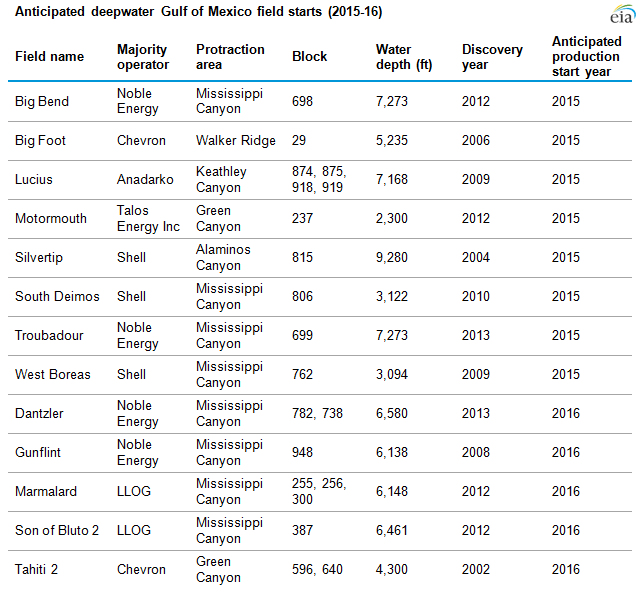
There are sound reasons to think that next year's graph may look quite different, starting with oil. The petroleum industry is still in turmoil from its turning point in late 2014, when OPEC declined to cut its output quota to restore the global oil market to balance. In North America and much of the world, drilling and investment in new projects are down sharply, and US oil production is retreating from the 44-year peak it reached in April. The subsequent decline would have been even more pronounced without the contribution of new deepwater platforms in the Gulf of Mexico that were planned long before oil prices fell.
However, anyone identifying 2015 as the start of a global shift away from oil, rather than another cyclical low point, must contend with some contrary statistics. Global oil demand appears to have increased by around 2%--equivalent to the output of Nigeria--in response to a 70% drop in oil prices. And despite a lot of media attention, electric vehicles--the leading contender to replace the internal-combustion cars that are the main users of refined oil--have yet to catch on with mainstream consumers.
Based on data from Hybridcars.com, US sales of battery-electric vehicles (EVs) grew slightly faster than the 6% pace of the entire US car market in 2015 but still accounted for less than 0.5% of all new cars. In fact, the combined US market share of hybrids, plug-in hybrids and battery EVs fell by 18%, compared to 2014, to below 3%. This is a respectable start for vehicle electrification, but it's not much different from the beachhead that hybrids alone occupied in 2009.
Although we might look back on this situation in a few years as a turning point, I believe that will depend on the condition of OPEC and the global oil industry, as well as the level of global oil consumption, when supply and demand come back into balance and today's high oil inventories are drawn down.
At the launch of API's latest State of American Energy report earlier this month I had the opportunity to ask Jack Gerard, the President and CEO of API, how he thought the current situation might change the oil and gas industry, and whether it would push it even farther towards shale development, including outside the US. His response focused on ensuring that policies will allow US producers to compete globally and build on the advantages of US resources, capital markets and rule of law to increase their share of the market.
As for US natural gas production, rising per-well productivity and growth in the Utica shale and Permian Basin offset less drilling in general and output declines in the Marcellus shale and elsewhere. The continued expansion of gas is remarkable, considering that natural gas futures prices (front month) averaged just $ 2.63 per million BTUs for the year and dipped below $2 in December. The LNG exports set to begin this month look very timely.
Renewable energy, mainly in the form of wind and solar power, continues to grow rapidly as its costs decline. US renewables got an unexpected boost in December when the US Congress extended the two main federal tax credits for wind, solar and other technologies, including retroactively reinstating the lapsed wind Production Tax Credit (PTC). Renewables should also benefit from the implementation of the EPA's Clean Power Plan, and from the effect of the Paris climate agreement on the investment climate for these technologies.
We may not know for years whether the Paris Agreement was truly a turning point for climate change, as many have suggested. Another prescriptive agreement with legally binding targets, along the lines of the Kyoto Protocol, was never in the cards. However, the Paris text is replete with tentative verbs, along the lines of, "requests, invites, recognizes, aims, takes note, encourages, welcomes, etc. " It remains up to the participating countries whether and how they fulfill their voluntary Intended Nationally Determined Contributions and financial commitments.
The Paris Agreement could turn out to be the necessary framework for firm steps by both developed and developing countries to reduce emissions and adapt to climatic changes that are already "baked in", or it might shortly be overtaken by other events, as previous climate change measures were in the aftermath of the 2008 financial crisis. The current financial problems of the world's largest emitter of greenhouse gases--arguably the most important signatory to the Paris Agreement--are not a positive signal.
With so many uncertainties in play, we should consider all of these potential turning points as signposts of changes that depend on other interconnected factors, if they are to lead to a future that breaks with the status quo. There are enough of them to make for a very interesting 2016, even if this wasn't also a US presidential election year.
A different version of this posting was previously published on the website of Pacific Energy Development Corporation.
Monday, January 11, 2016
Cheapest Gasoline Ever?
Last week the Energy Information Administration (EIA) reported that the $2.43 per gallon average US retail price for regular gasoline in 2015 was the lowest since 2009. A quick look at the EIA's handy page for comparing nominal and real fuel prices over time shows that last year's average, when adjusted for inflation, was actually the cheapest since 2004. A recent article suggested that current prices are lower than those in the mid-1960s, in the heyday of the American love affair with driving. I've lost the link, but that factoid checks out, too. However, even this understates the bargain currently on offer at the gas pump.
The price of gasoline is still one of the most visible prices in the US, prominently displayed on gas station signage and roadside billboards across the country. However, it only captures one aspect of how much motorists really pay, just as measuring fuel economy in miles per gallon misses the economic impact of driving. A few years ago I ran across a metric that combines these factors into a simple gauge of driving cost: miles per dollar, or mp$.
The chart below incorporates EIA data on inflation-adjusted fuel cost and data from the National Highway Transportation Safety Agency (NHTSA) on actual fleet corporate average fuel economy (CAFE) performance for each model year of passenger cars--not SUVs or light trucks--to display average mp$ for the last four decades.

Taking last week's average price of $2.03 for unleaded regular and using 36.4 mpg for the 2013 model year (the latest on NHTSA's site), today's fuel cost of driving is cheaper than at any time since 1978--and maybe ever. The 18 miles per dollar I calculated just beats the previous peak of mp$ in the late 1990s, when fuel economy was around 28 mpg and gas prices averaged barely over $1, due to the effects of the Asian Economic Crisis. By comparison, the $0.31 per gallon that motorists paid in 1965 was downright expensive, after adjusting for inflation and factoring in the low-to-mid-teens fuel economy of cars of the day.
Miles per dollar is also handy for comparing driving cost on gasoline to the cost of operating vehicles that use other fuels or electricity. When I first looked at miles per dollar in 2008, electric vehicles were significantly cheaper, per mile driven, than cars running on gasoline or diesel, even hybrid cars like the Prius. That gap still exists, but it has narrowed. At an US average residential electricity price of $0.126/kilowatt-hour last year, a Nissan Leaf or Chevrolet Volt would get around 26 mp$. However, in New England and other parts of the country with significantly higher-than-average electricity prices, the miles of driving that an EV can deliver per dollar of energy used could be less than that for gasoline in some locations.
A few caveats are in order. Based on data from the Transportation Research Institute at the University of Michigan, new-car fuel economy has slipped 0.8 mpg since oil prices started falling in the summer of 2014. And in any case, new cars are typically more efficient than the entire US car fleet, which includes older vehicles and substantial numbers of SUVs and light trucks. The Consumer Price Index is also an imperfect tool for comparing prices over long periods of time, because the Bureau of Labor Statistics periodically changes the components of the "basket" of goods and services that go into calculating the CPI.
None of those issues seems big enough to alter the basic conclusion that the gasoline cost of driving is exceptionally, perhaps historically cheap at the moment. If oil prices stay "lower for longer", as some experts expect, changing the make-up--and thus the emissions--of the US car fleet is likely to be an uphill battle.
The price of gasoline is still one of the most visible prices in the US, prominently displayed on gas station signage and roadside billboards across the country. However, it only captures one aspect of how much motorists really pay, just as measuring fuel economy in miles per gallon misses the economic impact of driving. A few years ago I ran across a metric that combines these factors into a simple gauge of driving cost: miles per dollar, or mp$.
The chart below incorporates EIA data on inflation-adjusted fuel cost and data from the National Highway Transportation Safety Agency (NHTSA) on actual fleet corporate average fuel economy (CAFE) performance for each model year of passenger cars--not SUVs or light trucks--to display average mp$ for the last four decades.

Taking last week's average price of $2.03 for unleaded regular and using 36.4 mpg for the 2013 model year (the latest on NHTSA's site), today's fuel cost of driving is cheaper than at any time since 1978--and maybe ever. The 18 miles per dollar I calculated just beats the previous peak of mp$ in the late 1990s, when fuel economy was around 28 mpg and gas prices averaged barely over $1, due to the effects of the Asian Economic Crisis. By comparison, the $0.31 per gallon that motorists paid in 1965 was downright expensive, after adjusting for inflation and factoring in the low-to-mid-teens fuel economy of cars of the day.
Miles per dollar is also handy for comparing driving cost on gasoline to the cost of operating vehicles that use other fuels or electricity. When I first looked at miles per dollar in 2008, electric vehicles were significantly cheaper, per mile driven, than cars running on gasoline or diesel, even hybrid cars like the Prius. That gap still exists, but it has narrowed. At an US average residential electricity price of $0.126/kilowatt-hour last year, a Nissan Leaf or Chevrolet Volt would get around 26 mp$. However, in New England and other parts of the country with significantly higher-than-average electricity prices, the miles of driving that an EV can deliver per dollar of energy used could be less than that for gasoline in some locations.
A few caveats are in order. Based on data from the Transportation Research Institute at the University of Michigan, new-car fuel economy has slipped 0.8 mpg since oil prices started falling in the summer of 2014. And in any case, new cars are typically more efficient than the entire US car fleet, which includes older vehicles and substantial numbers of SUVs and light trucks. The Consumer Price Index is also an imperfect tool for comparing prices over long periods of time, because the Bureau of Labor Statistics periodically changes the components of the "basket" of goods and services that go into calculating the CPI.
None of those issues seems big enough to alter the basic conclusion that the gasoline cost of driving is exceptionally, perhaps historically cheap at the moment. If oil prices stay "lower for longer", as some experts expect, changing the make-up--and thus the emissions--of the US car fleet is likely to be an uphill battle.
Tuesday, December 29, 2015
Has OPEC Lost Control of the Price of Oil?
- The shale revolution effectively sidelined OPEC's control over global oil prices, but the consequences of a year of low prices are shifting power back to the cartel.
That reputation was established during the twin oil crises of the 1970s. US oil production peaked in late 1970, and to the extent there was then a global oil market, the key influence in setting its supply--and thus prices--passed from the Texas Railroad Commission to OPEC, which had been around since 1960. From 1972 to 1980, the nominal price of a barrel of oil imported from the Persian Gulf increased roughly ten-fold, with disastrous effects on the global economy.
Just a few years later, however, oil prices collapsed. OPEC's control was undermined by new non-OPEC production from places like the North Sea and Alaskan North Slope and a remarkable 10% contraction in global oil demand. The turning point came in 1985. Saudi Arabia, which had successively cut its output from 10 million barrels per day (MBD) in 1981 to just 3.6 MBD, introduced "netback pricing" as a way to protect and recover market share.
That move helped set up nearly 20 years of moderate oil prices, during which OPEC's most successful intervention came in response to the Asian Economic Crisis of the late 1990s, when together with Mexico, Norway, Oman and Russia, it sharply curtailed production to pull the oil market out of a tailspin.
The proponents of today's "lower for longer" view of oil prices may see compelling parallels in the circumstances of the mid-1980s, compared to today's. Production from new sources, mainly US "tight oil" from shale, has created another global oil surplus. In the 1980s nuclear power and coal were pushing oil out of its established role in power generation. Now, renewables and electricity are beginning to erode oil's share of transportation energy, while the slowdown of China's economic growth and concerns about CO2 emissions raise doubts about the future growth of oil demand.
However, these similarities break down on some fundamental points. First, the production profile of shale wells is radically different from that of large, conventional onshore oil fields or offshore platforms. Once drilled, the latter produce at substantial rates for decades, while tight oil wells may deliver two-thirds of their lifetime output in just the first three years of operation. Sustaining shale production requires continuous drilling. In fact, new non-shale projects similar to the ones that underpinned oil-price stability from 1986-2003 make up the bulk of the $200 billion of industry investment that has reportedly been cancelled in response to the current price slump.
Another major difference relates to spare capacity. During most of the 1980s and '90s, OPEC maintained significant spare oil production capacity, much of it in Saudi Arabia. That wasn't necessarily by choice, but it was what enabled OPEC to absorb the loss of around 3.5 MBD from Kuwait and Iraq in 1990-91 while continuing to meet the needs of a growing global market. The virtual disappearance of that spare capacity was a key trigger of the oil price spike of 2004-8. (See chart below.) A little-discussed consequence of OPEC's current strategy to maintain, and in the case of Saudi Arabia to increase output has been a decline in OPEC's effective spare capacity, to just over 2 MBD, compared to 3.5 MBD in the spring of 2014.

As a result, global spare oil production capacity is essentially shifting from Saudi Arabia, which historically was willing to tap it to alleviate market disruptions, to Iran, Iraq and US shale. The responsiveness of all of these is subject to large uncertainties. Iran's production capacity has atrophied under sanctions, and it isn't clear how quickly it can ramp back up once sanctions are fully lifted. Iraq's capacity and output have increased rapidly, but key portions are threatened by ISIS.
Meanwhile, US tight oil production is falling, although numerous wells have been drilled but not completed, presumably enabling them to be brought online quickly, later--perhaps mimicking spare capacity. How that would work in practice remains to be seen. One uncertainty that was recently resolved was whether such oil could be exported from the US. As part of its recent budget compromise, Congress voted to lift the 1970s-vintage oil export restrictions. Even with US oil exports as a potential stabilizing factor, a world of lower or more uncertain spare capacity is likely be a world of higher and more volatile oil prices.
Oil prices were largely unshackled from OPEC's influence last year, after Saudi Arabia engineered a new OPEC strategy aimed at maximizing market share. However, with oil demand continuing to grow and millions of barrels per day of future non-OPEC production having been canceled--and unlikely to be reinstated any time soon--and with OPEC's spare capacity approaching its low levels of the mid-2000s, the potential price leverage of a cut in OPEC's output quota is arguably greater than it has been in some time.
Meanwhile, US tight oil production is falling, although numerous wells have been drilled but not completed, presumably enabling them to be brought online quickly, later--perhaps mimicking spare capacity. How that would work in practice remains to be seen. One uncertainty that was recently resolved was whether such oil could be exported from the US. As part of its recent budget compromise, Congress voted to lift the 1970s-vintage oil export restrictions. Even with US oil exports as a potential stabilizing factor, a world of lower or more uncertain spare capacity is likely be a world of higher and more volatile oil prices.
Oil prices were largely unshackled from OPEC's influence last year, after Saudi Arabia engineered a new OPEC strategy aimed at maximizing market share. However, with oil demand continuing to grow and millions of barrels per day of future non-OPEC production having been canceled--and unlikely to be reinstated any time soon--and with OPEC's spare capacity approaching its low levels of the mid-2000s, the potential price leverage of a cut in OPEC's output quota is arguably greater than it has been in some time.
In 2016 we will see whether OPEC finally pulls that trigger, or instead chooses to remain on a "lower for longer" path that raises big questions about the long-term aims of its biggest producers.
A different version of this posting was previously published on the website of Pacific Energy Development Corporation
Wednesday, December 16, 2015
A Grand Compromise on Energy?
The idea of a Congressional "grand compromise" on energy has been debated for years. A decade ago, such an agreement might have opened up access for drilling in the Arctic National Wildlife Refuge, in exchange for "cap and trade" or some other comprehensive national greenhouse gas emissions policy. By comparison, the deal apparently included in the 2016 spending and tax bill is small beer but still worthwhile: In exchange for lifting the outdated restrictions on exporting US crude oil, Congress will respectively revive and extend tax credits for wind and solar power.
Anticipation about the prospect of US oil exports seemed higher last year, when production was growing rapidly and threatening to outgrow the capacity of US oil refineries to handle the volumes of high-quality "tight oil" flowing from shale deposits. Just this week Michael Levi of the Council on Foreign Relations, citing a study by the Energy Information Administration, suggested that allowing such exports might now be nearly inconsequential in most respects.
Although little additional oil may flow in the short term, given the current global surplus, it's worth recalling that the gap between domestic and international oil prices hasn't always been as narrow as it is today. The discount for West Texas Intermediate relative to UK Brent crude has averaged around $4 per barrel this year, but within the last three years it has been as wide as $15-20. Oil traders will tell you that average differentials between markets are essentially irrelevant. What counts is the windows when those gaps widen, during which a lot of cargoes can move in short periods.
No matter how much or little US oil is ultimately exported, and how much additional production the lifting of the export ban will actually stimulate, the bigger impact on the global oil market is likely to be psychological. Having to find new outlets for oil shipped from West Africa, for example, because US refiners are processing more US crude and importing less from elsewhere is one thing; having to compete directly with cargoes of US oil is going to be quite another. That's where US consumers will benefit in the long run, from lower global oil prices that translate into lower prices at the gas pump.
Finally, if OPEC can choose to cease acting like a cartel--at least for the moment--and treat crude oil as a normal market, then it's timely for the US to follow suit and end an oil export ban that originated in the same 1970s oil crisis that put OPEC on the map.
How about the other side of this deal? What do we get for retroactively reinstating the expired wind production tax credit (PTC), along with extending the 30% solar tax credit that would have expired at the end of next year?
We'll certainly get more wind farms, along with some stability for an industry that has been whipsawed by past expirations and last-minute extensions of a tax credit that has been a major driver of new installations throughout its 20+ year history. Wind energy accounted for 4.4% of US grid electricity in the 12 months through September, up from a little over 1% in 2008.
However, this tax credit isn't cheap . The 4,800 Megawatts of new wind turbines installed in 2014 will receive a total of nearly $2.5 billion in subsidies--equivalent to around $19 per barrel--during the 10 years in which they will be eligible for the PTC, and 2015's additions are on track to beat that. The PTC is also the policy that enables wind power producers in places like Texas to sell electricity at prices below zero--still pocketing the 2.3¢ per kilowatt-hour (kWh) tax credit--distorting wholesale electricity markets and capacity planning.
As for solar power, it's not obvious that the tax credit extension was necessary at all, in light of the rapid decline in the cost of solar photovoltaic energy (PV). In any case, because the tax credit for solar is calculated as a percentage of installed cost, rather than a fixed subsidy per kWh of output like for wind, the technology's progress has provided an inherent phaseout of the dollar benefit. Solar's rapid growth seems likely to continue, with or without the tax credit.
The big missed opportunity from a clean energy and climate perspective is that these tax credit extensions channel billions of dollars to technologies that, at least in the case of wind, are essentially mature and widely regarded as inadequate to support a large-scale, long-term transition to low-emission energy. I would have preferred to see these federal dollars targeted to help incubate new energy technologies, along the lines of the Breakthrough Energy Coalition announced by Bill Gates and other high-tech leaders at the Paris climate conference.
The current deal, embedded within a $1.6 trillion "omnibus" spending bill, must still pass the Congress and be signed by the President. It won't please everyone, but it is at least consistent with the "all of the above" approach that has been our de facto energy strategy, at least since 2012. It also serves as a reminder that despite the commitments at Paris to reduce emissions of CO2 and other greenhouse gases, renewable energy will of necessity coexist with oil and gas for many years to come.
Anticipation about the prospect of US oil exports seemed higher last year, when production was growing rapidly and threatening to outgrow the capacity of US oil refineries to handle the volumes of high-quality "tight oil" flowing from shale deposits. Just this week Michael Levi of the Council on Foreign Relations, citing a study by the Energy Information Administration, suggested that allowing such exports might now be nearly inconsequential in most respects.
Although little additional oil may flow in the short term, given the current global surplus, it's worth recalling that the gap between domestic and international oil prices hasn't always been as narrow as it is today. The discount for West Texas Intermediate relative to UK Brent crude has averaged around $4 per barrel this year, but within the last three years it has been as wide as $15-20. Oil traders will tell you that average differentials between markets are essentially irrelevant. What counts is the windows when those gaps widen, during which a lot of cargoes can move in short periods.
No matter how much or little US oil is ultimately exported, and how much additional production the lifting of the export ban will actually stimulate, the bigger impact on the global oil market is likely to be psychological. Having to find new outlets for oil shipped from West Africa, for example, because US refiners are processing more US crude and importing less from elsewhere is one thing; having to compete directly with cargoes of US oil is going to be quite another. That's where US consumers will benefit in the long run, from lower global oil prices that translate into lower prices at the gas pump.
Finally, if OPEC can choose to cease acting like a cartel--at least for the moment--and treat crude oil as a normal market, then it's timely for the US to follow suit and end an oil export ban that originated in the same 1970s oil crisis that put OPEC on the map.
How about the other side of this deal? What do we get for retroactively reinstating the expired wind production tax credit (PTC), along with extending the 30% solar tax credit that would have expired at the end of next year?
We'll certainly get more wind farms, along with some stability for an industry that has been whipsawed by past expirations and last-minute extensions of a tax credit that has been a major driver of new installations throughout its 20+ year history. Wind energy accounted for 4.4% of US grid electricity in the 12 months through September, up from a little over 1% in 2008.
However, this tax credit isn't cheap . The 4,800 Megawatts of new wind turbines installed in 2014 will receive a total of nearly $2.5 billion in subsidies--equivalent to around $19 per barrel--during the 10 years in which they will be eligible for the PTC, and 2015's additions are on track to beat that. The PTC is also the policy that enables wind power producers in places like Texas to sell electricity at prices below zero--still pocketing the 2.3¢ per kilowatt-hour (kWh) tax credit--distorting wholesale electricity markets and capacity planning.
As for solar power, it's not obvious that the tax credit extension was necessary at all, in light of the rapid decline in the cost of solar photovoltaic energy (PV). In any case, because the tax credit for solar is calculated as a percentage of installed cost, rather than a fixed subsidy per kWh of output like for wind, the technology's progress has provided an inherent phaseout of the dollar benefit. Solar's rapid growth seems likely to continue, with or without the tax credit.
The big missed opportunity from a clean energy and climate perspective is that these tax credit extensions channel billions of dollars to technologies that, at least in the case of wind, are essentially mature and widely regarded as inadequate to support a large-scale, long-term transition to low-emission energy. I would have preferred to see these federal dollars targeted to help incubate new energy technologies, along the lines of the Breakthrough Energy Coalition announced by Bill Gates and other high-tech leaders at the Paris climate conference.
The current deal, embedded within a $1.6 trillion "omnibus" spending bill, must still pass the Congress and be signed by the President. It won't please everyone, but it is at least consistent with the "all of the above" approach that has been our de facto energy strategy, at least since 2012. It also serves as a reminder that despite the commitments at Paris to reduce emissions of CO2 and other greenhouse gases, renewable energy will of necessity coexist with oil and gas for many years to come.
Subscribe to:
Posts (Atom)