An editorial in this morning's Wall St. Journal reminded me that I had intended to update my readers on the latest installment in the ongoing saga concerning the global land-use impact of biofuels. The Journal's comments referred to a paper in the latest issue of Science entitled, "Fixing a Critical Climate Accounting Error", which concludes that the manner in which the greenhouse gas impacts of biofuels are currently assessed fails to account for significant emissions that occur outside the envelope normally drawn around an ethanol or biodiesel plant and the farms that supply it with feedstock. And if that omission weren't glaring enough, in the course of preparing for a meeting tomorrow I ran across another instance in which regulators appear to be turning a blind eye to the full impact of another popular option for addressing climate change, electric vehicles. As we prepare to re-orient our entire economy around the restrictions embodied in pending climate legislation, it is essential that we account for all of the emissions involved in a consistent way, and on a scale matching the global environmental problem we're trying to solve. This is crucial to making real progress on reducing emissions, rather than just making us all feel good about what we are doing.
When the emailed table of contents for the October 23 issue of Science showed up in my inbox last Friday, I spotted the name of Timothy Searchinger of Princeton University as lead author of the paper cited by the Journal today. Dr. Searchinger was also the lead author of an earlier paper in Science that I highlighted last February, when the debate concerning the global land-use implications of corn ethanol was just getting underway. Dr. Searchinger's collaborators on the new paper are an impressive bunch, including Dr. Dan Kammen, the director of the Renewable and Appropriate Energy Laboratory at U.C. Berkeley.
The report provides further evidence that it's no longer appropriate to assume that just because the carbon embodied in biofuels such as ethanol originated in green plants that absorbed it from the atmosphere, they must therefore be "carbon neutral"--other than the emissions from fossil fuels used in the cultivation, harvesting and transportation of the crops from which they are produced, along with the energy used in their processing. Additional emissions apparently result from the global displacement of the crops turned into energy here, and in some cases those emissions are on a similar order of magnitude to the direct emissions from the combustion of the biofuels--combustion that has gotten a free pass until now.
This is a highly inconvenient result for those engaged in the production of biofuels from food crops, on two levels. First, it puts the climate change justification for the subsidies and mandates responsible for the rapid ramp-up of conventional biofuel production in question. Second, the source of this doubt is no less than one of the same scientific journals in which so much of the peer-reviewed science contributing to the oft-cited scientific consensus on climate change has appeared, and subject to the same level of scientific scrutiny. Casting doubt on the source of this unwelcome message thus risks casting doubt on the entire edifice upon which the current, much-expanded biofuel endeavor rests.
Let's be clear that I don't blame the biofuel industry for promoting a product that many thought would help, but may ultimately turn out to do little or nothing to reduce the greenhouse gas emissions implicated in climate change, any more than we should blame the producers and consumers of fossil fuels for their contribution to the accumulation of those gases before the current consensus on climate change emerged. (I confess that I regard attempts to portray that consensus as having existed as long as 40 years ago as the worst kind of revisionism, since the creation of the consensus depended not on a few key insights, which might have turned out to be wrong, but on mounting evidence from the steady accumulation of peer-reviewed research during that interval.)
Having said that, I have a much harder time understanding the inclusion of an equally serious--and apparently entirely conscious--omission in the new automotive fuel economy and emissions standards jointly developed by the Environmental Protection Agency and the Department of Transportation. I had occasion to browse through the agencies' proposed text (warning: large file) yesterday and was startled to see that for purposes of calculating carmakers' fleet CO2 emission averages, it assumes that electric vehicles (EVs) and the electric usage of plug-in hybrids (PHEVs) have zero lifecycle emissions. Not only that, but the proposed regulation would count each EV as if it replaced two other emitting cars: thus, zero GHG impact not once but twice. Even the authors admit that this is false, and here I must quote,
"EPA recognizes that for each EV that is sold, in reality the total emissions off-set relative to the typical gasoline or diesel powered vehicle is not zero, as there is a corresponding increase in upstream CO2 emissions due to an increase in the requirements for electric utility generation. However, for the time frame of this proposed rule, EPA is also interested in promoting very advanced technologies such as EVs which offer the future promise of significant reductions in GHG emissions, in particular when coupled with a broader context which would include reductions from the electricity generation. For the California Paley 1 program, California assigned EVs a CO2 performance value of 130 g/mile, which was intended to represent the average CO2 emissions required to charge an EV using representative CO2 values for the California electric utility grid."
But while I appreciate the agencies' rationalization that EVs and PHEVs might be counted as having zero emissions on a purely temporary basis in order to provide incentives for carmakers to accelerate their introduction, I'm also painfully aware that other such "temporary" measures have persisted long after the original justification for them had become obsolete--and here I can't help but think of the ethanol blending credit that is now in its 31st year.
Why do these loopholes in the way we tally greenhouse gas emissions matter enough for me to hammer away at them like this? Consider the proposed vehicle rules. By ignoring emissions that occur outside these vehicles, the government is discouraging carmakers from using less exotic technologies that might actually deliver comparable savings of fuel and emissions sooner, and at a lower cost to taxpayers and consumers. A conventional Toyota Prius hybrid running on gasoline emits only 10% more grams of CO2 per mile than California claims for an EV powered by its greener-than-average state electricity mix. Since the same number of batteries could equip many more Prius-type hybrids, at a much lower cost per car than for a full EV, the benefits of rushing EVs into production seem much less compelling at this point, particularly when the government is also subsidizing the purchasers of EVs and PHEVs to the tune of many thousands of dollars per car. That will amount to billions of dollars of extra subsidies for an incremental emissions benefit that might just be negative for an EV recharged using coal-fired power.
"Start as you mean to go on," goes the old saying. We know that whatever their energy security benefits and general hi-tech niftiness, EVs are not zero-emission vehicles, just as we now understand that it is likely that burning corn ethanol releases roughly the same level of greenhouse gases as the gasoline it is intended to replace. If cap & trade bills such as Waxman-Markey and Kerry-Boxer are to have any integrity as tools for achieving genuine reductions in the global greenhouse gas emissions behind global climate change, then we must count all the emissions from all sources, no matter how politically unpalatable that may be. EPA and DOT might do well to heed this advice, too, before establishing a new, impossible-to-revoke entitlement for the manufacturers of electric vehicles.
Thursday, October 29, 2009

Tuesday, October 27, 2009
Missing the Point on Energy and Jobs
Two emails I received yesterday delivered press releases from two organizations with very different agendas, both emphasizing the impact of energy on jobs. With US unemployment showing little response to the economic stimulus, the rebounding stock market, or the "green shoots" appearing in some sectors, it's understandable that companies, groups and even the government would want to play up the direct employment impact of key initiatives or policies. Yet when it comes to energy, I believe much of this effort misses the mark. Our employment goal for energy should not be to have as many people working in the energy sector as we can, but to have the most efficient and cost-effective energy sector possible, in order to promote job creation and retention in the rest of the economy, where the vast majority of jobs are found. Our decisions about energy policy should not depend on the creation of a few green jobs.
I'm hardly suggesting that energy jobs are insignificant or inconsequential. I've spent my entire career in energy, and I recommend it without hesitation as a field in which one's contributions can have a measurable impact on society, often with better remuneration than in many other pursuits. The Oil & Natural Gas Industry Labor-Management Committee isn't wrong to stand up for the millions of industry-related jobs at stake in the current Congressional debate on energy industry tax benefits, any more than Wind Capital Group is to highlight the 2,500 jobs associated with the supply-chain effects of their Lost Creek Wind Project. But as important as preserving or expanding energy-related jobs appears today, it is even more essential for the long-term interests of the country that we not obsess about this one aspect of energy, to the detriment of others that will affect overall US employment and international competitiveness long after the unemployment rate has returned to its normal range.
Putting this into perspective requires recalling that by its nature energy is a capital-intensive business, rather than a labor-intensive one. One way to gauge that is to look at the labor productivity of energy companies. The latest annual report of my former employer, Chevron, reveals that on average in 2008 its 61,675 employees each accounted for $4.3 million of revenue, resulting in nearly $700,000 of pre-tax net income (after covering their own salaries and all other expenses.) In the utility sector, the comparable figures for FPL Group were $1.1 million and $137,000, respectively. Even a small, rapidly-growing renewable technology firm such as First Solar enjoyed revenue and pre-tax profit per employee in 2008 of approximately $354,000 and $132,000, respectively. With its high labor productivity, the primary employment impact of energy occurs where it is consumed, not where it's produced, because energy is such a crucial input for so many sectors and the sine qua non of more than a few.
When legislation like the Kerry-Boxer climate bill, which includes many provisions that would make energy more expensive for consumers and businesses, is marketed as a jobs bill it merits a skeptical reception. Stimulating jobs in the 6-10% of the economy devoted to energy seems unlikely to compensate for the loss of jobs that would ensue throughout the broader economy, if climate legislation caused energy costs to soar. That may, however, be a necessary evil, and the question we should really be asking is not how many green jobs such legislation will create, but whether on balance its provisions are truly justified in order to address climate change--even if they resulted in a net loss of employment, as I strongly suspect they would. Unless the answer is an unequivocal yes, we could be setting our long-term energy policy on the basis of a metric that is only a minor contributor to either energy costs or total economic activity, for reasons that seem unlikely to stand the test of time.
I'm hardly suggesting that energy jobs are insignificant or inconsequential. I've spent my entire career in energy, and I recommend it without hesitation as a field in which one's contributions can have a measurable impact on society, often with better remuneration than in many other pursuits. The Oil & Natural Gas Industry Labor-Management Committee isn't wrong to stand up for the millions of industry-related jobs at stake in the current Congressional debate on energy industry tax benefits, any more than Wind Capital Group is to highlight the 2,500 jobs associated with the supply-chain effects of their Lost Creek Wind Project. But as important as preserving or expanding energy-related jobs appears today, it is even more essential for the long-term interests of the country that we not obsess about this one aspect of energy, to the detriment of others that will affect overall US employment and international competitiveness long after the unemployment rate has returned to its normal range.
Putting this into perspective requires recalling that by its nature energy is a capital-intensive business, rather than a labor-intensive one. One way to gauge that is to look at the labor productivity of energy companies. The latest annual report of my former employer, Chevron, reveals that on average in 2008 its 61,675 employees each accounted for $4.3 million of revenue, resulting in nearly $700,000 of pre-tax net income (after covering their own salaries and all other expenses.) In the utility sector, the comparable figures for FPL Group were $1.1 million and $137,000, respectively. Even a small, rapidly-growing renewable technology firm such as First Solar enjoyed revenue and pre-tax profit per employee in 2008 of approximately $354,000 and $132,000, respectively. With its high labor productivity, the primary employment impact of energy occurs where it is consumed, not where it's produced, because energy is such a crucial input for so many sectors and the sine qua non of more than a few.
When legislation like the Kerry-Boxer climate bill, which includes many provisions that would make energy more expensive for consumers and businesses, is marketed as a jobs bill it merits a skeptical reception. Stimulating jobs in the 6-10% of the economy devoted to energy seems unlikely to compensate for the loss of jobs that would ensue throughout the broader economy, if climate legislation caused energy costs to soar. That may, however, be a necessary evil, and the question we should really be asking is not how many green jobs such legislation will create, but whether on balance its provisions are truly justified in order to address climate change--even if they resulted in a net loss of employment, as I strongly suspect they would. Unless the answer is an unequivocal yes, we could be setting our long-term energy policy on the basis of a metric that is only a minor contributor to either energy costs or total economic activity, for reasons that seem unlikely to stand the test of time.
Friday, October 23, 2009
Sequestration and Education
Yesterday afternoon I began scrutinizing the Senate climate bill, S.1733, widely referred to as the Kerry-Boxer bill. Like the Waxman-Markey bill that the House passed in June, the scope of Kerry-Boxer goes far beyond the establishment of an economy-wide cap & trade system for reducing greenhouse gas emissions, though at a comparatively skimpy 821 pages it has yet to acquire as much baggage as its counterpart accreted on its way to a floor vote. I was struck by the emphasis both bills place on carbon capture and sequestration (CCS), not just as a technology that receives significant support, but as the only viable pathway offered for new coal-fired power generation. However, as I looked through the provisions relating to permitting of sequestration sites and the innocuous-sounding section 812, "Performance Standards for New Coal-Fired Power Plants", I spotted a significant omission. There's nothing here to address what might constitute the largest non-technical barrier to implementing CCS. Public acceptance of it entails a significant educational effort on the efficacy and safety of this new technology. That will require going beyond the details of CCS to provide Americans a primer on basic geology.
The stakes are high. Despite recently losing some market share to natural gas and renewables, coal-fired power plants make up the single largest source of electricity in the US by a wide margin. In the 12 months through July, coal accounted for 46% of US power generation, compared with just 3% for non-hydro renewable energy. Short of simply shutting down every coal-fired power plant and leaving a gaping hole in our national electricity supply that the current generation of renewables can't yet fill, we need to find a way to control the emissions from coal directly. That's where CCS comes in. The coal power performance standards in Waxman-Markey and Kerry-Boxer would require that by no later than 2027 any new coal-fired power plants licensed after 1/1/09 must cut their net CO2 emissions by at least half. CCS looks like the only practical way of doing that--if you can call something that has been deployed so sparingly practical. But how can CCS be implemented if the public isn't willing to have CO2 stored underground anywhere?
CCS is new, but it's not so new that it hasn't already attracted pushback. Earlier this year Shell encountered significant opposition to injecting CO2 into a depleted gas field in the Netherlands. Meanwhile Vatenfall's project at Schwarze Pumpe in Germany is apparently venting its captured CO2 to the atmosphere, because the firm can't get a permit to inject it. "Not in My Ground", is how another article described opposition to carbon sequestration at an Ohio ethanol plant. My Google search even turned up a blog entitled, "Citizens Against CO2 Sequestration." Aside from the technical challenges associated with separating, transporting and injecting CO2 into geological storage sites, do these opponents have a scientific basis for being concerned about the health and safety risks? Perhaps, though an article on the subject cited by the Citizens Against blog that refers to the health hazards of drinking water mixed with CO2 had me rolling my eyes. Perhaps the author was unaware that hundreds of millions of us do that every day; we call it soda pop, and it's a big business.
Rather than dismissing all this as a simple case of uninformed NIMBYism (or as the Guardian newspaper in the UK referred to it, "numbyism", as in not under my back yard) I suspect it reflects a fundamental gap in the public's understanding of what lies beneath its feet. I simply cannot count the number of people I've encountered in the course of my long career in energy who were under the impression that oil was found as pools in giant underground caverns, rather than contained within tiny pores in solid rock strata. If most people so badly misunderstand the geological basis of a technology as established and commonplace as oil & gas drilling, how on earth can we expect them to have a coherent picture of what happens to CO2 when we pump it underground? Of course they're going to fear it could all come right back out and possibly asphyxiate them, in the manner of the volcanic CO2 seepage at Lake Nyos in Cameroon and elsewhere.
From my own perspective, the existence of enormous natural gas reservoirs--confusing terminology, perhaps--constitutes a sufficient proof of concept by demonstrating that gases can be stored safely underground for intervals as long as millions of years. If impermeable cap rock can seal in billions or trillions of cubic feet of methane, the molecular diameter of which is smaller than that of CO2, then once the CO2 is down there, the vast majority of it is going to stay there. But just as telling people that a flu vaccine is safe apparently leaves large numbers of them unconvinced, I conclude we need to invest a fair amount of time, attention and resources into educating the public about the science and safety of injecting CO2 under the ground, before we can base our national energy strategy on this technique.
The stakes are high. Despite recently losing some market share to natural gas and renewables, coal-fired power plants make up the single largest source of electricity in the US by a wide margin. In the 12 months through July, coal accounted for 46% of US power generation, compared with just 3% for non-hydro renewable energy. Short of simply shutting down every coal-fired power plant and leaving a gaping hole in our national electricity supply that the current generation of renewables can't yet fill, we need to find a way to control the emissions from coal directly. That's where CCS comes in. The coal power performance standards in Waxman-Markey and Kerry-Boxer would require that by no later than 2027 any new coal-fired power plants licensed after 1/1/09 must cut their net CO2 emissions by at least half. CCS looks like the only practical way of doing that--if you can call something that has been deployed so sparingly practical. But how can CCS be implemented if the public isn't willing to have CO2 stored underground anywhere?
CCS is new, but it's not so new that it hasn't already attracted pushback. Earlier this year Shell encountered significant opposition to injecting CO2 into a depleted gas field in the Netherlands. Meanwhile Vatenfall's project at Schwarze Pumpe in Germany is apparently venting its captured CO2 to the atmosphere, because the firm can't get a permit to inject it. "Not in My Ground", is how another article described opposition to carbon sequestration at an Ohio ethanol plant. My Google search even turned up a blog entitled, "Citizens Against CO2 Sequestration." Aside from the technical challenges associated with separating, transporting and injecting CO2 into geological storage sites, do these opponents have a scientific basis for being concerned about the health and safety risks? Perhaps, though an article on the subject cited by the Citizens Against blog that refers to the health hazards of drinking water mixed with CO2 had me rolling my eyes. Perhaps the author was unaware that hundreds of millions of us do that every day; we call it soda pop, and it's a big business.
Rather than dismissing all this as a simple case of uninformed NIMBYism (or as the Guardian newspaper in the UK referred to it, "numbyism", as in not under my back yard) I suspect it reflects a fundamental gap in the public's understanding of what lies beneath its feet. I simply cannot count the number of people I've encountered in the course of my long career in energy who were under the impression that oil was found as pools in giant underground caverns, rather than contained within tiny pores in solid rock strata. If most people so badly misunderstand the geological basis of a technology as established and commonplace as oil & gas drilling, how on earth can we expect them to have a coherent picture of what happens to CO2 when we pump it underground? Of course they're going to fear it could all come right back out and possibly asphyxiate them, in the manner of the volcanic CO2 seepage at Lake Nyos in Cameroon and elsewhere.
From my own perspective, the existence of enormous natural gas reservoirs--confusing terminology, perhaps--constitutes a sufficient proof of concept by demonstrating that gases can be stored safely underground for intervals as long as millions of years. If impermeable cap rock can seal in billions or trillions of cubic feet of methane, the molecular diameter of which is smaller than that of CO2, then once the CO2 is down there, the vast majority of it is going to stay there. But just as telling people that a flu vaccine is safe apparently leaves large numbers of them unconvinced, I conclude we need to invest a fair amount of time, attention and resources into educating the public about the science and safety of injecting CO2 under the ground, before we can base our national energy strategy on this technique.
Wednesday, October 21, 2009
The Weak Dollar
Oil prices have trended upward recently, spurring renewed speculation that only speculation could account for such a shift in the face of relatively weak fundamentals of supply and demand. It's certainly true that inventories of crude oil and refined products remain high, while demand is still well below the levels of just a couple of years ago, and OPEC is sitting on millions of barrels per day of spare capacity that could be deployed quickly if consumption spiked. But although it can't account for 100% of recent price movements, one factor stands out for its contribution to oil's lurch towards $80 per barrel after months of stability around $70: the further weakening of the US dollar relative to the Euro and other strong currencies. The future path of the dollar will be determined by a complex set of factors, including the relationship between US and other nations' interest rates, trade balances, current inflation, and expectations of future inflation. However, it's worth noting that the dollar's recent deterioration is hardly anomalous; it is part of pattern going back decades.
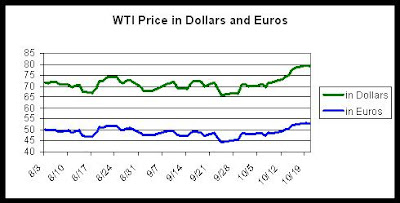

The above chart displays the price of West Texas Intermediate crude oil on the New York Mercantile Exchange since the beginning of August. I've added another line showing the same price in Euros, based on exchange rate data for the period. It's pretty clear that although oil priced in Euros has also been trending upward slightly, perhaps in response to reports that the global demand for other commodities is picking up--indicating that at least some parts of the world are recovering from the Great Recession--the recent upswing in oil prices looks much more muted than when expressed in dollars per barrel. That got me thinking about the long-term exchange rate trends, and where they might take us in the years ahead.
Having lived overseas and traveled extensively, I've been aware of exchange rates for most of my life. That's given me a clear perspective that the dollar isn't just weaker now than it was a few months ago or a couple of years ago, but has been deteriorating more-or-less steadily for a very long time. From my childhood I can recall when a dollar was worth roughly four Deutschmarks, and even my father's salary as a junior Army officer went pretty far on the local economy. As an adult I worked in Germany for a few months in the early 1980s, when a buck still bought more than 2 Marks. With the Deutschmark having been subsumed into the Euro, with its extremely short and volatile history, it's easy to lose sight of the dollar's gradual slippage, which has resulted in an equivalent Deutschmark/Dollar rate today of 1.30:1. Fully appreciating this trend requires examining the longer history of exchange rates between the dollar and more stable currencies such as the Deutschmark and the Swiss Franc, which is now trading at virtual parity with the greenback. It's not a pretty picture, and it has significant implications for a country with such large structural import requirements, not just for energy, but for so many other products.
While I'm not advocating a return to the gold standard or even necessarily dismissing the benefits that a weaker dollar has provided at times, I find the long and bumpy, but nevertheless steadily-downward slope of the dollar's value worrisome. Moreover, it's hard to see what could stem this trend in the near term, with the federal government committed out of necessity to holding short-term interest rates at essentially zero to avoid putting the economy back into a tailspin, while other countries still offer positive interest rates and some have even raised them slightly. Nor do trillion-dollar fiscal deficits seem conducive to a stronger dollar any time soon. What would dollar-denominated oil prices do if the dollar continued to fall past $1.50 per Euro toward the 2:1 level, all other things being equal? $100/bbl probably isn't a bad guess, along with everything else that goes with it.
Having lived overseas and traveled extensively, I've been aware of exchange rates for most of my life. That's given me a clear perspective that the dollar isn't just weaker now than it was a few months ago or a couple of years ago, but has been deteriorating more-or-less steadily for a very long time. From my childhood I can recall when a dollar was worth roughly four Deutschmarks, and even my father's salary as a junior Army officer went pretty far on the local economy. As an adult I worked in Germany for a few months in the early 1980s, when a buck still bought more than 2 Marks. With the Deutschmark having been subsumed into the Euro, with its extremely short and volatile history, it's easy to lose sight of the dollar's gradual slippage, which has resulted in an equivalent Deutschmark/Dollar rate today of 1.30:1. Fully appreciating this trend requires examining the longer history of exchange rates between the dollar and more stable currencies such as the Deutschmark and the Swiss Franc, which is now trading at virtual parity with the greenback. It's not a pretty picture, and it has significant implications for a country with such large structural import requirements, not just for energy, but for so many other products.
While I'm not advocating a return to the gold standard or even necessarily dismissing the benefits that a weaker dollar has provided at times, I find the long and bumpy, but nevertheless steadily-downward slope of the dollar's value worrisome. Moreover, it's hard to see what could stem this trend in the near term, with the federal government committed out of necessity to holding short-term interest rates at essentially zero to avoid putting the economy back into a tailspin, while other countries still offer positive interest rates and some have even raised them slightly. Nor do trillion-dollar fiscal deficits seem conducive to a stronger dollar any time soon. What would dollar-denominated oil prices do if the dollar continued to fall past $1.50 per Euro toward the 2:1 level, all other things being equal? $100/bbl probably isn't a bad guess, along with everything else that goes with it.
Monday, October 19, 2009
"Feeding Frenzy"
An article in today's New York Times offers more detail on the manner in which Congressional climate legislation has fractured the energy industry into competing groups of haves and have-nots, based on how companies and sectors were treated under the Waxman-Markey bill and their hopes for receiving a better deal in the pending Kerry-Boxer bill in the Senate. Not only has it fragmented utilities along the axis of their emissions intensity, but it has also opened gaps within the oil & gas industry between companies that produce primarily natural gas and those that produce or process mainly oil. I don't know whether the authors of Waxman-Markey saw this potential in their design for allocating emission allowances, though some supporters are bound to see it as a beneficial feature. I regard it as a worrying symptom of the distortions inflicted on the basic concept of cap & trade, which remains the best option for guiding the economy toward a lower-emission future, but now seems likely to underperform its potential in a very costly way, as a result of these flaws.
As recently as a couple of years ago, few energy companies were enthusiastic about the prospect of cap & trade, because it was bound to raise their costs and reduce demand for their output, at least from energy sources with substantial emissions of CO2 and other greenhouse gases. If the bill passed by the House had treated all emissions from all sectors equally--a level playing field--we'd still see visionary companies diverging from the industry's stance, but their numbers would probably be a lot fewer for the simple reason that there wouldn't be nearly as much financial gain in it for them. When no-nonsense companies like Exelon and several of its utility peers break ranks with the US Chamber of Commerce on this issue, it's a good bet that they see a direct strategic advantage that will put money in their shareholders' pockets. Simply put, this is as good a deal as they're going to get. But while I find their support of cap and trade perfectly rational and even laudable, it should by no means be read as a sign that the Waxman-Markey approach is the best means of addressing climate change.
As I've noted in previous postings, Waxman-Markey was excessively generous in handing out emission allowances to the electricity sector, at the expense of the transportation sector. It also lavished allowances on non-emitting sectors and favored causes and groups in lieu of cash--a form of largess that fundamentally undermines the accountability of these benefits, because no one knows or can know what they will be worth when they are eventually received. Yet although this is bad policy on many levels, I see many people holding their noses and supporting the W-M approach, because they conclude that once the free allocations have phased out in 2030, we'll be left with a more or less pure cap & trade system enforcing a steadily tightening cap on emissions. The problems with this thinking lie in the enormous distortions and unnecessary economic hardship those uneven allocations will create over the next 20-plus years and the opportunity cost of the emissions reductions that could have been achieved more quickly and cheaply.
My strong preference has been for an even-handed cap & trade system that would include the broadest possible collection of emissions sources, providing great diversity of abatement costs and thus great scope for emissions trading to minimize the cost of achieving our emission reduction goals, and with most of the proceeds rebated directly from the government to taxpayers. Unfortunately, the ship has sailed on that approach--at least for now--and anyone supporting cap & trade for the elegant simplicity of its mechanism for squeezing out emissions is left hoping that the legislative excesses of one chamber of Congress will cancel out those of the other, and that somehow two bad bills will beget a good one.
As recently as a couple of years ago, few energy companies were enthusiastic about the prospect of cap & trade, because it was bound to raise their costs and reduce demand for their output, at least from energy sources with substantial emissions of CO2 and other greenhouse gases. If the bill passed by the House had treated all emissions from all sectors equally--a level playing field--we'd still see visionary companies diverging from the industry's stance, but their numbers would probably be a lot fewer for the simple reason that there wouldn't be nearly as much financial gain in it for them. When no-nonsense companies like Exelon and several of its utility peers break ranks with the US Chamber of Commerce on this issue, it's a good bet that they see a direct strategic advantage that will put money in their shareholders' pockets. Simply put, this is as good a deal as they're going to get. But while I find their support of cap and trade perfectly rational and even laudable, it should by no means be read as a sign that the Waxman-Markey approach is the best means of addressing climate change.
As I've noted in previous postings, Waxman-Markey was excessively generous in handing out emission allowances to the electricity sector, at the expense of the transportation sector. It also lavished allowances on non-emitting sectors and favored causes and groups in lieu of cash--a form of largess that fundamentally undermines the accountability of these benefits, because no one knows or can know what they will be worth when they are eventually received. Yet although this is bad policy on many levels, I see many people holding their noses and supporting the W-M approach, because they conclude that once the free allocations have phased out in 2030, we'll be left with a more or less pure cap & trade system enforcing a steadily tightening cap on emissions. The problems with this thinking lie in the enormous distortions and unnecessary economic hardship those uneven allocations will create over the next 20-plus years and the opportunity cost of the emissions reductions that could have been achieved more quickly and cheaply.
My strong preference has been for an even-handed cap & trade system that would include the broadest possible collection of emissions sources, providing great diversity of abatement costs and thus great scope for emissions trading to minimize the cost of achieving our emission reduction goals, and with most of the proceeds rebated directly from the government to taxpayers. Unfortunately, the ship has sailed on that approach--at least for now--and anyone supporting cap & trade for the elegant simplicity of its mechanism for squeezing out emissions is left hoping that the legislative excesses of one chamber of Congress will cancel out those of the other, and that somehow two bad bills will beget a good one.
Thursday, October 15, 2009
Regulating EV Recharging
A feature on the New York Times website tipped me off to a debate that's brewing in California concerning whether and how the state's Public Utilities Commission (PUC) should regulate facilities and firms that will recharge the electric vehicles expected to dot California's roads within a few years. From my own experience in attempting to involve my former employer in the recharging infrastructure for the old GM EV-1 in the late 1990s, I knew this wouldn't be a simple matter, but I had little appreciation for the complexities that have emerged in the last decade. How this gets resolved will have enormous implications for automakers and incumbent utilities, as well as for start-ups such as Better Place that some would like to treat as regulated utilities.
The discussion with the PUC hinges on some very thorny questions: Is a company that buys electricity for resale to consumers for the purpose of recharging electric vehicles--which takes in both battery-electric vehicles and plug-in hybrids--more like a utility or a gasoline distributor or retailer? Who should pay for installing recharging facilities, and how--and from whom--should these parties recover their investment? Should a consumer who already uses large quantities of electricity at home and pays at the top rate tier, which can hit $0.40/kWh in some areas, qualify for discounted power to recharge an EV? How should a customer be billed when recharging outside the service area of the utility from which he normally buys power? The list of such questions is long, and looming behind them are larger questions about how best to gauge the effect of EV recharging on greenhouse gas emissions and air quality concerns, and to manage its impact on the regional generating mix, and on grid stability and reliability. Many EV advocates assume that EVs are inherently grid-stabilizing and renewable power-enabling, though it's not hard to construct scenarios in which the opposite could be equally true, if they're not implemented properly.
The emissions aspect becomes even more interesting in light of the views I saw expressed in a PUC filing by Tesla Motors, Inc., a Silicon Valley manufacturer of high-end electric sports cars that recently qualified for a half-billion dollars in low-interest expansion loans from the federal government. Tesla sees the generation of tradable credits under either cap & trade or the state's Low-Carbon Fuel Standard as a significant source of revenue for the owners of EV recharging facilities, and they might be right, though when I converted the federal estimates of emission allowance values under Waxman-Markey of around $15/ton of CO2 to cents per kilowatt-hour, using California's natural gas-dominated average generating mix, I came up with a value of less than a penny per kWh. I have to wonder how excited utilities will be to take on the cost and risk of putting in EV rechargers for such a small reward, if they can't also make a profit selling power to EV drivers.
The whole notion of regulating resellers of electricity to EVs as utilities also raises serious questions about the alternative business models now under consideration by companies such as Better Place. Would offering EV services on a cents-per-mile basis, rather than cents per kWh, be deemed sufficiently transparent, and would they have to negotiate their profit margins and investment recovery with the PUC? That sounds like a great way to make it harder for anyone new to the scene to compete with traditional utilities in this area.
Fairly soon the California PUC will resolve most of these questions and in the process largely define the environment in which EVs will emerge in the biggest early market for them in the US, potentially setting the standards for their use throughout the US and beyond. I don't have a horse in this race, but I will be watching the outcome with great interest.
The discussion with the PUC hinges on some very thorny questions: Is a company that buys electricity for resale to consumers for the purpose of recharging electric vehicles--which takes in both battery-electric vehicles and plug-in hybrids--more like a utility or a gasoline distributor or retailer? Who should pay for installing recharging facilities, and how--and from whom--should these parties recover their investment? Should a consumer who already uses large quantities of electricity at home and pays at the top rate tier, which can hit $0.40/kWh in some areas, qualify for discounted power to recharge an EV? How should a customer be billed when recharging outside the service area of the utility from which he normally buys power? The list of such questions is long, and looming behind them are larger questions about how best to gauge the effect of EV recharging on greenhouse gas emissions and air quality concerns, and to manage its impact on the regional generating mix, and on grid stability and reliability. Many EV advocates assume that EVs are inherently grid-stabilizing and renewable power-enabling, though it's not hard to construct scenarios in which the opposite could be equally true, if they're not implemented properly.
The emissions aspect becomes even more interesting in light of the views I saw expressed in a PUC filing by Tesla Motors, Inc., a Silicon Valley manufacturer of high-end electric sports cars that recently qualified for a half-billion dollars in low-interest expansion loans from the federal government. Tesla sees the generation of tradable credits under either cap & trade or the state's Low-Carbon Fuel Standard as a significant source of revenue for the owners of EV recharging facilities, and they might be right, though when I converted the federal estimates of emission allowance values under Waxman-Markey of around $15/ton of CO2 to cents per kilowatt-hour, using California's natural gas-dominated average generating mix, I came up with a value of less than a penny per kWh. I have to wonder how excited utilities will be to take on the cost and risk of putting in EV rechargers for such a small reward, if they can't also make a profit selling power to EV drivers.
The whole notion of regulating resellers of electricity to EVs as utilities also raises serious questions about the alternative business models now under consideration by companies such as Better Place. Would offering EV services on a cents-per-mile basis, rather than cents per kWh, be deemed sufficiently transparent, and would they have to negotiate their profit margins and investment recovery with the PUC? That sounds like a great way to make it harder for anyone new to the scene to compete with traditional utilities in this area.
Fairly soon the California PUC will resolve most of these questions and in the process largely define the environment in which EVs will emerge in the biggest early market for them in the US, potentially setting the standards for their use throughout the US and beyond. I don't have a horse in this race, but I will be watching the outcome with great interest.
Tuesday, October 13, 2009
The Necessity of "All of the Above"
I've devoted a lot of space in this blog to explaining why we need all of the energy choices currently available to us, including energy efficiency, in order for our economy to have the energy it needs to grow. Although we can't drill our way to energy independence, as some might wish, it's equally clear that the point at which renewable energy sources could enable us to dispense with fossil fuels is still a long ways off. I have no idea how many words I've written in service of this argument, but it's certainly many more than the clichéd 1,000:1 exchange rate vs. the picture that I suddenly realized I've never supplied. Today's posting is a modest attempt to rectify that omission: a simple graph showing how a significant shift in our energy consumption and production patterns might play out between now and 2020.

This picture starts with our total primary energy consumption in 2008 of 99.3 quadrillion BTUs (quads.) Nearly three-fourths of our needs, or 73.7 quads, were produced domestically by a mix of 79% coal, oil and natural gas, 11.5% nuclear power, and a bit over 3% hydropower. Non-hydro renewables--the wind, solar, geothermal and biomass power plus biofuels that constitute the primary focus of US energy policy today--made up the remaining 6.5% of domestic energy production. Now add the 26% of US energy consumption supplied by imports, mainly crude oil and petroleum products, and we have the breakdown shown at the left hand edge of the graph. The rest of the picture is the result of a highly simplified set of assumptions based on phasing out fossil fuels and replacing them with the non-hydro renewables that have been growing so rapidly. It ignores such important considerations as reliability and intermittency, compatibility with infrastructure, and turnover of vehicle fleets.
According to the Energy Information Agency's data, while wind and solar power have been growing at roughly 30% per year each, the total renewables category has been growing at a somewhat slower pace, even after separating out hydropower, which has actually declined significantly since the 1990s. While the average growth rate for all the non-hydro renewables since 2000 has been around 4%, I've more than doubled this for the purposes of my projection to 10%. Renewables would do very well to sustain that kind of pace over the next 11 years, because the bigger they get, the more capital they will require each year to add the next year's increment of growth, and the more hurdles they will face, particularly from NIMBY or "energy sprawl" concerns. 10% compound growth would see these renewables more than triple by 2020, providing plenty of room for biomass/biofuels to double and for wind and solar to double several successive times.
I've also assumed a steady improvement in energy efficiency of 1% per year. If that doesn't sound impressive, compare it against a pre-recession trend of 1% annual growth supporting population growth of around 0.7% and economic growth of 2-3%. 1%/yr. would reduce total energy consumption by almost 12% by 2020, reflecting an improvement in BTUs/$GDP over this interval on the order of around 35%. A recent study by McKinsey & Co. indicated that if the US invested $500 billion in energy efficiency, we could cut our energy consumption by 23% by 2020, so my view is only a little more conservative, reflecting my experience that such things tend to take a bit longer than we expect.
As for nuclear, I think we'll do well to maintain the output of the existing fleet without seeing retirements outweigh additions in this timeframe. Most of the new plants now being discussed would probably only affect the last couple of years of this scenario, in any case.
The biggest impact in the graph above comes from my assumption that domestic fossil fuel production would fall by 5% per year. That will probably seem extreme to some and timid to others. It certainly looks extreme in the context of the recent surge in natural gas production and the stable output of US coal mines. Even US oil production has staged a bit of a comeback recently, thanks to successes in the portions of the Gulf of Mexico where drilling is allowed. However, in the absence of strong sustained rates of oil and gas drilling--drilling that requires both access to resources and a supportive regulatory climate, neither of which appears to be forthcoming--these successes will fade and the high intrinsic decline rates of the mature US hydrocarbon basins would take over. And with new coal-fired power plants being canceled and older ones facing tough competition from gas turbines and renewable power, along with restrictions on practices such as "mountaintop mining" and the prospect of either a Congressionally-mandated or EPA-imposed cap on emissions, a decline in coal output would accompany drops in oil and gas.
All of these growth and decline rates working together produce the picture above, showing fossil fuels tailing off faster than renewables can backfill for some time. That results in net US energy imports growing through 2016, then tapering off gradually as renewables finally gather momentum, but with us arriving at 2020 even less energy independent than we are today. That outcome explains my strong conviction that it is premature for us to give up on the valuable contribution of domestic oil and gas, particularly when we take into account the form that most of those growing energy imports is likely to take: imported oil. Naturally, this is just one scenario among many--though I'd argue it's likelier than some--and it illustrates that no single solution, neither renewables, nor efficiency, nor even greatly expanded drilling, is likely to be capable of delivering the energy we will need without increasing our vulnerability to foreign energy suppliers. They must all work together, if we're to make meaningful progress toward greater energy self-reliance.
This picture starts with our total primary energy consumption in 2008 of 99.3 quadrillion BTUs (quads.) Nearly three-fourths of our needs, or 73.7 quads, were produced domestically by a mix of 79% coal, oil and natural gas, 11.5% nuclear power, and a bit over 3% hydropower. Non-hydro renewables--the wind, solar, geothermal and biomass power plus biofuels that constitute the primary focus of US energy policy today--made up the remaining 6.5% of domestic energy production. Now add the 26% of US energy consumption supplied by imports, mainly crude oil and petroleum products, and we have the breakdown shown at the left hand edge of the graph. The rest of the picture is the result of a highly simplified set of assumptions based on phasing out fossil fuels and replacing them with the non-hydro renewables that have been growing so rapidly. It ignores such important considerations as reliability and intermittency, compatibility with infrastructure, and turnover of vehicle fleets.
According to the Energy Information Agency's data, while wind and solar power have been growing at roughly 30% per year each, the total renewables category has been growing at a somewhat slower pace, even after separating out hydropower, which has actually declined significantly since the 1990s. While the average growth rate for all the non-hydro renewables since 2000 has been around 4%, I've more than doubled this for the purposes of my projection to 10%. Renewables would do very well to sustain that kind of pace over the next 11 years, because the bigger they get, the more capital they will require each year to add the next year's increment of growth, and the more hurdles they will face, particularly from NIMBY or "energy sprawl" concerns. 10% compound growth would see these renewables more than triple by 2020, providing plenty of room for biomass/biofuels to double and for wind and solar to double several successive times.
I've also assumed a steady improvement in energy efficiency of 1% per year. If that doesn't sound impressive, compare it against a pre-recession trend of 1% annual growth supporting population growth of around 0.7% and economic growth of 2-3%. 1%/yr. would reduce total energy consumption by almost 12% by 2020, reflecting an improvement in BTUs/$GDP over this interval on the order of around 35%. A recent study by McKinsey & Co. indicated that if the US invested $500 billion in energy efficiency, we could cut our energy consumption by 23% by 2020, so my view is only a little more conservative, reflecting my experience that such things tend to take a bit longer than we expect.
As for nuclear, I think we'll do well to maintain the output of the existing fleet without seeing retirements outweigh additions in this timeframe. Most of the new plants now being discussed would probably only affect the last couple of years of this scenario, in any case.
The biggest impact in the graph above comes from my assumption that domestic fossil fuel production would fall by 5% per year. That will probably seem extreme to some and timid to others. It certainly looks extreme in the context of the recent surge in natural gas production and the stable output of US coal mines. Even US oil production has staged a bit of a comeback recently, thanks to successes in the portions of the Gulf of Mexico where drilling is allowed. However, in the absence of strong sustained rates of oil and gas drilling--drilling that requires both access to resources and a supportive regulatory climate, neither of which appears to be forthcoming--these successes will fade and the high intrinsic decline rates of the mature US hydrocarbon basins would take over. And with new coal-fired power plants being canceled and older ones facing tough competition from gas turbines and renewable power, along with restrictions on practices such as "mountaintop mining" and the prospect of either a Congressionally-mandated or EPA-imposed cap on emissions, a decline in coal output would accompany drops in oil and gas.
All of these growth and decline rates working together produce the picture above, showing fossil fuels tailing off faster than renewables can backfill for some time. That results in net US energy imports growing through 2016, then tapering off gradually as renewables finally gather momentum, but with us arriving at 2020 even less energy independent than we are today. That outcome explains my strong conviction that it is premature for us to give up on the valuable contribution of domestic oil and gas, particularly when we take into account the form that most of those growing energy imports is likely to take: imported oil. Naturally, this is just one scenario among many--though I'd argue it's likelier than some--and it illustrates that no single solution, neither renewables, nor efficiency, nor even greatly expanded drilling, is likely to be capable of delivering the energy we will need without increasing our vulnerability to foreign energy suppliers. They must all work together, if we're to make meaningful progress toward greater energy self-reliance.
Friday, October 09, 2009
Meme Watch: Peak Demand
To whatever degree the oil price spike of 2007-8 was driven by speculation, the latter was riding on a wave of concern about Peak Oil, which anticipates an imminent decline in maximum global oil production. For the moment, the weak global economy has eased such worries, though they have hardly vanished, as I noted two months ago. Lately, however, conventional notions of Peak Oil are increasingly being challenged by a new meme, or contagious idea, called Peak Demand, which suggests that oil consumption is reaching a plateau from which it will soon decline, mitigating the worst consequences of Peak Oil. Neither of these memes would attract much interest if they weren't supported by a welter of statistics, however selective those might seem to their critics. And just as Peak Oil was much less credible and worrisome before we saw super-giant oil fields like Mexico's Cantarell go into precipitous decline, the logic of Peak Demand would have been much less compelling before US oil demand dropped by nearly 6% last year.
Earlier this week, a friend shared a copy of a report from Deutsche Bank Global Markets Research describing their view of the future oil market shaped by coinciding--and related--peaks in global oil supply and demand. Unfortunately, the report doesn't seem to be available on DB's public website, though it was recently summarized on the Wall St. Journal's Environmental Capital blog. While I spotted several possible weak points in their analysis, they make a strong case that the combination of improved efficiency and the electrification of vehicles will result in the global demand for oil stalling and eventually falling, roughly around the same time many analysts expect global oil supplies to peak.
Perhaps I was predisposed to accept this logic. My presentation on the Alternative Energy panel of the recent IHS Herold Pacesetters Energy Conference included a graph highlighting the ongoing compression of US petroleum gasoline demand between falling motor fuel consumption and rising biofuels supplies, a topic that was subsequently reported in the Journal's "Heard on the Street" column. At that same conference I also heard the Managing Director of CERA's Global Oil Group describe his firm's rigorously researched view of an impending peak in global oil demand. Peak Demand can't easily be dismissed as a "fringe" theory, because it is based on a combination of hard data and thoughtful analysis and forecasting.
My purpose in mentioning Peak Demand now isn't to debate its merits in depth; that's a matter for another day. Rather, on the basis of my conviction that there's at least a reasonable case for such an outcome, I thought I'd spend a moment musing on the consequences of the proliferation of this meme in the marketplace of ideas related to energy. After all, the Peak Demand meme challenges two key pieces of conventional wisdom about oil, one or both of which are central to the rate at which Peak Oil (supply) might be approaching. First, it undermines the notion that once the US economy finds its way back to meaningful growth, oil demand will resume its former trajectory, which had seen gasoline demand growing by 1-2% per year and diesel demand growing at an even faster pace. With a major new emphasis on miles per gallon and the demise of the SUV fad, the fuel economy of the total US car fleet doesn't need to improve by very much each year to outpace our underlying population growth and a modest resurgence in vehicle miles traveled. Secondly, the same dynamic might even hold true for large developing markets, if electric vehicle demand grew rapidly enough, undermining the notion that whatever happens in the US and EU, oil demand from China and India constitute an unstoppable juggernaut.
With spare global oil production capacity effectively used up by 2007, the logic of Peak Oil helped to provide the narrative support for an oil market that ran up from the low $50s to $145 per barrel in the course of 18 months. How different might a future oil price spike be, if instead of a widely-shared view that oil was on the verge of becoming truly scarce--rather than merely expensive--there were an equally widely-held expectation that in the long run that scarcity might become irrelevant as a result of the demand for the commodity gradually unwinding of its own accord? Such dueling memes, together with painful memories of oil's collapse down to $33 last winter, might give some traders pause, before again buying into the notion that $100 oil would soon give way to $200, $300, or $500 per barrel.
Earlier this week, a friend shared a copy of a report from Deutsche Bank Global Markets Research describing their view of the future oil market shaped by coinciding--and related--peaks in global oil supply and demand. Unfortunately, the report doesn't seem to be available on DB's public website, though it was recently summarized on the Wall St. Journal's Environmental Capital blog. While I spotted several possible weak points in their analysis, they make a strong case that the combination of improved efficiency and the electrification of vehicles will result in the global demand for oil stalling and eventually falling, roughly around the same time many analysts expect global oil supplies to peak.
Perhaps I was predisposed to accept this logic. My presentation on the Alternative Energy panel of the recent IHS Herold Pacesetters Energy Conference included a graph highlighting the ongoing compression of US petroleum gasoline demand between falling motor fuel consumption and rising biofuels supplies, a topic that was subsequently reported in the Journal's "Heard on the Street" column. At that same conference I also heard the Managing Director of CERA's Global Oil Group describe his firm's rigorously researched view of an impending peak in global oil demand. Peak Demand can't easily be dismissed as a "fringe" theory, because it is based on a combination of hard data and thoughtful analysis and forecasting.
My purpose in mentioning Peak Demand now isn't to debate its merits in depth; that's a matter for another day. Rather, on the basis of my conviction that there's at least a reasonable case for such an outcome, I thought I'd spend a moment musing on the consequences of the proliferation of this meme in the marketplace of ideas related to energy. After all, the Peak Demand meme challenges two key pieces of conventional wisdom about oil, one or both of which are central to the rate at which Peak Oil (supply) might be approaching. First, it undermines the notion that once the US economy finds its way back to meaningful growth, oil demand will resume its former trajectory, which had seen gasoline demand growing by 1-2% per year and diesel demand growing at an even faster pace. With a major new emphasis on miles per gallon and the demise of the SUV fad, the fuel economy of the total US car fleet doesn't need to improve by very much each year to outpace our underlying population growth and a modest resurgence in vehicle miles traveled. Secondly, the same dynamic might even hold true for large developing markets, if electric vehicle demand grew rapidly enough, undermining the notion that whatever happens in the US and EU, oil demand from China and India constitute an unstoppable juggernaut.
With spare global oil production capacity effectively used up by 2007, the logic of Peak Oil helped to provide the narrative support for an oil market that ran up from the low $50s to $145 per barrel in the course of 18 months. How different might a future oil price spike be, if instead of a widely-shared view that oil was on the verge of becoming truly scarce--rather than merely expensive--there were an equally widely-held expectation that in the long run that scarcity might become irrelevant as a result of the demand for the commodity gradually unwinding of its own accord? Such dueling memes, together with painful memories of oil's collapse down to $33 last winter, might give some traders pause, before again buying into the notion that $100 oil would soon give way to $200, $300, or $500 per barrel.
Wednesday, October 07, 2009
Setting Ethanol Free
The Government Accountability Office (GAO) recently issued its report assessing the impact of the production and use of biofuels in the US. Among its recommendations was a call for the Congress to reassess whether corn ethanol still needs the support of a $0.45 per gallon blenders' credit, when its use by refiners and gasoline blenders is now mandated under the federal Renewable Fuel Standard (RFS) that was set by the Energy Independence and Security Act of 2007 (EISA). As you might imagine, this has set the cat among the pigeons and prompted a terse and dismissive response from the Renewable Fuels Association, the trade group representing the US ethanol industry. Along with several points that I interpret as making at least as good a case for dropping the subsidy as keeping it, their main defense boils down to a combination of historical precedent and envy of the industry that is its primary customer. Neither justification stands up to scrutiny.
Consider the historical argument first. There's no doubt that without the subsidies provided by the federal government and various states over the last thirty-plus years, the ethanol industry would not have grown to a sufficient scale to take on the new challenge set for it by Congress in the EISA. From the landmark establishment of a $0.40/gal. excise tax exemption for ethanol blended into gasoline under the Energy Tax Act of 1978, it took the industry 14 years to grow to the 1 billion-gallon-per-year (BGY) mark (equivalent to 43,000 barrels per day of gasoline) and another decade to reach 2 BGY. When EISA was passed at the end of 2007, the industry was already producing around 6 BGY and had built enough capacity to produce nearly 8 BGY, or around 5.5% of US gasoline demand that year, by volume. That was already more than the 7.5 BGY required under the previous RFS established by the Energy Policy Act of 2005. But as ambitious as the goals of the newly-enacted RFS seemed in 2007, the industry continued building capacity at a rapid pace, and by the start of this year had enough ethanol plants built or under construction to satisfy 97% of the 15 billion gallon target (and ceiling) that Congress set for corn ethanol.
Two things seem clear from this history: First, the combination of a generous blenders' credit, which until the start of this year paid $0.51/gal., and two successive federal biofuel standards led to over-expansion of the ethanol industry relative to demand, either mandated or economic. That harmed the industry and led to many ethanol plants being sold or mothballed in the last year, with a number of ethanol companies going bankrupt, including VeraSun, which had been an industry leader not long before its demise. Other important factors certainly contributed to these business failures, including the spike in corn and oil prices in 2007 and 2008 and the sudden collapse of the latter last fall; however, the over-extension of these companies as they went deeper and deeper into debt to build new capacity left them particularly vulnerable to volatile commodity markets and the emerging credit crisis.
In addition, the above figures make it very plain that the US corn ethanol industry doesn't need to grow further, because it is already within striking distance of the target set by the government, which also appears to represent the maximum prudent level of output for a fuel source that makes such heavy use of water and fossil energy sources in its production, and that ultimately competes with the consumption of corn as food or feed, here and abroad. In other words, the work of the subsidies and mandates for corn ethanol is complete, and the government has shifted its focus to cellulosic ethanol and other advanced biofuels, which enjoy their own distinct--and more generous--subsidies. It hopes these sources will expand from essentially zero to cover the remaining 21 BGY of the current RFS by 2022.
The argument that corn ethanol is somehow entitled to perpetual subsidies on the basis of an inaccurate comparison to the tax benefits currently enjoyed by the oil & gas industry--tax benefits that are currently under threat, themselves--is equally unpersuasive. In the posting in which I recently examined the Treasury Department's arguments for dismantling those oil & gas tax benefits, I compared the level of incentives for conventional fuels with those provided to ethanol. That $0.45/gal. ethanol blenders' credit swells to the equivalent of about $0.77/gal. after accounting for the lower energy content of ethanol. That compares to incentives of around $0.12/gal. for US oil production. And that doesn't even take into consideration the fact that producing a gallon of ethanol requires much more energy from other sources, such as natural gas, than producing a gallon of crude oil or gasoline. Thus ethanol receives at least six times the subsidy per delivered BTU that domestic oil does, even though their energy security benefits per gallon are identical.
The GAO report estimates the cost to the Treasury of the ethanol blenders' credit at $4 billion last year, growing to $6.75 billion by 2015, if not sooner. Although at a time of trillion-dollar deficits that may look no more significant than a rounding error in the government's books, continuing this outdated and unnecessary incentive sends a bad message to the developers of other, less mature alternative energy sources. It tells them that they don't need to worry so much about making their technologies competitive with conventional energy, because the government is likely to subsidize them until the end of time--or until the Treasury runs out of money, a date that will surely arrive faster, the more unnecessary subsidies it hands out. After having been extended by last year's Farm Bill, the present Volumetric Ethanol Excise Tax Credit and the tariff on imported ethanol that mirrors it are due to expire at the end of next year. After 30 years of assistance--spanning my entire career in energy--it's time to find out whether this industry can survive and compete on its own.
Consider the historical argument first. There's no doubt that without the subsidies provided by the federal government and various states over the last thirty-plus years, the ethanol industry would not have grown to a sufficient scale to take on the new challenge set for it by Congress in the EISA. From the landmark establishment of a $0.40/gal. excise tax exemption for ethanol blended into gasoline under the Energy Tax Act of 1978, it took the industry 14 years to grow to the 1 billion-gallon-per-year (BGY) mark (equivalent to 43,000 barrels per day of gasoline) and another decade to reach 2 BGY. When EISA was passed at the end of 2007, the industry was already producing around 6 BGY and had built enough capacity to produce nearly 8 BGY, or around 5.5% of US gasoline demand that year, by volume. That was already more than the 7.5 BGY required under the previous RFS established by the Energy Policy Act of 2005. But as ambitious as the goals of the newly-enacted RFS seemed in 2007, the industry continued building capacity at a rapid pace, and by the start of this year had enough ethanol plants built or under construction to satisfy 97% of the 15 billion gallon target (and ceiling) that Congress set for corn ethanol.
Two things seem clear from this history: First, the combination of a generous blenders' credit, which until the start of this year paid $0.51/gal., and two successive federal biofuel standards led to over-expansion of the ethanol industry relative to demand, either mandated or economic. That harmed the industry and led to many ethanol plants being sold or mothballed in the last year, with a number of ethanol companies going bankrupt, including VeraSun, which had been an industry leader not long before its demise. Other important factors certainly contributed to these business failures, including the spike in corn and oil prices in 2007 and 2008 and the sudden collapse of the latter last fall; however, the over-extension of these companies as they went deeper and deeper into debt to build new capacity left them particularly vulnerable to volatile commodity markets and the emerging credit crisis.
In addition, the above figures make it very plain that the US corn ethanol industry doesn't need to grow further, because it is already within striking distance of the target set by the government, which also appears to represent the maximum prudent level of output for a fuel source that makes such heavy use of water and fossil energy sources in its production, and that ultimately competes with the consumption of corn as food or feed, here and abroad. In other words, the work of the subsidies and mandates for corn ethanol is complete, and the government has shifted its focus to cellulosic ethanol and other advanced biofuels, which enjoy their own distinct--and more generous--subsidies. It hopes these sources will expand from essentially zero to cover the remaining 21 BGY of the current RFS by 2022.
The argument that corn ethanol is somehow entitled to perpetual subsidies on the basis of an inaccurate comparison to the tax benefits currently enjoyed by the oil & gas industry--tax benefits that are currently under threat, themselves--is equally unpersuasive. In the posting in which I recently examined the Treasury Department's arguments for dismantling those oil & gas tax benefits, I compared the level of incentives for conventional fuels with those provided to ethanol. That $0.45/gal. ethanol blenders' credit swells to the equivalent of about $0.77/gal. after accounting for the lower energy content of ethanol. That compares to incentives of around $0.12/gal. for US oil production. And that doesn't even take into consideration the fact that producing a gallon of ethanol requires much more energy from other sources, such as natural gas, than producing a gallon of crude oil or gasoline. Thus ethanol receives at least six times the subsidy per delivered BTU that domestic oil does, even though their energy security benefits per gallon are identical.
The GAO report estimates the cost to the Treasury of the ethanol blenders' credit at $4 billion last year, growing to $6.75 billion by 2015, if not sooner. Although at a time of trillion-dollar deficits that may look no more significant than a rounding error in the government's books, continuing this outdated and unnecessary incentive sends a bad message to the developers of other, less mature alternative energy sources. It tells them that they don't need to worry so much about making their technologies competitive with conventional energy, because the government is likely to subsidize them until the end of time--or until the Treasury runs out of money, a date that will surely arrive faster, the more unnecessary subsidies it hands out. After having been extended by last year's Farm Bill, the present Volumetric Ethanol Excise Tax Credit and the tariff on imported ethanol that mirrors it are due to expire at the end of next year. After 30 years of assistance--spanning my entire career in energy--it's time to find out whether this industry can survive and compete on its own.
Monday, October 05, 2009
Gasoline Stimulus Update
Although it doesn't appear among the statistics that economists and market participants routinely track to assess our recovery from what some have been calling the Great Recession, a quick check on the status of the "gasoline stimulus" I described in June seems in order. Year-to-date, the retail price of regular gasoline has averaged $1.31/gallon below its price in the same week of 2008, leaving the typical American household with roughly an extra $110 per month of disposable income to spend on other goods and services, compared with last year. However, barring another dramatic collapse of crude oil prices from their present level of just under $70/barrel, that benefit should disappear within the next few weeks. Last October gas prices fell by more than a buck a gallon and began November 2008 below their current level. Once these lines cross over, any stimulus benefit from cheaper gas will be erased, with uncertain consequences in an economy in which unemployment is still rising.

The fact that average US gas prices topped out at only $2.69/gal. this year, far below last year's peak of $4.11/gal., was mainly a reflection of the weakness of the global economy. US gasoline demand through July was running at around 1% below the same period a year earlier, on top of 2008's roughly 3% drop. Together with very weak diesel demand, that also contributed to much lower refining margins this year, compared to the last couple years. However, even if refining margins averaged zero for the rest of this year, it would take a crude oil price drop on the order of $15/bbl to send gasoline prices below $2/gal., where they were last Thanksgiving. And we'd probably have to see oil down around $40/bbl to end the year close to the $1.61/gal. reported last December 29.
As I noted early in the year, although this gasoline stimulus was helpful while the federal stimulus effort was gearing up, it was always going to be short-lived. And just like the fiscal stimulus, we'll never know how many jobs it saved or helped create, though it's clear that we'd have been much worse off had this year's gas prices reprised their 2008 levels.
Friday, October 02, 2009
No Good Choices
I find myself in a foul mood concerning climate change, after a week that has seen US choices for managing our greenhouse gas emissions narrow to a trio of unappealing options. The long-awaited draft of a Senate bill on climate change issued by the Environment and Pubic Works Committee turned out to mirror most of the bad features of the distorted Waxman-Markey bill narrowly passed by the House in June. Adding insult to injury was the announcement by the Administrator of the EPA that her agency was preparing to regulate the greenhouse gases from large emitters--power plants, refineries, and other industrial facilities--as point-sources under the Clean Air Act as soon as next year. This leaves us with three poor choices: 1) a cap & trade system harnessed to the yoke of Congressional patronage and pork, 2) command-and-control regulations likely to extract emissions reductions from the highest-cost sources and thus having the most adverse impact on the economy, and 3) a status quo that will likely result in our emissions resuming their steady climb, once the economy recovers.
With regard to the Kerry-Boxer bill, designated as the "Clean Energy Jobs and American Power Act"--no catchy "ACES" acronym there--I haven't had time to wade through its 801 pages, so I'll keep my comments brief. Contrary to the conclusion reached by the editors of the Washington Post, the bill does include a cap & trade mechanism for greenhouse gas emissions, though I can understand why they might not have looked for it under the obscure rubric of "Pollution Reduction and Investment Program". From my quick scan of that section, it strongly resembles the cap & trade aspects of Waxman-Markey, with the crucial difference that the allocation of emission allowances among various sectors has been left to other Senate committees to fill in. The only allocation clearly specified is that 25% of allowances should be auctioned, with the proceeds to go toward deficit reduction. As laudable as that sounds, I would merely note that every dollar raised by cap & trade that is not returned to taxpayers constitutes a new tax by another name and should be counted in the total tax burden on the productive economy.
Now let's turn to the EPA announcement, which has me even more concerned. Last week I received an emailed article from the Institute for Policy Integrity at NYU suggesting that under the Clean Air Act the EPA could create its own cap & trade system for greenhouse gases without requiring additional authorizing legislation. That briefly buoyed my hopes for a more pristine version of cap & trade, without the unseemly scramble to siphon off its proceeds to fund every pet project and cause of every Member or Senator whose vote was needed to pass the thing. Then I read Administrator Jackson's remarks describing the approach she has in mind, and I knew the EPA was applying its old pollution-abatement mentality to climate change, facilitiated by a Supreme Court ruling that unhelpfully labeled CO2 and other GHGs as pollutants. The new rule would impose New Source Review criteria on the greenhouse emissions from power plants, refineries and factories when they expand or modernize, and it parallels the Best Available Control Technology requirement that is at least logical for local air pollutants like SOx and NOx that result from fuel impurities and combustion byproducts, but that makes little sense when dealing with the results of the primary chemical reaction of combustion: C + O2 --> CO2.
With all due respect to Administrator Jackson, a fellow chemical engineer who I'm sure understands the technical side of this issue as well as I do, her remarks betray a deep misunderstanding of the economic consequences of regulating carbon this way. The key phrase in her comments, which focused on minimizing the impact on the small businesses she seeks to exclude from this ruling was, "...all without placing an undue burden on the businesses that make up the better part of our economy," as if that "better part" didn't consume the electricity, fuels and raw materials produced by the part she proposes to regulate--presumably the "worst part" of our economy. The reality is that the costs imposed on large emitters will inevitably fall on those same small businesses when they pay their utility bills, buy fuel and other inputs, and when they seek to sell to consumers and other businesses equally burdened by these new, higher energy costs.
There is simply no getting around the fact that regulating greenhouse gas emissions, which amounts to charging a fee for something that has been free since the discovery of fire, is going to impose a burden on the entire economy. The principle behind cap & trade is the effort to make that burden as small as possible, by encouraging those parties with the lowest costs of emissions abatement to make the biggest cuts. Industrial emissions reductions are inherently more expensive than those in many other sectors, and we need a solution that unleashes the cheapest CO2 cuts, instead of forcing the most expensive ones to be done first.
I haven't given up entirely on the hope that the final outcome from the Senate might restore some sanity to the cap & trade provisions that Messrs. Waxman and Markey so deftly used to co-opt the biggest emitters into supporters, as we've seen with the recent fracturing of the US Chamber of Commerce on this issue. Utilities like Exelon, PG&E, and PNM Resources must realize that they are unlikely to get a better deal on emissions than under Waxman-Markey, and I don't blame them for advancing their interests. But that doesn't make this the best solution for the economy, or more importantly the best way to go about reducing the emissions responsible for humanity's contribution to climate change. And if the White House needs the threat of new EPA rules to have at least one flag to wave at the global climate conference in Copenhagen in December, in case the Congress fails to pass a Waxman-Markey/Kerry-Boxer hybrid by then, I understand that, too. However, that doesn't justify actually implementing those regulations and making the task of reducing our emissions harder and more costly.
With regard to the Kerry-Boxer bill, designated as the "Clean Energy Jobs and American Power Act"--no catchy "ACES" acronym there--I haven't had time to wade through its 801 pages, so I'll keep my comments brief. Contrary to the conclusion reached by the editors of the Washington Post, the bill does include a cap & trade mechanism for greenhouse gas emissions, though I can understand why they might not have looked for it under the obscure rubric of "Pollution Reduction and Investment Program". From my quick scan of that section, it strongly resembles the cap & trade aspects of Waxman-Markey, with the crucial difference that the allocation of emission allowances among various sectors has been left to other Senate committees to fill in. The only allocation clearly specified is that 25% of allowances should be auctioned, with the proceeds to go toward deficit reduction. As laudable as that sounds, I would merely note that every dollar raised by cap & trade that is not returned to taxpayers constitutes a new tax by another name and should be counted in the total tax burden on the productive economy.
Now let's turn to the EPA announcement, which has me even more concerned. Last week I received an emailed article from the Institute for Policy Integrity at NYU suggesting that under the Clean Air Act the EPA could create its own cap & trade system for greenhouse gases without requiring additional authorizing legislation. That briefly buoyed my hopes for a more pristine version of cap & trade, without the unseemly scramble to siphon off its proceeds to fund every pet project and cause of every Member or Senator whose vote was needed to pass the thing. Then I read Administrator Jackson's remarks describing the approach she has in mind, and I knew the EPA was applying its old pollution-abatement mentality to climate change, facilitiated by a Supreme Court ruling that unhelpfully labeled CO2 and other GHGs as pollutants. The new rule would impose New Source Review criteria on the greenhouse emissions from power plants, refineries and factories when they expand or modernize, and it parallels the Best Available Control Technology requirement that is at least logical for local air pollutants like SOx and NOx that result from fuel impurities and combustion byproducts, but that makes little sense when dealing with the results of the primary chemical reaction of combustion: C + O2 --> CO2.
With all due respect to Administrator Jackson, a fellow chemical engineer who I'm sure understands the technical side of this issue as well as I do, her remarks betray a deep misunderstanding of the economic consequences of regulating carbon this way. The key phrase in her comments, which focused on minimizing the impact on the small businesses she seeks to exclude from this ruling was, "...all without placing an undue burden on the businesses that make up the better part of our economy," as if that "better part" didn't consume the electricity, fuels and raw materials produced by the part she proposes to regulate--presumably the "worst part" of our economy. The reality is that the costs imposed on large emitters will inevitably fall on those same small businesses when they pay their utility bills, buy fuel and other inputs, and when they seek to sell to consumers and other businesses equally burdened by these new, higher energy costs.
There is simply no getting around the fact that regulating greenhouse gas emissions, which amounts to charging a fee for something that has been free since the discovery of fire, is going to impose a burden on the entire economy. The principle behind cap & trade is the effort to make that burden as small as possible, by encouraging those parties with the lowest costs of emissions abatement to make the biggest cuts. Industrial emissions reductions are inherently more expensive than those in many other sectors, and we need a solution that unleashes the cheapest CO2 cuts, instead of forcing the most expensive ones to be done first.
I haven't given up entirely on the hope that the final outcome from the Senate might restore some sanity to the cap & trade provisions that Messrs. Waxman and Markey so deftly used to co-opt the biggest emitters into supporters, as we've seen with the recent fracturing of the US Chamber of Commerce on this issue. Utilities like Exelon, PG&E, and PNM Resources must realize that they are unlikely to get a better deal on emissions than under Waxman-Markey, and I don't blame them for advancing their interests. But that doesn't make this the best solution for the economy, or more importantly the best way to go about reducing the emissions responsible for humanity's contribution to climate change. And if the White House needs the threat of new EPA rules to have at least one flag to wave at the global climate conference in Copenhagen in December, in case the Congress fails to pass a Waxman-Markey/Kerry-Boxer hybrid by then, I understand that, too. However, that doesn't justify actually implementing those regulations and making the task of reducing our emissions harder and more costly.
Wednesday, September 30, 2009
Resolving Iran Oil-Price Risk
It hasn't been easy keeping up with all the recent developments related to Iran's nuclear program, which still looms as a large, unresolved risk embedded in the global price of oil--though you would never know it from the behavior of oil markets in the week since Iran's hidden nuclear enrichment site was revealed. It's not clear whether traders have concluded that the exposure of the Qom site strengthens the hand of the US, Britain, France and Germany sufficiently to make a diplomatic solution likelier--and conflict correspondingly less likely--or the impact of this story has been overwhelmed for the moment by weak market fundamentals. After all, this is merely the latest phase of a crisis that has been simmering for a number of years; a wait-and-see attitude looks prudent, particularly in light of the market's current capacity to adjust for the temporary loss of Iran's oil output, should that ensue. However, I believe that we are also approaching the point at which much of this uncertainty resolves, because fairly soon the US and its allies must choose either to act decisively to prevent Iran from acquiring nuclear arms, or relinquish those options and focus on containing the threat.
Our relative torpor on the subject of Iran's nuclear enrichment program and that country's ultimate nuclear ambitions has been jolted by a succession of events this month. First, President Obama announced his intention to abandon the development of land-based anti-ballistic-missile sites in Central Europe, the main purpose of which was to intercept Iranian ICBMs on their way to targets in Europe or the US, in favor of a sea-borne strategy focused on shorter-range missiles. Then came the announcement at the G-20 meeting in Pittsburgh that Iran was building a secret uranium enrichment site that could start operations as soon as next year, potentially capable of producing roughly one atomic bomb's worth of weapons-grade material a year. Neither the fact that the US and its allies have apparently known about the Qom site for several years nor the last-minute disclosure of the facility by Iran to the International Atomic Energy Agency seemed to dampen the shock effect of the announcement. After customarily glib excuses, the Iranian regime's next step was to test-fire short- and medium-range missiles. The US has demanded immediate inspections of the new facility, and the UN Security Council meets tomorrow to take up these matters.
So where does this leave us, other than with nerve-wracking reminders of the pre-war situation with Iraq? If we've been paying attention, the latest revelation shouldn't have come as much of a surprise. As I explained at length in 2005, the arguments that Iran's enrichment efforts were aimed at anything other than a nuclear weapons capability were always pretty weak. Stripping away the diplomatic language of the US and its allies and the lame obfuscations from Tehran, the uncovered Qom facility leaves scant room for doubt concerning the determination of the Iranian government to militarize its nuclear program. Whether or not it is also currently developing warheads that would use the uranium enriched at sites like the one at Qom, there is no other plausible reason for building a nuclear facility in secret under a military base. And common sense tells us that, as with mice, where there is one there are very likely others.
What I conclude from all this is that we are approaching a set of distinct decision points, after a long and intricate dance that probably served the interests of both parties. The passage of time has allowed Iran to make steady progress on enrichment and missile technology, but it has also opened up options for us. As I noted last fall, lower oil prices have created a window for a set of actions--truly crippling sanctions, a naval blockade, or air attack on the facilities in question--that would have been unthinkable when oil was marching steadily toward $100/bbl and beyond. That window will begin to close once the global economy resumes growing rapidly enough to erode the healthy cushion of spare global oil production capacity that now stands at 5.5 million barrels per day--a buffer that would also erode from the other direction if new oil projects fail to keep up with oil's intrinsic decline rates. In other words, if the situation isn't resolved one way or another within the next year or so, the strategy of containment of a nuclear-armed Iran in a new kind of Cold War could become the only viable option left to us.
Our relative torpor on the subject of Iran's nuclear enrichment program and that country's ultimate nuclear ambitions has been jolted by a succession of events this month. First, President Obama announced his intention to abandon the development of land-based anti-ballistic-missile sites in Central Europe, the main purpose of which was to intercept Iranian ICBMs on their way to targets in Europe or the US, in favor of a sea-borne strategy focused on shorter-range missiles. Then came the announcement at the G-20 meeting in Pittsburgh that Iran was building a secret uranium enrichment site that could start operations as soon as next year, potentially capable of producing roughly one atomic bomb's worth of weapons-grade material a year. Neither the fact that the US and its allies have apparently known about the Qom site for several years nor the last-minute disclosure of the facility by Iran to the International Atomic Energy Agency seemed to dampen the shock effect of the announcement. After customarily glib excuses, the Iranian regime's next step was to test-fire short- and medium-range missiles. The US has demanded immediate inspections of the new facility, and the UN Security Council meets tomorrow to take up these matters.
So where does this leave us, other than with nerve-wracking reminders of the pre-war situation with Iraq? If we've been paying attention, the latest revelation shouldn't have come as much of a surprise. As I explained at length in 2005, the arguments that Iran's enrichment efforts were aimed at anything other than a nuclear weapons capability were always pretty weak. Stripping away the diplomatic language of the US and its allies and the lame obfuscations from Tehran, the uncovered Qom facility leaves scant room for doubt concerning the determination of the Iranian government to militarize its nuclear program. Whether or not it is also currently developing warheads that would use the uranium enriched at sites like the one at Qom, there is no other plausible reason for building a nuclear facility in secret under a military base. And common sense tells us that, as with mice, where there is one there are very likely others.
What I conclude from all this is that we are approaching a set of distinct decision points, after a long and intricate dance that probably served the interests of both parties. The passage of time has allowed Iran to make steady progress on enrichment and missile technology, but it has also opened up options for us. As I noted last fall, lower oil prices have created a window for a set of actions--truly crippling sanctions, a naval blockade, or air attack on the facilities in question--that would have been unthinkable when oil was marching steadily toward $100/bbl and beyond. That window will begin to close once the global economy resumes growing rapidly enough to erode the healthy cushion of spare global oil production capacity that now stands at 5.5 million barrels per day--a buffer that would also erode from the other direction if new oil projects fail to keep up with oil's intrinsic decline rates. In other words, if the situation isn't resolved one way or another within the next year or so, the strategy of containment of a nuclear-armed Iran in a new kind of Cold War could become the only viable option left to us.
Monday, September 28, 2009
Wake-Up Call
In his column in Sunday's New York Times, Tom Friedman highlighted the growth of renewable energy in China and proposed that it represented "The New Sputnik"--referring to the wake-up call this country received when the Soviet Union orbited the world's first satellite in 1957. As is so often the case when Mr. Friedman turns his attention to energy, I find his argument here to be made up of equal parts important insight and facile over-simplification. There is no doubt in my mind that the nascent renewable energy industry represents a new cornerstone for the global economy in the 21st century, and a tremendous business opportunity in the bargain. It is also a key element of any practical strategy to address the causes of climate change. At the same time, however, we must remain clear-headed about its characteristics and limitations, if we are to avoid falling into industrial-policy traps of the kind illustrated in last Friday's posting on solar power in Germany, or the creation of a green-energy equity bubble along the lines of last decade's Tech Boom/Bust.
At the core of these limitations is one so basic--and seemingly so obvious--that it constantly surprises me to hear smart people tangling themselves up in its allure. Perhaps that's because many of the venture capital folks funding new energy start-ups cut their teeth on the technology of the information/telecommunications revolution. Unfortunately, green energy is not the next Internet, at least not in the sense of a wave of technology that changes everything it touches and enables the creation of a vast array of new products and services that would have been impossible without it, and even inconceivable before its arrival. That's because however novel its means of producing it, the output of renewable energy technologies is something that is really quite mature: energy in its various forms, and mainly electricity. A "green electron" is physically and functionally indistinguishable from one generated from coal, gas, fission, or any other energy source. Nor is there an energy analog to Moore's Law, the empirical relationship describing the remarkable improvements in computing power that have put the data processing power of the entire Apollo space program into your laptop.
For developed countries, the green energy proposition is focused on replacing the energy already being supplied from other sources, including coal, oil, and natural gas. This will certainly have environmental benefits, including making our energy consumption more sustainable in the long run by linking it to the perpetual energy flows around us, rather than depleting sources of fossil fuels. However, the fact that this substitution is occurring on a still-modest scale, and only as a result of substantial subsidies and incentives from all levels of government, serves as a reminder that this is hardly a case of a better/faster/cheaper innovation sweeping its inefficient predecessors out of the way. If anything, rushing headlong to implement renewable energy before it has become fully competitive with our traditional energy sources risks embedding higher energy costs into the value chains of most of the goods and services produced across the entire economy. Governments may shift the point where that burden falls, but they can't wish it away.
The proposition for developing countries is decidedly different, and that's what Mr. Friedman has grasped with the determination of a Gila monster. There's not enough coal, oil or gas in the world to enable China and India to match the per-capita income of, say, Spain, and the climate change and local air-quality consequences of their trying to get there the old way are almost unthinkable. For them renewables, along with nuclear power, represent a necessary step in their development path. It shouldn't surprise anyone to see powerful renewable energy firms emerging in these countries in much the same way that powerful railroad and oil companies emerged during our own development. Some of them will become formidable global competitors.
Mr. Friedman sees a Sputnik moment in this, though I'm a little surprised that someone who made his name explaining globalization to the US public would choose to frame it in terms of a nationalistic competition between China and the US. I'd see it as more of a key signpost for business. Globally, wind power installations have been growing at a compound average rate of 28% since 2000, and solar has been running at about the same pace. That means that the industrial capacity to supply wind turbines and solar panels has been growing at similar rates in the background. The 27,051 MW of new wind capacity installed last year represented global sales of around $60 billion worth of hardware, ignoring the associated infrastructure. Until renewables, the US energy industry hadn't seen growth rates like this since the days of rural electrification and the take-off of the motor car in the 'teens and 1920s. Still, we can't lose sight of the fact that the driver here is not market economics or engineering superiority but a bewildering array of regulations and incentives in the form of renewables mandates, tax credits, feed-in tariffs and the like, with cap & trade waiting in the wings.
In the years ahead, the growth of renewable energy and related technologies will create huge opportunities. Someone is going to make a lot of money in these new green industries, though they also come with the potential for others to lose fortunes, as rapid technology change turns many of yesterday's brightest innovations into dead ends. The history of the high-tech industry is rife with example of this. While I agree with Mr. Friedman that the US runs the risk of being left behind if we don't embrace renewable energy, that embrace must take into account the fundamental differences in relative development levels between us and China. For the present, the real bonanza in clean energy appears to lie on the side of building it and selling it into government-supported markets, rather than implementing it wholesale here, if that means scrapping trillions of dollars worth of infrastructure, plant and equipment with decades of remaining useful life.
At the core of these limitations is one so basic--and seemingly so obvious--that it constantly surprises me to hear smart people tangling themselves up in its allure. Perhaps that's because many of the venture capital folks funding new energy start-ups cut their teeth on the technology of the information/telecommunications revolution. Unfortunately, green energy is not the next Internet, at least not in the sense of a wave of technology that changes everything it touches and enables the creation of a vast array of new products and services that would have been impossible without it, and even inconceivable before its arrival. That's because however novel its means of producing it, the output of renewable energy technologies is something that is really quite mature: energy in its various forms, and mainly electricity. A "green electron" is physically and functionally indistinguishable from one generated from coal, gas, fission, or any other energy source. Nor is there an energy analog to Moore's Law, the empirical relationship describing the remarkable improvements in computing power that have put the data processing power of the entire Apollo space program into your laptop.
For developed countries, the green energy proposition is focused on replacing the energy already being supplied from other sources, including coal, oil, and natural gas. This will certainly have environmental benefits, including making our energy consumption more sustainable in the long run by linking it to the perpetual energy flows around us, rather than depleting sources of fossil fuels. However, the fact that this substitution is occurring on a still-modest scale, and only as a result of substantial subsidies and incentives from all levels of government, serves as a reminder that this is hardly a case of a better/faster/cheaper innovation sweeping its inefficient predecessors out of the way. If anything, rushing headlong to implement renewable energy before it has become fully competitive with our traditional energy sources risks embedding higher energy costs into the value chains of most of the goods and services produced across the entire economy. Governments may shift the point where that burden falls, but they can't wish it away.
The proposition for developing countries is decidedly different, and that's what Mr. Friedman has grasped with the determination of a Gila monster. There's not enough coal, oil or gas in the world to enable China and India to match the per-capita income of, say, Spain, and the climate change and local air-quality consequences of their trying to get there the old way are almost unthinkable. For them renewables, along with nuclear power, represent a necessary step in their development path. It shouldn't surprise anyone to see powerful renewable energy firms emerging in these countries in much the same way that powerful railroad and oil companies emerged during our own development. Some of them will become formidable global competitors.
Mr. Friedman sees a Sputnik moment in this, though I'm a little surprised that someone who made his name explaining globalization to the US public would choose to frame it in terms of a nationalistic competition between China and the US. I'd see it as more of a key signpost for business. Globally, wind power installations have been growing at a compound average rate of 28% since 2000, and solar has been running at about the same pace. That means that the industrial capacity to supply wind turbines and solar panels has been growing at similar rates in the background. The 27,051 MW of new wind capacity installed last year represented global sales of around $60 billion worth of hardware, ignoring the associated infrastructure. Until renewables, the US energy industry hadn't seen growth rates like this since the days of rural electrification and the take-off of the motor car in the 'teens and 1920s. Still, we can't lose sight of the fact that the driver here is not market economics or engineering superiority but a bewildering array of regulations and incentives in the form of renewables mandates, tax credits, feed-in tariffs and the like, with cap & trade waiting in the wings.
In the years ahead, the growth of renewable energy and related technologies will create huge opportunities. Someone is going to make a lot of money in these new green industries, though they also come with the potential for others to lose fortunes, as rapid technology change turns many of yesterday's brightest innovations into dead ends. The history of the high-tech industry is rife with example of this. While I agree with Mr. Friedman that the US runs the risk of being left behind if we don't embrace renewable energy, that embrace must take into account the fundamental differences in relative development levels between us and China. For the present, the real bonanza in clean energy appears to lie on the side of building it and selling it into government-supported markets, rather than implementing it wholesale here, if that means scrapping trillions of dollars worth of infrastructure, plant and equipment with decades of remaining useful life.
Friday, September 25, 2009
Misguided Incentives
Today's Wall St. Journal includes an interesting article on the emerging controversy concerning Germany's subsidies for solar power and their unintended consequences for that country's solar industry. It seems that solar incentives there have been so generous that they have discouraged German solar manufacturers from focusing on becoming competitive, rather than merely bigger. As a result, a growing share of the incentives is going to foreign firms that can sell these products cheaper. The hue and cry about this suggests that perhaps the original motivation behind the subsidy program, which not long ago was paying as much as a dollar per kilowatt-hour for power generated from solar panels, had at least as much to do with industrial policy as protecting the environment. In fact, Germany may have harmed the environment by wasting money on an impractical solution for such a cloudy place, when the same funds could have bought much greater emissions reductions in other areas of the economy. This should serve as a cautionary tale for those who are promoting similar incentives here, and for columnists--even those with a Nobel Prize in Economics--who argue that going green will be cheap. It won't be if we encourage the wrong technologies with bloated incentives.
At the heart of the solar debate in Germany is something called a "feed-in tariff" or FIT. It requires utilities to buy the output of qualifying solar power installations at a guaranteed fixed price well above the prevailing price in the power market. What's unique about the FIT compared to incentives such as the US federal renewable Production Tax Credit of 2.1 cents per kWh is that the funds to pay this green premium don't come from the government but from each utility's ratepayers. In other words, it is a mechanism for redistributing wealth from utility customers to the owners of solar installations, whether the affected ratepayers receive any solar power or not. The paradox of the FIT is that it makes the most sense when a technology is at its very earliest stages, producing so little energy that the cost to average utility customers is just pennies a month. The more solar power is produced and bought at inflated prices, the higher utility bills go and the less competitive the entire economy becomes.
So far, this just sounds like a political matter. Germany decided to nurture a large industry to build and install solar products and chose to pay for it by sending the bill to utility customers every month. That might even make a certain amount of practical sense, if not for two facts. First, the subsidy remains extravagantly generous, even after having been significantly reduced in recent years. It currently stands at a range of 34-43 €cent/kWh, depending on the kind of installation involved. At current exchange rates, that equates to $0.50-0.635/kWh. A recent study comparing levelized power costs for a variety of power technologies puts the cost of unsubsidized solar power between $0.26-.32 for the crystalline silicon photovoltaic cells that most German solar firms produce, based on an average capacity factor above 20%. After adjusting for Germany's much poorer solar intensity, the cost of solar power might rise to as much as $0.40/kWh, still well below the level of the FIT. This makes un-sunny Germany a remarkably attractive place to sell solar panels, and German companies haven't been the only ones to notice this. Suddenly the FIT looks like a means for Germans to subsidize Chinese solar firms, and that is not going down quite so well. More importantly for the success of Germany's solar industrial policy, the Journal indicates that the head of one of the country's largest solar module manufacturers is now arguing that German suppliers will not become efficient enough to compete in the global market for solar panels unless they are weaned off such generous support.
The high effective cost of the emissions reductions these subsidies are buying ought to be of equal concern to German policy makers. Even if you assume that each kWh of power generated by FIT-subsidized solar panels backs out a kWh generated from coal, the extra premium over the cost of other low-emission power sources such as wind is enormous. The difference in the average solar FIT vs. Germany's FIT for offshore wind of 13 €cent/kWh ($0.19/kWh) yields an effective cost of CO2 reduction from solar of about $400 per ton. That compares to a current price for emissions credits on the European Climate Exchange of around $19/ton CO2. The more you pay for reducing emissions, the less of them you can afford to reduce, even in a prosperous country like Germany.
At the end of the day, German politicians appear to have spent billions of Euros of German consumers' and businesses' money to build a solar industry that has thrived on the installation of high-costs solar panels in one of the least suitable countries for solar power imaginable, and that may not be able to compete internationally without drastic restructuring. This initiative has also failed dismally as climate policy, purchasing less than 5% of the emissions reductions that could have been bought had this money been spent on other, more cost-effective power technologies or on energy efficiency. The further irony is that much of the German investment in solar technology to date would have to be written off should it turn out that the current generation of technology can't be made cheaply enough under any circumstances, and crystalline silicon cells ultimately give way to cells relying on non-silicon thin-film techniques or novel nanotech-based designs. These are the perils of industrial policy masquerading as environmental policy, and it is hardly a winning case for the application of a similar FIT in the US.
At the heart of the solar debate in Germany is something called a "feed-in tariff" or FIT. It requires utilities to buy the output of qualifying solar power installations at a guaranteed fixed price well above the prevailing price in the power market. What's unique about the FIT compared to incentives such as the US federal renewable Production Tax Credit of 2.1 cents per kWh is that the funds to pay this green premium don't come from the government but from each utility's ratepayers. In other words, it is a mechanism for redistributing wealth from utility customers to the owners of solar installations, whether the affected ratepayers receive any solar power or not. The paradox of the FIT is that it makes the most sense when a technology is at its very earliest stages, producing so little energy that the cost to average utility customers is just pennies a month. The more solar power is produced and bought at inflated prices, the higher utility bills go and the less competitive the entire economy becomes.
So far, this just sounds like a political matter. Germany decided to nurture a large industry to build and install solar products and chose to pay for it by sending the bill to utility customers every month. That might even make a certain amount of practical sense, if not for two facts. First, the subsidy remains extravagantly generous, even after having been significantly reduced in recent years. It currently stands at a range of 34-43 €cent/kWh, depending on the kind of installation involved. At current exchange rates, that equates to $0.50-0.635/kWh. A recent study comparing levelized power costs for a variety of power technologies puts the cost of unsubsidized solar power between $0.26-.32 for the crystalline silicon photovoltaic cells that most German solar firms produce, based on an average capacity factor above 20%. After adjusting for Germany's much poorer solar intensity, the cost of solar power might rise to as much as $0.40/kWh, still well below the level of the FIT. This makes un-sunny Germany a remarkably attractive place to sell solar panels, and German companies haven't been the only ones to notice this. Suddenly the FIT looks like a means for Germans to subsidize Chinese solar firms, and that is not going down quite so well. More importantly for the success of Germany's solar industrial policy, the Journal indicates that the head of one of the country's largest solar module manufacturers is now arguing that German suppliers will not become efficient enough to compete in the global market for solar panels unless they are weaned off such generous support.

The high effective cost of the emissions reductions these subsidies are buying ought to be of equal concern to German policy makers. Even if you assume that each kWh of power generated by FIT-subsidized solar panels backs out a kWh generated from coal, the extra premium over the cost of other low-emission power sources such as wind is enormous. The difference in the average solar FIT vs. Germany's FIT for offshore wind of 13 €cent/kWh ($0.19/kWh) yields an effective cost of CO2 reduction from solar of about $400 per ton. That compares to a current price for emissions credits on the European Climate Exchange of around $19/ton CO2. The more you pay for reducing emissions, the less of them you can afford to reduce, even in a prosperous country like Germany.
At the end of the day, German politicians appear to have spent billions of Euros of German consumers' and businesses' money to build a solar industry that has thrived on the installation of high-costs solar panels in one of the least suitable countries for solar power imaginable, and that may not be able to compete internationally without drastic restructuring. This initiative has also failed dismally as climate policy, purchasing less than 5% of the emissions reductions that could have been bought had this money been spent on other, more cost-effective power technologies or on energy efficiency. The further irony is that much of the German investment in solar technology to date would have to be written off should it turn out that the current generation of technology can't be made cheaply enough under any circumstances, and crystalline silicon cells ultimately give way to cells relying on non-silicon thin-film techniques or novel nanotech-based designs. These are the perils of industrial policy masquerading as environmental policy, and it is hardly a winning case for the application of a similar FIT in the US.
Monday, September 21, 2009
Technology and Critical Thinking
The other day I read a story in my local paper concerning a new technology for converting waste plastic into synthetic oil. The prototype "Envion Oil Generator" had been temporarily deployed at a solid-waste facility in Montgomery County, MD, and its owners were touting its benefits to the Washington Post. As I read the article, I found myself considering it on two levels: whether the reported details made sense, and whether the reporter was encouraging his readers to approach new inventions such as this with sufficient skepticism. We're living through a nearly unprecedented explosion in energy-related technology, and it's vital that the public not swallow every claim they encounter, because a large fraction of these technologies will ultimately prove to be either impractical or uneconomical, while some of them are in fact impossible, because they depend on the violation of basic physical laws. We might not all have the background for making detailed judgments about this, but I can suggest a few questions to ask in these situations, even if you don't have a science or engineering degree.
The first question is whether the description of the basic process seems logical. For example, in the case of the "Oil Generator" is it reasonable to expect that plastic could be turned back into something like crude oil by means of essentially just heating it up? After all, plastic is mostly derived from crude oil and natural gas in the first place, so perhaps heating it would cause it to decompose back into its constituents. If you Google on "plastic recycling", you'll see that this normally entails separating it strictly by type--those little numbers in the triangle that usually appears somewhere on an item--and then melting it. But that doesn't give you "oil"; it gets you back to the raw plastic, which can be used to make clothing, carpets, or some other recycled product. However, if you heat them further under the right conditions, the polymer chains of the plastic break down in a process called "thermal depolymerization." The result of that is a liquid that might resemble crude oil. OK, so far.
The next aspect you might look at is the whether any obvious physical laws are broken. Do the claims for the device hint at something impossible, such as getting more energy or mass out than are put into it? For example, the article indicates that this device can turn 10,000 tons of plastic per year into up to 60,000 barrels of oil. Is that plausible? A little Googling should turn up the fact that a typical crude oil has a specific gravity of around 0.85. That means that a gallon of it would weigh just over 7 lb., and a 42-gallon barrel would come in just under 300 lb., or 0.15 short tons. So the claim here is that 10,000 tons of plastic could turn into as much as 9,000 tons of usable oil. Personally, I'd say that sounds pretty optimistic, and I'd guess that a yield under 5 barrels per ton was likelier, particularly if the gas produced as a byproduct from the process is supposed to generate most of the energy for this conversion. At a minimum, though, this gizmo doesn't appear to bend any physical laws.
If you know a bit of organic chemistry, you could delve a little further into this, looking up the chemical structure of such common plastics as Polyethylene Terephthalate (PET or Type 1), Polystyrene (Type 5), and Polyvinyl Chloride (PVC or Type 3). De-polymerizing a random mix of those is either going to yield a stew of specialized petrochemical molecules, or if you break them down further you might get back to more basic chemicals full of double bonds and benzene rings. Neither result has much in common with the typical constituents of good-quality crude oil that refineries turn into gasoline, diesel or jet fuel, so it raises a key question about the value of the product this technology produces.
That brings us to the economics. The article quotes the company as claiming that the process costs only $10 per barrel of oil produced. It's not clear whether that $10 is just the operating cost or is meant to include the capital cost of the device, which apparently totals $6-7 million. Using the "PMT" function in Excel it took about 1 minute to determine that at an 8% cost of capital--about the best a small business could hope for in the current environment--the amortized hardware cost would be at least $611,000 per year over a 20-year life. Spread that over 60,000 bbls and you're already over $10/bbl, before you've paid for the first employee or the first kWh of purchased electricity. And since a device like this is unlikely to operate around the clock every day of the year, and the realistic yield is probably lower than 6 bbls/ton, it's not hard to come up with an effective fixed cost per barrel of around $20, over and above whatever variable costs are involved.
And then we come to the environmental impact of all this, and that hinges on assessing realistic alternatives. If the plastic would otherwise be buried in a landfill, this looks like a win-win, as long as the process complies with all local pollution regulations for stationary sources. However, if the device is chewing up plastic that could otherwise be recycled, the latter seems by far the better route, in terms of energy consumption and displacement of oil byproducts that would otherwise be used to make virgin plastic. It's also clear that a significant fraction of the input plastic is converted to CO2 and emitted to the atmosphere. Whether its emissions are higher or lower than those associated with burying the waste and producing new plastic isn't obvious.
Ultimately, all we can really conclude about the Oil Generator is that if it operates as advertised--a big if for any new technology--and if there is indeed a viable market for its output at some discount to crude oil, then this might leave a reasonable profit margin for the owners. That would also depend on how much rent the operators must pay, if any, for the land it sits on, how much plastic they could really run through it, and whether they would have to pay for that plastic or might even get paid to dispose of it. This is not meant as an endorsement of the company's claims, but then that wasn't the point of this exercise, which was more about taking my readers through the application of some basic critical thinking. Although the Post reporter didn't undertake all this analysis, he at least included a suitably skeptical viewpoint, instead of giving in to the breathless enthusiasm that seems so prevalent these days in reporting on any new technology with an environmental angle.
The first question is whether the description of the basic process seems logical. For example, in the case of the "Oil Generator" is it reasonable to expect that plastic could be turned back into something like crude oil by means of essentially just heating it up? After all, plastic is mostly derived from crude oil and natural gas in the first place, so perhaps heating it would cause it to decompose back into its constituents. If you Google on "plastic recycling", you'll see that this normally entails separating it strictly by type--those little numbers in the triangle that usually appears somewhere on an item--and then melting it. But that doesn't give you "oil"; it gets you back to the raw plastic, which can be used to make clothing, carpets, or some other recycled product. However, if you heat them further under the right conditions, the polymer chains of the plastic break down in a process called "thermal depolymerization." The result of that is a liquid that might resemble crude oil. OK, so far.
The next aspect you might look at is the whether any obvious physical laws are broken. Do the claims for the device hint at something impossible, such as getting more energy or mass out than are put into it? For example, the article indicates that this device can turn 10,000 tons of plastic per year into up to 60,000 barrels of oil. Is that plausible? A little Googling should turn up the fact that a typical crude oil has a specific gravity of around 0.85. That means that a gallon of it would weigh just over 7 lb., and a 42-gallon barrel would come in just under 300 lb., or 0.15 short tons. So the claim here is that 10,000 tons of plastic could turn into as much as 9,000 tons of usable oil. Personally, I'd say that sounds pretty optimistic, and I'd guess that a yield under 5 barrels per ton was likelier, particularly if the gas produced as a byproduct from the process is supposed to generate most of the energy for this conversion. At a minimum, though, this gizmo doesn't appear to bend any physical laws.
If you know a bit of organic chemistry, you could delve a little further into this, looking up the chemical structure of such common plastics as Polyethylene Terephthalate (PET or Type 1), Polystyrene (Type 5), and Polyvinyl Chloride (PVC or Type 3). De-polymerizing a random mix of those is either going to yield a stew of specialized petrochemical molecules, or if you break them down further you might get back to more basic chemicals full of double bonds and benzene rings. Neither result has much in common with the typical constituents of good-quality crude oil that refineries turn into gasoline, diesel or jet fuel, so it raises a key question about the value of the product this technology produces.
That brings us to the economics. The article quotes the company as claiming that the process costs only $10 per barrel of oil produced. It's not clear whether that $10 is just the operating cost or is meant to include the capital cost of the device, which apparently totals $6-7 million. Using the "PMT" function in Excel it took about 1 minute to determine that at an 8% cost of capital--about the best a small business could hope for in the current environment--the amortized hardware cost would be at least $611,000 per year over a 20-year life. Spread that over 60,000 bbls and you're already over $10/bbl, before you've paid for the first employee or the first kWh of purchased electricity. And since a device like this is unlikely to operate around the clock every day of the year, and the realistic yield is probably lower than 6 bbls/ton, it's not hard to come up with an effective fixed cost per barrel of around $20, over and above whatever variable costs are involved.
And then we come to the environmental impact of all this, and that hinges on assessing realistic alternatives. If the plastic would otherwise be buried in a landfill, this looks like a win-win, as long as the process complies with all local pollution regulations for stationary sources. However, if the device is chewing up plastic that could otherwise be recycled, the latter seems by far the better route, in terms of energy consumption and displacement of oil byproducts that would otherwise be used to make virgin plastic. It's also clear that a significant fraction of the input plastic is converted to CO2 and emitted to the atmosphere. Whether its emissions are higher or lower than those associated with burying the waste and producing new plastic isn't obvious.
Ultimately, all we can really conclude about the Oil Generator is that if it operates as advertised--a big if for any new technology--and if there is indeed a viable market for its output at some discount to crude oil, then this might leave a reasonable profit margin for the owners. That would also depend on how much rent the operators must pay, if any, for the land it sits on, how much plastic they could really run through it, and whether they would have to pay for that plastic or might even get paid to dispose of it. This is not meant as an endorsement of the company's claims, but then that wasn't the point of this exercise, which was more about taking my readers through the application of some basic critical thinking. Although the Post reporter didn't undertake all this analysis, he at least included a suitably skeptical viewpoint, instead of giving in to the breathless enthusiasm that seems so prevalent these days in reporting on any new technology with an environmental angle.
Thursday, September 17, 2009
Overproducing US Oil?
Tuesday morning I dialed into an API media teleconference concerning the administration's latest proposals on energy taxation and access. During the call API's President, Jack Gerard, mentioned the recent Congressional testimony of a Treasury Dept. official who suggested that current policies were promoting "overproduction of US oil and gas." That remark struck me as so absurd that I later asked for the reference, so that I could confirm what had actually been said. In fact, the written testimony of Alan Krueger, Assistant Secretary for Economic Policy and Chief Economist of the US Treasury, before the Subcommittee on Energy, Natural Resources and Infrastructure of the Senate Finance Committee included that statement and others in a similar vein. According to Dr. Krueger, the US oil & gas industry has benefited from a set of tax policies and incentives that have steered too much of the nation's capital investment towards energy and away from other sectors. In his view, removing those incentives would increase federal revenue by some $30 billion per year and create a "level playing field" for other forms of energy, while resulting in only insignificant reductions in US oil & gas output, with a negligible impact on our energy security. While his opinions might be shared by plenty of Americans, they reflect an excessive adherence to theory, ignoring the geopolitical circumstances in which global energy markets operate. And on a more basic level, his numbers don't even add up.
It's hard to know where to begin in analyzing Dr. Krueger's remarks. Perhaps the best starting point is the limited zone of agreement between his views and mine. From his comments about greenhouse gas emissions, I assume we share a deep concern about climate change and the contribution of fossil fuels to this problem. Reducing our emissions will require us to consume progressively less of these fuels in the years ahead, and improved energy efficiency and alternative energy production are important strategies for achieving that result. However, Dr. Krueger seems to believe that constraining domestic oil & gas production is another appropriate strategy for addressing climate change. I hope that view is merely his own and not widely shared in the administration, because it represents a horribly inefficient way to reduce emissions, at a shockingly high cost to the US economy. As I've noted many times, most of the emissions from oil and gas come from their consumption, not their production, and merely offshoring the upstream emissions associated with the oil and gas we consume would do nothing at all for global climate change, while reducing US economic output, employment, and energy security and increasing our trade deficit. In this regard the needs of energy security and climate change are perfectly aligned on the necessity of reducing our use of imported oil. Domestic oil and gas are not the enemy; they are part of the solution, and no reasonably informed person would suggest we produce too much oil.
Then there's the notion of a "level playing field," which in this case is fatally flawed for at least two reasons that should be obvious from the most cursory inspection of the issue. First, the global oil market does not conform to anyone's notion of a level playing field. The chief economist of my old firm used to preface many of his comments on oil prices by reminding his audience that the entire oil market was based on turning conventional economics on its head. If the oil market matched economic theory, the lowest cost producers would be going flat out all the time, and only enough high-cost oil from places like the US, UK, etc. would turn up to balance supply & demand. On that basis, I imagine OPEC would be producing 70 or 80% of the world's oil, and the US wouldn't be importing 57% of our crude oil needs, but perhaps 90%, because many US producers would slide right off the edge of that level playing field. Of course that wouldn't be a problem, because in that pure world no OPEC member would ever think of cutting output to raise prices, or of using oil as a geopolitical lever.
The other obvious fact undermining Dr. Krueger's hope for a level playing field arises from his administration's own policies--and those of the last several administrations--with regard to renewable energy. We have tilted the playing field quite far from the level in favor of corn ethanol and electricity from wind and a variety of other renewable sources. Putting all of these incentives into common, more familiar units might help to illustrate just how un-level we have made the field. Consider ethanol, which receives a Volumetric Excise Tax Credit, a.k.a. "blenders' credit" of $0.45 per gallon. That's $18.90 per volumetric barrel, though when we adjust for ethanol's much lower energy content compared to petroleum products, it works out to an effective rate of $32 per barrel of oil-equivalent energy (BOE). Wind power and other renewable electricity sources are eligible for a federal Production Tax Credit of $0.021/kWh generated. Assuming that they back out mainly power generated from natural gas, that works out to an effective subsidy of $2.33 per million BTUs (63% of the current spot natural gas price) or $13.40/BOE. Now let's compare those figures to that $30 billion the government could collect by closing tax loopholes that benefit oil and gas.
If you have a gut feeling that the subsidy per BOE of oil and gas would be much lower than for renewables, give yourself a gold star. The reason the incentives in question are lower is that the denominator is so large. When you add 2008 US domestic production of crude oil, natural gas, and natural gas liquids on an oil-equivalent basis, it works out to a shade over 6 billion barrels. As a result, that $30 billion worth of incentives equates to just $5 per barrel, or 12 cents per gallon, which is not only less than the incentives for renewable energy--the production of some of which appears to be no better for the environment than oil--but also less than the federal excise tax on gasoline. And while Dr. Krueger expressed concern that US lease terms for offshore oil production in the Gulf of Mexico were more generous than those of other producing countries, he does not appear to have factored in the effective 40% federal income tax rate on the earnings of the companies producing oil & gas from those fields.
Now, I can't say that taking $5 per bbl away from the domestic oil & gas industry would cripple it. At this point, the industry is pretty healthy, though not nearly as healthy as it was a year or two ago. But even in a world of $70 per barrel oil, and with US natural gas currently trading at a much lower equivalent price of $21/bbl, that $5 looks like a significant deterrent to investing in more production here--production that would contribute essentially net-zero to global greenhouse gas emissions but that would back out foreign oil and gas imports on a direct, barrel-for-barrel basis. With a lifetime of experience in that industry, I don't need an economic model to know that Dr. Krueger's estimate of losing only "one-half of one percent" of domestic oil & gas output defies common sense and looks suspiciously like a manifestation of "garbage in, garbage out".
There is legitimate debate over the best way to address the externalities associated with our use of oil and gas and the emissions they create, and I come down squarely on the side of recognizing the emissions externality via the mechanism of cap & trade--though not in the grossly-distorted
form inherent in Waxman-Markey. That's an entirely different kettle of fish than making US hydrocarbon production less competitive with the imported oil and gas with which it must contend, in a global market that is anything but level, thanks to OPEC and the consequences of resource nationalism. A quick review of Dr. Krueger's impressive bio suggests that his main expertise lies in the economics of education and labor. It is clearly not in energy. We live in a world in which the geopolitics of energy are so challenging, and in which the EU subsidizes airliners, while China apparently subsidizes tire makers, and any number of countries--now including ours--subsidize carmakers. In that context, a modest level of incentives for the production of domestic energy from a variety of sources, including oil and gas, doesn't look so extraordinary. If anything, it's sensible and prudent.
It's hard to know where to begin in analyzing Dr. Krueger's remarks. Perhaps the best starting point is the limited zone of agreement between his views and mine. From his comments about greenhouse gas emissions, I assume we share a deep concern about climate change and the contribution of fossil fuels to this problem. Reducing our emissions will require us to consume progressively less of these fuels in the years ahead, and improved energy efficiency and alternative energy production are important strategies for achieving that result. However, Dr. Krueger seems to believe that constraining domestic oil & gas production is another appropriate strategy for addressing climate change. I hope that view is merely his own and not widely shared in the administration, because it represents a horribly inefficient way to reduce emissions, at a shockingly high cost to the US economy. As I've noted many times, most of the emissions from oil and gas come from their consumption, not their production, and merely offshoring the upstream emissions associated with the oil and gas we consume would do nothing at all for global climate change, while reducing US economic output, employment, and energy security and increasing our trade deficit. In this regard the needs of energy security and climate change are perfectly aligned on the necessity of reducing our use of imported oil. Domestic oil and gas are not the enemy; they are part of the solution, and no reasonably informed person would suggest we produce too much oil.
Then there's the notion of a "level playing field," which in this case is fatally flawed for at least two reasons that should be obvious from the most cursory inspection of the issue. First, the global oil market does not conform to anyone's notion of a level playing field. The chief economist of my old firm used to preface many of his comments on oil prices by reminding his audience that the entire oil market was based on turning conventional economics on its head. If the oil market matched economic theory, the lowest cost producers would be going flat out all the time, and only enough high-cost oil from places like the US, UK, etc. would turn up to balance supply & demand. On that basis, I imagine OPEC would be producing 70 or 80% of the world's oil, and the US wouldn't be importing 57% of our crude oil needs, but perhaps 90%, because many US producers would slide right off the edge of that level playing field. Of course that wouldn't be a problem, because in that pure world no OPEC member would ever think of cutting output to raise prices, or of using oil as a geopolitical lever.
The other obvious fact undermining Dr. Krueger's hope for a level playing field arises from his administration's own policies--and those of the last several administrations--with regard to renewable energy. We have tilted the playing field quite far from the level in favor of corn ethanol and electricity from wind and a variety of other renewable sources. Putting all of these incentives into common, more familiar units might help to illustrate just how un-level we have made the field. Consider ethanol, which receives a Volumetric Excise Tax Credit, a.k.a. "blenders' credit" of $0.45 per gallon. That's $18.90 per volumetric barrel, though when we adjust for ethanol's much lower energy content compared to petroleum products, it works out to an effective rate of $32 per barrel of oil-equivalent energy (BOE). Wind power and other renewable electricity sources are eligible for a federal Production Tax Credit of $0.021/kWh generated. Assuming that they back out mainly power generated from natural gas, that works out to an effective subsidy of $2.33 per million BTUs (63% of the current spot natural gas price) or $13.40/BOE. Now let's compare those figures to that $30 billion the government could collect by closing tax loopholes that benefit oil and gas.
If you have a gut feeling that the subsidy per BOE of oil and gas would be much lower than for renewables, give yourself a gold star. The reason the incentives in question are lower is that the denominator is so large. When you add 2008 US domestic production of crude oil, natural gas, and natural gas liquids on an oil-equivalent basis, it works out to a shade over 6 billion barrels. As a result, that $30 billion worth of incentives equates to just $5 per barrel, or 12 cents per gallon, which is not only less than the incentives for renewable energy--the production of some of which appears to be no better for the environment than oil--but also less than the federal excise tax on gasoline. And while Dr. Krueger expressed concern that US lease terms for offshore oil production in the Gulf of Mexico were more generous than those of other producing countries, he does not appear to have factored in the effective 40% federal income tax rate on the earnings of the companies producing oil & gas from those fields.
Now, I can't say that taking $5 per bbl away from the domestic oil & gas industry would cripple it. At this point, the industry is pretty healthy, though not nearly as healthy as it was a year or two ago. But even in a world of $70 per barrel oil, and with US natural gas currently trading at a much lower equivalent price of $21/bbl, that $5 looks like a significant deterrent to investing in more production here--production that would contribute essentially net-zero to global greenhouse gas emissions but that would back out foreign oil and gas imports on a direct, barrel-for-barrel basis. With a lifetime of experience in that industry, I don't need an economic model to know that Dr. Krueger's estimate of losing only "one-half of one percent" of domestic oil & gas output defies common sense and looks suspiciously like a manifestation of "garbage in, garbage out".
There is legitimate debate over the best way to address the externalities associated with our use of oil and gas and the emissions they create, and I come down squarely on the side of recognizing the emissions externality via the mechanism of cap & trade--though not in the grossly-distorted
form inherent in Waxman-Markey. That's an entirely different kettle of fish than making US hydrocarbon production less competitive with the imported oil and gas with which it must contend, in a global market that is anything but level, thanks to OPEC and the consequences of resource nationalism. A quick review of Dr. Krueger's impressive bio suggests that his main expertise lies in the economics of education and labor. It is clearly not in energy. We live in a world in which the geopolitics of energy are so challenging, and in which the EU subsidizes airliners, while China apparently subsidizes tire makers, and any number of countries--now including ours--subsidize carmakers. In that context, a modest level of incentives for the production of domestic energy from a variety of sources, including oil and gas, doesn't look so extraordinary. If anything, it's sensible and prudent.
Wednesday, September 16, 2009
Mega Gas Project
I took some pride in Chevron's announcement earlier this week that it and its partners would proceed with construction of the Gorgon LNG plant in Australia. That's partly due to my vicarious interest in this project as a Chevron shareholder, but mainly from my peripheral involvement in the early stages of planning and thinking about it when I worked at Texaco. Prior to merging with Chevron, Texaco held a 25% interest in the Gorgon natural gas field, as did Chevron, ExxonMobil, and Shell. Because of the scale of the resource involved, even that one-quarter share was enough to make Gorgon potentially one of Texaco's most valuable long-term assets. However, the technical complexity of the project, combined with the uncertainties about the future global gas market, made it difficult to create the necessary consensus among the partners about how best to proceed. In retrospect, it probably took the merger to give one party a big enough stake in the project to drive it forward.
At a planned production rate of 15 million tons per year of liquefied natural gas (LNG) and 300 terajoules per day of pipeline gas for use on the mainland, it's a little hard to put the scale of the project in perspective. It works out to around 2.2 billion cubic feet per day of total natural gas delivery, which is equivalent to the entire production of the largest independent US gas driller, Chesapeake Energy Corp., one of the most aggressive developers of the shale gas deposits that are transforming the US natural gas market. If Gorgon's entire output were sent to gas turbine power plants, it would generate around 85 billion kilowatt-hours per year, as much as 32,000 MW of wind turbines or 9 nuclear power plants of 1200 MW each--and over a similar 40 year operating life. However you look at it, it's big.
Among the challenges the field's owners needed to overcome in order to get to this point was a plan for handling the relatively high CO2 content of the gas in the Gorgon field, at around 12%. Even a decade ago, it was becoming clear that such large quantities of CO2 could not simply be vented to the atmosphere. According to Chevron's fact sheet for the project, the CO2 content of the gas will be separated and sequestered in geological reservoirs under Barrow Island, where the LNG plant will be located, and it will apparently rank among the world's largest carbon capture and sequestration (CCS) projects to date, with total storage of up to 120 million tons of CO2 over the life of the project.
Of course, that doesn't negate the entire greenhouse gas impact of such a project, which must be compared to the emissions that would occur if it didn't proceed. Chilling natural gas to -260 °F, at which it becomes a liquid, requires a significant expenditure of energy, typically generated by burning more gas. As a result, the lifecycle emissions of LNG are somewhat higher than those for pipeline gas, though they are still substantially less than from the coal or oil it would displace in power generation in the Asian market for which most of Gorgon's output is slated. According to a recent study by Pace Consultants, the emissions from gas liquefaction, LNG transportation, and re-gasification at destination would effectively increase the lifecycle emissions from a combined-cycle power plant by roughly 22%, compared to one running on domestic (pipeline) gas. However, that result would still come in around 40% lower than the emissions from the best coal-fired power technology without CCS, and 60% less than typical coal-fired power plants.
Technology has also advanced in other areas, since the Gorgon field was first discovered in the early 1980s. The idea of developing Gorgon and the nearby fields such as Jansz and Chrysaor using sub-sea completions, with no surface platform standing above them, is a reflection of how far the state of the art has come since then. The comparison of Gorgon's offshore and onshore footprint to Australia's other giant offshore gas field, the Northwest Shelf, which was developed in that timeframe using then-current technology, is remarkable. As one of the videos on Chevron's Gorgon sitelet points out, the development also had to be done in a manner that was harmonious with the nature preserve on Barrow Island. That complicated the permitting process and added additional years to the development timeline.
And that's really my key take-away for this project. While a variety of factors contributed to Gorgon's requiring something like 33 years from discovery to first production, big energy projects aren't like building a supermarket or office park. Aside from the great patience these efforts require, large sums of money must be spent over a long span of time before the first dollar of revenue can be collected to recoup them. That requires the deepest of pockets and the most meticulous strategic and financial planning. Only governments and the very largest companies--with massive free cash-flow or debt capacity--can pull this off. Moreover, because of the numerous risks associated with geology, permitting and development, a project like this works best when that risk is shared by more than one party, each of which has a portfolio of sufficient size and diversity to absorb the delays that are inherent in such ventures. So while it's true that the oil Super Majors need big LNG projects to bolster reserve replacement and cash flows that are being pinched by the challenges of gaining access to large-scale oil projects in the current environment, the global supply of clean gas from such projects would be much lower, without companies on this scale to develop them. This is a match that is both good for business and good for the long-term decarbonization of global energy supplies.
At a planned production rate of 15 million tons per year of liquefied natural gas (LNG) and 300 terajoules per day of pipeline gas for use on the mainland, it's a little hard to put the scale of the project in perspective. It works out to around 2.2 billion cubic feet per day of total natural gas delivery, which is equivalent to the entire production of the largest independent US gas driller, Chesapeake Energy Corp., one of the most aggressive developers of the shale gas deposits that are transforming the US natural gas market. If Gorgon's entire output were sent to gas turbine power plants, it would generate around 85 billion kilowatt-hours per year, as much as 32,000 MW of wind turbines or 9 nuclear power plants of 1200 MW each--and over a similar 40 year operating life. However you look at it, it's big.
Among the challenges the field's owners needed to overcome in order to get to this point was a plan for handling the relatively high CO2 content of the gas in the Gorgon field, at around 12%. Even a decade ago, it was becoming clear that such large quantities of CO2 could not simply be vented to the atmosphere. According to Chevron's fact sheet for the project, the CO2 content of the gas will be separated and sequestered in geological reservoirs under Barrow Island, where the LNG plant will be located, and it will apparently rank among the world's largest carbon capture and sequestration (CCS) projects to date, with total storage of up to 120 million tons of CO2 over the life of the project.
Of course, that doesn't negate the entire greenhouse gas impact of such a project, which must be compared to the emissions that would occur if it didn't proceed. Chilling natural gas to -260 °F, at which it becomes a liquid, requires a significant expenditure of energy, typically generated by burning more gas. As a result, the lifecycle emissions of LNG are somewhat higher than those for pipeline gas, though they are still substantially less than from the coal or oil it would displace in power generation in the Asian market for which most of Gorgon's output is slated. According to a recent study by Pace Consultants, the emissions from gas liquefaction, LNG transportation, and re-gasification at destination would effectively increase the lifecycle emissions from a combined-cycle power plant by roughly 22%, compared to one running on domestic (pipeline) gas. However, that result would still come in around 40% lower than the emissions from the best coal-fired power technology without CCS, and 60% less than typical coal-fired power plants.
Technology has also advanced in other areas, since the Gorgon field was first discovered in the early 1980s. The idea of developing Gorgon and the nearby fields such as Jansz and Chrysaor using sub-sea completions, with no surface platform standing above them, is a reflection of how far the state of the art has come since then. The comparison of Gorgon's offshore and onshore footprint to Australia's other giant offshore gas field, the Northwest Shelf, which was developed in that timeframe using then-current technology, is remarkable. As one of the videos on Chevron's Gorgon sitelet points out, the development also had to be done in a manner that was harmonious with the nature preserve on Barrow Island. That complicated the permitting process and added additional years to the development timeline.
And that's really my key take-away for this project. While a variety of factors contributed to Gorgon's requiring something like 33 years from discovery to first production, big energy projects aren't like building a supermarket or office park. Aside from the great patience these efforts require, large sums of money must be spent over a long span of time before the first dollar of revenue can be collected to recoup them. That requires the deepest of pockets and the most meticulous strategic and financial planning. Only governments and the very largest companies--with massive free cash-flow or debt capacity--can pull this off. Moreover, because of the numerous risks associated with geology, permitting and development, a project like this works best when that risk is shared by more than one party, each of which has a portfolio of sufficient size and diversity to absorb the delays that are inherent in such ventures. So while it's true that the oil Super Majors need big LNG projects to bolster reserve replacement and cash flows that are being pinched by the challenges of gaining access to large-scale oil projects in the current environment, the global supply of clean gas from such projects would be much lower, without companies on this scale to develop them. This is a match that is both good for business and good for the long-term decarbonization of global energy supplies.
Subscribe to:
Posts (Atom)