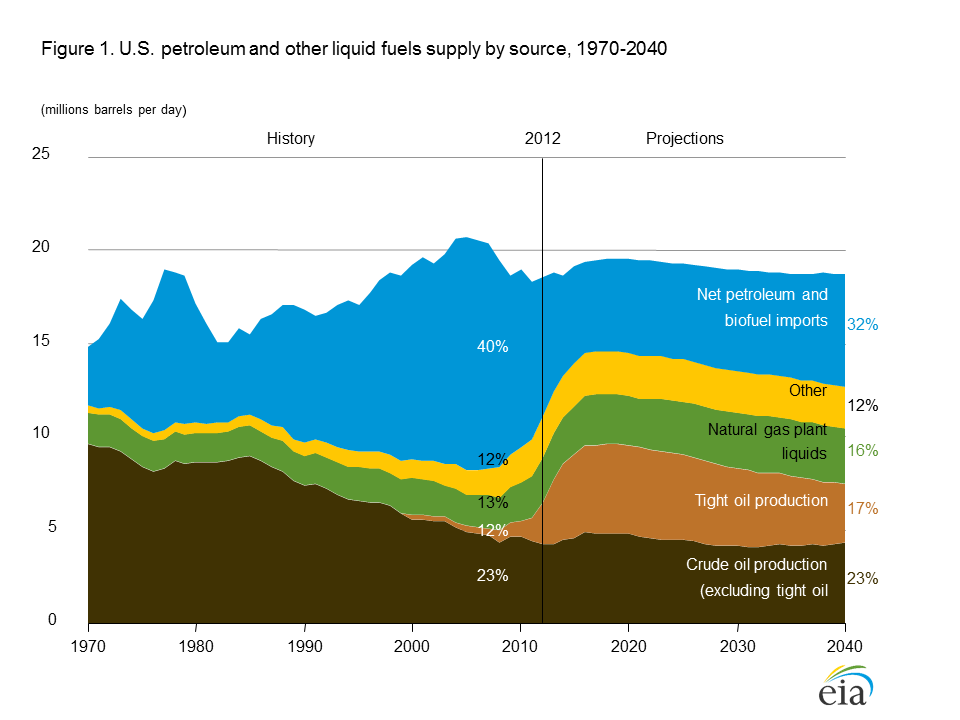
Toward the end of Sunday night's presidential debate I was startled to hear Secretary Clinton reply to an audience question by stating, "We are now for the first time ever energy-independent." If the price of oil were $100, rather than $50, that might have constituted a "Free Poland" moment, recalling President Ford's famous gaffe in a 1976 debate.
This point is likely to get lost in the dueling fact-checking of both candidates' numerous claims, but while the overall US energy deficit has fallen from about a quarter of total consumption (net of exports) in 2008 to just 11% in 2015, we still import 8 million barrels per day of oil from other countries. That includes over 3 million barrels per day from OPEC, a figure that has been growing again as US oil and gas drilling slowed following the collapse of oil prices in late 2104.
Oil has always been at the heart of our notions of energy security and energy independence, because it is our most geopolitically sensitive energy source and the one for which it is hardest to devise large-scale substitutes. So although the US is certainly in a better overall position than it has been in decades, with progress on multiple aspects of energy, it is not yet energy independent, especially where it counts the most.
Moreover, the policies that Mrs. Clinton has proposed would, at least initially, be likely to expand that gap by imposing additional restrictions on hydraulic fracturing, or "fracking." Mr. Trump, for his part, seemed to devote much of his response to Mr. Bone's debate question talking about coal, which while still a significant player in electricity production has become largely irrelevant to the topic of energy independence, because its use is being displaced by other domestic energy sources, mainly natural gas and renewables like wind and solar power.
In fact, of the various contributors to the energy independence gains the US has made from 2008-15 (shown in blue in the above chart) the largest depend on fracking. Oil still makes up most of our remaining energy deficit, after help from a million barrels per day of ethanol--50% of the energy content of which comes from domestic natural gas. Electric vehicles also help, but the roughly 400,000 on the road in the US today displace the equivalent of only about 12,000 barrels per day of oil products, too small to be visible on the scale of this graph. As a result, continued fracking of shale and tight oil resources must be the linchpin of any realistic strategy to close the remaining US energy deficit within the next decade or so.
I understand that Secretary Clinton's proposed energy policies put a higher priority on addressing climate change. However, she raised the issue of energy independence in the second debate, even though her proposals are unlikely to deliver it in the foreseeable future--or preserve our present, hard-won reduced dependence on foreign energy sources. Anyone who doubts that this is a pocketbook issue should recall where oil and gasoline prices were just three years ago, before US shale added over 4 million barrels per day to global oil supplies.
Providing useful insights and making the complex world of energy more accessible, from an experienced industry professional. A service of GSW Strategy Group, LLC.
Showing posts with label fracking. Show all posts
Tuesday, October 11, 2016
Monday, January 05, 2015
2014 in Review: Shale Energy's First Price Cycle
2014 was an extraordinary year in energy, vividly illustrating both sides of the Chinese proverb about interesting times. Oil market volatility was the big story for much of the year, with the dominance of geopolitical risks finally yielding to surging supplies. Of the two energy revolutions underway, shale wields the bigger stick for now, while the growth of renewables gathers momentum. All of this has implications for 2015 and beyond.
The US remained the epicenter of the shale revolution this year, with development elsewhere still subject to uncertainties about economic production potential, infrastructure, and the rules of the road. A comparison of oil-equivalent additions to US energy supplies from oil, gas and non-hydro renewables for the first nine months of the year highlights both the significance of shale and the differences in relative scale that impede a rapid shift to renewables.
|
US shale drilling added over a million barrels per day of "light tight oil" (LTO) production, compared to 2013, based on US Energy Information Administration data for the first nine months of the year. That brings cumulative gains since 2011 to nearly 3 million bbl/day. This hasn't just upended the global oil market; it has also revolutionized the way oil moves across North America. Over a million bbl/day now moves by rail, a figure recently projected to peak at 1.5 million by 2016. Nor is that entirely the result of delays to pipeline projects like Keystone XL. One proposed pipeline for Bakken LTO was reportedly canceled due to a lack of interest from shippers. Rail is expensive but provides producers and refiners with greater flexibility in both volume and destinations than fixed pipelines.
The collapse of oil prices has prompted many producers to reassess drilling plans, although it has been a boon for refiners and consumers. Refining margins look relatively healthy, at least based on the proxy of "crack spreads", the difference between the wholesale prices of gasoline and diesel and the oil from which they are made. Some refiners also anticipate that low prices will spur demand growth, as described in a fascinating Wall St. Journal interview with Tom O'Malley, who has turned a succession of castoff refineries into profitable businesses.
We may already be seeing the demand response to lower prices. November US volumes were at a 7-year high, according to API. This is unlikely to be replicated quickly elsewhere, however, for the same reasons that global oil demand was slow to moderate when prices rose over the last several years: In many countries the influence of oil prices on consumer behavior is overwhelmed by fuel taxes or subsidies. With prices now falling, some developing countries are capitalizing on the opportunity to unwind billions of dollars in consumption subsidies, offsetting market drops. That could have important implications for future oil demand and greenhouse gas emissions.
Meanwhile US consumers have watched retail gasoline prices fall by $1.39 per gallon since July and by over a dollar compared to a year ago. If sustained, the effective stimulus could exceed $100 billion annually, ignoring the effect of lower prices for jet fuel, diesel and other products. It's not surprising that half of respondents in last month's Wall St. Journal/NBC poll indicated this was important for their families.
While oil has been making headlines, shale gas without much fanfare added the equivalent of another half-million bbl/day to US production. That explains why despite enormous drawdowns of gas during last winter's "Polar Vortex", gas inventories began this winter much closer to normal levels than was widely expected in the spring. Gas has lost a little ground in electricity generation to coal in the last two years, but few reading the EPA's proposed Clean Power Plan regulation would expect that trend to continue.
Shale gas remains controversial in some areas due to perceived environmental and community impacts. New York state is apparently making its temporary ban on hydraulic fracturing ("fracking") permanent, preferring to rely on shale gas supplies from neighboring Pennsylvania. Yet while shale drilling in North Dakota has led to an increase in gas flaring--burning off gas that can't economically reach a market--the latest findings from the University of Texas and Environmental Defense Fund measured methane leakage from gas wells at an average of 0.43%. That shrinks gas's emissions footprint and enhances its potential role in climate change mitigation.
Turning to renewables, wind energy now provides a little over 4% of US electricity. However, its growth has slowed due to uncertainty about continued federal subsidies. The wind production tax credit, or PTC, had previously been extended through 2013 in a way that allowed projects brought online later to benefit from the extension. It was just extended again through the end of 2014, along with a broad package of other expiring tax benefits. This late revival might be a gift to a few projects already under construction, but it seems unlikely to spur additional projects without further legislative action in the new Congress.
Solar power has also made great strides, with costs falling rapidly and US additions in 2014 expected to reach 6,500 MW, likely outpacing wind additions. This is happening despite the ongoing trade dispute between the US and China over imported solar modules. Utilities are already experiencing solar's impact on their traditional business model. Yet as important as wind and solar power are likely to be in the future energy mix, their impact in 2014, at least in the US, was still dwarfed by the growth of shale resources. Drilling is already slowing down, however, so renewables could take the lead in 2015 as shale is expected to post smaller gains.
Looking ahead, the global focus on greenhouse gas emissions will increase in the run-up to the Paris climate conference in December. It remains to be seen whether enough progress was made in the recently completed talks in Lima, Peru, to resolve the significant remaining obstacles to a new global climate agreement. And while oil supply gains trumped geopolitics in 2014, a list of risk hot-spots from the Council on Foreign Relations includes several scenarios with major implications for oil and/or natural gas prices. Meanwhile we can expect the new Congress to take up Keystone XL, oil exports, EPA regulations, and other energy-related issues. I'd bet on another lively year.
A different version of this posting was previously published on the website of Pacific Energy Development Corporation.
Thursday, November 06, 2014
Will Falling Prices Shift Oil Industry's Focus to Cost Reduction?
- Lower oil prices may have less impact on US oil production from shale than competitors in Saudi Arabia and elsewhere appear to assume.
- The cost of producing tight oil is not static, and US producers have various options for cost reduction, including optimizing their logistics. The newly elected Congress can help.
From the end of 2010 to the first half of this year, as the rapid development of light tight oil (LTO) from shale deposits was adding more than 2.9 million barrels per day (bpd) to US output, the benchmark price of West Texas Intermediate crude oil (WTI) averaged $96/bbl. The global oil price, represented by UK Brent, averaged $110/bbl for the same period. Having now fallen to the $80s, if prices were to stay here or lower for long, we should expect to learn a great deal about the actual cost structure of new and existing LTO production in the Bakken, Eagle Ford, Permian Basin and other shale plays.
Based on my experience of several oil-price declines from the inside during my time at Texaco, Inc., I'm skeptical that many LTO producers would be inclined to trim output from currently producing wells, other than as a last resort. From late 1997 to the end of '98, WTI prices fell by almost half, from around $20/bbl to under $11--equivalent to roughly $15 today. Prices for heavier grades of oil fell to single digits. After months of that, revenues from some oil fields no longer covered variable costs, and upstream management took the decision to shut in high-cost production. Once prices revived, they discovered that some of that capacity had been lost essentially permanently.
I suspect there would be even greater uncertainty and hesitation today about shutting in producing shale wells for any significant period, especially in light of the limited experience with such wells. The bigger question is whether the drilling of new wells would slow or stop, resulting in a gradual slide in output as existing wells decline.
Then and presumably now, however, the first option in a situation like this is generally to cut costs, rather than output. I saw this in the mid-1980s, when oil prices fell by nearly 60% and took more than a decade to recover fully, then again in the late '90s, and during periodic, smaller market corrections. Suppliers were squeezed, big projects deferred, and employees saw travel, raises and benefits curtailed. Similar actions now could make a difference in keeping new shale drilling going.
Even for relatively efficient operators, it can be surprising how much expense can be reduced without affecting near-term productivity, and many of those savings would persist if prices recovered. LTO producers might ultimately become more profitable after weathering a period of weak prices.
A heightened focus on costs would also likely extend beyond producing company budgets and supplier agreements. One of the biggest non-production costs for LTO is transportation, whether paid directly by the producer or deducted by the purchaser from the market price. Because of its rapid growth and the constraints of existing infrastructure, a high proportion of LTO output must currently be shipped by rail--up to one million bpd in the second quarter of 2014.
Rail offers flexibility and can reach many destinations, but it is expensive. For example, if it costs over $10/bbl to ship Bakken crude to the Gulf Coast by rail, that means that with WTI at $78/bbl the producer might realize less than $70/bbl at the wellhead. Pipelines are often cheaper to use, though not in all cases. The current tariff on the existing Keystone Pipeline for taking oil from the Canadian border to Cushing, OK, the storage hub for WTI, works out to around $4/bbl. If oil prices stayed low for a while, that might increase interest in the proposed Bakken Marketlink Project. It would connect the Bakken shale operations to the Keystone XL pipeline, the prospects for which look decidedly better after the outcome of Tuesday's mid-term election.
Another aspect of transportation costs that could come under a different kind of pressure relates to federal restrictions on shipping oil and petroleum products by vessel between US ports. Under the "Jones Act", only US-flagged, -owned and -crewed ships can perform such deliveries, even though the rates for such shipments are normally significantly higher than on foreign-flag tankers in comparable service. This is a significant factor in current petroleum trade patterns, in which refined products from Gulf Coast refineries are often shipped halfway around the world, while blenders and marketers on the east and west coasts must import gasoline and other products from outside North America.
And as long as US crude oil exports are prohibited, with a few exceptions, the combination of the Jones Act and the export ban effectively keep LTO bottled up on the Gulf Coast--depressing its price--or force it onto rail. Amending the Jones Act to exempt LTO, or the issuance of a waiver to that effect from the Executive Branch, could increase producers' margins while expanding the supply options for US refineries on the other coasts. I wouldn't be surprised to see this taken up by the new Congress early next year.
Based on the current behavior of oil markets, the global impact of the US shale oil boom has been greater than many expected and seems very much in the national interest of the US--and of US consumers--to keep it going. It remains to be seen whether measures such as new pipeline infrastructure and reform of shipping regulations, together with more traditional forms of expense reduction, could boost producers' returns on LTO sufficiently to sustain drilling at roughly current rates while oil prices are weak.
Even if both drilling and tight oil production slowed for a while, this price correction won't spell the end of the shale boom. As the Heard on the Street column in the Wall Street Journal put it recently, "Once someone has cracked it, it can't be unlearned. Barring a prolonged period of very low prices, the US oil industry isn't about to disintegrate." Rather than an existential crisis, the current weakness in oil markets looks like a test of adaptability for this new but important energy sector.
A different version of this posting was previously published on the website of Pacific Energy Development Corporation.
Wednesday, March 19, 2014
Making Oil-by-Rail Safer
- A series of rail accidents involving trains carrying crude oil has focused attention on safety procedures and even the tank cars used in this service.
- Another concern is the variable characteristics of the "light tight oil "now shipped by rail in large quantities. That isn't the result of "fracking", but of the oil's inherent chemistry.
In the immediate aftermath of Lac-Megantic, the Federal Railroad Administration issued an emergency order on procedures railroads must follow when transporting flammable and other hazardous materials. And on February 21, 2014 railroads reached a voluntary agreement with the US Department of Transportation (DOT) on additional steps, including reduced speed limits for oil trains passing through cities, increased track inspection, and upgraded response plans. These steps have the highest priority, because crude oil loaded in tank cars doesn't cause rail accidents. Every incident I've seen reported in the last year began with a derailment or similar event.
At the same time, the packaging and characteristics of the oil can affect the severity of an accident. Investigators have focused on two specific issues in this regard, starting with the structural integrity of the tank cars carrying the oil. The vast majority of tank cars in this service are designated as DOT-111--essentially unpressurized and normally non-insulated cylinders on wheels. These cars routinely carry a variety of cargoes aside from crude oil, including gasoline and other petroleum products, ethanol, caustic soda, sulfuric acid, hydrogen peroxide, and other chemicals and petrochemicals.
Their basic design goes back decades, and even the older DOT-111s incorporate learnings from earlier accidents. A growing proportion of the US fleet of around 37,000 DOT-111 tank cars in oil service consists of post-2011, upgraded cars that have been strengthened to resist punctures, but the majority is still made up of older, unreinforced models. The Pipeline and Hazardous Materials Safety Administration (PHMSA) is studying whether to make upgrades mandatory, but some railroads and shippers aren't waiting. Last month Burlington Northern Santa Fe Railway, owned by Warren Buffet's Berkshire Hathaway, announced it would buy up to 5,000 new, more accident-resistant tank cars.
Another issue that has received much attention since Lac-Megantic concerns the flammability of the light crude from shale formations like North Dakota's Bakken crude, which accounts for over 700,000 barrels per day of US crude-by-rail. The Wall Street Journal published the results of its own investigation, reporting that Bakken crude had a higher vapor pressure--a measure of volatility and an indicator of flammability--than many other common crude oil types.
The Journal apparently based its findings on crude oil assay test data assembled by the Capline Pipeline. Although a Reid Vapor Pressure of over 8 pounds per square inch (psi) for Bakken crude is higher than for typical US crudes, it's not unusual for oil as light as this. That's especially true where, due to lack of field infrastructure, only the co-produced natural gas is separated out, leaving all liquids in the crude oil stream.
What makes this situation unfamiliar in the US is that domestic production of oil as light as Bakken had nearly disappeared before the techniques of precision horizontal drilling and hydraulic fracturing were applied to the Bakken shale and similar "source rock" deposits. (Note: High vapor pressures are characteristic of the naturally-occurring mix of hydrocarbons in very light crudes, rather than a result of the "fracking" process.) Nor is the reported vapor pressure for Bakken or Eagle Ford crude higher than that of gasoline, a product that is federally certified for transportation in the same DOT-111 tank cars that carry crude oil.
The variability of the vapor pressure data that the Journal's reporters identified for Bakken crude may result from another unfamiliar feature of such "light tight oil". Crude produced from conventional reservoirs, which are much more porous than the Bakken shale, tends to be relatively homogeneous. However, because the Bakken and other shales are so much less porous, limiting diffusion within the source rock reservoir, the composition of their liquids can vary much more between wells.
In any case, vapor pressure isn't the preferred measure of fuel flammability. Actual rail cargo classifications are based on flash point and initial boiling point. These routine quality tests aren't included in Capline's publicly available data. PHMSA initiated "Operation Classification" to ensure that manifests and tank car placards for crude oil shipments accurately reflect the potential hazards of each cargo, based on such measurements. The agency has determined that it hasn't always been done consistently, and DOT issued another emergency order requiring shippers to test oil for proper classification.
As mentioned in an oil-by-rail webinar yesterday, hosted by Argus Media, assigning the proper classification to oil shipments may seem like a bureaucratic concern--it doesn't necessarily affect the tank car type chosen to transport the crude--but it can have a significant impact on operational factors such as routing and the notification of first responders along the route.
There's no quick and simple way to make the transportation of crude oil by rail as safe as hauling a dry bulk cargo like grain. Tank car fleets can't be replaced overnight, not just because of the cost involved, but due to limited manufacturing capacity. However, in the meantime significant improvements can be achieved through a combination of government attention and sustained industry initiatives. Since the new crude streams traveling by rail play a key role in increasing North America's energy security, this is in the interest of everyone involved--producers, shippers, railroads, and not least the communities through which this oil travels.
A different version of this posting was previously published on the website of Pacific Energy Development Corporation.
Labels:
bakken,
derailment,
energy security,
fracking,
hydraulic fracturing,
lac-megantic,
rail,
safety,
shale oil,
tight oil,
train
Friday, September 13, 2013
Energy Projects Seem Less Urgent in A Post-Energy-Crisis World
- Rather than being another component of an ongoing energy crisis, opposition to various energy projects points to the alleviation of a decades-long string of US energy crises.
- The audience for concerns about pipelines and fracking would be much smaller if oil were still at $145 per barrel and natural gas over $10 per million BTUs.
The alleviation of what seemed to many a permanent energy crisis might not be obvious, because it has crept up on us. But consider a few of the big-picture elements that have changed:
In crisis mode, US energy security was focused on steadily rising oil and later natural gas imports, while "energy independence" was a goal embraced by politicians but rarely energy experts. Cars offering better fuel economy were available but entailed trade-offs in size and performance. Today, oil imports are falling, the US is a net exporter of refined petroleum products, and public concern about Peak Oil is waning, as measured by internet search activity. Ethanol from corn supplies 10% of US gasoline demand, while other forms of renewable energy are growing rapidly, from a small base. The big question for the federal government this summer is how many natural gas export facilities to allow. Meanwhile, the threshold for fuel-efficient cars has shifted from 30 mpg to 40 mpg, offered in numerous attractive models.
Another way to gauge the success of technologies like hydraulic fracturing, or "fracking", in shifting our energy landscape is to remind ourselves how bad we thought today's situation would be, just a few years ago. In 2005 the official US annual energy forecast projected oil imports to increase from 11 million barrels per day (MBD) in 2003 to nearly 15 MBD by this year, due to rising demand and domestic production that was expected to remain flat, at best (see below chart.)
The Energy Information Agency (EIA) also expected US natural gas imports to increase steadily, reaching 3.5 trillion cubic feet (TCF) of LNG imports this year, on their way to 6 TCF per year by 2022. As a consequence, in 2005 the EIA forecast that coal would still generate 48% of US electricity by 2013.
Now imagine energy prices in that alternative 2013. With US natural gas suppliers importing an average of 90 LNG tankers per month, would the wellhead price of gas still be under $4 per million BTUs, or closer to the $16 price paid in some international markets? And with US refiners importing up to twice as much crude oil as they are actually on track to do this year, in the context of sanctions on Iran and turmoil in North Africa, how likely does it seem that oil would be at $105-110/bbl, instead of much higher? $100 oil is a drag on the economy, but US consumers have adjusted to gasoline priced around $3.50-3.75/gal., on average. Every $1 per gallon above that would take another $130 billion per year away from other purchases, with adverse effects on the US economy.
More to the point, in such an environment how much tolerance would there be for opposition to oil pipelines or gas drilling that had the potential to lower energy prices, or at least reduce imports and enhance energy security? If oil were above its 2008 high of $145/bbl, and gasoline flirting with $5 per gallon, it would surely be much harder for elected officials to delay approving projects like the Keystone XL pipeline, or to sustain gas drilling moratoria. Ironically then, the successful large-scale application of shale drilling techniques, which has resulted in a 29% increase in US natural gas production and 33% rise in oil production since 2004, helped make it possible for opponents of Keystone or fracking to be heard, rather than dismissed out of hand.
I was recently struck by a reported remark by a pipeline executive. "Shale is everywhere," he said, but it won't be produced everywhere because "people make choices." I agree with that insight, while recognizing that such choices are available mainly because altered economic conditions and the same technologies to which some now object have enabled us to shed an energy crisis mindset. This situation might have future parallels for other technologies that have escaped much pushback, so far.
Monday, August 12, 2013
Unlocking the UK's Shale Gas Potential
- Following estimates of substantial shale gas resources underlying parts of Britain, the UK government is proposing incentives for companies and local communities to encourage its timely development.
- Even if it ultimately proved less transformative than in the US, shale gas could balance the UK's future energy mix, while setting an example that other shale-rich EU countries could follow.
The UK's natural gas market has been experiencing problems similar to those the US encountered in the last decade, prior to wide-scale development of shale gas resources. Natural gas production from the offshore fields of the UK sector of the North Sea, which provided an energy surplus until about ten years ago, has declined rapidly. As a result, the Interconnector UK, a bi-directional gas pipeline linking Britain to continental Europe, has recently operated mainly in import mode. UK natural gas prices have been correspondingly high and volatile, spiking briefly to around $17 per million BTUs this March. Prices in excess of $10/MMBTU are typical.
Against this background, the UK government is understandably interested in pursuing the exploration of the country's potentially enormous shale gas deposits. In June the British Geological Survey released its detailed estimate for the Bowland shale in the north of England. With a range of 822-2,281 trillion cubic feet (TCF) of gas-in-place, and a "central estimate" of 1,329 TCF, this looks like a significant resource. Even at the low end of the BGS assessment, and using a conservative figure of 15% recovery based on relevant US shale gas recovery rates, the Bowland could provide 120 TCF or more of technically recoverable gas, the equivalent of over 40 years of current UK consumption.
Two aspects of the government's proposals caught my attention. First, the Chancellor of the Exchequer indicated his plan to make development attractive for producers with a new tax structure that he intends to be "the most generous for shale in the world." Earnings from shale would be taxed at 30%, compared to 62% for other hydrocarbon projects. With only a few companies currently exploring for shale, that should attract additional drillers, along with the service companies that perform many of the key activities at the well site.
I was more intrigued by the proposal--apparently originating with industry--to provide local communities with a benefit of at least £100,000 per well-site that is hydraulically fractured, or "fracked", plus a small share of gas revenue. In a country where the government owns the sub-surface property rights, this could be a crucial step in gaining local support for projects that, in addition to significant economic activity and eventually local employment, will also result in unavoidable increases in noise, traffic and other intrusions in daily life during the weeks or months in which each site is being prepared, drilled, completed and brought on-line, and for the longer periods that crews would be operating in the area.
We've certainly seen the importance of local benefits in promoting receptiveness towards gas drilling in the US, where most shale development has occurred on private land, and where royalties from production provide property owners with regular payments ranging from helpful to lifestyle-altering, depending on production rates and the ownership interests. Sharing financial benefits from shale production at the community level, rather than with individuals, might even galvanize broader-based support than in some parts of the US. Much will depend on whether British communities consider the offered compensation sufficiently generous.
UK shale development still faces significant above- and below-ground uncertainties that only time and drilling can resolve. Nor is it clear whether development of the Bowland shale would have as large an impact on the UK gas market as shale gas has had here. Skeptics can be found among opposition politicians and respected energy analysts, though I must say their arguments about high costs and low production rates sound very similar to those that I heard in energy conferences in the US not many years ago. Signposts to watch include the number of drilling companies moving into the north of England and emulation of the UK government's pro-development policies by other countries.
A different version of this posting was previously published on the website of Pacific Energy Development Corporation.
Labels:
Bowland shale,
energy mix,
fracking,
gas shale,
hydraulic fracturing,
incentives,
natural gas,
UK
Tuesday, July 30, 2013
A First-Hand View of Fracking in Pennsylvania's Marcellus Shale
- Producing shale gas requires drilling numerous wells, often in regions that have seen little or no oil & gas activity for decades. Addressing environmental and other community concerns is crucial to acceptance.
- On a recent visit to a shale operation in Lycoming County, PA, I was impressed by the rigorous attention I saw to safety, spill prevention, soil conservation, and other impacts.


The Anadarko Petroleum well site, or “pad” that I toured is located in Cogan House Township in rural Lycoming County, atop the Marcellus shale formation. API arranged this site visit for bloggers and other media and paid for accommodations in Williamsport. Anadarko provided experts from its local engineering and public affairs staffs and hosted a dinner with members of the community the evening before the site tour. No one paid me to write about the visit, nor was there any expectation that I would report anything other than my candid, objective opinion of what I saw.
I’m no stranger to industrial sites or oil fields. I’ve also invested countless hours researching and discussing shale drilling and hydraulic fracturing. When it comes to complex technical subjects like this, however, no amount of reading or Youtube videos can substitute for seeing the real thing and being able to talk to the people actually doing the job about how it all works.
One example of that is safety. Safety plans, targets and slogans are important, but it carries more weight when the site engineer looks you in the eye and says emphatically in his own words, “The most important thing is that everyone goes home at night,” and then proceeds to explain the stop-work rules, the “red zones” that have to be clear of workers when the fracking pumps are running, and other aspects of onsite safety. We were constantly reminded to watch where we stepped and to make sure we had multiple points of contact with the ground whenever we looked at something or photographed it.
Concern for environmental impacts was similarly thorough. I consider surface spills a much bigger potential risk to groundwater than fracturing a layer of shale thousands of feet below any aquifer. The first thing I noticed at the site, all five wells of which had already been drilled and prepared for fracturing, was the floor. The entire pad was covered with a three-layer mat of black felt, HDPE plastic and fabric, to isolate any spills from the ground. The pad was also surrounded by a berm to contain any spills, which would promptly be vacuumed up by a waiting truck. They even vacuum up rainwater. Yet the real key to spill control is prevention, which in Anadarko’s case is reinforced by its “Eyes On” program. This requires an extra observer any time a liquid other than fresh water is being handled or transferred. Soil conservation efforts looked similarly scrupulous.
Another issue I asked about was noise. I couldn’t gauge it for myself, because aside from trucks delivering supplies the site was shut down during our visit. It’s not prudent to have untrained people wandering around when 30,000 HP of truck-mounted pumps are running, injecting fluids down a well at nearly 10,000 psi. When I inquired, I was told that the pumps themselves were loud, requiring ear protection nearby but not at the perimeter of the site. How far the sound carries beyond the site is a function of terrain, foliage and weather conditions.
Then there were the fluids themselves. An Anadarko engineer described the company’s approach to the five wells at this site as minimal and “green”. The fracking fluid was a simple “slickwater frac”. The main ingredients consisted of around 4 million gallons of water per well--much of it filtered and recycled from nearby gas wells--and 4-6 million pounds of sand, to prop open the fractures created by high-pressure water. The formula also includes a little hydrochloric acid for downhole cleanup, and two other ingredients: a low dose of “biocide” to prevent corrosion from bacterial growth in the well, and a friction reducer, without which significantly higher fracking pressure would be required. The details of the chemicals used at the pad will be available on the public disclosure site www.FracFocus.org once the wells are complete.
I also inquired about methane emissions during well completion. Some critics claim--incorrectly, per independent analysis--that such emissions, along with other leakage, negate the climate benefits of shale gas. Although I was told Anadarko wasn’t specifically employing “green completion” techniques at this site, it was taking steps to minimize emissions, starting with having the gas gathering pipeline ready to go. As each well is completed, it’s hooked up to production so no methane escapes. That maximizes revenue. The site also had a temporary flare to burn off any excess gas from operations before the well could be connected to the pipeline. That sounds wasteful but is environmentally preferable to venting gas.
Of course for all the precautions and evident best practices there’s no disguising that while it is being prepared, drilled, fractured and completed, each drilling site is a compact industrial operation and hub of activity. Numerous trucks carry water, sand, chemicals and equipment back and forth. Anadarko has improved over 200 miles of country roads to handle this traffic, while minimizing freshwater haulage by the use of water pipelines connecting its sites.
The consolation for the neighbors is that the entire process runs its course like any construction project. A few weeks or months of intense activity are followed by years of unobtrusive operation, during which gas flows into pipelines and royalties into the community. The employment and other local economic benefits this creates are significant, especially for communities that have lost many of the industries that sustained their economies in the past.
Several of the participants at the dinner the evening before drew comparisons to wind turbines, which are much taller than the drilling rigs used for gas wells, and remain on-site for decades. That got me thinking about relative energy contributions. At Anadarko's estimated lifetime gas production (EUR) of 8 billion cubic feet each well could generate more than 1.1 billion kilowatt-hours (kWh) of electricity in an efficient gas-fired power plant. By comparison, a 1.5 MW wind turbine would normally generate less than 80 million kWh over 20 years. So when brought online the five wells on the one pad I visited will together produce energy equivalent to a wind farm of more than 70 turbines.
Even if the ultimate recoveries from these wells turned out to be closer to the lower figures estimated by third parties from the limited data available to them, compared to those used in Anadarko's calculations, it would still represent a very substantial energy yield for such a small site.
I came away from the tour with a strong impression of a well-trained and experienced team, focused on doing the job right — safely and with minimal impacts, because this is where they and their families live; the landowners from whom they lease their sites are their neighbors. And for all the truly impressive technology deployed, what really counts is the people using it.I can understand skepticism about the balance of risks and benefits from shale gas development--this is a skeptical age--but nothing I observed in Williamsport would validate such concerns. Instead, I saw a well-tuned operation that is a microcosm of the biggest US energy revolution of the last 40 years.
A different version of this posting was previously published on Energy Trends Insider.
Labels:
Anadarko,
chemicals,
drilling,
emissions,
fracking,
gas shale,
greenhouse gas,
hydraulic fracturing,
marcellus,
methane,
Pennsylvania,
water,
wind power
Monday, July 01, 2013
The President's Climate Plan Hinges on Natural Gas
- President Obama's plan for addressing US greenhouse gas emissions depends heavily on expanded fracking of US shale gas resources.
- Reducing power sector emissions will be expensive, unless implemented with maximum flexibility.
- The President's endorsement of climate adaptation was helpful, if overdue.
Some context is necessary. In 2009 the US Congress, controlled by the President's party, took up comprehensive climate legislation centered on "cap-and-trade." In principle, that would have limited emissions while enabling emitters with high abatement costs to purchase offsets from others who could cut emissions less expensively. Unfortunately, the Waxman-Markey Bill's version of cap-and-trade was so distorted by handouts to favored constituencies that its effectiveness at reducing future emissions was highly questionable. By the time it died in the Senate, it looked more like a piñata of revenue allocation than a serious effort to address climate change.
So depending on your perspective, the President's new climate plan is either a punishment for Congressional failure to pass a climate bill, or the unavoidable sequel to legislative stalemate. Its prescriptive approach to parceling out emissions cuts to different sectors, with a heavy focus on electricity generation, might prove effective at reducing some emissions but will certainly be more expensive than a broad, market-based approach.
The hallmark of the speech was the President's instruction to the Environmental Protection Agency (EPA) to develop carbon emissions standards for both new and existing power plants. This feature had been leaked in advance, and it was hailed by many environmentalists. How much it will cost us depends on how EPA constructs the regulations necessary to put it into effect.
If they approach the power plant carbon standard in a manner similar to the corporate average fuel economy (CAFE) rules applied to each automaker's new car fleet, then the resulting flexibility could moderate both its cost and adverse consequences. Conversely, if they cap emissions at each individual power plant--analogous to specifying the mpg of each new car--we should expect a wave of power plant closures, including at some gas-fired plants necessary to manage peak loads and back up wind and solar power. The implications for utility bills and electric reliability are significant, so the details will matter enormously.
The President has a point when he says that past predictions of economic harm associated with previous environmental regulations largely failed to materialize, due to the ingenuity of American businesses. However, I believe his dismissal of concerns about EPA regulation of CO2 emissions is overly cavalier, because it ignores two fundamental facts.
First and foremost, energy-related CO2 has little in common with the pollutants the EPA has regulated in the past. It results neither from small impurities in fuel, such as sulfur or mercury, nor as a minor byproduct of combustion with air, such as NOx. Along with water and heat, CO2 is a primary and unavoidable outcome of all hydrocarbon combustion. We can't clean it up cheaply by purifying the fuel or adding a catalytic converter or scrubber to an exhaust pipe or smokestack. We must either send it to the atmosphere, as we've done since the invention of fire, or chemically separate it from the exhaust, and then compress it and bury it underground, or react it chemically to produce new fuel or some other product. So far, both of the latter options are expensive and energy-intensive. There's simply no free lunch to be had in dealing with emissions from the fossil fuels without which, as the President admitted, "Our economy wouldn't run very well."
The other problem, familiar to my long-time readers, is scale. President Obama said that his new plan would "double again our energy from wind and sun", as it doubled in the last four years. Unfortunately, that further doubling would only yield enough electricity to displace 9.5% of the electricity generated from coal last year, saving less than 3% of total US emissions. New nuclear power plants require many years to build, and those now under construction only offset the announced and plausible retirements of existing nuclear units. Thus, any shortfall in electricity supply due to the retirement of additional coal plants must be made up mainly by natural gas, which a new report from the Breakthrough Institute calls the "Coal Killer".
For the first time in a generation, it appears we have enough gas to take on such a challenge. Replacing half of 2012's coal-fired power generation would require a 50% increase in the quantity of gas sold to US generating plants last year, supported by another 20% increase in US dry gas production, to nearly 29 trillion cubic feet per year. That level of output would be consistent with the Energy Information Administration's current forecast for US production by the mid-2020's. Of course the power sector would have to compete with other sectors that are also seeking more gas, including manufacturing and transportation, so the future price of natural gas--even with abundant shale sources--is uncertain. The bottom line is that President Obama's plan for reducing CO2 emissions from the power sector depends mainly on raising US natural gas production through expanded hydraulic fracturing of shale deposits.
I should also briefly mention a few other aspects of the speech. The President wants to promote energy efficiency and renewable energy by having the federal government lead in their adoption. This sounds like motherhood and apple pie, and there's no question that efficiency measures have a role to play in reducing both energy consumption and emissions. However, they shouldn't be divorced from a broader perspective encompassing financial and operational efficiency. I would wager that the federal government could cut its energy consumption from buildings just as quickly, and perhaps less expensively, by reducing its vast inventory of owned and leased buildings.
Federal adoption of renewable energy should also be guided by financial and operational considerations. For example, it is desirable for the military to ensure that as many of its aircraft, ships and vehicles as possible are capable of using alternative fuels, and to certify new systems on such fuels. However, it would be counterproductive verging on irresponsible to prioritize the purchase of uncompetitively priced alternative fuels, when budget cuts and sequestration are grounding fighter squadrons and otherwise impairing readiness. Funds are fungible, as CFOs are wont to say, and every extra dollar spent on renewable vs. ordinary jet fuel is a dollar that can't be spent on training or maintenance. And investments in high-cost renewables could achieve more if diverted into support for innovation on improved energy technologies capable of competing without endless subsidies.
The President's remarks on the Keystone XL pipeline were consistently vague. Some supporters of the project were encouraged, while opponents could still conclude a rejection was inevitable. From my perspective the only new element was his apparent dismissal of any objections on the basis of potential leaks and other local concerns from the final decision.
Finally, there's the issue of adaptation. President Obama effectively acknowledged that if the climate models that underlie his plan are correct, we face additional warming and other consequences, no matter how much we reduce emissions. He proposes to "protect critical sectors of our economy and prepare the United States for the impacts of climate change that we cannot avoid." This is overdue and ought to attract bipartisan support, irrespective of whether our elected representatives are convinced that human activities are responsible for the changes we see in the climate. Too many people and too many assets have been placed in the path of natural disasters that could become more frequent or severe, if the globe continues to warm. Adaptation offers "no regrets" opportunities, though building more resilient infrastructure is only part of the appropriate response. Expect to hear more about this subject in the weeks and months ahead.
The Executive Branch actions outlined in the President's speech constitute a Plan B for climate change. They may yield emissions reductions, though likely at a higher cost than broader, more even-handed measures that have become politically unpalatable. However, in a persistently weak economy the resulting higher energy prices are also likely to threaten an emerging source of US competitive advantage. Instead of solving the politics of climate change, the President's plan could deepen the polarization that already exists on this issue.
Wednesday, May 01, 2013
Ex-Shell Chief Hofmeister Promotes US Fuel Diversity
Alternative fuels have lost some of their luster in the US, lately, for understandable reasons. Oil production here is booming based on shale resources that keep expanding, while the market for ethanol, our most successful alternative fuel, has stalled at the long-anticipated "blend wall", resulting in ethanol plant closures and bankruptcy filings. More advanced cellulosic biofuel is still only available in minute quantities, and last year's sales of electric vehicles will displace less than 24 million gallons per year of gasoline--around 0.02% of US gasoline demand. With all this in mind, it seemed like an excellent time to speak with former Shell Oil Company President John Hofmeister, who recently joined the advisory board of the Fuel Freedom Foundation, a group dedicated to expanding fuel diversity.
I don't conduct many interviews for Energy Outlook, but I wouldn't have missed the opportunity to discuss energy with Mr. Hofmeister. Given the focus of Fuel Freedom Foundation, which arranged the call, I started by asking him what kind of changes he expects in the US fuel mix over the next 10 years. Mr. Hofmeister replied that his outreach efforts at Fuel Freedom, together with Citizens for Affordable Energy, which he founded after retiring as head of Shell's US operations, are intended to "make sure something has changed 10 years out. Left to our own devices, not much will change." With plans and "enablers of change" from government, he sees an opportunity to "transform the nation in 10 years." He went on to describe what that transformation might include, in the form of further decreases in our dependence on imported oil and more "inward investment". He also clarified that he includes domestic oil in his list of alternatives.
When I asked him about the barriers impeding the fuel diversity that he advocates, he immediately mentioned the interest groups that spring up, pro and con, whether concerning oil, natural gas, the lifecycle and materials for advanced vehicle batteries, or infrastructure for hydrogen fuel cell vehicles. He would like to see federal and state governments enable change and "tell the interest groups to back off." He observed that despite the shale revolution, "we still rely on imports and can't agree on creating new markets for natural gas" or to build the Keystone XL pipeline. These disagreements stifle development. Together with federal regulation of hydraulic fracturing, this results in "government as disabler", not enabler of change.
We had a lively conversation about some of the specific fuels that would make up the more diverse mix Mr. Hofmeister would like to see in the marketplace, such as methanol, ethanol, natural gas and electricity. I expressed some of my own concerns about the energy-equivalent cost of methanol and the safety risks involved in its use on the service station forecourt. He replied that with expanded supply based on abundant US natural gas, the price of methanol could fall significantly from today's level of $1.60/gal. (equivalent to wholesale gasoline at $3.25/gal.) That's certainly conceivable, because at a typical 70% conversion efficiency, the natural gas feedstock to produce a gallon of methanol would only cost about $0.37 at recent industrial gas prices. He also envisioned fuels like this being dispensed in a closed system, to maximize safety.
We discussed natural gas as a bridge fuel for vehicles and whether it might be hard to get off this bridge, later. In response he pointed to what he called the "EV lifestyle"--the improved convenience and driveability already experienced by EV owners who don't need extended driving ranges--and seemed to agree with my own view of electrification as a given in the long-run. He also suggested that this transition could be promoted by a coherent and comprehensive plan. Earlier, he had pointed out that the administration's "all of the above" approach was just a concept, not a plan, because it lacks the targets, milestones and accountability necessary for a real plan--a point on which an ex-CEO and current strategist were bound to agree.
I couldn't end the interview without asking Mr. Hofmeister whether the tremendous recent turnaround in US oil production had led him to alter his idea, expressed in various talks and in his book, "Why We Hate the Oil Companies," for the US to establish an energy equivalent of the Federal Reserve Bank. "I'm convinced it's the way to go," he said. "There's too much politics in energy policy now." He believes an "Energy Reserve Board" would stimulate the economy with investments focused on short, medium and long-term goals. "What energy needs is consistency."
My half-hour conversation with him validated my view that John Hofmeister isn't your typical oil guy. His ideas are grounded in the scale and complexity of the energy industry, but not bound by its conventional wisdom. Although I didn't agree with all of them--particularly concerning the degree of government intervention necessary--his responses to my questions were forthright and reflected long and careful analysis, along with a strong sense of the benefits available to the US from a more rational and planned approach to our national energy endowment and opportunities.
Labels:
alternate fuels,
batteries,
ethanol,
ev,
fracking,
fuel freedom foundation,
Hofmeister,
keystone xl,
methanol,
natural gas,
shale,
shell
Monday, April 22, 2013
Will Water Limit Fracking in Arabia?
- Poor water availability could hamper efforts to develop Saudi Arabia's shale gas resources, in order to meet growing gas demand from Saudi industry.
- Water recycling and alternative fracking fluids could provide the solution.
Recent comments by Saudi Arabia's oil minister, Ali Al-Naimi, indicated that Saudi Aramco would soon begin exploring the country's shale gas resources. As another means of reducing oil consumption in the Kingdom's electricity sector, in order to preserve oil exports, this appears to make both practical and economic sense. However, as noted by the Wall St. Journal, compared to the US Saudi Arabia has much less water available for the hydraulic fracturing of shale and tight gas reservoirs. Absent a reallocation of its substantial conventional gas production, Saudi shale gas could become a key factor in global energy security. However, the techniques employed to extract it might be different from those that currently dominate the US shale gas scene.
It must seem odd that Saudi Arabia would even be interested in shale gas, a resource that wasn't exploited in the US until conventional gas production was declining steadily. Saudi Arabia might still be the world's largest oil producer, at least for now, but it is not the "Saudi Arabia of natural gas". Although the country has proved gas reserves comparable to those of the US, it apparently didn't win nature's gas lottery on the Arabian Peninsula. Saudi gas reserves and production amount to only about 10% and 19%, respectively, of the Middle East's gas totals. Iran and Qatar are far ahead. And while Saudi gas production has doubled since 2000, output in neighboring Qatar has expanded by a factor of six in the same interval.
Much of the Kingdom's conventional gas reserves are associated with oil production and are often required to be reinjected to maintain reservoir pressure and oil output. Available Saudi gas has been preferentially allocated to industrial projects, such as petrochemicals expansion. As a result, little new gas was supplied for power generation, so the Saudi electricity sector has been burning large and increasing quantities of oil that could otherwise be exported. The need for additional gas has become acute, but exploration in the vast Empty Quarter has not yielded the expected gas bonanza, while the internal price of natural gas has been constrained at levels well below even recent low US natural gas prices--too low to make most new production attractive on its own merits.
As if the economics of shale gas development weren't challenging enough in such an environment, the key ingredient that has fueled the US shale revolution, water, is in short supply in Saudi Arabia. The needs of cities and industry in this arid country exceed the water supply from aquifers to such an extent as to require 27 desalination facilities, delivering nearly 300 billion gallons annually. At several million gallons of water per hydraulically fractured shale gas well, the logic of burning oil to desalinate water to produce gas looks questionable. Fortunately, there are multiple emerging pathways for reducing or eliminating net water consumption in "fracking".
For starters, many US producers now routinely recycle the 10-30% of injected water that typically flows back from the well after hydraulic fracturing, for use in subsequent wells. Recycling has become the standard in places like Pennsylvania's portion of the Marcellus shale, reducing the call on fresh water for fracking. The oil services industry offers various techniques for cleaning "flowback" water, and new ones are under development, including the use of algae.
Drillers can further reduce freshwater consumption through the use of nitrogen in foam or other forms. ERDA, a precursor of the US Department of Energy, conducted research on that technique in the 1970s, and it has been refined since then. Nitrogen is readily available from air separation plants and does not depend on water, though it does require energy.
Another approach for waterless fracking has been field-tested in Canada, using gelled propane. A blog post in Scientific American described some of the pros and cons of this method, which is more expensive where water is cheap but might fit the bill in dry regions where LPG is readily available. For that matter, it might make sense in New Mexico if the Mancos Shale of the San Juan Basin turns out to be another viable tight oil play.
The upshot is that a shortage of fresh water shouldn't constitute an insurmountable obstacle to exploiting Saudi Arabia's unconventional gas resources, which Mr. Al-Naimi cited at 600 trillion cubic feet. However, it remains to be seen whether shale gas development is the best answer to a problem that has been created by selling natural gas to industry for as little as $0.75 per million BTUs, while burning $100 oil ($17 per million BTU) to generate electricity. Whether the ultimate solution is shale gas or something else, resolving this gap in Saudi industrial policy could have a significant impact on future oil prices.
A slightly different version of this posting was previously published on the website of Pacific Energy Development Corporation.
Tuesday, March 05, 2013
A Secretary of Energy for a Leaner DOE?
I've read a number of stories on President Obama's nomination of MIT physicist Ernest Moniz to be the next Secretary of Energy. This overview of his background from the Washington Post is as good a place as any to start. Although I haven't met Dr. Moniz, I've seen him on various panels and am familiar with some of his department's work, such as MIT's reports on the Future of Natural Gas, Future of Coal and Future of Nuclear Power. As many comments since his announcement have suggested, it would be hard to find a more ideal steward of an all-of-the-above energy strategy. At the same time, this choice also reflects many of the key challenges facing the Department of Energy at this moment, not least the preservation of its R&D activities and other capabilities in a post-sequestration environment. This is likely to be a different Department of Energy (DOE) than the one that Dr. Chu guided for the last four years.
If I thought it likely that the DOE would continue to pursue large-scale industrial policy, such as the expanded energy loan guarantee program and other renewable energy deployment-focused activities that originated in the 2009 stimulus bill, I would be a lot more concerned that the President has selected another scientist and academic administrator to lead the DOE, instead of someone who has actually run a large energy business. Lack of commercial experience was arguably a key factor in the DOE's decision to fund Solyndra even as its main business proposition was unraveling, along with promoting a premature and excessive expansion of US electric vehicle battery manufacturing capacity.
However, the federal budget sequester is now in place and Congress has little appetite for expensive new programs. Business acumen seem less critical for a department that must make do with less for the foreseeable future while remaining relevant in an administration focused on advancing renewable energy and reducing greenhouse gas emissions. From the relatively little I know of Dr. Moniz, his prior experience in government--including a stint as an undersecretary of energy--and prominent role in a first-class research institution should equip him well for this task.
Dr. Moniz faces criticism from environmentalists for his views on nuclear power, natural gas and hydraulic fracturing ("fracking.") It's hard to imagine any nominee for this job who wouldn't spark some level of controversy, given the conflicting energy goals we've pursued over the years. I don't give much credence to the Post's inclusion of the views of Professor Howarth of Cornell on the Moniz nomination, considering that much of Dr. Howarth's widely-disseminated analysis of shale gas emissions has subsequently failed to withstand scrutiny. In any case I prefer the choice of a Secretary of Energy who has some appreciation of the importance of the energy sources that still supply roughly 90% of our energy needs, and possesses a clear understanding of the complexities of the long transition to cleaner sources, rather than one exclusively focused on the latter.
Labels:
doe,
fracking,
gas shale,
hydraulic fracturing,
moniz,
nuclear,
secretary of energy,
solyndra
Subscribe to:
Posts (Atom)