The pending administration decision on whether to impose a tariff or other fee on US imports of solar equipment from China raises serious concerns. The right choice in this case is less obvious than suggested by the jobs and free-trade arguments from the main US solar trade association (SEIA) or the Wall St. Journal's editorial page. Solar power generates less than 2% of US electricity today. However, if it is to grow as experts forecast and advocates claim is essential, then considerations such as long-term energy security can't be ignored, while near-term job losses from a new tariff would be more than offset by subsequent growth.
Last October the US International Trade Commission issued its recommendations in favor of the complaint by two US manufacturers of solar panel components. I usually favor low tariffs and open access, especially when the markets in question are functioning smoothly and the principal impacts from trade are the result of "comparative advantage" in production or extraction between countries. However, there is little about the market for solar equipment, including the photovoltaic (PV) cells and modules at issue here, that qualifies as free.
The production and deployment of solar energy hardware has depended since its inception, and from one end of its value chain to the other, on significant government interventions. In the case of China-based PV manufacturing, these have included low-interest government loans, preferential access to land, and minimal environmental regulations. China-based PV manufacturers were also able to take advantage of extravagantly generous European solar subsidies in the 2000s to scale up their output, drive down their costs, and ultimately send much of the EU's solar manufacturing industry into bankruptcy.
On the US end, both solar manufacturing and deployment (installation) have benefited greatly from federal tax credits, cash grants from the US Treasury, and a web of state quotas for aggressively increasing utilization of renewable energy sources. Justified on grounds of energy security, "green jobs", and climate change mitigation, these measures have strongly promoted solar power and delivered an extraordinary 68% compound annual growth rate in US solar installations since 2006. On a per-unit-of-energy basis, these supports are also at least an order of magnitude more valuable to the solar industry than the federal tax benefits received by the oil and gas industry.
One of the factors that makes this decision so difficult and politically sensitive is that a whole industry has apparently grown up around cheap solar imports, to the point that the main solar benefit to the US economy today is from installation, not manufacturing. US companies and their employees build solar panel racks and other "balance of system" gear, finance rooftop and other solar projects, and construct these installations.
These companies could be at risk of losing business and shedding jobs, if a large tariff were imposed on imported solar cells, modules and panels. Those impacts might be less than feared, though, because the cost of the actual sunlight-converting PV hardware now makes up less than a third of total solar project costs. In other words, a tariff that doubled effective PV cost would drive up total solar costs to a much smaller degree, and least of all for residential solar, which has the highest total costs per kilowatt.
There's another important aspect of this debate that hasn't received much attention. If solar power is as important to our future energy diet as many think, then it should be no more desirable to become heavily reliant on China for our supplies of PV components than it did to depend on growing imports of Middle East oil. That was the main energy security issue for the US for the last 30 years, until the shale revolution unexpectedly reversed that trend. Relying on solar imports from China in the long run will be nothing like depending on Canada for the largest share of the petroleum the US still imports.
It also makes sense to address this situation now, before solar power has grown to 20% or 30% of the US electricity mix, and with the US economy near full employment, when those workers that did lose their jobs would have the best chance to replace them quickly.
From the start, the complaint of unfair competition lodged by Suniva Inc. and Solar World Americas--Chinese- and German-owned, respectively--has been derided as an effort to prop up a couple of marginal players at the expense of the much larger US solar-installation sector. That ignores the position of First Solar (NASDAQ:FSLR), a US-based PV manufacturer with $3 billion in global sales. The company is on record supporting the trade complaint. Of course they aren't a disinterested party; they stand to benefit from a tariff that would raise the cost of competing PV gear from China and elsewhere.
That's precisely the point of the complaint: strengthening US solar manufacturers, so that the growth of solar energy in this country doesn't end up like TV sets and other consumer electronics. There's more at stake, because PV isn't TV. If solar power becomes a major part of US energy supplies by mid-century, it will actually matter if we have a robust manufacturing base to drive its deployment, rather than relying on any one country or region for its key building block.
Showing posts with label tariff. Show all posts
Showing posts with label tariff. Show all posts
Friday, January 19, 2018

Tuesday, March 08, 2011
Arguing With the Numbers
Over the weekend I read a remark in one of the Wall St. Journal's political columns that resonated with an implicit theme of this blog since its inception in early 2004. In her discussion of the budget crises facing various states and the debates concerning how to resolve them, Peggy Noonan highlighted the benefits of focusing on the numbers involved. "It doesn't matter if you're a liberal or a conservative, it's all about the numbers, and numbers are sobering things." Our national debate on energy would be much more productive if that same rationale were applied to it. That's happening more than it used to, perhaps because blogs are making some of the numbers more accessible, but an example in Monday's Journal reminded me just how far we still have to go in this regard.
In a supplement providing highlights from the Journal's annual "ECO-nomics" session in Santa Barbara, I saw a reference to a discussion of Brazil's sugarcane ethanol model and the merits of trying to apply something like that here, either on a domestic basis or by importing more cane ethanol. Brazil is widely credited for its vision of fueling its cars from domestic renewable sources, largely in response to the oil shocks of the 1970s. As hard as those were on the developed world, they were even more disruptive for developing economies. Today, Brazil consumes more ethanol than gasoline, because so many cars in Brazil run on either pure ethanol or a blend with a much higher proportion of alcohol than the standard US 10% blend. Who could fail to find this attractive, conceptually?
When we look at the actual numbers involved, however, we see Brazil's cane ethanol and its flexible fuel vehicle fleet in a somewhat different light, in terms of providing a model for the US. Start with the number of cars in the country, comprising around 26 million in a nation of 194 million, or 2/3rds the population of the US. By contrast, the US has more cars and light trucks than there are Brazilians. Next compare Brazil's total ethanol output to US gasoline consumption. With Brazil's annual ethanol yield approaching 7 billion gallons, and factoring in ethanol's lower energy content, the US would need roughly 27 Brazils worth of cane ethanol to fuel our car fleet, after subtracting the 13 billion gallons of corn ethanol we produce domestically, and ignoring logistical and fleet modification issues.
So without trivializing the important question of whether to continue to impose a tariff on Brazilian ethanol imported into the US, or taking anything away from the tremendous biomass conversion inherent in sugar cane grown in the tropics and processed in efficient facilities that make use of essentially every part of the cane plant to produce ethanol, sugar and a modest surplus of electric power, it's hard to see that we could encourage Brazil to ramp up its output enough to displace all the gasoline attributable to imported oil, or gear up US cropland in Florida and Louisiana to produce the equivalent. That conclusion couldn't be gleaned from purely conceptual arguments without the numbers.
This isn't intended as a slam on the Journal's conference or other high-concept confabs--I have attended many, myself, and found them very stimulating--or on Brazil's sugar/ethanol industry. It just seems that if our fiscal problems have finally reached the level of concern at which serious conversations must be grounded in the numbers, then energy deserves no less. And while I recognize that many of the numbers involved are daunting, there are many resources available to make them more accessible. That includes the recently revamped public website of the Energy Information Agency of the US Department of Energy. Although the update to EIA.gov has unfortunately blown up numerous embedded links in my past postings, the result seems to be more user-friendly.
Tomorrow I'll be participating in a webinar examining the energy implications of the unfolding revolutions in North Africa and the Middle East at The Energy Collective. Click here for more information and to register.
In a supplement providing highlights from the Journal's annual "ECO-nomics" session in Santa Barbara, I saw a reference to a discussion of Brazil's sugarcane ethanol model and the merits of trying to apply something like that here, either on a domestic basis or by importing more cane ethanol. Brazil is widely credited for its vision of fueling its cars from domestic renewable sources, largely in response to the oil shocks of the 1970s. As hard as those were on the developed world, they were even more disruptive for developing economies. Today, Brazil consumes more ethanol than gasoline, because so many cars in Brazil run on either pure ethanol or a blend with a much higher proportion of alcohol than the standard US 10% blend. Who could fail to find this attractive, conceptually?
When we look at the actual numbers involved, however, we see Brazil's cane ethanol and its flexible fuel vehicle fleet in a somewhat different light, in terms of providing a model for the US. Start with the number of cars in the country, comprising around 26 million in a nation of 194 million, or 2/3rds the population of the US. By contrast, the US has more cars and light trucks than there are Brazilians. Next compare Brazil's total ethanol output to US gasoline consumption. With Brazil's annual ethanol yield approaching 7 billion gallons, and factoring in ethanol's lower energy content, the US would need roughly 27 Brazils worth of cane ethanol to fuel our car fleet, after subtracting the 13 billion gallons of corn ethanol we produce domestically, and ignoring logistical and fleet modification issues.
So without trivializing the important question of whether to continue to impose a tariff on Brazilian ethanol imported into the US, or taking anything away from the tremendous biomass conversion inherent in sugar cane grown in the tropics and processed in efficient facilities that make use of essentially every part of the cane plant to produce ethanol, sugar and a modest surplus of electric power, it's hard to see that we could encourage Brazil to ramp up its output enough to displace all the gasoline attributable to imported oil, or gear up US cropland in Florida and Louisiana to produce the equivalent. That conclusion couldn't be gleaned from purely conceptual arguments without the numbers.
This isn't intended as a slam on the Journal's conference or other high-concept confabs--I have attended many, myself, and found them very stimulating--or on Brazil's sugar/ethanol industry. It just seems that if our fiscal problems have finally reached the level of concern at which serious conversations must be grounded in the numbers, then energy deserves no less. And while I recognize that many of the numbers involved are daunting, there are many resources available to make them more accessible. That includes the recently revamped public website of the Energy Information Agency of the US Department of Energy. Although the update to EIA.gov has unfortunately blown up numerous embedded links in my past postings, the result seems to be more user-friendly.
Tomorrow I'll be participating in a webinar examining the energy implications of the unfolding revolutions in North Africa and the Middle East at The Energy Collective. Click here for more information and to register.
Friday, January 22, 2010
Energy Lessons from Brazil
I was surprised by a headline I saw this morning: "Brazilians Call for Cut to 20% Ethanol Import Tax." At first I thought this referred to the US duty and tariff on ethanol imports, the repeal of which Brazil's President Lula has suggested to his US counterpart on more than one occasion. Instead, it seems that Brazil has had an ethanol import tariff of its own all along--who knew?--and today's call from Brazilian sugar trade association Unica stems from the recent weather-related shortfall in cane production that reduced ethanol inventories in Brazil and led to the government's temporary cut in the required ethanol content of gasoline from 25% to 20%. This situation illustrates a couple of energy lessons that don't quite square with the usual, overly-simplistic interpretation of Brazil's success at displacing oil with biofuel.
Brazil deserves recognition for its consistent approach to supporting the expansion of ethanol production from its normally-abundant sugar cane crop. The country has benefited from its government's deliberate efforts to promote the use of domestically-produced ethanol in a car fleet that increasingly consists of "flexible fuel vehicles" capable of running on widely-varying proportions of ethanol and gasoline. With an ethanol surplus and climate and geography well-suited to producing more--and much more efficiently than from corn and the other principal ethanol crops in northern latitudes--it's no surprise that Brazilians now consume more ethanol than petroleum gasoline. Yet as we see in today's news, Brazil's extraordinary reliance on biofuel creates a different kind of energy-security vulnerability, one related to crop yields rather than geopolitics. While Brazil's dual-fuel capability gives it ample flexibility to prevent a 5% drop in ethanol production for a few months from causing a crisis, just imagine the economic consequences of a comparable drop in oil production from the Middle East. Anyone advocating a complete switch to biofuels ought to ponder the potential unintended consequences carefully.
Another lesson hiding behind these ethanol statistics is that contrary to popular opinion, Brazil hasn't become energy independent because of its ethanol policies, though these have certainly helped. Rather, it is chiefly the surging output of Brazil's oil fields, which nearly doubled to 2.6 million barrels per day in the last 10 years and is not done growing, that has made Brazil self-sufficient in fuels. To put that in perspective, Brazil's oil platforms produce the energy-equivalent of 72 billion gallons of ethanol per year, or ten times its cane ethanol output. Although this was only possible because of the discovery of world-class resources off the country's coast, their development depended on consistent policies providing attractive access for the international firms that partnered with the state oil company, Petrobras, in exploring them. I wish more people in Washington, DC paid attention to the crucial contribution of offshore drilling to Brazil's appealing energy story.
As for the import tariff, I confess amusement at the inconsistency inherent in Brazilian politicians and business leaders criticizing a US tariff that exists mainly to prevent a US ethanol blending subsidy from leaking abroad, when they have their own tariff protection in place. I'd be happy to see both of these tariffs reduced or dropped entirely, but only if we finally ended our three decades of generous taxpayer support for ethanol blending. It's bad enough to subsidize domestic ethanol production from corn, but subsidizing Brazilian sugar companies to produce ethanol in their country would be a travesty, yet that's exactly what we'd do if we eliminated the tariffs without eliminating the Volumetric Excise Tax Credit, too.
Brazil deserves recognition for its consistent approach to supporting the expansion of ethanol production from its normally-abundant sugar cane crop. The country has benefited from its government's deliberate efforts to promote the use of domestically-produced ethanol in a car fleet that increasingly consists of "flexible fuel vehicles" capable of running on widely-varying proportions of ethanol and gasoline. With an ethanol surplus and climate and geography well-suited to producing more--and much more efficiently than from corn and the other principal ethanol crops in northern latitudes--it's no surprise that Brazilians now consume more ethanol than petroleum gasoline. Yet as we see in today's news, Brazil's extraordinary reliance on biofuel creates a different kind of energy-security vulnerability, one related to crop yields rather than geopolitics. While Brazil's dual-fuel capability gives it ample flexibility to prevent a 5% drop in ethanol production for a few months from causing a crisis, just imagine the economic consequences of a comparable drop in oil production from the Middle East. Anyone advocating a complete switch to biofuels ought to ponder the potential unintended consequences carefully.
Another lesson hiding behind these ethanol statistics is that contrary to popular opinion, Brazil hasn't become energy independent because of its ethanol policies, though these have certainly helped. Rather, it is chiefly the surging output of Brazil's oil fields, which nearly doubled to 2.6 million barrels per day in the last 10 years and is not done growing, that has made Brazil self-sufficient in fuels. To put that in perspective, Brazil's oil platforms produce the energy-equivalent of 72 billion gallons of ethanol per year, or ten times its cane ethanol output. Although this was only possible because of the discovery of world-class resources off the country's coast, their development depended on consistent policies providing attractive access for the international firms that partnered with the state oil company, Petrobras, in exploring them. I wish more people in Washington, DC paid attention to the crucial contribution of offshore drilling to Brazil's appealing energy story.
As for the import tariff, I confess amusement at the inconsistency inherent in Brazilian politicians and business leaders criticizing a US tariff that exists mainly to prevent a US ethanol blending subsidy from leaking abroad, when they have their own tariff protection in place. I'd be happy to see both of these tariffs reduced or dropped entirely, but only if we finally ended our three decades of generous taxpayer support for ethanol blending. It's bad enough to subsidize domestic ethanol production from corn, but subsidizing Brazilian sugar companies to produce ethanol in their country would be a travesty, yet that's exactly what we'd do if we eliminated the tariffs without eliminating the Volumetric Excise Tax Credit, too.
Wednesday, July 02, 2008
The Ethanol Tariff and Subsidy Reform
Brazilian ethanol producers have long sought a level playing field on which to compete with their US counterparts, and this week they are launching a campaign to publicize their message that ethanol derived from sugar cane could be imported from Brazil at a lower cost than ethanol can be produced from corn in the US, if only the import tariff were reduced or eliminated. Legislation to reduce the tariff has been introduced in both the House and Senate. But while the modest step of cutting the tariff to match the domestic ethanol subsidy makes sense, eliminating it entirely would require substantial changes in the mechanism by which the federal government supports the use of domestic ethanol, to prevent taxpayer dollars directly subsidizing Brazilian cane growers and distillers. It is hard to imagine legislators wanting to open such a can of worms this year.
With the exception of imports under the Caribbean Basin Initiative, all ethanol imported into the US is subject to an import tariff and "secondary duty" worth about $0.60 per gallon. Although its original purpose may have been to protect domestic producers from foreign competition, it serves an important practical function, because of the way the US subsidizes domestic ethanol. Along with direct support to corn farmers and loan guarantees and other benefits for ethanol distillers, the government provides a credit of $0.51/gal. to companies that blend ethanol into gasoline, as a reduction to the fuel tax they would otherwise owe--though no longer at the expense of funding for road maintenance. The Farm Bill recently enacted over President Bush's veto reduced this "blenders' credit" to $0.45/gal, starting next year, but it will still amount to over $3 billion per year, based on 2007 volumes, which are slated to double by 2012.
Due to surging US ethanol production in 2007, imports from Brazil fell last year, compared to 2006. However, in the wake of the flooding that has devastated crops and paralyzed rail and barge transport in a large section of the Midwest, more imports might be necessary in order to meet the mandated volume of 9 billion gallons of ethanol for this year, under the Renewable Fuel Standard provisions of the Energy Independence and Security Act of 2007. If the tariff were repealed without changing the way the blenders' credit is paid, and if Brazilian imports merely matched their 2006 level, taxpayers could end up subsidizing Brazilian ethanol producers to the tune of $220 million this year.
I see two possible ways to avoid this outcome, while still taking advantage of lower-cost, higher-efficiency Brazilian ethanol: First, the law governing the ethanol credit could be modified to restrict its application to volumes produced in the US. Even if that passed muster under World Trade Organization rules, it would require the creation of a two-tier ethanol subsidy system and the means of monitoring it. In the process, it would increase the incentives for ethanol smuggling. That might sound like a relic of Prohibition, but given their established involvement in evading gasoline taxes, organized crime might find it a lucrative new line of business.
The other, more drastic alternative would be to shift the point of subsidy payment from the blender to the ethanol producer. This would impose its own regulatory and accounting burden and create other opportunities for abuse. However, it would also raise a more awkward question for ethanol producers. The original choice to subsidize blenders was hardly accidental; it was designed to encourage greater use of a domestic fuel during the previous energy crisis, and it has certainly achieved that goal. But with refiners and other blenders of gasoline now required by law to blend specified quantities of ethanol into gasoline, and with wholesale ethanol now generally selling for less at the distillery gate than wholesale gasoline, the justification for providing blenders with additional financial incentives to use this fuel has been greatly diminished.
Considering all these factors, ending the tariff and duty applied to imports of ethanol from Brazil and elsewhere would hardly be the simple matter suggested by the supporters of this idea. It would force a choice between extending ethanol subsidies to foreign producers--imagine that coming up in a presidential debate--and confronting the larger question of continuing ethanol subsidies at a time when our ethanol use is widely perceived to contribute to higher food prices. Unless the logistical problems caused by the Midwest flooding result in a severe enough shortage of domestic ethanol to drive up gasoline prices, I would be surprised if this idea got any traction this year.
With the exception of imports under the Caribbean Basin Initiative, all ethanol imported into the US is subject to an import tariff and "secondary duty" worth about $0.60 per gallon. Although its original purpose may have been to protect domestic producers from foreign competition, it serves an important practical function, because of the way the US subsidizes domestic ethanol. Along with direct support to corn farmers and loan guarantees and other benefits for ethanol distillers, the government provides a credit of $0.51/gal. to companies that blend ethanol into gasoline, as a reduction to the fuel tax they would otherwise owe--though no longer at the expense of funding for road maintenance. The Farm Bill recently enacted over President Bush's veto reduced this "blenders' credit" to $0.45/gal, starting next year, but it will still amount to over $3 billion per year, based on 2007 volumes, which are slated to double by 2012.
Due to surging US ethanol production in 2007, imports from Brazil fell last year, compared to 2006. However, in the wake of the flooding that has devastated crops and paralyzed rail and barge transport in a large section of the Midwest, more imports might be necessary in order to meet the mandated volume of 9 billion gallons of ethanol for this year, under the Renewable Fuel Standard provisions of the Energy Independence and Security Act of 2007. If the tariff were repealed without changing the way the blenders' credit is paid, and if Brazilian imports merely matched their 2006 level, taxpayers could end up subsidizing Brazilian ethanol producers to the tune of $220 million this year.
I see two possible ways to avoid this outcome, while still taking advantage of lower-cost, higher-efficiency Brazilian ethanol: First, the law governing the ethanol credit could be modified to restrict its application to volumes produced in the US. Even if that passed muster under World Trade Organization rules, it would require the creation of a two-tier ethanol subsidy system and the means of monitoring it. In the process, it would increase the incentives for ethanol smuggling. That might sound like a relic of Prohibition, but given their established involvement in evading gasoline taxes, organized crime might find it a lucrative new line of business.
The other, more drastic alternative would be to shift the point of subsidy payment from the blender to the ethanol producer. This would impose its own regulatory and accounting burden and create other opportunities for abuse. However, it would also raise a more awkward question for ethanol producers. The original choice to subsidize blenders was hardly accidental; it was designed to encourage greater use of a domestic fuel during the previous energy crisis, and it has certainly achieved that goal. But with refiners and other blenders of gasoline now required by law to blend specified quantities of ethanol into gasoline, and with wholesale ethanol now generally selling for less at the distillery gate than wholesale gasoline, the justification for providing blenders with additional financial incentives to use this fuel has been greatly diminished.
Considering all these factors, ending the tariff and duty applied to imports of ethanol from Brazil and elsewhere would hardly be the simple matter suggested by the supporters of this idea. It would force a choice between extending ethanol subsidies to foreign producers--imagine that coming up in a presidential debate--and confronting the larger question of continuing ethanol subsidies at a time when our ethanol use is widely perceived to contribute to higher food prices. Unless the logistical problems caused by the Midwest flooding result in a severe enough shortage of domestic ethanol to drive up gasoline prices, I would be surprised if this idea got any traction this year.
Wednesday, May 07, 2008
Practical Remedies
The price of oil has set consecutive record highs this week, with no end in sight. This energy crisis that has crept up on us over the last four years, doubling the historical average price of oil, doubling it again, and in the widely-reported view of Goldman Sachs heading for a third doubling, is now provoking a sense of panic. You can see this in the flurry of proposals for providing short-term relief from retail gasoline prices that have increased by nearly 60% in the last 18 months. But while most of these ideas would likely be either ineffective or counter-productive, there are a few options that could make a difference this year, without having to wait for infrastructure to be built, fleets to turn over, or new production to come on line.
In order to see what might work, we need to start with a clear understanding of what has driven prices well beyond most experts' expectations, including mine. Rising prices have failed to halt the steady growth of global demand, because many of the countries in which demand is increasing fastest insulate their consumers from the global energy market. Nor has $100+ oil stimulated a flood of new production, because too much of the world's resource base is locked up by nationalist or environmentally-inspired barriers. To make matters much worse, important suppliers such as Nigeria are under-producing due to unrest, while Mexico and Russia are allowing their output to slip because of domestic politics. Instead of giving in to our frustration at these seemingly intractable problems, we can still have a positive impact on them, if we focus our efforts intelligently.
The controversy over food vs. fuel is an example of how tangled this mess has become. Governors and Senators worried about food prices have asked for relief from the aggressive Renewable Fuel Standard put in place by last year's Energy Bill. As sensible as that may seem for addressing consumer-level inflation and an unfolding global food crisis, it could push oil even higher. The market expects a couple of billion gallons of additional ethanol this year, the equivalent of about 100,000 barrels per day of oil. Curtailing that would hardly help high oil prices. So what could we do?
Start with ethanol. For all its many faults, it is an effective oil extender, because most of the energy that goes into making it comes from natural gas, not oil. The most immediately helpful action Congress could take on this front is not a reduction in the ethanol mandate, but a temporary suspension of the $0.54 per gallon ethanol import tariff. That might even address both fuel and food costs, by allowing in more Brazilian ethanol and shutting down the least efficient US ethanol plants. As I've noted previously, dropping the tariff would effectively mean subsidizing foreign ethanol producers, because of the way our ethanol blenders' credit is doled out, but this would cost only a fraction of the lost revenue associated with a summer fuel tax holiday. The volumes involved are small, in oil terms, but with oil prices determined at the margin, every little bit helps.
There might also be more practical and productive uses of America's international influence than prosecuting OPEC for anti-competitive behavior. Instead of pleading with or pressuring Gulf oil producers to increase output, we might talk to them about ending retail subsidies and letting their domestic fuel prices rise to market levels. That would slow down some of the fastest demand growth rates in the world, which are starting to erode oil exports from the Middle East. And if we treated the problems in the Niger Delta with the same urgency we apply to other geopolitical crises, we might be able to mediate a solution that would bring most of the half-million barrels of Nigerian production shut in by rebel action back online. Recent signals from the rebels have suggested that possibility. That would have a salutary effect on the oil market, which has a terminal case of the jitters these days.
Then there's the Strategic Petroleum Reserve. With oil at $120/bbl., it has become an absolute "no-brainer" to stop filling it. Even better, this is one of the few measures that could be accomplished virtually overnight, and it is entirely within the President's power to do so. The switch by the government from buyer to seller--putting the barrels acquired under its most recent royalty-swap contracts back into the market--might not knock $10/bbl. off the oil price, but in combination with a requirement to suspend SPR additions until oil is back under $100/barrel--or better yet, $80--it could help cool off speculation.
Assuming these remedies would actually have the desired effect, we still face an important dilemma with regard to energy prices. As important as fuel price relief seems in an economy already battered by the housing slump and accompanying credit crisis, our goal can't be reducing gasoline and diesel fuel prices to a level that stimulates demand that can't be met without lighting a new fire under crude oil. Furthermore, with a new administration likely to institute climate change policies that will increase energy prices, either directly or indirectly, the chief objection to high oil prices within policy circles is not that they are too high, but that the revenue is going to the wrong people: producing countries and oil companies, rather than the US Treasury. Consumers see this matter quite differently, and until we resolve that divergence of aims, our actions are likely to be as disjointed as our politics on this matter are schizophrenic.
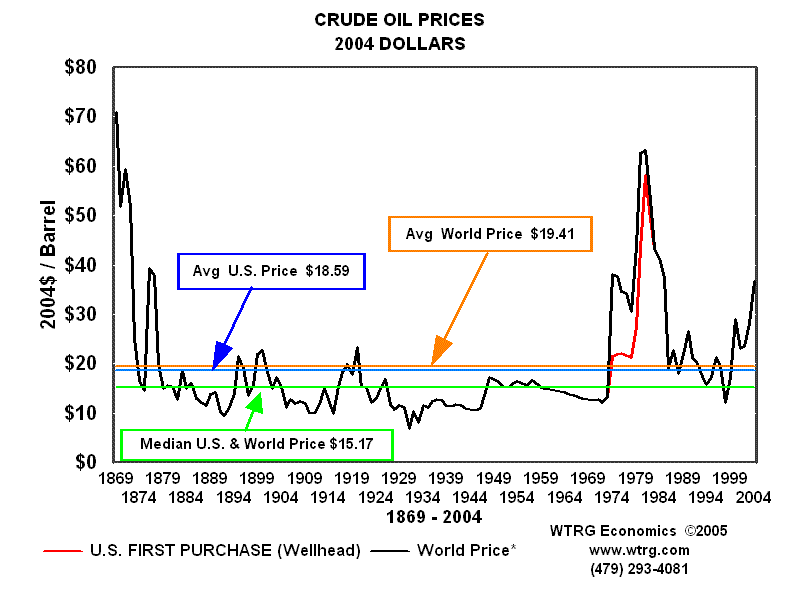
In order to see what might work, we need to start with a clear understanding of what has driven prices well beyond most experts' expectations, including mine. Rising prices have failed to halt the steady growth of global demand, because many of the countries in which demand is increasing fastest insulate their consumers from the global energy market. Nor has $100+ oil stimulated a flood of new production, because too much of the world's resource base is locked up by nationalist or environmentally-inspired barriers. To make matters much worse, important suppliers such as Nigeria are under-producing due to unrest, while Mexico and Russia are allowing their output to slip because of domestic politics. Instead of giving in to our frustration at these seemingly intractable problems, we can still have a positive impact on them, if we focus our efforts intelligently.
The controversy over food vs. fuel is an example of how tangled this mess has become. Governors and Senators worried about food prices have asked for relief from the aggressive Renewable Fuel Standard put in place by last year's Energy Bill. As sensible as that may seem for addressing consumer-level inflation and an unfolding global food crisis, it could push oil even higher. The market expects a couple of billion gallons of additional ethanol this year, the equivalent of about 100,000 barrels per day of oil. Curtailing that would hardly help high oil prices. So what could we do?
Start with ethanol. For all its many faults, it is an effective oil extender, because most of the energy that goes into making it comes from natural gas, not oil. The most immediately helpful action Congress could take on this front is not a reduction in the ethanol mandate, but a temporary suspension of the $0.54 per gallon ethanol import tariff. That might even address both fuel and food costs, by allowing in more Brazilian ethanol and shutting down the least efficient US ethanol plants. As I've noted previously, dropping the tariff would effectively mean subsidizing foreign ethanol producers, because of the way our ethanol blenders' credit is doled out, but this would cost only a fraction of the lost revenue associated with a summer fuel tax holiday. The volumes involved are small, in oil terms, but with oil prices determined at the margin, every little bit helps.
There might also be more practical and productive uses of America's international influence than prosecuting OPEC for anti-competitive behavior. Instead of pleading with or pressuring Gulf oil producers to increase output, we might talk to them about ending retail subsidies and letting their domestic fuel prices rise to market levels. That would slow down some of the fastest demand growth rates in the world, which are starting to erode oil exports from the Middle East. And if we treated the problems in the Niger Delta with the same urgency we apply to other geopolitical crises, we might be able to mediate a solution that would bring most of the half-million barrels of Nigerian production shut in by rebel action back online. Recent signals from the rebels have suggested that possibility. That would have a salutary effect on the oil market, which has a terminal case of the jitters these days.
Then there's the Strategic Petroleum Reserve. With oil at $120/bbl., it has become an absolute "no-brainer" to stop filling it. Even better, this is one of the few measures that could be accomplished virtually overnight, and it is entirely within the President's power to do so. The switch by the government from buyer to seller--putting the barrels acquired under its most recent royalty-swap contracts back into the market--might not knock $10/bbl. off the oil price, but in combination with a requirement to suspend SPR additions until oil is back under $100/barrel--or better yet, $80--it could help cool off speculation.
Assuming these remedies would actually have the desired effect, we still face an important dilemma with regard to energy prices. As important as fuel price relief seems in an economy already battered by the housing slump and accompanying credit crisis, our goal can't be reducing gasoline and diesel fuel prices to a level that stimulates demand that can't be met without lighting a new fire under crude oil. Furthermore, with a new administration likely to institute climate change policies that will increase energy prices, either directly or indirectly, the chief objection to high oil prices within policy circles is not that they are too high, but that the revenue is going to the wrong people: producing countries and oil companies, rather than the US Treasury. Consumers see this matter quite differently, and until we resolve that divergence of aims, our actions are likely to be as disjointed as our politics on this matter are schizophrenic.
Monday, April 14, 2008
Sharing the Climate Burden
A recent op-ed in the Asian Wall St. Journal raised some provocative questions about the allocation of responsibility for addressing climate change after the expiration of the Kyoto Protocol in 2012. While some might view the author's arguments as another effort to shift blame away from the US, EU and Japan, which together account for something like 60% of cumulative estimated emissions since industrialization, they highlight the challenges of dealing with this truly global problem in a world that is so inter-connected, and where economic activity no longer neatly aligns with national borders. This is a further indication of how difficult the essential task of crafting a successor to Kyoto is likely to be.
It's not unusual for advocates of an urgent response to climate change to treat such questions of international and inter-generational environmental equity as though the solutions were glaringly obvious. Yet when I assess the conflicting considerations involved, they look anything but simple. Because most greenhouse gases persist in the atmosphere for decades, with a few of them lasting thousands of years, historical emissions will affect the climate for many years and are thus clearly relevant to any allocation of responsibility for mitigating emissions. But emissions alone don't tell the whole story, without including widespread changes in land use that have altered the earth's ability to absorb both natural and man-made emissions. Including this factor for the period from 1950-2000 puts developing countries into a virtual tie with the industrialized nations in term of overall climate impact.
Nor does the inclusion of land-use changes resolve all questions of equity concerning historical emissions. Today's scientific consensus on anthropogenic climate change--widely but still not universally accepted--did not exist prior to the 1980s, and apportioning blame for emissions that predate that consensus seems unproductive. Holding current Americans and Europeans responsible for the consequences of emissions that were generated prior to the signing of the UN Framework Convention on Climate Change in Rio in 1992 seems at least as unfair as asking Chinese and Indians to take as much responsibility for their current and future emissions as developed countries must. While some might see a parallel to the duplicitous arguments of tobacco companies that knew for decades that their products were dangerous, the global warming theories of Arrhenius a century ago hardly count as a "smoking gun." There's legitimate disagreement about the point at which we should have known that fossil fuels and other activities were affecting the climate, but it was certainly no earlier than the last two decades.
Then there's the problem of offshored emissions. With a considerable share of the emissions from Asia's rapid industrialization attributable to products made for export markets in Europe and the US, who should bear responsibility for the CO2 and other greenhouse gases emitted along the way? Producers, who are often making slimmer margins than the retailers selling their output? Consumers, who have benefited from lower prices and thus seen their purchasing power rise, but have also seen jobs sent offshore? While an emissions cap & trade system with accompanying GHG-leveling tariff could resolve this conundrum going forward, by pricing this externality and letting the marketplace apportion it along the value chain, I can't begin to fathom how to allocate the emissions responsibility for the last decade of this phenomenon.
So if it's not fair to include historical emissions but it's equally unfair to ignore them, and with emissions from the developing world rapidly overtaking the developed world's--but including some ultimately attributable to the latter--where can we find middle ground from which to move ahead, together? Not in the past: the only emissions over which we have control are those that haven't occurred, yet. If the negotiations kicked off with the Bali Roadmap are diverted by arguments over history and fail to focus squarely on the output of the world's twenty or so largest emitters between now and 2050, then they will be fruitless, and we will need to shift our attention to more practical matters of adaptation and possible geo-engineering. We should know the outcome of this debate within a year or so.
It's not unusual for advocates of an urgent response to climate change to treat such questions of international and inter-generational environmental equity as though the solutions were glaringly obvious. Yet when I assess the conflicting considerations involved, they look anything but simple. Because most greenhouse gases persist in the atmosphere for decades, with a few of them lasting thousands of years, historical emissions will affect the climate for many years and are thus clearly relevant to any allocation of responsibility for mitigating emissions. But emissions alone don't tell the whole story, without including widespread changes in land use that have altered the earth's ability to absorb both natural and man-made emissions. Including this factor for the period from 1950-2000 puts developing countries into a virtual tie with the industrialized nations in term of overall climate impact.
Nor does the inclusion of land-use changes resolve all questions of equity concerning historical emissions. Today's scientific consensus on anthropogenic climate change--widely but still not universally accepted--did not exist prior to the 1980s, and apportioning blame for emissions that predate that consensus seems unproductive. Holding current Americans and Europeans responsible for the consequences of emissions that were generated prior to the signing of the UN Framework Convention on Climate Change in Rio in 1992 seems at least as unfair as asking Chinese and Indians to take as much responsibility for their current and future emissions as developed countries must. While some might see a parallel to the duplicitous arguments of tobacco companies that knew for decades that their products were dangerous, the global warming theories of Arrhenius a century ago hardly count as a "smoking gun." There's legitimate disagreement about the point at which we should have known that fossil fuels and other activities were affecting the climate, but it was certainly no earlier than the last two decades.
Then there's the problem of offshored emissions. With a considerable share of the emissions from Asia's rapid industrialization attributable to products made for export markets in Europe and the US, who should bear responsibility for the CO2 and other greenhouse gases emitted along the way? Producers, who are often making slimmer margins than the retailers selling their output? Consumers, who have benefited from lower prices and thus seen their purchasing power rise, but have also seen jobs sent offshore? While an emissions cap & trade system with accompanying GHG-leveling tariff could resolve this conundrum going forward, by pricing this externality and letting the marketplace apportion it along the value chain, I can't begin to fathom how to allocate the emissions responsibility for the last decade of this phenomenon.
So if it's not fair to include historical emissions but it's equally unfair to ignore them, and with emissions from the developing world rapidly overtaking the developed world's--but including some ultimately attributable to the latter--where can we find middle ground from which to move ahead, together? Not in the past: the only emissions over which we have control are those that haven't occurred, yet. If the negotiations kicked off with the Bali Roadmap are diverted by arguments over history and fail to focus squarely on the output of the world's twenty or so largest emitters between now and 2050, then they will be fruitless, and we will need to shift our attention to more practical matters of adaptation and possible geo-engineering. We should know the outcome of this debate within a year or so.
Tuesday, November 27, 2007
Equalizing the Cost of Emissions
One of the few benefits of air travel these days is the opportunity to catch up on one's reading. This trip I took along a few back issues of the Economist, the most recent of which included an article criticizing a key aspect of pending US climate change legislation as "Green protectionism." While I often agree with its editorial positions, I think the Economist misses the mark on the Lieberman-Warner Bill, which I examined here a couple of weeks ago. If viewed purely as trade policy, they might be correct about its provision to assess an emissions charge on imports into the US. However, they assign too little importance to its role in neutralizing US critics of climate agreements. This could prove to be the key to enabling a more aggressive US response to climate change.
The Economist strongly supports the idea of pricing carbon emissions by means of cap & trade mechanisms, but they raise two reasonable arguments--one stronger than the other--against the imposition of a trade barrier along the lines contemplated in the Lieberman-Warner climate bill. They see little incentive over the long-term for emissions-intensive industries to flee a cap & trade system, on the basis that environmental regulation has not been bad for economic growth in the past. Fair enough, though regulating the primary byproduct of combustion works on a vastly different scale than dealing with fuel or exhaust impurities. They also appear to doubt the necessity of external financial pressures to compel China and India, among others, to regulate their emissions, arguing that the US is not now approaching emissions regulations because of such pressure from Europe.
However, it is precisely the need to break the who-goes-first deadlock between the US and developing Asia with regard to binding commitments on emissions reductions that the trade element of Lieberman-Warner seems both pragmatic and sensible, even as a short-term measure that could be phased out once all major emitting countries are on board. And by denying domestic climate change critics the cover of rapidly growing emissions from China and India, it could finally clear the way for a federal emissions policy as tough as that of some of the states, and also for full US participation in the follow-on agreement to the Kyoto Protocol.
The Economist is right to be concerned about the protectionist rhetoric emanating from several of the presidential campaigns and from influential groups such as labor unions, but I believe they err in attributing this aspect of Lieberman-Warner to the populist-protectionist camp. The cap & trade mechanism is aimed squarely at a major unpriced externality in our market system, and emissions-equalizing import assessments would merely globalize the treatment of that externality, closing an obvious loophole. And while some believe that China and India would bow to the moral authority of a US government that has joined with other developed countries to regulate our own emissions, the more pragmatic path to their necessary participation lies in helping to monetize that same externality for them.
The Economist strongly supports the idea of pricing carbon emissions by means of cap & trade mechanisms, but they raise two reasonable arguments--one stronger than the other--against the imposition of a trade barrier along the lines contemplated in the Lieberman-Warner climate bill. They see little incentive over the long-term for emissions-intensive industries to flee a cap & trade system, on the basis that environmental regulation has not been bad for economic growth in the past. Fair enough, though regulating the primary byproduct of combustion works on a vastly different scale than dealing with fuel or exhaust impurities. They also appear to doubt the necessity of external financial pressures to compel China and India, among others, to regulate their emissions, arguing that the US is not now approaching emissions regulations because of such pressure from Europe.
However, it is precisely the need to break the who-goes-first deadlock between the US and developing Asia with regard to binding commitments on emissions reductions that the trade element of Lieberman-Warner seems both pragmatic and sensible, even as a short-term measure that could be phased out once all major emitting countries are on board. And by denying domestic climate change critics the cover of rapidly growing emissions from China and India, it could finally clear the way for a federal emissions policy as tough as that of some of the states, and also for full US participation in the follow-on agreement to the Kyoto Protocol.
The Economist is right to be concerned about the protectionist rhetoric emanating from several of the presidential campaigns and from influential groups such as labor unions, but I believe they err in attributing this aspect of Lieberman-Warner to the populist-protectionist camp. The cap & trade mechanism is aimed squarely at a major unpriced externality in our market system, and emissions-equalizing import assessments would merely globalize the treatment of that externality, closing an obvious loophole. And while some believe that China and India would bow to the moral authority of a US government that has joined with other developed countries to regulate our own emissions, the more pragmatic path to their necessary participation lies in helping to monetize that same externality for them.
Tuesday, July 31, 2007
Our Energy Omelet
Today's Washington Post cast some serious doubts on the environmental sustainability of producing ethanol from Brazilian sugar cane, demonstrating yet again that when it comes to energy, the temporary resemblance of any option to a silver bullet usually only reflects our poor understanding of its consequences. The cost in this case is the potential deforestation of the Cerrado, Brazil's non-rainforest plateau. While Brazilian cane ethanol clearly has a role to play in the world's future energy balance, this prospect should remind us that meeting the world's daily energy demand entails breaking eggs on a vast scale. Despite the growing sophistication of the public and our leaders on energy matters, the discussion is still not being framed in terms of the hard trade-offs involved.
Since ethanol has become the cornerstone of US energy policy, let's look at the size of the problem relative to the ethanol volumes we hear bandied about in the news and on the floor of Congress. The US currently produces about 6 billion gallons of ethanol, mostly from corn. The administration and Senate want to expand this volume six-fold. It's not clear that we can do that without a large contribution from cellulosic ethanol technology that is not yet commercial, but let's assume it could all come from corn. At a yield of about 2.7 gallons per bushel, this would consume 13 billion bushels annually, roughly equal to at least one estimate for the entire 2007 corn crop, planted on 90 million acres, or about 20% of total US cropland. So if it were all planted in corn for ethanol, our current agricultural land would yield something less than 200 billion gallons per year. That's a big number, but put it in perspective. The US uses 100 quadrillion BTUs per year of energy. That equates to 1.25 trillion gallons of ethanol on volume alone. Replacing the actual net BTUs from fossil fuels would require roughly 3.5 trillion gallons of ethanol, based on its current energy yield of 1.3:1 (energy return on energy invested.)
Of course, this is an absurd comparison, because we're not going to grow corn to make ethanol to feed power plants, home furnaces, or factories. The point here is to emphasize just how large the implied equivalent agricultural footprint of our energy consumption is. If we want an appreciable fraction of those needs to be met with biofuels, even if the actual crops involved are not corn, but Brazilian cane or US switchgrass--both of which are much more efficient net energy producers than corn--it's still a big footprint. And make no mistake, as long as oil prices remain high and federal incentives are in place, the market will deliver it, even if it has to overcome an import tariff to do it.
For all of our new-found environmental concern relating to climate change, I have yet to hear any politician debate how the total environmental impact of greatly increased biofuels output--including all land, water, and air impacts--compares to the environmental footprint of getting the same quantity of energy from natural gas drilling in protected areas, from large offshore wind farms, or new nuclear power plants, among our other choices. None of those options are silver bullets, either, but they could all be part of the mix, along with biofuels. Unless we talk about it in these terms, how can we be sure that the mix of broken eggs we're implicitly choosing is really the one we want? We ought to discuss this now, rather than after the Cerrado has all been planted in cane to power our cars.
Since ethanol has become the cornerstone of US energy policy, let's look at the size of the problem relative to the ethanol volumes we hear bandied about in the news and on the floor of Congress. The US currently produces about 6 billion gallons of ethanol, mostly from corn. The administration and Senate want to expand this volume six-fold. It's not clear that we can do that without a large contribution from cellulosic ethanol technology that is not yet commercial, but let's assume it could all come from corn. At a yield of about 2.7 gallons per bushel, this would consume 13 billion bushels annually, roughly equal to at least one estimate for the entire 2007 corn crop, planted on 90 million acres, or about 20% of total US cropland. So if it were all planted in corn for ethanol, our current agricultural land would yield something less than 200 billion gallons per year. That's a big number, but put it in perspective. The US uses 100 quadrillion BTUs per year of energy. That equates to 1.25 trillion gallons of ethanol on volume alone. Replacing the actual net BTUs from fossil fuels would require roughly 3.5 trillion gallons of ethanol, based on its current energy yield of 1.3:1 (energy return on energy invested.)
Of course, this is an absurd comparison, because we're not going to grow corn to make ethanol to feed power plants, home furnaces, or factories. The point here is to emphasize just how large the implied equivalent agricultural footprint of our energy consumption is. If we want an appreciable fraction of those needs to be met with biofuels, even if the actual crops involved are not corn, but Brazilian cane or US switchgrass--both of which are much more efficient net energy producers than corn--it's still a big footprint. And make no mistake, as long as oil prices remain high and federal incentives are in place, the market will deliver it, even if it has to overcome an import tariff to do it.
For all of our new-found environmental concern relating to climate change, I have yet to hear any politician debate how the total environmental impact of greatly increased biofuels output--including all land, water, and air impacts--compares to the environmental footprint of getting the same quantity of energy from natural gas drilling in protected areas, from large offshore wind farms, or new nuclear power plants, among our other choices. None of those options are silver bullets, either, but they could all be part of the mix, along with biofuels. Unless we talk about it in these terms, how can we be sure that the mix of broken eggs we're implicitly choosing is really the one we want? We ought to discuss this now, rather than after the Cerrado has all been planted in cane to power our cars.
Thursday, April 26, 2007
A Superfluous Subsidy
While listening to the podcast of a recent conference call with the President of the American Petroleum Institute, a question from one of the participating bloggers provoked one of those slap-your-forehead moments for me. Robert Rapier, who writes the R-Squared Energy Blog, asked why ethanol still needed a subsidy, since its use is now mandatory under the new Renewable Fuels Standard (RFS) regulation in the US. It bothers me that when I was dissecting the RFS the other day, this never occurred to me. Mr. Rapier's question seems highly appropriate, since ethanol is now required under not one, but two federal fuel regulations, along with various state and local rules. It's hard to avoid the conclusion that, with ethanol production booming, it doesn't require three support mechanisms, and so the subsidy should go.
As I described last week, the new national RFS sets an annual quantity of alternative fuel--which today means principally ethanol--that must be blended into gasoline, starting with 4 billion gallons in 2006 and rising each year. Anyone caught short must buy credits from another blender who used more ethanol than required. At the same time, however, most of the present ethanol supply is used to satisfy the oxygenate specification under EPA and state reformulated gasoline (RFG) regulations. So ethanol producers have a guaranteed market on two levels: the amount required for RFG and an overlapping and steadily increasing quantity set by the RFS. And that is now in addition to the 51 cent per gallon Volumetric Ethanol Excise Tax Credit, which effectively subsidizes production of fuel ethanol by enabling refiners and blenders to pay more for it than it is worth as a gasoline extender. How many other businesses would like to have the government pay them to make something, and then force their customers to buy it?
The US ethanol market would eventually look very different without the subsidy. Let's start with some numbers. Eyeballing the chart for the May ethanol contract on the Chicago Board of Trade exchange, ethanol was going for about $2.20/gallon (delivered in storage in Chicago) when the comparable wholesale gasoline futures contract for May was trading for an average of $1.92/gallon in New York. Considering that rail freight can add another 10-15 cents/gal. to the price of ethanol delivered to the blending location, incorporating 10% into gasoline raises its cost by about 4 cents/gallon, offset slightly by ethanol's higher octane rating. In today's market, the difference is covered by a 5 cent contribution from the excise tax credit.
Absent the subsidy, several things would have to happen. First, since the demand for ethanol required to meet oxygenated fuel specifications would not change, ethanol sellers into that segment should be able to hold their prices, while refiners would see their net cost of producing marketable gasoline rise. Eventually, the ethanol price for this segment would settle out at a level equivalent to the gasoline price plus the market value of the new, traded Renewable Identification Number attribute created by the RFS. Most of the resulting increase in gasoline cost would eventually be passed on to consumers.
Once the ethanol supply exceeds the quantity necessary to back out any remaining MTBE from the oxygenate requirement--somewhere around 6 billions gallons of ethanol per year--the price of any production in excess of the national RFS quota would fall toward parity with gasoline, plus a small premium for its octane value. Some of the surplus might end up in E-85, which at least for now commands a premium price, but the resulting price pressure would eventually trigger a shakeout among ethanol suppliers. Large, efficient (newer) ethanol producers would win, and some small producers with higher costs would go out of business, or have to idle their facilities until the expanding RFS quota broadened the mandated market enough to include them.
To complicate the picture further, if the subsidy were lifted, it would be hard to justify maintaining the 54 cent tariff on imported ethanol. If that were repealed, marginal US suppliers would find themselves under even more pressure, and they would lose share to imports that might come in at a low enough price to compete into gasoline on blending value alone.
But if small ethanol operators could ultimately lose from the end of the subsidy, who would win? Not the oil companies, which stand to see their blending costs increase, perhaps by more than they can recover in the marketplace. Although some foreign ethanol producers might benefit, the biggest winners would be the US economy and taxpayers. We'd get all the ethanol necessary for environmental and energy security purposes at the most efficient price, and at an immediate federal budget savings of $2.5 billion/year, and growing. At that point, the only remaining argument for continuing the subsidy would be to protect the least efficient domestic producers from competition, at a very high effective cost per gallon.
As I described last week, the new national RFS sets an annual quantity of alternative fuel--which today means principally ethanol--that must be blended into gasoline, starting with 4 billion gallons in 2006 and rising each year. Anyone caught short must buy credits from another blender who used more ethanol than required. At the same time, however, most of the present ethanol supply is used to satisfy the oxygenate specification under EPA and state reformulated gasoline (RFG) regulations. So ethanol producers have a guaranteed market on two levels: the amount required for RFG and an overlapping and steadily increasing quantity set by the RFS. And that is now in addition to the 51 cent per gallon Volumetric Ethanol Excise Tax Credit, which effectively subsidizes production of fuel ethanol by enabling refiners and blenders to pay more for it than it is worth as a gasoline extender. How many other businesses would like to have the government pay them to make something, and then force their customers to buy it?
The US ethanol market would eventually look very different without the subsidy. Let's start with some numbers. Eyeballing the chart for the May ethanol contract on the Chicago Board of Trade exchange, ethanol was going for about $2.20/gallon (delivered in storage in Chicago) when the comparable wholesale gasoline futures contract for May was trading for an average of $1.92/gallon in New York. Considering that rail freight can add another 10-15 cents/gal. to the price of ethanol delivered to the blending location, incorporating 10% into gasoline raises its cost by about 4 cents/gallon, offset slightly by ethanol's higher octane rating. In today's market, the difference is covered by a 5 cent contribution from the excise tax credit.
Absent the subsidy, several things would have to happen. First, since the demand for ethanol required to meet oxygenated fuel specifications would not change, ethanol sellers into that segment should be able to hold their prices, while refiners would see their net cost of producing marketable gasoline rise. Eventually, the ethanol price for this segment would settle out at a level equivalent to the gasoline price plus the market value of the new, traded Renewable Identification Number attribute created by the RFS. Most of the resulting increase in gasoline cost would eventually be passed on to consumers.
Once the ethanol supply exceeds the quantity necessary to back out any remaining MTBE from the oxygenate requirement--somewhere around 6 billions gallons of ethanol per year--the price of any production in excess of the national RFS quota would fall toward parity with gasoline, plus a small premium for its octane value. Some of the surplus might end up in E-85, which at least for now commands a premium price, but the resulting price pressure would eventually trigger a shakeout among ethanol suppliers. Large, efficient (newer) ethanol producers would win, and some small producers with higher costs would go out of business, or have to idle their facilities until the expanding RFS quota broadened the mandated market enough to include them.
To complicate the picture further, if the subsidy were lifted, it would be hard to justify maintaining the 54 cent tariff on imported ethanol. If that were repealed, marginal US suppliers would find themselves under even more pressure, and they would lose share to imports that might come in at a low enough price to compete into gasoline on blending value alone.
But if small ethanol operators could ultimately lose from the end of the subsidy, who would win? Not the oil companies, which stand to see their blending costs increase, perhaps by more than they can recover in the marketplace. Although some foreign ethanol producers might benefit, the biggest winners would be the US economy and taxpayers. We'd get all the ethanol necessary for environmental and energy security purposes at the most efficient price, and at an immediate federal budget savings of $2.5 billion/year, and growing. At that point, the only remaining argument for continuing the subsidy would be to protect the least efficient domestic producers from competition, at a very high effective cost per gallon.
Thursday, February 08, 2007
Ethanol Tariffs and Trade
Today's Washington Post reports that US and Brazilian officials are meeting this week in talks on a new biofuels energy partnership, with the aim of increasing biofuels use and trade between the US and Latin America. This seems a laudable goal, in light of our commitment to increase our ethanol use and given the greater efficiency of producing ethanol from cane in the tropics. Although you might guess that one of the key topics of conversation at this trade session would be the $0.54/gallon US tariff on imported ethanol, the article indicates this is not on the table. There's a good reason for that. The tariff is an integral part of the US ethanol incentive system, which is here to stay. Repealing the tariff would create a loophole that would effectively subsidize Brazilians to compete with American farmers. Imagine the headlines and sound-bites that would generate.
Our ethanol subsidy structure has evolved over the nearly 30 years since it was created. The current $0.51/gallon federal Volumetric Ethanol Excise Tax Credit (VEETC) was established by the American Jobs Creation Act of 2004 and reinforced by the Energy Policy Act of 2005. Under this system, the tax credit is issued to those who blend ethanol into gasoline at any fraction, including but not limited to the popular 10% (E-10) and 85% (E-85) blends. US ethanol producers benefit indirectly by charging a higher price for their product than they otherwise could, effectively receiving the 51 cents without having to file to get it. The current tariff prevents a blender from importing cheaper foreign ethanol, selling it at the domestic market price, and pocketing a subsidy that was intended to help US agriculture. The other way to look at this is that the net tariff on imported ethanol is really a modest 3 cents per gallon, after the blender collects the VEETC.
Our ethanol imports from Brazil have reached 1.7 billion gallons per year (110,000 barrels/day) in spite of the tariff, and that probably has as much to do with the cost of transporting domestic ethanol from the Midwest to coastal markets as with any inherent US ethanol shortage, which will rapidly disappear as new capacity comes online in the next year or two. It also reflects the lower cost of producing ethanol from sugar cane, which contrary to some assertions about its environmental impact, can apparently be grown in a sustainable fashion, with a higher energy return on energy invested (EROEI) than for corn ethanol, or even for fossil fuels.
I hope the Brazil/US ethanol discussions are fruitful. This is the kind of trade we should be promoting, and it adds at least in a small way to the diversification of our energy supply, which has been the most successful energy strategy we have pursued since the 1970s. More importantly, market pressure from expanding ethanol trade with Brazil, along with the prospect of having to compete with cellulosic ethanol later, should give US farmers and corn-ethanol producers ample incentives to become much more efficient, reducing their energy inputs and consuming a smaller fraction of a larger corn crop. That should help minimize ethanol's looming impact on food prices, while improving its contribution to reducing greenhouse gas emissions.
Our ethanol subsidy structure has evolved over the nearly 30 years since it was created. The current $0.51/gallon federal Volumetric Ethanol Excise Tax Credit (VEETC) was established by the American Jobs Creation Act of 2004 and reinforced by the Energy Policy Act of 2005. Under this system, the tax credit is issued to those who blend ethanol into gasoline at any fraction, including but not limited to the popular 10% (E-10) and 85% (E-85) blends. US ethanol producers benefit indirectly by charging a higher price for their product than they otherwise could, effectively receiving the 51 cents without having to file to get it. The current tariff prevents a blender from importing cheaper foreign ethanol, selling it at the domestic market price, and pocketing a subsidy that was intended to help US agriculture. The other way to look at this is that the net tariff on imported ethanol is really a modest 3 cents per gallon, after the blender collects the VEETC.
Our ethanol imports from Brazil have reached 1.7 billion gallons per year (110,000 barrels/day) in spite of the tariff, and that probably has as much to do with the cost of transporting domestic ethanol from the Midwest to coastal markets as with any inherent US ethanol shortage, which will rapidly disappear as new capacity comes online in the next year or two. It also reflects the lower cost of producing ethanol from sugar cane, which contrary to some assertions about its environmental impact, can apparently be grown in a sustainable fashion, with a higher energy return on energy invested (EROEI) than for corn ethanol, or even for fossil fuels.
I hope the Brazil/US ethanol discussions are fruitful. This is the kind of trade we should be promoting, and it adds at least in a small way to the diversification of our energy supply, which has been the most successful energy strategy we have pursued since the 1970s. More importantly, market pressure from expanding ethanol trade with Brazil, along with the prospect of having to compete with cellulosic ethanol later, should give US farmers and corn-ethanol producers ample incentives to become much more efficient, reducing their energy inputs and consuming a smaller fraction of a larger corn crop. That should help minimize ethanol's looming impact on food prices, while improving its contribution to reducing greenhouse gas emissions.
Thursday, February 01, 2007
Ethanol Supply Chain
Because of the problems involved in transporting ethanol in petroleum product pipelines, the key piece of infrastructure for our chosen fuel of the future is the railroad. Who would have guessed that the 21st century would owe such a debt to the 19th? Today's Wall Street Journal includes two articles describing the transportation hurdles and import barriers that ethanol will have to overcome to expand to the extent contemplated by the White House and Congress. High energy prices and environmental concerns are providing rail companies with wonderful new opportunities, but I hope their strategic planners are thinking carefully about where this could lead. Somewhere along the road to 35 billion gallons per year, the conventional wisdom about ethanol and pipelines will be challenged, perhaps in ways no one expects.
In some respects the development of ethanol is recapitulating the growth of petroleum a century ago. Although pipelines came along fairly early in the history of the oil industry, rail transport was a key supply chain link from its start in Pennsylvania, and it never went away. My first assignment after joining Texaco's Supply and Distribution department in the early 1980s involved trading LPG in tank car lots, and later I dealt with unit-trains of crude oil going from Bakersfield to Los Angeles. As interesting as all this was, I quickly discovered that trains are a lot more expensive and less reliable than pipelines, and I'm sure the ethanol industry is learning the same lessons. The incentives to shift from rail to pipeline will only grow, as ethanol volumes increase.
Besides its well-known incompatibility problems, ethanol faces other hurdles in shifting to pipelines. As crude oil production in the key ethanol producing region, including states like Illinois, Indiana, Kansas and Nebraska, declined from a million barrels per day in 1980s to less than half that today, existing oil pipelines were reversed and new ones built to supply the region's refineries with imported oil from Canada or the Gulf Coast ports. And the main petroleum product pipelines in the mid-continent flow north from the Gulf. That means that most of pipeline capacity between the Midwest, where ethanol is produced, and the Gulf Coast, where a third of America's gasoline is made, is going the wrong direction to help ethanol producers. As long as ethanol accounts for less than 2% of the country's liquid fuel supply, it can't win that battle.
As it grows, however, this impediment will turn into an opportunity, and some clever entrepreneurs will figure out that ethanol pipelines can share a right-of-way with crude and products lines going the other way. How big is the incentive? Ignoring transshipment costs and tank car rental fees, shipping ethanol from St. Louis to Houston by rail costs about 12 cents/gallon. Shipping gasoline from Houston to St. Louis on the Explorer Pipeline costs 3.5 cents. 8.5 cents per gallon would pay for a lot of pipe. And with ethanol being totally biodegradable, they might even be able to use cheaper materials to build their pipelines and the gathering systems needed to collect the ethanol from its widely dispersed sources. In any case, ethanol pipelines would face a significantly easier permitting process than anything involving oil or its refined products. If I were running a railroad, I'd enjoy those tariffs while I could, and start thinking hard about laying dedicated ethanol pipe.
In some respects the development of ethanol is recapitulating the growth of petroleum a century ago. Although pipelines came along fairly early in the history of the oil industry, rail transport was a key supply chain link from its start in Pennsylvania, and it never went away. My first assignment after joining Texaco's Supply and Distribution department in the early 1980s involved trading LPG in tank car lots, and later I dealt with unit-trains of crude oil going from Bakersfield to Los Angeles. As interesting as all this was, I quickly discovered that trains are a lot more expensive and less reliable than pipelines, and I'm sure the ethanol industry is learning the same lessons. The incentives to shift from rail to pipeline will only grow, as ethanol volumes increase.
Besides its well-known incompatibility problems, ethanol faces other hurdles in shifting to pipelines. As crude oil production in the key ethanol producing region, including states like Illinois, Indiana, Kansas and Nebraska, declined from a million barrels per day in 1980s to less than half that today, existing oil pipelines were reversed and new ones built to supply the region's refineries with imported oil from Canada or the Gulf Coast ports. And the main petroleum product pipelines in the mid-continent flow north from the Gulf. That means that most of pipeline capacity between the Midwest, where ethanol is produced, and the Gulf Coast, where a third of America's gasoline is made, is going the wrong direction to help ethanol producers. As long as ethanol accounts for less than 2% of the country's liquid fuel supply, it can't win that battle.
As it grows, however, this impediment will turn into an opportunity, and some clever entrepreneurs will figure out that ethanol pipelines can share a right-of-way with crude and products lines going the other way. How big is the incentive? Ignoring transshipment costs and tank car rental fees, shipping ethanol from St. Louis to Houston by rail costs about 12 cents/gallon. Shipping gasoline from Houston to St. Louis on the Explorer Pipeline costs 3.5 cents. 8.5 cents per gallon would pay for a lot of pipe. And with ethanol being totally biodegradable, they might even be able to use cheaper materials to build their pipelines and the gathering systems needed to collect the ethanol from its widely dispersed sources. In any case, ethanol pipelines would face a significantly easier permitting process than anything involving oil or its refined products. If I were running a railroad, I'd enjoy those tariffs while I could, and start thinking hard about laying dedicated ethanol pipe.
Subscribe to:
Posts (Atom)