Has the high cost of fuel got you down? Why not buy your own oil refinery? That's apparently what Delta Air Lines is considering. With jet fuel purchases constituting one of the largest operating costs for carriers like Delta, and with several refineries in the Northeast US facing permanent closure due to poor profitability, it's not hard to see why this idea would seem attractive, at least superficially. However, there are a host of reasons why most of the press I've seen on this story is negative, including today's Heard on the Street column in the Wall St. Journal, entitled, "Delta Chases Fuel's Gold." The fundamental problem is the same one that has made me skeptical about the benefits of airlines investing in the production of renewable aviation fuel: Any advantageous pricing they may choose to provide to their airline division must come at the expense of lost opportunities for the fuels business, because the value of that fuel is set by the market.
How a company should reflect such opportunity costs in its inter-departmental transfer pricing is an age-old problem. I dealt with this routinely when I traded refined products for Texaco's west coast refining and marketing business in the 1980s. The marketing department always wanted to receive the output of the refineries at a lower price than we were charging them, so that they could capture market share and justify investments in new and remodeled gas stations. But making them look good at the cost of the refineries just made it harder to justify the investments needed to keep the refineries operating efficiently and in compliance with current and future regulations. Delta might buy ConocoPhillips' Pennsylvania refinery at a low price today, but they could be forced to invest at least as much within a few years to meet new gasoline sulfur regulations or other changes. It doesn't trivialize the situation to put it into the category of no free lunches.
Then there's the question of reorienting a refinery to make a lot more jet fuel that it has done historically, as one article suggested Delta was considering. Modern refineries are fairly flexible, and it would be possible to do that to some degree, though within limits that would require significant investments to exceed, making the proposition look much less attractive. Moreover, refineries optimize their output every day to make the slate of products that yields the highest profit, as crude and product prices fluctuate. Steering a less flexible course would almost certainly make the facility less, not more profitable, and it's only on the market because it wasn't sufficiently profitable as it was.
The only scenario in which I could see this idea actually working to Delta's benefit is if the refinery closures now being planned tightened the supply of jet fuel into the New York market so significantly that Delta was able to effectively corner that market, forcing other airlines to pay it a significant premium, either in cash or in jet fuel supply in other locations, while artificially keeping costs for its own flight operations low and allowing it to expand its share of the important NY air market. But New York isn't some isolated inland location, and they'd always be competing with jet fuel cargoes brought in by vessel, or with fuel shipped from Gulf Coast refineries via the Colonial Pipeline, which is expanding to meet the new demand its faces in light of the pending refinery closures. They might eke out a few extra cents, but would that be enough to justify taking on the enormous capital and operating costs--not to mention the substantial operating risks--of owning a refinery? If Delta has discovered some enticing angle I've missed, I'd love to know what it is.
Showing posts with label jet fuel. Show all posts
Showing posts with label jet fuel. Show all posts
Friday, April 06, 2012

Wednesday, May 18, 2011
Fueling the Aerotropolis
Roger Cohen's column in Monday's New York Times sent my mind spinning with its portrayal of a global network of airport-based businesses and organizations that might have closer links to airports a country or continent away than with the traditional urban centers for which these facilities are often named. I'm embarrassed to admit that it was the first time I had run across the "Aerotropolis" concept, which has apparently been around since 2000. Its implications are thought-provoking, not least for their impact on energy and the environment.
The term aerotropolis was apparently coined by a professor at the University of North Carolina business school; it's also the title and subject of his new book. It evokes a retro-1920s science fiction vision of gleaming cities connected by flying cylinders, crossed with the gritty reality of the modern airport and its environs. I wasn't surprised to learn that a third of world trade-- though just 1% by weight--moves by air, but the idea of a hospital integrated into an airport in Hyderabad, India, or an entire city in South Korea growing up around the Incheon International Airport was new to me. The possibilities seem endless, though I can't think about them without also considering where the energy to facilitate the implied explosion of air travel and air freight will come from.
A few years ago, I would have said that air travel was even more closely linked to petroleum than are automobiles. That's not because alternative aviation fuels seemed impossible--quite the contrary--but because the aviation world has historically been understandably cautious and conservative about what goes into the engines that power aircraft. From a technical standpoint, jet turbines offer a great deal more fuel flexibility than the internal combustion engines under the hoods of most automobiles. However, while a fuel failure in your car is a major inconvenience, a fuel failure at 30,000 feet is catastrophic. In some respects the alacrity with which the aviation industry has begun to embrace alternative fuels is nearly as big a surprise as the shale gas revolution, and perhaps ultimately as transformative. Airlines and militaries have entered partnerships and set targets for integrating alternative jet fuel into their consumption, and supplies are gradually appearing.
Scale remains an issue. Kerosene-based jet fuel accounted for 7% of US petroleum consumption last year, down from nearly 8.5% a decade ago, as air carriers have transitioned to more efficient aircraft and higher load factors. That's still a big volume, though it turns out to be easier to make suitable kerosene substitutes from a variety of sources, including natural gas, coal and biomass, than to make comparable substitutes for gasoline. Nor does jet fuel produced from camelina seeds, algae, or the gasification and FT-synthesis of bulk biomass, natural gas or even animal fat entail the kind of performance penalties inherent in our primary gasoline alternative, ethanol. Delivering on this potential will require significant investment, but of a magnitude that seems much more achievable than what is required for many other renewable energy goals.
Another important aspect of scale concerns the logistics of gathering enough biomass to produce meaningful quantities of "biojet". The government of Ontario Province just awarded Rentech, Inc., a company with long expertise in gasification and fuel synthesis, a 1.3 million ton-per-year supply of forest waste and other biomass from Canada's Crown Forests, specifically for the production of renewable jet fuel. The proposed facility would produce around 22 million gallons per year of biojet, along with another 11 million gallons of non-jet products. That equates to roughly 1% of Canada's current jet fuel consumption. Canada might have enough forest biomass available to produce a sizable fraction of its jet fuel needs from such sources, but other countries don't, so it's fortunate that alternative jet fuel can be made through so many different pathways.
That's also fortunate for the aerotropolis concept, because without an incremental supply of non-petroleum jet fuel, meeting the energy needs inherent in this idea without dramatic increases in aviation's current approximately 3% share of global greenhouse gas emissions could become a major obstacle within just a few years. With sufficient supplies of renewable and gas-to-liquids jet fuel, the concept might even be able to withstand a peak in global oil output, even if the price of such alternatives seems likely to track that of oil-based jet fuel.
The term aerotropolis was apparently coined by a professor at the University of North Carolina business school; it's also the title and subject of his new book. It evokes a retro-1920s science fiction vision of gleaming cities connected by flying cylinders, crossed with the gritty reality of the modern airport and its environs. I wasn't surprised to learn that a third of world trade-- though just 1% by weight--moves by air, but the idea of a hospital integrated into an airport in Hyderabad, India, or an entire city in South Korea growing up around the Incheon International Airport was new to me. The possibilities seem endless, though I can't think about them without also considering where the energy to facilitate the implied explosion of air travel and air freight will come from.
A few years ago, I would have said that air travel was even more closely linked to petroleum than are automobiles. That's not because alternative aviation fuels seemed impossible--quite the contrary--but because the aviation world has historically been understandably cautious and conservative about what goes into the engines that power aircraft. From a technical standpoint, jet turbines offer a great deal more fuel flexibility than the internal combustion engines under the hoods of most automobiles. However, while a fuel failure in your car is a major inconvenience, a fuel failure at 30,000 feet is catastrophic. In some respects the alacrity with which the aviation industry has begun to embrace alternative fuels is nearly as big a surprise as the shale gas revolution, and perhaps ultimately as transformative. Airlines and militaries have entered partnerships and set targets for integrating alternative jet fuel into their consumption, and supplies are gradually appearing.
Scale remains an issue. Kerosene-based jet fuel accounted for 7% of US petroleum consumption last year, down from nearly 8.5% a decade ago, as air carriers have transitioned to more efficient aircraft and higher load factors. That's still a big volume, though it turns out to be easier to make suitable kerosene substitutes from a variety of sources, including natural gas, coal and biomass, than to make comparable substitutes for gasoline. Nor does jet fuel produced from camelina seeds, algae, or the gasification and FT-synthesis of bulk biomass, natural gas or even animal fat entail the kind of performance penalties inherent in our primary gasoline alternative, ethanol. Delivering on this potential will require significant investment, but of a magnitude that seems much more achievable than what is required for many other renewable energy goals.
Another important aspect of scale concerns the logistics of gathering enough biomass to produce meaningful quantities of "biojet". The government of Ontario Province just awarded Rentech, Inc., a company with long expertise in gasification and fuel synthesis, a 1.3 million ton-per-year supply of forest waste and other biomass from Canada's Crown Forests, specifically for the production of renewable jet fuel. The proposed facility would produce around 22 million gallons per year of biojet, along with another 11 million gallons of non-jet products. That equates to roughly 1% of Canada's current jet fuel consumption. Canada might have enough forest biomass available to produce a sizable fraction of its jet fuel needs from such sources, but other countries don't, so it's fortunate that alternative jet fuel can be made through so many different pathways.
That's also fortunate for the aerotropolis concept, because without an incremental supply of non-petroleum jet fuel, meeting the energy needs inherent in this idea without dramatic increases in aviation's current approximately 3% share of global greenhouse gas emissions could become a major obstacle within just a few years. With sufficient supplies of renewable and gas-to-liquids jet fuel, the concept might even be able to withstand a peak in global oil output, even if the price of such alternatives seems likely to track that of oil-based jet fuel.
Monday, May 10, 2010
How Fast a Transition from Oil?
The Gulf Coast oil spill remains the top energy story this week, eclipsing a $10 drop in oil prices that should soon ripple through to gas pumps near you. With BP's latest effort to contain the spill having run afoul of a slush buildup composed of methane hydrate crystals, the deepwater well continues to leak at an undetermined rate. The longer the spill continues, the greater the chances for severe environmental consequences, and the likelier that it will become a perception-altering milestone event as some environmentalists have already suggested. However, even if the spill were to galvanize public opinion in a manner similar to the 1969 Santa Barbara oil spill, what options do we have that could realistically reduce our reliance on oil produced from offshore platforms?
Last week I focused on the energy contribution of the oil we produce offshore in US waters, particularly in the deep water of the Outer Continental Shelf (OCS) of the Gulf of Mexico. It constitutes 30% of domestic crude oil production, or about 10% of our total oil consumption, and contrary to the wildly-inaccurate assertion on a widely-read environmental blog last week, essentially none of it is exported. (Anyone who doesn't know the difference between crude oil and petroleum products has no business commenting on that aspect of energy policy.) Today I'd like to go into a little more detail on the alternatives to offshore drilling that I alluded to last Wednesday.
Gasoline, jet fuel and diesel accounted for 75% of the petroleum we consumed last year. Other than the heating oil included in the diesel tally, these are the fuels that power most transportation of people and goods. Many initiatives are under way to develop non-petroleum fuels for cars, trucks and even jet aircraft, though at this point they are all in relatively early stages of development or deployment. On paper, at least, electricity looks like the best option for replacing gasoline, by means of plug-in electric vehicles like the Chevrolet Volt and Nissan Leaf. Since less than 1% of US oil consumption is used to generate electricity, switching cars from gasoline to electric power represents a nearly total displacement of oil. It would also facilitate the direct use of renewable electricity sources to eliminate greenhouse gas emissions. This prospect has many people excited, and I've heard it mentioned frequently in reactions to the Gulf spill. Yet this is hardly a slam-dunk, for numerous reasons, topped by scale and the unproven consumer acceptance of mass-market EVs.
In one of their periodic special sections on energy, today's Wall St. Journal included an article on the development of EV recharging networks in the US. It cited a study by Pike Research forecasting 610,000 EVs by 2015. That would be a great start, though it would fall short of President Obama's goal to put a million plug-in vehicles on the road by then. Even assuming that the million-EV mark were reached that soon, and that they were driven as much as other cars and replaced vehicles averaging 25 mpg, the quantity of gasoline they would displace amounts to just 31,000 bbl/day--less than the quantity of oil the leaking Macondo field would have been producing in a couple of years, had Deepwater Horizon's exploration well been completed uneventfully. Substituting for all of the oil currently produced from offshore drilling--or for the decline in US oil production that would occur by 2020 if we stopped drilling offshore--would require up to 50 million EVs, making up roughly 40% of all the cars likely to be sold in the US this decade. I suppose that might barely be possible on a crash basis, with a World War II-style mobilization of the resources required to achieve it, but it doesn't look very likely to me. I would be impressed if the US had 10 million EVs by 2020, implying annual production of well over a million units within just a couple of years, though that would reduce our current oil demand by under 2%.
So if EVs can only take us a small part of the way to replacing our oil consumption in the near future, what about advanced biofuels? There are many promising avenues, including biofuels produced from agricultural or forestry waste or dedicated energy crops, biofuels from algae, and bio-hydrocarbons from plant sugars. All are in their infancy. The EPA recently had to reduce its mandate for advanced biofuels delivered in 2010 from 100 million gallons to just 6.5 million gallons--424 barrels per day--because no truly commercial-scale facilities will come on-stream this year. We might get a few billion gallons per year from these sources by 2020, if numerous technical and economic hurdles can be overcome, but that would displace at most a couple of hundred thousand bbl/day of oil.
Natural gas looks like another good alternative transportation fuel. T. Boone Pickens has put forward his plan to shift long-distance trucking onto compressed or liquefied gas. There's no shortage of gas available for this purpose, thanks to the much larger supplies made possible by shale gas drilling. It starts from a very low level, however, with current natural gas used in transportation equivalent to less than 1,500 bbl/day of diesel fuel. It also competes with other uses of gas, such as generating more electricity to reduce our consumption of coal. Or, looking at it another way, there might be plenty of gas to do both, but not at today's price.
That leaves what looks like the best option for reducing our oil consumption, other than simply deciding to drive less, as some folks have apparently already done. Because the US car fleet is so large and is driven so far, increasing its fuel efficiency by just 3 miles per gallon could save nearly a million bbls/day of gasoline. That's more than the entire contribution of corn ethanol, our most significant alternative transportation fuel. In fact, the latest demand forecasts of the Energy Information Agency are already based on that kind of improvement, reflecting new regulations requiring new-car fuel economy to increase to 35 mpg before 2020. Still, only a small fraction of our fleet of 240 million cars turns over every year, so it will take a long time before average fleet fuel economy even begins to approach these levels.
Whether your preferred alternative to offshore drilling requires replacing millions of vehicles with hybrids, EVs, natural gas-powered vehicles, or highly-efficient small conventional cars like the new Ford Fiesta, or depends on a vast new infrastructure of alternative fuel production and distribution, none of these solutions can work overnight. In the meantime, every barrel of oil we consume but don't produce here must be imported, some of it from countries that don't like us very much--as we're frequently reminded--and all of it with serious implications for our national financial and trade balances. (And don't forget the inevitable oil spills from all those extra tankers.) If we don't want OPEC to be the biggest beneficiary of a new environmental mindset after the Gulf Coast spill, then we face some very tough choices, including whether we'd prefer to open up major new areas for onshore drilling, instead of some of the offshore prospects that were slated to be leased in the next few years, or to continue drilling offshore under updated procedures and with strengthened environmental protections, at the same time we pursue all of our options for reducing our overall reliance on oil.
Last week I focused on the energy contribution of the oil we produce offshore in US waters, particularly in the deep water of the Outer Continental Shelf (OCS) of the Gulf of Mexico. It constitutes 30% of domestic crude oil production, or about 10% of our total oil consumption, and contrary to the wildly-inaccurate assertion on a widely-read environmental blog last week, essentially none of it is exported. (Anyone who doesn't know the difference between crude oil and petroleum products has no business commenting on that aspect of energy policy.) Today I'd like to go into a little more detail on the alternatives to offshore drilling that I alluded to last Wednesday.
Gasoline, jet fuel and diesel accounted for 75% of the petroleum we consumed last year. Other than the heating oil included in the diesel tally, these are the fuels that power most transportation of people and goods. Many initiatives are under way to develop non-petroleum fuels for cars, trucks and even jet aircraft, though at this point they are all in relatively early stages of development or deployment. On paper, at least, electricity looks like the best option for replacing gasoline, by means of plug-in electric vehicles like the Chevrolet Volt and Nissan Leaf. Since less than 1% of US oil consumption is used to generate electricity, switching cars from gasoline to electric power represents a nearly total displacement of oil. It would also facilitate the direct use of renewable electricity sources to eliminate greenhouse gas emissions. This prospect has many people excited, and I've heard it mentioned frequently in reactions to the Gulf spill. Yet this is hardly a slam-dunk, for numerous reasons, topped by scale and the unproven consumer acceptance of mass-market EVs.
In one of their periodic special sections on energy, today's Wall St. Journal included an article on the development of EV recharging networks in the US. It cited a study by Pike Research forecasting 610,000 EVs by 2015. That would be a great start, though it would fall short of President Obama's goal to put a million plug-in vehicles on the road by then. Even assuming that the million-EV mark were reached that soon, and that they were driven as much as other cars and replaced vehicles averaging 25 mpg, the quantity of gasoline they would displace amounts to just 31,000 bbl/day--less than the quantity of oil the leaking Macondo field would have been producing in a couple of years, had Deepwater Horizon's exploration well been completed uneventfully. Substituting for all of the oil currently produced from offshore drilling--or for the decline in US oil production that would occur by 2020 if we stopped drilling offshore--would require up to 50 million EVs, making up roughly 40% of all the cars likely to be sold in the US this decade. I suppose that might barely be possible on a crash basis, with a World War II-style mobilization of the resources required to achieve it, but it doesn't look very likely to me. I would be impressed if the US had 10 million EVs by 2020, implying annual production of well over a million units within just a couple of years, though that would reduce our current oil demand by under 2%.
So if EVs can only take us a small part of the way to replacing our oil consumption in the near future, what about advanced biofuels? There are many promising avenues, including biofuels produced from agricultural or forestry waste or dedicated energy crops, biofuels from algae, and bio-hydrocarbons from plant sugars. All are in their infancy. The EPA recently had to reduce its mandate for advanced biofuels delivered in 2010 from 100 million gallons to just 6.5 million gallons--424 barrels per day--because no truly commercial-scale facilities will come on-stream this year. We might get a few billion gallons per year from these sources by 2020, if numerous technical and economic hurdles can be overcome, but that would displace at most a couple of hundred thousand bbl/day of oil.
Natural gas looks like another good alternative transportation fuel. T. Boone Pickens has put forward his plan to shift long-distance trucking onto compressed or liquefied gas. There's no shortage of gas available for this purpose, thanks to the much larger supplies made possible by shale gas drilling. It starts from a very low level, however, with current natural gas used in transportation equivalent to less than 1,500 bbl/day of diesel fuel. It also competes with other uses of gas, such as generating more electricity to reduce our consumption of coal. Or, looking at it another way, there might be plenty of gas to do both, but not at today's price.
That leaves what looks like the best option for reducing our oil consumption, other than simply deciding to drive less, as some folks have apparently already done. Because the US car fleet is so large and is driven so far, increasing its fuel efficiency by just 3 miles per gallon could save nearly a million bbls/day of gasoline. That's more than the entire contribution of corn ethanol, our most significant alternative transportation fuel. In fact, the latest demand forecasts of the Energy Information Agency are already based on that kind of improvement, reflecting new regulations requiring new-car fuel economy to increase to 35 mpg before 2020. Still, only a small fraction of our fleet of 240 million cars turns over every year, so it will take a long time before average fleet fuel economy even begins to approach these levels.
Whether your preferred alternative to offshore drilling requires replacing millions of vehicles with hybrids, EVs, natural gas-powered vehicles, or highly-efficient small conventional cars like the new Ford Fiesta, or depends on a vast new infrastructure of alternative fuel production and distribution, none of these solutions can work overnight. In the meantime, every barrel of oil we consume but don't produce here must be imported, some of it from countries that don't like us very much--as we're frequently reminded--and all of it with serious implications for our national financial and trade balances. (And don't forget the inevitable oil spills from all those extra tankers.) If we don't want OPEC to be the biggest beneficiary of a new environmental mindset after the Gulf Coast spill, then we face some very tough choices, including whether we'd prefer to open up major new areas for onshore drilling, instead of some of the offshore prospects that were slated to be leased in the next few years, or to continue drilling offshore under updated procedures and with strengthened environmental protections, at the same time we pursue all of our options for reducing our overall reliance on oil.
Friday, October 31, 2008
Understanding Southwest's Hedging
I don't normally pay much attention to the quarterly earnings reports of companies outside the energy sector, so I initially missed the confusion over the impact of fuel hedging on the third quarter results of Southwest Airlines. An article in yesterday's Washington Post brought this to light again, along with the effect of falling oil prices on the fuel hedging efforts of a diverse group of companies, including Coca Cola, Royal Caribbean Cruise Lines, and local heating oil distributors. The reporting on this subject illustrates two important points: commodities hedging is no free lunch, and understanding its full consequences requires more that a superficial look at the bottom line.
This morning I pored over Southwest's quarterly earnings press release to see what had happened. I was suspicious of the headlines suggesting that hedging had pushed Southwest into the red, because the average futures price of West Texas Intermediate crude oil for the quarter was $118 per barrel--hence ExxonMobil's record-breaking earnings--still well above the level at which Southwest was generally understood to have hedged its jet fuel. After some scrutiny, and to my considerable surprise, I concluded that both the Post and the Wall Street Journal in their earlier story on Southwest's earnings appeared to have misinterpreted some key aspects of the hedging results. Discerning that wasn't easy, since Southwest saw fit to report their earnings on both a GAAP (Generally Accepted Accounting Principles) and non-GAAP basis, and the intricacy of their "Reconciliation of Impact from Fuel Contracts" table forced me to jump-start some brain cells that have been dormant since my B-school financial accounting course.
Evaluating the benefit or cost of a hedge must include the result of the physical transactions it was intended to cover. In the case of Southwest, it appears that its unhedged fuel cost for the quarter--what it actually paid its fuel suppliers--was $1.387 billion. The hedges and related derivative contracts that settled in the quarter offset that by $448 million, reducing Southwest's effective fuel bill to $939 million. The problem that the Journal and Post focused on was related to future hedges, not those that unwound between July and September. Marking the company's total hedge portfolio to market resulted in an additional pre-tax cost of $247 million, reported as a special item. Factoring this in turned the company's modest operating profit of $69 million into a $120 million net loss, after tax. But it's not correct to say that hedging hurt Southwest. Had it not hedged at all, its after tax loss for the quarter would have been approximately $189 million, assuming it could have operated in the same manner. That seems unlikely, given the behavior of competitors with less active hedging programs.
But while the confusion over Southwest's earnings seems to arise from the requirement to recognize the reduced value of the future hedges still on its books as a loss to current income, this doesn't justify calls to set aside mark-to-market accounting. That special item should prompt investors to read the explanation Southwest has provided concerning its overall hedge portfolio, because it signals the prospect of further hedge-related losses in the future:
"In addition to our fourth quarter 2008 derivative position, we have derivative contracts for over 75 percent of our estimated 2009 fuel consumption at an average crude-equivalent price of approximately $73 per barrel; approximately 50 percent of our estimated 2010 fuel consumption at an average crude-equivalent price of approximately $90 per barrel; approximately 40 percent of our estimated 2011 fuel consumption at an average crude- equivalent price of approximately $93 per barrel; over 35 percent of our estimated 2012 fuel consumption at an average crude-equivalent price of approximately $90 per barrel; and have begun building a modest position for 2013."
That means that if oil prices remain between $60 and $70/bbl, then the effective cost Southwest will pay for jet fuel in future quarters could end up higher than that of competitors who didn't hedge or who hedged lower percentages of their expected fuel consumption than Southwest. Of course, that's not certain, either, because the price of oil might again rise above the level of their hedges.
The key to a successful hedging strategy is that companies shouldn't view it as a magician's hat out of which to pull larger profits, quarter after quarter. The benefit comes from reducing the volatility of earnings and enabling firms to continue operating more normally, when others have had to cut back drastically. Although this strategy could rebound on Southwest, if oil prices remain low for an extended period, falling prices may not hurt them as much as rising prices have hurt their less-hedged competitors, some of whom are now in a very poor position to capitalize on lower fuel costs.
Note: Energy Outlook will be on vacation next week, with postings resuming the week of November 10.
This morning I pored over Southwest's quarterly earnings press release to see what had happened. I was suspicious of the headlines suggesting that hedging had pushed Southwest into the red, because the average futures price of West Texas Intermediate crude oil for the quarter was $118 per barrel--hence ExxonMobil's record-breaking earnings--still well above the level at which Southwest was generally understood to have hedged its jet fuel. After some scrutiny, and to my considerable surprise, I concluded that both the Post and the Wall Street Journal in their earlier story on Southwest's earnings appeared to have misinterpreted some key aspects of the hedging results. Discerning that wasn't easy, since Southwest saw fit to report their earnings on both a GAAP (Generally Accepted Accounting Principles) and non-GAAP basis, and the intricacy of their "Reconciliation of Impact from Fuel Contracts" table forced me to jump-start some brain cells that have been dormant since my B-school financial accounting course.
Evaluating the benefit or cost of a hedge must include the result of the physical transactions it was intended to cover. In the case of Southwest, it appears that its unhedged fuel cost for the quarter--what it actually paid its fuel suppliers--was $1.387 billion. The hedges and related derivative contracts that settled in the quarter offset that by $448 million, reducing Southwest's effective fuel bill to $939 million. The problem that the Journal and Post focused on was related to future hedges, not those that unwound between July and September. Marking the company's total hedge portfolio to market resulted in an additional pre-tax cost of $247 million, reported as a special item. Factoring this in turned the company's modest operating profit of $69 million into a $120 million net loss, after tax. But it's not correct to say that hedging hurt Southwest. Had it not hedged at all, its after tax loss for the quarter would have been approximately $189 million, assuming it could have operated in the same manner. That seems unlikely, given the behavior of competitors with less active hedging programs.
But while the confusion over Southwest's earnings seems to arise from the requirement to recognize the reduced value of the future hedges still on its books as a loss to current income, this doesn't justify calls to set aside mark-to-market accounting. That special item should prompt investors to read the explanation Southwest has provided concerning its overall hedge portfolio, because it signals the prospect of further hedge-related losses in the future:
"In addition to our fourth quarter 2008 derivative position, we have derivative contracts for over 75 percent of our estimated 2009 fuel consumption at an average crude-equivalent price of approximately $73 per barrel; approximately 50 percent of our estimated 2010 fuel consumption at an average crude-equivalent price of approximately $90 per barrel; approximately 40 percent of our estimated 2011 fuel consumption at an average crude- equivalent price of approximately $93 per barrel; over 35 percent of our estimated 2012 fuel consumption at an average crude-equivalent price of approximately $90 per barrel; and have begun building a modest position for 2013."
That means that if oil prices remain between $60 and $70/bbl, then the effective cost Southwest will pay for jet fuel in future quarters could end up higher than that of competitors who didn't hedge or who hedged lower percentages of their expected fuel consumption than Southwest. Of course, that's not certain, either, because the price of oil might again rise above the level of their hedges.
The key to a successful hedging strategy is that companies shouldn't view it as a magician's hat out of which to pull larger profits, quarter after quarter. The benefit comes from reducing the volatility of earnings and enabling firms to continue operating more normally, when others have had to cut back drastically. Although this strategy could rebound on Southwest, if oil prices remain low for an extended period, falling prices may not hurt them as much as rising prices have hurt their less-hedged competitors, some of whom are now in a very poor position to capitalize on lower fuel costs.
Note: Energy Outlook will be on vacation next week, with postings resuming the week of November 10.
Friday, July 11, 2008
Airlines vs. Speculators
Yesterday a friend sent me a copy of an email letter she had received from an airline on which she is a frequent flyer. It made an urgent plea for public support to rein in oil market speculation, which it blamed for between $30 and $60 per barrel of the current oil price, which has been ruinous for the airline industry. Millions of Americans received the same letter--apparently I haven't flown enough, lately, to merit one--with a link to the "Stop Speculation Now" campaign website. Congress and the Commodity Futures Trading Commission have been grappling with this issue, and new energy futures market regulations should be forthcoming shortly. However, I hope that the chiefs of America's airlines are not banking on a speedy return to sub-$100 oil, and the $1.00 or more per gallon this would subtract from their jet fuel bills. Even if all speculation were eliminated tomorrow, the combination of a weak supply response and the low price elasticity of demand for oil make it unlikely that prices would quickly revert to last fall's $80-$95 per barrel price range.
For the last year, I have discussed the potential impact of speculation on oil prices. Investment in oil futures, options and derivatives as a new asset class has affected the market in ways that traditional speculation by financial players--a key ingredient of market liquidity--didn't. Even if these investors never take delivery of a single barrel of oil, they constitute a new segment of demand for oil futures and exert upward pressure on the market. I have also described at length the mechanism by which the resulting higher futures prices affect the prices that refineries pay for the physical barrels of oil they process, and why in that margin-based business, resistance to higher prices is likelier to come from end users, rather than refiners. But none of this alters the main facts governing the price of oil: The growth of global demand over the last five years has consumed most of the existing spare production capacity, and restrictions on access to resources--within OPEC and the US--combined with the time-lags inherent in bringing new supplies online have left the market balanced on a knife edge, setting up the conditions without which asset-class investments in oil futures would just be another complicated way to lose money, which may still be the ultimate result for many.
In a recent Wall Street Journal op-ed, Martin Feldstein, a former chairman of the Council of Economic Advisers, provided an exceptionally clear explanation of how small changes in supply and demand can translate into large price movements for commodities with very low short-term price elasticity, or sensitivity, of demand. Yesterday I discussed the recent demand response in the US. It took $4 per gallon pricing to halt the steady year-on-year rise of US gasoline consumption, a trend that was unbroken since 1991. And in the absence of serious refining problems, the only two paths to $4 gasoline were $130 oil or the imposition of a $1.00 per gallon surtax when oil was still under $100/bbl. Constraining the futures market now might provide some temporary relief, but it won't resolve the underlying problems that brought us to this point.
I don't blame the CEOs of the airlines for grasping at this straw. The signatories to the letter include my former boss at Texaco, Glenn Tilton, who understands the oil and airline businesses better than most. These executives know that a commercial aviation industry built on cheap fuel will emerge from a long period of sustained high oil prices as transformed as if it had been re-regulated, and that the mass access to cheap and convenient air travel that we have taken for granted could disappear. Their effort here may even pay off, but as I noted recently, the exact form of any new regulations on energy trading matters greatly, if the cure is not to be worse than the disease.
For the last year, I have discussed the potential impact of speculation on oil prices. Investment in oil futures, options and derivatives as a new asset class has affected the market in ways that traditional speculation by financial players--a key ingredient of market liquidity--didn't. Even if these investors never take delivery of a single barrel of oil, they constitute a new segment of demand for oil futures and exert upward pressure on the market. I have also described at length the mechanism by which the resulting higher futures prices affect the prices that refineries pay for the physical barrels of oil they process, and why in that margin-based business, resistance to higher prices is likelier to come from end users, rather than refiners. But none of this alters the main facts governing the price of oil: The growth of global demand over the last five years has consumed most of the existing spare production capacity, and restrictions on access to resources--within OPEC and the US--combined with the time-lags inherent in bringing new supplies online have left the market balanced on a knife edge, setting up the conditions without which asset-class investments in oil futures would just be another complicated way to lose money, which may still be the ultimate result for many.
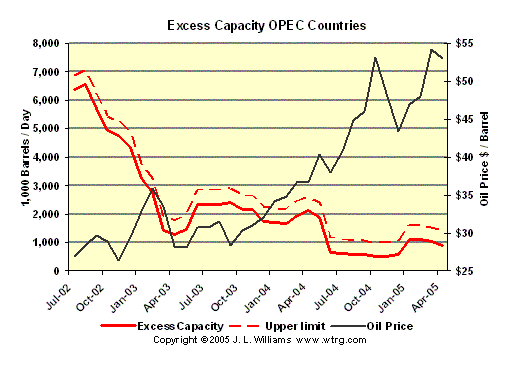
In a recent Wall Street Journal op-ed, Martin Feldstein, a former chairman of the Council of Economic Advisers, provided an exceptionally clear explanation of how small changes in supply and demand can translate into large price movements for commodities with very low short-term price elasticity, or sensitivity, of demand. Yesterday I discussed the recent demand response in the US. It took $4 per gallon pricing to halt the steady year-on-year rise of US gasoline consumption, a trend that was unbroken since 1991. And in the absence of serious refining problems, the only two paths to $4 gasoline were $130 oil or the imposition of a $1.00 per gallon surtax when oil was still under $100/bbl. Constraining the futures market now might provide some temporary relief, but it won't resolve the underlying problems that brought us to this point.
I don't blame the CEOs of the airlines for grasping at this straw. The signatories to the letter include my former boss at Texaco, Glenn Tilton, who understands the oil and airline businesses better than most. These executives know that a commercial aviation industry built on cheap fuel will emerge from a long period of sustained high oil prices as transformed as if it had been re-regulated, and that the mass access to cheap and convenient air travel that we have taken for granted could disappear. Their effort here may even pay off, but as I noted recently, the exact form of any new regulations on energy trading matters greatly, if the cure is not to be worse than the disease.
Friday, June 27, 2008
The Baby and the Bath
Over the course of the last year, speculation has become a primary focus of concerns about the rapid increase in oil prices. For a Congress under intense pressure from constituents to address energy prices, regulating speculation in energy commodities could present the best prospect for appearing to deal decisively with the current energy crisis prior to the November election. Nor would I rule out the possibility that it might even provide some genuine price relief, although there are ample fundamental reasons for oil to be much dearer than it was just a few years ago. However, if Congress is going to take on the energy markets, it is imperative that it does so in a measured way, to avoid impeding their legitimate functions--some of which might be considered as speculative as the "commodity index" investment that has come in for the most severe criticism. Overkill could ultimately cost businesses, and eventually consumers, as much as inaction.
There's no shortage of conflicting opinions on this topic. A number of academics and financial experts have dismissed the possibility that speculation in oil futures could have much influence on the price of the physical commodity, pointing instead to the very real contribution of rapid demand growth in the developing world, slower production growth, particularly among non-OPEC producers, and the disappearance of global spare production capacity. Others have highlighted the recent and substantial flow of funds into the market from a new class of commodity investors, including pension funds and other institutions. They spot a cause-and-effect relationship in the accompanying rise in oil prices and find worrying parallels to the high-tech and housing bubbles. For my own part, I worry about the systematic linkages between the impact of this additional demand on futures prices and the mechanisms by which the price of oil purchased by refineries is set. But while I see a connection between speculation and higher fuel prices, I am skeptical of attempts to quantify it.
My background gives me a unique vantage point on this debate. After my graduate training in business and economics, I acquired a hands-on education in markets during a decade spent trading energy commodities for Texaco, Inc. This included a two-year stint trading international petroleum products from London, involving extensive dealings with our futures trading group and external floor broker. When I returned to Los Angeles, I was responsible for managing the commodity risk profile of the company's West Coast refining and marketing operations. Although this experience wasn't recent, I have no conflicts of interest in this area that would constrain my objectivity about the various proposals for regulating oil market speculation.
Some of the recent suggestions for regulating energy futures and derivatives trading might do more good than harm. This includes raising margin requirements, which might decrease liquidity, but also ought to reduce volatility by deterring investors from putting on enormous positions in hopes of turning small per-unit margins into huge aggregate gains, a strategy that hedge funds have employed in many markets. Shrinking volatility would be bad for traders, who thrive on it, but good for the economy. Closing the so-called "Enron Loophole" probably falls into a similar category of positive benefit vs. cost.
Other ideas seem likely to do much more harm to non-financial firms seeking to manage their business risks. For example, one of Senator Obama's recent anti-speculation proposals would force all energy commodities to trade on regulated exchanges. If this shut down the over-the-counter "swap" transactions that are used to bridge the price gaps between the small selection of crude and products traded on the NYMEX and the actual grades that companies buy and sell, it would make it much harder for businesses to hedge their risks. Airlines come to mind, here. Because there is no futures contract for jet fuel, an airline hedging its fuel supplies by buying crude oil or heating oil futures/options often also executes a swap covering the difference in price between jet and crude or jet and diesel. Otherwise, it runs the risk that when it purchase its jet fuel later, the hedge will have only appreciated by a fraction of the increase in the price of the physical product, or worse yet, might have lost money, while jet fuel prices continued to climb due to local or global scarcity. But as important as this transaction has become to airlines, it seems unlikely to generate the scale and liquidity required to merit launching an exchange-traded futures contract to cover it.
An even worse notion making the rounds on Capitol Hill would require anyone buying a futures contract to take physical delivery of the oil or product. As sensible as this might sound to the public, it would be catastrophic for the market and for the vast majority of participants, large and small, who use these markets to manage the enormous price risks associated with real-world energy activities. Even the small minority of players who rely on the NYMEX for physical supply in the New York Harbor would suffer, as liquidity for these contracts dried up. Consumers used to buying heating oil at a fixed-price for the season or year would probably lose this option, as all but the largest suppliers would be unable to offer this service.
Even the basic principle of limiting futures market activity to entities that produce or consume oil or its products is fundamentally flawed. On any given day, the producers and end-users wouldn't be active enough to make a real, liquid market. I experienced this first hand trading refined products on the West Coast. Top management preferred us to deal mainly with other oil companies, but when our own output fell short, the other refiners weren't always in the mood to sell. Without being able to buy from risk-taking independent traders who had previously taken a bet on the market, we would have run out of product on many occasions, and consumers would ultimately have been harmed.
Speculation plays an important role in lubricating the wheels of commerce, although it may also be contributing to higher oil prices, as investors increasingly turn to these markets as an inflation hedge or as another long-term asset class. My advice to Congress is to err on the side of caution in regulating energy commodity trading, and to specify very precisely which activities they want to rein in, rather than designing indirect and intricate rules that would ultimately entangle many participants that are essential to the efficient functioning of these markets. If Congress disrupted the entire energy market, just to constrain speculation by pension funds and other portfolio investors, the resulting chaos would hardly benefit consumers.
There's no shortage of conflicting opinions on this topic. A number of academics and financial experts have dismissed the possibility that speculation in oil futures could have much influence on the price of the physical commodity, pointing instead to the very real contribution of rapid demand growth in the developing world, slower production growth, particularly among non-OPEC producers, and the disappearance of global spare production capacity. Others have highlighted the recent and substantial flow of funds into the market from a new class of commodity investors, including pension funds and other institutions. They spot a cause-and-effect relationship in the accompanying rise in oil prices and find worrying parallels to the high-tech and housing bubbles. For my own part, I worry about the systematic linkages between the impact of this additional demand on futures prices and the mechanisms by which the price of oil purchased by refineries is set. But while I see a connection between speculation and higher fuel prices, I am skeptical of attempts to quantify it.
My background gives me a unique vantage point on this debate. After my graduate training in business and economics, I acquired a hands-on education in markets during a decade spent trading energy commodities for Texaco, Inc. This included a two-year stint trading international petroleum products from London, involving extensive dealings with our futures trading group and external floor broker. When I returned to Los Angeles, I was responsible for managing the commodity risk profile of the company's West Coast refining and marketing operations. Although this experience wasn't recent, I have no conflicts of interest in this area that would constrain my objectivity about the various proposals for regulating oil market speculation.
Some of the recent suggestions for regulating energy futures and derivatives trading might do more good than harm. This includes raising margin requirements, which might decrease liquidity, but also ought to reduce volatility by deterring investors from putting on enormous positions in hopes of turning small per-unit margins into huge aggregate gains, a strategy that hedge funds have employed in many markets. Shrinking volatility would be bad for traders, who thrive on it, but good for the economy. Closing the so-called "Enron Loophole" probably falls into a similar category of positive benefit vs. cost.
Other ideas seem likely to do much more harm to non-financial firms seeking to manage their business risks. For example, one of Senator Obama's recent anti-speculation proposals would force all energy commodities to trade on regulated exchanges. If this shut down the over-the-counter "swap" transactions that are used to bridge the price gaps between the small selection of crude and products traded on the NYMEX and the actual grades that companies buy and sell, it would make it much harder for businesses to hedge their risks. Airlines come to mind, here. Because there is no futures contract for jet fuel, an airline hedging its fuel supplies by buying crude oil or heating oil futures/options often also executes a swap covering the difference in price between jet and crude or jet and diesel. Otherwise, it runs the risk that when it purchase its jet fuel later, the hedge will have only appreciated by a fraction of the increase in the price of the physical product, or worse yet, might have lost money, while jet fuel prices continued to climb due to local or global scarcity. But as important as this transaction has become to airlines, it seems unlikely to generate the scale and liquidity required to merit launching an exchange-traded futures contract to cover it.
An even worse notion making the rounds on Capitol Hill would require anyone buying a futures contract to take physical delivery of the oil or product. As sensible as this might sound to the public, it would be catastrophic for the market and for the vast majority of participants, large and small, who use these markets to manage the enormous price risks associated with real-world energy activities. Even the small minority of players who rely on the NYMEX for physical supply in the New York Harbor would suffer, as liquidity for these contracts dried up. Consumers used to buying heating oil at a fixed-price for the season or year would probably lose this option, as all but the largest suppliers would be unable to offer this service.
Even the basic principle of limiting futures market activity to entities that produce or consume oil or its products is fundamentally flawed. On any given day, the producers and end-users wouldn't be active enough to make a real, liquid market. I experienced this first hand trading refined products on the West Coast. Top management preferred us to deal mainly with other oil companies, but when our own output fell short, the other refiners weren't always in the mood to sell. Without being able to buy from risk-taking independent traders who had previously taken a bet on the market, we would have run out of product on many occasions, and consumers would ultimately have been harmed.
Speculation plays an important role in lubricating the wheels of commerce, although it may also be contributing to higher oil prices, as investors increasingly turn to these markets as an inflation hedge or as another long-term asset class. My advice to Congress is to err on the side of caution in regulating energy commodity trading, and to specify very precisely which activities they want to rein in, rather than designing indirect and intricate rules that would ultimately entangle many participants that are essential to the efficient functioning of these markets. If Congress disrupted the entire energy market, just to constrain speculation by pension funds and other portfolio investors, the resulting chaos would hardly benefit consumers.
Tuesday, February 05, 2008
Virgin Biojet
I've been following the trend-setting ways of Richard Branson's Virgin Group of companies for many years, so I'm not surprised to see them on the cutting edge of alternative fuels for commercial jet aircraft. Running a normal 747 on a blend of 80% jet kerosene and 20% biofuel is a daring move, especially coming just a few weeks after the remarkable Heathrow crash-landing of a British Airways B-777, in which fuel contamination now seems to be the leading focus of the accident investigation. As this article in the San Francisco Chronicle makes clear, it's going to take years of testing before large passenger aircraft are certified to fly on something other than petroleum distillate, but the rewards for finding suitable substitutes have energized both private and military aviation to pursue this goal.
Each generation of new passenger jets seems to be more fuel-efficient than the one before it, with Boeing's new 787 Dreamliner representing the current state of the art, coming in at just a hair under 100 passenger-miles per gallon, compared to an industry average of around 60 mpg. Nevertheless, the cost, emissions and long-term availability of jet fuel derived from crude oil look like major limitations on the future growth of commercial aviation. Fuel accounts for more than a quarter of the US commercial airlines' cost structure and exceeds labor as a component of unit costs per available seat-mile. That's why United has started charging extra for checked bags. This gives airlines a big incentive to find cheaper, more sustainable energy sources for the long-term, an incentive shared by the Pentagon, as it seeks to reduce the cost of its operations and logistics.
None of this changes the fact that aircraft engines and their fuel systems must work in very challenging environments, with widely-varying temperature and humidity. You can make a turbine engine pretty tolerant of fuel quality when it's sitting on the ground generating electricity at a power plant, and I wouldn't be surprised if biofuels became a popular fuel for gas turbines, when natural gas gets back to BTU parity with crude oil. However, put that same engine at 40,000 feet and -40 degrees F., and suddenly fuel quality matters very much indeed. That's why oil refiners are choosy about the crude oils from which they produce jet fuel, and then go to extraordinary lengths to segregate it from any possible source of contamination from the other products in the distribution system.
The pursuit of alternative forms of jet fuel raises two key questions, relevant to both military and commercial use. First, can the fuel be manufactured to meet the necessary specifications for jet fuel with absolute consistency? Most manufacturers of high-speed diesel engines will not certify a fuel containing more than 20% biodiesel, so Virgin's choice of a 20% biofuel blend for this even more sensitive application looks aggressive. The US military's choice of alternative fuels produced using the Fischer-Tropsch synthesis (FT) and starting with very simple molecules (from natural gas or gasification) looks much safer in this regard. In fact, this route should provide even greater control over the specific properties of the resulting jet fuel blend than if it all came from the distillation and conventional processing of crude oil.
The bigger question is whether any of these substitutes can be produced at a lower cost than oil-based avjet. Although unsubsidized oilseed-based biodiesel typically costs more than untaxed petroleum diesel, fuels produced using FT synthesis could be significantly cheaper. At a typical 60% conversion efficiency, synthetic jet fuel from natural gas would cost about $1.60/gallon, based on gas at $8/MMBTU. That's a lot less than the $2.56/gallon average price that airlines are reportedly paying for Jet-A today, and synthetic jet fuel from coal-to-liquids or biomass gasification might cost even less, at least before the cost of the extra carbon emissions from coal is considered.
For a long time, aviation appeared to be the only transportation segment without a viable energy substitute for petroleum products. The high price of oil, new technology--or at least new applications of an old technology--and the rapid development of the biofuels industry looks set to alter that conclusion in this decade. The prospect of creating synthetic kerosene from scratch from a wide variety of materials at a lower net cost than oil should provide all the incentive necessary for airlines and aircraft and engine manufacturers to plow through the lengthy testing and certification process for these fuels, without cutting any corners on safety. I'll be watching the results of Virgin's test flight with great interest.
Each generation of new passenger jets seems to be more fuel-efficient than the one before it, with Boeing's new 787 Dreamliner representing the current state of the art, coming in at just a hair under 100 passenger-miles per gallon, compared to an industry average of around 60 mpg. Nevertheless, the cost, emissions and long-term availability of jet fuel derived from crude oil look like major limitations on the future growth of commercial aviation. Fuel accounts for more than a quarter of the US commercial airlines' cost structure and exceeds labor as a component of unit costs per available seat-mile. That's why United has started charging extra for checked bags. This gives airlines a big incentive to find cheaper, more sustainable energy sources for the long-term, an incentive shared by the Pentagon, as it seeks to reduce the cost of its operations and logistics.

None of this changes the fact that aircraft engines and their fuel systems must work in very challenging environments, with widely-varying temperature and humidity. You can make a turbine engine pretty tolerant of fuel quality when it's sitting on the ground generating electricity at a power plant, and I wouldn't be surprised if biofuels became a popular fuel for gas turbines, when natural gas gets back to BTU parity with crude oil. However, put that same engine at 40,000 feet and -40 degrees F., and suddenly fuel quality matters very much indeed. That's why oil refiners are choosy about the crude oils from which they produce jet fuel, and then go to extraordinary lengths to segregate it from any possible source of contamination from the other products in the distribution system.
The pursuit of alternative forms of jet fuel raises two key questions, relevant to both military and commercial use. First, can the fuel be manufactured to meet the necessary specifications for jet fuel with absolute consistency? Most manufacturers of high-speed diesel engines will not certify a fuel containing more than 20% biodiesel, so Virgin's choice of a 20% biofuel blend for this even more sensitive application looks aggressive. The US military's choice of alternative fuels produced using the Fischer-Tropsch synthesis (FT) and starting with very simple molecules (from natural gas or gasification) looks much safer in this regard. In fact, this route should provide even greater control over the specific properties of the resulting jet fuel blend than if it all came from the distillation and conventional processing of crude oil.
The bigger question is whether any of these substitutes can be produced at a lower cost than oil-based avjet. Although unsubsidized oilseed-based biodiesel typically costs more than untaxed petroleum diesel, fuels produced using FT synthesis could be significantly cheaper. At a typical 60% conversion efficiency, synthetic jet fuel from natural gas would cost about $1.60/gallon, based on gas at $8/MMBTU. That's a lot less than the $2.56/gallon average price that airlines are reportedly paying for Jet-A today, and synthetic jet fuel from coal-to-liquids or biomass gasification might cost even less, at least before the cost of the extra carbon emissions from coal is considered.
For a long time, aviation appeared to be the only transportation segment without a viable energy substitute for petroleum products. The high price of oil, new technology--or at least new applications of an old technology--and the rapid development of the biofuels industry looks set to alter that conclusion in this decade. The prospect of creating synthetic kerosene from scratch from a wide variety of materials at a lower net cost than oil should provide all the incentive necessary for airlines and aircraft and engine manufacturers to plow through the lengthy testing and certification process for these fuels, without cutting any corners on safety. I'll be watching the results of Virgin's test flight with great interest.
Monday, June 04, 2007
Soft Targets?
I was flying back from the west coast when news of the plot to blow up the JFK airport jet fuel system broke. Other than noting the distinctly different coverage by the two cable news channels available on Jet Blue, I had plenty of time to think about the implications of such an attack. As the authorities have stressed repeatedly, it's highly unlikely that the plotters could have produced the carnage they desired, though they might have disrupted air travel across the eastern seaboard for days. This story serves as a useful reminder that energy infrastructure remains an attractive, and in many cases "soft" target for terrorists. While noting the success of law enforcement at unraveling this particular scheme, it's equally important to ensure that the operators of such infrastructure have contingency plans in place to deal with the consequences of an actual attack.
As the story in the Washington Post notes, the built-in safeguards of the airport's fuel distribution system would have prevented any explosion or fire in the pipeline or tank farm from spreading to the terminal area. Like many large airports, JFK has a hydrant system, which delivers jet fuel from an underground pipeline directly "into wing", minimizing the number of trucks carrying fuel on airport premises. Instead, refueling trucks just carry a pump and the requisite hoses to connect aircraft to the hydrant valve. However, while this approach reduces the risk of fuel-related accidents on the tarmac, it also increases the system's vulnerability to disruptions at the airport's tank farm.
Destroying all the fuel at JFK--an act apparently beyond the competence of this daft-sounding group--would have dried up the hydrants and forced suppliers to bring both fuel and refueling trucks in from other nearby airports. Doing that on short notice would be a lot more effective if someone has spent time in advance identifying where all those trucks are, who owns them, and what else would be required to pull it off. I'd like to think all this was done right after 9/11, but I'll bet there's a flurry of activity this week, as Homeland Security officials, airport authorities and jet fuel providers review their procedures, in light of this scheme.
The most worrying aspect of this story is its reminder of the human element in infrastructure security. The key to this plot was a former airport employee with knowledge of the fuel system at JFK. The petroleum products industry alone has many thousands of current and former employees who possess this kind of information. Add the natural gas and utility industries, and even if only a small fraction of these personnel have the motivation and inclination to turn what they know to mischief, the number of potential threats is large enough to be worrisome. At a minimum, facility operators should make sure that flow diagrams, plot plans, and aerial photography that would be useful to anyone planning an infrastructure attack are not widely available.
As the story in the Washington Post notes, the built-in safeguards of the airport's fuel distribution system would have prevented any explosion or fire in the pipeline or tank farm from spreading to the terminal area. Like many large airports, JFK has a hydrant system, which delivers jet fuel from an underground pipeline directly "into wing", minimizing the number of trucks carrying fuel on airport premises. Instead, refueling trucks just carry a pump and the requisite hoses to connect aircraft to the hydrant valve. However, while this approach reduces the risk of fuel-related accidents on the tarmac, it also increases the system's vulnerability to disruptions at the airport's tank farm.
Destroying all the fuel at JFK--an act apparently beyond the competence of this daft-sounding group--would have dried up the hydrants and forced suppliers to bring both fuel and refueling trucks in from other nearby airports. Doing that on short notice would be a lot more effective if someone has spent time in advance identifying where all those trucks are, who owns them, and what else would be required to pull it off. I'd like to think all this was done right after 9/11, but I'll bet there's a flurry of activity this week, as Homeland Security officials, airport authorities and jet fuel providers review their procedures, in light of this scheme.
The most worrying aspect of this story is its reminder of the human element in infrastructure security. The key to this plot was a former airport employee with knowledge of the fuel system at JFK. The petroleum products industry alone has many thousands of current and former employees who possess this kind of information. Add the natural gas and utility industries, and even if only a small fraction of these personnel have the motivation and inclination to turn what they know to mischief, the number of potential threats is large enough to be worrisome. At a minimum, facility operators should make sure that flow diagrams, plot plans, and aerial photography that would be useful to anyone planning an infrastructure attack are not widely available.
Subscribe to:
Posts (Atom)