Showing posts with label UN. Show all posts

Thursday, November 13, 2014

How Good Is The New Emissions Deal with China?

  • President Obama's emissions deal with China sets an ambitious target for US CO2 cuts while leaving substantial headroom for emissions growth in China. 
  • It will likely compound his problems, domestically, but could have significant influence on upcoming international climate negotiations.
Only an event like Tuesday's agreement between President Obama and his Chinese counterpart to limit greenhouse gas emissions (GHG) from the two countries could top the unexpected scramble in the US Senate to pass a Keystone XL pipeline bill as the big energy story of the week. The significance of the climate deal is open to interpretation, from both international and US political perspectives. Before exploring those, we should examine its consequences.

The White House announced that in exchange for the US agreeing to reduce "net greenhouse gas emissions 26-28 percent below 2005 levels by 2025", China would undertake to cap its GHG emissions by "around 2030." It also announced plans to step up a number of cooperative efforts with China in this area, including joint R&D and a jointly funded public/private carbon capture and sequestration (CCS) project in China. What does all this mean in terms of US emissions?

We need to start with the 2012 baseline in which net US emissions were already nearly 11% below 2005 levels. The current Annual Energy Outlook of the US Energy Information Administration (EIA), assuming the laws and regulations in force at the time it was produced, projects that US energy-related CO2 emissions will increase by 236 million metric tons (MT) by 2025, compared to 2012, leaving us at roughly 7% under 2005. Emissions from transportation would shrink, while those from industry would rise as the US economy grows by an expected 2.4% per year.

As I understand it that EIA forecast doesn't include the emissions that the EPA's "Clean Power Plan" for existing power plants would be expected to save if fully implemented. EPA targets reducing CO2 emissions from the US electricity sector--accounting for 39% of net emissions in 2005--by 25% by 2020 and 30% by 2030, compared to 2005. That would shave around 460 million MT from the EIA figure for 2025, getting us to nearly 15% below 2005. The additional savings to reach 26% below 2005 are thus in the neighborhood of 700 million MT per year by 2025. To put that in perspective, it's equivalent to the 2012 CO2 emissions from combustion in the entire US industrial sector, and exceeds total emissions of methane from all sectors, including agriculture, oil & gas, and landfills.

So unless I've done my sums wrong, or misinterpreted the government's data, the US/China deal commits to reducing US emissions by as much again as we've cut since 2005--largely as a result of a weaker economy and the shale gas revolution--after banking the expected savings from the 2011 fuel economy regulations, energy efficiency programs and renewable energy incentives, and an EPA plan for the power sector that is certain to run into strong opposition in the new Congress. That seems pretty ambitious to me, although it falls short of the 40% reduction recently agreed by the EU for 2030.

It's harder to assess what China's side of the deal means in practical terms. Its 2012 emissions were estimated at nearly 10 billion MT/yr, having grown by 8%/yr since 2004 and by 6%/yr since 2009. At that rate, even if its emissions peaked in 2030, they could double before starting to decline. If China's emissions growth declined to just 2% per year, consistent with the lower rates of growth in coal consumption observed recently, by 2030 it could still add nearly 4 billion MT/yr--equivalent to the current emissions of the entire EU, and 5 times the incremental US cuts to which President Obama just agreed. The most recent projection of China's emissions from the EIA had them growing by 5 billion MT by 2030 but essentially plateauing thereafter.

This falls substantially short of what would be required to keep global emissions within the range that climate models predict would limit average global temperature increases to 2°C, compared to pre-industrial levels. However, it goes well beyond China's previous commitment on emissions intensity at Copenhagen in 2009.

Now consider how this deal looks from the standpoint of US politics. Voters just resoundingly handed undivided control of the legislative branch of government to the President's opposition. Republican office-holders and those who just voted for them are likely to regard it as an unwelcome commitment of the US by a lame-duck President to a promise that only his successors could fulfill. In the process, it hands China and other countries a point with which to prod future US administrations should they fall short of its goals. In exchange, he got President Xi Jinping to admit that China can't emit CO2 limitlessly, but can still do more or less what it may have been planning, anyway. It's hard to see this making things easier in Congress for the President's existing environmental agenda.

The deal looks better from the perspective of international environmental and climate policy circles in the lead-up to the Paris climate conference, "COP21", at the end of 2015. One lesson from the Kyoto Protocol is that to be meaningful a global climate agreement must have a strong commitment from the world's largest emitters of CO2 and other GHGs. China and the US are the two biggest emitters, and the EU at #3 is effectively pre-committed. Together these three blocs account for over half of all emissions today. Having them on-side at the start raises the chances of reaching a  big agreement.

As others have observed, this deal makes it harder to argue against a global CO2 agreement based on China's relative inaction, while increasing pressure on other developing countries to agree to limit their own emissions. It also signals that despite political weakness at home, the White House will likely push for aggressive targets at COP21, setting up further conflict with Congress in the next election year. Finally, its timing is early enough to influence the negotiations but not so early as to permit close scrutiny of Chinese or US follow-through on its goals before the Paris talks begin.

Tuesday, May 10, 2011

Justifying $15 Trillion for Renewables

Yesterday I received a joint press release from a group of renewable energy trade associations. It touted a new report from the UN Intergovernmental Panel on Climate Change (IPCC) on the potential growth of renewable energy by 2050. The report has already garnered an impressive array of headlines, such as "Renewable Energy Can Power the World" and "Renewable Energy Key to Solving Climate Change". The headline from the Financial Times was characteristically more concrete, "World faces $15,000 bn renewable energy bill." Unfortunately, although the final report, rumored to run 1,000 pages, might support all of those conclusions when it is issued at the end of the month, the 25-page "Summary for Policymakers" falls far short of inspiring such confidence. Heaven help those policymakers if the summary is all they actually read.

I'm not even sure if "read" is even the correct verb to apply to this document. Once I got beyond the introductory paragraphs it seemed to degenerate into jargon and bureaucratese that was very hard to parse into plain meaning. The report's genesis as the product of pure consensus is readily apparent. Or as Andy Revkin of the New York Times' Dot Earth blog kindly put it, "it doesn't take readers much beyond what is already well established." That's a shame, because we don't need yet another report telling us that we are swimming in enough renewable energy to power our civilization umpteen times over, if we can merely muster the willpower to reach out and tap it. What we urgently need is a roadmap that describes a path--or preferably several possible paths--through the brambles that separate the energy status quo of 2011 from its ideal low-carbon state of 2050.

For example, we need to understand just how renewables will supplant the petroleum that currently provides around 94% of all transportation energy, at least in the US. That demand might be met by biofuels, although the report points out that the first-generation biofuels that supply nearly 3% of global road transport fuel today, but are still the only kind available on a commercial scale, have serious shortcomings. Closing the gap between 3% and 94% would require a true revolution in next-generation biofuels from sources such as cellulose and algae, yet after reading the Summary for Policymakers we are no wiser about when and how this will occur. I might note that such developments are rarely amenable to precise timetables, as the EPA is learning to its chagrin.

Alternatively, or in combination with biofuels, renewables might replace petroleum in transportation via the potentially more robust pathway of vehicle electrification, matching improved batteries with rapidly expanding supplies of intermittent renewables (wind, solar, tidal, etc.) delivered via increasingly intelligent power grids. But if that's the scenario, its crucial details are barely hinted at here.

The basic message of the summary appears to be that with enough investment, supported by the right policies, the currently identified renewable energy sources could expand by enough that in the very best case (out of 164 scenarios they considered) they could supply roughly as much energy by mid-century as we currently get from fossil fuels. That corresponds to 77% of total expected energy consumption in 2050 and may be the source of the headlines I saw. Of course the median level of those 164 scenarios is quite a bit lower, and the determination of the share of renewables in total energy relies on a projection implying that total global energy consumption will grow by an average of just 0.25% per year over the next 40 years. That suggests either a massive energy efficiency effort or minimal further economic uplift in the developing world. On a more reasonable track of 1% annual energy growth, the top scenario in the scatter chart on page 19 would meet 58% of total 2050 demand, while the median result would cover just a third of global energy needs. That's still impressive, compared to where we are today, but not quite as headline-grabbing.

I will be keenly interested to see what sort of scenarios the IPCC looked at in putting together the report on which this summary is based. Something tells me that they are likelier to fall into the category of what I would call projections or "cases" than true scenarios, which dig deeply into underlying trends and uncertainties and are not merely the output of a mechanistic model. That's not just a technical quibble, because I'm not aware of a single model-type forecast from 1970 that accurately projected the economic and sociopolitical conditions in which we find ourselves today. The intervening improvements in computing power and econometric sophistication still seem insufficient to conquer the fundamental unpredictability of looking that far into the future. But then the IPCC has a built-in bias to accept the results of such work, since long-term climate models underpin its entire effort. I hope I'm not alone in thinking that the expenditure of up to $15 trillion requires a much more rigorous justification than anything provided in this document. Whether or not Saint-Exupery really said it, a goal without a plan is just a wish.

If it seems that I'm being overly critical of a 1,000 page report that I haven't even seen on the basis of the horse-by-committee summary that I have seen, I plead guilty. But isn't that the same sin that the journalists and industry spokespeople are committing when they use this summary as the basis of glowing claims about the potential of renewables? And then there are the politicians and bureaucrats who will attempt to commit vast sums without ever reading any more than summaries such as this--at best--and without questioning the host of assumptions that went into them. If anything, this Summary for Policymakers reinforces my concern that the UN climate process has become so unwieldy and unresponsive that we must look elsewhere for leadership on this complex challenge. Meanwhile, we deserve a clearer articulation of how renewables can overcome the considerable obstacles that stand between their recent impressive performance and the achievement of the milestones this report suggests lie ahead.

Monday, December 13, 2010

The Post-Kyoto World

Saturday's conclusion of the Cancun climate talks yielded modest agreements that allowed the meeting to be described in positive terms by its hosts and organizers, but at least on the major question of a globally-binding treaty to extend or replace the expiring Kyoto Protocol, it merely kicked the can down the road to the late-2011 session in Durban, South Africa. As low as the expectations going into Cancun were, keeping the UN climate process on life support looks like a good result, compared to last year's fiasco in Copenhagen. However, in light of the objections raised by Japan, Russia, Canada and others, it's difficult to see how the Durban meeting could succeed where Cancun and Copenhagen failed. It looks increasingly likely that the replacement for Kyoto might appear face-savingly similar, but will lack that document's cohesiveness and global authority.

As I read the portion of the "Cancun Agreements" dealing with the extension of the Kyoto Protocol beyond its previously-set 2008-2012 term, the delegates mainly agreed to keep talking and to try to come up with a framework in time to avoid a "gap between the first and second commitment periods." Considering that last year's session in Copenhagen was widely viewed before its start as the last, best chance to accomplish that goal based on the timeline set in Bali two years prior, the end of 2011 looks pretty late in the game to deliver on that. Moreover, while Cancun was able to get by on low expectations, Durban will be unable to repeat that trick and avoid the kind of set-up that helped doom the Copenhagen talks.

The chasm that remains to be bridged doesn't seem to have changed much: the developing countries still insist on binding emissions reduction targets from the developed countries, to which the UN process attributes the majority of emissions under the "principle of historical responsibility, their emissions debt and addressing the needs of developing countries", but won't commit to binding targets themselves. (I've discussed this notion of "emissions debt" previously.) But while the US has signed up for voluntary emissions reductions under the Copenhagen Accord, it won't agree to binding cuts unless the world's largest emitter, China, also does. And all China appears willing to agree to, based on its Copenhagen commitments, is the sort of productivity-based reductions that the rest of the developed world rejected when the US advanced this idea for managing our emissions in the first term of the Bush administration. Even if China succeeds in cutting its emissions per GDP by 40-45% while its economy continues on its present growth trend, its overall emissions would still increase in absolute terms. Japan and some other Kyoto signatories are understandably reluctant to sign up for deeper cuts themselves, unless the world's two biggest emitters commit to sharing their pain.

And this is where the timing of any substantive Kyoto extension hits the wall of US politics. If the administration wasn't able to pass cap and trade legislation in the last Congressional session, when its party had an effective majority of 60 seats in the US Senate in 2009 and 59 in 2010, the prospect of ratifying a climate treaty with a majority of just 53 next year--including one who campaigned vocally against cap and trade--is nearly non-existent. The administration is struggling just to get the new strategic arms treaty with Russia ratified in the Lame Duck session--a treaty with solid bi-partisan endorsements from the foreign policy leadership of past administrations. The likely reception for a new climate treaty would be much less favorable than that until at least 2013 and probably beyond, in light of the ratio of seats up for reelection in 2012.

Unless I'm missing something major, without the US and China on board for binding cuts Japan and others won't agree to deeper reductions in the next round of Kyoto. That doesn't mean that the Durban Climate Conference won't cobble together an eleventh-hour agreement that looks like an extension of Kyoto, in order to avoid an irreparable rupture between the developed and developing world parties to the talks. The subtext for that is already in place in the Cancun outcome. However, it seems highly unlikely that such a document would actually do what Kyoto was intended to do. As a result, the UN process seems to be consigned to focusing on the secondary areas that progressed in Cancun, relating to funding for adaptation and technology transfer, and emissions reductions from sectors like land-use changes and forestry. With the economies of the developed world looking as weak as they do, and with domestic expenditure cuts in the EU having generated noisy and sometimes violent protests, coming up with the funding for those efforts looks more than challenging enough for now.

Monday, March 17, 2008

The Road Not Taken

This week marks the fifth anniversary of the start of the Iraq War. With the outcome of November's US presidential election hinging at least in part on the judgment to go to war in 2003, and in light of the release of a new book by a Nobel-winning economist assessing the cost of the war, it seems appropriate to spend a moment reflecting on the road not taken, at least in terms of its energy aspects. Although we will never know what would have ultimately happened, had the US decided not to invade Iraq, we can make some educated guesses about the level of oil prices in such a world. Just as the war itself cannot properly be characterized as a war for oil--though it has certainly been about oil--today's oil price of $110 per barrel reflects the results of that decision, though it has not been directly caused by it.

In gauging the impact of the Iraq War on oil prices, we need to evaluate two broad areas: the relative importance of Iraqi under-production, compared to all the other factors that have contributed to oil's dramatic rise from the mid-$20s per barrel, and the nature of Iraq's status quo ante, with regard to oil. Let's start with the latter, since after five years of war, most commentators have forgotten about the way that Saddam Hussein's behavior regularly roiled the market.

In the aftermath of the 1991 Gulf War and leading up to our invasion in 2003, Iraq was under UN sanctions that inhibited its oil trade, among other things. Foreign firms could not enter into new development deals with the Iraqi government, and the country's oil exports were capped and managed under the Oil for Food Program, which was later revealed to have been rife with corruption and used by Saddam as an ATM to fund his pet projects. Between 1992 and 2003, Iraq suspended its oil exports several times--most recently in 2002--and threatened to do so on many other occasions, temporarily driving oil prices higher. If the war had never happened and the sanctions regime remained in place today, the combination of UN restrictions and Saddam's pattern of using oil exports as a geopolitical tool would be contributing to market instability, not lower prices.

I would argue that the likelier scenario was not a continuation of the pre-war status quo, but the gradual disintegration of the sanctions regime--a process already apparent in 2002--as oil companies from Security Council countries such as France and Russia pressed for commercial access to Iraq's enormous untapped oil reserves. Still, it takes time to bring new oil fields on line, even when exploration risk is very low and geology quite favorable, as it is in Iraq. Had sanctions collapsed entirely in 2004 or 2005, we still would not have any contribution from such projects at this point, and Iraq's exports would be about what they averaged between 1999 (when the dollar-cap on Oil for Food exports was eliminated) and 2002: 1.9 million barrels per day (bpd.) It's also likely, however, that these exports would have been interrupted by Iraqi politics and periodic military confrontations with the US, such as Operation Desert Fox in late 1998. In other words, other than the cumulative loss of perhaps a billion barrels of oil exports from 2003-2006, Iraq's current exports absent the Iraq War would probably be about the same as they are today.

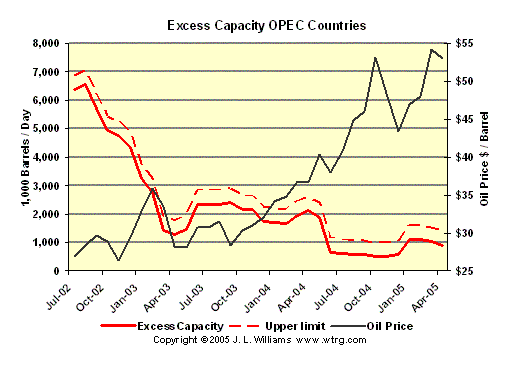
Nor has the Iraq War been the only factor applying pressure on oil prices since 2003. You've heard the litany many times: the growth of Asia and especially China, turmoil in Nigeria, resource nationalism, tensions with Iran, Hurricane Katrina, and so on. Is there any reason to think these wouldn't have been just as significant--except for the risk of conflict with Iran --had the Iraq War never occurred? If anything, global economic growth, and oil consumption with it, might have been even higher, if the US hadn't embarked on a major war financed largely by foreign debt. The largest direct contribution of the Iraq War to oil prices probably occurred in 2003-2004, when Iraq's curtailed output helped drive OPEC's spare capacity below 1 million bpd, and sent prices soaring past $50/bbl for the first time. That impact has largely abated, as Iraq's oil exports have gradually been restored.

On balance, then, the effect of the Iraq War on current oil prices has been largely indirect. I believe it is attributable more to mismanagement of the war, and particularly to our choices about how to finance it, than with the 2003 decision to invade. The alternative scenario is less a function of how much oil Iraq might now be producing than of the relative health of a US economy that was only engaged in one foreign war, not two. Spending hundreds of billions of dollars on a war, without raising taxes to support it, has expanded our fiscal and external financing deficits, weakening the US dollar and feeding speculation in commodities--a lesson we should have learned from the Vietnam War. Had the dollar maintained its 2003 pre-war level against the Euro of about $1.08, oil might today be closer to $75/bbl than $110.

Monday, August 06, 2007

Ruling the Waves

One reason that the energy industry has fascinated me for as long as I can remember is the way in which it connects to nearly everything, especially in the realm of geopolitics. The UN Convention on the Law of the Sea (LOS) provides a great example. The LOS was a hot-button issue back in the 1980s and again in the early 1990s, before disappearing from sight--at least for the American public. When the Senate again took up the subject of its ratification earlier this year, the LOS suddenly reappeared in a flurry of duelling op-eds and editorials. While most of its remaining controversies involve issues of national security and military navigation, the LOS has profound implications for the energy industry, as our extraction technology makes increasingly-remote resources accessible. With most of the rest of the world having already ratified this treaty, we only stand to lose by continuing to defer our accession to it, at least from an economic perspective.

Reading the recent op-eds jogged a lot of old memories. The Reagan Era version of the LOS, like its cousin the so-called Moon Treaty, reflected the competing ideologies of the Cold War and appeared to impose a Soviet-style approach on the exploitation of much of the world's resource endowment, which lay beyond the limits of then-current technology. For many in the oil and gas industry at the time, the idea of drilling on the Outer Continental Shelf, in more than a mile of water, might have seemed as fanciful as drilling on the moon. But the US argued successfully against these provisions, and I regard it as highly significant that former Reagan Administration and Bush-I officials such as Kenneth Adelman and Lawrence Eagleburger are satisfied by the subsequent modifications to the LOS's mechanisms on resources.

The enthusiasm of the energy industry for this treaty is understandable. Companies need a clear delineation of resource rights, when they negotiate agreements for access to undersea oil and gas deposits, once technology advances bring them within range. That applies not only to margins of the US continental shelf, which under the LOS would extend beyond 200 miles in places, and up to 600 miles in the Arctic, but also to the offshore regions of Africa, Asia, Australia, Europe and South America, all of which already produce large quantities of oil and gas. However, this should be seen as more than just an extension of the industry's search for profits and shareholder value. A sizable fraction of the world's future energy supply will likely come from these seabeds, and it is also conceivable that in the future, important quantities of oil and gas will be found in the regions beyond any national waters, as defined by the LOS, and will thus fall under the purview of the International Seabed Authority. Until we ratify the treaty, the US cannot take up our permanent seat on that Authority's governing Council.

I'm also struck by the irony of another international treaty for which the US remains the most significant non-ratifying nation, even though an important chunk of it was renegotiated to suit our interests. Four successive US administrations have treated the LOS as US policy, despite our not having officially signed on. At the very least, this situation dilutes some of the congressional criticisms of the current administration over Kyoto, since in the case of the LOS their roles are largely reversed.

In concluding, I have to concede that there might still be a few serious security concerns that could trump our numerous other advantages in joining this treaty. Dismissing those is beyond my expertise, although I find it persuasive that many former military and government officials with impeccable security credentials have publicly endorsed the treaty's ratification. From a national and global energy perspective, formalizing our adherence to this agreement--and thereby gaining our rightful voice in its various bodies--seems to offer only upside, with negligible downside risk. It could also buy us some international good will and legitimacy, at a time when our stocks of those commodities have become depleted.