Showing posts with label Germany. Show all posts

Thursday, April 14, 2016

Lessons from the Coal Bust

Yesterday's Chapter 11 filing by the largest US coal mining company is the latest in a series of coal bankruptcies. While factors such as regulations and poorly timed acquisitions have played a role, this trend reflects the parallel technology revolutions playing out across the energy sector. Here are a few key lessons from the ongoing coal bust:
  • There are many other ways to make electricity, and coal brings nothing unique to the party. In a growing number of markets it is no longer the cheapest form of generation, and it is certainly the one with the most environmental baggage, from source to combustion.
  • Coal-fired power generation is in competition with alternatives that are already producing at scale, like nuclear and natural gas generation, or growing rapidly from a smaller base, like renewables. It may not compete with all of these in every market, but few markets lack at least one of these challengers.
  • The costs of renewables and gas have fallen significantly in recent years, due to major technology gains. Coal has also benefited from some improvements in scale and end-use technology. Today's ultra supercritical coal plants are more efficient than coal plants of a generation ago, but they are more expensive to build, even without carbon capture (CCS). However, wind and solar power continue to grow cheaper and more efficient, while gas has benefited from resource-multiplying production technologies and advanced gas turbines that can exceed 60% efficiency and ramp up and down rapidly to accommodate the swings of intermittent renewables.
  • Despite all of these threats, coal is not on the verge of being forced out of power generation, even in developed countries where all the above factors are at work. Replacing its enormous contribution to primary energy supply and electricity generation will be a very heavy lift, particularly where another major energy source like nuclear power is being phased out. Germany is the prime example of that.
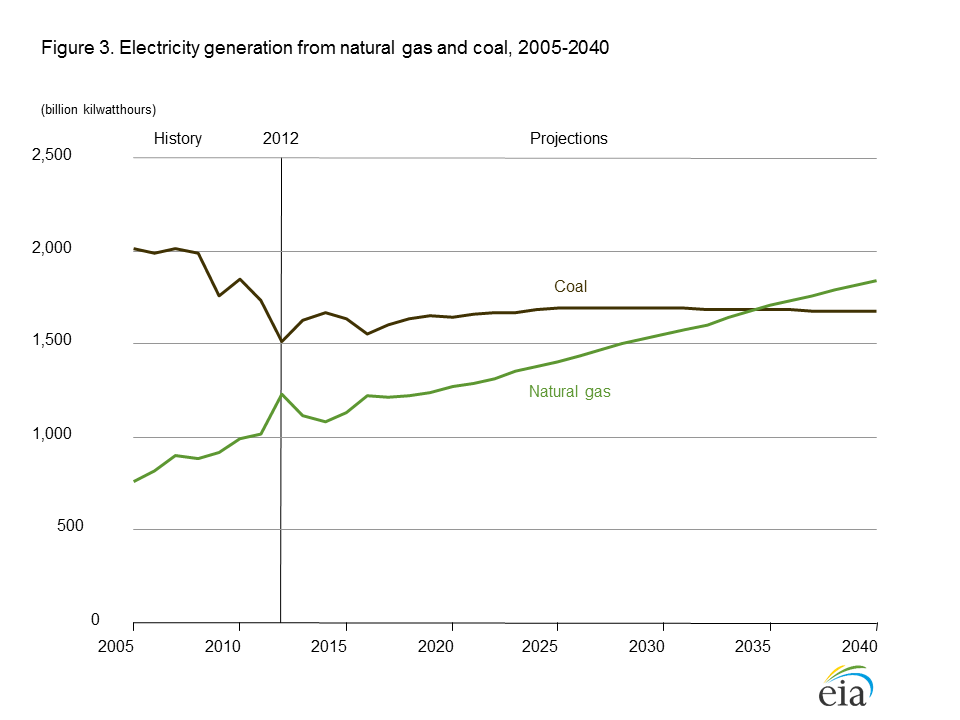
Consider what it would take to replace the remainder of coal in the US power sector. Last year coal generated 33% of US electricity, down from nearly 45% in 2010. Gas picked up 70% of the drop in coal's power output, but that still left coal's contribution at 1,356 Terawatt-hours (TWh) or about 6x the grid contribution of all US wind and solar power last year. (A Terawatt is a billion kilowatts.)

Displacing coal completely from US electricity would require doubling the 2015 output of US gas-fired power generation and a roughly 36% increase in US natural gas production. By comparison, the US nuclear power fleet would have to more than double. If coal were to be replaced entirely by renewables, which in practice probably means gas pushing coal out of baseload power and renewables reducing gas-fired peak generation, the hill looks steep.

Last year the US added 7.3 GW of new solar installations and 8.6 GW of new wind turbines. Assuming they were mostly sited in locations with reasonable solar or wind resources, their combined annual output should be around 35 TWh. At that pace it would take another 36 years to make up what coal now generates. It's true that net annual wind and solar additions continue to grow at double-digit rates, but keeping that up may get harder as the best sites become saturated and earlier wind turbines and PV arrays reach the end of their useful lives in the meantime.

In other words, driving coal from here to zero seems possible but very difficult, even with an all-of-the-above strategy in a market without demand growth. And if electricity demand continues to grow, as it is globally, or resumed growing in the US and other developed countries to enable a big shift to electric vehicles, the prospect of retiring coal entirely recedes into the future.


Tuesday, December 03, 2013

Making Petrochemicals from CO2

  • R&D is under way in Germany to see whether CO2 emitted from power plants or other facilities could become a useful feedstock for manufacturing chemicals.

  • This could have several advantages over producing fuels from CO2, while providing modest emission reduction benefits.

A recent article in Chemical & Engineering News described current German research and development work focused on devising new industrial processes for making organic chemicals from CO2. These public/private partnerships capitalize on that country’s long expertise in industrial chemistry and its highly successful chemical sector. They are also extremely timely, not just because of growing concern about steadily increasing levels of CO2 in the atmosphere, but because Germany’s “Energiewende”, which includes the rapid phase-out of nuclear power, appears to be raising the country’s emissions as it relies increasingly on coal for baseload electricity generation.

In my last post I explained why it is unlikely that fossil fuels could be phased out rapidly enough to threaten the current valuations of oil and gas firms. But if carbon-based fuels will be with us for some time, that leaves open the large question of what to do about the CO2 emitted when they are burned, particularly from stationary installations like factories and power plants. The long-mooted approach of carbon capture and sequestration (CCS) still faces significant obstacles in terms of cost and social acceptance. That makes CO2 utilization efforts such as those underway in Germany especially intriguing as a way of turning lemons into lemonade.

It’s impossible to predict today whether any of the CO2 utilization processes that German companies and universities are pursuing will ever become commercial. However, they share some key advantages over “classic” CCS and various efforts to produce fuels and other chemicals from CO2 captured directly from the atmosphere:
  1. Producing chemicals, rather than fuels, finesses a fundamental obstacle to recycling CO2. Thermodynamics dictate that reversing the results of combustion requires more energy than the fuels released when burned. As long as most energy globally comes from fossil fuels, it will be hard to come out ahead from an energy, emissions or cost perspective when turning CO2 back into fuels. However, if the output is valuable chemicals, that energy deficit might not be such a hindrance.
  2. The target chemicals for these projects, including polyols, polypropylene carbonate, and acrylates, are widely used and have a global market. While most don’t quite fall into the category of premium specialty chemicals, they are unlikely to become as commoditized as motor fuels. So while cost is an important consideration, there’s probably a bit more leeway for a new process to compete and become successful.
  3. The scale of production for these chemicals is much smaller than for motor fuels, by orders of magnitude. That means that a company investing in producing them from CO2 can hope to capture meaningful revenue and market share with a manageable scale-up from the laboratory. Yet they’re not so small that a single new plant on a scale large enough to demonstrate CO2 utilization would swamp the global market and destroy the margins that made the investment attractive in the first place.
  4. These projects appear to be focused mainly on using the CO2 effluent from other industrial processes or power generation, ranging from 4-14% for power plants and up to 90% for some industrial processes, rather than having to collect it from the atmosphere, where it is present at just 0.04%. Starting with a CO2 concentration 100-1000 times higher than in air entails much less surface area for absorption, and likely lower energy consumption and overall capture cost.
  5. Germany is committed to significant CO2 reduction, but the German public seems uncomfortable with the prospect of burying CO2 underground. Lacking large numbers of mature oil fields that could be revived by CO2 injection, a commercial-scale CO2 utilization industry would solve Germany’s problem of what to do with at least some of the CO2 it will eventually want to capture from the country's coal- and gas-fired power plants and other sources. 
As promising as these efforts look, they are unlikely to reduce global CO2 emissions by enough to meet current goals. While chemical markets are big enough to take up some captured-and-converted CO2, they are much smaller than the global fossil fuel consumption responsible for most man-made CO2 emissions. If carbon capture really took off, the volumes of concentrated CO2 involved would require multiple additional large-scale dispositions including enhanced oil recovery, fuel production–perhaps driven by advanced nuclear power–underground burial, and possibly chemical sequestration as carbonate rock.

In the meantime, turning some CO2 that would otherwise end up in the atmosphere into organic chemicals that will end up in more durable products seems worth pursuing. If these processes can become commercial, they will help move us in the right direction, and more cost-effectively than some other approaches receiving large ongoing government subsidies, rather than the modest seed money involved in these cases. I’ll be very interested to see how these efforts turn out.

A different version of this posting was previously published on Energy Trends Insider.

Tuesday, April 02, 2013

Two Energy Revolutions Vie across the Atlantic

A front-page article in today's Washington Post reported on the trend of energy-related investments in the US by European companies.  This is another aspect of the competing energy revolutions I mentioned a few weeks ago, in my comments on President Obama's State of the Union speech.  Germany's 2000 Renewable Energy Law introduced feed-in tariffs for wind and solar power that have made that country a global leader in green energy implementation, yet it has also become increasingly apparent that this carefully planned transformation paid insufficient attention to the cost of the new energy sources it was embedding at the heart of the German economy.  The Post describes how leading German firms are looking across the Atlantic to invest where energy is cheaper, thanks to the unplanned, largely unanticipated extraction of hydrocarbons from shale. 

The Ludwigshafen, Germany dateline of the article caught my eye immediately.  Having just returned from a family trip to California with a packet of letters I wrote to my parents during a temporary work assignment in Germany in the early 1980s, I had only yesterday re-read the account of my visit to BASF's sprawling petrochemicals complex there.  I recall being greatly impressed by the site, which dwarfed the Los Angeles refinery at which I worked at the time. The BASF facility was part of the post-war boom--the Wirtschaftswunder--that made Germany the economic and industrial center of Europe, where it remains today two decades after reunification and a decade after relinquishing its cherished Deutchmark for the Euro.  Now the company apparently wonders whether Ludwigshafen can remain competitive in a global market dominated by US shale gas.

The divergence of energy prices that worries German industrialists is the result of conscious choices made by that country's government and a set of developments that occurred here largely out of sight of the US government, while its attention was focused elsewhere. In the same decade in which production from shale gas deposits in Arkansas, Louisiana, Oklahoma, Pennsylvania and Texas--output that now sets the price of both gas and electricity in much of the US--was gathering momentum, the German government was negotiating for more imported natural gas from Russia, via a pipeline built by a company led by a former German Chancellor.  It also set up a mechanism for consumers of electricity to fund the payment of up to $0.70 per kilowatt-hour that was necessary to support the initial solar power installations in one of the world's least sunny countries.

German solar tariffs have declined significantly since then, thanks in part to ruinous competition with China-based solar manufacturers.  However, in the aftermath of the nuclear accident at Fukushima, the German government agreed to retire the country's nuclear power plants, which supplied 22% of its electricity in  2010.  New solar might soon be cheaper than new nuclear capacity, but there aren't many energy sources cheaper than an existing, fully-depreciated nuclear reactor, even after allowing for waste disposal and site cleanup.  As a consequence of these policies, German managers such as those at BASF face natural gas prices that are a multiple of those here, along with the prospect of steadily rising electricity rates.  The option to offshore production must seem as obvious for them as it did for US companies in 2005, when US natural gas prices reached $10 per million BTUs.

Of course this comparison is just a snapshot in time; the competition between these two energy revolutions will likely ebb and flow for years.  However, the current energy divergence between Germany and the US should remind us that the cost of energy remains a very important economic parameter, even in highly developed countries.  Measures that inevitably raise it are very likely to bring adverse consequences, no matter how well-intended or carefully justified they might seem.  That's worth considering here, as well, when Congress debates new energy taxes and the administration proposes new rules that could raise energy costs or constrain output. 

Thursday, March 17, 2011

Fewer Choices Post-Fukushima?

Even before the resolution of the crisis at the Fukushima Daiichi reactor complex--a crisis that has diverted media attention from the much larger humanitarian crisis caused by last Friday's tsunami--its consequences for nuclear energy policy are rippling across the globe. It is extraordinarily premature to form conclusions about these events, although that didn't stop many from arriving at similarly hasty and under-informed conclusions in the case of last spring's Deepwater Horizon accident. Pervasive instant analysis promotes knee-jerk responses. If the nuclear renaissance that had already been slowed by the recession and financial crisis was struck a fatal blow last week, what could that mean for our energy choices in the years ahead?

Although I want to focus mainly on the potential consequences in the US, what has already transpired in Germany provides a cautionary tale. As reported Tuesday, seven nuclear power plants of similar vintage and/or design to the damaged quartet at Fukushima are being shut down, at least temporarily, as the German government reassesses its decision to extend the operating life of the country's 17 power reactors. Germany hasn't been comfortable with its nukes for some time, though I find it remarkable that 70% of the population is apparently concerned that an accident that required an epic earthquake and a tsunami to trigger could happen there, too. (The next time someone lectures you about German practicality, this would be a fine counter-example to trot out.) However odd that reaction might seem to me and others with an engineering/hard science bent, it's a reminder that nuclear risks are viewed differently than many others, perhaps because radiation is invisible and insidious in its effects. Even if the reactors are finally cooled down with no further incidents and no injuries beyond the plant personnel, who have taken great risks for the public good, we will tend to focus on how much worse the outcome could have been.

Yet shutting down those nuclear plants in Germany is not without consequences, either, as noted by the Breakthrough Institute. Germany's greenhouse gas emissions will inevitably increase, because the country is already adding renewable generation as fast as it can and must make up any shortfall from fossil fuels. After committing an estimated €120 billion ($167 billion) for solar power through 2011, based on the 20 years of feed-in tariff support existing installations will receive, Germany still gets just 2% of its annual generation from solar, compared to around 24% from nuclear. That's mainly because Germany is such an unsuitable location for solar.

What about the US? Nuclear power supplied almost 20% of the electricity generated here in 2010, compared to 45% for coal, nearly 24% for natural gas, 10% for all renewables, and less than 1% from oil. Any notion of replacing the contribution of nuclear power in the longer term would require careful consideration of the energy sources that might fill the gap--based on scale and growth potential--and what it would mean for efforts to cut greenhouse gas emissions by reducing the generation of electricity from coal, which accounted for 81% of the emissions from the electricity sector and 26% of all US emissions in 2009. As for replacing nuclear power in the short run, that's simply out of the question, unless we want to bring on a recession that would make 2009 look like a boom year.

It's not that it's impossible to imagine a US energy mix without nuclear. After all, that's what we had on a much smaller scale prior to the 1960s. We certainly have enough coal and natural gas to take up any slack, although I don't think that would be quite the desired solution of those who would be most eager for an end to nuclear power. For that matter, a combination of geothermal power and concentrated solar power (CSP), the former baseload and the latter at least dispatchable, could also fill the gap, although a geothermal build-out on that scale would provoke concerns about "induced seismicity", while CSP would be largely a regional solution or require lots of very long-distance, high voltage power lines that present massive NIMBY issues of their own. Wind power, which until last year was growing at around 40% annually, could provide 20% or more of the generating mix by 2030, but it can't substitute for nuclear's central role without far more cheap power storage than we can reasonably expect to have available by then. And while solar has great potential, especially as its cost falls, it's no better suited to delivering reliable 24/7 power than is wind, and it is starting from an even smaller level than wind's 2.3% of generation last year.

The likeliest replacement for nuclear power in the US would thus be a combination of sources similar to our current non-nuclear mix, comprised of about 55% coal, 30% gas and 15% renewables, with some help from efficiency. On the basis of the average emissions from these sources, making up for the loss of the 807 billion kilowatt-hours generated by nuclear last year would increase US greenhouse gas emissions by around 580 million tons of CO2-equivalent per year, or 10% of net US emissions in 2009. That would hardly be conducive to meeting our Copenhagen pledge to reduce emissions by 17% by 2020, but then in a non-nuclear world most such pledges would have to be considered null and void.

Barring a worst-case outcome in Japan, I don't expect a groundswell in the US if favor of abandoning nuclear power--not even for the 35 reactors of generally similar design to the ones at Fukushima. Despite that, the emissions figures I calculated above remain relevant. Without a concerted effort to build new power reactors in the next two decades, the US will be on a sure path to de-nuclearization, as 41 of the existing plants would reach the end of their lives and operating licenses--many after a full 60 years of operations--by the mid-2030s. That process could accelerate significantly if the facilities that are awaiting license extensions now face much tougher scrutiny and are turned down in significant numbers. In that case we could lose up to 10,000 MW of nuclear capacity by the end of this decade, generating roughly the same annual output as our entire current wind power capacity. There are some who are already working to make that happen, either openly or more subtly. In that context the story on MSNBC yesterday listing US nuclear reactors in order of earthquake risk was either a public service or fear-mongering, depending on your perspective.

Whether we back away from nuclear power all at once, as Germany seems poised to consider doing, or one plant at a time, the result would be much the same: increased emissions, costlier and less reliable power, at least in the near-to-medium term, and more strain on infrastructure. I still think we'll choose to include nuclear in our evolving future energy mix, particularly given the significant improvements in the technology since the Fukushima reactors were built, along with the development of new, smaller-scale nuclear power options. Yet I have to admit my confidence in that result has been shaken by the reaction to the events in Japan.

Friday, September 25, 2009

Misguided Incentives

Today's Wall St. Journal includes an interesting article on the emerging controversy concerning Germany's subsidies for solar power and their unintended consequences for that country's solar industry. It seems that solar incentives there have been so generous that they have discouraged German solar manufacturers from focusing on becoming competitive, rather than merely bigger. As a result, a growing share of the incentives is going to foreign firms that can sell these products cheaper. The hue and cry about this suggests that perhaps the original motivation behind the subsidy program, which not long ago was paying as much as a dollar per kilowatt-hour for power generated from solar panels, had at least as much to do with industrial policy as protecting the environment. In fact, Germany may have harmed the environment by wasting money on an impractical solution for such a cloudy place, when the same funds could have bought much greater emissions reductions in other areas of the economy. This should serve as a cautionary tale for those who are promoting similar incentives here, and for columnists--even those with a Nobel Prize in Economics--who argue that going green will be cheap. It won't be if we encourage the wrong technologies with bloated incentives.

At the heart of the solar debate in Germany is something called a "feed-in tariff" or FIT. It requires utilities to buy the output of qualifying solar power installations at a guaranteed fixed price well above the prevailing price in the power market. What's unique about the FIT compared to incentives such as the US federal renewable Production Tax Credit of 2.1 cents per kWh is that the funds to pay this green premium don't come from the government but from each utility's ratepayers. In other words, it is a mechanism for redistributing wealth from utility customers to the owners of solar installations, whether the affected ratepayers receive any solar power or not. The paradox of the FIT is that it makes the most sense when a technology is at its very earliest stages, producing so little energy that the cost to average utility customers is just pennies a month. The more solar power is produced and bought at inflated prices, the higher utility bills go and the less competitive the entire economy becomes.

So far, this just sounds like a political matter. Germany decided to nurture a large industry to build and install solar products and chose to pay for it by sending the bill to utility customers every month. That might even make a certain amount of practical sense, if not for two facts. First, the subsidy remains extravagantly generous, even after having been significantly reduced in recent years. It currently stands at a range of 34-43 €cent/kWh, depending on the kind of installation involved. At current exchange rates, that equates to $0.50-0.635/kWh. A recent study comparing levelized power costs for a variety of power technologies puts the cost of unsubsidized solar power between $0.26-.32 for the crystalline silicon photovoltaic cells that most German solar firms produce, based on an average capacity factor above 20%. After adjusting for Germany's much poorer solar intensity, the cost of solar power might rise to as much as $0.40/kWh, still well below the level of the FIT. This makes un-sunny Germany a remarkably attractive place to sell solar panels, and German companies haven't been the only ones to notice this. Suddenly the FIT looks like a means for Germans to subsidize Chinese solar firms, and that is not going down quite so well. More importantly for the success of Germany's solar industrial policy, the Journal indicates that the head of one of the country's largest solar module manufacturers is now arguing that German suppliers will not become efficient enough to compete in the global market for solar panels unless they are weaned off such generous support.

The high effective cost of the emissions reductions these subsidies are buying ought to be of equal concern to German policy makers. Even if you assume that each kWh of power generated by FIT-subsidized solar panels backs out a kWh generated from coal, the extra premium over the cost of other low-emission power sources such as wind is enormous. The difference in the average solar FIT vs. Germany's FIT for offshore wind of 13 €cent/kWh ($0.19/kWh) yields an effective cost of CO2 reduction from solar of about $400 per ton. That compares to a current price for emissions credits on the European Climate Exchange of around $19/ton CO2. The more you pay for reducing emissions, the less of them you can afford to reduce, even in a prosperous country like Germany.

At the end of the day, German politicians appear to have spent billions of Euros of German consumers' and businesses' money to build a solar industry that has thrived on the installation of high-costs solar panels in one of the least suitable countries for solar power imaginable, and that may not be able to compete internationally without drastic restructuring. This initiative has also failed dismally as climate policy, purchasing less than 5% of the emissions reductions that could have been bought had this money been spent on other, more cost-effective power technologies or on energy efficiency. The further irony is that much of the German investment in solar technology to date would have to be written off should it turn out that the current generation of technology can't be made cheaply enough under any circumstances, and crystalline silicon cells ultimately give way to cells relying on non-silicon thin-film techniques or novel nanotech-based designs. These are the perils of industrial policy masquerading as environmental policy, and it is hardly a winning case for the application of a similar FIT in the US.

Friday, May 02, 2008

What Europe Pays

With American consumers reeling from gas prices that have gone up by fifty cents per gallon since the beginning of the year, it occurred to me to wonder what Europeans are now paying. Although the decline of the dollar has amplified the impact of recent increases in oil prices, Europe hasn't been immune, either. Crude oil expressed in Euros or Sterling is roughly 75% and 110% higher, respectively, than it was in January 2007, and this has boosted the price of fuels that were already much more expensive than those sold here. While searching for European fuel price data, I was surprised to discover proposals for gas tax cuts similar to those being debated here. Consumer displeasure with petroleum product prices is increasing the pressure on governments on both sides of the Atlantic to respond.

Having lived in both Germany and the UK, I chose them as my basis of comparison--one inside the Euro zone, the other outside. As of today, Normalbenzin (regular gasoline) averages €1.457/liter, or €5.51/US gallon. So whether you assess the dollar/euro exchange at its market rate of $1.55 to the Euro--which gets you to $8.55/gal.--or adjust it based on purchasing-power parity, or even the Economist's Big Mac Index, which was close to 1:1 last summer, gasoline in Germany is a darned sight more expensive than it is here, thanks to Europe's stout taxation of motor fuels. And while diesel is taxed at a lower rate, to promote the use of diesel automobiles as a means of reducing oil consumption and greenhouse gas emissions, €5.26/gal. ($8.15/gal.) is hardly a bargain. Petrol is not much cheaper in the UK, either. At a current average of 110 pence per liter, or £4.18/US gallon ($8.25/gal.), even filling up your Mini would set you back $80.

Of course, it's not only the absolute fuel price that counts, but the magnitude and rate of its recent change. A big part of our problem is that most Americans are still driving cars that were purchased when gasoline was under $1.50/gal., to commute between work and home locations that were chosen when fuel was even cheaper. As of this week, nominal US retail gasoline prices have gone up by 25% in the last year and by 130% in the last five years. How does that compare to other countries? Well, motorists in the UK are experiencing prices that are now 25% higher than the average of last year, and 42% higher than five years ago, but gas hasn't been cheap in Europe for more than a generation. Buffered by the strong Euro, gasoline in Germany has increased by a smaller percentage, 19% vs. the 2007 average and 29% over five years.

Although proportional fuel-price increases have thus been smaller in Europe than here, the high absolute price level is still causing serious discomfort and prompting calls for governments to act, particularly by reducing fuel taxes. Consider that while it accounts for more than 70% of the US retail gasoline price, crude oil makes up less than a third of the gas price in Germany. Because most of the difference is attributable to taxes, the scope for reducing the retail price via tax relief is enormously greater than here. A member of the German coalition government has suggested instituting a cap on gasoline, diesel and heating oil prices, adjusting the tax rate periodically to hold prices steady. Other proposals include rolling back the 3% increase in the value-added tax that kicked in on 1/1/07, which at current prices is worth as much as the entire US federal fuel excise tax that Senators McCain and Clinton wish to suspend this summer. The arguments against lower German gas taxes are similar to those economists have raised here: fuel supplies will tighten even further, and government revenues will fall.

It's small comfort, but high gasoline prices are a global phenomenon, unless you live in a major oil exporting country, such as Kuwait or Venezuela. Consumers in Europe are no happier about this than we are. But instead of waiting for our governments to decide whether higher fuel prices or lower tax receipts are more harmful to the economy, we could follow the advice on fuel conservation from the Alliance to Save Energy. As reported in yesterday's Wall St. Journal, a combination of six strategies could save the average household up to $600 per year, or at least 20 times the expected benefit from a summer gas tax holiday. And instead of protesting in Washington, truckers might achieve more by posting "Slow Down" signs on our highways. Even the airlines are reducing aircraft speeds to save fuel.